$94.96
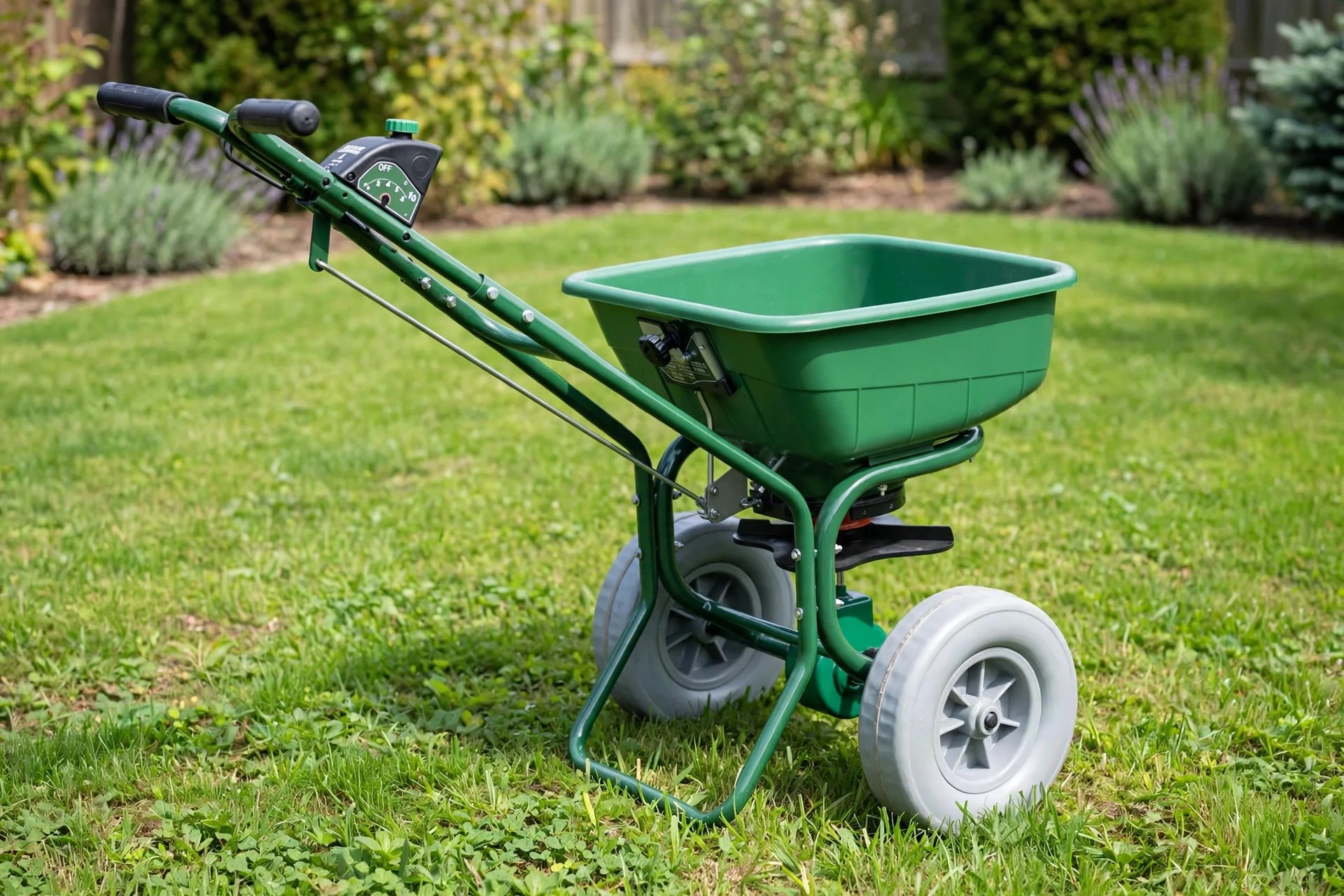
The Scotts EdgeGuard DLX is a pre-calibrated push broadcast spreader that covers up to 15,000 sq ft per fill, with EdgeGuard edge control and a rate dial that matches Scotts bag labels.
Description
Stripes in a lawn rarely come from bad fertilizer. They come from a spreader that throws heavy on one side, dribbles at a slow walk, or runs empty two thirds of the way across the yard. The Scotts EdgeGuard DLX is the spreader most US homeowners end up with because it removes those three problems in one simple machine. It holds enough product to cover up to 15,000 sq ft per fill, it arrives pre-calibrated with no assembly, and its EdgeGuard feature blocks the right side of the spread pattern so granules stay off driveways, sidewalks and flower beds. For a typical suburban lawn, the scotts edgeguard dlx is the default answer: fill it, set the dial to the number printed on the bag, and walk.
Key Features
EdgeGuard edge control
A sliding lever blocks off the right side of the spread pattern while you work the borders of the lawn. Fertilizer and seed land on grass, not on concrete where they stain, wash into storm drains and feed nothing.
15,000 sq ft hopper capacity
The hopper holds enough Scotts product to treat up to 15,000 sq ft in one fill, which covers most suburban front and back lawns without a trip back to the garage for the bag.
Pre-calibrated precision rate dial
The control panel dial is matched to the settings printed on Scotts product bags, so the number on the bag is the number you set. The spreader arrives calibrated and fully assembled, ready to use out of the box.
Curved hopper and dual-bladed agitator
The redesigned hopper shape and dual-bladed agitator keep granules funneling smoothly toward the drop opening, which reduces surging and keeps the application rate steadier across the whole pass.
Product Description
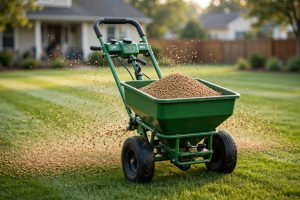
The Scotts EdgeGuard DLX is a walk-behind rotary broadcast spreader built for fertilizer, grass seed, salt and ice melt. Granules drop from the hopper onto a spinning plate, which fans them out in a wide swath as you walk. Because the pattern feathers at its edges, small overlaps between passes blend instead of stacking, which is what makes broadcast spreading more forgiving than drop spreading for most homeowners.
Owner feedback on this model repeats two themes: the settings genuinely match Scotts bag labels, which removes the guesswork new spreader owners struggle with, and the plastic wheels ride rougher than pneumatic tires on bumpy or rutted lawns. Keep a steady walking pace, because like every single-rotor spreader, pattern accuracy depends on it.
Benefits of Using This Product
- One fill covers most home lawns, so applications stay even from start to finish
- EdgeGuard keeps product off hard surfaces and out of beds and borders
- Dial settings match Scotts bag labels, cutting out calibration guesswork
- No assembly and no tools: it is ready to spread the day it arrives
- Works across the year with fertilizer, grass seed, salt and ice melt
Specifications
| Capacity | Holds up to 15,000 sq ft of Scotts product per fill |
| Spreader type | Push broadcast (rotary) |
| Edge control | EdgeGuard right-side block off |
| Rate control | Precision dial, pre-calibrated to Scotts bag settings |
| Agitator | Dual-bladed, curved hopper design |
| Assembly | None, fully assembled |
| Materials | Fertilizer, grass seed, salt, ice melt |
| Model | 76232 |
How to Use
Set the dial to the setting printed on your product bag. Fill the hopper on a driveway, not on the lawn, so spills do not burn a patch. Start walking before you open the gate, close it before you stop or turn, and keep a steady pace of roughly 3 mph. Engage EdgeGuard on passes along drives, paths and beds. For the most even result on important jobs like overseeding, apply at half rate in two passes at right angles. Rinse the spreader after use and store it dry and empty.
Why Choose the Scotts EdgeGuard DLX?
Most home lawns do not need a professional machine; they need a spreader whose dial they can trust and whose hopper matches the size of the yard. The scotts edgeguard dlx is built exactly around that job, and its combination of capacity, edge control and bag-matched settings is why it outsells everything else in the category. Owners who later move to rough ground or want a metal gearbox step up, but for a standard suburban lawn this is the sensible first spreader.
Frequently Asked Questions
Does the Scotts EdgeGuard DLX need assembly?
No. It arrives fully assembled and pre-calibrated. Unfold it, fill the hopper, set the dial and spread.
What setting should I use for fertilizer?
Use the setting printed on the fertilizer bag for Scotts spreaders. If a bag lists no setting for your model, start near half open and confirm with a weigh-in, weigh-out calibration test over a measured 1,000 sq ft strip.
Can it spread grass seed and ice melt as well as fertilizer?
Yes. It is designed for fertilizer, grass seed, salt and ice melt. Rinse it thoroughly after spreading salt, which is the most corrosive material it will carry.
How big a lawn does one fill cover?
Up to 15,000 sq ft of product per fill at typical fertilizer rates. Lawns much beyond that will need one refill, or a larger model such as the Scotts Elite.
Final Verdict
For a typical home lawn, the Scotts EdgeGuard DLX gets the fundamentals right: enough capacity for one-fill coverage, a dial that speaks the same language as the product bag, and edge control that solves the main complaint people have about broadcast spreaders. It is a plastic-wheeled homeowner machine rather than a pro tool, and judged on its own terms that is exactly what most lawns need.
Still deciding? Our guide to the best broadcast spreader for home lawns compares all ten models on capacity, spread width, wheels and calibration, with an honest Best for and Not ideal for for each one.
Related products
-
Buy LawnMaster Electric Corded Lawn Mower – Smart Lawn Care
$114.99 Buy product -

Buy RHINO USA Folding Survival Shovel – Best for Gardening
$28.90 Buy product -
Buy 3 Pcs Soil Sifter Set with Shovel – Stainless Steel Garden Sieve
$16.99 Buy product -
Buy Soil Test Kit – 2 in 1 Soil Moisture Meter & Soil pH Meter
$16.99 Buy product