
10 Best Lawn Edgers for Clean Lines
A lawn can be freshly mowed, fed, and watered, and still look unfinished. The giveaway is the border: turf creeping over the sidewalk in shaggy tongues, grass swallowing the first inch of the driveway, bed edges that wander instead of run. Mowing cannot fix that. A lawn edger can, in about fifteen minutes, because it does the one job a mower and a string trimmer do badly: it cuts a vertical line through turf and soil, right where the lawn is supposed to stop.
The best lawn edger for your yard depends on how much edge you own and how long it has been neglected. A small suburban lot with a driveway and two walks is a corded or cordless job. A half acre of beds, tree rings, and curbs asks for more depth and more stamina. And an edge that has not been cut in three seasons is a different problem again: it needs power or a forged blade, not a weekly trimmer. This guide compares ten current edgers, from a 12 amp corded workhorse to a half moon edger that has not changed in decades because it never needed to, and judges them on edge quality, depth control, ease of use, and build.
A note on how we picked: Agribloom is written by a plant pathologist (BSc Agriculture, MSc in Plant Pathology). We compared manufacturer specifications and cross checked them against owner feedback on the same listings. We did not hands on test these edgers, and we will not pretend otherwise. Where listings conflict, we print the smaller figure and say so. Prices change too fast to print honestly, so each pick links to the live price instead; some of those links are affiliate links that may earn Agribloom a commission.
Quick Recommendation
Short on time? Start here, then read the full notes for the pick that matches your yard and how you work.
- Most home lawns, one sensible buy: BLACK+DECKER LE750, pick 1.
- Deepest cut, cordless, you own EGO tools: EGO Power+ EA0800 edger attachment, pick 2.
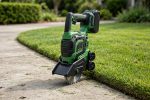
- A dedicated cordless edger, no attachments: Greenworks Pro 60V Brushless Edger, pick 3.
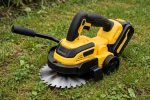
- Small lawn, light tool, Ryobi batteries in the garage: Ryobi 18V ONE+ Edger, pick 4.
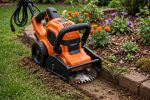
- Corded value with a trenching mode: Worx WG896, pick 5.
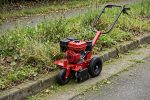
- Neglected, overgrown edges and long runs: Troy-Bilt TB516 EC gas edger, pick 6.
- Corded, heavy duty, longest blade life: Greenworks 27032, pick 7.
- Beds and borders by hand, the classic way: Razor-Back 61108 Half Moon Edger, pick 8.
- Step edger for tree rings and installing bed edging: Yard Butler EDGE-180, pick 9.
- Weekly upkeep along walks, no fuel or cord: Truper 35195 Rotary Edger, pick 10.
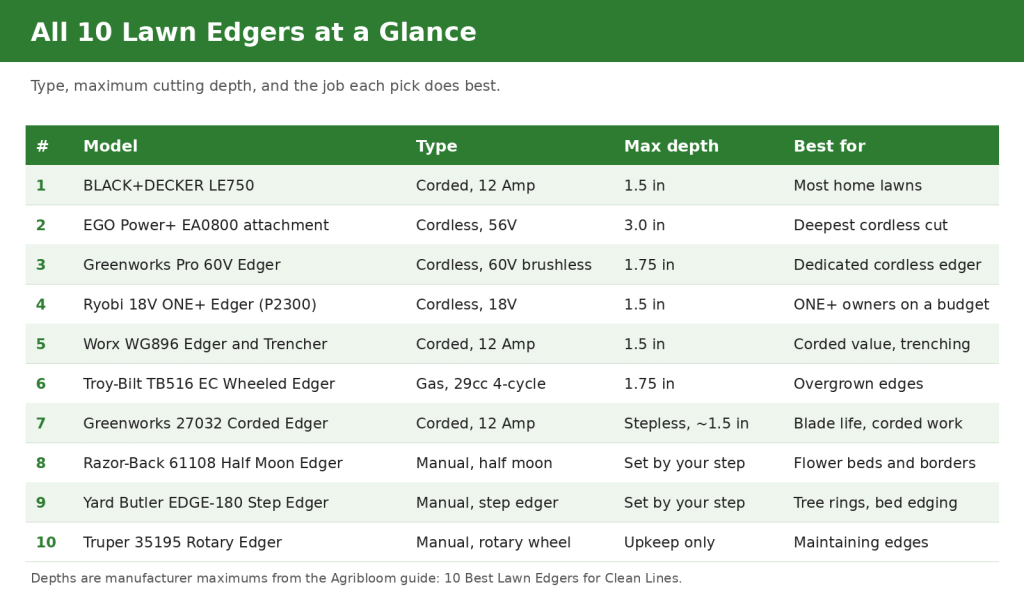
Quick Picks: All 10 Lawn Edgers Compared
| Model | Best For | Type / Power | Price | Action |
|---|---|---|---|---|
 | Most home lawns | Corded, 12 Amp | Check live price | View Deal |
 | Deepest cordless cut | Cordless, 56V multi-head attachment | Check live price | View Deal |
 | Dedicated cordless edger | Cordless, 60V brushless | Check live price | View Deal |
 | Budget cordless, ONE+ owners | Cordless, 18V | Check live price | View Deal |
 | Corded value, trenching | Corded, 12 Amp | Check live price | View Deal |
 | Overgrown edges | Gas, 29cc 4-cycle | Check live price | View Deal |
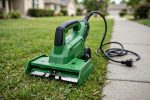 | Heavy duty corded, blade life | Corded, 12 Amp | Check live price | View Deal |
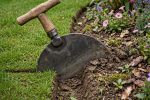 | Flower beds, classic manual edging | Manual, half moon | Check live price | View Deal |
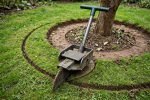 | Tree rings, installing bed edging | Manual, step edger | Check live price | View Deal |
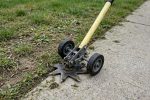 | Maintaining edges along walks | Manual, rotary wheel | Check live price | View Deal |
How We Chose: Lawn Edger Reviews You Can Check
An edger has one job: cut a straight, vertical face where lawn meets hardscape or bed, at a depth you choose, without wandering, scalping, or dying halfway down the driveway. Everything else is comfort and cost. So our scoring weights the quality of the edge itself first, then how easy the tool is to keep on line, then the muscle behind the blade, then depth control, then value. Owner feedback mattered most where it repeated: complaints about clogging guards, blades that dulled in a season, depth knobs that slipped, and handles at the wrong height were counted against a model even when its spec sheet looked fine.
Our scoring system
| Factor | Weight | What we looked at |
|---|---|---|
| Edge quality | 30% | Blade design, guide wheels or guide plates, line tracking, owner reports of ragged or wavy cuts |
| Ease of use | 20% | Weight, handle comfort, starting, clog clearing, how fast a first time user gets a straight line |
| Power and build | 20% | Motor or engine output against blade size, gearbox and guard materials, warranty length |
| Depth control | 15% | Maximum cutting depth, number and spacing of depth settings, whether the setting holds under load |
| Value | 15% | What the tool costs against its depth, build, and whether batteries or a power head are extra |
The judgements in this guide come from this system applied to verified specifications and owner feedback. They are not lab test scores, and no edger here was bench tested by us.
Is a Lawn Edger Worth It?
For most lawns, yes, and the reason is biological as much as cosmetic. Lawn grasses spread by above ground runners (stolons) and below ground stems (rhizomes). Given an open border, bermudagrass, zoysia, St. Augustine, and creeping fescues will march straight across a sidewalk gap and root in the cracks, and every week you leave it, the invasion gets thicker and harder to cut back. A clean vertical edge severs those runners and gives the lawn a hard stop. It also leaves a narrow shadow gap along beds that slows grass creeping into mulch, which is the cheapest weed control in the whole yard.
The honest limits: an edger will not fix a lawn whose edges fail because of shade, thin soil, or dogs. A string trimmer turned sideways can maintain an edge that already exists, and for a tiny townhouse lawn that may honestly be enough. But a trimmer line rounds the edge off a little more every week, and it cannot re-cut an edge that has been lost. That re-cutting, and keeping the line crisp through the season, is what a dedicated edger is for.
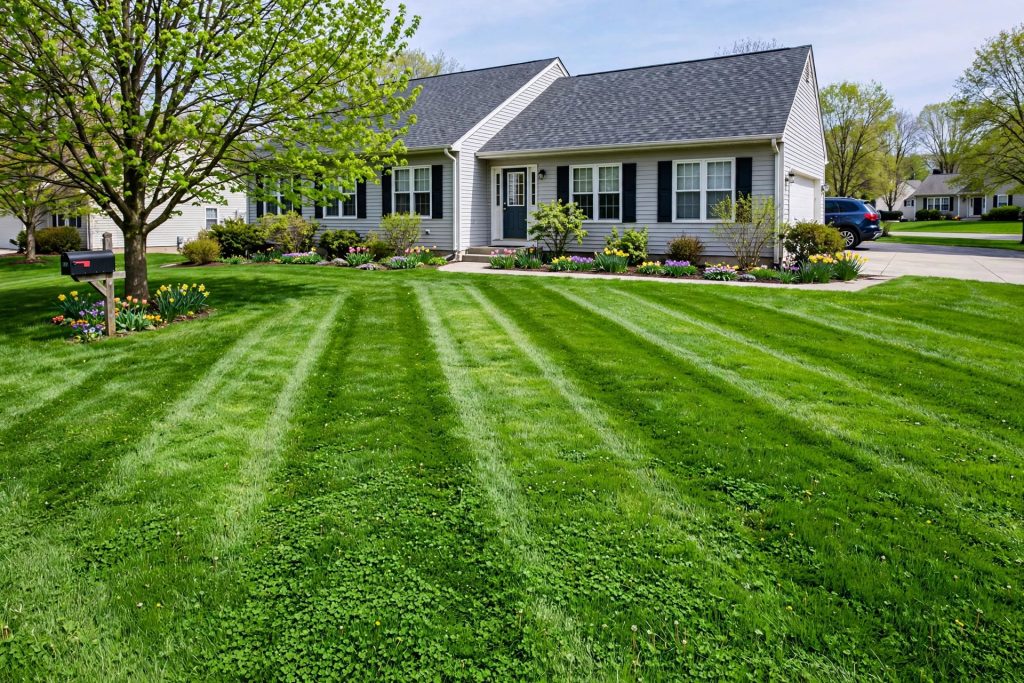
Edging is seasonal work, not a one time fix: the deep spring re-cut, light touch ups through summer, and a final clean line before the lawn slows down in fall. Our month by month lawn calendar shows where edging sits alongside feeding, seeding, and mowing height changes.
The 10 Best Lawn Edgers for Clean Lines
BLACK+DECKER LE750 2-in-1 Edger and Trencher: Best for Most Home Lawns
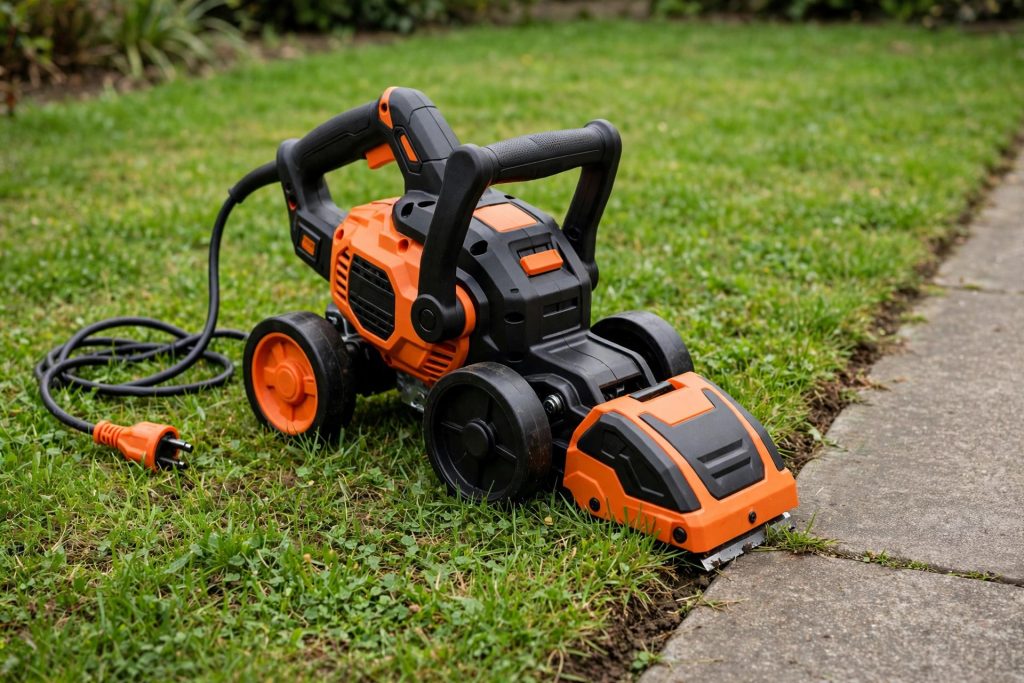
Manufacturer specifications and editorial assessment.
The LE750 is the edger most American suburbs run on, and the spec sheet explains why. A 12 amp high torque motor (150 in-lb, spinning at 4,700 RPM) drives a 7.5 in hardened steel blade, with three depth positions at 1, 1.25, and 1.5 in. It weighs 12.4 lb on a three wheel chassis, so it rolls rather than hovers, and the pull-up edge guide converts it from edger to landscape trencher for burying low voltage cable or cutting bed lines. There is a built in cord retainer, a guard door that opens for cleaning out packed soil, an assist handle that fits either side, and tool free assembly. Warranty is two years.
Quick Verdict: The default answer for a typical lawn with a driveway, sidewalks, and a patio. It is powerful enough to re-cut a neglected edge in passes and light enough that the cord is the only real annoyance.
Pros
- 12 amp motor with real torque: it does not stall in thick turf the way small cordless tools can
- Three positive depth settings up to 1.5 in, enough for a proper spring re-cut
- Trencher mode earns its keep for bed lines and low voltage lighting cable
- Guard door opens for cleaning, which matters more than any feature after a wet week
Cons
- Corded, so your range is an extension cord and your patience
- Plastic guard and wheels feel a step below the price class leaders
Best for: Typical suburban lawns with a few hundred feet of hardscape edge.
Not ideal for: Properties where the far edge is beyond a 100 ft cord, or anyone who hates managing a cable.
Real-world limitation: Your working radius is the length of your extension cord, and wet soil packs into the guard, so muddy weeks mean stopping to clean it out. The plastic guard and wheels also feel a step below the class leaders once grit gets into them.
Who should buy: Buy it if your edges sit within cord reach of an outlet and you want one proven tool for the spring re-cut and weekly upkeep alike.
When you are ready to price it: Check Price on Amazon. BLACK+DECKER’s own specifications are on the BLACK+DECKER LE750 product page.
Full specifications and buyer notes for the LE750 are on its product page.
EGO Power+ EA0800 Edger Attachment: Best Cordless Edger for Depth
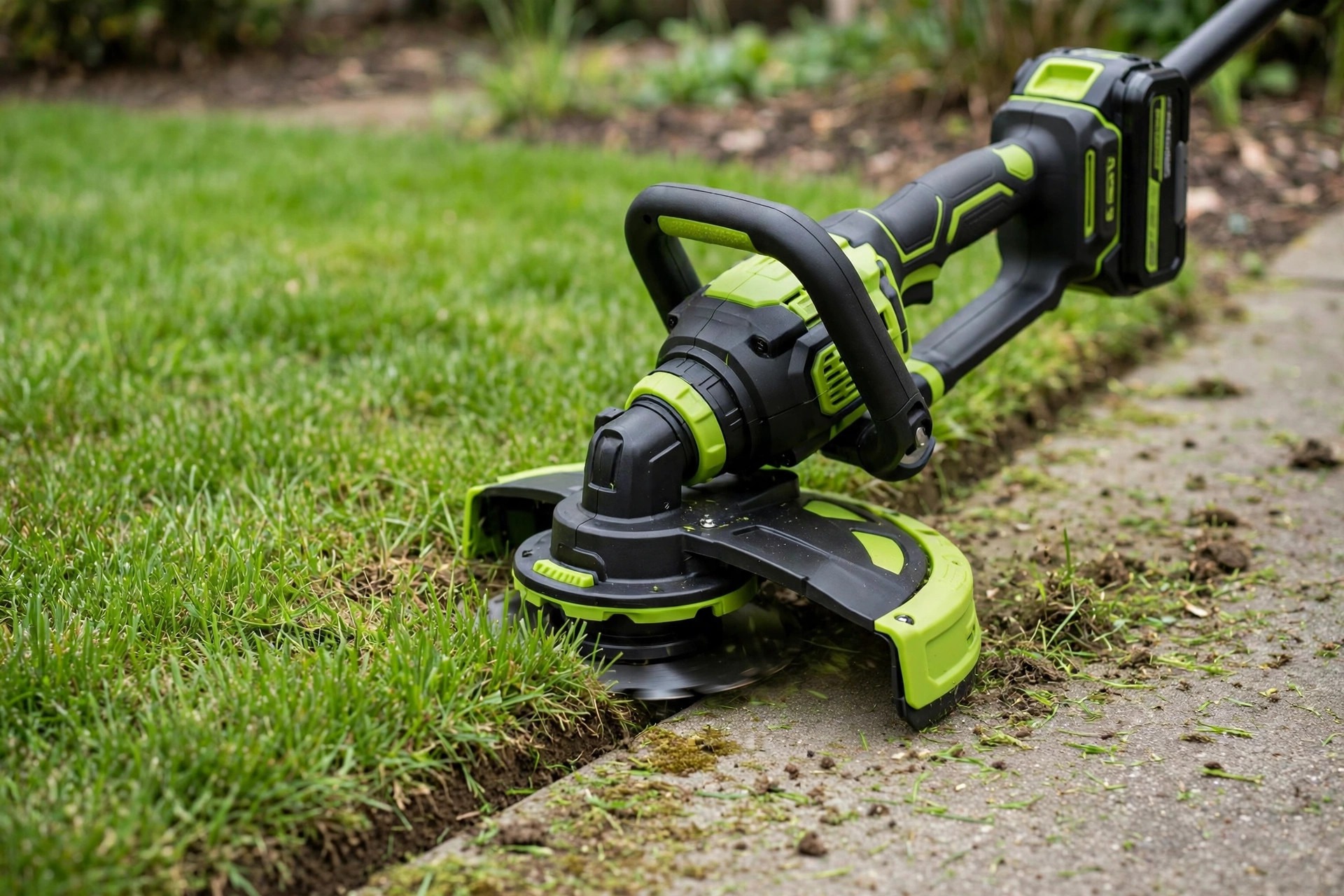
Manufacturer specifications and editorial assessment.
Read this one carefully, because it is an attachment, not a whole tool: the EA0800 clicks onto EGO’s Multi-Head power heads (PH1400 or PH1420) and turns a 56V battery platform you may already own into the deepest cutting edger in this guide. The 8 in steel blade is 3 mm thick, the guide wheel carries a depth adjustment knob that runs to a full 3 in of cutting depth, roughly double what the corded picks manage, and the assembly is IPX4 weather resistant with an aluminum debris guard and a rubber skirt. The attachment itself weighs about 5 lb (2.26 kg). The power head’s brushless motor runs it at up to 4,000 RPM. Warranty on the attachment is five years.
Quick Verdict: If you already own EGO 56V batteries, this is the cordless edger to buy, and it is not close. Three inches of depth re-cuts edges that lesser tools just polish.
Pros
- 3 in maximum cutting depth, the deepest in this guide by a wide margin
- Guide wheel with a real adjustment knob, so depth changes are quick and repeatable
- IPX4 weather resistance and a five year warranty, the longest coverage here
- Uses batteries EGO owners already have on the shelf
Cons
- Attachment only: without a PH1400 or PH1420 power head, it is an expensive paperweight
- Total working weight depends on the power head and battery you pair it with
Best for: EGO platform owners, and anyone whose edges need a genuinely deep re-cut without a cord or fuel.
Not ideal for: Shoppers who do not own, and do not want, the EGO multi-head system.
Real-world limitation: This is an attachment, not a complete tool: without an EGO multi-head power head (PH1400 or PH1420) and a 56V battery on the shelf, it cannot cut anything, and the total working weight depends on the head and battery you pair with it.
Who should buy: It belongs in the garage of an existing EGO 56V owner who wants the deepest cordless re-cut in this guide, a full 3 in, without fuel or a cord.
When you are ready to price it: Check Price on Amazon. EGO’s own specifications are on the EGO EA0800 product page.
Full specifications and buyer notes for the EGO EA0800 are on its product page.
Greenworks Pro 60V 8 in Brushless Edger: Best Dedicated Cordless Edger
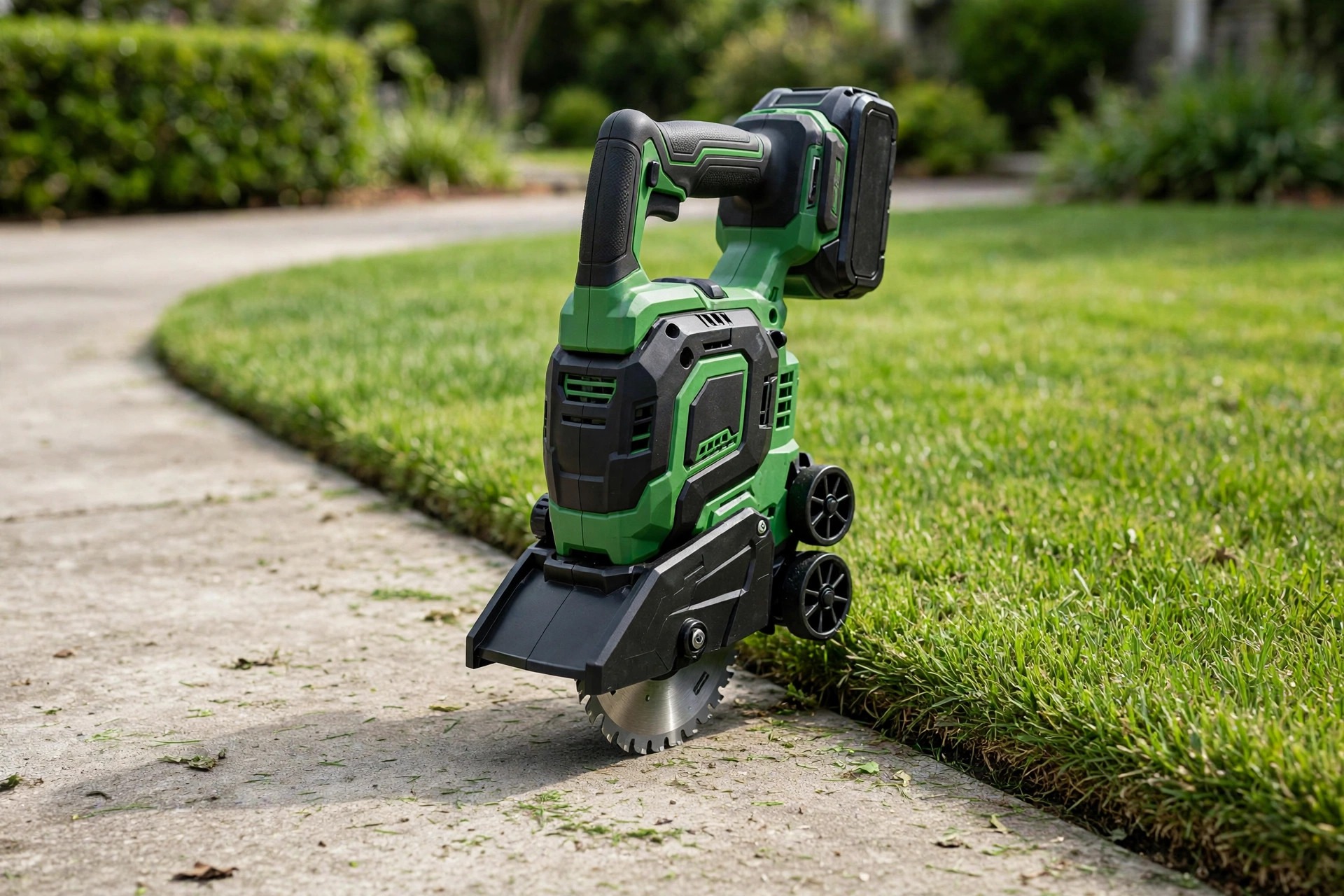
Manufacturer specifications and editorial assessment.
Not everyone wants an attachment system, and this is the cordless alternative: a complete, dedicated 60V edger with no power head and no mains cable. The brushless motor spins the 8 in blade at up to 7,000 RPM, cutting depth adjusts tool free to 1.75 in, and in the ED60L211 package the box holds a 2.0 Ah battery and a rapid charger. Runtime is listed as up to 60 minutes in light conditions. With the battery fitted, the tool is about 13.4 lb. The warranty runs to four years on both tool and battery.
Quick Verdict: The best cordless lawn edger for buyers who want one purpose built tool rather than a head system: gas-like pace, real depth, and nothing to plug in.
Pros
- 7,000 RPM brushless motor cuts fast and does not bog down in thick edges
- Complete kit in the box: battery and rapid charger included in the ED60L211 package
- Tool free depth adjustment to 1.75 in, deep enough for first time edges in most soils
- Four year warranty on tool and battery, double the corded picks
Cons
- Heavier in hand than the Ryobi, and it feels it on long bed runs
- Runtime falls well short of 60 minutes when you are cutting new edges in heavy soil
Best for: Homeowners with mid to large lawns who want cordless freedom in a single dedicated tool.
Not ideal for: Anyone already deep into another battery platform, or very small lawns where it is more tool than they need.
Real-world limitation: The 60 minute runtime is a light conditions figure; cutting new edges in heavy soil drains the 2.0 Ah battery far sooner, and at about 13.4 lb with the battery fitted, it feels heavy on long bed runs.
Who should buy: Choose it if you want one dedicated cordless tool with gas-like pace and no interest in attachment systems or another brand’s battery shelf.
When you are ready to price it: Check Price on Amazon. Greenworks’ own specifications are on the Greenworks 60V edger product page.
Full specifications and buyer notes for the Greenworks 60V are on its product page.
Ryobi 18V ONE+ Edger (P2300): Best Budget Cordless Edger
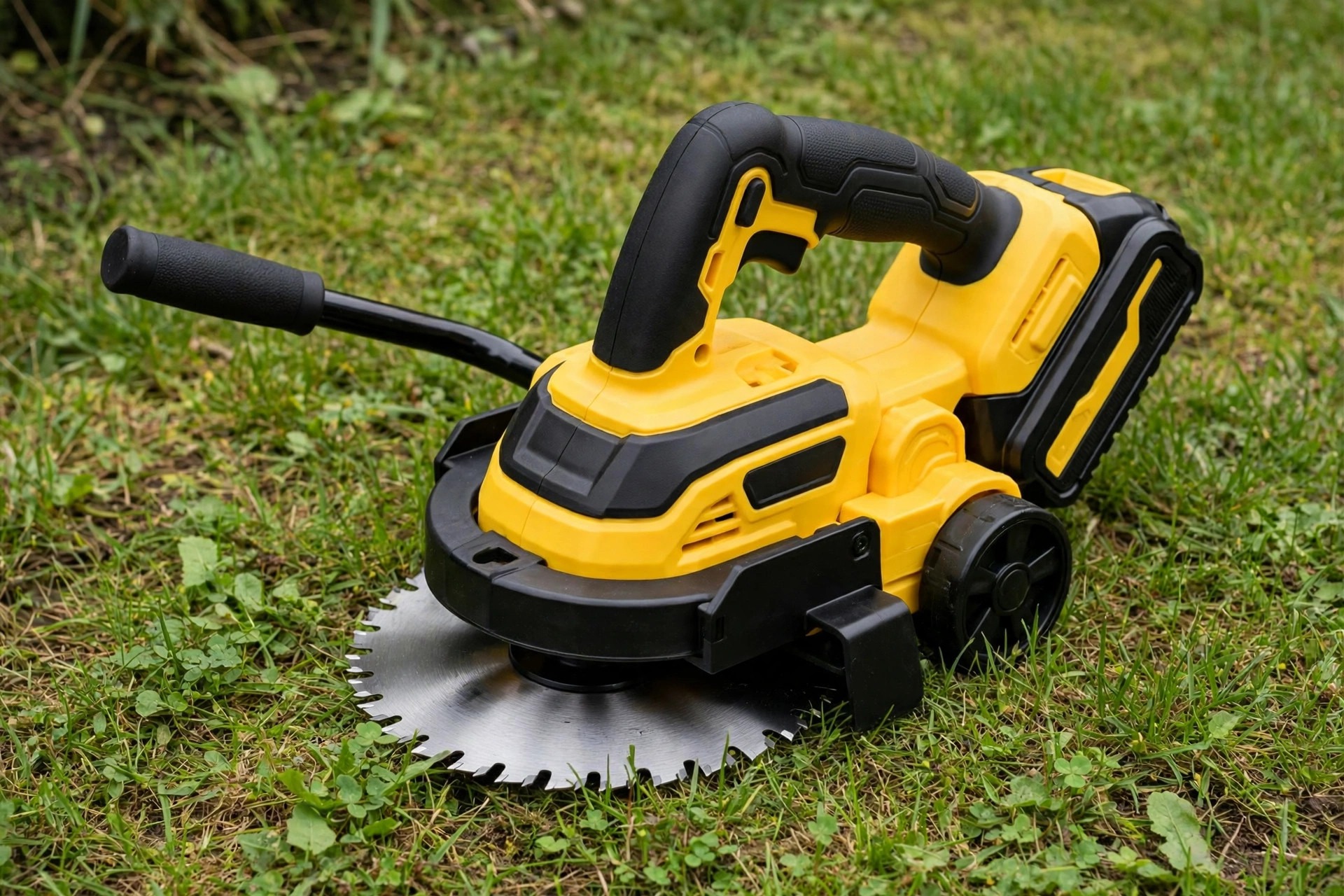
Manufacturer specifications and editorial assessment.
The Ryobi is the lightest powered edger here, and for small lawns that matters more than raw muscle. The current tool is sold in two badges: the P2300 bare tool and the P2310 kit with a 2.0 Ah battery and charger. The 9 in dual serrated steel blade is a selling point at this price, since it can be reversed when one edge dulls. There are four depth settings, from about 0.25 in to 1.5 in. Tool weight is about 8.2 lb dry. Runtime per charge is listed at more than 25 minutes on a 2.0 Ah battery, which is honestly matched to the tool’s purpose: small lawns, frequent passes.
Quick Verdict: The sensible cordless buy for small lawns and for the millions of garages already holding ONE+ batteries.
Pros
- About 8.2 lb dry: the easiest powered edger here to carry, hang up, and use one handed for touch ups
- 9 in dual serrated blade flips for a second life when the first edge dulls
- Four depth positions from a shallow 0.25 in skim to a full 1.5 in cut
- Runs on any ONE+ 18V battery, so owners often need only the bare tool
Cons
- 25 minutes of realistic runtime caps the size of lawn it can re-cut in one session
- Light build wanders more on uneven ground than the heavier wheeled picks
Best for: Small to mid sized lawns, and ONE+ owners adding edging to an existing battery shelf.
Not ideal for: Large properties or first time cuts through years of overgrowth.
Real-world limitation: Around 25 minutes per charge is the hard ceiling on a 2.0 Ah battery, and the light build that makes it easy to carry also wanders more on uneven ground. In the US it is sold mainly through Home Depot, so the Amazon link lands on marketplace listings.
Who should buy: It is the right buy for ONE+ owners and small lawns, where edging takes ten minutes and light, frequent passes beat one big restoration.
When you are ready to price it: Check Price on Amazon. Ryobi’s specifications are published on the Home Depot listing for the P2310 kit.
Full specifications and buyer notes for the Ryobi P2300 are on its product page.
Worx WG896 12 Amp Edger and Trencher: Best Corded Value
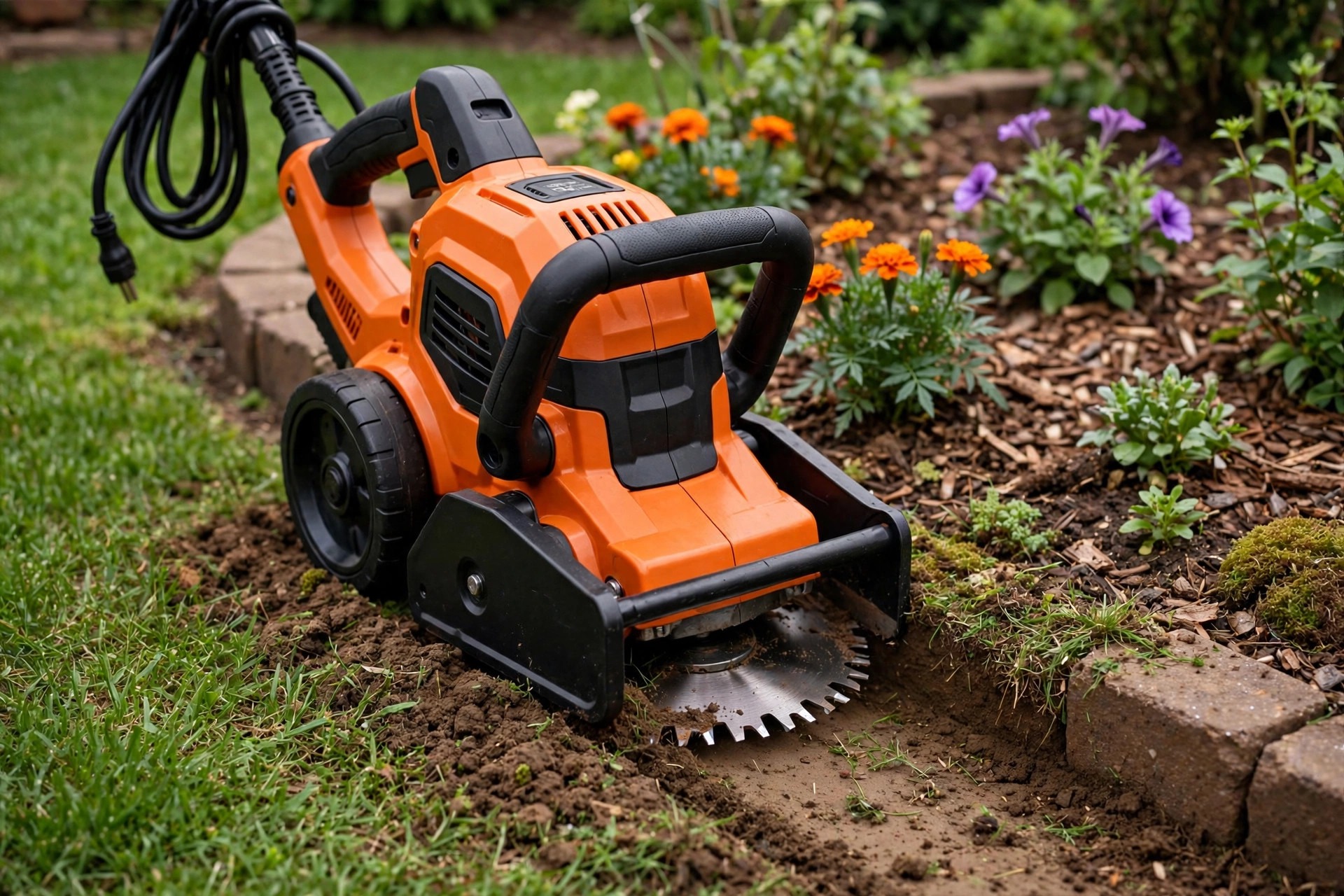
Manufacturer specifications and editorial assessment.
The WG896 goes head to head with the BLACK+DECKER at the top of this guide and undercuts it on warranty. Its 12 amp motor drives a 7.5 in serrated steel blade with a wear indicator (a genuinely useful detail: you can see how much blade is left). Depth adjusts across three positions to 1.5 in (some listings state 1.75 in; Worx’s own manual says 1.5 in, and we print the smaller figure). The shaft adjusts and the handle pivots to fit the user, and like the LE750 it converts to a trencher. At 14 lb it is the heaviest of the corded picks. Warranty is three years.
Quick Verdict: Buy this one if the BLACK+DECKER is out of stock or priced up, and arguably buy it anyway: the wear indicator and the three year warranty are real edges at the same money.
Pros
- Serrated steel blade with a wear indicator: maintenance you can read at a glance
- Three year warranty, the best among the corded picks
- Adjustable shaft and pivoting handle fit shorter and taller users
- Cutting line indicator genuinely helps beginners hold a straight line
Cons
- At 14 lb it is the heaviest corded edger here, noticeable on long runs
- Struggles, like all corded picks, in wet soil that packs the guard
Best for: Homeowners who want corded power and trenching at a value price, with a longer warranty cushion.
Not ideal for: Anyone who found the LE750 heavy, or edges far from an outlet.
Real-world limitation: At 14 lb it is the heaviest corded edger here, noticeable on long runs, and like every corded pick it struggles in wet soil that packs the guard.
Who should buy: Pick it if you edge within reach of an outlet and value the three year warranty and the blade wear indicator more than a light tool.
When you are ready to price it: Check Price on Amazon. Worx’s specifications are in the WG896 instruction manual.
Full specifications and buyer notes for the Worx WG896 are on its product page.
Troy-Bilt TB516 EC Wheeled Edger: Best Edger for Overgrown Edges
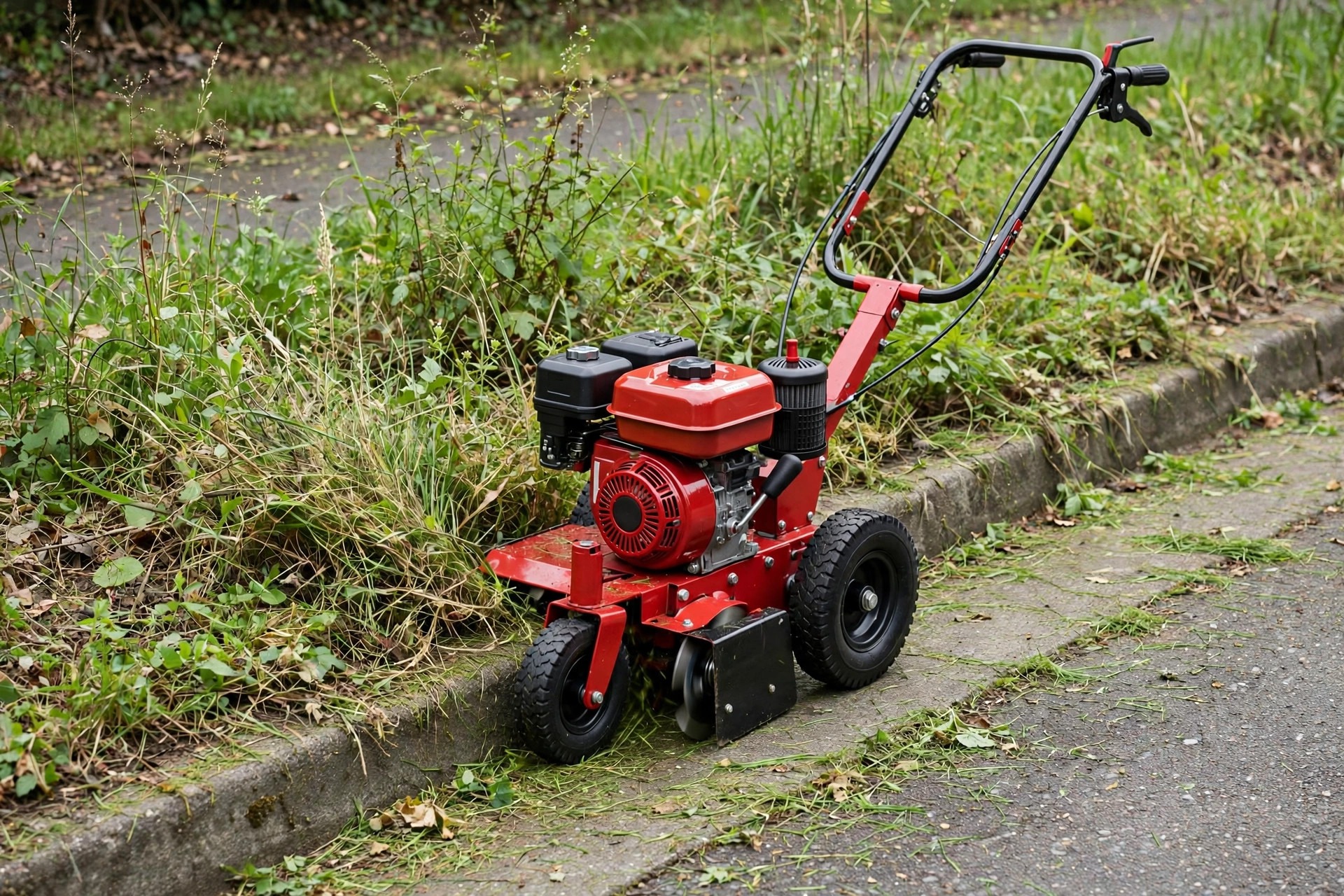
Manufacturer specifications and editorial assessment.
Every guide needs the heavy option, and this is it. The TB516 EC runs a 29cc 4-cycle Troy-Bilt engine, so there is no fuel and oil mixing, and turns a 9 in triple edged blade. It rolls on three wheels with a curb wheel for street edges, has six depth settings to a maximum of 1.75 in, a folding V handle for storage, and SpringAssist starting: a lever primes the engine for an easier pull start. It also trenches. Shipping weight is about 22 lb, which tells you honestly what using it feels like.
Why gas, in 2026, for a home lawn? Because of the one job the electrics hate: the first cut. An edge that has swallowed the sidewalk needs sustained low speed torque and a deep blade, and this machine provides both without a cord trailing through the mess or a battery dying at the far end.
Quick Verdict: Overkill for weekly upkeep, and the right tool anyway if your edges are overgrown or your property is large.
Pros
- 4-cycle engine: no fuel mixing, strong low speed torque for buried edges
- Six depth positions and a 1.75 in maximum cut, with a curb wheel for street work
- Three wheels and a folding V handle make a heavy machine manageable and storable
- SpringAssist starting takes the fight out of pull starts
Cons
- Gas ownership: fuel, oil changes, air filter, and storage prep the electrics never ask for
- Loudest and heaviest pick here, and the only one with exhaust
Best for: Overgrown edges, large properties, and long curb runs where cords and batteries give up.
Not ideal for: Small lawns, quiet neighborhoods at 8 am, or anyone done with small engines.
Real-world limitation: Gas ownership is the trade: fuel, oil changes, an air filter, and storage prep the electrics never ask for, plus the noise and exhaust of the loudest machine in this guide. At 22 lb shipping weight, it is a machine you push, not carry.
Who should buy: It earns its keep if your edges are buried under seasons of bermuda runners or run to hundreds of feet, and you are comfortable keeping a small engine alive.
When you are ready to price it: Check Price on Amazon. Troy-Bilt’s specifications for this model are published in the TB516 EC retailer specification listing.
Full specifications and buyer notes for the Troy-Bilt TB516 are on its product page.
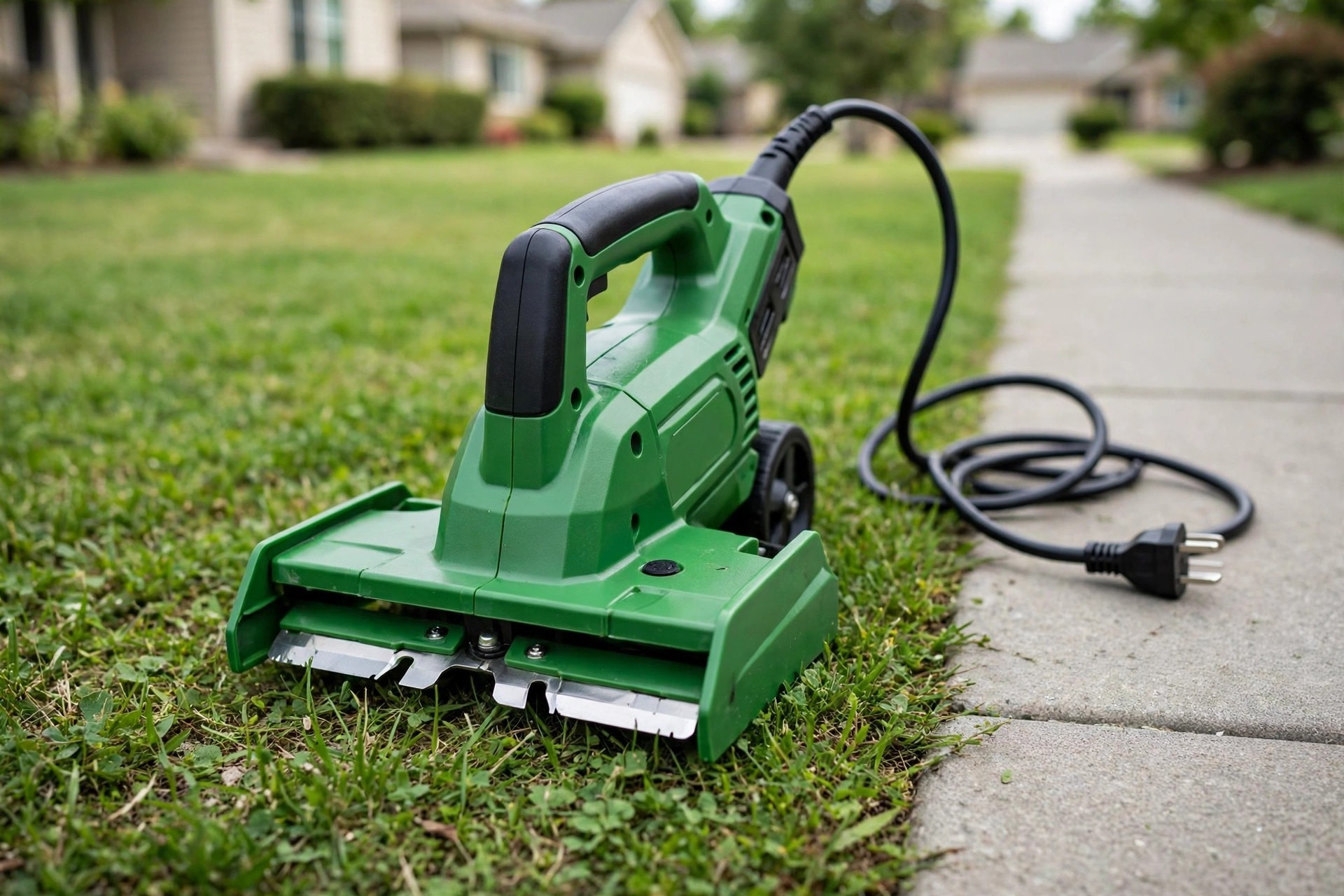
Greenworks 27032 12 Amp Corded Edger: Best for Blade Life and Heavy Corded Work
Manufacturer specifications and editorial assessment.
The second Greenworks in this guide is a different animal from its 60V sibling: a corded 12 amp edger built heavy on purpose. Its 8 in blade is double edged, so when one edge dulls you flip it over instead of buying a new one. Depth control is a spring assist front wheel with stepless adjustment, which trades the numbered clicks of the LE750 for a smooth dial in feel. Weight is the compromise here: manufacturer listings put the tool around 17.8 lb, the heaviest of the corded picks, because the build is mostly steel where the cheaper tools are plastic.
That weight cuts both ways. Owners with long, straight driveway runs tend to like it, because a heavy edger tracks straight and does not bounce off roots; on curves and slopes, the same weight is work. Warranty is four years, double most corded picks.
Quick Verdict: The corded pick for people who edge hard and often: the flip over blade and the four year warranty make it the cheapest edger here to own for a decade.
Pros
- Double edged blade flips for a second cutting life
- Four year warranty, best among corded edgers here
- Planted, stable feel on long straight runs in hard soil
- Spring assist front wheel gives stepless depth control instead of three fixed stops
Cons
- About 17.8 lb: the heaviest corded edger here, and it shows on curves and slopes
- Depth setting by wheel feel takes practice compared with numbered positions
Best for: Frequent edgers with long straight runs who want minimum blade fuss.
Not ideal for: Small users, tight curving beds, or anyone who found the lighter corded picks tiring.
Real-world limitation: Weight is the compromise: at about 17.8 lb it is the heaviest corded edger here, and its stepless depth is set by wheel feel rather than numbered stops, so even depth takes practice.
Who should buy: It suits frequent edgers with long, straight driveway runs who would rather flip a blade over than keep buying replacements.
When you are ready to price it: Check Price on Amazon. Its specifications are published in the Amazon product information for the Greenworks 27032.
Full specifications and buyer notes for the Greenworks 27032 are on its product page.
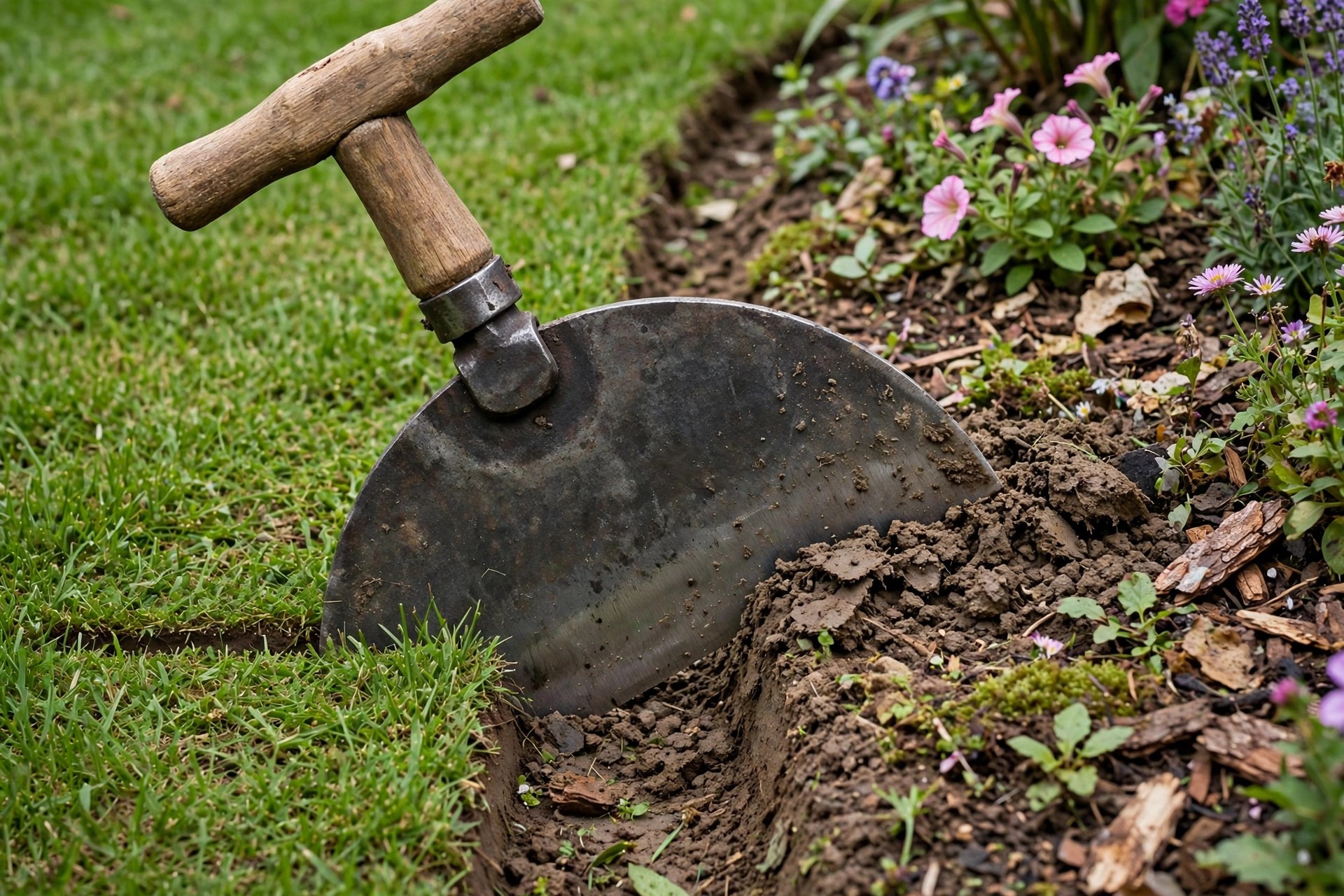
Razor-Back 61108 Half Moon Edger: Best Half Moon Edger for Beds and Borders
Manufacturer specifications and editorial assessment.
Now we put the motors away. The half moon edger is the oldest design in this guide: a forged steel head, a forward step for your boot, and a wood handle, in this case 48 in long and North American hardwood. The half moon head rocks through soil as you step it down, slicing a clean vertical face one stride at a time. Razor-Back’s version is the one gardeners tend to land on because the forged head holds an edge and the steel socket does not flex in hard or rocky soil.
Technique is the whole game: step down on the forward step, rock the blade slightly, lift, move half a stride, repeat. In twenty minutes you can recut a flower bed edge that looks professionally done, with a V trench an electric edger cannot shape.
Quick Verdict: The best edging tool for flower beds ever made has no motor, and this is its sturdiest common form.
Pros
- Forged steel head shrugs off rocky, rooty soil that bends cheap half moons
- Total control: new bed lines, curves, and V trenches no power edger can shape
- Silent, fuelless, cordless, and effectively unbreakable in normal use
- 48 in handle gives leverage and keeps your back straight
Cons
- Slow: figure on a few feet per minute, not per second
- Foot and leg work adds up on long straight edges
Best for: Flower beds, curved borders, tree rings, and gardeners who edge a few times a season and enjoy doing it by hand.
Not ideal for: Long driveway and sidewalk runs, or anyone with knee or hip trouble.
Real-world limitation: Speed is the honest price: a few feet per minute, and the foot and leg work adds up on long straight edges. Anyone with knee or hip trouble will feel it.
Who should buy: Take it home if your edging is mostly flower beds, curved borders, and tree rings that you shape a few times a season and want cut precisely.
When you are ready to price it: Check Price on Amazon. The manufacturer’s specifications are on the Home by AMES Razor-Back 61108 page.
Full specifications and buyer notes for the Razor-Back 61108 are on its product page.
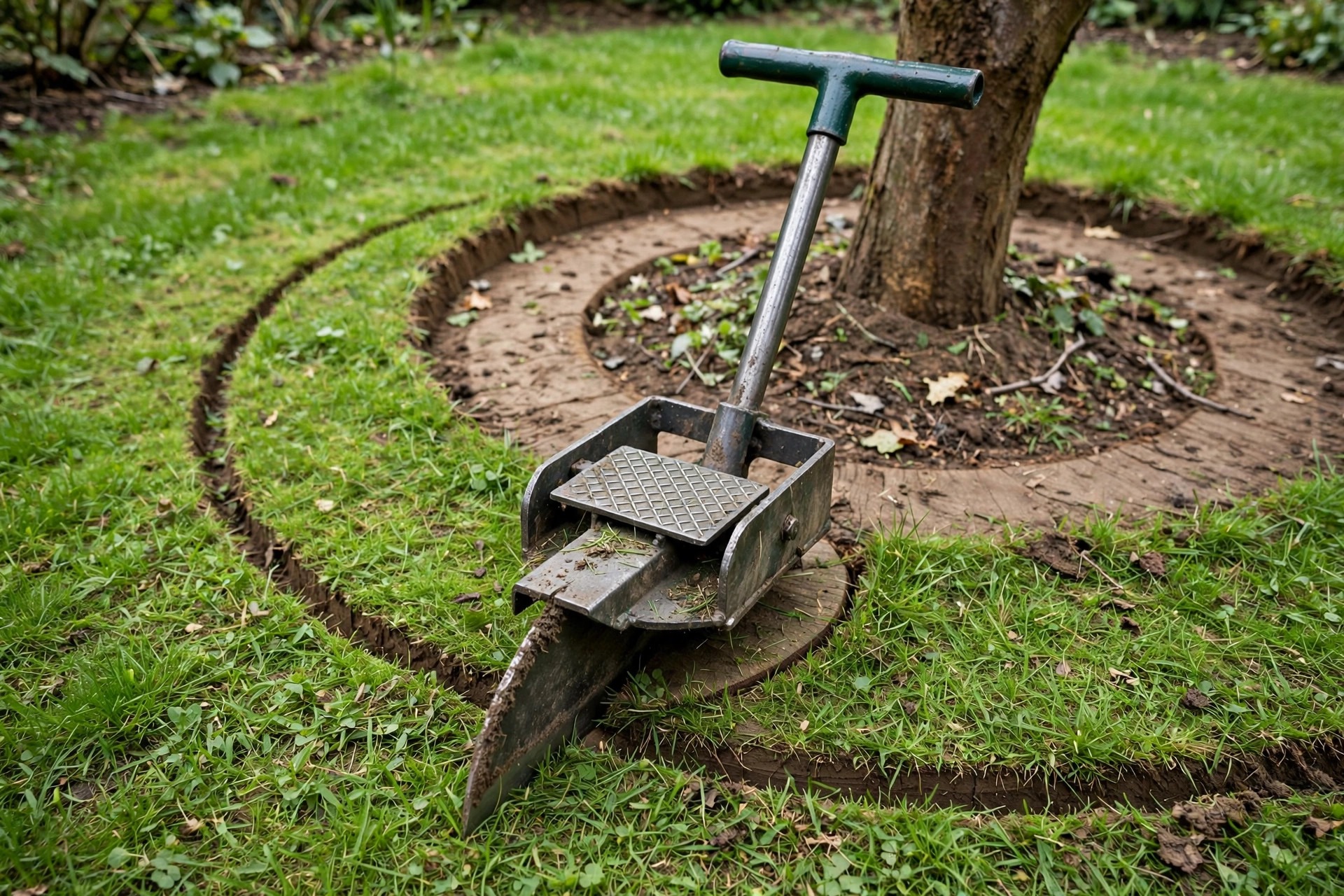
Yard Butler EDGE-180 Step Edger: Best Step Edger for Close Work
Manufacturer specifications and editorial assessment.
The EDGE-180 takes the half moon idea and fixes its one ergonomic flaw: on a normal half moon your foot presses beside the shaft, so half your force twists sideways. Here the step sits in the center of the tool, directly over a 6 in wide sawtooth steel blade, so your body weight goes straight down into the cut. The foot pedal can turn sideways, which makes close work around tree trunks and shrubs much easier. The tool is 37 in long, powder coated steel, with a cushion grip, and it carries a lifetime warranty.
The sawtooth edge matters in practice: the teeth saw through stolons and small roots that a smooth blade slides over, which is also why step edgers like this one are the standard tool for slotting a trench to install plastic bed edging.
Quick Verdict: The manual edger we would hand a beginner: the center step makes the technique almost automatic, and the sawteeth do the work your legs would otherwise do.
Pros
- Center step puts your weight directly over the blade: deeper cuts with less effort
- Sawtooth blade severs runners and small roots cleanly in one step
- Sideways foot position makes tree rings and shrub grooming easy
- Powder coated steel with a lifetime warranty
Cons
- Shorter 37 in handle suits a choppier, step by step rhythm rather than long strokes
- Like every manual edger, it is the wrong tool for hundreds of feet of curb
Best for: Tree rings, bed edges, installing plastic landscape edging, and smaller lawns kept by hand.
Not ideal for: Long straight runs where a rotary or power edger covers ground ten times faster.
Real-world limitation: The shorter 37 in build works in a choppier, step by step rhythm rather than long strokes, and like every manual edger it is the wrong tool for hundreds of feet of curb.
Who should buy: Hand it to a beginner, or to anyone slotting trenches for plastic bed edging and grooming around trees and shrubs.
When you are ready to price it: Check Price on Amazon. Its full specifications are published in the Yard Butler EDGE-180 specification listing.
Full specifications and buyer notes for the Yard Butler EDGE-180 are on its product page.
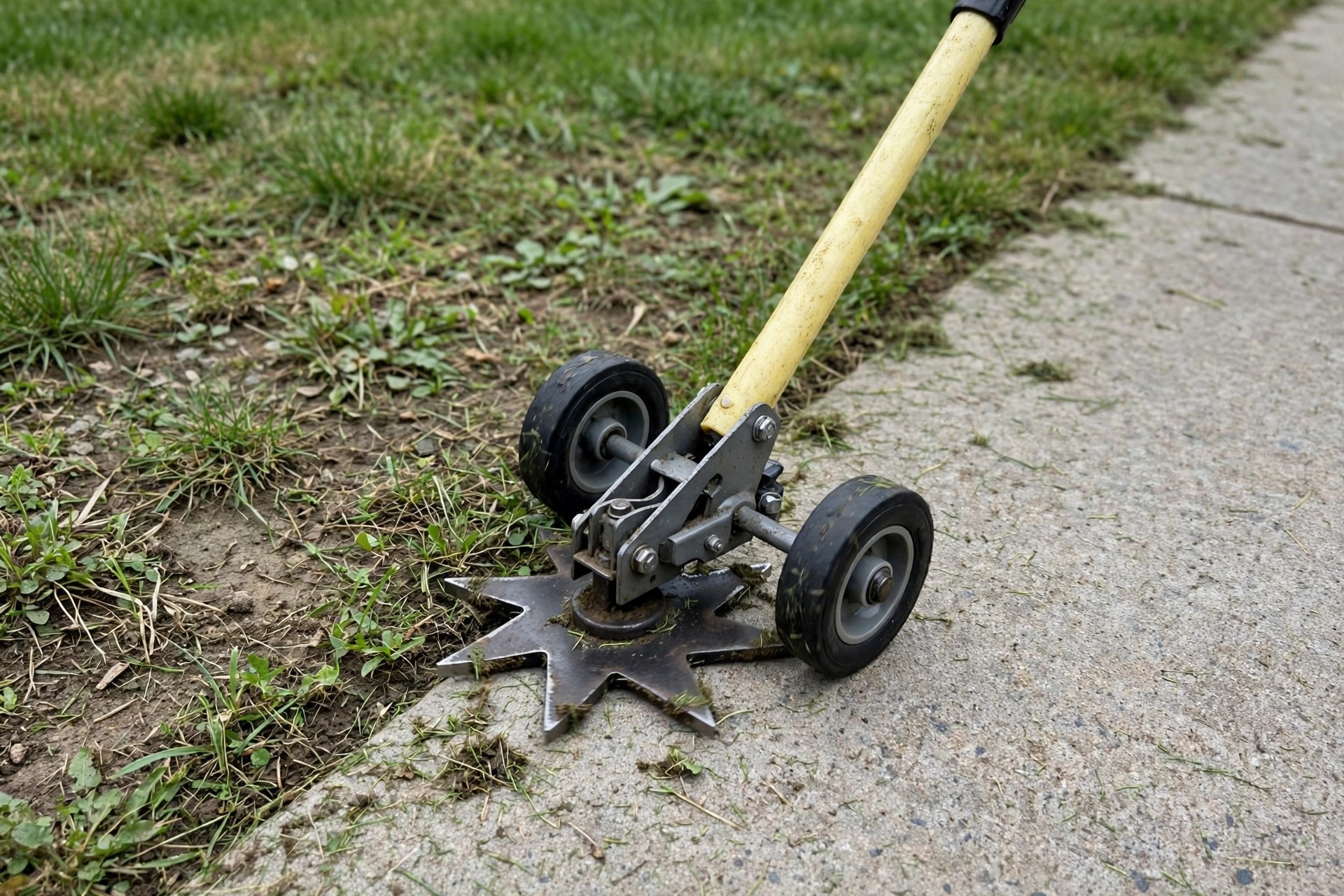
Truper 35195 Rotary Lawn Edger: Best Manual Edger for Maintaining Edges
Manufacturer specifications and editorial assessment.
The rotary edger is the manual tool people forget exists, and for weekly upkeep it is arguably the best design here: two wheels roll along the pavement edge while a star shaped blade in the middle shears turf back to the line at walking pace. Truper’s version weighs 3.8 lb, has a 48 in fiberglass handle that will not rust or rot, and a self cleaning blade with three depth positions. There’s no cord, no battery, no engine: it hangs on a nail in the garage and works every time you grab it.
Set expectations correctly and this tool delights. It maintains an edge that already exists, shaving a quarter inch of creep per pass. It will not cut a new edge, it will not rescue an overgrown one, and asking it to is the only way to be disappointed with it.
Quick Verdict: The perfect second edger: pair it with any pick above for the spring re-cut, then let the Truper keep the line honest all summer.
Pros
- Continuous rolling cut: the fastest manual way to maintain an existing edge
- Dual wheels track straight and steady, even for beginners
- Self cleaning three position blade resists the clogging that plagues rotary edgers
- 3.8 lb with a 48 in fiberglass handle: light, rust free, and easy on the back
Cons
- Cannot cut a new edge or rescue an overgrown one
- Star blades wear and need eventual replacement, like mower blades
Best for: Weekly or fortnightly upkeep along sidewalks, driveways, and patios after a proper edge exists.
Not ideal for: First time edges, beds, or any edge you cannot already see.
Real-world limitation: It can only maintain an edge that already exists: thick overgrowth stops it cold, and the star blade wears with use and will eventually need replacing.
Who should buy: Add it if your edges are already cut and you want silent, walking pace upkeep along sidewalks, driveways, and patios with nothing to charge or fuel.
When you are ready to price it: Check Price on Amazon. Its specifications are published in the Amazon product information for the Truper 35195.
Full specifications and buyer notes for the Truper 35195 are on its product page.
Manual vs Electric Lawn Edger: Which Should You Buy?
The manual vs electric lawn edger question is really a question about how much edge you have and how it got there. Electric edgers, corded and cordless, are built for distance and speed along hardscape. Manual edgers are built for shape: curves, beds, tree rings, and the V trench that keeps mulch out of the lawn. Most serious gardeners end up with one of each, and this section explains where the line falls.
| Manual edger | Corded electric | Cordless electric | |
|---|---|---|---|
| Speed on a maintained edge | Slow to moderate (rotary is fastest) | Fast | Fast |
| Cutting a new or lost edge | Yes, with effort (half moon, step) | Yes | Yes, if the platform has the power |
| Typical depth | Your leg decides, roughly 2 to 4 in | 1 to 1.75 in | 1.5 to 3 in |
| Running cost | Nothing | Electricity | Electricity, battery replacement years out |
| Noise | None | Moderate | Low to moderate |
| Best fit | Beds, small lawns, precision work | Small to mid lawns near outlets | Mid to large lawns, platform owners |
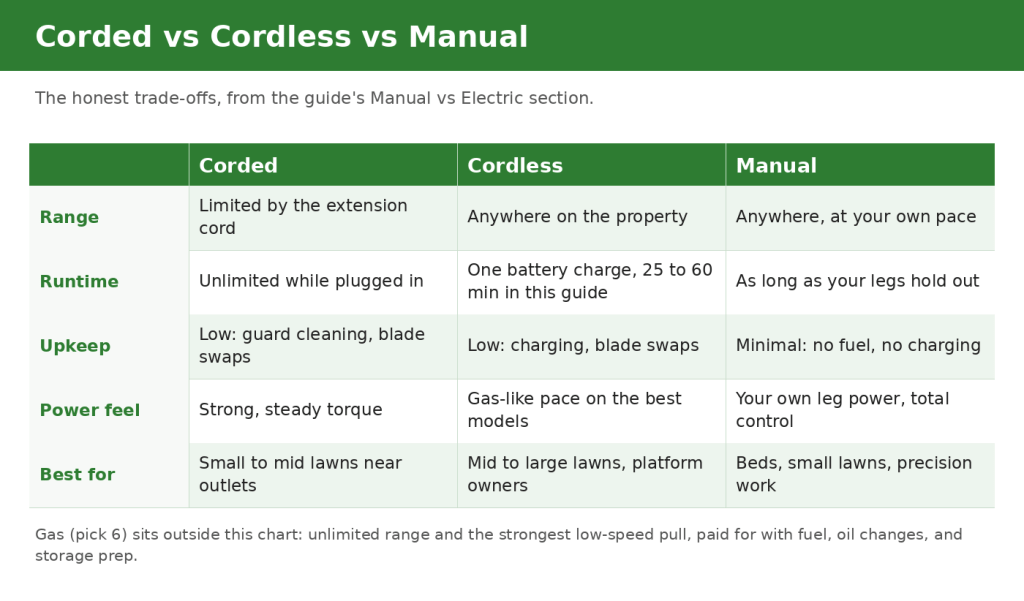
Our honest rule of thumb: if your property has more than about 150 feet of hardscape edge, go powered for the straight runs and keep a manual tool for the beds. If your whole lawn is a townhouse plot, a half moon or step edger plus a rotary for upkeep may be all the edger you ever need.
How to Edge a Lawn Like a Pro in 6 Steps
Good edging is 20 percent tool and 80 percent sequence. Here is the order that produces the crisp line in the magazine photos, and keeps it:
- Mow first, at your normal height, so you can see exactly where the lawn ends and the creep begins.
- Mark problem areas: edges swallowed by turf get flagged for a deep re-cut; clean edges get a maintenance pass.
- Clear the line: sweep soil, mulch, and stones off the hardscape so the guide wheel or your eye can follow the true edge.
- Cut the face: for a re-cut, set the deepest setting and make several shallow passes rather than one deep bite. Guide wheels ride the pavement; manual tools work in strides.
- Trim the top: run a string trimmer horizontally along the top edge to knock off the shaggy fringe the vertical cut leaves behind.
- Sweep and inspect: blow the clippings back onto the lawn (they are free nitrogen), then walk the line and touch up the misses.
For a yard of how-to guides built on the same measured approach, see our how to guides. For the seasonal rhythm, edging belongs right after the first spring mow, with touch ups monthly through the growing season and a final clean cut before winter.
Best Lawn Edger for Overgrown Edges
When the edge has been lost for a season or more, the job changes character: you are not trimming, you are excavating a line. The winning traits are torque, depth, and a blade that does not care about buried soil and small roots. That is why the Troy-Bilt TB516 EC (pick 6) leads this use case: 4-cycle torque, a 9 in blade, six depth settings to 1.75 in, and wheels that keep the cut straight when the going is lumpy. Behind it, the EGO EA0800’s 3 in depth (pick 2) is made for exactly this in slices: cut at 1.5 in, then deepen. The corded pair, LE750 and WG896 (picks 1 and 5), can do it in passes on extension cord range. Manual rescue is possible with a half moon or step edger and patience, a few feet at a time; a rotary edger cannot help you here at all.
Technique for the rescue cut: mow the overgrowth short first, soak dry hard soil the night before, then take the edge in shallow passes, clearing the spoil as you go. Expect the first pass to look terrible and the third to look like a different yard.
Best Lawn Edger for Flower Beds
Beds ask for shape, not speed. The edge that sets off a flower bed is a shallow V trench: vertical on the lawn side, sloping down into the bed, so mulch stays put and the line reads from across the street. Only manual tools cut that profile, which is why the Razor-Back 61108 half moon (pick 8) is our flower bed pick, with the Yard Butler EDGE-180 (pick 9) for tree rings, tight curves, and slotting in plastic edging. Keep the trench 2 to 3 in deep, recut it each spring, and top the mulch after, not before. If bed edges are most of your edging, the powered picks in this guide are the supporting act, not the headline.
Lawn Edger Buying Guide: What Actually Matters
Spec sheets make edgers sound complicated. In practice, six things separate a satisfying edger from a garage ornament:
- Cutting depth first. Maintenance needs an inch; restoration needs 1.5 in or more. Fixed depth notches are easier for beginners; stepless wheels like the Greenworks 27032’s give finer control once you have the feel.
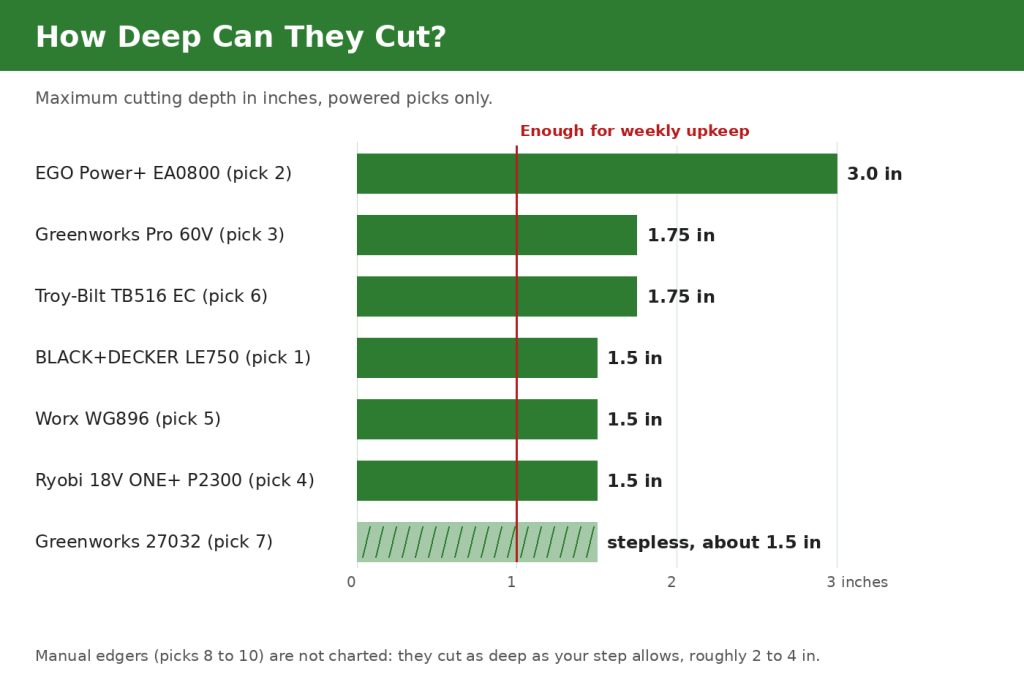
- Blade size and replacement. Bigger blades (9 in) suit first cuts and hard soil; smaller blades feel nimbler. Check replacement cost and whether the blade flips: the Ryobi and Greenworks 27032 designs double blade life for free.
- Weight is a feature. Under 9 lb cordless tools are ceiling hook easy; 14 to 22 lb machines track straighter and punish you on slopes. Match the tool to your strength and your footage.
- Power source honesty. Corded means unlimited runtime inside 100 ft of an outlet. Cordless means freedom bounded by runtime: 25 minutes (Ryobi) to an optimistic 60 (Greenworks 60V). Gas means unlimited range and a maintenance calendar.
- Guards, guides, and clog clearing. The features that sound dull decide whether you love the tool in week three: an edge guide that holds the line, a guard door that opens for cleaning, and wheels that do not pack with mud.
- Warranty tells the truth. Two years is standard; three (Worx), four (Greenworks), five (EGO attachment), and lifetime on the Yard Butler say more about build confidence than any marketing line.
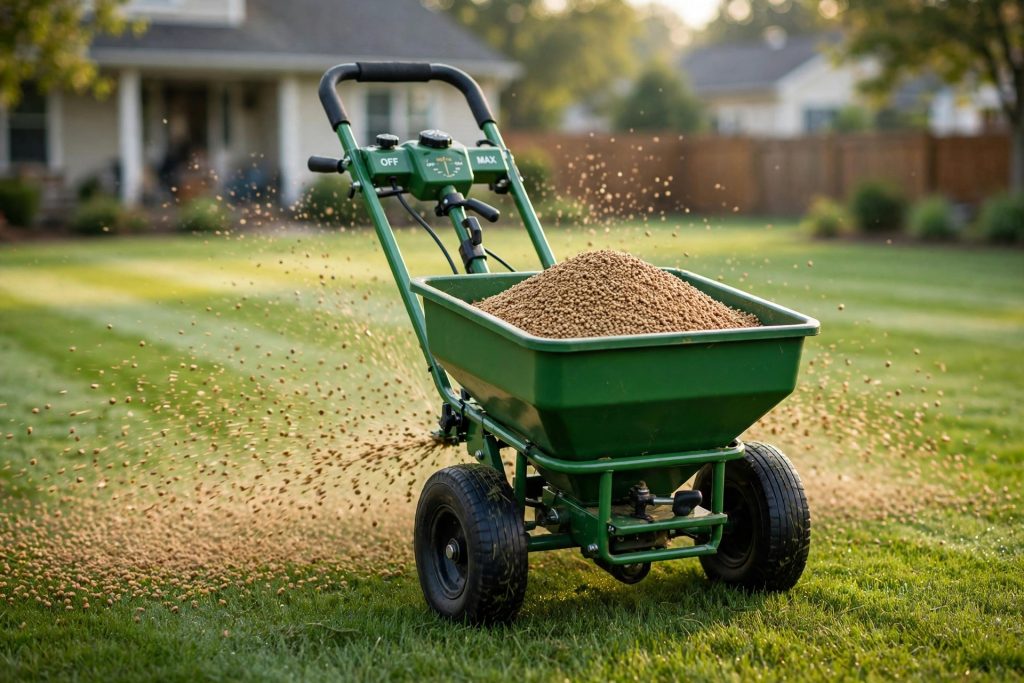
An edge is one half of the tidy lawn equation; even feeding is the other. Once the lines are cut, uneven fertilizer shows up as stripes you can see from the street, and a decent spreader is what prevents them.
Final Choice
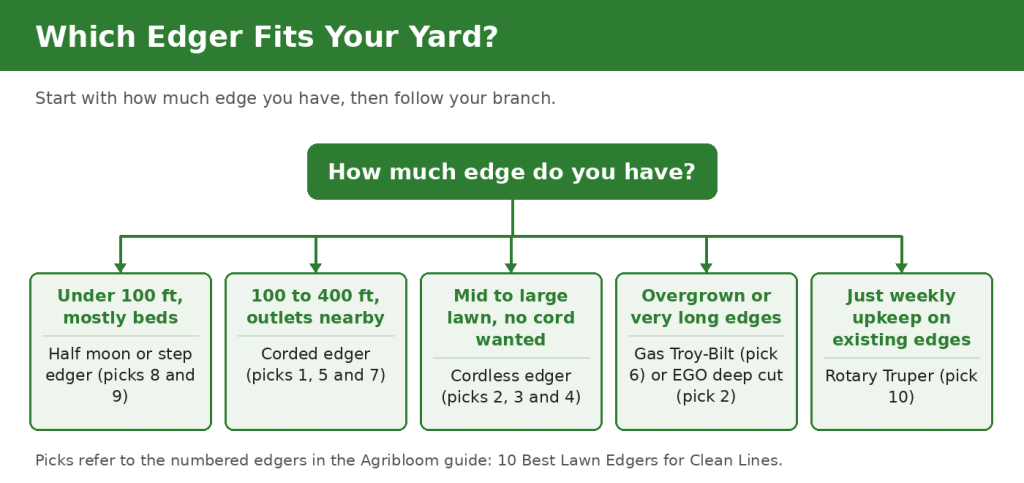
If we had to keep exactly one edger from this list for a typical home lawn, it is the BLACK+DECKER LE750 (pick 1): proven, powerful, deep enough, and honest value. Cordless households should skip straight to their platform: the EGO EA0800 (pick 2) for EGO owners, the Greenworks 60V (pick 3) as a dedicated tool, and the Ryobi ONE+ (pick 4) for small lawns on a budget. Neglected edges belong to the Troy-Bilt TB516 EC (pick 6), and nobody maintaining beds by hand will regret the Razor-Back 61108 (pick 8) or the Yard Butler EDGE-180 (pick 9).
Final Thoughts
Edging is the highest return half hour in lawn care. It costs little, it shows instantly, and it quietly does agronomic work too: severed runners, cleaner mower lines, less grass invading beds, and fewer weeds rooting in pavement cracks. Pick the tool that matches your footage and your patience, cut the first edge properly, and after that the whole job is fifteen light minutes a few times a season.
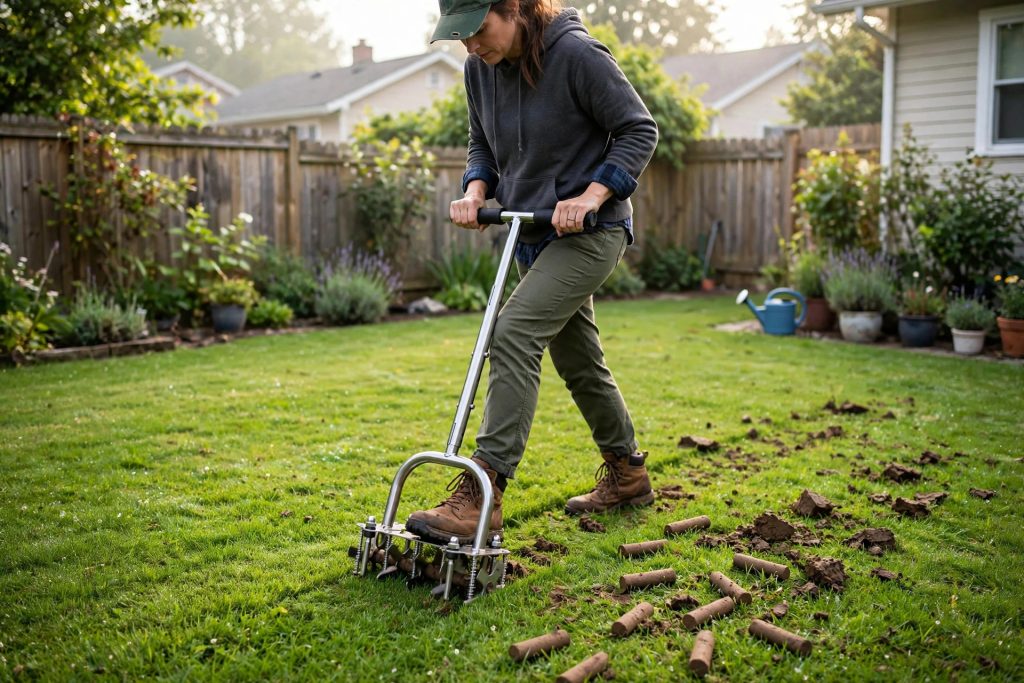
Edges are the visible frame, but the lawn inside the frame lives or dies on air and water reaching the roots. Our manual aerator roundup covers the other quiet tool that transforms a tired lawn without renting machinery.
References
- BLACK+DECKER LE750 2-in-1 Landscape Edger and Trencher, product specifications
- EGO Power+ EA0800 Multi-Tool Lawn Edger, product specifications
- Greenworks Pro 60V Brushless 8 in Edger, product specifications
- Worx WG896 12 Amp 2-in-1 Lawn Edger and Trencher, instruction manual
- Better Homes & Gardens: How to Edge Your Lawn for a Professionally Manicured Look
Frequently Asked Questions
What is the best lawn edger for most home lawns?
For most homes, a 12 amp corded edger like the BLACK+DECKER LE750 is the best lawn edger to start with: it cuts to 1.5 in, never needs charging, and handles both re-cuts and weekly maintenance. If cords bother you, the cordless picks in this guide (EGO, Greenworks 60V, Ryobi) cover the same work at a higher price.
Manual vs electric lawn edger: which should I buy?
In the manual vs electric lawn edger choice, manual wins for beds, curves, small lawns, and budgets: a half moon or step edger costs little and lasts decades. Electric wins on footage: past roughly 100 feet of edge, or whenever edges need re-cutting after neglect, a powered edger pays for itself in one afternoon.
What is the best cordless lawn edger?
The best cordless lawn edger depends on your platform. EGO owners should get the EA0800 attachment, which cuts a full 3 in deep. As a dedicated tool, the Greenworks Pro 60V brushless edger is the strongest all rounder here, and the Ryobi 18V ONE+ is the light, budget friendly option for small lawns.
What is a half moon edger used for?
A half moon edger cuts bed edges by hand: you step on its forward turned step and rock the crescent blade through turf and soil. It is the best tool for shaping new curved bed lines, cutting the V trench against mulch, and working precisely around tree roots and irrigation lines where a power blade is a liability.
How deep should a lawn edger cut?
For routine maintenance, 0.5 to 1 in is enough to sever fresh runners and keep the face clean. When you are restoring a lost edge, cut 1.5 in or deeper so the line holds for the season. Cutting much deeper than 2 in along beds is rarely useful and can disturb irrigation and landscape fabric.
Can a lawn edger handle overgrown edges?
Yes, with the right tool and technique. The best edger for overgrown edges has torque and depth: the gas Troy-Bilt TB516 EC or the deep cutting EGO EA0800. Work in two passes, a shallow clearing pass, then a full depth pass, and remove the turf strip between passes instead of forcing the blade through everything at once.

Thesis Link : https://saulibrary.edu.bd/daatj/public/uploads/BAU200601_19-Pp_5.pdf
- How to Dethatch a Lawn: Signs, Timing and Methods - October 9, 2026
- 10 Best Lawn Edgers for Clean Lines - October 9, 2026
- 10 Best Broadcast Spreaders for Home Lawns - October 9, 2026