
Brown patches in October send a lot of homeowners straight to the store for a bag of grub killer. Sometimes that is the right move. Often it is not. Drought, dog urine and fungus can all leave the same brown patch, and even when grubs are the cause, a healthy lawn can live with a few of them without any treatment at all.
If you want to know how to get rid of grubs for good, the answer starts with a spade, not a spreader. Confirm the diagnosis, count what you find, treat only when the count clears the threshold, and then repair the damage and fix the timing for next year. That sequence is what this guide walks through, step by step.
Reading this in October? Two parts of this guide are for right now: the diagnosis steps and, if your count is over threshold, a curative treatment plus repair and overseeding. The preventive product timing (June to July) is for next year, and it is covered in its own section below so you can plan it with this fall’s real numbers in hand.
Quick Checklist: How to Get Rid of Grubs the Right Way
Use this short version if you are standing in the yard right now. Steps 1 to 3 come first, always. Never treat before you have diagnosed and counted.
First, diagnose and count:
- Do the tug test on the edge of a brown patch. If the turf lifts easily and the roots look cut, suspect grubs.
- Dig and fold back a 1 square foot flap, 2 to 4 inches deep, at the patch edge. Count the grubs in the soil and thatch. Repeat in several spots.
- Judge the count honestly. Under about 5 grubs per square foot, monitor only. Around 5 to 10, decide by lawn vigor and species. Over 10, treatment is justified.
Then act on the count:
- If you treat in fall, use a labeled curative product while grubs are still near the surface, and water it in with about 1/2 inch of irrigation right away.
- Do not apply a preventive product in October. It only works on newly hatched grubs in early summer.
- Repair thin and bare areas once grubs are controlled. Rake out dead turf, overseed, and keep the seedbed moist.
- Mark your calendar for next June. That is the preventive window that stops next fall’s damage before it starts.
What Lawn Grubs Are
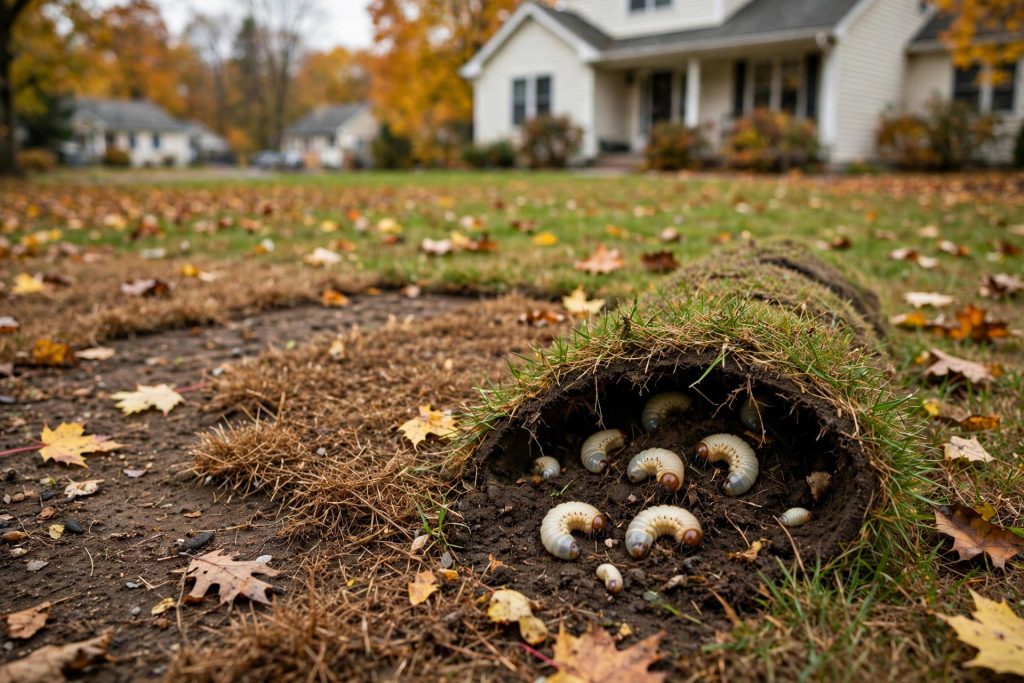
White grubs are the C-shaped larvae of scarab beetles. The common lawn species in the United States include Japanese beetle, masked chafers, European chafer and June beetles. The grubs are dirty white or cream colored, with a brown head, six legs near the head, and a body that rests in a tight C shape when you expose it. Full grown grubs of the common one-year species are about 3/4 inch to just over 1 inch long.
Most of these beetles complete their life cycle in one year. Adults lay eggs in the soil in summer. The eggs hatch in about 10 to 21 days, and the young grubs start feeding on fine roots and organic matter right away. They feed near the surface through late summer and fall, move deeper when the soil turns cold, then come back up in spring for a short final round of feeding before they pupate in May to early June. May and June beetles are the exception, with a three-year cycle, but the feeding pattern homeowners see is similar.
Fall is when the damage hurts most. By September and October the grubs are large, they are feeding hard, and the lawn has less time to grow new roots before winter. That is why a patch that looked fine in August can fall apart in October.
The Grub Year at a Glance
| Season | What the grubs are doing | What the homeowner should do |
|---|---|---|
| Late spring, April to May | Overwintered grubs feed briefly near the surface, then pupate | Check old damage, repair thin areas, do not expect much from a spring curative |
| Early summer, June to early July | Adults emerge, mate and lay eggs, eggs begin to hatch | Apply a preventive only if last year’s counts justified it, water it in |
| Late summer, August to September | Young grubs feed near the surface and grow fast | Scout with the dig test, this is the best curative window |
| Fall, September to October | Large grubs feed heavily, worst damage shows | Confirm, count, use a curative only over threshold, then repair and overseed |
| Winter | Grubs sit 2 to 8 inches deep and do not feed | Leave the lawn alone, plan next June’s preventive decision |
Signs of Grub Damage
Grub damage has a feel to it, not just a look. The grass turns brown or straw colored in irregular patches. The patch feels spongy underfoot because the roots that anchor the turf are gone. In a heavy infestation the sod rolls back like a piece of carpet when you pull on it. That carpet test is the classic field sign extension services point to.
Animal digging is the second clue. Skunks, crows, raccoons and moles dig for grubs, and a lawn torn up overnight in small holes often has grubs underneath. Treat that as an indicator, not proof. Moles also eat earthworms, and skunks dig for other insects too. The only honest diagnosis is the dig test in the next section.
Before you dig, rule out the look-alikes. The table below covers the four causes homeowners confuse most often.
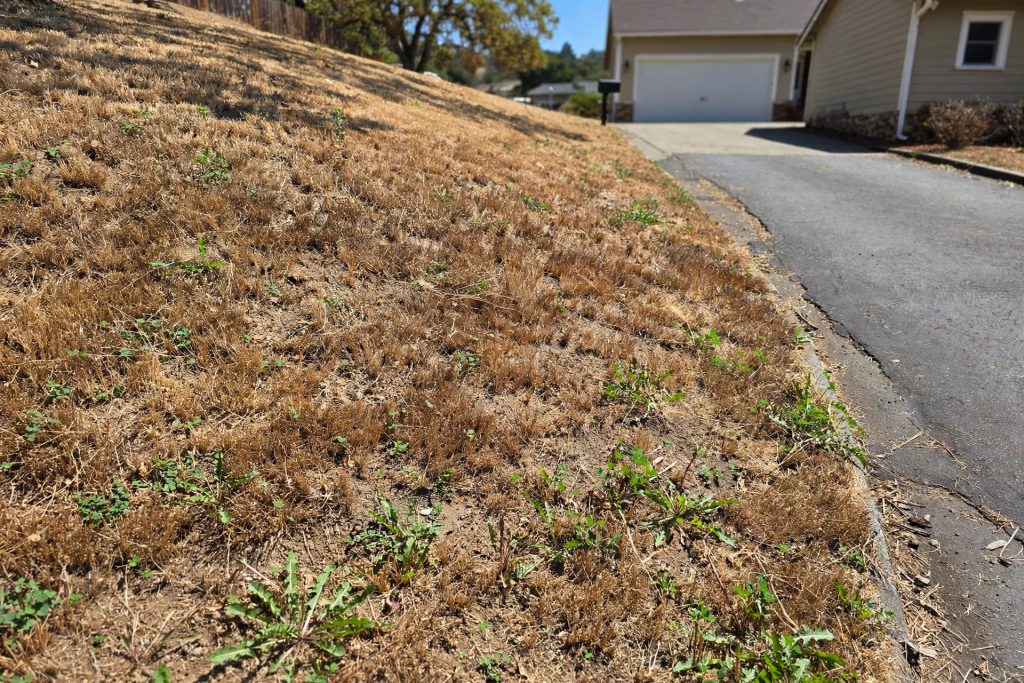
| Problem | What it looks like | Tug and dig check | The fix |
|---|---|---|---|
| Grub damage | Irregular brown patches, spongy feel, worst in sunny areas in fall | Turf lifts like carpet, roots cut short, white C-shaped grubs in the soil | Count grubs, treat only over threshold, then overseed |
| Drought stress | Large dull or brown areas, often on slopes and near pavement | Turf stays rooted, soil is dry and hard, no grubs found | Deep, infrequent watering, raise mowing height |
| Dog urine spots | Small round dead spots with a dark green ring around each spot | Turf stays rooted, damage stays in spots the dog uses | Flush with water, train to one area, reseed dead centers |
| Brown patch fungus | Circular patches with a darker smoky edge, worse in heat and humidity | Turf stays rooted, leaf blades show lesions, no grubs found | Improve air flow, avoid evening watering, fungicide only if labeled and needed |
If the turf lifts and you find grubs, keep going. If it stays rooted and the soil is empty, save your money and fix the real cause.
Step by Step: Confirm, Treat and Repair
Work through these six steps in order. Skipping the count is how homeowners end up treating a drought problem with an insecticide.
Step 1: Do the Tug Test on a Damaged Patch
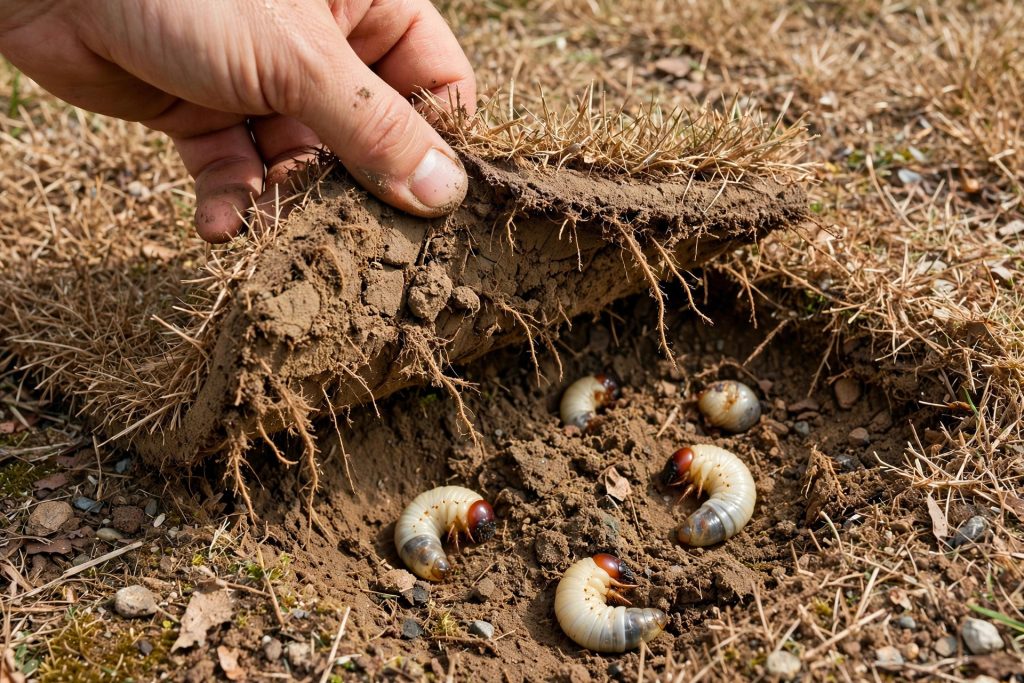
Start at the edge of a brown patch, where damaged turf meets green turf. Grab a handful of grass and pull gently upward. Healthy turf resists because the roots hold. Grub-damaged turf peels up with little effort, and the underside shows short, cut roots with almost no soil hanging on. Check two or three patch edges, not just one. If every edge resists and the roots look intact, grubs are probably not your problem.
Step 2: Dig and Fold Back a 1 Square Foot Flap
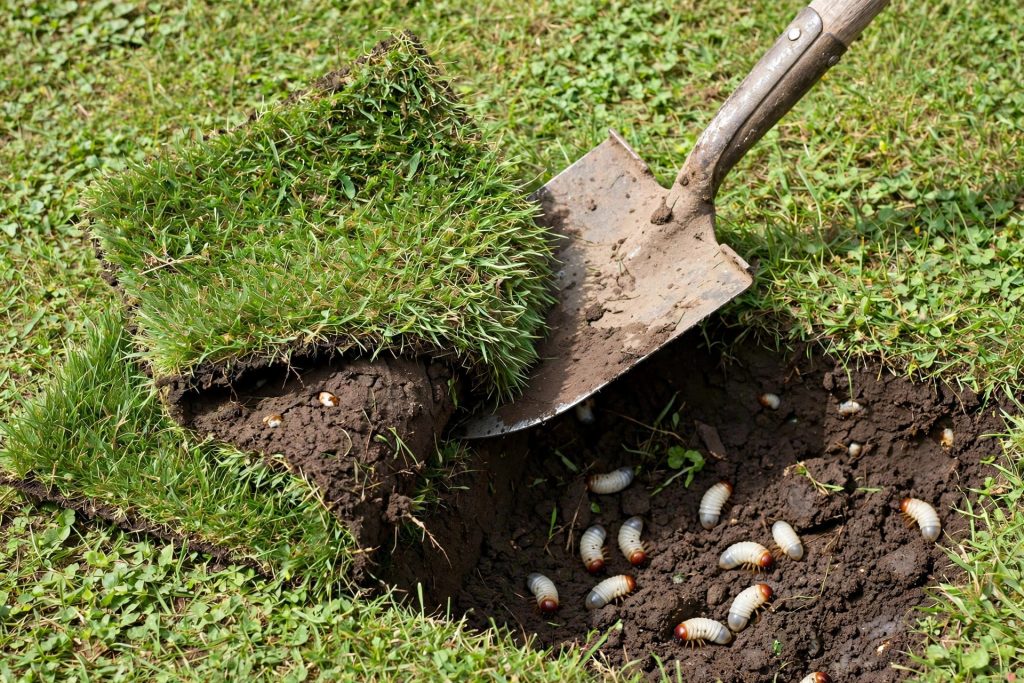
Take a garden spade and cut three sides of a 1 square foot piece of turf at the patch edge, about 2 to 4 inches deep. Leave the fourth side attached as a hinge and fold the flap back. This is the survey method Penn State Extension describes for home lawns, and it works because it shows you the exact zone where grubs feed: the soil, the thatch layer and the underside of the sod. Work at the edge of the damage, not the dead center. Grubs move outward into healthy turf, so the center of an old patch is often empty.
Step 3: Count Grubs in Soil and Thatch
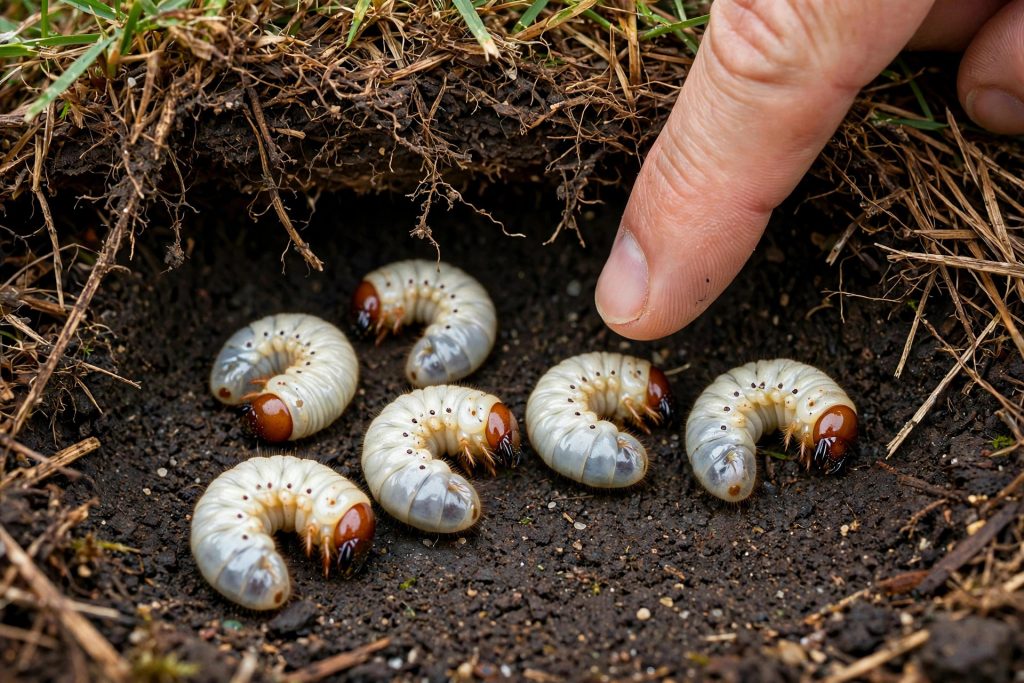
Break apart the soil under the flap and shake the roots and thatch over the hole. Count every white grub you find in that square foot. Then fold the sod back into place, firm it down with your foot, and water the spot so it can re-root. One sample is not enough. Grubs cluster, so take three to five samples across the damaged area and near it, and use the highest counts, not the average of an empty hole, to judge the problem.
Step 4: Decide by the Threshold, Not by Fear
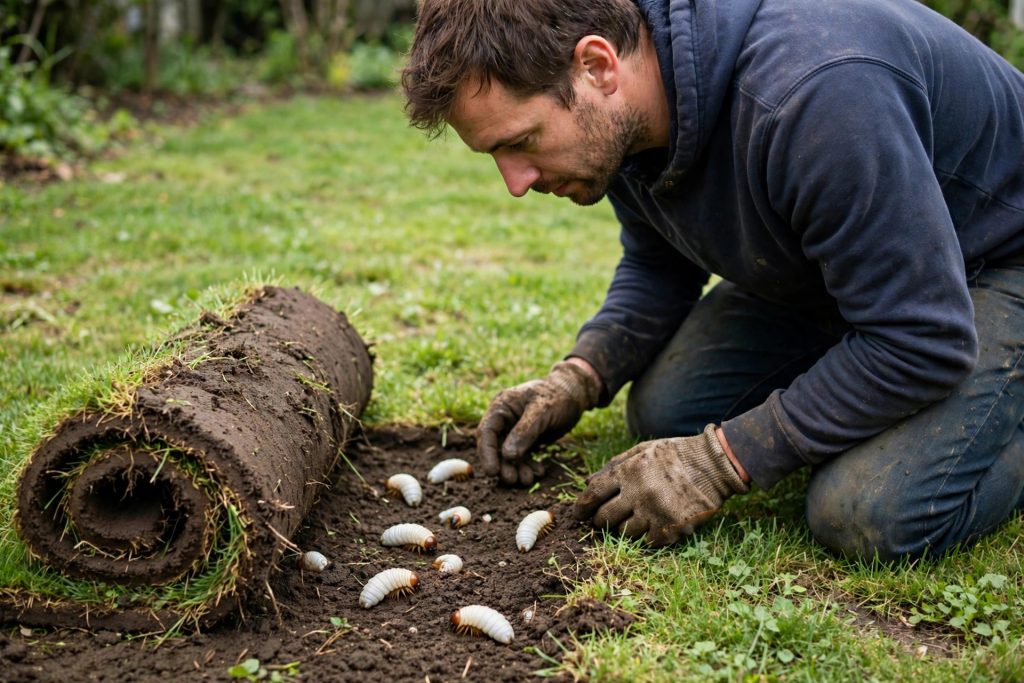
Extension guidance uses about 5 to 10 grubs per square foot as the curative threshold, and the right number inside that range depends on species and lawn vigor. UMass Extension puts it plainly: healthy turf usually tolerates eight to ten grubs per square foot without visible weakening, while stressed turf (drought, heavy traffic) can be weakened by as few as five. European chafer is the most damaging of the common species, so its tolerance level sits lower. Japanese beetle and masked chafer usually need counts near the top of the range to cause visible injury. A thick, irrigated lawn can tolerate counts that would wreck a thin, drought-stressed lawn, because it regrows roots faster than the grubs remove them.
Use this plain rule. Under about 5 per square foot, do not treat, just water and monitor. From about 5 to 10, treat only if the turf is already thin, dry or showing fresh damage. Over 10 per square foot, treatment is justified, and you should also plan a preventive for next June.
Step 5: If Treating in Fall, Use a Labeled Curative and Water It In
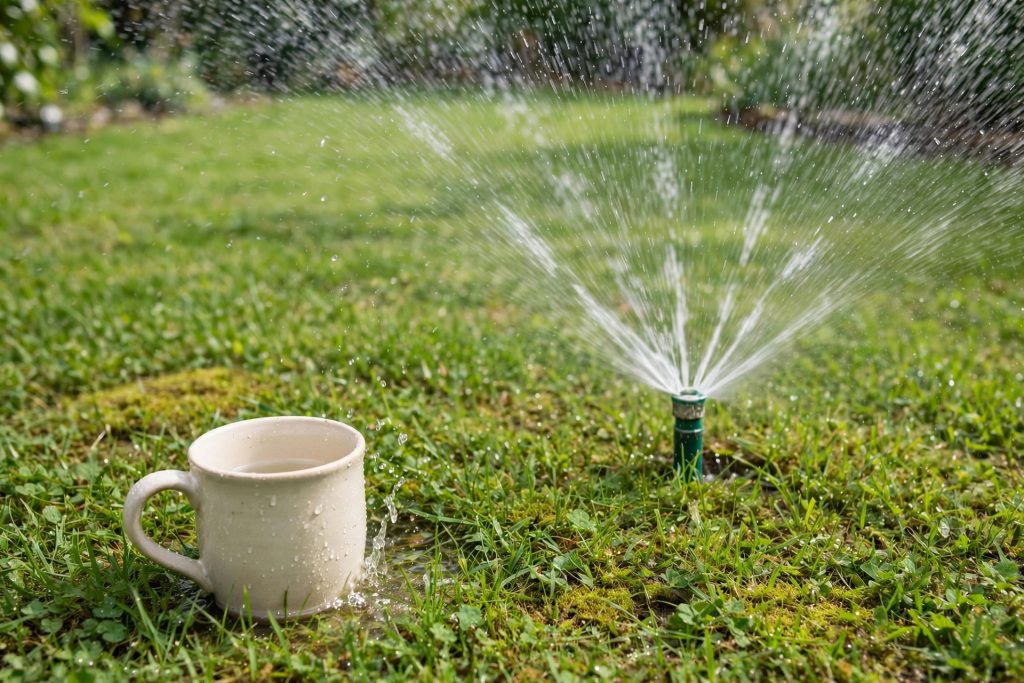
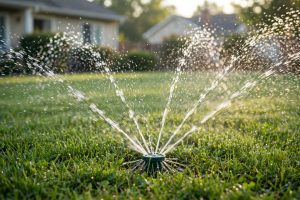
Timing decides whether a product works. A curative product is made for grubs that are present and feeding now. The curative active ingredients extension services list are trichlorfon and carbaryl. They are short-lived contact products, so they must reach the grubs in the root zone. Mow first, apply at the rate printed on your product’s own label (rates differ between brands and formulations, so never borrow a rate from a different product), and water immediately with about 1/2 inch of irrigation. You can measure that with a few coffee mugs or empty cans set on the lawn: run the sprinkler until the water in them reaches the 1/2 inch mark.
Check the active ingredient, not the brand name. The Sevin brand, for example, no longer contains carbaryl: current Sevin products use bifenthrin and zeta-cypermethrin, which do not control grubs at all. A familiar brand on the bag guarantees nothing.
Be honest about expectations. Michigan State University Extension research reports curative control of about 20 to 80 percent when applied in September, and 20 to 55 percent in late October, as the grubs grow larger. A fall curative limits damage and buys the lawn a chance to recover. It is not a guarantee, which is why the repair step and next June’s preventive matter so much.
Safety, from the label outward. Read the full label before you open the bag. Keep children and pets off the treated lawn until sprays have dried, or until granules have been watered in and the lawn has dried again, whichever your label states. Store the product in its original labeled container, out of reach of children and pets. Never apply more than the label rate: more product does not mean more control, and exceeding the rate is illegal. Some states and municipalities also restrict which active ingredients homeowners may use, so check your local rules before you buy.
Step 6: Repair the Damage, Rake, Overseed and Keep Moist
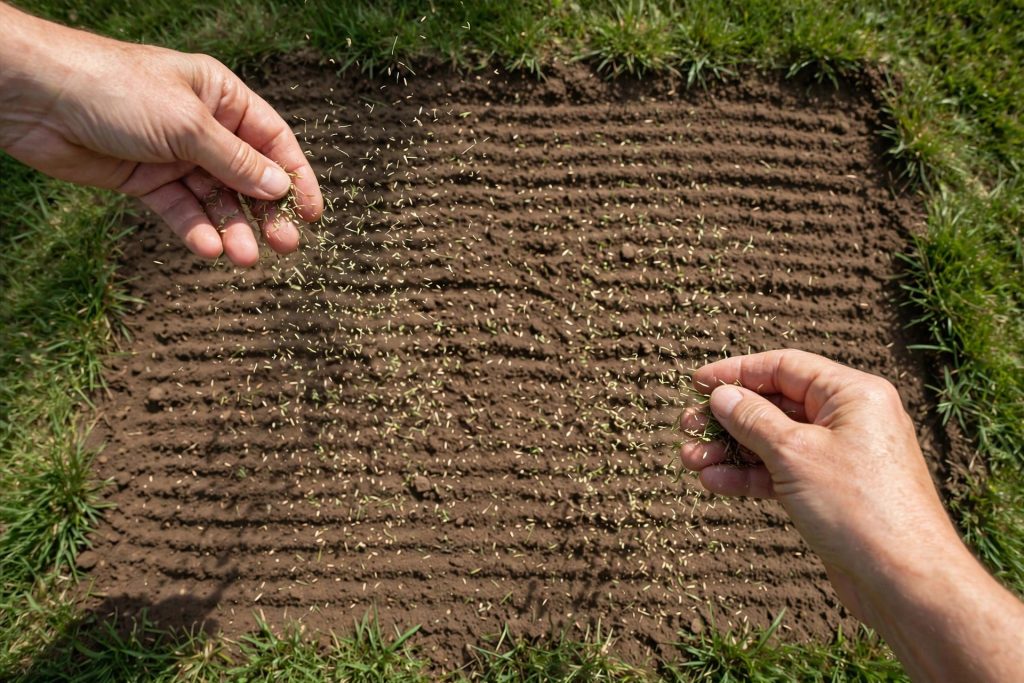
Do not overseed a patch that still has grubs feeding in it. The new seedlings have almost no roots, and the grubs will cut them the same way they cut the old turf. Once the count is controlled, rake out the dead, loose turf so seed can touch soil. Spread a quality grass seed suited to your region and light conditions, press it into contact with the soil, and keep the top layer moist with light, frequent watering until germination.
Fall is prime seeding time for cool-season lawns because the soil is warm, weed pressure is lower, and the seedlings get both fall and spring to establish before summer heat. Warm-season lawns in the South should hold major overseeding decisions for their own spring and early summer window, except for the planned winter ryegrass overseeding some Bermuda lawns use.
Preventive vs Curative Products: The Distinction That Saves Money
Almost every grub failure comes down to using the right product in the wrong month. This is the one detailed explanation of the two product types in this guide; the other sections refer back to it instead of repeating it.
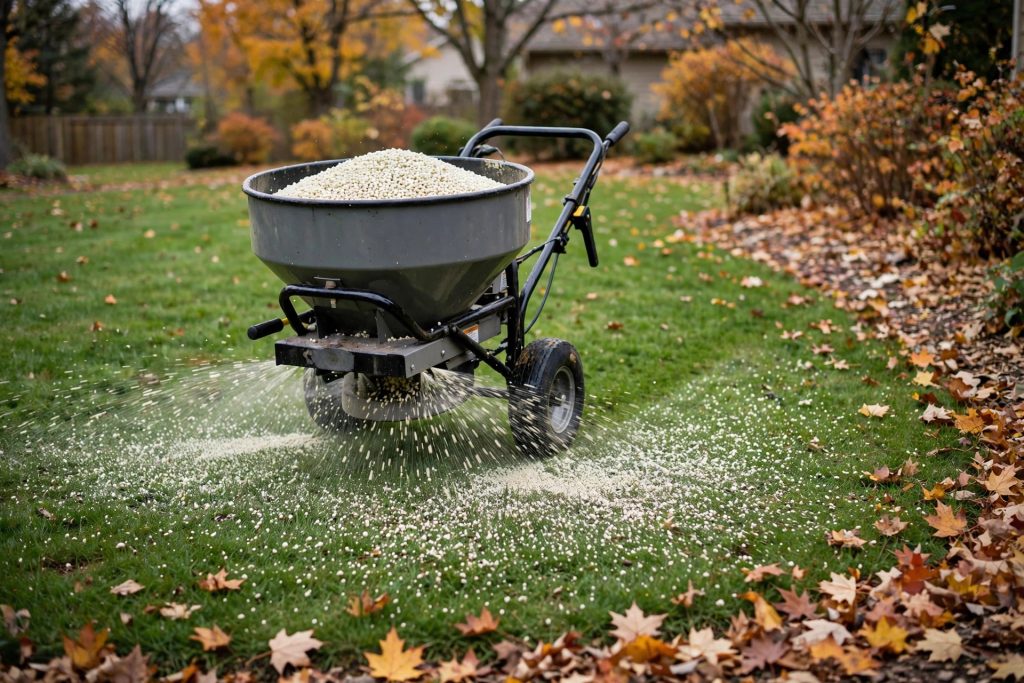
Preventive products work on newly hatched grubs only. The preventive active ingredients are chlorantraniliprole, imidacloprid, thiamethoxam and clothianidin (clothianidin also gives some curative action, but it is sold and timed as a preventive). They need to be in the soil before or around egg hatch. For imidacloprid, thiamethoxam and clothianidin products, Michigan State University Extension recommends applying in June or July. Chlorantraniliprole moves slowly into the soil and is less water soluble, so it can go down any time from April to mid-July, and applications before June perform best.
Water preventives in with about 1/2 inch of irrigation as well. Applied in October, a preventive does almost nothing to the large grubs already feeding: Michigan State notes these products will not work on grubs found in the lawn from mid-October through mid-May. A fall preventive is wasted money. If you are reading this in October, this whole paragraph is next year’s plan, to be decided by this fall’s grub counts.
Curative products work in the opposite window. They target grubs that are already present, best while the grubs are still small to medium and feeding near the surface in late summer to early fall (the ingredients and the application procedure are covered in Step 5 above). By late October the window is closing, and by spring it is the weakest timing of all: overwintered grubs are large, they feed for only a short time, and then they pupate. Michigan State advises against any curative application after mid-May, because the grubs stop feeding as they prepare to pupate. A spring curative also gives no protection against the eggs adults lay in summer.
One more trap to avoid: products that contain only pyrethroid ingredients such as bifenthrin, lambda-cyhalothrin or permethrin do not control grubs. Those ingredients bind to organic matter near the surface and never reach the root zone where grubs feed. Check the active ingredient list on the bag, not just the front panel claim.
Biological and Low-Input Options, Stated Honestly
If you prefer to avoid insecticides, or your counts sit near the threshold, biological options deserve a fair and honest look.
Beneficial nematodes are the strongest biological option. The species Heterorhabditis bacteriophora hunts all the common white grub species, enters the grub body, and kills it within a few days. The conditions matter more than the brand. Apply in late July through August when grubs are young and near the surface, or in early fall while grubs are still active near the surface. Soil temperature should be above about 50 to 60 degrees F.
Apply in the evening or on a cloudy day because ultraviolet light kills nematodes, irrigate before and after application, and keep the soil moist for several days. Nematodes are living organisms. They are fragile in storage and shipping, they have a short shelf life, and results vary from lawn to lawn. Check the expiration date on the package and follow the label exactly.
Milky spore needs a clear warning. The bacterium Paenibacillus popilliae, sold as milky spore, works only on Japanese beetle grubs. It does nothing for European chafer, masked chafer or the other species in most lawns. It also builds very slowly. Penn State Extension notes it can take three to five years to become established, and more recent extension guidance rates its control as weak to inconsistent. It is not a quick fix for a lawn that is coming apart this fall, and presenting it as one would be dishonest.
The long-term defense is cultural, and it is free. A lawn with deep roots tolerates grub feeding that would destroy a weak lawn. Mow at 3 to 4 inches for most cool-season grasses, water deeply and less often to push roots down, fertilize on a soil test rather than a guess, and core aerate compacted areas so roots can grow. Strong turf is the cheapest grub insurance there is. Stressed, thin turf always shows damage first.
What NOT to Do in October
October is the month of expensive grub mistakes. Avoid these four.
Do not apply a preventive product now and expect it to kill the grubs you just counted. It will not (see the preventive vs curative section above). Save that budget for next June, and only spend it if this fall’s counts showed a real problem worth preventing.
Do not treat the whole lawn when only two patches clear the threshold. Spot treat the infested areas and a small margin around them. Blanket applications expose pollinators, soil life and your wallet to product that most of the lawn never needed.
Do not skip the water-in step. A curative left sitting on dry thatch never reaches the grubs. The 1/2 inch of irrigation immediately after application is part of the treatment, not an optional extra.
Do not overseed first and treat later. Seed into a patch with active grubs and you feed the seedlings to the problem. Control first, then repair.
Common Mistakes
Treating without counting is the most common mistake. A bag applied on a hunch fixes nothing when the real cause is drought or fungus, and you will never know, because you never looked under the turf.
Treating too late in spring is the second. After mid-May the overwintered grubs stop feeding and pupate, and a curative has almost nothing left to control. If spring damage appears, focus on watering, repair and the June preventive decision instead.
Forgetting the mow before treatment matters for pollinators. If flowering weeds such as clover are blooming in the lawn, mow them off before any insecticide application so bees are not visiting treated flowers, and keep spray or granule drift out of flower beds.
The last mistake is expecting one treatment to end the story forever. Grub pressure changes with weather, beetle flights and lawn health. Count again next August and September, and let the numbers, not the calendar alone, drive the decision.
Final Thoughts
Getting rid of lawn grubs for good is less about finding a stronger product and more about getting the sequence right. Confirm with the dig test. Count honestly against the 5 to 10 per square foot threshold. Use a curative only when the count earns it, water it in properly, and repair the damage while fall still favors new seed. Then do the thing most homeowners skip: decide next June’s preventive based on this fall’s real numbers.
Do that two years in a row and the pattern usually breaks. The lawn gets thicker, the roots get deeper, and the counts that once tore patches out of your yard stop clearing the threshold at all.
References
- Penn State Extension, White Grubs in Home Lawns, https://extension.psu.edu/white-grubs-in-home-lawns: Supports the survey method (1 square foot of turf and soil, 2 to 4 inches deep, at several locations), the spongy turf and carpet roll-back signs, damage showing in spring (April to May) and late summer to fall (September to October), the 5 to 10 grubs per square foot curative threshold, milky disease working only on Japanese beetle grubs and taking three to five years to establish, and nematode results being inconsistent with Heterorhabditis usually performing better. All checked against the live page on 2026-10-18.
- Michigan State University Extension, How to Choose and When to Apply Grub Control Products for Your Lawn, https://www.canr.msu.edu/news/how_to_choose_and_when_to_apply_grub_control_products_for_your_lawn: Supports the preventive ingredients (imidacloprid, thiamethoxam, clothianidin, chlorantraniliprole) and their June to July timing, chlorantraniliprole from April to mid-July with pre-June applications most effective, preventives not working on grubs found from mid-October to mid-May, the curative ingredients trichlorfon and carbaryl with trial control of 20 to 80 percent in September and 20 to 55 percent in late October, the 1/2 inch water-in requirement immediately after application, the warning that current Sevin products no longer contain carbaryl, no curative applications after mid-May, mowing before application to protect bees, and pyrethroid-only products not controlling grubs. All checked against the live page on 2026-10-18.
- UMass Extension, Monitoring Lawn Insects, https://www.umass.edu/agriculture-food-environment/home-lawn-garden/fact-sheets/monitoring-lawn-insects: Supports white grubs being active near the surface in April to May and again from early August through October, healthy turf tolerating eight to ten grubs per square foot without visible weakening, stressed turf being weakened by as few as five per square foot, and European chafers causing more damage than other species so their tolerance level is lower. All checked against the live page on 2026-10-18.
Frequently Asked Questions
How many grubs per square foot is too many?
About 5 to 10 grubs per square foot is the threshold extension services use. Below about 5, a healthy lawn usually needs no treatment. Near 10 or above, especially in thin or dry turf, treatment is justified. Species and lawn vigor shift the exact number, so judge the count together with the condition of the turf.
What is the best month to treat for grubs?
For prevention, June to early July is the key window, when preventive products can reach newly hatched grubs. For a curative treatment on grubs already feeding, late August through September is best, while grubs are small to medium and near the surface. October curative treatment can still help, but control drops as grubs get larger.
Will lawn grubs go away on their own?
The grubs feeding now will pupate and become beetles next summer, so that generation does end. The problem is the cycle: those beetles lay new eggs in summer, and the next generation hatches and feeds in fall. Without repair, stronger turf or a well timed preventive, the damage pattern usually returns.
Do beneficial nematodes really work on grubs?
Yes, with conditions. Heterorhabditis bacteriophora nematodes attack all common white grub species and can give useful control when applied to young grubs in late summer, in the evening, into moist soil above about 50 to 60 degrees F, with irrigation before and after. They are fragile living organisms, so storage, timing and moisture decide the result.
Can I treat for grubs in October?
Yes, with a curative product only, and only if your dig test shows counts over threshold while grubs are still feeding near the surface. Expect partial control (late October trials show roughly 20 to 55 percent), water it in right away, and plan the repair and next June’s preventive as the real fix. Preventives do nothing in October, for the reasons in the preventive vs curative section.
When can I reseed after treating for grubs?
Reseed after the grubs are controlled and the label waiting period for your product, if any, has passed. Rake out dead turf so seed touches soil, then keep the seedbed moist until germination. Seeding into a patch where grubs are still actively feeding wastes the seed, because the grubs cut the new roots the same way they cut the old turf.

Thesis Link : https://saulibrary.edu.bd/daatj/public/uploads/BAU200601_19-Pp_5.pdf
- How to Get Rid of Lawn Grubs for Good - October 18, 2026
- 10 Best Garden Kneelers With Handles - October 18, 2026
- How to Winterize Your Lawn Before the First Freeze - October 17, 2026