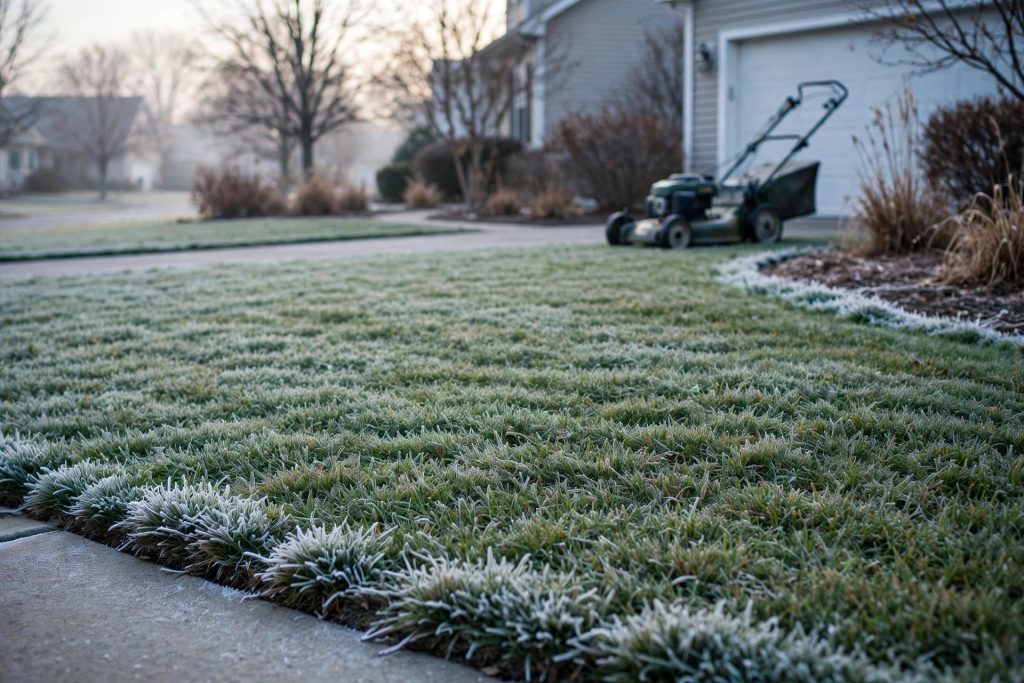

Learning how to winterize lawn areas properly is the last important job of the growing season. The grass may look quiet in late fall, but what happens below the surface decides how it comes through winter. Roots are still active after top growth slows, crowns are storing food, and soil moisture at freeze up shapes how much winter injury you see in spring.
This guide covers how to winterize lawn turf in the final weeks before the ground freezes. It is not the whole fall programme. Aerating, overseeding and early fall feeding belong earlier, and our fall checklist below covers that order. Winterizing is the closing sequence: clear the surface, finish mowing at the right height, apply the late feeding only where it fits your grass type, water before you shut the system down, then drain lines and store equipment so nothing cracks or rusts over winter.
The timing rule is simple to say and easy to miss. Do the lawn jobs while the grass is still green and the soil is not frozen, and finish the water jobs before the first hard freeze, when temperatures stay at or below about 28 degrees Fahrenheit for several hours.
Quick Checklist: How to Winterize a Lawn in 5 Steps
Work through these five steps in order:
- Clear leaves, sticks and debris off the grass so nothing mats down under snow.
- Lower the mowing height gradually and finish at about 2.5 to 3 inches for most cool season lawns.
- Apply a late fall feeding for cool season grass after top growth stops but while the lawn is still green, at no more than about 0.9 to 1 pound of nitrogen per 1,000 square feet, and only if your plan and local rules allow it.
- Water deeply in a dry fall before you shut down irrigation, so the lawn does not enter winter dry.
- Drain hoses, shut off outdoor water and winterize irrigation lines before the first hard freeze, then clean and store tools and the mower.
If you do only part of this list, protect the two deadlines: the feeding window closes when the ground freezes, and the irrigation window closes at the first hard freeze.
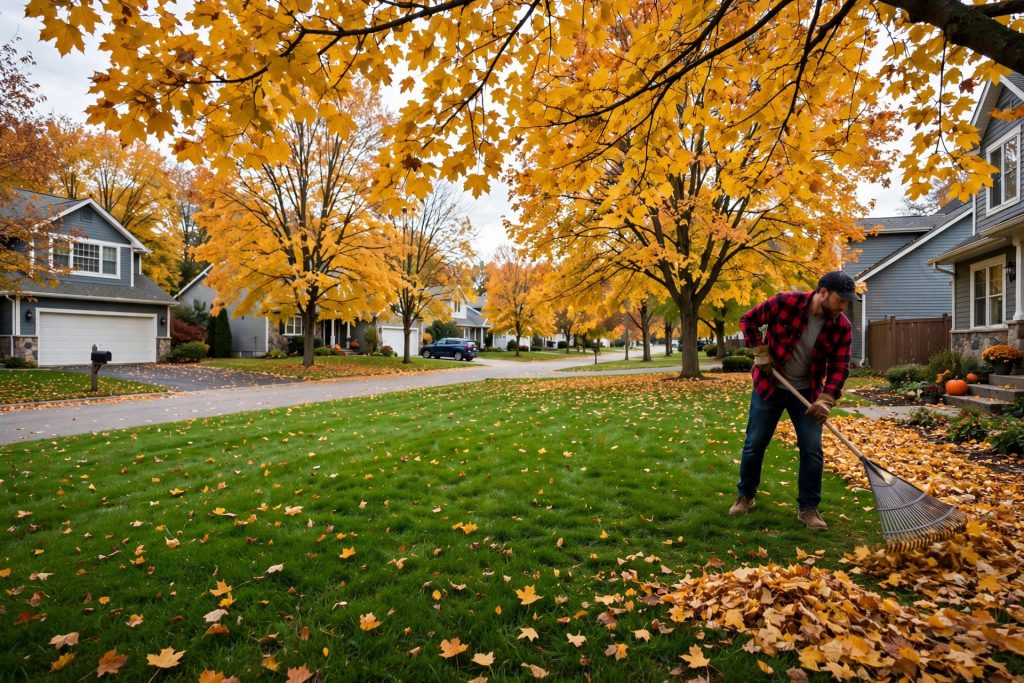
When to Winterize: Watch the Grass and the Soil, Not Just the Calendar
Dates help, but conditions decide. In northern states the closing sequence often falls in late October to November. In the transition zone it can run later. Use these signals instead of a fixed day:
Top growth has stopped or nearly stopped. You are mowing rarely, if at all, because the blades are no longer pushing upward. The lawn is still green. Green tissue can still take up nutrients and store them in the crown and roots. Soil is workable and not frozen. A screwdriver pushes in without forcing, and fertilizer or water can still move into the soil rather than sitting on a frozen crust. A hard freeze is forecast soon, but has not happened yet. That forecast is your deadline for hoses and irrigation, not a signal to rush fertilizer onto frozen ground.
Warm season lawns use a different clock. Bermuda, zoysia, St. Augustine and centipede slow down as nights cool and move toward dormancy after the first frost. For them, winterizing means stopping nitrogen well before dormancy, clearing leaves, and protecting the system from freezes, not applying a late nitrogen feeding.
Cool Season and Warm Season Winterizing Compared
| Point | Cool season lawns | Warm season lawns |
|---|---|---|
| Examples | Kentucky bluegrass, tall fescue, perennial ryegrass, fine fescue | Bermuda, zoysia, St. Augustine, centipede |
| Late fall nitrogen | Yes, one late application after top growth stops, still green, before ground freezes | No. Stop nitrogen about 6 to 8 weeks before average first frost |
| Final height guide | About 2.5 to 3 inches for bluegrass and fescue types | Follow the normal range for the type, avoid scalping before dormancy |
| Main winter risk | Snow mold on long, matted grass, and dry soil at freeze up | Winter kill where late nitrogen pushed tender growth, and freeze damage to lines |
| Leaves and surface | Clear or mulch finely, never leave a mat | Same: clear or mulch finely, never leave a mat |
| Water before freeze | Water in a dry fall until close to freeze up | Reduce as dormancy sets in, protect lines before hard freeze |
If you are unsure which group your lawn belongs to, check the seed bag, sod record or a local extension identification guide before you feed. Feeding the wrong group at the wrong time is the most expensive winterizing mistake.
Regional rules change the plan as much as grass type does. A few states and many counties set fertilizer blackout dates that close the application window in mid November until early spring, and some restrict phosphorus unless a soil test shows a need. Timing also shifts by region: the closing sequence often runs in October in the Upper Midwest, late October to November in the Northeast and transition zone, and later still where winters are mild. Before you set a date, check your state extension lawn calendar and your local fertilizer rules, not just the forecast.
Step 1: Clear Leaves and Debris Off the Grass
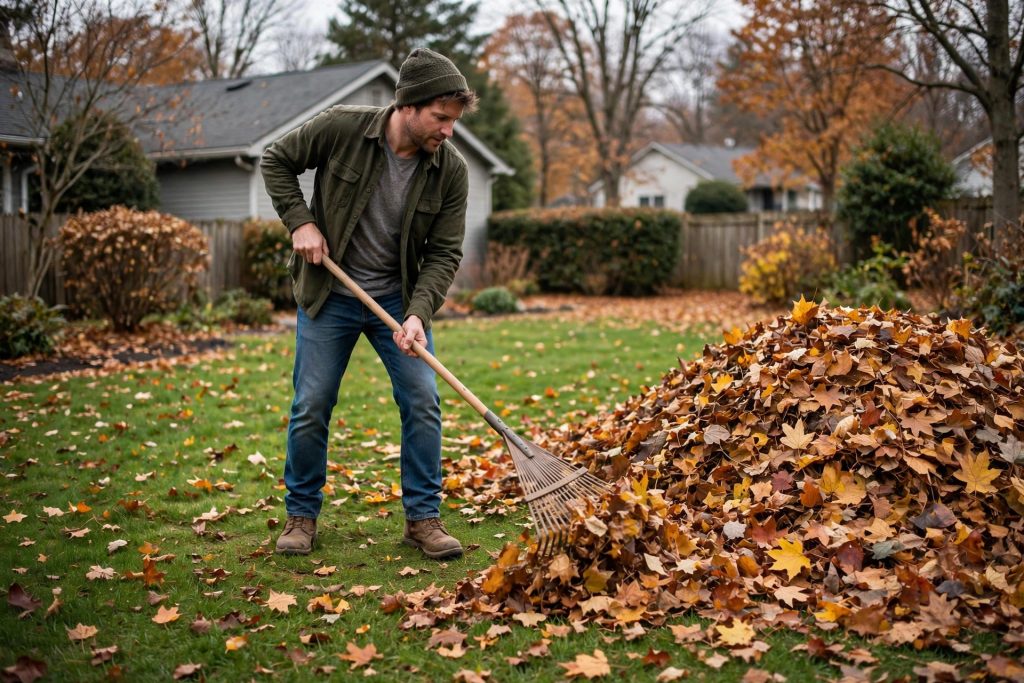
A lawn cannot winter well under a blanket of wet leaves. A thick layer blocks light in the last green weeks, holds moisture against the crowns, and creates the damp, matted conditions where snow mold develops under snow cover. Branches, toys and furniture left on the grass cause the same problem in smaller patches.
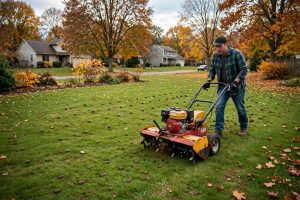
Mulch mow light leaf fall. A mulching mower works when the leaves are chopped fine enough to fall between the blades and you can still see grass through them. Make a second pass over heavier spots rather than letting a layer build.
Collect heavy leaf fall. When leaves cover the lawn, or large leaves mat together when wet, rake or blow them off. Compost healthy leaves or use them shredded as mulch in beds. Send diseased material to municipal composting where piles get hot enough to break down pathogens.
Finish with a general clear up. Pick up sticks, stones and debris that would be hidden under snow and hit by the mower in spring. Move hoses, toys and outdoor furniture off the turf so the grass underneath is not smothered all winter.
Step 2: Do the Final Mow, Lowering the Height Gradually
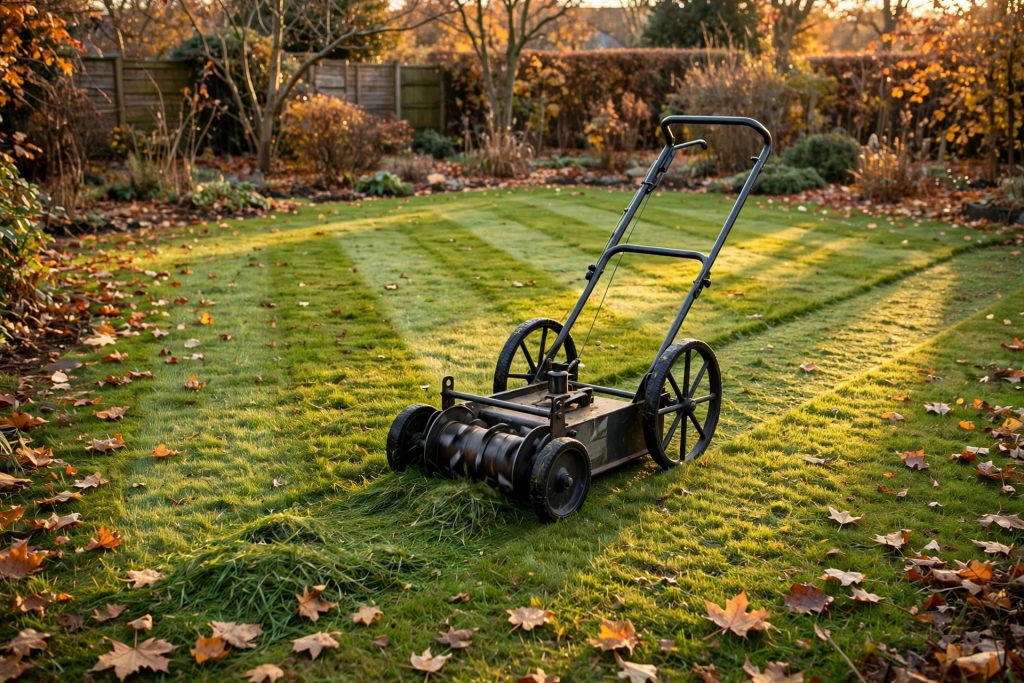
Keep mowing as long as the grass is growing. When growth slows, bring the height down over the last two or three cuts, never removing more than a third of the blade in one pass. A sudden scalp weakens the plant right before dormancy.
For most Kentucky bluegrass and tall fescue lawns, a final height of about 2.5 to 3 inches is a sound target. Grass left much longer flops over under snow, mats down, and stays wet, which raises snow mold risk. Grass cut far shorter exposes crowns to cold wind and freeze and thaw damage. Extension guidance varies a little by state and grass type, so treat 2.5 to 3 inches as the middle ground and follow local guidance where it differs.
Use a sharp blade for the last cuts. A dull blade tears the leaf tip, and torn tips lose moisture and look brown through winter. Bag or rake the final clippings if they are heavy or wet, so they do not form a mat of their own.
Do not mow or walk heavily on frost covered or frozen grass where you can avoid it. Frozen blades are brittle, and traffic on them can leave brown footprints and tracks that only grow out in spring.
Step 3: Apply the Late Fall Feeding Where It Fits
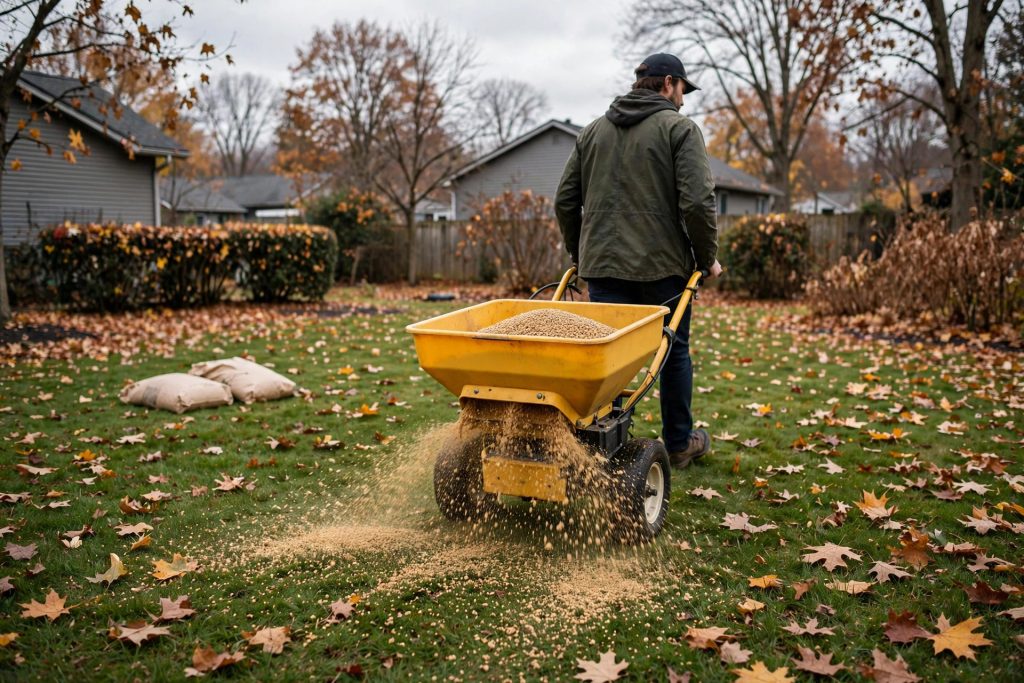
For cool season lawns, the late fall feeding is often called a winterizer. The word on the bag matters less than the timing and the rate. Apply after top growth has stopped, while the grass is still green, and before the ground freezes. At that point the plant is not pushing new leaves, so nitrogen is directed toward roots and storage in the crown. Those stores support earlier and more even green up in spring.
Keep the rate modest. University schedules for tall fescue and Kentucky bluegrass commonly list about 0.7 to 0.9 pound of nitrogen per 1,000 square feet for the October to mid November application, and general guidance caps a single application at about 1 pound per 1,000 square feet. Read the bag, set the spreader to the label rate, and sweep granules off paths and driveways back onto the lawn.
Here is the maths for a real lawn. Say your target is 0.8 pound of nitrogen per 1,000 square feet and your winterizer bag is labelled 20 percent nitrogen. Divide the target by the percentage: 0.8 divided by 0.20 is 4, so you need 4 pounds of product for every 1,000 square feet. A 5,000 square foot lawn therefore takes about 20 pounds of that fertilizer, and a standard 5,000 square foot bag is sized exactly for that job.
Three cautions protect both the lawn and local water:
- Never spread fertilizer on frozen or snow covered ground. The grass cannot take it up, and melt water can carry it away.
- Do not apply heavy nitrogen too early, while shoots are still growing fast. That pushes soft growth that is more open to snow mold and cold injury.
- Respect local fertilizer dates and setbacks. Some states and towns close the application window in mid November, so check your local rule before you plan the date.
For warm season lawns, skip this step. Extension calendars direct the last nitrogen about 6 to 8 weeks before the average first frost, so the plant hardens off naturally. Potassium only helps where a soil test shows it is low. A test result, not a bag label, should decide that application.
Our fertilizer guide below explains how to read an NPK label and match a product to a soil test.
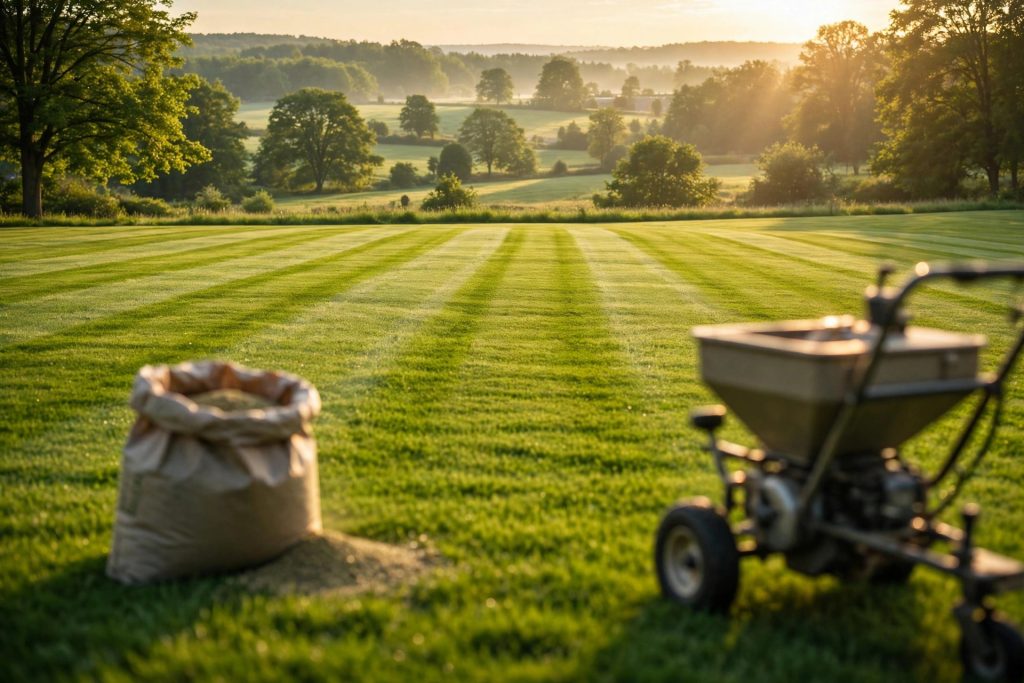
Step 4: Water Before You Shut Down, Then Drain Every Line
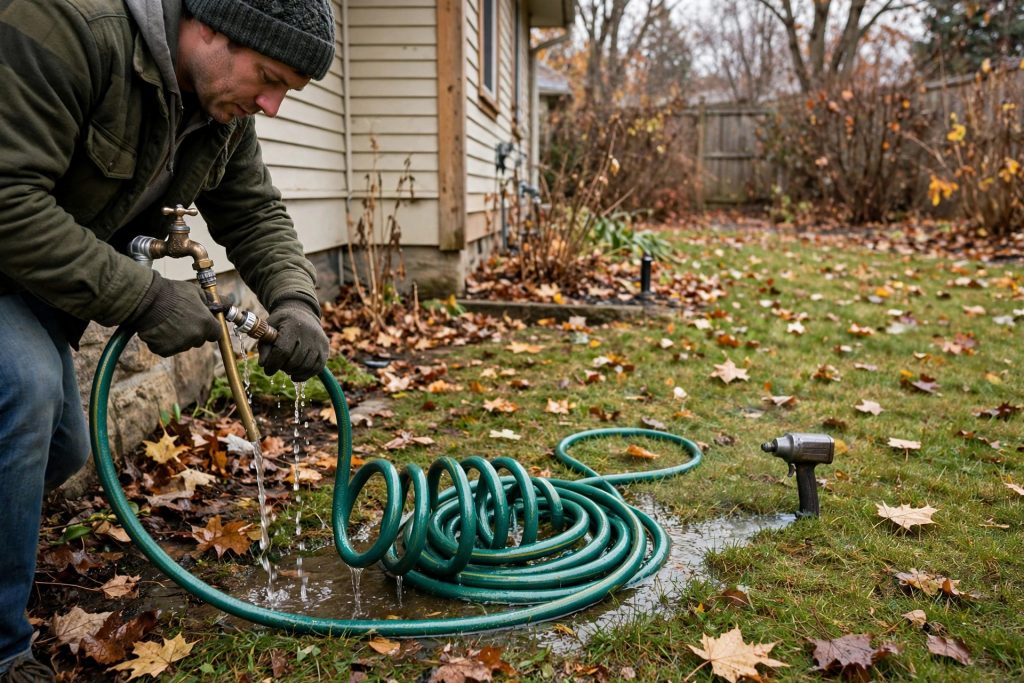
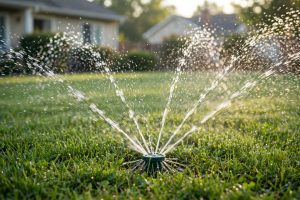
A lawn that enters winter dry is slower to recover, especially on sandy soil and in winters with little snow cover. If fall rain has been light, water deeply before you close the system, aiming to moisten the root zone rather than wetting only the surface. Do this while soil is still open and daytime temperatures are above freezing, then shut the system down.
Winterizing water lines is a deadline job. Water expands when it freezes, and trapped water can crack pipes, valves, backflow parts and hose fittings. In many northern areas the work belongs in October, in the Midwest and Northeast by late October to mid November, and later in the South. Your local first hard freeze date is the deadline that counts.
For an in ground irrigation system: shut off the water supply to the system, drain manual drain valves where fitted, and have the lines blown out with regulated compressed air where your climate and system require it. Blow out one zone at a time until only mist comes from the heads. Set the controller to off or rain mode, and insulate exposed above ground parts and the backflow preventer. If you are not confident with compressor pressure and fittings, hire this job out. Too much air pressure can damage the system it is meant to protect.
For hoses and outdoor faucets: disconnect every hose before the first frost, drain it fully, coil it and store it indoors. Close the inside shut off valve for outdoor faucets where one is fitted, open the outside tap to drain the short pipe section, and fit an insulating cover. A hose left connected can trap ice in the faucet and split a pipe inside the wall, even on a frost free fitting.
Step 5: Protect the Lawn Through Winter and Store Equipment Clean
The last step is quieter, but it prevents spring problems. Reduce traffic on dormant and frozen turf where you can. Repeated walking on the same frozen path wears crowns and compacts soil, and parked vehicles or stored materials kill the patch beneath them. Mark driveway and path edges with stakes before snow, so plows and shovels stay off the lawn edge. Keep de icing salt off turf where you can, and sweep stray granules off grass beside paths.
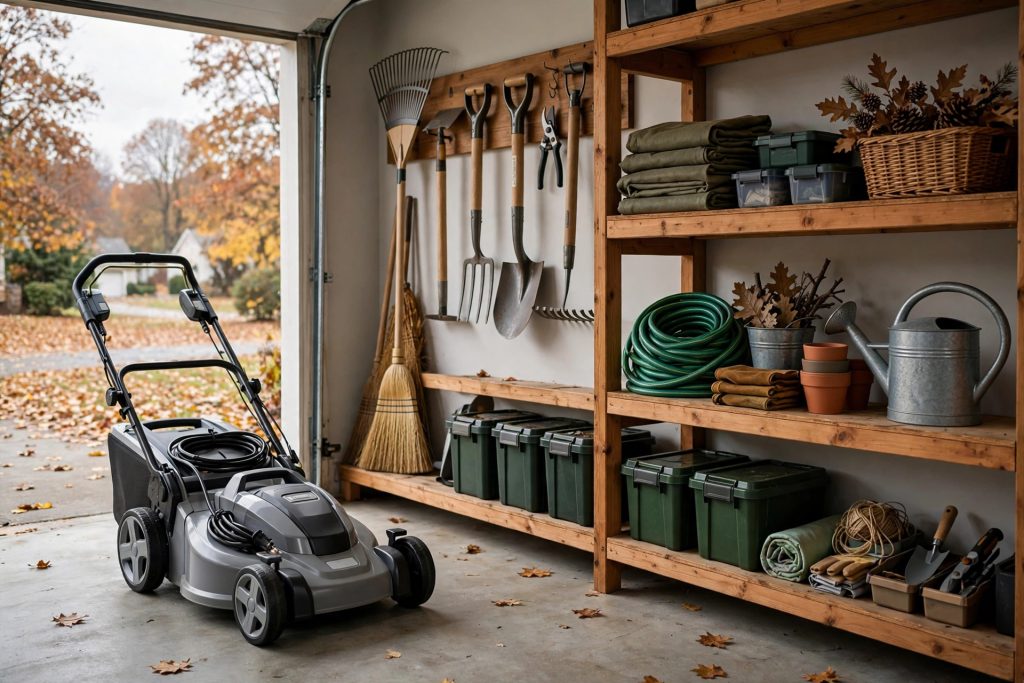
Store seed and any leftover fertilizer dry, sealed and off a damp floor. Both lose quality in a wet garage corner, and fertilizer that has clumped is hard to spread evenly.
Clean the mower before storage: brush clippings and mud from the deck, follow the maker guidance on fuel for storage, and sharpen the blade now rather than in the first busy week of spring. Clean soil off spades, rakes and hand tools, dry them, and wipe metal parts lightly with oil where the maker recommends it. Coil extension leads, check sprinkler heads for visible damage, and note any repairs on a spring list while you still remember them.
Our lawn care calendar below places this closing work in the full year plan, so the spring jobs follow on in order.
Common Winterizing Mistakes
Feeding warm season grass late. See Step 3: the last nitrogen belongs 6 to 8 weeks before the first frost.
Spreading fertilizer on frozen ground. The grass cannot take it up and melt water carries it off. Wait for next fall’s window instead of forcing a late one.
Leaving the final mow too long, or scalping it in one cut. Lower the height gradually over the last cuts, as in Step 2.
Shutting irrigation off too early in a dry fall, then never draining it. The lawn goes into winter dry, and the lines still freeze because draining was skipped in the rush.
Leaving a hose connected. It can trap ice in the faucet and split a pipe inside the wall, as covered in Step 4.
Piling shovelled snow in the same spot all winter. Deep, long lasting piles melt last, keep that patch cold and wet, and raise disease pressure there. Spread snow where you can.
Final Thoughts on How to Winterize a Lawn
To winterize well, finish in the right order and before the right deadlines. Clear the surface so nothing mats under snow, finish mowing at a sensible height, feed cool season grass once and late only where it fits, water a dry lawn before you close the system, and drain every hose and line before a hard freeze can do damage. None of these jobs is difficult on its own. Together, done while the lawn is still green and the soil is still open, they are how to winterize lawn turf so it enters winter fed, clean and protected, and starts spring from strength rather than repair.
References
- Iowa State University Extension and Outreach, Late Summer and Fall Lawn Care – Supports fall timing for feeding, aeration and leaf management for cool season lawns.
- University of Maryland Extension, Lawn Fertilizer Schedule (Table) – Supports the October to November nitrogen amounts of about 0.7 to 0.9 pound per 1,000 square feet for tall fescue and Kentucky bluegrass, and no fall nitrogen for zoysia and Bermuda.
- Utah State University Extension, How do I take care of my lawn in Utah in the fall? – Supports continuing to mow until growth stops, a shorter final mow to reduce winter disease and matting, and mulching leaves at light depths.
- University of Maryland Extension, Lawn Aeration – Supports fall as the best aeration time for cool season lawns and core plug dimensions and spacing.
- US EPA WaterSense, Watering Tips – Supports efficient watering practice and checking system output before setting runtimes.
Frequently Asked Questions
When should I winterize my lawn?
For cool season lawns, winterize in late fall after top growth stops, while the grass is still green and before the ground freezes. That is often late October to November in northern states and later in the transition zone. Drain hoses and irrigation before the first hard freeze in your area, regardless of the feeding date.
What is a winterizer fertilizer, and how much should I apply?
Winterizer is the name used for a late fall feeding, not a separate kind of nutrient. For tall fescue and Kentucky bluegrass, university schedules commonly list about 0.7 to 0.9 pound of nitrogen per 1,000 square feet for the late application. Follow the bag label and any local fertilizer dates, and never apply to frozen or snow covered ground.
How short should I cut my lawn before winter?
About 2.5 to 3 inches is a sound final height for most Kentucky bluegrass and tall fescue lawns. Lower the height gradually over the last cuts, following the one third rule. Much longer grass mats under snow and raises snow mold risk, and a hard scalp exposes crowns to cold.
Should I water my lawn before winter?
Yes, if fall has been dry. Water deeply enough to moisten the root zone before you shut the system down, while the soil is still open. A lawn that enters winter dry, especially on sandy soil, recovers more slowly in spring.
Do warm season lawns need a winterizer feeding?
No. Bermuda, zoysia, St. Augustine and centipede should receive their last nitrogen about 6 to 8 weeks before the average first frost. Late nitrogen can delay dormancy and cause winter kill. For warm season lawns, winterizing is mainly leaf clearance, avoiding traffic on dormant turf, and draining irrigation before a hard freeze.
When should I drain hoses and blow out sprinklers?
Disconnect and drain hoses by the first frost. Drain or blow out an in ground irrigation system before the first hard freeze, when temperatures stay at or below about 28 degrees Fahrenheit for several hours. In northern areas that often means October, and in the Midwest and Northeast late October to mid November.

Thesis Link : https://saulibrary.edu.bd/daatj/public/uploads/BAU200601_19-Pp_5.pdf
- How to Winterize Your Lawn Before the First Freeze - October 17, 2026
- 10 Best Cordless Hedge Trimmers - October 16, 2026
- Lawn Watering Guide: How Much, How Long, How Often - October 16, 2026