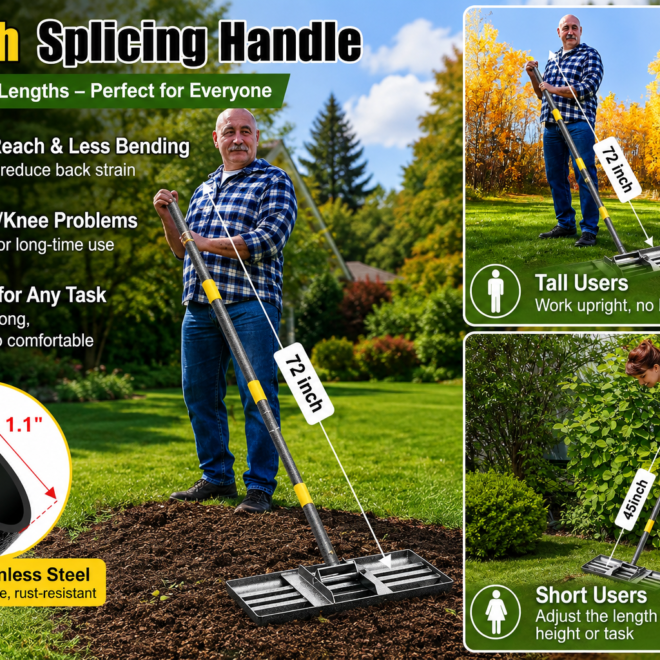
A bumpy lawn is more than an eyesore. Low spots hold water and scalp when you mow over the humps beside them, high spots dry out and thin, and every pass with the mower rattles your wrists. The tool for the job is a simple one: a wide, flat head on a long handle. You push and pull it across the surface, and it shaves material off the high spots and drops it into the low ones. The best lawn leveling rake for your yard depends on three things: how wide a head your lawn size justifies, what the head is made of, and how much weight you want doing the work for you.
We analyzed manufacturer specifications, materials and dimensions, and owner feedback across the current US market to build this list of ten. Every pick below is a real, buyable tool with a verified listing, and we have flagged the honest limitations of each one, because leveling rakes look similar in photos and behave very differently on grass.
Quick Recommendation
In a hurry? Start here.
- Best overall: Landzie Original Leveling Rake. The proven design, three head widths, useful working weight and a lifetime warranty. If you level once a year and want one tool for a decade, this is it.
- Best premium stainless: Rocklin Levelawn 48 inch. A 304 stainless steel leveling rake with a handle that shortens for storage. If your lawn is large, this is the one we would start with.
- Best value: Walensee 30 inch. Fully welded, sensibly heavy, and usually well under the big-brand prices.
- Best budget: VEVOR 30 inch. The cheapest way to find out whether leveling transforms your lawn, at under half the Landzie price.
- Best for topdressing: JouZYA Roller Leveler 30 inch. Rollers glide over fresh seed and delicate turf where a plate would drag.
The 10 Best Lawn Leveling Rakes at a Glance
| Product | Approx. price | Head width | Best lawn size | Weight | Warranty | Best for | Our rating | View Deal |
| Landzie Original | $70-$120 by size | 24 / 36 / 48 in | Any size, pick your width | 9.6 lb (36 in) | Lifetime | Most lawns, proven design | 9.4 | View Deal |
| Rocklin Levelawn | About $120 (48 in) | 48 in | Large, open lawns | About 10 lb | 360-day (per listing) | Large lawns, stainless quality | 9.3 | View Deal |
| Landzie AeroLeveler | $75-$150 | 36 in | Medium to large | 9.6 lb | Lifetime | Anti-flip control | 9.0 | View Deal |
| Dremmt Professional | About $65 | 30 in | Small to medium | 10.2 lb | Check listing | Renovation and sod prep | 8.8 | View Deal |
| Walensee 30 inch | $50-$72 | 30 in | Small to medium | 10.5 lb | Check listing | Value all-rounder | 8.7 | View Deal |
| JouZYA Roller Leveler | $60-$80 (est.) | 30 in | Small to medium | Not published | Check listing | Topdressing on delicate turf | 8.5 | View Deal |
| VEVOR 30 inch | $46-$56 | 30 in | Small to medium | 7.3 lb | 12 months | Budget first buy | 8.4 | View Deal |
| Heavy-Duty Stainless Leveler 30 inch | $54-$60 | 30 in | Small to medium | Not published | None stated | Cheap stainless alternative | 8.2 | View Deal |
| EAGWON Roller Leveler | Check listing | 30 in | Small to medium | 9.6 lb | Check listing | Roller leveling on a budget | 8.0 | View Deal |
| Walensee 17 inch | About $40 | 17 in | Spot repairs, small patches | Not published | Check listing | Spot repairs and small lawns | 7.9 | View Deal |
Prices are approximate US prices checked in October 2026 and they change often, so use View Deal for the live price. Weights are for the size reviewed where a size is named. Where a maker does not publish a weight or a warranty term, the table says so rather than guessing.
How We Chose These Leveling Rakes
A note on how we picked: we did not physically test these tools. We compared manufacturer specifications (head width and depth, plate thickness, materials, handle length, total weight), checked the listings and prices against each other, and read owner feedback for recurring patterns, the same handles loosening, the same coatings chipping, the same heads flipping. Where a specification and owner reports disagreed, we trusted the owners.
Each rake was scored out of 100 on the factors below, then converted to the 10-point ratings in the table.
| Factor | Weight | What we looked for |
|---|---|---|
| Leveling performance | 30% | Head width and flatness, working weight, whether the head flips or rides up |
| Build and materials | 25% | Stainless vs coated steel, weld quality, plate thickness, handle strength |
| Ease of use | 20% | Weight in use, handle length and grip, storage |
| Versatility | 15% | Sand, topsoil and mix work; topdressing; spot repair vs full lawns |
| Value for money | 10% | Price against materials, width and warranty |
Lawn Leveling Rake vs Lute: Is There a Difference?
Search for lawn leveling rake vs lute and you will find the same tools sold under both names, because in the modern US market they are the same tool. Lute is the older term, borrowed from golf course and British groundskeeping, for an open frame of parallel bars, usually about 10 inches deep, that is pushed and pulled to spread and consolidate material. American leveling rakes kept the same 10 inch depth but often replaced the open frame with a solid flat plate.
The tool that is genuinely different is the toothed landscape rake. Its teeth dig, tear and grade soil aggressively, which is what you want for preparing bare ground and exactly what you do not want on living turf. For leveling an established lawn, you want the smooth plate or bar frame that glides over grass, not teeth. Throughout this guide, rake and lute mean the same class of tool.
The 10 Best Lawn Leveling Rakes, Reviewed
1. Landzie Original Leveling Rake: Best for Most Lawns
Manufacturer specifications and editorial assessment
The Landzie is the rake that popularized the category for home lawns, and the specification still reads like the template everyone else copies. The head comes in 24, 36 and 48 inch widths, all about 10 inches deep, in powder-coated steel on a 72 inch handle, at roughly 9.6 lb in the middle size. That weight is the point: a leveling head needs enough heft to stay down and shave high spots instead of bouncing over them, and Landzie’s sits in the sweet spot between control and fatigue.
Owners consistently praise two things: the head stays planted, and the company stands behind the tool with a lifetime warranty, which is rare in this category and worth real money on a coated-steel tool whose finish will eventually wear. The 36 inch is the right buy for most suburban lawns; go 48 only if your lawn is large and open, and 24 if it is small or broken up by beds and paths.
Quick verdict: for most homeowners, this is the one we would start with. Proven design, sensible weight, and a lifetime warranty behind it.
Pros
- Three widths cover almost every lawn size
- Working weight keeps the head planted on bumps
- Lifetime warranty, unusually strong for the category
Cons
- Powder coating will chip over years of use and need a dry store
- Amazon pricing often runs well above the direct store price
Real-world limitation: the 48 inch head is a handful in tight or sloped yards; it bridges wide hollows beautifully and then catches on every edge and obstacle.
Best for: anyone leveling a typical lawn once or twice a year who wants the proven option.
Not ideal for: small, fiddly lawns where even the 36 inch feels wide; look at the 24 inch or the Walensee 17.
2. Rocklin Levelawn 48 Inch: Best Stainless Steel Leveling Rake
Manufacturer specifications and editorial assessment
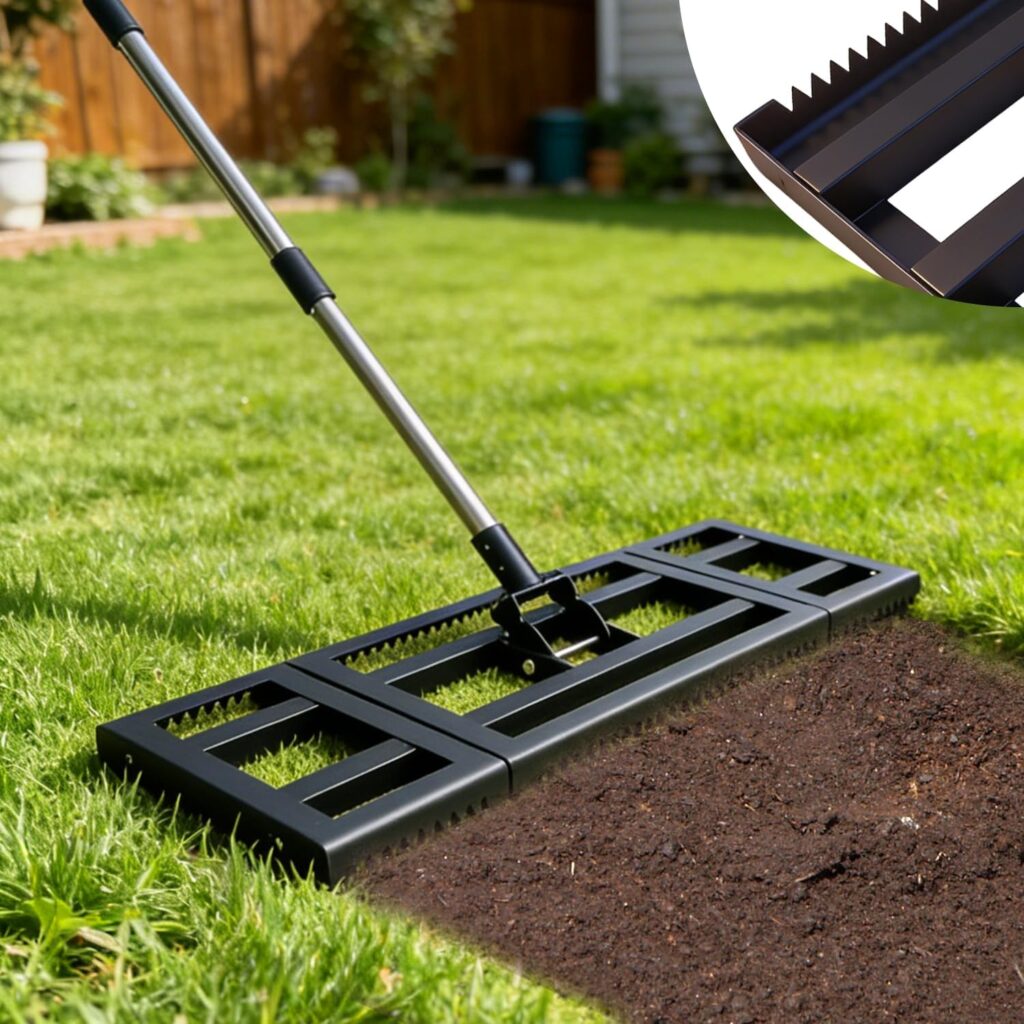
If you want a stainless steel leveling rake and you want it wide, this is the flagship. The Levelawn’s head is 48 inches of 304 stainless steel, the grade that shrugs off fertilizer, wet sand and winter storage without a coating to chip, because there is no coating. The 78 inch handle gives the longest reach in this roundup and cleverly shortens to about 50 inches, which solves the storage problem that puts people off 48 inch tools.
Stainless at this width is not light, and that mass is a feature on big, open, genuinely bumpy lawns where lighter heads ride up and skate. Rocklin has sold this design to the serious lawn community for years, and owner feedback centers on exactly what the specification promises: it stays flat, it stays down, and it does not rust.
Quick verdict: the premium pick on this page. It is heavy and it costs more, but owners buy it once and keep it for years.
Pros
- 304 stainless head: nothing to chip, nothing to rust
- 48 inch width halves the passes on large lawns
- Handle shortens to about 50 inches for storage
Cons
- The priciest pick in this roundup
- Its weight will tire smaller users on long sessions
Real-world limitation: on small or heavily landscaped lawns it is simply too much tool; you will spend more time maneuvering than leveling.
Best for: large, open lawns and owners who buy tools once.
Not ideal for: small lawns, tight spaces, or anyone who finds 10 lb of tool tiring by itself.
3. Landzie AeroLeveler 36 Inch: Best Anti-Flip Design
Manufacturer specifications and editorial assessment
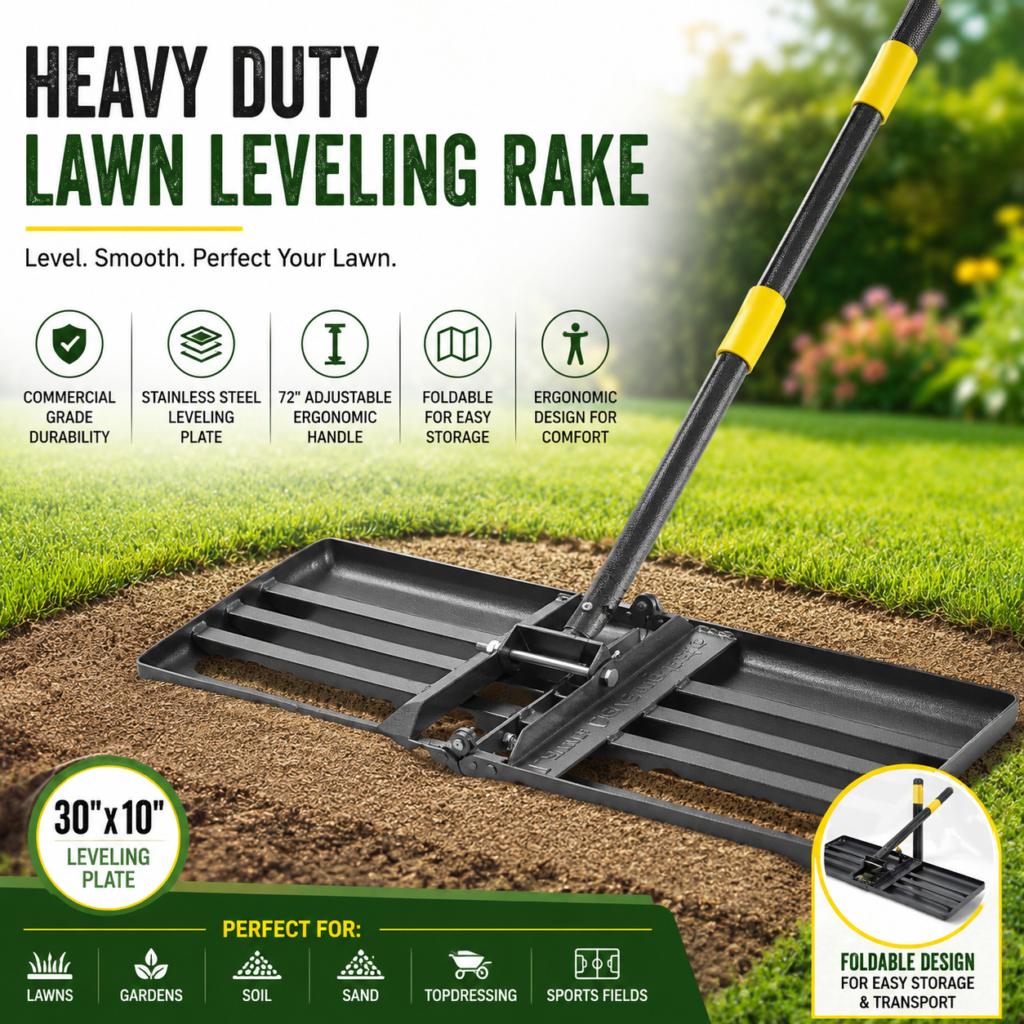
Every leveling rake owner knows the flip: the head catches, rolls, and dumps its load or digs an edge in. The AeroLeveler is Landzie’s answer, a 36 inch head fitted with a pneumatic strut that resists flipping and keeps the plate tracking flat through the push and the pull. In specification terms it is the standard Landzie package, powder-coated steel, 72 inch handle, with the strut doing quiet work on every stroke.
Owner reports say the difference is real on rougher lawns, where a plain head flips most. The trade-offs are price and one more moving part to maintain, and at the time of writing, resale listings price it well above the standard model.
Quick verdict: the control freak’s pick; if head flip is what ruined your last leveling session, this is your rake.
Pros
- Anti-flip strut keeps the head tracking flat
- Same proven Landzie sizing and warranty support
- Particularly good on rougher, bumpier turf
Cons
- Costs more than the standard Landzie, sometimes much more
- The strut is a moving part that needs occasional attention
Real-world limitation: on an already fairly flat lawn you will barely notice the strut; its value shows up on genuinely uneven ground.
Best for: bumpy lawns where standard heads flip and catch.
Not ideal for: budget buyers; the standard Landzie or VEVOR levels the same lawns for less.
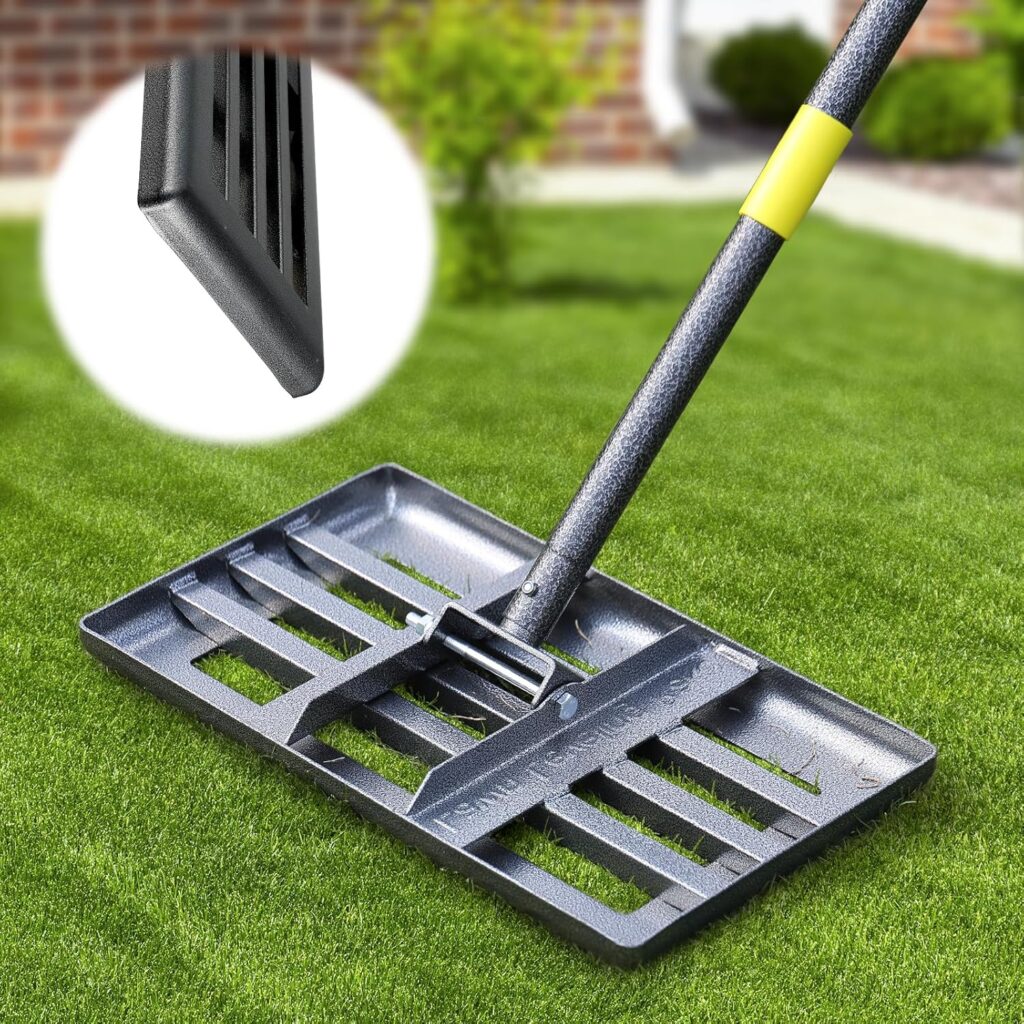
4. Dremmt Professional 30 Inch: Best for Renovation Work
Manufacturer specifications and editorial assessment
The Dremmt splits the difference between the coated budget tools and the Rocklin: a flat plate of 2 mm stainless steel, 30 inches wide, on a 72 inch handle with a slight curve and a total weight around 10.2 lb. The 2 mm plate thickness matters; cheap stainless listings quietly use plate nearer 1 mm that flexes and oil-cans under load, while 2 mm stays flat and keeps its edge.
The curved handle changes the working angle just enough that many owners find it easier on the wrists during long renovation sessions, spreading soil before seeding or knocking down high spots ahead of sod. Around the mid-sixty dollar mark it is the cheapest way into genuinely stainless construction at a sensible thickness.
Quick verdict: the renovation specialist; stainless done properly at a mid-range price.
Pros
- 2 mm stainless plate stays flat, no coating to fail
- Curved handle is kind on long sessions
- Good working weight for cutting high spots
Cons
- Only one width, 30 inches
- Less polished finish and hardware than the Rocklin
Real-world limitation: the plate’s edge is honest and sharp enough to scalp a high spot you meant to shave; work shallow passes on fragile turf.
Best for: renovation, overseeding prep and sod work.
Not ideal for: very large lawns where a 36 or 48 inch head would finish faster.
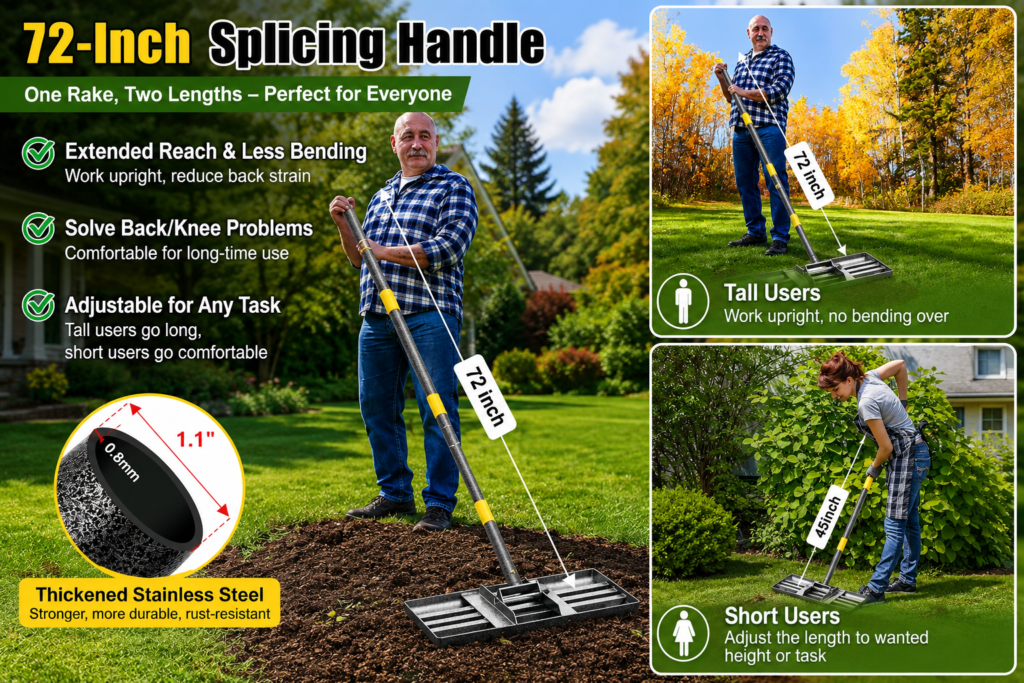
5. Walensee 30 Inch: Best Value All-Rounder
Manufacturer specifications and editorial assessment
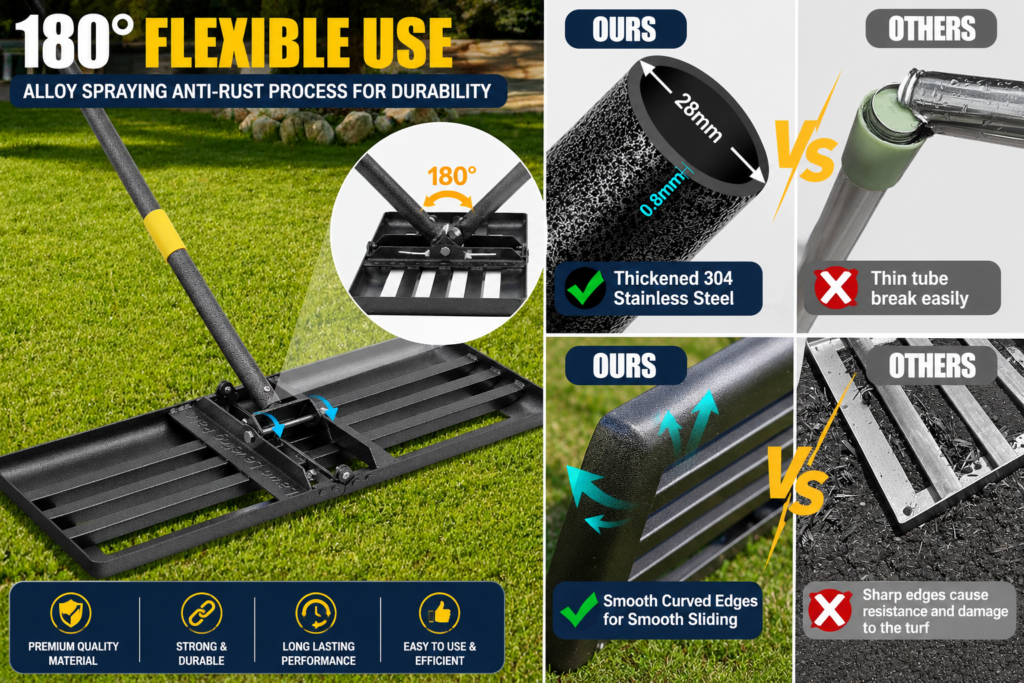
Walensee’s 30 inch is the value anchor of this category: powder-coated iron head, 30 by 10 inches, fully welded rather than bolted at the head, on a 7 ft handle, at about 10.5 lb. Fully welded matters at this price because the budget failure mode is a head that works loose on its brackets; a weld does not loosen. Street prices usually land between about 50 and 72 dollars, well under the Landzie for a tool of similar working weight.
The iron head is heavier for its size than aluminium rivals and that helps it stay down. The coating is the long-term question, as with all coated tools: chip it on a stone and that spot will rust unless it is stored dry and touched up.
Quick verdict: the most leveling per dollar on this page; buy it, store it dry, and it will serve for years.
Pros
- Fully welded head cannot work loose
- Useful 10.5 lb working weight
- Long 7 ft handle suits taller users
Cons
- Powder coat chips will rust if stored wet
- Iron head is plain and utilitarian in finish
Real-world limitation: the fixed long handle is awkward in sheds with low ceilings; measure your storage before ordering.
Best for: value hunters leveling a medium lawn once a season.
Not ideal for: coastal or very wet climates where a chipped coating rusts fast; go stainless.
6. JouZYA Roller Leveler 30 Inch: Best Rake for Topdressing
Manufacturer specifications and editorial assessment
When owners ask for the best rake for topdressing, this is the design we point to. The JouZYA replaces the plain plate with a stainless plate and rollers: the rollers let the head glide over freshly spread compost or sand and over tender new seedlings without dragging material into piles or tearing young grass. Its handle adjusts from about 27 to 80 inches, the widest range here, so it can be shortened for close work around beds and lengthened for open lawn.
The glide is the blessing and the curse. On established bumps a roller head is less aggressive than a dead-flat plate, so it takes more passes to shave a real high spot. Think of it as the finishing tool that follows the cutting tool.
Quick verdict: the topdresser’s choice; kind to seed and seedlings, gentler on severe bumps.
Pros
- Rollers glide over fresh topdressing and new seed
- Stainless plate resists rust
- Hugely adjustable handle length
Cons
- Less cutting power on hard high spots
- Rollers add parts to rinse clean after muddy work
Real-world limitation: on a lawn with serious humps it will take extra passes; pair it with a plate rake for the first cut or accept slower progress.
Best for: topdressing days, overseeding projects, and delicate or newly seeded areas.
Not ideal for: a one-tool owner facing a very bumpy lawn; a flat plate cuts faster.
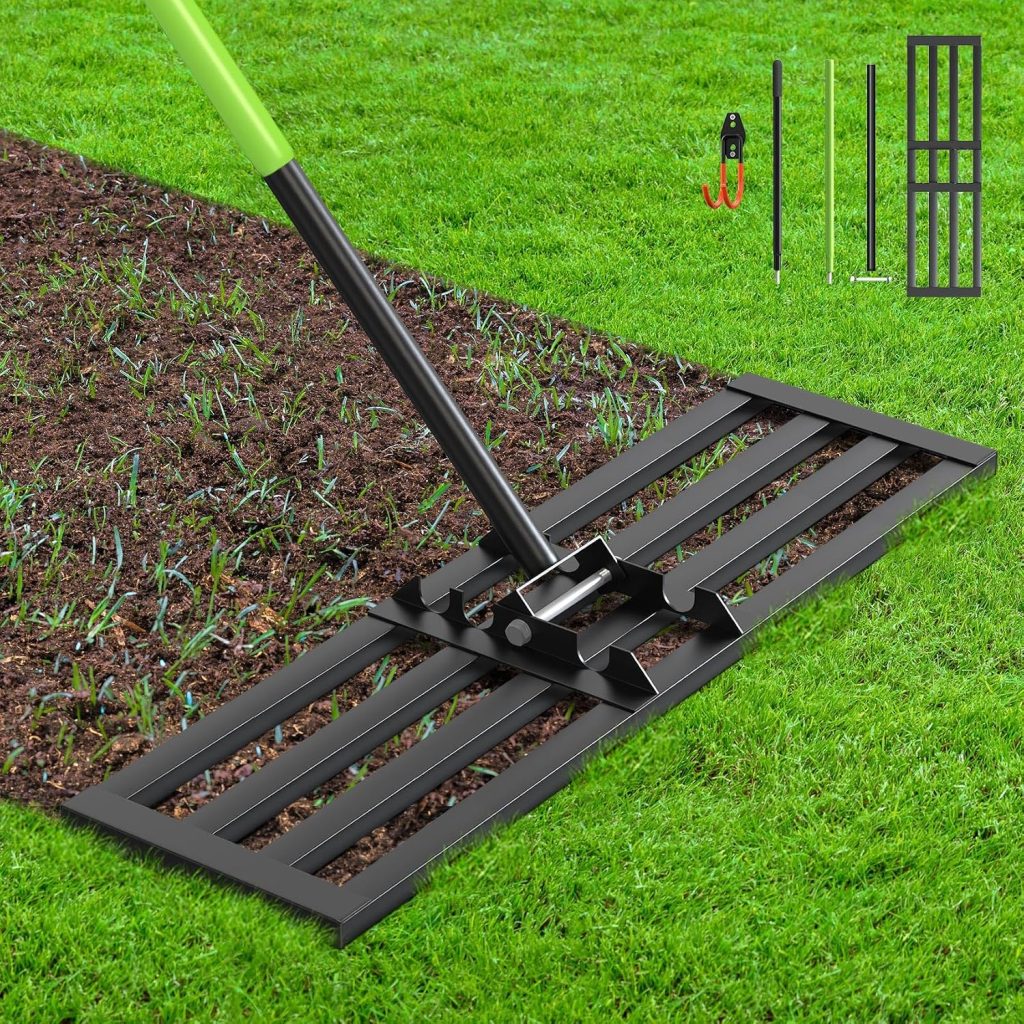
7. VEVOR 30 Inch: Best Budget Pick
Manufacturer specifications and editorial assessment
VEVOR’s 30 inch leveler is the entry ticket: Q235 steel head, 30 by 10 inches, on a 78 inch handle, and light at about 7.28 lb, typically priced in the high forties to mid fifties. Q235 is a basic structural steel, so this is a tool to store dry and treat as a consumable rather than an heirloom, but the geometry is right and that is what levels lawns.
The lighter weight cuts both ways. It is the easiest pick here to push for a full afternoon, and the easiest to skate over a stubborn bump; experienced owners add their weight through the handle or make a second pass rather than fighting it.
Quick verdict: the cheapest honest way to level a lawn; respect its limits and it punches above its price.
Pros
- Lowest price of any full-size pick here
- Long handle, light weight, easy long sessions
- Correct 30 by 10 inch geometry
Cons
- Basic Q235 steel and coating demand dry storage
- Light head rides up on hard bumps
Real-world limitation: do not expect it to survive being left out all winter; budget steel punishes neglect faster than any other pick here.
Best for: first-time levelers and small-to-medium lawns on a budget.
Not ideal for: heavy annual renovation work; step up to the Dremmt or Landzie.
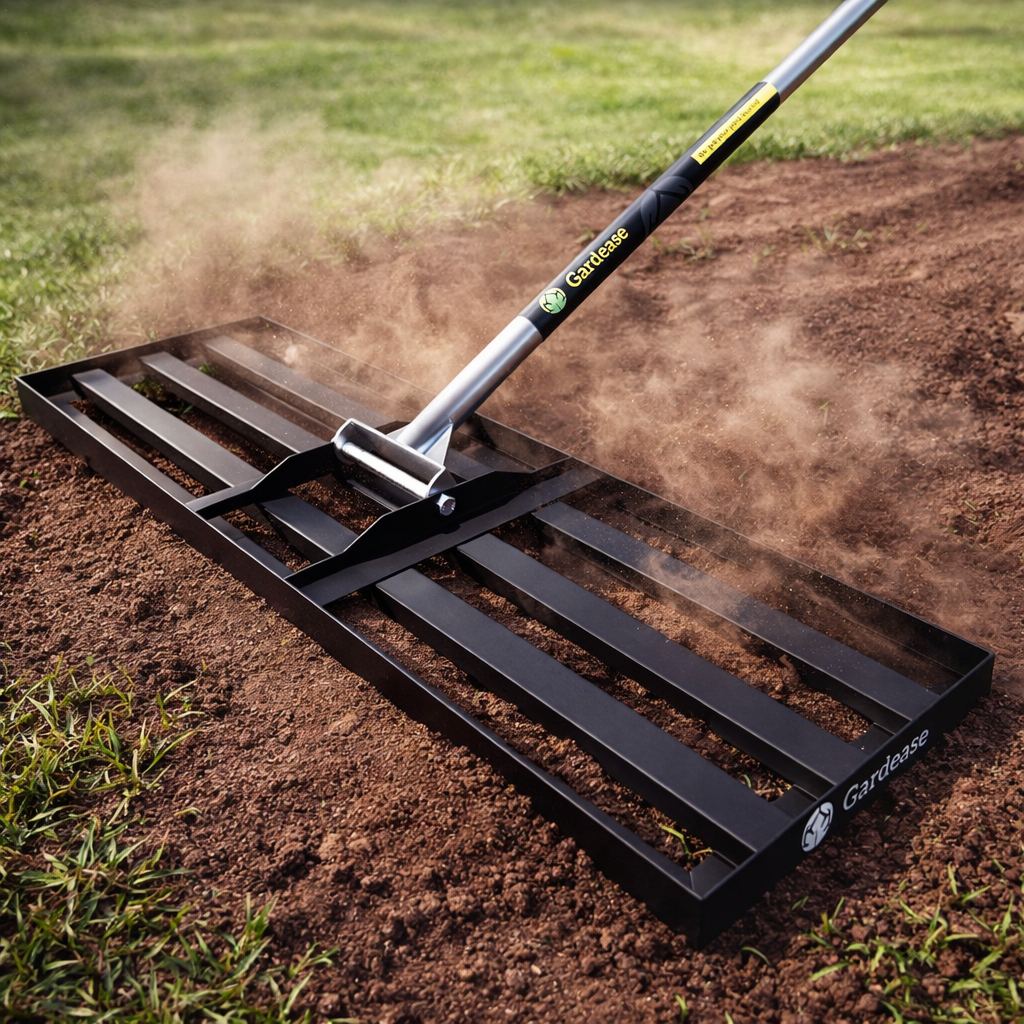
8. Heavy-Duty Stainless Leveler 30 Inch: Cheap Stainless Alternative
Manufacturer specifications and editorial assessment
This unbranded 30 inch stainless leveler, sold under rotating seller names, is the market’s answer to the Rocklin at a fraction of the price: a stainless plate head, a handle around 6 ft, and a strong owner rating across several hundred reviews. On specification alone it is the cheapest stainless on this page, usually in the mid fifties.
The honest caveats are consistency and support. Unbranded listings vary batch to batch, plate thickness is rarely stated (measure yours on arrival; under about 1.5 mm will flex), and there is no meaningful warranty channel. Buy it as a bargain with open eyes, not as a Rocklin equivalent.
Quick verdict: stainless on the cheap, with bargain-bin caveats; check the plate thickness when it arrives.
Pros
- Stainless head at a coated-steel price
- Strong aggregate owner ratings
- Sensible 30 inch all-round size
Cons
- Plate thickness unspecified and variable
- No real warranty or brand support
Real-world limitation: quality control is a lottery; a flexy unit levels nothing, so test it on concrete the day it arrives and return it if the plate bends by hand.
Best for: bargain hunters who will inspect what arrives.
Not ideal for: anyone who wants guaranteed specifications and support.
9. EAGWON Roller Leveler 30 Inch: Roller Leveling on a Budget
Manufacturer specifications and editorial assessment
The EAGWON brings the roller concept down in price: a 30 inch head with rollers that spread sand and mix without dragging, on a handle of about 6 ft. For the level-with-sand crowd it is an appealing middle path, gentler than a plate, cheaper than the JouZYA, and perfectly serviceable for spring topdressing passes.
As with the other roller design, expect glide rather than cut. The build and hardware are a step below the JouZYA’s, and the handle adjustment is less refined, but at its price the compromise is fair.
Quick verdict: the budget roller; good for sand topdressing, modest everywhere else.
Pros
- Rollers spread material without tearing turf
- Noticeably cheaper than the other roller pick
- 30 inch head suits most lawns
Cons
- Gentle action needs more passes on bumps
- Hardware and finish are basic
Real-world limitation: rollers clog with wet, clay-heavy mix; keep material dry and friable or the head becomes a rolling pin.
Best for: sand topdressing on a budget.
Not ideal for: wet soil mixes or serious bump removal.
10. Walensee 17 Inch: Best for Spot Repairs
Manufacturer specifications and editorial assessment
Not every leveling job is a whole lawn. The Walensee 17 inch pairs its big brother’s welded, powder-coated iron construction with a compact 17 by 10 inch head on a 6.5 ft handle, around the 40 dollar mark. It is the tool for the sunken sprinkler head surround, the frost-heaved strip along the drive, the dog-dug hollow: places a 30 inch head simply cannot work.
It earns its place as a second tool rather than a main one. Spot leveling with a small head takes minutes and looks surgical; trying to level a full lawn with it takes all weekend.
Quick verdict: the spot-repair specialist; buy it alongside a full-size rake, not instead of one.
Pros
- Works in spaces no full-size head can reach
- Same welded build as the 30 inch Walensee
- Ideal for filling hollows after repairs
Cons
- Hopeless for whole-lawn work
- Same coating care as its big brother
Real-world limitation: its small footprint bridges nothing; across a wide shallow dip it follows the contour instead of flattening it.
Best for: spot repairs, small lawns, and detail work around beds and heads.
Not ideal for: anyone’s only leveling rake.
How to Level a Bumpy Lawn, Step by Step
Knowing how to level bumpy lawn turns a frustrating afternoon into a satisfying one. The method matters more than the tool.
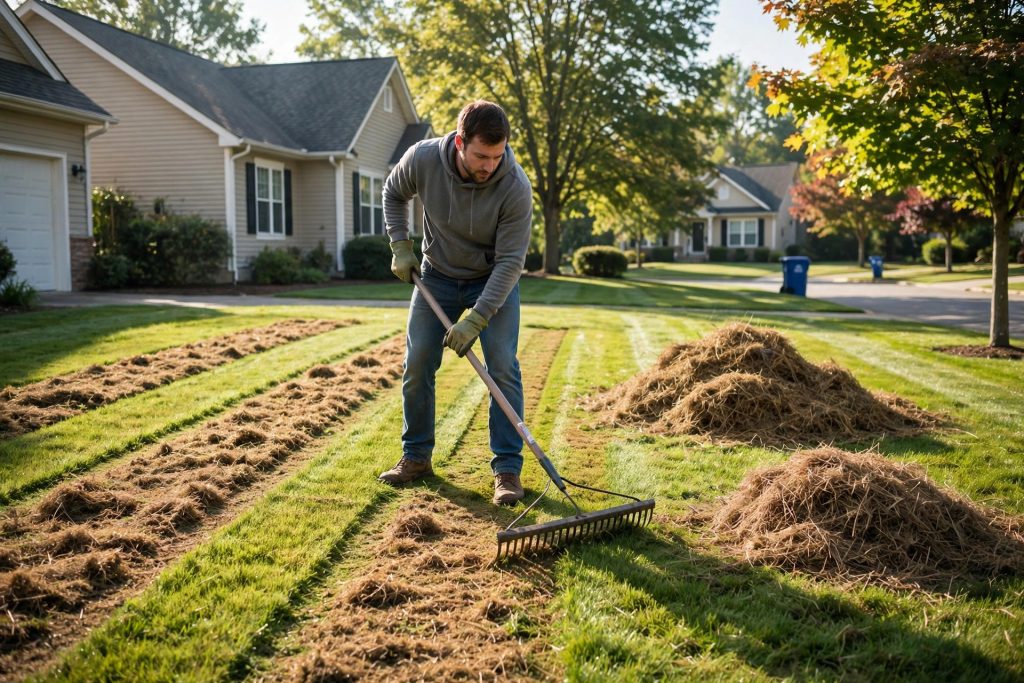
- Mow short first. Take the lawn down to about 1.5 inches so you can see the contours and the material can reach the soil. Collect the clippings.
- Work on a dry day, with dry material. Wet mix clumps, clogs rollers and smears instead of flowing into dips.
- Spread your material in piles or a rough layer over the worst areas with a shovel and wheelbarrow. For most lawns this is at most a quarter to a half inch deep per pass; grass blades must still show through.
- Work the rake in two directions. Push and pull across the area, then repeat at right angles. The head shaves highs and the excess collects in the lows; that redistribution is the whole trick.
- Mind the deep spots. A hollow deeper than about an inch or two cannot be fixed in one pass without burying the grass. Fill in stages a few weeks apart, or lift the turf, fill beneath it, and relay it.
- Water it in. A gentle soak settles the material around the crowns and shows you the true new surface. Re-check in two weeks; a second light pass finishes most lawns.
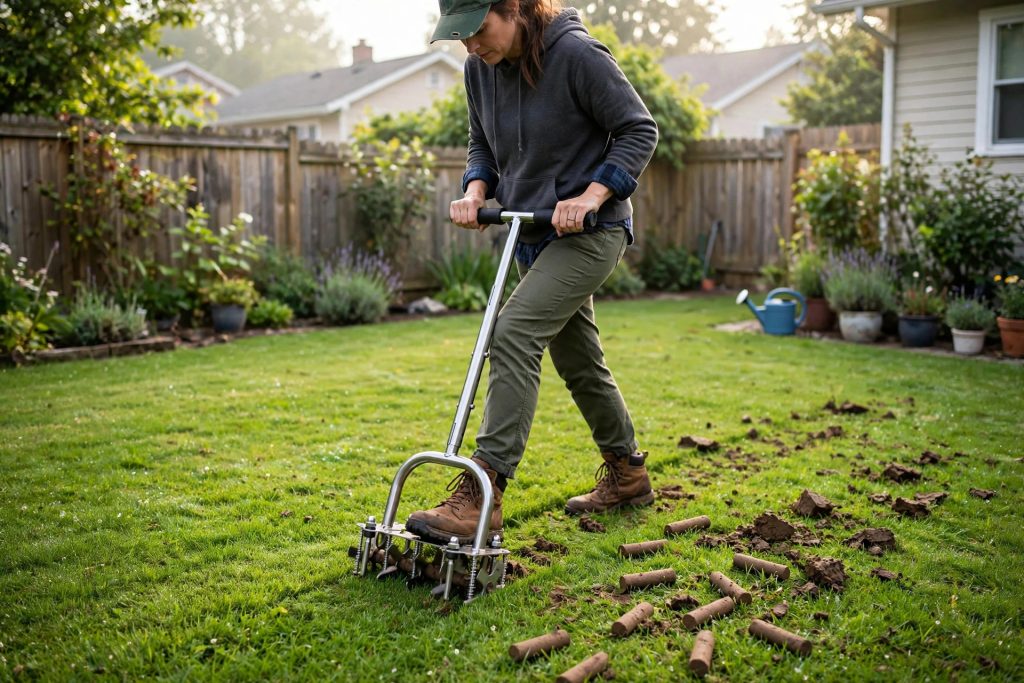
Aerating before you level helps the material settle into the soil profile.
Lawn Leveling With Sand, Soil or a Mix
Lawn leveling with sand is the warm-season standard for a reason: washed masonry sand flows into dips, does not decompose, and so the level you make in May is still there in September. Its limits are real too. Sand adds no nutrition, and on clay soil a thick pure-sand layer can form a cap that roots dislike; keep sand passes thin, a quarter to a half inch, with blades showing.
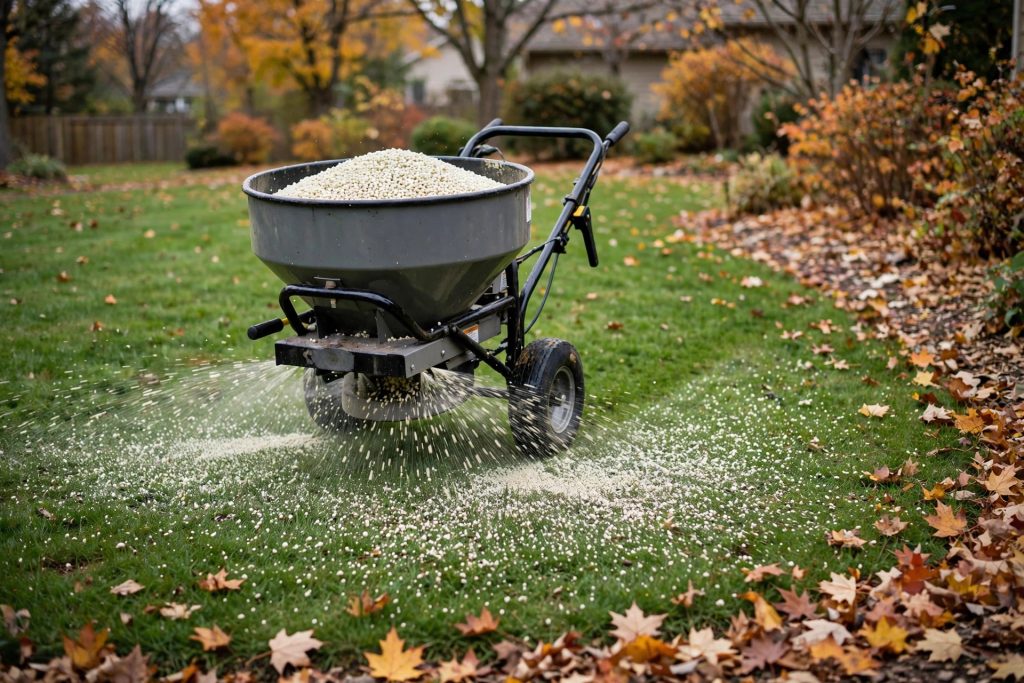
Screened topsoil or compost suits cool-season lawns better, feeding as it levels, but it settles as it decomposes, may carry weed seed, and the level softens over a season. The common compromise, and our default recommendation for most lawns, is a mix: half sand, half screened soil or compost (some turf managers use 70/30 sand to soil). You get most of sand’s permanence with some of soil’s kindness. Whatever you choose, buy washed, screened material; lumpy unscreened fill makes the rake’s job impossible.
When to Level a Lawn
Timing decides whether leveling feeds your lawn or wounds it. The rule: only level when the grass is growing actively enough to grow through the material within a couple of weeks.
- Warm-season grasses (Bermuda, Zoysia, St. Augustine): late spring through mid-summer, with peak warmth ideal. Never level heading into dormancy or near frost; the grass cannot recover and the material sits on crowns all winter.
- Cool-season grasses (Kentucky bluegrass, fescue, ryegrass): early fall is best, spring is second. Avoid summer stress, when a buried crown plus heat is a killing combination.
- Any lawn: level onto dry grass, ahead of a gentle rain if the forecast offers one, and give the lawn about two weeks of normal growth before judging the result.
Planning the work into your season is easier with a month-by-month lawn schedule.
Buying Guide: Choosing Your Leveling Rake
Head width. Seventeen inches is for spots, 24 for small lawns, 30 is the sweet spot for most homes, 36 for medium-large, and 40 to 48 only for large, open lawns. Wider bridges hollows better and halves your passes; it is also heavier per push and hopeless around obstacles.
Material. Stainless steel, especially 304, costs more, but there is no coating to chip and nothing to rust, so it is the material least likely to need replacing. Powder-coated carbon steel is stiff, usefully heavy and cheaper, but chips become rust spots, so store it dry. Aluminium is the light, rust-free option for very wide heads, but it is softer, and its lack of dead weight can let it ride up over material.
Weight. Roughly 9 to 11 lb is the working sweet spot for plate heads. Much lighter skates; much heavier exhausts.
Handle. Seventy-two inches or more keeps your back honest. Check how it stores: the Rocklin’s shortening handle and the JouZYA’s adjustable one solve real problems.
Welds and plate. Fully welded heads cannot work loose. On stainless, plate around 2 mm stays flat; mystery-thin plate flexes, so verify on arrival if the listing stayed silent.
Final Choice
For most readers the decision is simple. Buy the Landzie Original in 36 inch if you want the proven tool with a lifetime warranty behind it. Buy the Rocklin Levelawn if your lawn is large and your budget stretches to it. Buy the Walensee 30 inch if value rules, the VEVOR if you are testing the waters, and add the Walensee 17 inch when spot repairs keep appearing on your list. Whichever you choose, level in active growth, work dry, and keep passes thin; the lawn will do the rest.
Frequently Asked Questions
What is the best lawn leveling rake for a typical home lawn?
For most homes, a 30 to 36 inch plate rake around 10 lb, like the Landzie Original 36 or the Walensee 30, balances coverage, control and effort. Go wider only for large open lawns, and narrower for spot work.
Is a leveling rake the same as a lute?
Yes, in the modern US market the two names describe the same tool: a wide, flat, smooth head for spreading material over turf. The genuinely different tool is the toothed landscape rake, which digs and is wrong for established grass.
Can I level my lawn with just sand?
Yes, and for warm-season lawns washed sand is the standard choice. Keep each pass to a quarter to a half inch with grass blades showing, and for deep hollows build up in stages or lift the turf and fill beneath it.
When is the best time to level a lawn?
Only during active growth: late spring to mid-summer for warm-season grasses, early fall (then spring) for cool-season grasses. Avoid dormancy, frost risk and summer stress.
How deep can I fill a low spot in one pass?
About a quarter to a half inch over living grass. Deeper fills smother the crown; stage them a few weeks apart or lift, fill and relay the turf for anything beyond an inch or two.
Stainless steel or powder-coated steel: which lasts longer?
Stainless, by a wide margin, because there is no coating to chip and 304 stainless does not rust in normal garden conditions. Coated steel lasts for years too if it is stored dry and chips are touched up.
References
- University of Georgia Extension, Lawns in Georgia: Establishment
- Clemson Cooperative Extension (HGIC), Topdressing a Home Lawn
- LSU AgCenter, Topdressing Turfgrass Sod
- Manufacturer specification pages for Landzie, Rocklin (Levelawn), Walensee, VEVOR, Dremmt and JouZYA leveling rakes.

Thesis Link : https://saulibrary.edu.bd/daatj/public/uploads/BAU200601_19-Pp_5.pdf
- 10 Best Lawn Leveling Rakes - October 11, 2026
- Lawn Soil pH: How to Test It and Fix It - October 10, 2026
- Best Garden Hose No Kink – 10 Picks That Stay Flexible - October 10, 2026