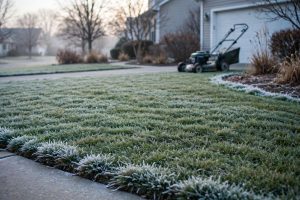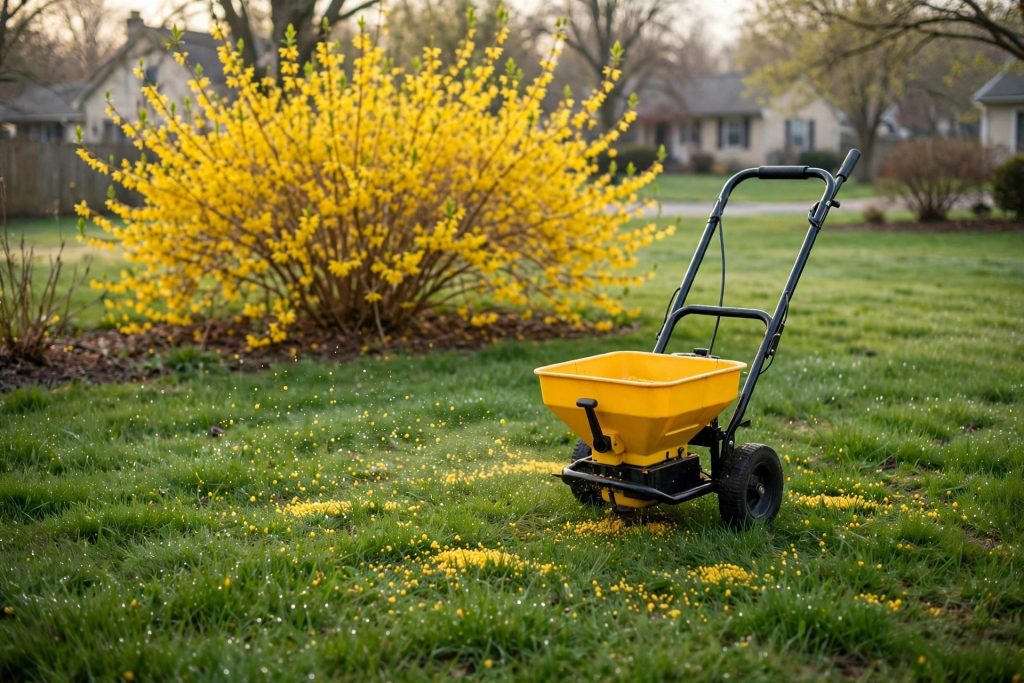

Every spring, the same lawn on the same street gets two very different results. One homeowner puts down a crabgrass preventer on a warm weekend in February because the hardware store display is up. The other waits, checks the soil, and applies three weeks later. By July, the second lawn is mostly clean and the first one is full of crabgrass along the driveway. The product was not the difference. The timing was.
Knowing when to apply pre emergent is the whole job. A pre-emergent herbicide does not kill weeds you can see. It stops weed seeds as they germinate, and seeds germinate on soil temperature, not on the date printed on a store poster. This guide gives you the exact soil temperature windows for spring and fall, how to read them at home, which active ingredient fits your situation, a step by step application method, and the one planning conflict that catches more homeowners than any other: pre-emergent and grass seed do not mix.
Quick Checklist: Is It Time to Apply?
Work through this short checklist before you open a bag or fill a sprayer. If you can tick every line, you are in the window.
- Soil temperature at 1 to 2 inches deep has reached 50 to 55 degrees F for 3 to 5 days in a row in spring, and crabgrass has not germinated yet.
- For a fall application, soil temperature is falling toward 70 degrees F and winter annual weeds have not sprouted yet.
- You are not planning to sow grass seed in the treated area during the waiting interval printed on the product label.
- The lawn is established and not drought stressed, and you have finished any aerating or dethatching first, because that work must happen before the barrier goes down.
- Rain or irrigation of about 1/2 inch is expected, or you can water the product in yourself within the window the label allows.
- You have measured your lawn area and checked the label rate for your grass type, so you apply the right amount once instead of guessing.
If one line fails, fix that line first. Applying on the wrong day wastes the product and still leaves you hand pulling weeds in July.
What a Pre-Emergent Herbicide Actually Does
A pre-emergent herbicide forms a thin treated layer in the top layer of soil, right where weed seeds sit. When a seed germinates and its first root tip grows into that layer, the herbicide stops cell division in the root tip. The seedling never establishes, and it dies before it ever breaks the surface. University extension programs describe this the same way: the product prevents germinated seedlings from growing, it does not poison mature plants.
Three practical facts follow from how it works.
First, it only works before emergence. Once crabgrass, spurge or annual bluegrass is up and growing, a standard pre-emergent will not control it. You would need a post-emergent product labeled for that weed instead.
Second, established turf is not harmed because its roots and growing points sit below and beyond that shallow treated layer. That is why labels limit these products to established lawns and warn against use on newly seeded or newly sodded areas until the turf has settled in.
Third, the barrier breaks down over time. Soil microbes, sunlight on unwatered granules, and warm wet weather all shorten its life. Most home lawn products protect for roughly 2 to 4 months depending on the active ingredient, the rate, and conditions, and Purdue Extension notes that spring crabgrass preventers generally last in the soil about 60 to 120 days. That breakdown clock is exactly why applying far too early fails: the barrier can fade before the main flush of seeds germinates.
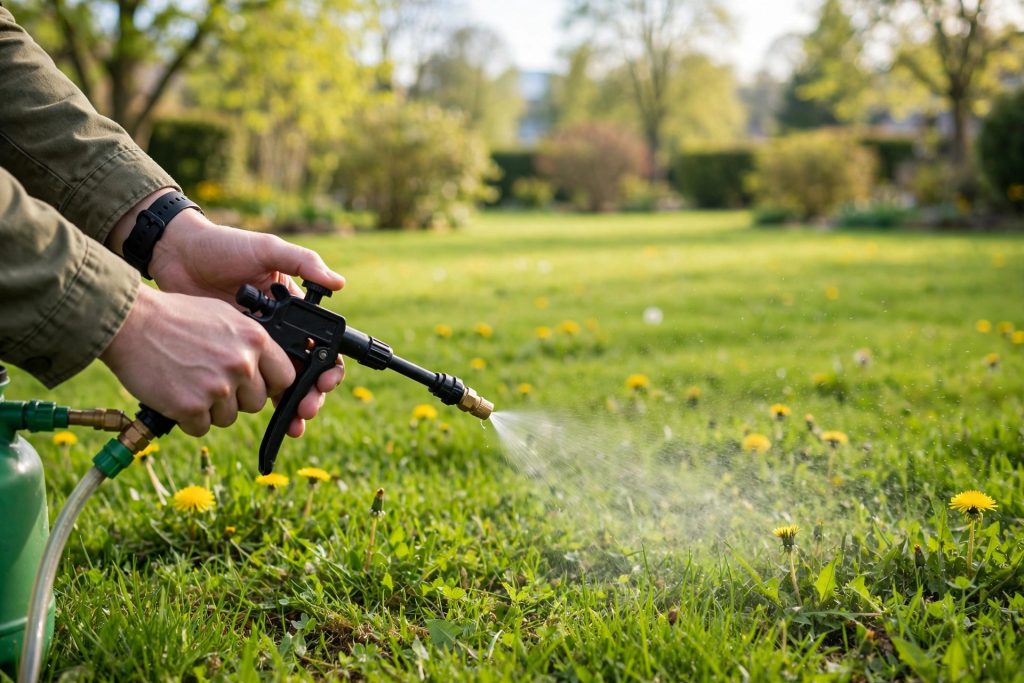
For the weeds a pre-emergent cannot reach, and for weeds already growing, a selective post-emergent program is the other half of lawn weed control:
When to Apply Pre Emergent in Spring: Follow Soil Temperature, Not the Calendar
Crabgrass is the main spring target, along with goosegrass, foxtail and summer annual broadleaf weeds such as spurge. Crabgrass seed starts to germinate when soil temperatures hold around 55 degrees F for several days. NC State Extension puts the trigger at a 24 hour mean soil temperature averaging about 53 to 55 degrees F for several consecutive days, and the University of Missouri Extension advises that the product is most effective when the mean soil temperature at 1 inch deep reaches 50 to 55 degrees F for five days in a row.
That gives you a clear working rule: apply when soil at 1 to 2 inches deep is consistently 50 to 55 degrees F and rising, and get it watered in before soil passes 60 degrees F, because germination is starting by then.
| Soil signal at 1 to 2 inches deep | What it means | What to do |
|---|---|---|
| Below 45 degrees F for days | Too early for most lawns; barrier breakdown clock starts before seeds move | Wait, unless your extension service advises an early split program for your area |
| 50 to 55 degrees F for 3 to 5 days | The application window is open | Apply now and water in |
| 55 to 60 degrees F and rising | First crabgrass seeds are germinating | Apply immediately; consider dithiopyr, which has limited early post-emergent activity on very young crabgrass |
| Above 60 degrees F for several days | Germination is under way | A standard pre-emergent is late for the first flush; use it for later germinating weeds and plan post-emergent spot treatment for what emerges |
How to check soil temperature at home
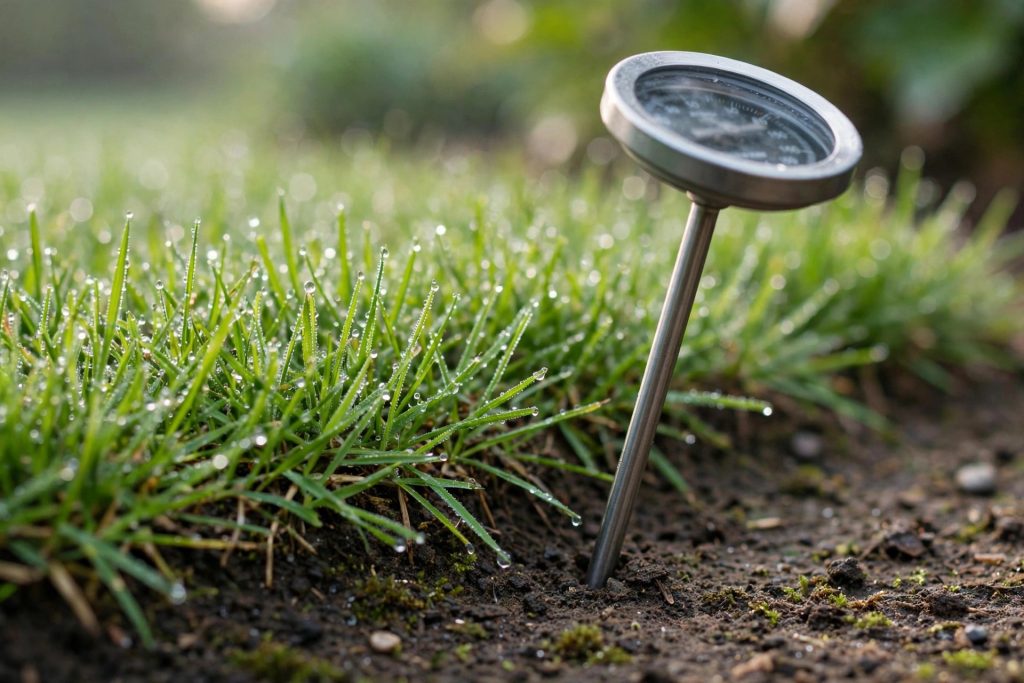
Push a soil thermometer or a simple probe thermometer 1 to 2 inches into the soil in a typical sunny part of the lawn, and read it in the morning on three to five mornings in a row. Bare or thin spots along pavement warm faster than dense shaded turf, so check an average area, not the hottest edge by the sidewalk. If you do not own a thermometer, most state extension services and regional turf programs publish daily soil temperature maps, and forsythia in full bloom in your neighborhood is the traditional visual cue that the window is near. Treat the bloom as a prompt to start measuring, not as the measurement itself, because flowering and soil warming do not line up perfectly every year.
Why the calendar date misleads you
In the Southeast, the 50 to 55 degree window can arrive in late February. In the upper Midwest and New England, it may not arrive until late April or early May. NC State has documented crabgrass germinating in February in warm recent years, which is why its specialists have moved their guidance earlier than the old mid March rule of thumb. A fixed date from a national article will be too late in Georgia and too early in Minnesota in the same spring. Soil temperature is the only signal that adjusts itself to your yard and your year.
A worked example: timing one lawn
Take a tall fescue lawn in the Transition Zone in an average spring. On March 10 the morning readings sit at 48 degrees F: too early, and a barrier laid now starts breaking down before crabgrass moves. By March 17 the same lawn reads 52 degrees F four mornings in a row and the forsythia on the street is in full bloom, the traditional prompt to measure. That is the window: the application goes down that weekend, gets watered in with a half inch of irrigation, and the date goes in the lawn notebook. With prodiamine at its lowest label rate, the label’s four month interval makes mid July the earliest seeding date, which changes nothing because this lawn’s overseeding is planned for late August anyway. One measurement habit, one label check, and the whole year is planned without a single calendar guess.
When to Apply Pre Emergent in Fall: The 70-Degree Rule
The fall application targets a different set of weeds: winter annuals that germinate in cool fall soil, grow slowly through winter, and explode in spring. Annual bluegrass (Poa annua), henbit and chickweed are the common ones. These seeds germinate as soil temperatures fall through about 70 degrees F.
The fall rule mirrors the spring rule in reverse. Apply when soil temperature is dropping toward 70 degrees F and holding there, late summer to early fall in most regions, while the soil is still warm enough that the weeds are about to germinate but have not sprouted yet. Apply too early in hot August soil and the barrier fades before the last winter annuals germinate. Apply after they are up and you are back to post-emergent control.
One warning belongs here: if you overseed cool season grass in fall, a fall pre-emergent will block your new seed along with the weed seed. Most tall fescue and bluegrass lawns should choose fall seeding, skip the fall pre-emergent, and let the seeding section below plan the year.
Spring and Fall Windows by Region
Use these windows only as a starting point for when to start measuring soil temperature. Your thermometer reading overrules every row in this table.
| Region | Spring window to start checking | Typical spring application | Fall window for winter annuals |
|---|---|---|---|
| Deep South and Gulf Coast | Late January to February | February to early March | September, as soil falls to 70 degrees F |
| Southeast and Carolinas | February to early March | Late February to mid March | Mid September to early October |
| Transition Zone (Virginia, Kentucky, Missouri, Kansas) | Early to mid March | Mid March to early April | September |
| Midwest and Great Lakes | Late March to April | April to early May | Late August to September, if not seeding |
| Northeast and New England | April | Mid April to early May | Late August to September, if not seeding |
| Pacific Northwest | March | Late March to April | September |
| Mountain West and high elevations | April to May | Late April to May | August to early September, if not seeding |
Warm season lawns (Bermuda, zoysia, St. Augustine, centipede) follow the same soil temperature triggers. The difference is that these grasses are dormant or just greening up during the spring window, so the pre-emergent is doing its work before the turf wakes up, which is exactly when crabgrass would otherwise take the open space.
Choosing an Active Ingredient
Home lawn pre-emergents are built on a small set of active ingredients. The right choice depends on your timing, how long you need the barrier to last, and whether seeding is anywhere in your plan. Read the active ingredient line on the front or back of the bag, not just the brand name, because the same brand sells several different actives.
| Active ingredient | Typical barrier life | Best fit | Seeding note |
|---|---|---|---|
| Prodiamine | Longest of the common options, often 3 months or more at label rates | Early single spring application; split programs | Rate based wait before seeding: 4 months at the lowest label rate, up to 12 months at high rates in the South |
| Dithiopyr | About 2 to 3 months | Slightly late spring applications; it can stop very young crabgrass just after germination, before tillering | Wait 3 months before seeding after one application; 4 months after a sequential program |
| Pendimethalin | About 2 months at typical home rates | Standard lawns where a second or split application is planned | Wait 4 months before seeding (Scotts Halts label); water in promptly because sunlight breaks it down on the surface |
| Mesotrione | Short, about 3 to 4 weeks of prevention | Seeding years; labeled for use at seeding time on listed cool season grasses | Can be applied at seeding on the grass species named on the label |
| Siduron | Short to moderate | New seedings where a preventer is needed at planting | The traditional exception labeled for use with new seedings; follow its narrower weed list |
Two honest cautions. First, barrier life numbers vary with rate, soil and weather, so treat the table as a guide and the label as the law. Second, corn gluten meal is sold as a natural pre-emergent. Extension trials find its control inconsistent and much weaker than the synthetic actives in most years, and it also blocks grass seed. Choose it with realistic expectations if you prefer an organic program. Iowa State Extension’s research rate is 20 lb per 1,000 sq ft, applied 3 to 5 weeks before crabgrass germination, and seed sown within about 4 to 6 weeks of an application can also fail.
Split applications: when one pass is not enough
A split application puts down part of the seasonal program first, then the rest about 6 to 8 weeks later, staying within the label maximum for the year. Missouri Extension notes that splitting the recommended amount at 30 to 45 day intervals gives longer lasting results than a single full dose. Splits make sense in long spring seasons in the South, in lawns with a heavy crabgrass history, and where an early application was necessary and you need the barrier to still be alive in June. In short northern seasons, one well timed application is usually enough.
How to Apply Pre-Emergent Step by Step
Good timing fails if the application is uneven. A missed strip becomes a crabgrass strip, and a double dosed strip wastes product and can stress turf. These four steps keep coverage even from the first pass to the last.
Step 1: Confirm the window and read the label end to end
Check your three to five morning soil readings against the windows above. Then read the whole label of the product in your hand: the grass species it allows, the rate for your lawn, the waiting interval before seeding, the watering in requirement, and the protective equipment it specifies. Rates differ between products with the same active ingredient, so never carry a rate over from last year’s different bag.
Step 2: Prepare the lawn before the barrier goes down
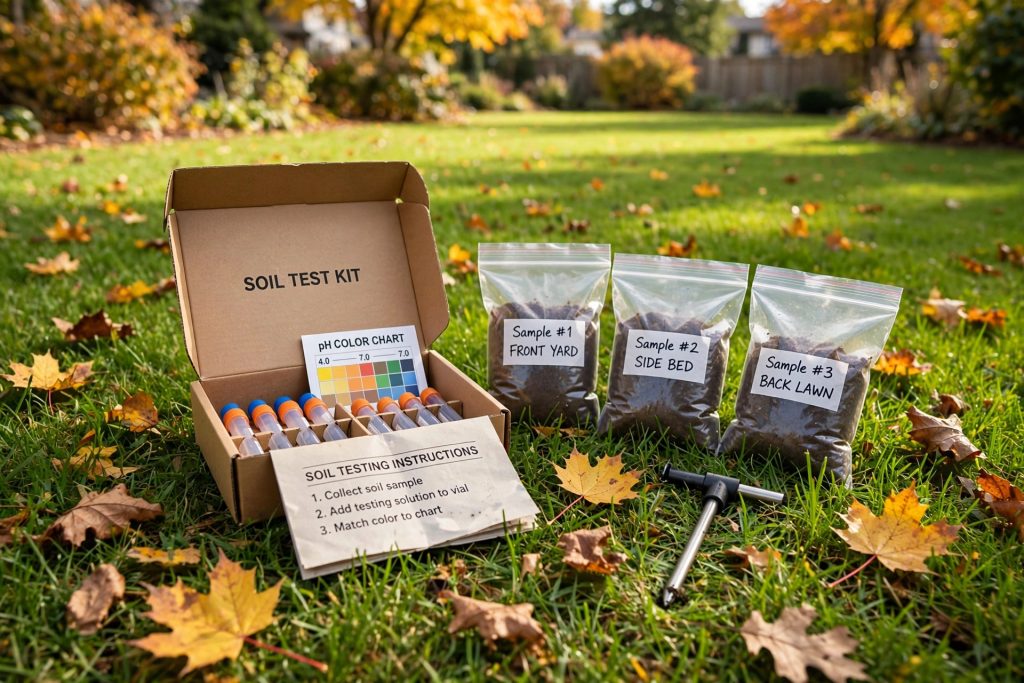
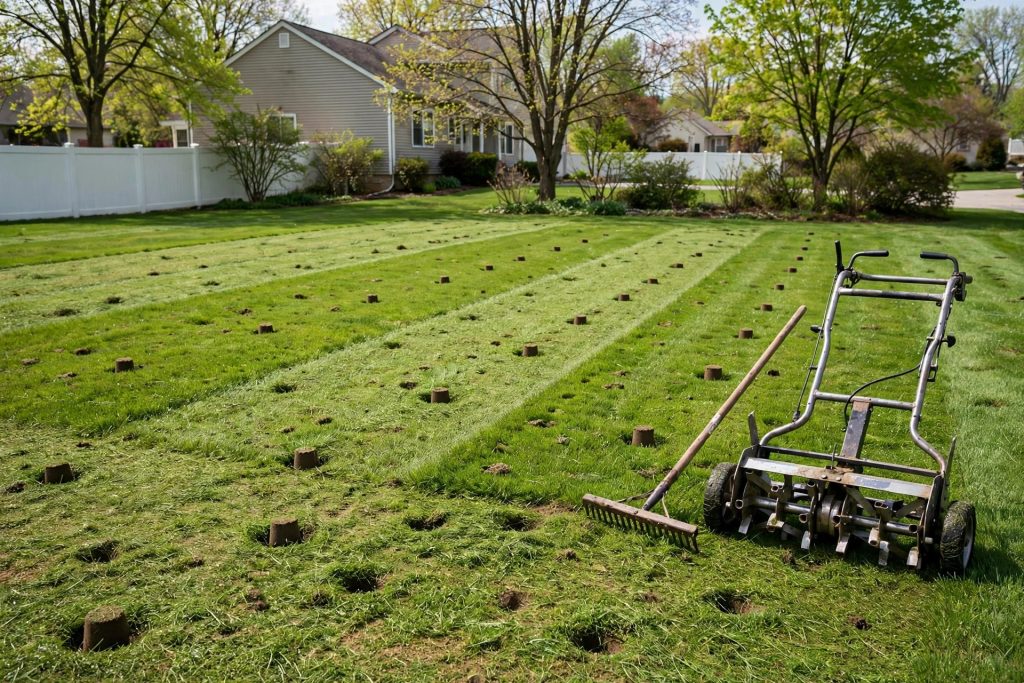
Mow at your normal height so granules fall through to the soil instead of sitting on leaf blades. Do any core aerating or dethatching now, before application, because breaking the soil after the barrier is set breaks the barrier itself in those spots. If your soil test is overdue, take samples before you apply as well, and correct pH in the season your test recommends. A dense, correctly fed lawn is the long term weed control; the herbicide only guards the gaps while you build that density.
Step 3: Measure, calibrate and apply in two half rate passes
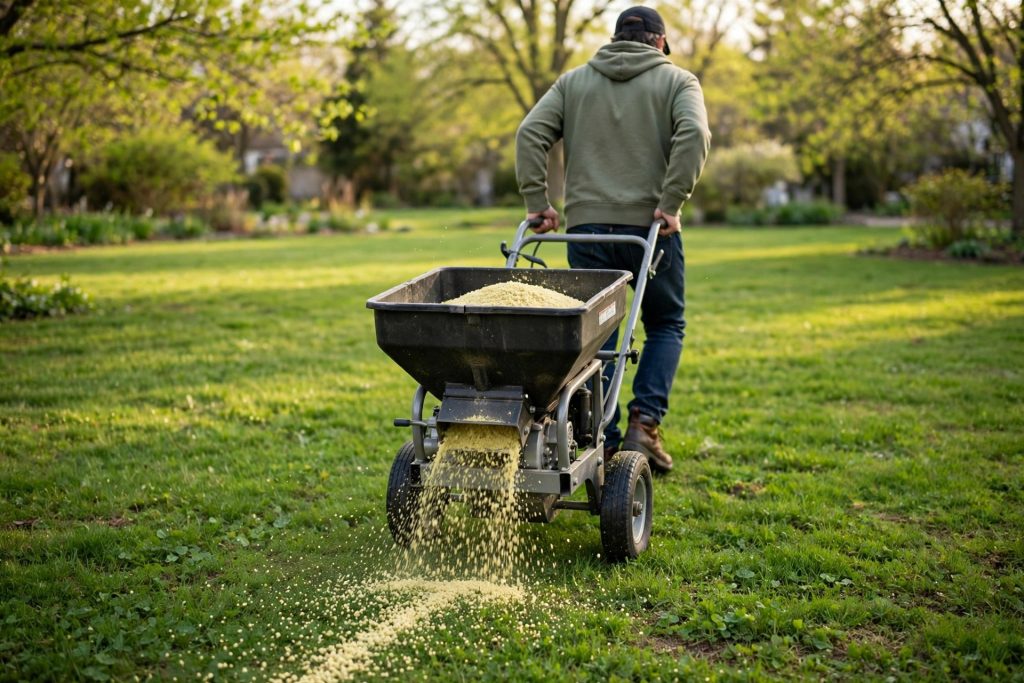
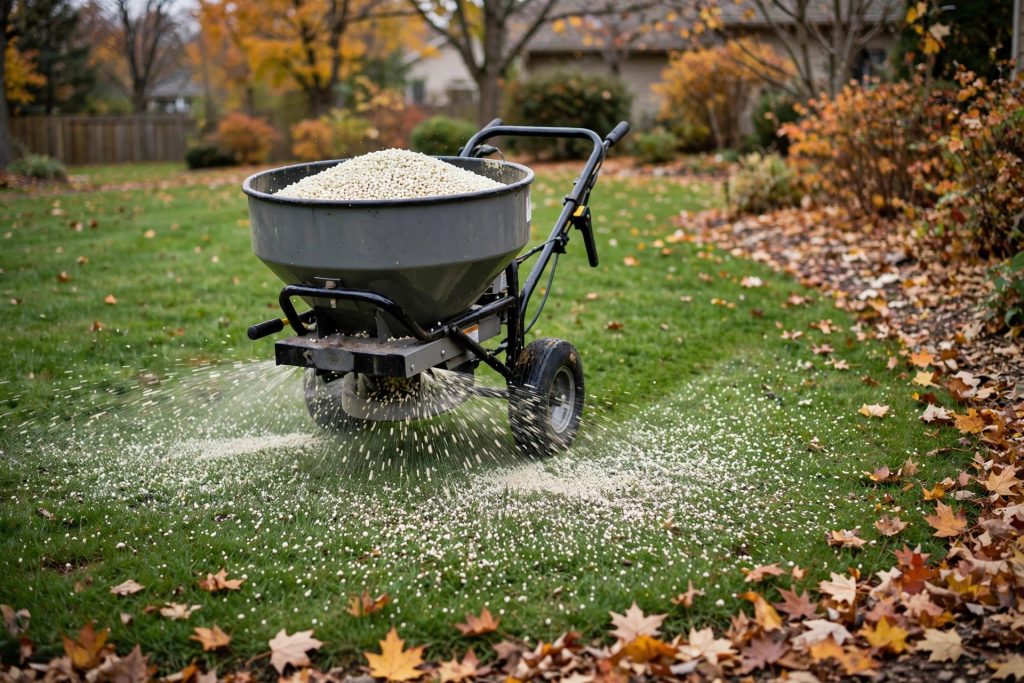
Measure your lawn area in square feet, subtracting beds, paths and driveways, and work out how much product the label rate requires for that area. Set your broadcast spreader to the label setting as a starting point, then apply in two passes at half rate, the second pass at a right angle to the first. Two half passes forgive small pace and overlap errors that a single full rate pass prints straight into the lawn. Walk at a steady speed, shut the hopper at turns and at the lawn edge, and keep granular product off driveways and walks. Sweep any stray granules from hard surfaces back onto the lawn, because granules left on pavement wash into storm drains instead of forming your barrier.
For liquid products, calibrate your sprayer output over a measured area with plain water first, mix exactly to the label concentration, and spray on a calm day to avoid drift onto beds and garden plants.
Step 4: Water it in, then protect the barrier
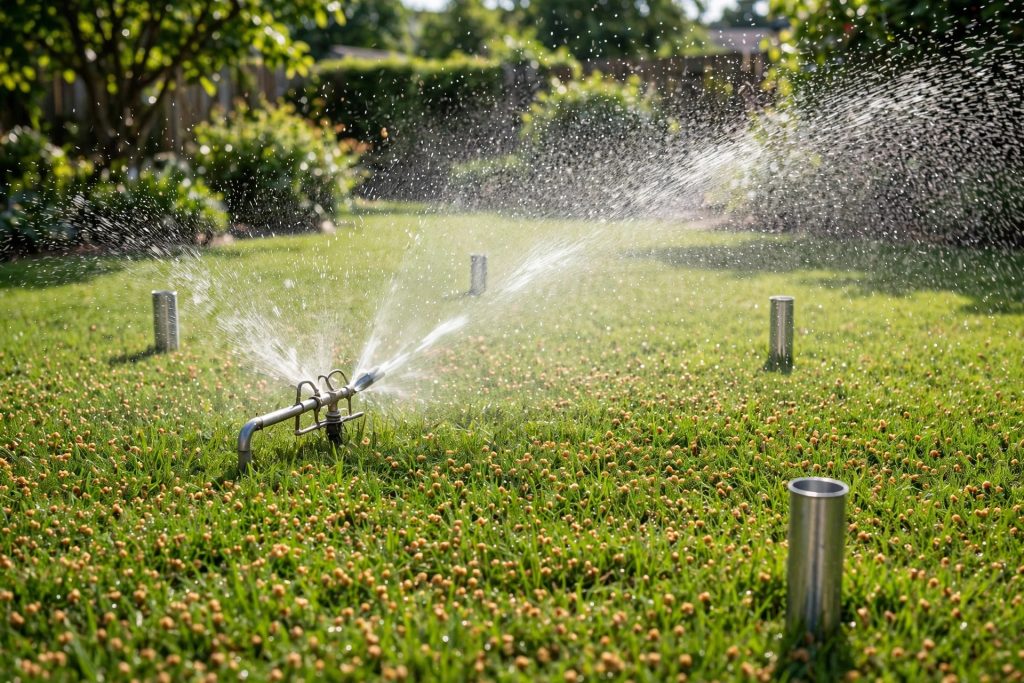
A pre-emergent only works once it is washed off the leaf blades and into the top layer of soil. EPA registered labels for prodiamine products state that the most effective control comes when the product is activated by at least 1/2 inch of rainfall or irrigation before weed seed germination and within the days after application that the label specifies. If rain is not forecast inside that window, run your sprinklers and put down about 1/2 inch yourself, measured with a few straight sided cans set out on the lawn. After watering in, stay off heavy soil disturbance: no aerating, no aggressive raking and no digging in treated areas until the barrier’s job is done. Note the date, product and rate in your lawn records, along with the earliest seeding date the label allows. That one line in a notebook prevents the most expensive mistake in the next section.
The Seeding Conflict: Pre-Emergent and Overseeding
This is the trade off that decides many lawn calendars. A standard pre-emergent cannot tell crabgrass seed from fescue seed. Both are germinating grass seeds growing into the same treated layer, so both are stopped. If you apply a spring pre-emergent and then overseed in spring, the seed will largely fail, and homeowners often blame the seed.
Label seeding intervals at a glance
Every figure below comes from the product label or, for corn gluten meal, university extension guidance. Your bag’s label at your rate is the final word.
| Active ingredient | Example product | Wait before overseeding (per label) |
|---|---|---|
| Prodiamine | Barricade | 4 months at the lowest label rate; 6 to 12 months at higher rates, longest in the South |
| Dithiopyr | Dimension | 3 months after one application; 4 months after a sequential program |
| Pendimethalin | Scotts Halts | 4 months before seeding or sodding; 5 months before sprigging |
| Isoxaben | Gallery | 60 days (broadleaf weeds only; no crabgrass control) |
| Mesotrione | Tenacity | None; may be applied at seeding, except on fine fescue |
| Siduron | Tupersan | None; labeled for use at the time of seeding |
| Corn gluten meal | (various) | About 4 to 6 weeks (extension guidance, not a label) |
One warning on a number you will see quoted online: the 60 day figure attached to prodiamine is the wait AFTER overseeding before you may apply it (60 days or the second mowing, whichever is longer), not the wait before seeding. Mixing the two up ruins a seeding.
Plan the year around the label interval instead:
- Spring pre-emergent plus fall overseeding is the standard cool season plan. A spring application in March or April has usually broken down well before the late August to September seeding window, which is one reason fall is the best overseeding season.
- Typical label intervals: pendimethalin products ask for 4 months before seeding, dithiopyr 3 to 4 months, and prodiamine 4 months at the lowest rate rising to 12 months at high southern rates. The chart above has the full label picture; write your own earliest seeding date down on application day.
- If you must seed in spring, skip the standard pre-emergent on the seeded area and use mesotrione or siduron products labeled for use at seeding on your grass type, accepting their shorter protection, or accept some crabgrass and control it after the new grass is established and has been mowed several times.
- For small bare spots in a treated lawn, you can rake through the treated soil in that spot to break the barrier locally, add a thin layer of fresh topsoil, and spot seed. Expect weaker weed protection in just that patch.
- Warm season lawns seeded or sprigged in late spring face the same rule: seed first on the label’s schedule for new plantings, not on top of a fresh spring barrier.
Mistakes That Break the Barrier
Most pre-emergent failures trace back to one of these five errors, and none of them is the product’s fault.
Applying by the calendar in an unusual year. A warm February or a cold April moves germination by weeks; measure the soil, not the date, as the spring section above explains.
Applying after germination. Once crabgrass has emerged and tillered, a standard preventer does nothing for those plants. Dithiopyr can catch crabgrass only while it is very young. After that, you need a post-emergent labeled for crabgrass, applied while the weed is still small.
Skipping the water in. Granules sitting on dry leaves under spring sun lose strength and never form an even layer in the soil. If no rain comes inside the label window, irrigate. No exceptions.
Disturbing the soil afterward. Aerating, power raking or digging beds through a treated lawn opens untreated soil lines where seeds germinate in neat rows. Do soil work first, or wait until the barrier has expired.
Guessing the rate. Too little leaves gaps in time and coverage. Too much wastes money, can stress turf roots, and pushes your seeding date further out. Measure the lawn, weigh or measure the product, and calibrate the spreader. Ten minutes of measuring beats a season of weeds.
Safety, Pets and Water
Follow the label’s protective equipment and re-entry directions exactly: gloves and long sleeves for granular and liquid products, and keep children and pets off the treated lawn until the product has been watered in and the grass has dried, or for the interval the label states if it gives one. Store leftover product sealed, dry and away from children, and never transfer it to a food or drink container.
Keep product off hard surfaces and out of water. Sweep granules off pavement back onto the lawn the same day. Do not apply before a forecast downpour that will run off the lawn, because runoff carries the product where it does no good and into drains where it does harm. Lawns near ponds, streams or wells deserve an extra untreated buffer and extra care with liquid drift on breezy days.
Final Thoughts
Pre-emergent herbicide is the rare lawn product where knowledge beats effort. The bag, the spreader and the work are the same for everyone on your street. What separates the clean lawn from the crabgrass lawn is a thermometer, three to five mornings of readings, and the discipline to apply at 50 to 55 degrees in spring and at falling 70 degrees in fall instead of on a traditional date. Add an honest choice of active ingredient, an even two pass application, a proper water in, and a seeding plan that respects the label interval, and the barrier will do quietly in April what hours of summer weed pulling cannot do in July.
Write this year’s dates and soil readings in your lawn notes. Next year you will not start from a generic calendar. You will start from your own yard’s record, and your timing will get sharper every season.
References
- NC State Extension, TurfFiles: When to Apply Preemergent Herbicides for Turfgrasses. Supports the crabgrass germination trigger of a 24 hour mean soil temperature around 53 to 55 degrees F for several consecutive days and the move toward earlier applications in warm years. https://www.turffiles.ncsu.edu/news/when-to-apply-preemergent-herbicides-for-turfgrasses/
- Purdue Extension: Preventing Crabgrass. Supports spring application timing, the 60 to 120 day soil life of crabgrass preventers, and germination near 60 degrees F at shallow depth. https://extension.purdue.edu/news/county/whitley/2022/03/preventing-crabgrass.html
- University of Missouri Extension: Now Is the Time to Apply Spring Preemergent Herbicides on Lawns. Supports the 50 to 55 degrees F window for five days at 1 inch depth and split applications at 30 to 45 day intervals. https://extension.missouri.edu/news/now-is-the-time-to-apply-spring-preemergent-herbicides-on-lawns
- Purdue Turf Science: Cooler Than Average Spring Temperatures May Extend the Window for Preemergence Herbicide Applications. Supports growing degree day timing, forsythia as an imperfect indicator, and dithiopyr as the pre-emergent with early post-emergent activity. https://turf.purdue.edu/cooler-than-average-spring-temperatures-for-some-may-extend-the-window-for-preemergence-herbicide-applications/
- US EPA Pesticide Product Label, Lawn Food With 0.38% Prodiamine. Supports activation by at least 1/2 inch of rainfall or irrigation before weed seed germination and within the label window after application. https://www3.epa.gov/pesticides/chem_search/ppls/009404-00092-20260625.pdf
Frequently Asked Questions
When is the best time to apply pre-emergent in spring?
Apply when soil temperature at 1 to 2 inches deep holds at 50 to 55 degrees F for 3 to 5 days and is rising, and water it in before soil passes 60 degrees F. That window arrives from February in the Deep South to late April or May in northern states, which is why soil temperature beats a fixed calendar date.
Can I apply pre-emergent too early?
Yes. The barrier starts breaking down as soon as it is applied and most home products last about 2 to 4 months. Applied many weeks before germination, it can fade before the main flush of crabgrass arrives. If you must apply early, plan a split application 6 to 8 weeks later within the label yearly maximum.
What happens if I apply pre-emergent after crabgrass has sprouted?
A standard pre-emergent will not control emerged crabgrass. Dithiopyr is the exception with limited activity on very young crabgrass before it tillers. For visible, growing crabgrass, use a post-emergent herbicide labeled for crabgrass on your grass type, and use the pre-emergent to stop later germinating weeds.
How long after pre-emergent can I overseed?
It depends on the active ingredient and rate on your label. Typical intervals are about 12 weeks for pendimethalin and dithiopyr products and around 16 weeks for prodiamine products. A spring application normally clears the way for fall overseeding. Mesotrione and siduron are the labeled exceptions that can be used at seeding time on listed grasses.
Do I need to water in pre-emergent?
Yes. The product must move off the grass blades and into the top layer of soil to form its barrier. Labels commonly require about 1/2 inch of rain or irrigation before weed germination and within a set number of days after application. If rain does not come in that window, irrigate it in yourself.
Should I apply pre-emergent in fall as well as spring?
Apply in fall if winter annuals such as annual bluegrass, henbit or chickweed are a problem and you are not seeding. Time it as soil temperature falls toward 70 degrees F. If you overseed cool season grass in fall, skip the fall pre-emergent, because it will block your new seed as well as the weed seed.

Thesis Link : https://saulibrary.edu.bd/daatj/public/uploads/BAU200601_19-Pp_5.pdf
- Pre-Emergent Herbicide Guide: When and How to Apply - October 19, 2026
- 10 Best Sun Hats for Gardening - October 19, 2026
- How to Get Rid of Lawn Grubs for Good - October 18, 2026