Soil Inoculant Review – What It Does, Who Should Use It and Whether It Is Worth Buying
Gardeners often spend money on seeds, compost, fertilizers, and raised beds, but many still overlook one of the simplest ways to improve legume performance: the right inoculant. If you grow beans, peas, lima beans, or vetch, a soil inoculant can help those crops form the root nodules needed to fix nitrogen efficiently. That matters because legumes do not fix nitrogen on their own.
They rely on compatible rhizobia bacteria living in association with their roots. Extension guidance from Colorado State University, Penn State Extension, and USDA NRCS all emphasize the same point: inoculation is crop-specific, and it is most useful when the proper rhizobia are absent or uncertain in the soil.
The product discussed here, Park Seed Nature’s Aid Garden Soil Inoculant, is marketed as a granular inoculant for beans, peas, lima beans, and vetch. According to Park Seed, one 8.7-ounce container treats up to 150 feet of row, and the blend contains nitrogen-fixing organisms including Bradyrhizobium species, Rhizobium leguminosarum, and R. phaseoli. Park Seed also states that it is designed specifically for those legume crops rather than for all vegetables generally.
That distinction is important. If someone is shopping for a product to help tomatoes, peppers, cucumbers, or roses directly, this is not the right fit. The strongest use case is for legumes. University extension sources consistently explain that each legume group requires compatible rhizobia, so a “one product fits everything” expectation is not realistic. In other words, this product makes sense when the crop matches the inoculant.
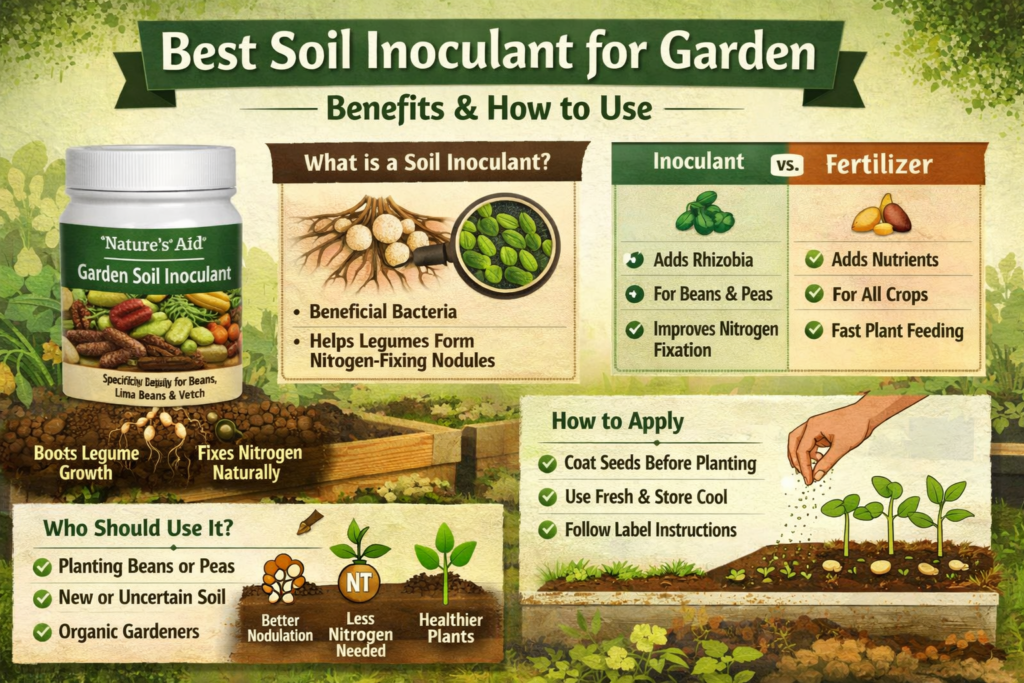
What a soil inoculant actually does
A soil inoculant is not the same thing as a regular fertilizer. Fertilizer adds nutrients directly. A legume inoculant adds beneficial bacteria that help the plant access atmospheric nitrogen through biological nitrogen fixation. New Mexico State University explains that legumes can meet much of their nitrogen need through this process when effective nodulation occurs. Penn State Extension similarly notes that rhizobia can supply nitrogen to the crop and may leave some nitrogen benefit for following crops.
For the home gardener, that means a good inoculant may support stronger plant growth, reduce dependence on added nitrogen, and improve overall performance in the right conditions. It does not replace all good gardening practice. Poor drainage, weak sunlight, compacted soil, or severe nutrient imbalance can still limit results. But when the crop is appropriate and conditions are reasonable, inoculation can be a valuable biological tool.
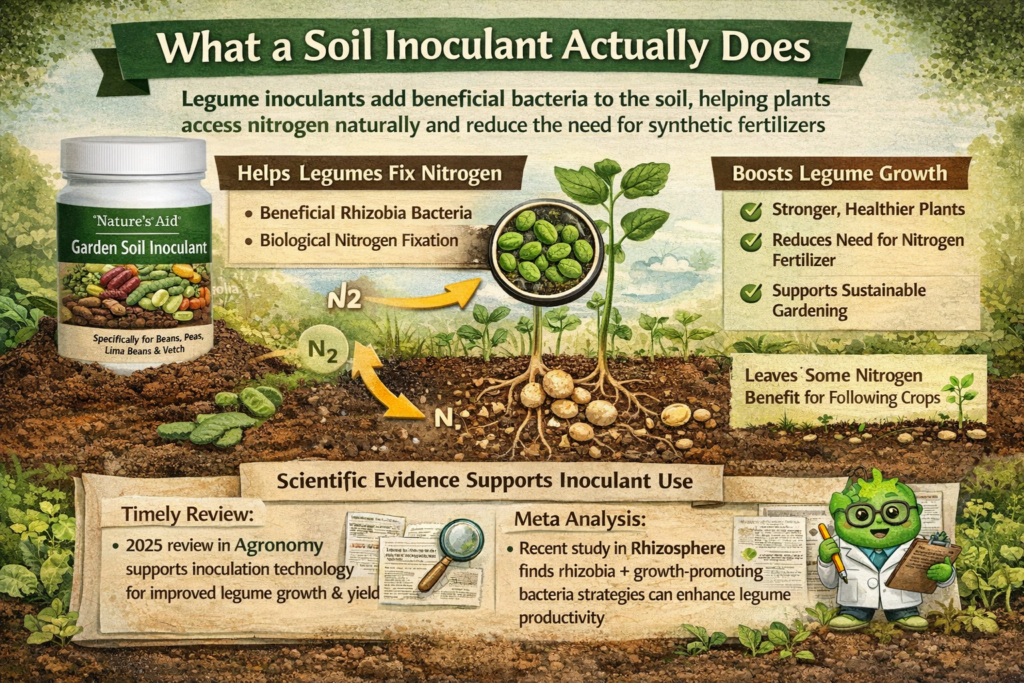
Recent scientific literature also supports the broader value of microbial inoculation in legumes. A 2025 review in Agronomy describes rhizobial inoculants as an important technology for supporting legume growth and yield, especially where native rhizobia are absent, ineffective, or outcompeted.
A recent meta analysis in Rhizosphere also found that co-inoculation strategies involving rhizobia and plant growth promoting bacteria can improve legume productivity under many conditions, although response varies by species and environment.
What makes Park Seed Nature’s Aid relevant for gardeners
The main selling point of this product is convenience. It is granular, easy to handle, and aimed at common garden legumes rather than large scale farm use only. Park Seed says it treats 150 feet of row, which is enough for many home gardens and even some larger backyard plots.
There are three reasons this product stands out for a gardening audience :
First, it is crop focused. It is meant for beans, peas, lima beans, and vetch, which aligns with how inoculants should actually be used. Extension guidance repeatedly stresses that matching the inoculant to the crop matters.
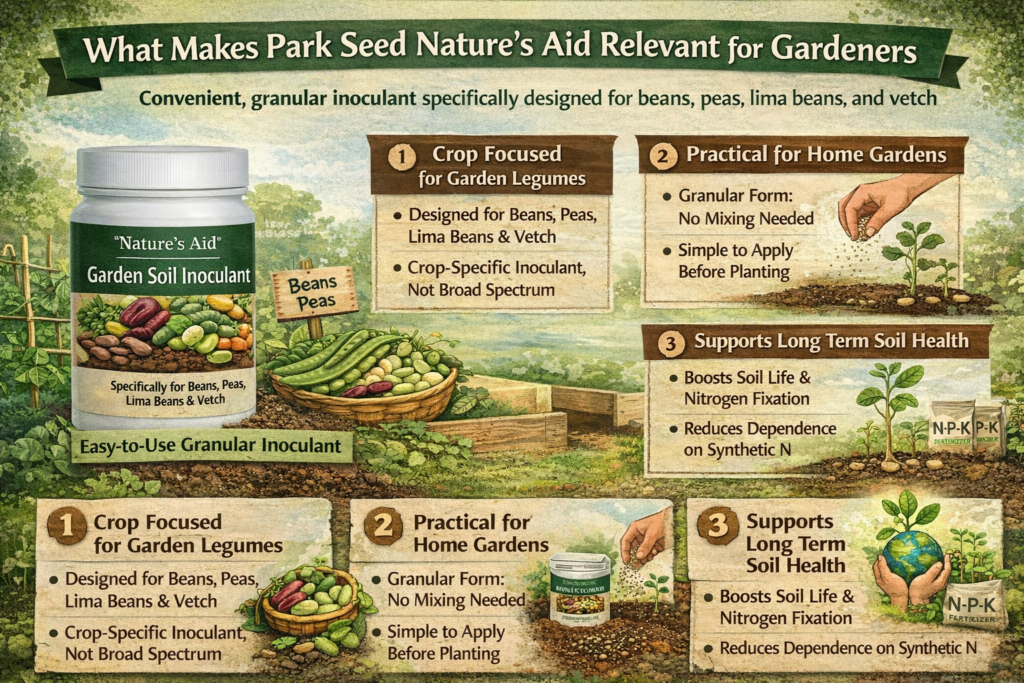
Second, it is practical for people who want something simpler than mixing custom biological inputs. Many home gardeners are not looking for technical farm formulations. They want a product they can apply quickly before planting.
Third, it fits a long term soil health mindset better than relying only on synthetic nitrogen. Microbial inoculation is not magic, but it supports a more biological approach to growing legumes. That is one reason it continues to attract attention in current sustainable agriculture research.
Key benefits of using this Soil inoculant
When used on the correct crops, Park Seed Nature’s Aid may offer several practical benefits.
It can support better nodulation in legumes, which improves the plant’s ability to fix nitrogen. This is especially valuable in beds where beans or peas have not been grown before, or where the presence of the right rhizobia is uncertain. USDA NRCS notes that when a legume is planted in a field for the first time, there is a good chance the correct rhizobia are not already present.
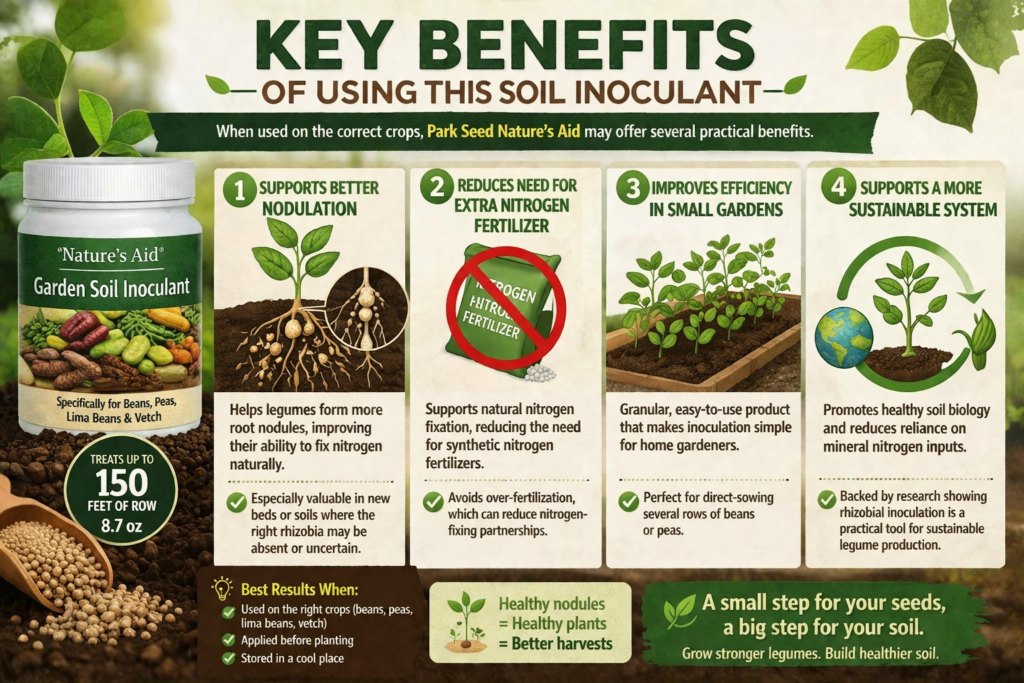
It may help reduce the need for extra nitrogen fertilizer. That is useful because too much applied nitrogen can actually reduce the incentive for legumes to form strong nitrogen-fixing partnerships. Extension recommendations often emphasize supporting the symbiosis rather than overfeeding with nitrogen.
It can improve efficiency in small gardens. For gardeners who direct-sow several rows of beans or peas, a single granular product is often easier to manage than more complex treatments.
It supports a more sustainable system. Recent research continues to frame rhizobial inoculation as one of the practical tools for reducing reliance on mineral nitrogen inputs in legume production.
Who Should Buy Soil Inoculant
This product is a sensible option for several kinds of buyers.
If you are planting beans, peas, lima beans, or vetch in a new bed, it is worth considering. If the soil has never hosted those crops, inoculation becomes more relevant.
If you garden organically or want to rely less on synthetic nitrogen, this product fits that goal.
If you have had weak legume growth in the past and suspect low nodulation, an inoculant is a practical variable to improve.
If you are planting only tomatoes, peppers, lettuce, or ornamentals, this is probably not the product to prioritize. The value here is legume-specific, not universal.
Who should skip Soil Inoculant
Not every gardener needs it.
If you regularly grow the same compatible legumes in the same soil and have seen healthy nodules and good growth, the benefit may be smaller. Colorado State University notes that inoculation is most beneficial when compatible rhizobia are lacking or uncertain, not necessarily when they are already abundant and effective.
If you want an all-purpose microbial product for every crop in your garden, this is too specific.
If the product is old, expired, or stored poorly, performance may drop. Extension recommendations stress cool storage, avoiding heat and direct sunlight, and paying attention to expiration.
How to use Soil Inoculant well
The best product still underperforms if it is used badly. Based on extension guidance and standard inoculant practice, here are the practical points that matter most.
Use it on the right crop group. Beans and peas are not interchangeable with every other vegetable.
Follow label instructions carefully. Product specific directions matter.
Store it in a cool place and avoid direct sun and excessive heat. Colorado State University specifically warns that inoculum and preinoculated seed should be kept cool and away from sunlight, and packages usually carry an expiration date.
Apply close to planting time. Living inoculants are not like dry mineral amendments that can sit indefinitely in harsh conditions.
Do not assume it fixes poor soil by itself. Soil structure, moisture, pH, drainage, and general fertility still matter.
Strengths and limitations of Soil Inoculant
A trustworthy review should include both.
Strengths
Park Seed Nature’s Aid has a clear crop target, which is good. Many gardening products sound broad and impressive but are vague about where they actually work. This one is straightforward about its intended use.
The product size and treatment range are practical for backyard gardeners. An 8.7-ounce container that covers 150 feet of row is a reasonable fit for a small to mid-sized food garden.
Its biology matches established extension advice about the value of rhizobia for legumes. That gives the product category real agronomic credibility.
Limitations
It is not a broad solution for every crop.
Results are condition dependent. Inoculants tend to perform best when the right rhizobia are absent or ineffective, and responses vary by environment. Recent review literature makes that clear.
It is not a substitute for full soil management. If your bed is waterlogged, heavily compacted, or severely nutrient-poor, inoculation alone will not solve the problem.
Is Soil Inoculant better than Regular Fertilizer
That depends on the crop and the goal.
For beans and peas, a rhizobial inoculant and a fertilizer do different jobs. Fertilizer feeds the system more directly. Inoculant helps the plant build a biological partnership that can supply nitrogen more naturally.
In many cases, they are not strict replacements for one another. But for legumes, inoculants address a specific function that standard fertilizer does not. Extension guidance from Penn State and New Mexico State University supports the importance of nitrogen fixation in meeting legume nitrogen needs.
If the goal is long term biological efficiency and better legume performance, inoculant has a strong case. If the goal is simply quick feeding of non legume crops, that is a different conversation.
Soil Inoculant Review Summary
Summary Table
| Category | Details |
|---|---|
| Product Name | Park Seed Nature’s Aid Garden Soil Inoculant |
| Product Type | Granular legume soil inoculant |
| Target Crops | Beans, peas, lima beans, and vetch |
| Main Purpose | Helps legumes form root nodules for biological nitrogen fixation |
| Coverage | Up to 150 feet of row per 8.7-ounce container |
| Best Use Case | New garden beds or soils where compatible rhizobia may be absent or uncertain |
| Not Suitable For | Tomatoes, peppers, cucumbers, roses, and other non-legume crops |
| Main Value | Supports stronger legume growth and may reduce the need for added nitrogen fertilizer |
Comparison: Soil Inoculant vs Regular Fertilizer
| Feature | Soil Inoculant | Regular Fertilizer |
|---|---|---|
| Primary Role | Adds beneficial bacteria | Adds nutrients directly |
| Best For | Legume crops only | Nearly all crops |
| Nitrogen Function | Helps plants fix atmospheric nitrogen through root nodules | Supplies nitrogen directly from the product |
| Speed of Action | Gradual and biology-dependent | Usually faster and more direct |
| Crop Specificity | Very specific | Broad use |
| Soil Biology Benefit | Supports microbial partnership | Does not usually improve microbial symbiosis |
| Works Alone? | No, good soil conditions still matter | No, soil structure and drainage still matter |
| Best Use Strategy | Use for legumes in suitable conditions | Use for general crop nutrition as needed |
Who Should Use It
- Gardeners planting beans, peas, lima beans, or vetch
- People using new beds or first-time planting areas
- Organic gardeners wanting lower synthetic nitrogen use
- Growers who suspect poor nodulation in past legume crops
- Gardeners who already grow legumes regularly in the same soil
- People with decent legume performance but who want to optimize results
- People growing only tomatoes, peppers, lettuce, or ornamentals
- Shoppers looking for an all-purpose garden microbial product
- Gardeners expecting it to fix drainage, compaction, or poor fertility by itself
Strengths vs Limitations
Strengths
- Clear crop-specific purpose
- Easy granular application for home gardeners
- Supports nitrogen fixation in legumes
- May reduce dependence on synthetic nitrogen fertilizer
- Fits sustainable and biological gardening methods
- Practical container size for backyard gardens
Limitations
- Not useful for non-legume crops
- Performance depends on soil and environmental conditions
- Less valuable if compatible rhizobia are already abundant
- Does not replace full soil management
- Storage and freshness matter because it contains living organisms
If you would like to purchase a soil inoculant, please visit the product page on our website.
View Product PageFinal Thought
Park Seed Nature’s Aid Garden Soil Inoculant looks like a sensible, crop-appropriate choice for gardeners growing beans, peas, lima beans, or vetch. The product details align with established extension principles on rhizobia inoculation, and current research continues to support the broader value of microbial inoculants in legume systems, especially where compatible rhizobia are missing or weak.
The biggest reason to buy it is not hype. It is fit. If you are growing the crops it was designed for, and especially if you are planting in new or uncertain soil, this product makes practical sense. If you are expecting a miracle across every crop in the garden, it is the wrong tool.
For a home gardener who wants a simple inoculant from a known garden retailer, this is a credible option. Used correctly, it can be a smart part of a legume growing strategy built around healthier soil, more efficient nitrogen use, and better harvest potential.
References
- Park Seed. Nature’s Aid Garden Soil Inoculant. Product details for size, treatment range, and listed organisms.
- Colorado State University Extension. Legume Seed Inoculants. Guidance on crop-specific inoculation, storage, and use.
- New Mexico State University. Nitrogen Fixation by Legumes. Background on biological nitrogen fixation and nitrogen contribution by legumes.
- Kruszka et al. 2025. Agronomy. Review discussing modern legume inoculation technologies and yield support.
- Prando et al. 2024. Rhizosphere. Meta-analysis on rhizobia co-inoculation effects in legumes.
Common Questions About Soil Inoculant
Do beans and peas always need inoculant?
No, they do not always need it. If you have already grown beans or peas in the same soil before, the helpful bacteria may still be there. In that case, your plants may do just fine without adding anything extra. Inoculant is more useful when you are working with new soil or a place where legumes have not been planted before.
Can inoculant replace fertilizer?
No, it cannot do the full job of fertilizer. It mainly helps plants get nitrogen in a natural way. But crops also need other nutrients to grow well. If your soil is poor, you may still need fertilizer to give the plants proper support.
Can it be used for all vegetables?
No. This is one of the biggest misunderstandings. Inoculant made for beans and peas is only helpful for legume crops. It will not do anything special for vegetables like tomatoes, cucumbers, onions, or lettuce.
How long does it take to work?
It does not give fast results. You will not see a change right away. First, the roots need time to develop nodules, and then the plant starts getting the benefit. This means the results show gradually during the growing period.
What happens if you do not use it?
Your beans or peas may still grow, so skipping it does not mean total failure. But if the soil does not already have the right bacteria, the plants may not perform as well. They may grow more slowly and produce a smaller harvest.

Thesis Link : https://saulibrary.edu.bd/daatj/public/uploads/BAU200601_19-Pp_5.pdf
- 10 Best Loppers for Thick Branches - October 14, 2026
- Fall Lawn Care Checklist – 9 Jobs Before Winter - October 14, 2026
- 10 Best Garden Tool Sets for Beginners - October 13, 2026