Hydroponic Farming USA – A Complete Business and Setup Guide
Hydroponic Farming USA has moved far beyond being a trendy concept. It is now a practical and profitable production model used in greenhouses, indoor warehouses, and container farms across the country. At its core, the idea is straightforward. Plants do not need soil to thrive. They need the right balance of water, oxygen, nutrients, light, and climate control.
This guide is designed for business owners, growers, farm managers, and committed beginners who want a realistic view of Hydroponic Farming USA in 2026. The focus here is on real business decisions, not hobby gardening. You will learn what the U.S. market is actually buying, which crops offer the strongest commercial potential, You will learn what the U.S. market is actually buying, which crops offer the strongest commercial potential, and what equipment is essential, including hydroponic starter kits, along with how startup and operating costs are structured and where many new operators make expensive mistakes.
One important point to keep in mind is that no two hydroponic farms have the same budget. Costs can change based on location, utility rates, building type, production scale, and system design. The figures in this guide should be used as planning benchmarks, then confirmed with supplier quotes, local contractors, and regional market data before you invest.
Disclaimer: This post may contain affiliate links. This means I may earn a small commission if you purchase through these links, at no extra cost to you. I only recommend products that I believe are useful and relevant.
U.S. Hydroponics Market in 2026
A lot of people still ask a basic question. Is hydroponic farming really happening in the United States?
Yes, it is. And not in a small way.

Hydroponics is now an important part of controlled environment agriculture in the U.S. This includes crops grown inside greenhouses, tunnels, and indoor facilities where light, temperature, water, and nutrients are managed carefully. USDA data shows that protected food crop production is already a serious commercial category, with national sales above USD 1 billion in 2024.
The market is growing, not fading
The 2022 Census of Agriculture reported that food crops grown under glass or other protection reached about USD 981.7 million in sales. The same report recorded 11,465 farms in this category and 133.4 million square feet of protected production area, which is roughly 3,062 acres. That was up from about USD 748.3 million in 2017, showing strong growth over five years.
The newer 2024 Census of Horticultural Specialties confirms that the category kept moving upward. USDA reported about USD 1.011 billion in total sales for food crops grown under protection in 2024. That means the U.S. market stayed above the billion dollar mark and continued to expand.
What this really tells us
The biggest takeaway is simple: America is not just experimenting with hydroponics. It is building real production around it.
Ready to start your own hydroponic system?
That said, one detail matters. USDA tracks a broad category called food crops grown under protection. This includes hydroponics, but it is not limited to hydroponics alone. So when we talk about the hydroponics market, we should be careful. The numbers clearly prove that protected agriculture is large and growing, and they also show that hydroponic production is a major piece of it.
How much of this production is hydroponic
The 2024 Census of Horticultural Specialties gives one of the clearest national pictures available.
USDA counted 3,731 operations selling food crops grown under protection in 2024. These operations used about 89.6 million square feet of protected growing area. Total output reached 5,774,596 hundredweight, and 3,442,159 hundredweight of that came from hydroponic systems. Total sales came to roughly USD 1.011 billion.
That is an important point for growers, investors, and suppliers. Hydroponics is not sitting on the edge of this category. It is already responsible for a very large share of production volume inside protected food crop systems.
Which crops lead the market
The strongest crop by value is tomatoes.
In the 2024 USDA table, tomatoes generated about USD 383.0 million in sales. Strawberries followed at about USD 140.3 million. Lettuce brought in about USD 86.5 million, and fresh cut herbs were close at about USD 86.4 million. Cucumbers also posted meaningful sales at about USD 40.7 million.

This matters because it shows where demand is already proven. Tomatoes are still the main commercial driver in protected food crop production. Strawberries have become a major revenue crop. Lettuce and herbs remain attractive because they fit hydroponic systems well and move quickly through retail and foodservice channels.
What growers should learn from the data
Anyone planning a hydroponic project in the U.S. should not start with a trendy crop idea. Start with real market proof.

The USDA numbers suggest that protected crop success in the U.S. is concentrated in categories that already have established buyer demand, repeat production systems, and clear pricing pathways. Tomatoes, strawberries, lettuce, herbs, and cucumbers stand out because the market has already shown willingness to buy them at scale.
This does not mean other crops cannot work. It means that proven categories carry less risk, especially for new operators trying to match production costs with actual market demand.
References
- USDA National Agricultural Statistics Service, 2024 Census of Horticultural Specialties overview and highlights.
- USDA National Agricultural Statistics Service, 2022 Census of Agriculture, Table 39, Food Crops Grown Under Glass or Other Protection: 2022 and 2017.
- USDA National Agricultural Statistics Service, 2024 Census of Horticultural Specialties, Table 15, Food Crops Grown Under Protection and Sold: 2024.
Hydroponic Business Models and Farm Setups
Hydroponics is not a business by itself. It is a growing method. The real business depends on how you plan to sell, who you want to serve, and how steady your production can be.

That is why the first big decision is not the system. It is the business model.
Many new growers make the mistake of buying channels, tanks, pumps, and lights before they know how the farm will make money. That usually leads to wasted spending, weak crop planning, and a setup that does not match the market.
A better approach is to start with the sales path, then build the farm around it.
Start with the business model, not the equipment
A hydroponic farm can serve different markets. Each one comes with a different pace, different pricing pressure, and different operational demands.

Direct to consumer
This is often the easiest way to test demand in the beginning. You can sell at farmers markets, through community supported agriculture programs, or by local delivery. The biggest advantage is margin. You keep more of the final sale price and get direct feedback from customers.
The tradeoff is that you must also become a seller. You are not only growing. You are packaging, promoting, showing up, talking to buyers, and building repeat demand.
For a new grower, this model works well when production is still small and flexibility matters.
Wholesale and distribution
Wholesale can give you steadier volume, but it is a different kind of business. Buyers usually expect consistency in size, packaging, delivery timing, and food safety practices. Prices are often lower than direct sales, so mistakes become more expensive.
This model fits growers who can already produce a reliable crop and want more predictable movement each week.
Restaurants and institutions
Chefs, schools, hospitals, and similar buyers can be valuable accounts, especially for herbs and fresh greens. These buyers often care about quality, shelf life, and delivery reliability more than flashy branding.
This route can work very well for small and mid sized farms that want premium local customers without going fully into retail distribution.
A hybrid path is often the smartest starting point
For many growers, the most practical option is a mix. Start with direct sales to learn what customers actually want. Once your growing process becomes more stable, add a few wholesale or foodservice accounts that can take regular volume.
This approach lowers risk. It helps you learn the market while building a production system that can support repeat orders.
Cornell Controlled Environment Agriculture business resources support this kind of planning mindset by stressing business and marketing decisions alongside production design.
Your farm design should follow your market
Once the sales path is clear, the setup becomes easier to choose.
A hydroponic system should match the crop, the harvest style, and the buyer. Penn State Extension explains that common hydroponic systems include nutrient film technique, deep water systems, and media based systems, but the right choice depends on what you grow and how the crop performs in that environment.
That means you should not begin with a debate about NFT, DWC, or drip irrigation. Begin with a simple farm blueprint.
Build the farm blueprint in the right order
1. Choose one main crop and one backup crop
Keep the first plan narrow. A farm that tries to grow everything usually struggles to grow anything well.
Pick one crop that will carry the business and one secondary crop that gives you flexibility. A common example is butterhead lettuce as the main crop and basil as the backup. This helps with planning, purchasing, scheduling, and sales conversations.
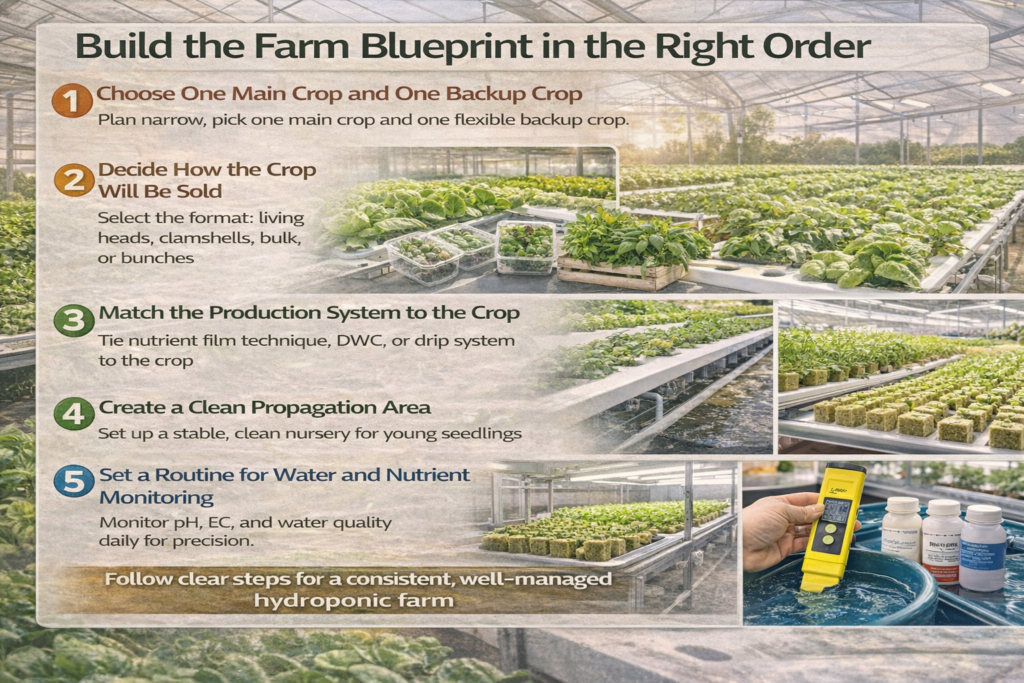
2. Decide how the crop will be sold
The same lettuce can be sold in different ways. You might offer living heads with roots attached, packed clamshell greens, bulk packs for foodservice, or bunches for local buyers. Each format changes labor, packaging, post harvest handling, and pricing.
In other words, the sales format is not a small detail. It affects the entire farm workflow.
3. Match the production system to the crop
Leafy greens often perform well in nutrient film technique and deep water culture systems. Fruiting and vining crops such as tomatoes and cucumbers are commonly grown in Dutch buckets or grow bag systems with drip feeding.
Penn State and Oregon State Extension both describe these system differences clearly and show that system choice should be tied to crop needs, root zone management, and production goals.
4. Create a clean propagation area
A weak nursery leads to weak production later. Seedlings need a clean, organized space with stable moisture, temperature, and light. Good propagation reduces losses and creates more uniform harvests.
This part is often overlooked, but it is one of the easiest places to improve consistency.
5. Set a routine for water and nutrient monitoring
Hydroponics moves quickly. When the nutrient solution shifts, plants often respond fast. That is why monitoring cannot be casual.
Oklahoma State Extension and University of Missouri Extension both emphasize the importance of checking pH, electrical conductivity, alkalinity, and overall water quality. These are not advanced details for later. They are part of daily or scheduled management from the beginning.
If you do not track the root zone, you are guessing. And guessing gets expensive in hydroponics.
What actually works now
The setups that work best right now are usually not the most complicated ones. They are the ones that fit a clear crop plan, a realistic sales channel, and a disciplined production routine.
A small grower with strong local demand can do well with a focused leafy greens system and direct sales. A greenhouse operator with solid buyers may succeed with herbs, lettuce, or specialty crops delivered on a schedule. A more advanced farm can combine direct sales with selected wholesale accounts once consistency is proven.
The common thread is not technology alone. It is repeatability.
Cornell describes controlled environment agriculture as a highly managed production system that requires attention to horticulture, engineering, plant health, and operations. That is a useful reminder for anyone entering the space. Success does not come from equipment alone. It comes from managing the environment well and repeating what works.
A practical goal for any new hydroponic farm
A good hydroponic farm does three things well.
- It controls the air environment.
- It controls the root environment.
- It keeps records so good results can be repeated.
That is the real foundation of a working hydroponic business. Not just growing plants, but building a system that can deliver the same quality again and again for buyers who will come back.
References
- USDA. Urban Agriculture and Innovative Production. Hydroponics and other controlled environment production methods are included within innovative production systems.
- Cornell Controlled Environment Agriculture. Business planning and marketing resources for CEA operations.
- Cornell Controlled Environment Agriculture. Overview of CEA as a hydroponically based, highly managed production approach.
- Penn State Extension. Hydroponics systems and nutrient solution guidance, including NFT and deep water systems.
Why Home Hydroponic Farming Is the Best Place to Start
If you want to learn hydroponics the right way, start at home.
A small home system gives you the chance to understand how plants respond to water, nutrients, light, and daily care without taking on the pressure of a large commercial setup. It is one of the safest ways to build real skill because mistakes at this stage are manageable. You learn by doing, not by guessing. University extension guides for small scale hydroponics also describe home systems as a practical way to grow crops indoors or outdoors with basic equipment and regular monitoring.

A home setup can be simple
You do not need a complex farm to begin. A basic home hydroponic system can be built with a small deep water culture container or a compact nutrient film technique setup, a reservoir, a pump, and simple plumbing. If the system is indoors, a grow light is usually needed to provide enough light for steady growth. Extension resources from Minnesota, New Hampshire, Missouri, and Oregon all describe small hydroponic systems in these terms and note that indoor growing often depends on artificial lighting.
That is one of the biggest strengths of home hydroponics. You can start small, keep costs under control, and still learn the core skills that matter later.
What a home system actually teaches you
Home hydroponics is not just about producing lettuce or herbs for the kitchen. It is a training ground.
It helps you learn how to manage pH and electrical conductivity, which are two of the most important measurements in hydroponic production. EC shows the strength of the nutrient solution, and pH affects how easily plants can take up nutrients. Extension publications from Oklahoma State and the University of Missouri both stress that nutrient management in hydroponics depends on tracking these measurements regularly.
It also teaches plant observation. You start to notice how leaves change when nutrition is off, how roots react to poor water conditions, and how quickly small issues become larger problems if you ignore them.
Most importantly, a home system builds discipline. You begin to think in routines. Check the reservoir. Watch the roots. Clean the equipment. Record the readings. Make small corrections. That mindset is the foundation of a good farm operator.
A home system is not mainly about profit
A small system at home is not likely to become a major income source. Its real value is skill development.
It gives you a low risk way to build confidence before moving into a larger project. You can test crops, practice harvest timing, improve sanitation, and develop simple operating routines. If local rules allow it and the product is handled safely, it may also help you build a small customer base among neighbors or local buyers. But the bigger win is experience, not scale.
That is why home production is the right place to make beginner mistakes. It is much better to learn lessons in a small setup than inside a large commercial build with serious overhead.
Why discipline matters so much in hydroponics
Hydroponics rewards careful growers and punishes careless ones.
One reason is that water moves through the entire system. In a recirculating setup, that means one problem can spread quickly. University guidance on hydroponic disease management notes that water molds such as Pythium and Phytophthora can move through shared nutrient solution and infect multiple plants fast, especially when sanitation is weak and root conditions are poor. Prevention is often more effective than treatment.
This is why cleaning, monitoring, and consistency matter so much. A healthy hydroponic system depends on routine, not luck.
The smartest reason to begin at home
Starting at home gives you something that money cannot buy quickly. It gives you judgment.
You begin to understand what a healthy root zone looks like. You learn how fast pH can drift. You see why lighting, airflow, and temperature matter. You get used to record keeping. You stop thinking like a hobby buyer and start thinking like a grower.
That is the real purpose of home hydroponics. It prepares you for larger decisions later with less risk and more confidence.
References
- University of Minnesota Extension. Small scale hydroponics.
- University of New Hampshire Extension. Hydroponics at Home.
- Oklahoma State University Extension. Electrical Conductivity and pH Guide for Hydroponics.
- University of Missouri Extension. Hydroponic Nutrient Solutions.
Hydroponic Shipping Container Farm Cost and What Large Scale Hydroponics
Shipping container farms get attention for a reason. They are compact, controlled, and fast to deploy compared with building a full greenhouse or warehouse from scratch. But convenience comes at a price. On a square foot basis, a container farm can be one of the more expensive ways to produce leafy greens and herbs.
That does not mean container farming is a bad idea. It means the business case has to be honest from day one.
What a container farm really is
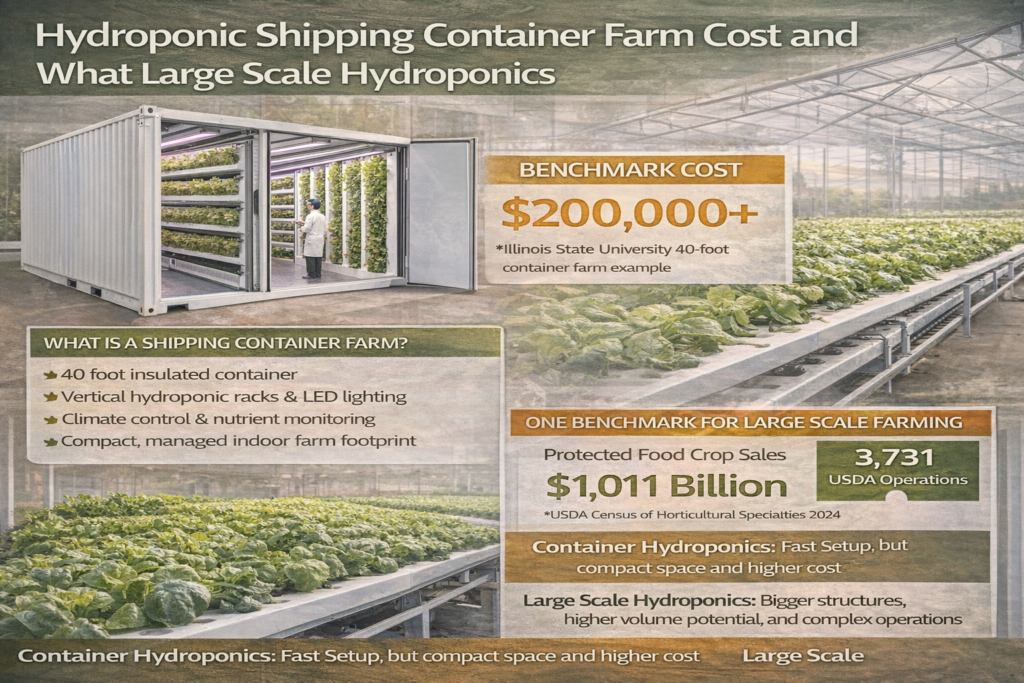
A hydroponic shipping container farm is usually a 40 foot insulated container fitted with vertical racks, LED lighting, climate control, irrigation, nutrient dosing, and software for monitoring the growing environment. Illinois State University describes its new 40 foot vertical farm this way, using a recirculating hydroponic system with LED lighting inside a repurposed shipping container.
In practical terms, you are buying a highly managed indoor farm in a very small footprint. That can be useful when land is limited, weather is difficult, or your market rewards fresh local supply every week.
What a container farm can cost
Costs vary a lot because there is no single standard package.
A do it yourself retrofit can cost far less upfront than a turnkey unit, but it also shifts the engineering risk to you. A turnkey container farm is more complete, though site prep, freight, electrical work, water connections, and labor are still separate decisions in many cases. FarmAnywhere, ZipGrow, and Freight Farms all market container systems as packaged or turnkey style solutions, but public pricing is often limited and buyers are usually pushed toward custom quotes or financing conversations.
One useful real world benchmark comes from Illinois State University. Its 40 foot demonstration vertical farm was reported at about USD 200,000 total project cost. The university also describes the unit as a controlled hydroponic system with recirculating nutrient solution and LED lighting. That figure should not be treated as a universal market price, but it is a solid example of what a serious container based project can cost in practice.
So the smart takeaway is this. A container farm is not just the price of a box. It is the price of the box, the growing system, the environmental controls, the installation work, and the cost of operating that system every day.
When container farms make sense
Container farms tend to work best when the product can be sold as very fresh, very local, and reliably available. That usually means leafy greens, herbs, microgreens, and similar crops sold into markets that value consistency over low commodity pricing. Vendor materials from Freight Farms and ZipGrow both position container farms around year round production, controlled environments, and local food supply.
This model can make sense for institutions, campuses, foodservice programs, community food projects, and premium local markets.
Where container farms struggle is on raw unit economics when electricity is expensive and the crop is competing against lower cost greenhouse or field production. A packaged indoor system can be operationally efficient in some ways, but it still carries a heavy burden in lighting, cooling, and labor relative to the small productive footprint. That is why sales planning matters as much as farm design.
Large scale hydroponic farming is a different game
Large scale hydroponic farming usually means greenhouse production, multiple greenhouse bays, or a large indoor warehouse with automation, labor planning, food safety systems, and distribution in place.
This is not just a bigger version of a home setup or a container. It is a real operating business with logistics, scheduling, packaging, crop turns, and account management.
USDA data helps explain why scale matters. In the 2024 Census of Horticultural Specialties, food crops grown under protection generated about USD 1.011 billion in sales from 3,731 operations. More broadly, USDA Table 2 shows that across horticultural specialty operations, the highest sales brackets account for a large share of total industry sales, which is a useful sign that larger operations capture an outsized part of the market value.
That does not mean every big farm wins. It means the market tends to reward farms that can deliver dependable volume and operate efficiently.
What large hydroponic farms compete on
At scale, success usually comes down to a few things.
The first is consistency. Buyers want the same product every week, not great harvests one month and weak supply the next.
The second is food safety and traceability. Large buyers expect procedures, records, and clean handling, not informal farm routines.
The third is unit economics. Labor efficiency, energy efficiency, packaging efficiency, and crop scheduling all matter more as the farm grows. USDA protected crop data and broader horticulture data show there is real money in the category, but they do not remove the need for disciplined operations.
The right first step if you want to go large
If your goal is a large hydroponic farm, your first step should not be buying more equipment. It should be proving the business model.
Start by validating the crop, the buyer, the price point, and the production rhythm. Build a small system or pilot program that lets you test quality, yield, labor time, and delivery performance. Once those numbers are real, scaling becomes a business decision instead of a guess.
That approach is usually safer than jumping straight into a large capital project with no reliable sales history.
References
- Illinois State University News. New Vertical Farm at Illinois State University to serve as example of sustainable urban agriculture. Published May 1, 2025.
- Illinois State University Facilities. Vertical Farm at ISU project overview.
- USDA National Agricultural Statistics Service. 2024 Census of Horticultural Specialties overview and report hub.
- USDA National Agricultural Statistics Service. Table 2. Horticultural Specialty Operations and Sales of Commodity Groups by Value of Sales, 2024.
Hydroponic Farming USA Cost in 2026
When people search for hydroponic farming cost in the United States, they usually want one clean number. The truth is that there is no single price that fits every farm. Cost depends on the structure you build, the level of climate control you need, the crops you grow, and the way you plan to sell. University and government sources show that hydroponic startup costs can range from a few hundred dollars for a learning system to six figures or more for a commercial greenhouse or indoor facility.

A more useful way to think about cost is to break it into three parts.
First comes the build cost
This is the money required to create the farm itself. It includes the greenhouse or indoor room, lighting, irrigation and fertigation equipment, environmental controls, racks, reservoirs, sensors, and a basic packing area. In the Missouri hydroponic leafy greens budget published in late 2024, the example greenhouse capital package included about 50,000 USD for the structure and covering, 30,000 USD for environmental controls, 25,000 USD for growing and storage equipment, and 10,000 USD for site preparation and infrastructure. That sample setup totaled about 115,000 USD before operating costs.
Kentucky Extension also notes that a production ready greenhouse for hydroponic lettuce can exceed 10 USD per square foot, excluding land. That is a useful reminder that even a modest commercial project can become expensive faster than new growers expect.
Then comes the monthly operating cost
Operating expense is what keeps the farm running. It includes labor, utilities, seed, growing media, nutrients, packaging, pest control, repairs, insurance, and delivery. In the same Missouri budget, annual operating costs were modeled at about 70,620 USD, with labor at 26,000 USD, packaging at 10,523 USD, and utilities at 22,782 USD. That utility number included natural gas for heating at 15,741 USD per year and electricity at 4,581 USD per year under that specific scenario.
This is why many growers underestimate the real cost of hydroponics. The system is not only expensive to build. It also needs constant spending to stay productive.
The third cost is working capital
Working capital is the money that keeps the business alive between planting and getting paid. This matters even more if you sell wholesale and wait on net payment terms. Extension enterprise budgets are useful because they show that farms can look profitable on paper while still facing cash pressure during the production cycle. The Missouri and Mississippi greenhouse budgets both separate capital costs from annual operating and ownership costs, which helps explain why cash planning matters from the beginning.
What small systems can cost
A home or pilot setup is the cheapest place to start. A simple system for learning can cost a few hundred to a few thousand dollars depending on whether you use basic deep water culture, small nutrient film channels, indoor lights, and environmental controls. Extension guidance consistently describes small hydroponic systems as a practical learning step before larger investment, even though costs vary by equipment choice.
For someone in the learning phase, that smaller setup is usually the smarter investment because it lets you learn nutrient management, sanitation, and workflow before committing serious capital.
What a small commercial greenhouse can look like
One of the clearest real world examples comes from the Missouri hydroponic leafy greens planning budget. It assumes a 2,816 square foot greenhouse, with 85 percent of the floor area used for production, and a yield assumption of 30 heads per square foot per year with 95 percent sold. The sample capital investment totaled about 115,000 USD. Total annual costs were estimated at about 87,967 USD.
That does not mean every greenhouse of that size will cost the same. It does mean that a serious small commercial setup can move into six figure territory quickly once structure, controls, and equipment are included.
What hydroponic lettuce economics can look like
Kentucky Extension, drawing on a Kentucky adapted hydroponic lettuce scenario, reported breakeven costs of 0.74 USD per head for variable costs and 0.19 USD per head for fixed costs in a 3,000 square foot greenhouse. That puts total breakeven at about 0.93 USD per head under that specific set of assumptions.
This is a helpful benchmark because it shows how tight the numbers can be. If a buyer wants low prices, the farm needs strong yields, low waste, disciplined labor, and steady demand.
What greenhouse tomatoes can cost
Mississippi State Extension published a greenhouse tomato budget that gives another practical benchmark. In that example, a 24 by 96 foot Quonset greenhouse had an estimated capital requirement of 22,983 USD, or about 9.98 USD per square foot. The same publication estimated annual production costs of about 13,656 USD for two crops per year. It also noted that with a conservative yield assumption of 14,000 pounds for a continuous crop, tomato prices around 1 USD per pound would be needed to break even under that scenario.
This kind of budget is valuable because it replaces vague optimism with real numbers.
Hidden costs that catch growers off guard
Food safety is one of the most overlooked costs in hydroponics. The FDA Produce Safety Rule sets science based minimum standards for the growing, harvesting, packing, and holding of produce for human consumption, and FDA also provides coverage and exemption guidance because not every farm is regulated in the same way. Even when an operation is exempt, buyers often still expect good agricultural practices and strong records.
For hydroponic and aquaponic farms, the Northeast Center to Advance Food Safety explains that recirculating nutrient rich water creates unique produce safety concerns because contamination in one part of the system can spread through the rest of it. Their guidance focuses on risks tied to water, sanitation, worker practices, and record keeping.
Other costs often appear after the first quote is signed. These include electrical upgrades, water filtration, monitoring tools, packaging reorders, labeling, cold storage, delivery time, labor training, and repairs. Extension budgets and produce safety resources support the same lesson here. A hydroponic project usually costs more than the first estimate if these practical items are ignored.
Energy can decide whether the business works
Energy is one of the most important cost lines in hydroponics, especially for indoor farms and heavily controlled greenhouse systems. In the Missouri leafy greens budget, utilities were one of the largest expenses, behind only labor.
National electricity data shows why this matters. According to the U.S. Energy Information Administration, the national average price of electricity in December 2025 was 13.63 US cents per kilowatt hour for commercial customers and 8.53 US cents per kilowatt hour for industrial customers, with major differences by state.
That means two farms with the same design can have very different profitability depending on where they operate and what electric rate they pay.
A better way to estimate your real cost
The smartest way to price a hydroponic project is not to ask for one national average. It is to build a farm specific budget.
Start with your structure. Then estimate utility demand, labor, packaging, water treatment, and delivery. After that, test whether your expected selling price can actually support the cost per head, pound, or unit. The extension budgets from Missouri, Kentucky, and Mississippi are useful because they give realistic starting points, not sales language.
References
- Missouri Extension. Hydroponic Leafy Greens Planning Budget, 2024.
- Kentucky Extension. Hydroponic Lettuce, updated 2024.
- Mississippi State University Extension. Greenhouse Tomato Budgets for Mississippi.
- U.S. Food and Drug Administration. FSMA Final Rule on Produce Safety.
Revenue Drivers and Hydroponic Farming USA Prices
Pricing is where many hydroponic farms either become sustainable or slowly run out of room to breathe.
A lot of growers focus on yield first. The stronger operators usually do something different. They track margin by crop, margin by customer, and margin by sales channel. That is often what keeps them in business longer. A planning budget from the University of Missouri shows exactly why channel mix matters. In its deep water culture leafy greens example, wholesale revenue was modeled at 1.50 USD per head while retail was modeled at 2.75 USD per head, creating a big difference in income potential from the same crop.

What actually shapes your selling price
There is no single national number for hydroponic farm pricing. The final price depends on the crop, the packaging format, the buyer type, and the value you add around the product. A head of lettuce sold loose into wholesale is not the same product as a living head with roots attached sold to a premium local retailer. A branded clamshell of greens with reliable weekly delivery is also not the same as a one time unbranded box. These differences are exactly why enterprise budgets separate market channels instead of pretending one price fits every sale.
In practical terms, price is shaped by four things. The first is the crop itself. The second is the package and presentation. The third is the market channel, such as direct retail, restaurant sales, or distribution. The fourth is service level, which includes consistency, delivery discipline, and whether buyers trust you to meet the same spec every week. The Missouri planning budget reflects this clearly because it assigns different revenue assumptions to wholesale and retail sales in the same farm model.
A grounded leafy greens example
One of the most useful public benchmarks comes from the Missouri hydroponic leafy greens planning budget. It models a 2,816 square foot greenhouse, assumes that 85 percent of the area is usable for production, and uses a yield assumption of 30 heads per square foot per year with 95 percent of heads sold. Under its sample pricing, wholesale leafy greens were modeled at 1.50 USD per head and retail at 2.75 USD per head. Total annual income in the combined example was estimated at 110,922 USD, while total annual costs were estimated at 87,967 USD, leaving income over total costs of 22,955 USD under those assumptions.
That budget should not be treated like a promise. It is better used as a planning template. It shows how to structure your own numbers and test whether your mix of pricing, yield, and costs makes sense before you invest too heavily. The University of Missouri also presents this budget as a planning tool, not a guarantee, and encourages growers to customize the estimates to their own conditions.
What usually raises revenue without doubling the workload
One of the best ways to improve revenue is to sell a product that holds quality longer. Living lettuce is a good example. University of Arizona controlled environment agriculture guidance notes that lettuce sold with roots and substrate attached can maintain quality much longer than cut heads when handled properly in cold storage. Longer shelf life can reduce shrink and give buyers a reason to pay more for freshness and convenience.
Another strong lever is product mix. Farms that sell only one standard item often get pushed toward commodity pricing. A lineup that includes butterhead, romaine, specialty greens, herbs, or premium mixes gives you more room to serve different buyers at different price points. USDA Market News can help validate whether the broader market is rewarding that mix because it publishes free wholesale, retail, and shipping data across specialty crops.
Consistency also matters more than many beginners expect. Buyers often pay for fewer surprises, not just lower prices. That is especially true for restaurants, institutions, and repeat wholesale accounts that need the same quality and pack style every week. The reason this matters financially is simple. A dependable farm becomes easier to reorder from, and repeat orders are often worth more than one time high price sales. The extension budget evidence supports this because the same production system becomes far more attractive when retail or stronger channel pricing is achieved consistently.
Microgreens can also lift average order value for some farms. Missouri Extension lists microgreens alongside hydroponic leafy greens in its specialty crop budget resources, which reflects their role as a viable controlled environment product category for growers building mixed sales baskets.
Where to get real pricing benchmarks
Before setting your own prices, it helps to compare them against outside data. USDA Agricultural Marketing Service Market News publishes free reports covering wholesale, terminal market, and shipping point information for specialty crops. These reports are meant to help producers and buyers evaluate market conditions and price movement.
For retail context, USDA Economic Research Service maintains fruit and vegetable price datasets with estimated average retail prices for more than 150 commonly consumed products. ERS says these reports provide average retail price estimates per pound and other consumer relevant units, making them useful as a reference point when you are trying to judge whether your local retail target is realistic.
Hydroponic Farming USA Profit and ROI Examples for 2026
The most useful way to think about profit is not through hype. It is through scenario testing.

Scenario one: small greenhouse leafy greens with mixed sales
This model fits a newer commercial grower selling through a blend of retail and wholesale. The Missouri example is a strong reference point here because it uses a greenhouse of about 2,816 square feet, assumes 30 heads per square foot per year, and shows that the business outcome depends heavily on the revenue mix and total costs. With the example channel pricing and cost structure, income over total costs reached 22,955 USD. That is encouraging, but only under those specific assumptions.
The practical lesson is that profit can look reasonable on paper, but labor efficiency, cull rate, packaging discipline, and utilities will decide what stays in your account at the end of the year. Missouri’s budget is useful precisely because it shows where the money goes instead of only showing gross revenue.
Scenario two: small greenhouse tomatoes
This path fits growers with strong local demand and enough labor discipline to manage a more demanding crop. Mississippi State Extension’s greenhouse tomato budget estimates capital requirements of 22,983 USD for one 24 by 96 foot Quonset style greenhouse equipped for typical tomato production. In that example, annual production costs were estimated at about 13,656 USD for two crops per year. The budget also notes that with a continuous crop yield assumption of 14,000 pounds, a price of around 1 USD per pound would be needed to break even.
The real takeaway is not that tomatoes are easy money. It is that tomatoes can work when demand is strong and management is tight. Missing irrigation, pruning, or harvest timing on a crop like this can quickly hurt both yield and quality. The budget itself highlights how closely returns are tied to production management and marketing outcomes.
Scenario three: container farm selling premium local greens
This model fits urban or institutional growers who have a real premium market and can use the container itself as part of the sales story. Public pricing for turnkey container farms is often limited, but a strong real world benchmark comes from Illinois State University. Its 40 foot vertical hydroponic container farm project was reported at about 200,000 USD total project cost. The system was described as a controlled hydroponic setup with recirculating nutrient solution and LED lighting.
This kind of setup can make sense when the product is sold as very fresh, ultra local, and available year round. But the model only works when premium pricing or premium contracts are real. Container systems carry heavy capital and energy demands relative to their footprint, so they need strong gross margin per unit to justify the investment. That is why many vendors position them around local supply, controlled year round production, and branded value rather than commodity sales.
What matters most in the end
The farms that last usually do not win because they grow the most. They last because they understand what each crop is worth, what each customer is worth, and how much service each channel actually requires.
That is the honest answer to hydroponic farming prices in the United States. Price is not just about what the market pays. It is about whether your crop, your packaging, your labor, and your customer mix produce enough margin to keep the system working month after month. The best way to get there is to build your own farm specific math using extension budgets and USDA price data as reference points.
References
- University of Missouri Extension, Hydroponic Leafy Greens Planning Budget.
- University of Missouri Extension, Specialty Crop Budgets.
- Mississippi State University Extension, Greenhouse Tomato Budgets for Mississippi.
- USDA Agricultural Marketing Service, USDA Market News and specialty crop market reports.
Hydroponic Farming USA: Summary Table
| Section | Main Point | Key Numbers / Examples | Practical Takeaway |
|---|---|---|---|
| U.S. Hydroponics Market in 2026 | Hydroponics is now a serious part of U.S. controlled environment agriculture. | Protected food crop sales: $981.7M (2022) → $1.011B (2024) | The market is real, growing, and commercially proven. |
| Protected Production Scale | USDA tracks a broader “food crops under protection” category, with hydroponics making up a large share. | 3,731 operations, 89.6M sq ft, 5,774,596 cwt total output, 3,442,159 cwt hydroponic | Hydroponics is not marginal; it already represents major production volume. |
| Top U.S. Crops by Value | Proven demand is concentrated in a few major crops. | Tomatoes $383.0M, Strawberries $140.3M, Lettuce $86.5M, Herbs $86.4M, Cucumbers $40.7M | Start with crops that already have buyer demand and pricing pathways. |
| Business Model First | Hydroponics is a growing method, not a business model. | Direct-to-consumer, wholesale, restaurants/institutions, hybrid | Choose your sales path before buying equipment. |
| Direct to Consumer | Higher margin, flexible, good for testing. | Farmers markets, CSA, local delivery | Best for smaller new growers learning demand. |
| Wholesale / Distribution | Lower price but steadier volume. | Consistency, packaging, delivery timing, food safety | Works best once production is reliable. |
| Restaurants / Institutions | Premium local accounts can be valuable. | Herbs and fresh greens often fit well | Good for small to mid-size farms with dependable quality. |
| Hybrid Model | Mixing direct and repeat buyers lowers risk. | Start direct, then add wholesale or foodservice | Often the smartest launch strategy. |
| Farm Blueprint | Setup should follow crop and market. | Main crop + backup crop, sales format, system match, nursery, monitoring | Simplicity and repeatability beat complexity. |
| System Selection | Choose system based on crop, not trend. | NFT / DWC for leafy greens; Dutch buckets / drip for tomatoes and cucumbers | Match root-zone system to crop biology. |
| Propagation Area | A clean nursery improves consistency. | Stable moisture, temperature, and light | Strong seedlings lead to stronger harvests. |
| Water & Nutrient Monitoring | Daily discipline is essential. | Track pH, EC, alkalinity, water quality | If you do not monitor the root zone, you are guessing. |
| Why Start at Home | Home hydroponics is the safest place to learn. | Small DWC or NFT, basic pump/reservoir/light setup | Build skill before risking commercial capital. |
| What Home Systems Teach | Home systems build operator judgment. | Reservoir checks, root observation, sanitation, records | The main payoff is skill, not profit. |
| Disease & Sanitation | Shared water can spread problems fast. | Pythium / Phytophthora risk in recirculating systems | Cleanliness and consistency matter more than luck. |
| Container Farms | Container farms are compact and controlled, but expensive per square foot. | 40-foot system example: about $200,000 total project cost | Container farms only work when premium pricing or contracts are real. |
| When Container Farms Make Sense | Best for premium-local, year-round markets. | Leafy greens, herbs, microgreens | Works for campuses, institutions, foodservice, and premium local markets. |
| Large-Scale Hydroponics | Large farms compete on operations, not just technology. | Consistency, food safety, traceability, labor and energy efficiency | Prove the business model before scaling. |
| Build Cost | Startup cost depends on structure and control level. | Missouri example: greenhouse capital package about $115,000 | Even modest commercial hydroponics can enter six figures quickly. |
| Operating Cost | Ongoing costs are often underestimated. | Missouri annual operating cost about $70,620 | Labor, utilities, packaging, and repairs shape profitability. |
| Utilities Example | Energy can make or break a hydroponic business. | Missouri utilities: $22,782/year | Utility assumptions must be localized before investing. |
| Working Capital | Cash flow matters as much as projected profit. | Needed between planting and payment | A farm can look profitable on paper and still face cash pressure. |
| Small / Pilot Systems | Cheapest entry point for learning. | A few hundred to a few thousand dollars | Best for testing skills before large investment. |
| Small Commercial Greenhouse | A serious small setup is still capital-heavy. | 2,816 sq ft example, $115,000 capital, $87,967 annual costs | Small commercial hydroponics still requires disciplined budgeting. |
| Hydroponic Lettuce Benchmark | Lettuce margins can be tight. | Breakeven about $0.93/head ($0.74 variable + $0.19 fixed) | Yield, waste, labor, and sales price must stay under control. |
| Greenhouse Tomato Benchmark | Tomatoes can work, but management must be strong. | Capital $22,983, annual cost $13,656, break-even about $1/lb | Fruiting crops are more labor-sensitive and operationally demanding. |
| Hidden Costs | First quotes often miss practical expenses. | Electrical upgrades, filtration, cold storage, labeling, training, repairs | Budget beyond the visible equipment list. |
| Food Safety | Produce safety is a real operating cost. | FSMA rules, sanitation, records, worker practices | Even exempt farms often need strong food safety practices for buyers. |
| Energy Benchmarks | Energy cost varies widely by region. | U.S. average electricity, Dec 2025: 13.63¢/kWh commercial, 8.53¢/kWh industrial | Two identical farms can have very different profit outcomes by state. |
| Revenue Drivers | Margin depends on crop, packaging, channel, and service. | Missouri example: wholesale $1.50/head, retail $2.75/head | Channel mix matters as much as yield. |
| Pricing Factors | Price is not one national number. | Crop, package, buyer type, consistency, delivery | Selling the same crop in different formats can change margins a lot. |
| How to Raise Revenue | Better product form and mix can improve margins. | Living lettuce, herbs, specialty greens, microgreens | Premium formats and better shelf life can increase revenue without huge scale. |
| Use Market Benchmarks | External price data helps validate targets. | USDA Market News and ERS retail price data | Do not guess prices; compare against real market data. |
| Profit Scenario 1: Leafy Greens | Mixed-channel leafy greens can be viable. | Income $110,922, total annual costs $87,967, income over costs $22,955 | Profit is possible, but only with the right yield, pricing, and control. |
| Profit Scenario 2: Tomatoes | Tomatoes can work under strong management. | Break-even around $1/lb in example scenario | Good for growers with strong local demand and labor discipline. |
| Profit Scenario 3: Container Farm | Premium local greens may justify container economics. | About $200,000 project benchmark | Works only if premium contracts or pricing are real. |
| Final Business Lesson | Long-term success comes from repeatable margin, not hype. | Crop value, customer value, service cost | Build farm-specific math before scaling. |
In Short
| Topic | Bottom Line |
|---|---|
| Market | U.S. protected food crop sales are above $1B and growing. |
| Best crops | Tomatoes, strawberries, lettuce, herbs, cucumbers. |
| Best starting strategy | Start with one crop, one backup crop, and a clear sales channel. |
| Best beginner path | Learn at home or in a small pilot system. |
| Biggest cost risks | Utilities, labor, packaging, food safety, hidden infrastructure costs. |
| Best pricing strategy | Focus on margin by crop and channel, not just yield. |
| Best scaling advice | Validate buyer, price, and production rhythm before investing heavily. |
Final Thought
Hydroponic Farming USA in 2026 is no longer a niche idea. It is a serious production model with real market demand, proven crop categories, and growing commercial importance across the country. But the guide also shows that success in hydroponics does not come from technology alone. It comes from clear business planning, disciplined production, careful cost control, and repeatable results.
The strongest farms are usually not the ones that chase the newest trend or buy the most advanced equipment first. They are the ones that understand their crop, know their buyer, manage the environment well, and keep records strong enough to repeat success. For anyone considering hydroponics in the United States, the smartest move is to treat it as a business system, not just a growing method.


References
- University of Arizona Controlled Environment Agriculture guidance on living lettuce
- USDA National Agricultural Statistics Service, 2024 Census of Horticultural Specialties overview and highlights
- USDA National Agricultural Statistics Service, 2022 Census of Agriculture, Table 39, Food Crops Grown Under Glass or Other Protection: 2022 and 2017
- USDA National Agricultural Statistics Service, 2024 Census of Horticultural Specialties, Table 15, Food Crops Grown Under Protection and Sold: 2024
- USDA, Urban Agriculture and Innovative Production
- Cornell Controlled Environment Agriculture, Business planning and marketing resources for CEA operations
- Cornell Controlled Environment Agriculture, Overview of CEA as a hydroponically based, highly managed production approach
- Penn State Extension, Hydroponics systems and nutrient solution guidance
- Oregon State Extension, hydroponic system guidance
- Oklahoma State University Extension, Electrical Conductivity and pH Guide for Hydroponics
- University of Missouri Extension, Hydroponic Nutrient Solutions
- University of Minnesota Extension, Small Scale Hydroponics
- University of New Hampshire Extension, Hydroponics at Home
- Illinois State University News, New Vertical Farm at Illinois State University to serve as example of sustainable urban agriculture
- Illinois State University Facilities, Vertical Farm at ISU project overview
- Missouri Extension, Hydroponic Leafy Greens Planning Budget, 2024
- Kentucky Extension, Hydroponic Lettuce, updated 2024
- Mississippi State University Extension, Greenhouse Tomato Budgets for Mississippi
- U.S. Food and Drug Administration, FSMA Final Rule on Produce Safety
- Northeast Center to Advance Food Safety, hydroponic and aquaponic produce safety guidance
- U.S. Energy Information Administration, national electricity price data
- USDA Agricultural Marketing Service, USDA Market News and specialty crop market reports
- USDA Economic Research Service, fruit and vegetable retail price datasets
FAQ for Hydroponic Farming USA
1. Is hydroponic farming really profitable in the USA in 2026?
Yes, it can be profitable, but only when the farm matches the right crop, sales channel, and cost structure. The guide makes it clear that hydroponics is not automatically profitable just because demand exists. Profit depends on disciplined control of labor, utilities, packaging, yields, and buyer relationships. A farm can look strong on paper and still struggle if operating costs are too high or selling prices are too weak.
2. Which hydroponic crops have the strongest commercial potential in the U.S.?
The strongest proven categories in this guide are tomatoes, strawberries, lettuce, herbs, and cucumbers. These crops already show real buyer demand and established pricing pathways in protected agriculture. For new growers, that makes them lower-risk starting points than chasing trendy or untested crops.
3. What is the best way for a beginner to start hydroponic farming?
The best starting point is usually a small home or pilot system. That gives new growers a chance to learn pH control, EC monitoring, sanitation, propagation, and daily operating discipline before committing large amounts of money. The guide argues that skill development is more important than chasing profit too early.
4. How much does it cost to start a hydroponic farm in the USA?
There is no single startup cost because hydroponic farming budgets change based on building type, utility rates, scale, and system design. A very small learning setup may cost only a few hundred to a few thousand dollars, while a serious commercial greenhouse or container project can quickly move into five or six figures. The guide’s examples show that even a modest commercial setup can require significant capital once structure, environmental controls, and operating needs are included.
5. What is the biggest mistake new hydroponic growers make?
One of the biggest mistakes is buying equipment before deciding how the farm will actually make money. Many new growers focus on systems first instead of market demand, crop choice, packaging, pricing, and sales channels. The smarter path is to start with the business model, then design the production system around it.

Thesis Link : https://saulibrary.edu.bd/daatj/public/uploads/BAU200601_19-Pp_5.pdf
- 10 Best Loppers for Thick Branches - October 14, 2026
- Fall Lawn Care Checklist – 9 Jobs Before Winter - October 14, 2026
- 10 Best Garden Tool Sets for Beginners - October 13, 2026