
Unsure how often to water lawn? Most homeowners either water too often and too lightly, or wait until the grass turns brown , this guide replaces both habits with a simple routine.
An established lawn does not need guesswork. About 1 inch of water a week, including rainfall, is a useful starting point for many established lawns — though the real figure varies with weather, evapotranspiration, soil, grass type, shade, and the season.
Quick Checklist: The Weekly Watering Rule
- Target about 1 inch per week including rain while actively growing.
- Water deeply and infrequently: one or two sessions a week, not daily.
- Water early morning, ideally 4 am to 8 am, so blades dry in morning sun.
- Measure sprinkler output with straight sided containers. Do not trust a timer alone.
- Skip a session after useful rain, check soil moisture with a screwdriver before watering again.
How Much Water Does a Lawn Need?
The 1 inch rule is a starting point. Most established lawns stay green on roughly 1 to 1.5 inches per week from rain and irrigation combined. Cool season lawns in hot, windy weather sit at the higher end. Warm season lawns such as Bermuda often do well closer to 1 inch a week in summer.
What does an inch do? In typical loam, 1 inch applied evenly soaks the soil roughly 6 to 8 inches deep, where most roots grow — but take that as a rough guide for loam only, not a guarantee. The real depth varies with soil texture, compaction, organic matter, and how moist the soil already is.
Keep a rain gauge. If the gauge shows 0.6 inch of rain, you only need about 0.4 to 0.9 inch from irrigation that week, depending on heat and grass type.
Lawn Watering Frequency: Deep and Infrequent Wins
Deliver the weekly total in as few deep sessions as your soil allows — usually one or two sessions a week — and split the total into shorter cycles on heavy clay or slopes so water soaks in instead of running off.
| Situation | Sessions per week | Target per session | Notes |
|---|---|---|---|
| Established lawn, loam soil | 1 to 2 | 0.5 to 1 inch | Normal pattern for most home lawns |
| Established lawn, sandy soil | 2 to 3 | 0.3 to 0.5 inch | Shorter sessions, check moisture more often |
| Established lawn, heavy clay | 1 to 2, split into cycles | 0.5 inch per cycle set | Pause between cycles so water soaks in |
| Hot, windy week, cool season grass | 2 | 0.5 to 0.75 inch | Move toward 1.5 inches total for week |
| New seed or overseeded area | 1 to 2 per day, light | Keep seedbed moist | See new seed section, then taper |
The Container Test: How Long to Run Your Sprinklers
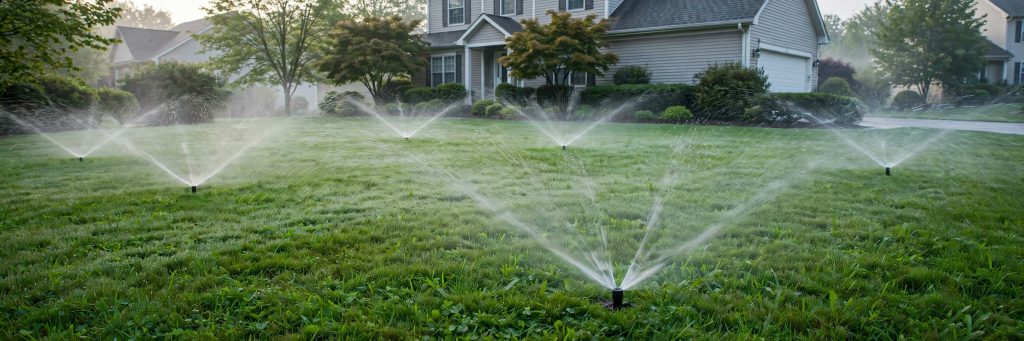
Minutes mean nothing until you know output. Sprinkler output varies widely by type, nozzle, spacing, and water pressure, so the container test is the only reliable way to know what your system delivers. Choosing a sprinkler that covers your lawn shape evenly also makes every runtime below easier to hit.
Step 1: Place Straight Sided Containers Across the Zone
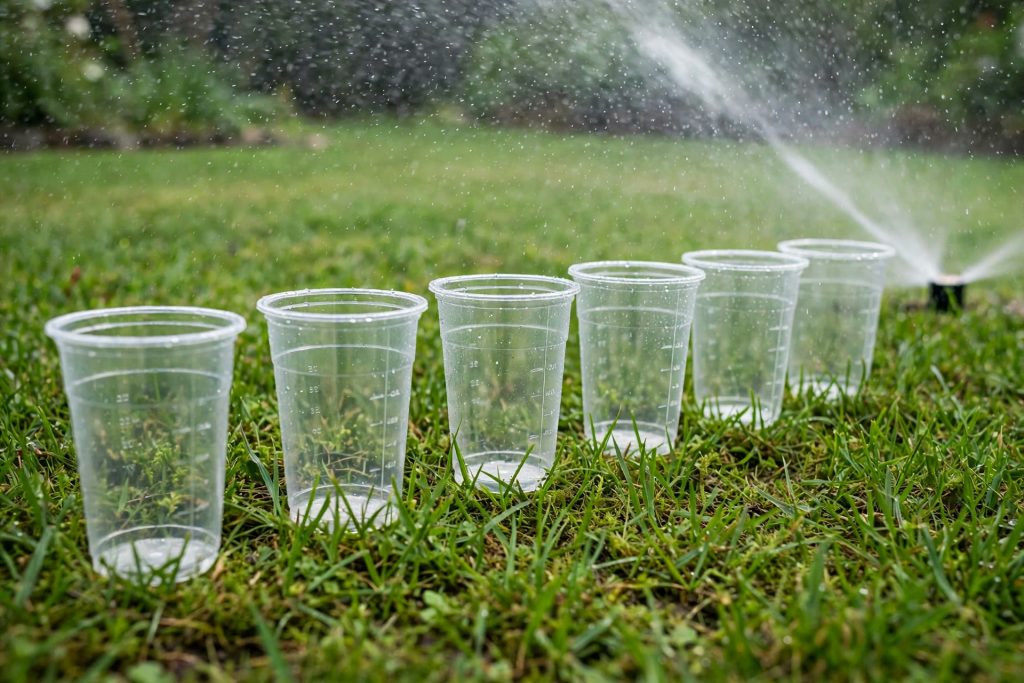
Set out five or six identical straight-sided cans across the watered area — one near the head, one at the pattern’s edge.
Step 2: Run the Sprinkler for a Timed Period
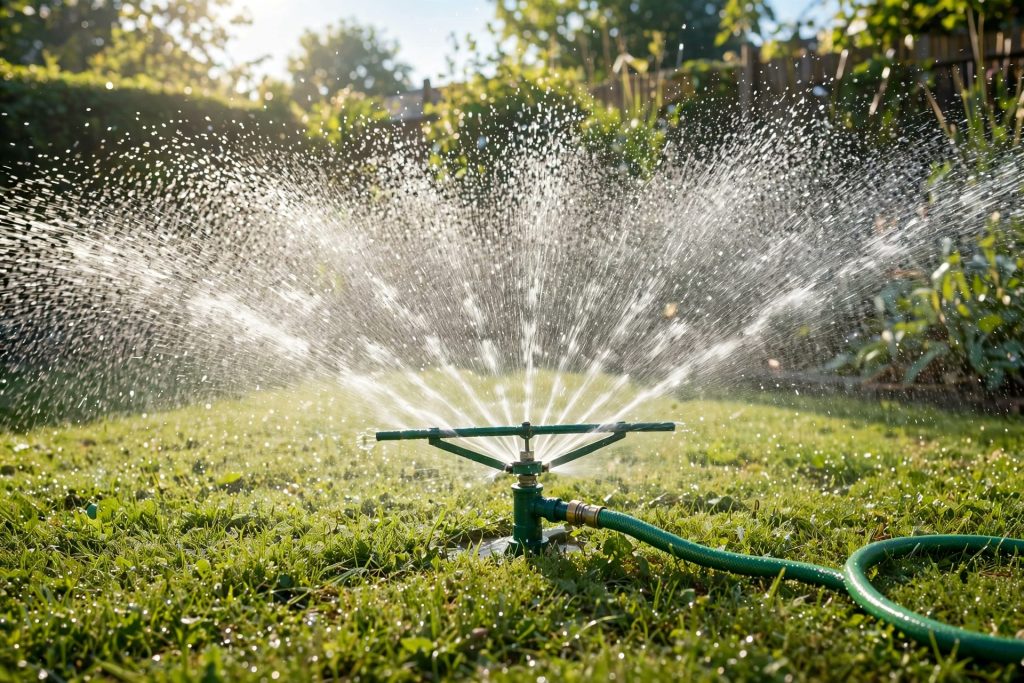
Run the zone for exactly 15 minutes at normal pressure and settings — changing them changes the answer.
Step 3: Measure and Average the Depth
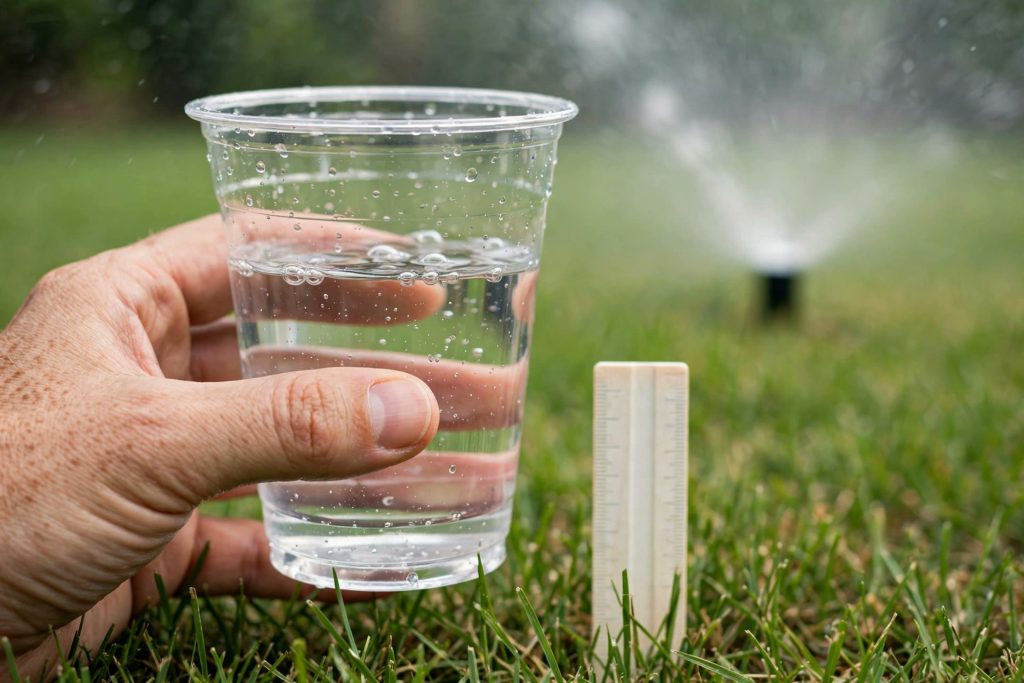
Measure the depth in each container with a ruler, average them, and note the lowest reading — a big gap between the lowest and the average means uneven coverage.
Step 4: Work Out Your Runtime
Multiply the 15-minute average by four to get the output per hour. Example: 0.25 inch in 15 minutes equals about 1 inch per hour, so a 0.5-inch session takes about 30 minutes; 0.06 inch means about 0.25 inch per hour, so the same session takes about two hours — split into cycles if runoff starts. Write the result down and repeat for each zone.
Best Time of Day to Water
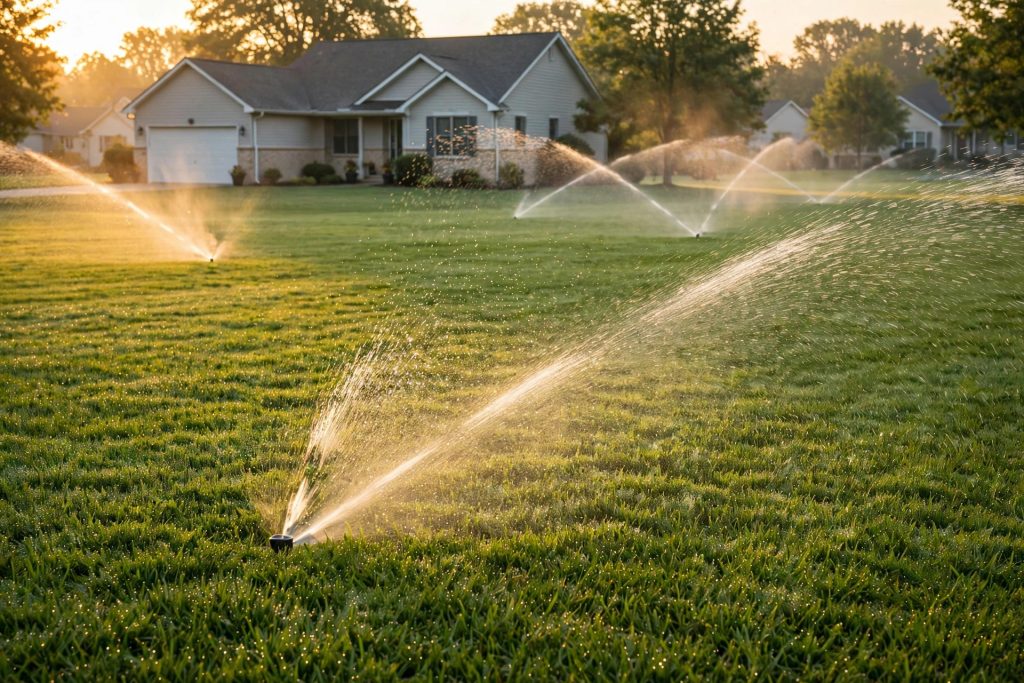
Early morning, roughly 4 am to 8 am, is the best time to water: it is cooler, the wind is usually low, and the grass dries soon after sunrise, which keeps disease pressure down. Midday watering loses the most to heat and wind, while evening watering leaves blades wet for hours and encourages disease.
If water pools or runs off, stop, let it soak in, and restart later. Cycle and soak is essential on clay soil and on slopes.
Watering New Seed and Overseeded Lawns
New seed breaks the deep-and-infrequent rule: keep the seedbed consistently moist with light watering once or twice a day until germination, then taper over two to three weeks — from daily to every other day, then to one or two deep sessions a week as roots grow deeper.
New sod is the middle case: keep the sod and the soil beneath it moist for the first two weeks, check that water is reaching the soil under the sod, then shift to deep and infrequent watering as the roots knit.
Adjusting for Soil Type and Grass Type
Sandy soil drains fast: use shorter, slightly more frequent sessions, and check moisture 4 to 6 inches down before watering again.
Loam is the easiest case: one or two deep sessions a week usually work. Cool-season grasses such as Kentucky bluegrass and fescue use the most water in spring and fall, and may go semi-dormant in summer heat.
Warm season grasses such as Bermuda, zoysia, and St Augustine handle heat better. In hot climates they often do well with roughly 1 inch every five to seven days in peak summer, still given in deep sessions — treat that as a range, not a fixed schedule, and adjust for heatwaves, humidity, and rainfall.
Shade stays moist longer and needs less irrigation than full sun, so put shaded zones on a shorter runtime if you can.
Signs of Too Little and Too Much Water
Use this diagnosis table before changing your schedule — look at the pattern across the lawn, not a single spot, because isolated damage often has another cause.
| What you see | Likely cause | Quick check | The fix |
|---|---|---|---|
| Blades fold, color dull bluish green, footprints stay | Too little water | Screwdriver hard to push 6 inches | Water deeply that morning, resume weekly target |
| Brown crispy patches in hot weather | Drought stress or dormancy | Soil dry several inches down, crowns firm | Soak deeply or let cool season lawn stay dormant, do not fertilize |
| Yellow patches, spongy feel, mushrooms | Too much water | Soil soggy a day after watering | Skip sessions, let soil dry, check leaks and long runtimes |
| Runoff, puddles, water on pavement | Application faster than soil absorbs | Runoff starts within minutes | Cycle and soak, shorten cycles, adjust heads |
| Shallow roots, lawn stresses quickly | Frequent light watering | Roots mostly in top inch | Switch to one or two deep sessions a week |
Screwdriver test: after watering, a long screwdriver should slide 6 to 8 inches into moist soil easily.
Fall Watering: When to Reduce and When to Stop
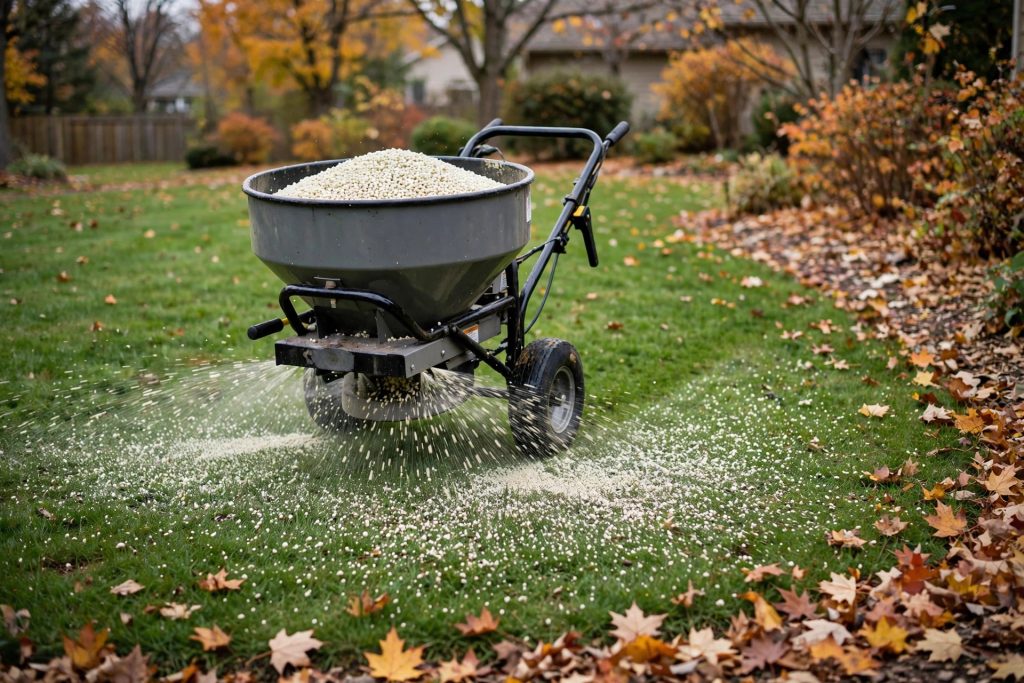
Keep watering in early fall while the lawn is still actively growing and recovering, especially after aerating or overseeding — fall is prime root-growth time for cool-season lawns, and steady moisture now does more for next year’s lawn than extra water in midsummer.
Reduce watering as temperatures cool and rainfall becomes more reliable. Stop regular irrigation when growth stalls, the ground stays consistently cold, or local rules require winterising. Warm-season lawns need cutting back as they go dormant and turn brown, with little irrigation after that except in a long dry winter spell.
Before the first hard freeze, drain or winterise irrigation lines if your climate requires it, and disconnect hoses so trapped water can’t crack fittings.

Common Watering Mistakes
Watering every day for 10 minutes. Short daily sessions wet only the surface, so roots stay near the top and the lawn stresses quickly in heat — then needs water again the next day.
Never measuring output. Thirty minutes can mean 0.15 inch on one system and 0.75 inch on another — minutes on a timer tell you nothing until you have measured what your system delivers.
Ignoring rainfall. A timer does not know it rained last night — running a full session straight after useful rain wastes water and keeps soil too wet, so check the gauge first.
Watering at night. Watering after dark leaves blades wet for hours, which invites fungus — shift it to early morning so the lawn dries quickly after sunrise.
Watering pavement. Misaligned or tilted heads send water onto paths and driveways while the lawn stays thirsty — adjust the heads and recheck coverage.
A Simple Weekly Routine You Can Follow
On Monday morning, check the rain gauge and soil moisture. If rain has already covered the weekly target and the lawn shows no stress, skip watering; otherwise run each zone for the container-test runtime for 0.5 inch, early in the morning — splitting into two shorter cycles on clay or slopes so water soaks in.
Later in the week, check for footprints that stay visible and blades that fold or curl — add a second session only if those signs show and the soil is dry at depth. Monthly, walk the system while it runs to spot leaks, tilted heads, and dry edges, and redo a quick container check if a nozzle or the water pressure changed.
Final Thoughts
A good watering schedule is measured and deep: about an inch a week including rain, in one or two early-morning sessions adjusted for soil and grass type. Measure output once, keep a rain gauge, and let the lawn tell you when to skip or add a session. New seed is the one exception: water lightly and often until established, then move back to deep watering gradually.
References
- Cornell University Integrated Pest Management, Watering Your Lawn – Supports the one inch per week target in one or two applications, and the early morning watering window.
- University of Georgia Extension, Water Your Lawn Wisely This Summer – Supports the one inch rule, the thirst signs such as footprints staying visible and folded blades, and checking your own sprinkler output.
- University of Georgia Extension, Water by Inch Is Trusty Rule of Thumb for Lawns – Supports the container test, the rough quarter inch per hour output many systems deliver, and soaking the soil 6 to 8 inches deep.
- NC State Extension, Tall Fescue and Kentucky Bluegrass Home Lawn Calendar – Supports the one inch weekly guide for fescue and bluegrass, watering several inches deep, half an inch every third day on sandy soil, and cycling clay soil until runoff starts.
- US EPA WaterSense, Watering Tips – Supports the can test with a half inch twice a week as a starting pattern, cycle and soak on clay and slopes, and the risks of overwatering.
- Utah State University Extension, Simple Sprinkler Performance Testing – Supports the catch can layout, measuring the depth caught, and working out the precipitation rate.
Frequently Asked Questions
How often should I water my lawn each week?
Most established lawns usually do well with watering once or twice a week — about 1 inch in total including rainfall as a starting point. Sandy soil may need two or three shorter sessions, and clay soil is best split into cycles.
How long should I run sprinklers each time?
Long enough to apply about 0.5 inch per session: measure 15-minute output with the container test, multiply by four for the hourly rate, then divide 0.5 inch by that rate.
Is morning or evening better for watering?
Morning, roughly 4 am to 8 am: less evaporation than midday, blades dry in the morning sun, and lower disease pressure than night watering.
How much water does a lawn need per week?
About 1 to 1.5 inches per week including rainfall while actively growing — use 1 inch as the starting point and adjust for rain, heat, and soil.
How often should I water new grass seed?
Lightly once or twice a day. Keep the seedbed moist until germination, then taper over two to three weeks to every other day, and then to one or two deep sessions a week.
When should I stop watering in fall?
Reduce watering as growth slows and rainfall becomes reliable, and stop regular watering when the lawn stops growing or the ground stays consistently cold. Keep watering a fall overseeded lawn until the seedlings are established.

Thesis Link : https://saulibrary.edu.bd/daatj/public/uploads/BAU200601_19-Pp_5.pdf
- Lawn Watering Guide: How Much, How Long, How Often - October 16, 2026
- 10 Best Crack Weeders for Pavement - October 16, 2026
- How to Aerate a Lawn: Step by Step Guide - October 15, 2026