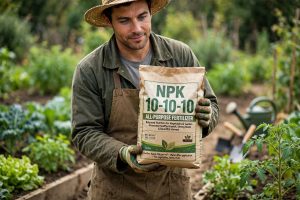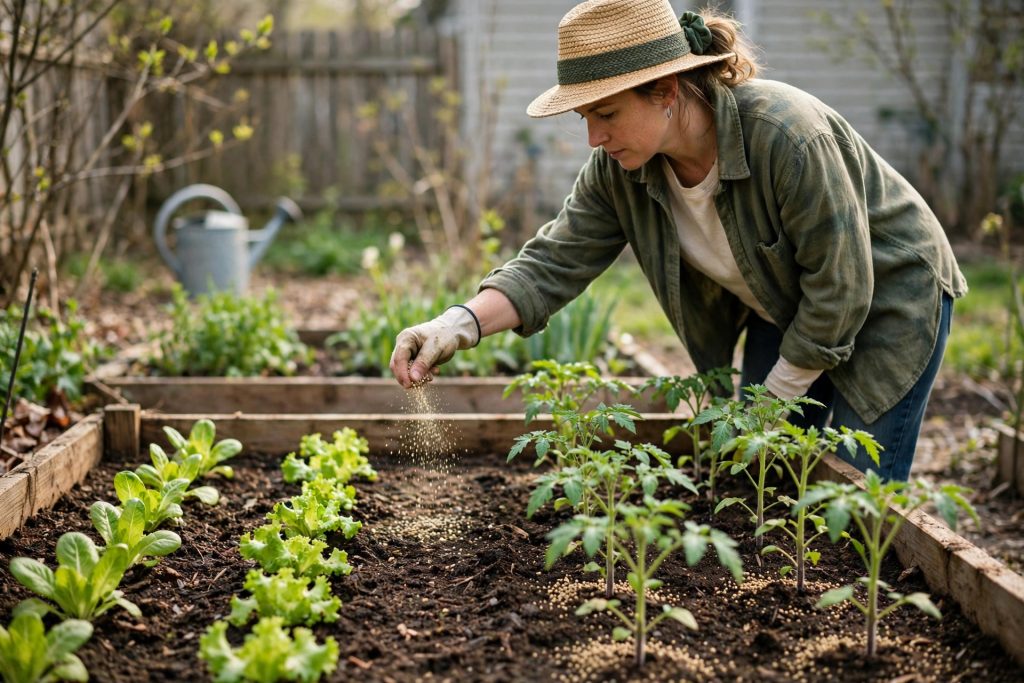

Most garden feeding problems are timing problems, not product problems. The same bag of fertilizer helps a tomato plant in June and hurts it in October, feeds lettuce well in spring and pushes it to bolt in a heat wave. Plants need different nutrients at different stages, and the calendar on the store display does not know what you planted, what your soil already holds, or whether your last frost is in March or in May.
This guide answers when to fertilize your garden by plant type and by season, for vegetable beds, flowers, perennials, roses, fruit trees, raised beds, and containers. The rule underneath all of it is simple: feed a plant when it is actively growing and can use the food, feed to what a soil test says it needs, and stop before the plant should be hardening off for winter.
The Short Answer: Feed to Growth, Not to the Calendar
If you only remember one section, remember this. Feed vegetables at planting and again when they hit their hungry growth stage. Feed flowers and perennials in spring as growth resumes. Feed roses and fruit trees in spring, and be careful with late season nitrogen. Feed containers little and often through the growing season. Stop feeding most garden plants as growth slows in fall, and never feed a stressed, dry, or dormant plant to “cheer it up.”
Fixed dates mislead because a warm March in Georgia and a cold March in Minnesota are not the same season. Watch the plant instead. New growth, flowering, and fruit set are the triggers. A soil test is the other trigger: it tells you whether the plant actually needs feeding at all, which matters because many garden soils already hold plenty of phosphorus and potassium, and adding more only builds up in the soil and washes away.
First, Test the Soil Before You Feed Anything
A soil test is the cheapest timing tool you own. University extension labs test pH and nutrient levels for a small fee, and the report replaces guessing with numbers. Vegetable crops grow best in soil with a pH of 6.5 to 6.8, according to the University of New Hampshire Cooperative Extension, and lime or wood ash added to correct acidity needs time to work. Lime works slowly, so fall is the practical time to apply it. Wood ash acts faster and can go on in spring before planting, but it is easy to overapply, so do not add it every year unless a test says you need it.
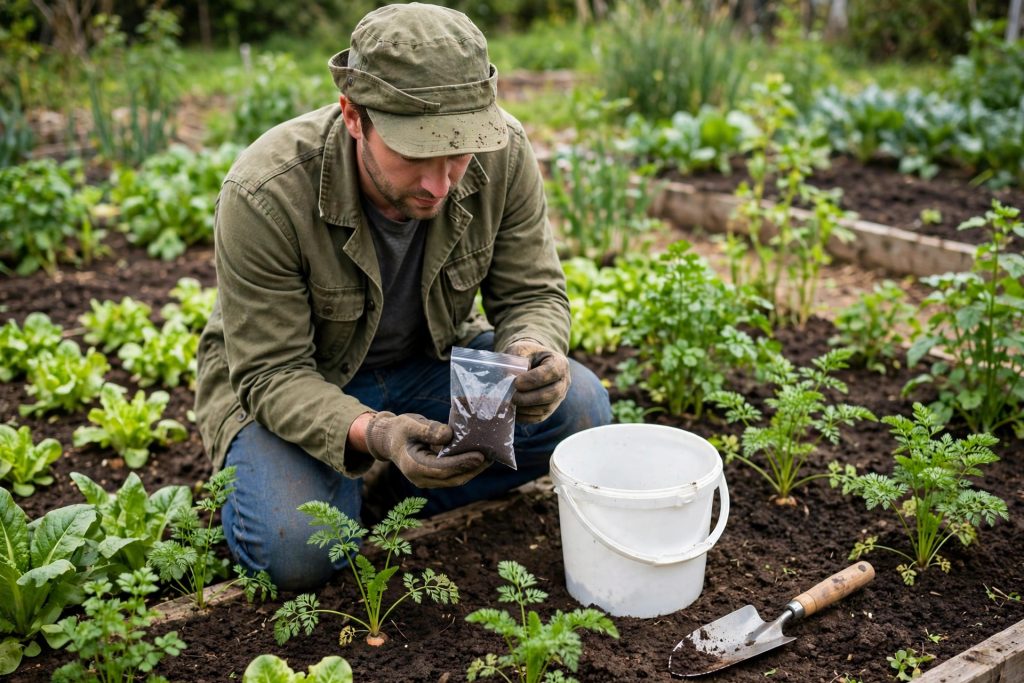
Test well before planting if you can. Clemson Extension advises taking the sample at least three months ahead of planting so lime has time to adjust the soil. If you missed that window, test anyway. A late test still beats a blind feeding, and it tells you whether the bed needs nitrogen at all or only one nutrient.
Where a test is not available, the general guidelines in this article are a safe starting point, not a prescription. Use the lower end of any range on rich soil, on beds heavy with compost, or where plants already look vigorous. Overfeeding causes more garden trouble than underfeeding: soft leggy growth, delayed flowering, burned roots, and nutrients lost to runoff.
Timing by Region: The Same Job on a Different Calendar
Every timing in this guide follows growth stages and frost dates, not fixed calendar dates. That is why the same advice lands differently in different regions. A warm March in Georgia and a cold March in Minnesota are not the same season, and a feeding date that is right in one place can be weeks early or weeks late in another.
In cold winter regions, the season is short. Spring feeding waits until the soil is workable and growth has actually resumed, and the fall stop comes earlier, before the first hard frost, so that tender new growth is not caught by freezing weather. Feeding on a date from a warmer region only pushes growth the cold will kill.
In mild winter regions, the season runs longer. Spring feeding starts earlier and the fall stop moves later, but the principle does not change: feed while the plant is actively growing, and stop when it slows down. Where winters stay mild, watch the plant rather than the month, and let a pause in growth be the stop signal.
Region is only half the local story. Soil changes timing inside a single region: sandy soil leaches nitrogen fast, so a sidedress there is split into two smaller doses, while clay holds a single sidedress longer. Before you move any date in this guide, check two local facts: your last spring frost and first fall frost dates, and your soil test. Your state extension service’s dates override any general date here. The timings for fruit trees, perennials, and fruiting vegetables in this guide are starting points in exactly that sense: they assume average soil and average weather, and your soil test and your local weather move them.
Vegetables: Preplant Feeding, Then a Sidedress at the Right Stage
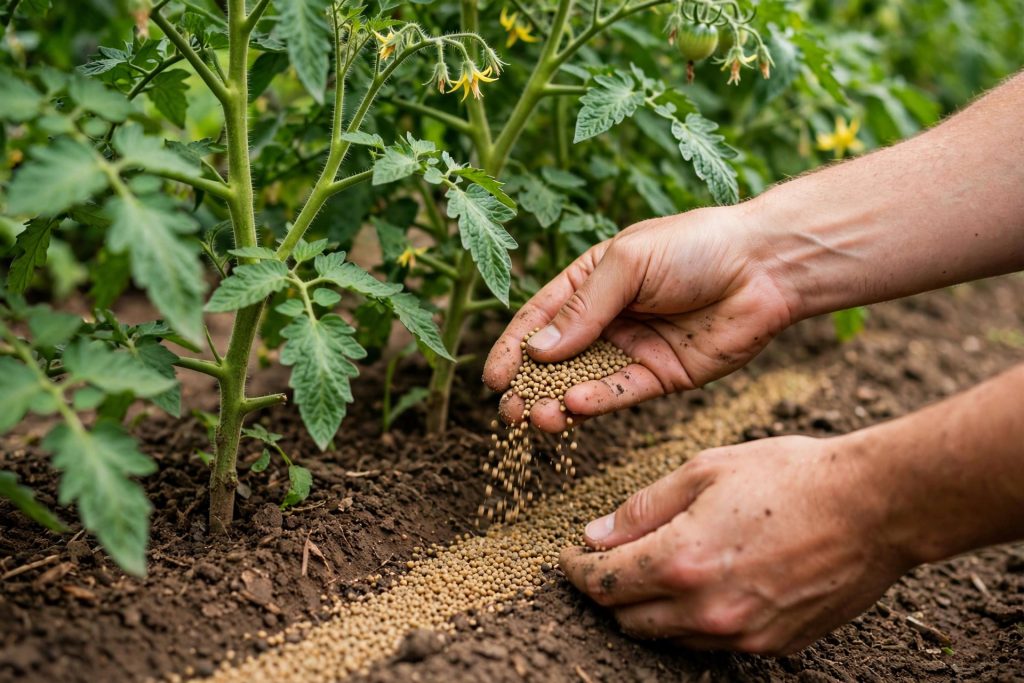
Vegetables are the hungriest part of most gardens, and they are also the part where timing matters most, because a vegetable plant changes what it needs as it grows. The pattern extension services repeat is a two step pattern: feed before planting, then sidedress, which means placing fertilizer in a band beside the growing plants, once they reach the stage where they need it most.
Before planting, work a complete fertilizer into the top few inches of soil. The University of New Hampshire advises incorporating fertilizer thoroughly within the top few inches before planting, and the University of Nevada, Reno Extension puts the depth at the upper 2 to 3 inches. Clemson Extension adds the split that makes the whole system work: put all the recommended phosphorus and potassium in before planting, along with only 30 to 40 percent of the recommended nitrogen. Nitrogen moves through soil and washes away, so holding part of it back for later is what keeps it available when the plant actually needs it.
How you split the rest depends on the fertilizer type. If you use an organic slow release fertilizer, the University of New Hampshire says the full amount can go in before planting, incorporated 4 to 6 inches deep in the rows or beds. If you use a synthetic or quick release fertilizer, apply half the total before planting and sidedress the remainder 4 to 6 weeks later.
What “later” means depends on the crop. The table below gives the usual sidedress moments. They are growth stages, not dates, so they work in any climate.
Table 1: Vegetable Timing by Crop Group
| Crop group | First feeding | Sidedress moment | Notes |
|---|---|---|---|
| Leafy greens (lettuce, kale, spinach) | Complete fertilizer worked in before planting | Light sidedress about 3 to 4 weeks after planting if growth is pale or slow | Nitrogen drives leaf growth here, so greens respond fastest to a sidedress |
| Brassicas (broccoli, cabbage, cauliflower) | Complete fertilizer worked in before planting | About 3 weeks after transplanting | A second sidedress 2 to 3 weeks later helps on sandy soil |
| Tomatoes, peppers, eggplant | Complete fertilizer worked in before planting | When plants begin to set fruit, then repeat every 2 to 3 weeks for tomatoes | Do not push heavy nitrogen before fruit set, or you get leaves instead of fruit |
| Cucumbers, squash, melons | Complete fertilizer worked in before planting | As vines begin to run and again at flowering | One sidedress at flowering is often enough |
| Sweet corn | Complete fertilizer worked in before planting | When plants are 8 to 10 inches tall, and again when tasseling begins | Corn is a heavy feeder and shows pale leaves quickly when short of nitrogen |
| Onions, garlic, potatoes | Complete fertilizer worked in before planting | Onions 4 to 6 weeks after planting; potatoes at last hilling, before blossoming | Keep fertilizer off the foliage and water it in |
| Root crops (carrots, beets, parsnips) | Complete fertilizer worked in before planting | Usually none needed | Too much nitrogen gives forked roots and big tops with small roots |
| Legumes (beans, peas) | Complete fertilizer worked in before planting | Usually none needed | Legumes fix much of their own nitrogen, and extra nitrogen delays pods |
| Asparagus (perennial vegetable) | Feed before new growth begins in spring, or after harvest | Not a midseason sidedress crop | Established crowns feed on the spring application |
A few crops never need the second step. The Nevada Extension notes that a single preplant feeding carries beets, carrots, beans, and peas through the season. That is worth remembering, because the most common vegetable feeding mistake is treating every row the same and sidedressing the carrots just because the tomatoes got fed.
On sandy soil, split the sidedress itself. Clemson Extension advises two smaller sidedress applications on sandy soil, the first 3 weeks after planting and the second 3 to 4 weeks later, because nitrogen leaches out of sand faster than out of loam or clay. On clay soil, one sidedress usually holds longer, and the risk is compaction and waterlogging rather than leaching.
How to Sidedress Without Burning Plants
Sidedressing is a simple technique, and most of the damage comes from placing fertilizer in the wrong spot. Keep dry fertilizer 3 to 6 inches to one side of the row, or in a circle around an individual plant at about its drip line, which is the distance from the base that the furthest branches reach. The Nevada Extension gives 3 to 6 inches to the side of the row, and Clemson gives 4 to 6 inches away from the plants. Either way, the point is the same: never pile fertilizer against the stem, and never leave it sitting on the leaves.
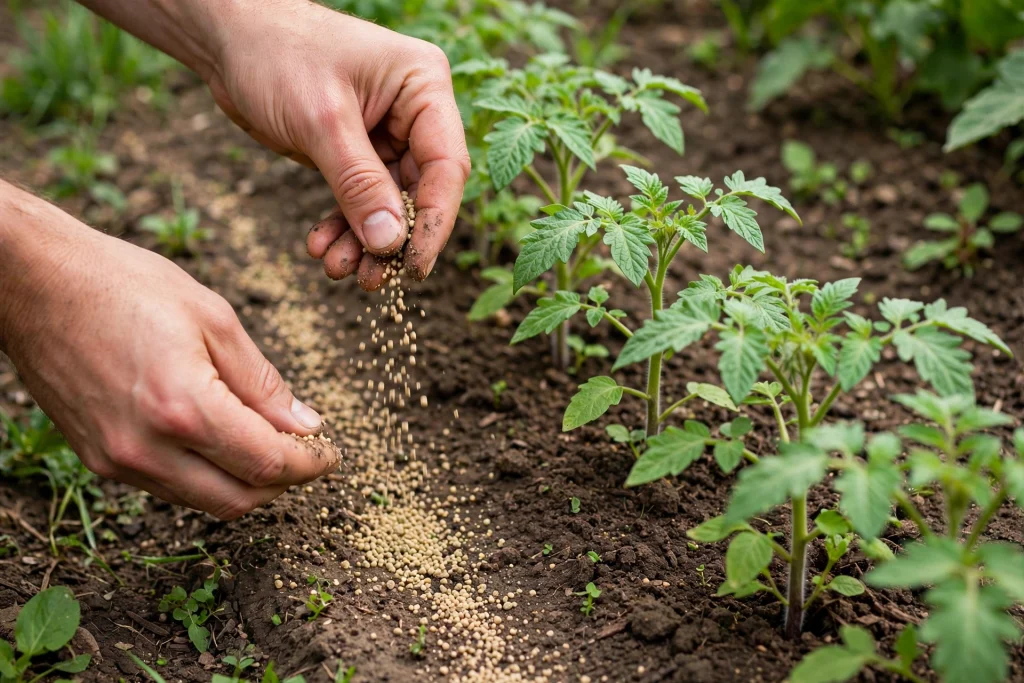
Water it in after applying. Moisture carries the nutrients into the root zone and washes granules off foliage, which is how you avoid leaf burn. If you broadcast fertilizer rather than banding it, water overhead right after so granules do not sit on leaves. And never sidedress dry soil in a drought. Fertilizer needs soil moisture to work, and a plant that cannot take up water cannot take up nutrients either. Moisten the soil first, feed, and water again lightly.
Watch the plant after a sidedress. Nitrogen response usually shows within about a week when soil moisture is adequate. Pale green or yellow leaves with slowed growth are the classic sign of nitrogen shortage, and that is the plant asking for food. But yellow leaves have other causes too, including overwatering, compacted soil, and disease, so if a plant looks sick rather than just pale and slow, check water and drainage before reaching for fertilizer.
Flowers and Annuals: Light, Regular Feeding Through Bloom
Annual flowers are short season plants that bloom hard and then finish, so they like steady, light feeding rather than one heavy dose. Feed at planting with a complete fertilizer worked into the bed, then sidedress lightly every few weeks while they are actively blooming. Liquid feed works well here because it acts fast and is easy to dose lightly.
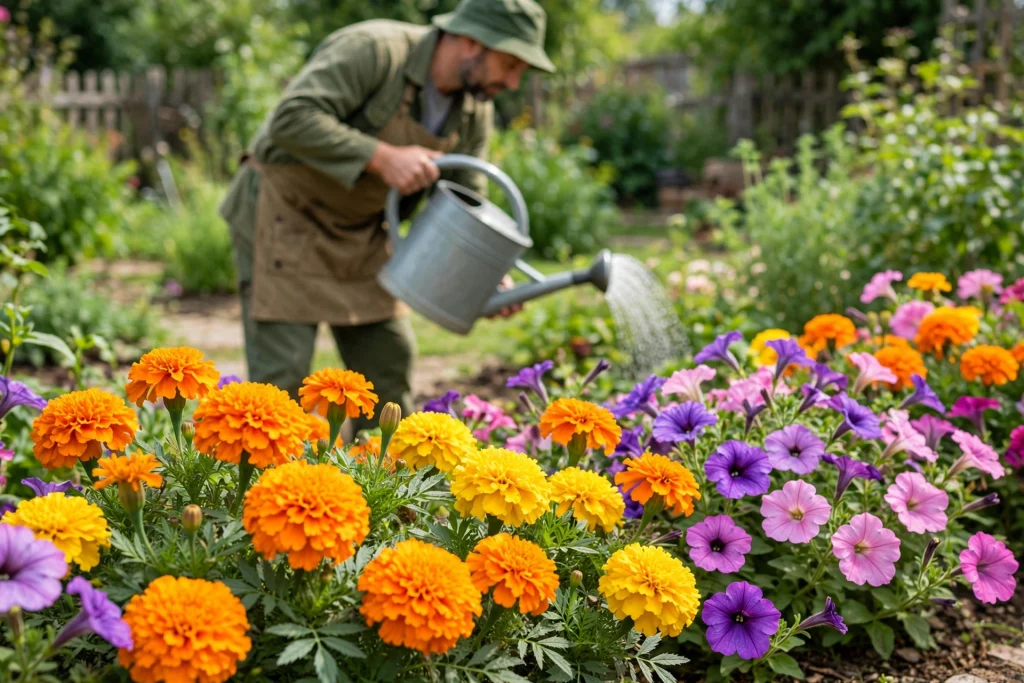
There is one caution that surprises new gardeners: too much nitrogen on flowering annuals gives lush leaves and poor, delayed flowering. If a petunia bed is all foliage and no flowers, the usual suspect is heavy nitrogen, not a lack of it. Some annuals, including cosmos, marigolds, and nasturtiums, actually bloom better in poorer soil, so hold back on those and let them prove they need food before you feed again.
Stop feeding annuals as they wind down. There is no point pushing new growth on a plant that is finishing its season, and late nitrogen only produces soft growth that the first cold night will damage.
Perennials: One Spring Feeding, Then Leave Them Alone
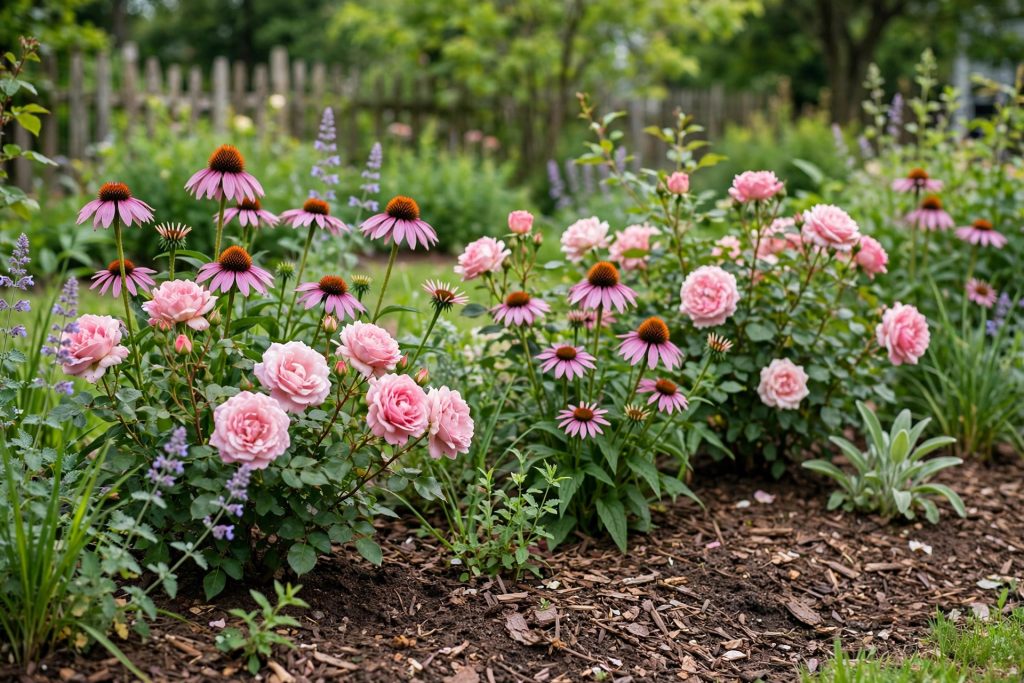
Perennials are the opposite of vegetables. Most need only one feeding a year, in early spring as new growth resumes, and many need none at all in a bed rich with compost. Feed after the soil has warmed and shoots are actively growing, not while the plant is still dormant. A slow release or organic fertilizer worked lightly into the top of the soil, or a layer of compost, is usually enough for the whole season.
Then stop. As a rule of thumb, do not feed perennials after midsummer. Late nitrogen pushes tender new growth just when the plant should be hardening off for winter, and that soft growth is the first thing a frost damages. Some perennials, including yarrow, globe thistle, sages, speedwells, liatris, rudbeckias, baptisias, garden irises, moss phlox, and ornamental grasses, prefer poorer soil and bloom worse when fed heavily, so skip them unless they look genuinely starved.
Fall planted perennials are a special case: do not feed them in fall. A perennial planted in early fall has one job before winter, which is to grow feeder roots and settle in. Nitrogen in fall redirects its energy into leafy growth that winter will damage, and it can interfere with root establishment. Mulch the root zone instead, and wait until early spring to feed.
Roses, Fruit Trees, and Shrubs: Spring Feed, Fall Caution
Roses, fruit trees, and shrubs follow the same spring pattern, with a stricter fall rule. Feed roses as growth resumes in spring. Repeat flowering roses can take a second feeding after the first flush of blooms, but stop well before fall. A rose pushing fresh green shoots in late fall looks healthy, but that growth has not had time to harden before freezing weather, and it is easily damaged.
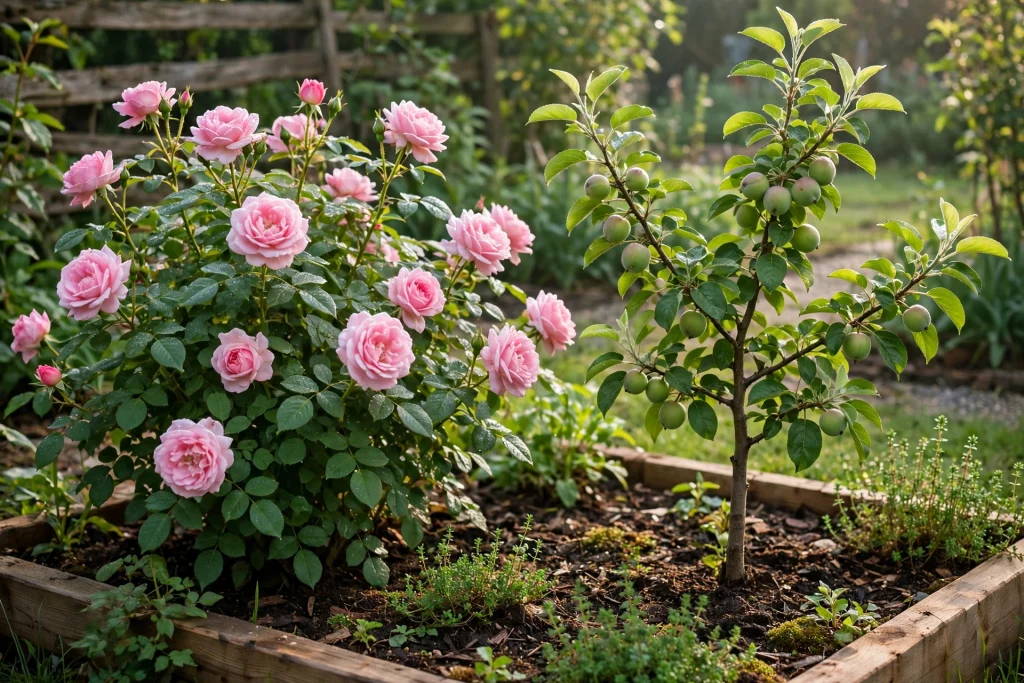
Fruit trees are even stricter. The University of Massachusetts advises against fertilizing fruit trees in fall because it may cause winter injury. Its timing for established trees is a single annual feeding sometime between mid April and early May, after growth has started. Newly planted trees and shrubs should not be fertilized at planting time at all. Plant them in soil rich with organic matter, let them establish for a season or two, and only then bring them into a feeding program.
For ornamental trees and shrubs generally, Massachusetts gives two safe windows: early spring, or late fall in October after top growth has ceased, and usually only every 2 or 3 years. The late fall window is different from feeding in early fall while shoots are still actively growing. Dormant wood can take nutrients intended for spring growth. Actively growing shoots cannot, because the nitrogen pushes growth that winter will kill. If you are unsure which window you are in, spring is the safer choice.
Raised Beds and Containers: Feed More Often, in Smaller Doses
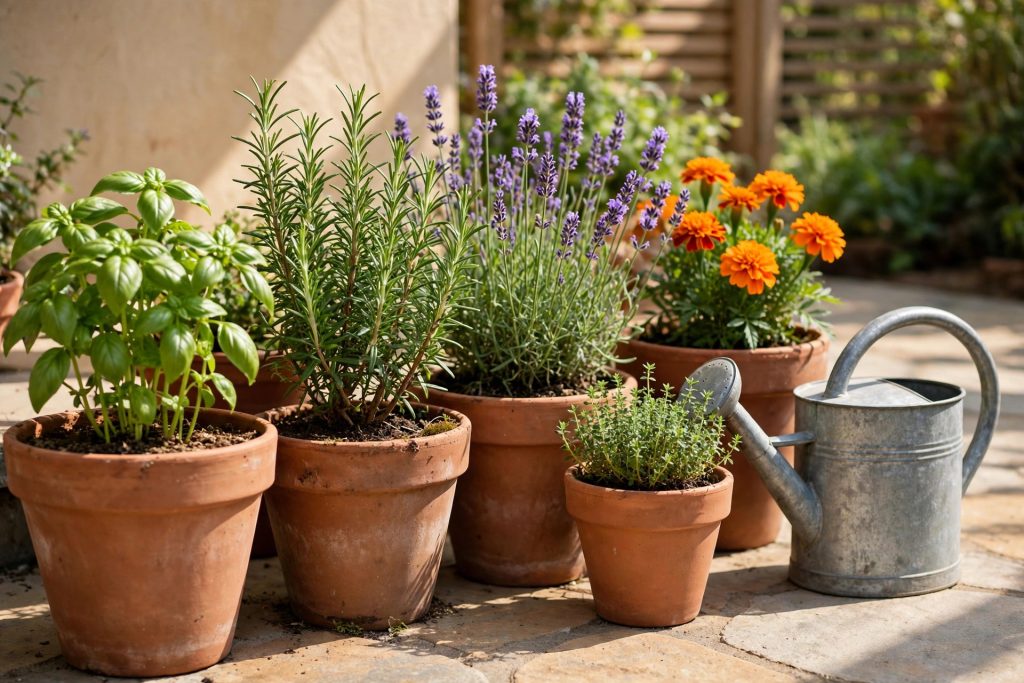
Raised beds and containers change the timing because they change how fast nutrients leave the soil. A raised bed drains faster than ground soil, and a container drains faster still. Every watering carries some nutrients out of the pot, so container plants run short sooner than the same plant in the ground, even when both were fed at planting.
The fix is smaller doses, more often, not bigger doses. For containers, use a liquid feed at half to full label strength during active growth, roughly every 1 to 2 weeks for heavy feeders like tomatoes and flowering annuals, and less often for herbs and slow growers. Slow release pellets mixed into the potting mix at planting cover the early weeks, and liquid feed takes over once growth picks up. Always water the pot first if the mix is dry, feed, and let excess drain away rather than letting the pot sit in fertilizer solution.
Raised beds sit between containers and ground beds. Feed at planting as usual, sidedress vegetables on the same schedule as ground beds, and expect to sidedress a little sooner on a fast draining mix, especially a mix heavy with perlite or coarse bark. Compost topped up each season helps here too, because organic matter holds nutrients in the root zone longer than a bare mineral mix.
Stop container feeding when growth slows, just as with ground plants. A container rose or perennial that keeps getting fed into fall will push soft growth with nowhere to harden, and a container vegetable that has finished fruiting needs no more food.
When to Stop Fertilizing in Fall
Fall is where most timing mistakes happen, because fall feels like a tidy-up season and feeding feels like care. For most garden plants, fall feeding should stop. Nitrogen applied while shoots are still growing pushes tender growth into cold weather. The exceptions are specific, and they prove the rule.
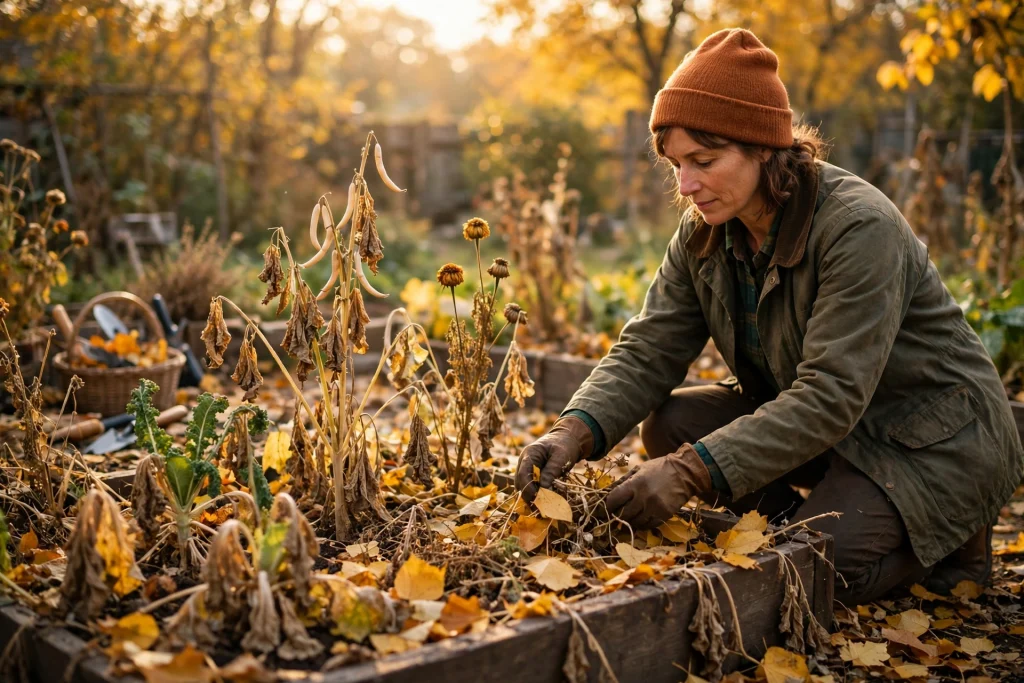
Lime is a fall job, not a fertilizer job. Lime works slowly, so applying it in fall gives it months to adjust soil pH before spring planting. Compost and well rotted manure worked into beds in fall are also sound, because soil microbes break them down over winter and release nutrients in time for spring gardening. That is feeding the soil, not forcing the plant, and it is the right kind of fall work.
The other exception is dormant woody plants, fed after top growth has fully ceased, as described above. Everything else, vegetables finishing their season, annuals winding down, perennials settling in, roses, and fruit trees, should be left alone. If a plant still looks hungry in fall, check whether the real problem is water, drainage, or disease, because a late dose of nitrogen will not fix any of those, and it may make winter damage worse.
Mistakes That Waste Fertilizer or Hurt Plants
The same handful of mistakes shows up in garden after garden. Feeding a dry plant burns roots, so moisten the soil first. Feeding during drought or extreme heat wastes fertilizer the plant cannot use, because growth has paused. Feeding a dormant plant does nothing, because there are no active roots to take it up. Feeding every plant on the same schedule overfeeds the light feeders and starves the heavy ones. And feeding by the calendar instead of by growth stage puts nitrogen down weeks before the plant wants it, by which time much of it has washed away.
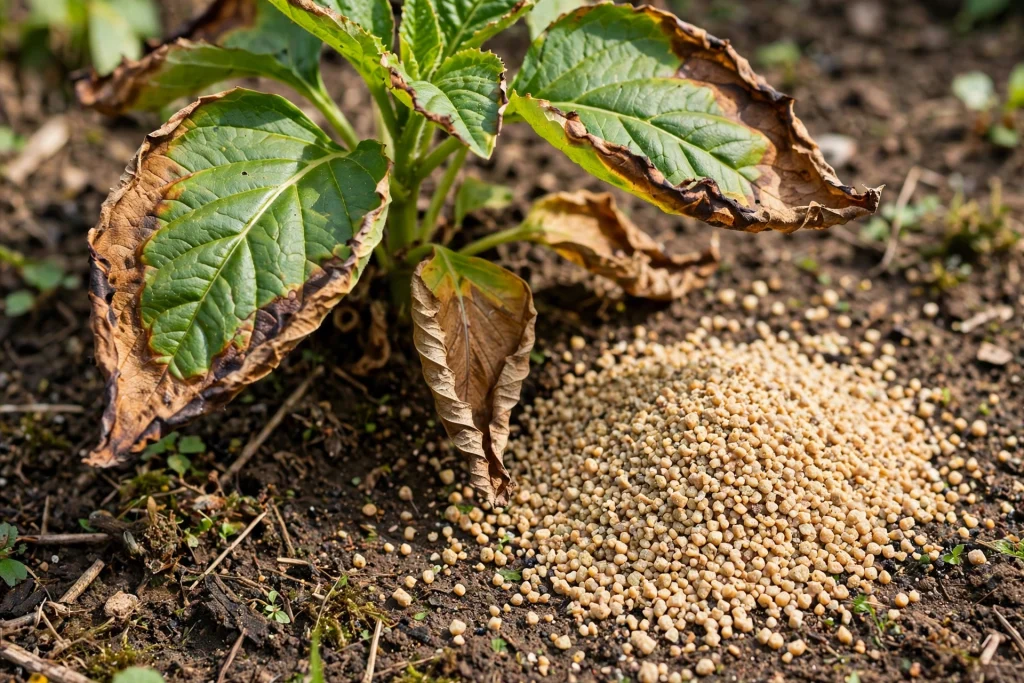
A related mistake is feeding to fix a problem that is not hunger. Yellow leaves, poor flowering, and weak growth all have many causes. Before you feed, check the simple ones: is the soil dry or waterlogged, is the plant rootbound in its pot, is it getting enough light, and does a soil test show an actual shortage? Fertilizer is not a cure-all, and the Massachusetts guidance says so plainly. Used at the right time, it is one of the best tools in the garden. Used at the wrong time, it is just expensive runoff.
What the NPK Numbers Mean
Timing decides when to feed, but the bag decides what you feed. Every fertilizer bag carries three numbers, always in the same order: nitrogen (N), phosphorus (P), and potassium (K). Those numbers are percentages by weight: nitrogen, phosphate, and potash. A 10 pound bag of 10-10-10 carries 1 pound of each. The ratio between the numbers tells you which nutrient the blend emphasizes.
| Ratio | What it means | When it fits |
|---|---|---|
| 10-10-10 | Balanced: 10 percent nitrogen, 10 percent phosphate, 10 percent potash | General purpose feeding where a soil test shows no single shortage. |
| 5-10-10 | Lower nitrogen, higher phosphate and potash relative to nitrogen | Flowering and fruiting stage, such as tomatoes once flowering starts, or soil that already holds enough nitrogen. |
| High nitrogen blend, first number highest | Nitrogen led, for leafy growth | Leafy greens and lawns, only where a soil test supports extra nitrogen. |
No ratio replaces a soil test. If your soil already holds plenty of phosphorus and potassium, even a balanced blend adds nutrients that only build up and wash away. Match the ratio to the plant’s stage and to what the test says is short, and when in doubt, ask your local extension service which ratio fits your soil.
A Season Calendar You Can Copy
Table 2: Garden Fertilizing Calendar
| Season | Vegetables | Flowers and perennials | Roses, trees, and shrubs |
|---|---|---|---|
| Fall (before planting season) | Work compost and lime into beds; take a soil test | Mulch perennial beds; do not feed fall planted perennials | Lime only if a test calls for it; dormant woody feeding only after top growth has ceased |
| Early spring | Work complete fertilizer into beds before planting | Feed perennials as new growth resumes | Feed established trees and fruit trees mid April to early May |
| Late spring | Sidedress vegetables 3 to 4 weeks after planting | Light feeding for annuals as blooming starts | Second rose feeding after the first bloom flush for repeat flowerers |
| Summer | Sidedress heavy feeders at flowering and fruit set; repeat tomatoes every 2 to 3 weeks | Light liquid feeding for annuals through bloom; stop perennials by midsummer | No feeding for fruit trees or shrubs in summer heat |
| Fall (end of season) | Stop feeding as crops finish; work compost into empty beds | Stop all feeding as growth slows | Stop feeding; do not fertilize fruit trees in fall |
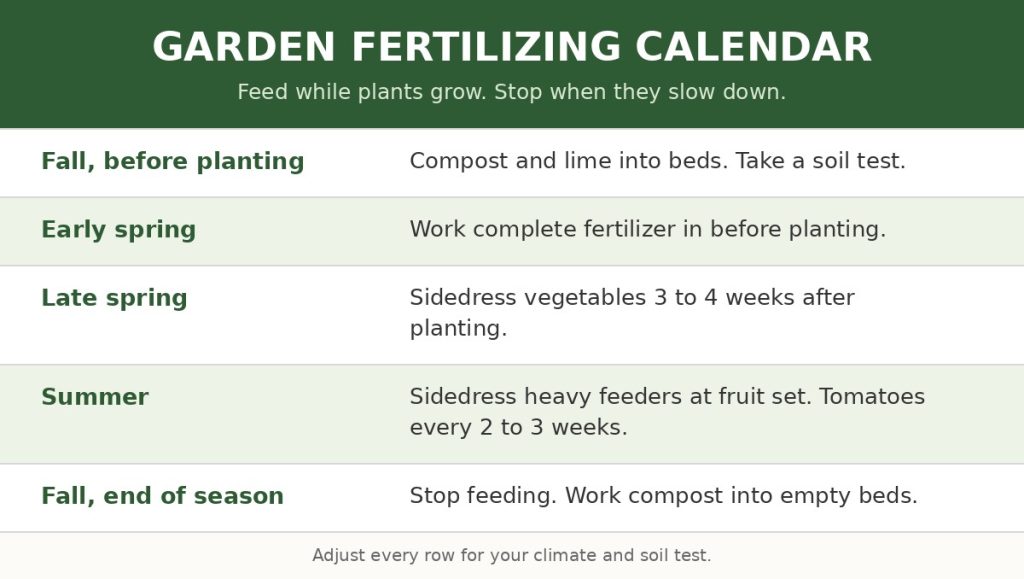
Adjust every row for your climate. In mild winter areas, the growing season runs longer and the stop date moves later, but the principle does not change: feed while the plant is actively growing, and stop when it slows down.
Final Thoughts
Knowing when to fertilize your garden comes down to watching the plant and trusting the soil test more than the calendar. Feed vegetables at planting and again at their hungry stage. Feed flowers lightly through bloom. Feed perennials and woody plants in spring, and leave them alone after that. Feed containers little and often. Stop in fall, except for lime, compost, and dormant wood.
If you take one habit from this guide, make it this: before every feeding, ask whether the plant is actively growing and whether the soil actually needs it. When both answers are yes, feed, water it in, and walk away. The garden will do the rest.
How to Test Garden Soil: Step by Step Guide
This guide walks through testing garden soil step by step.
How to Read a Soil Test Report: A Garden Guide
This guide explains how to read the numbers on a soil test report.
How to Improve Clay Soil: A Garden Guide
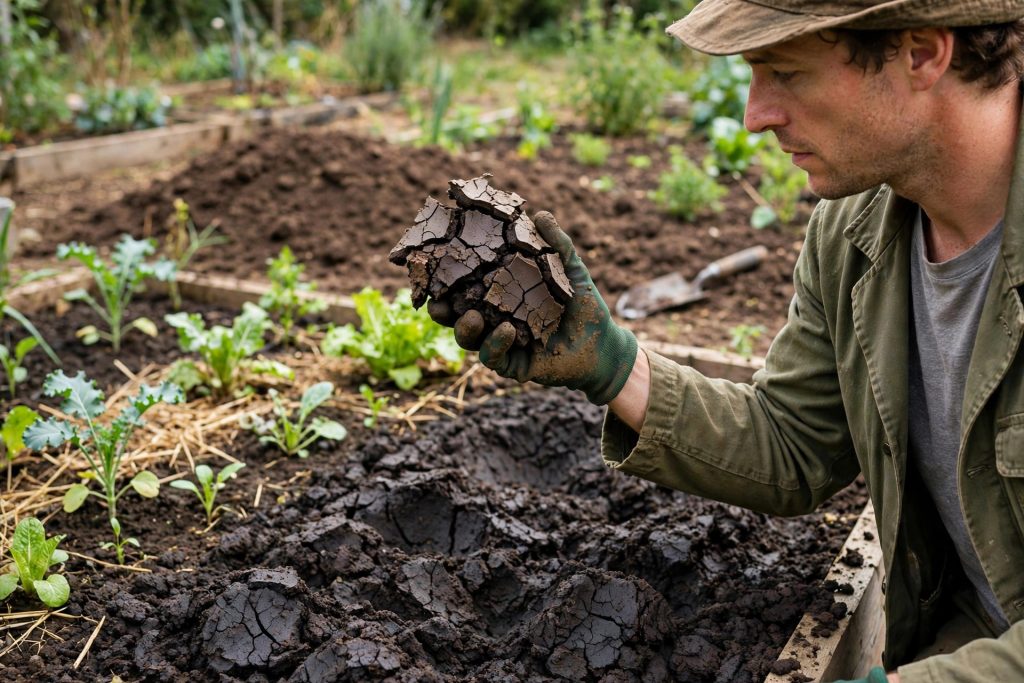
This guide shows practical ways to improve heavy clay soil.
How to Improve Sandy Soil: A Garden Guide
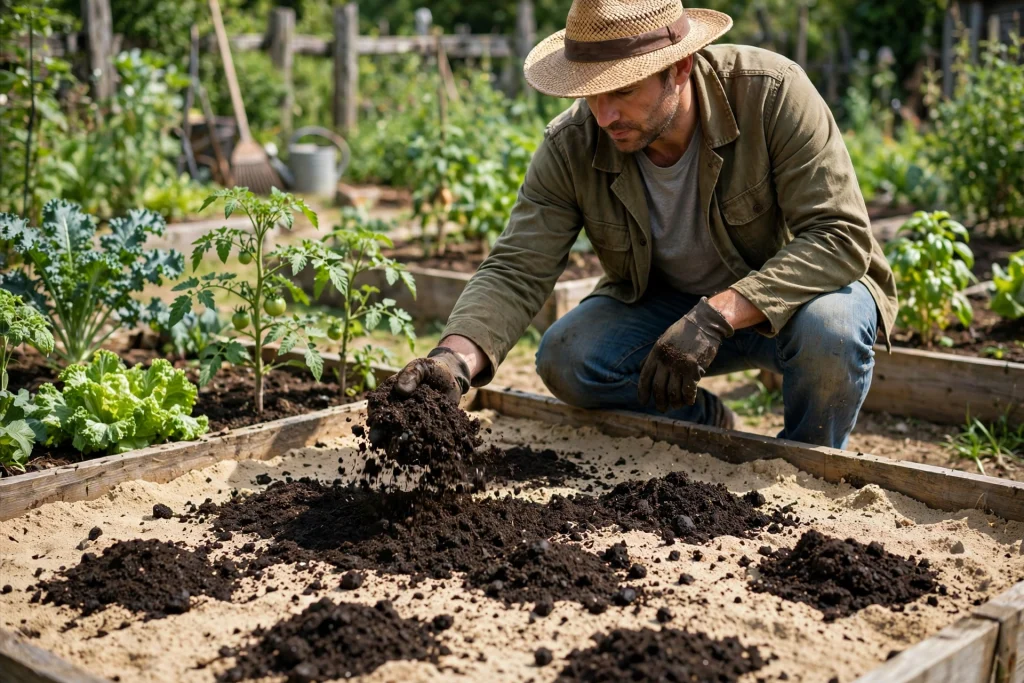
This guide shows practical ways to improve fast draining sandy soil.
References
- University of New Hampshire Cooperative Extension, Fertilizing Vegetable Gardens: https://extension.unh.edu/resource/fertilizing-vegetable-gardens-fact-sheet
- Clemson Cooperative Extension, Recommendations for Liming and Fertilizing Vegetables: https://hgic.clemson.edu/factsheet/fertilizing-vegetables/
- University of Nevada, Reno Extension, Fertilizing Your Vegetable Garden: https://extension.unr.edu/small-business-education/pub.aspx?PubID=3167
- University of Missouri Integrated Pest Management, Side-Dressing: Mid-season Boost for Hungry Plants: https://ipm.missouri.edu/meg/2024/6/side_dressing-dt/
- University of Massachusetts Amherst, Center for Agriculture, Food, and the Environment, Fertilizing Guidelines: https://www.umass.edu/agriculture-food-environment/home-lawn-garden/fact-sheets/fertilizing-guidelines
- Clemson Cooperative Extension, Understanding Your Soil Test Report: https://blogs.clemson.edu/fnr/2023/03/27/understanding-your-soil-test-report/
Frequently Asked Questions
When should I fertilize my vegetable garden for the first time?
Work a complete fertilizer into the top few inches of soil before planting, with all the phosphorus and potassium and only part of the nitrogen. Hold the rest of the nitrogen back for a sidedress 3 to 4 weeks after planting, or at the crop’s hungry stage, such as fruit set for tomatoes.
How often should I sidedress tomatoes?
Sidedress tomatoes when plants begin to set fruit, then repeat every 2 to 3 weeks through the fruiting season. Avoid heavy nitrogen before fruit set, or the plant puts its energy into leaves instead of fruit.
Should I fertilize my garden in fall?
For most plants, no. Stop nitrogen as growth slows in fall, and do not fertilize fruit trees in fall. Lime and compost are the useful fall jobs, because lime needs months to adjust pH and compost breaks down over winter for spring. The only feeding exception is dormant woody plants after top growth has fully ceased.
Can I fertilize a dry garden?
No, not until you water first. Fertilizer on dry soil can burn roots, and a plant that cannot take up water cannot take up nutrients either. Moisten the soil, apply the fertilizer away from stems and foliage, and water it in lightly.
Do container plants need fertilizer more often than ground plants?
Yes. Watering washes nutrients out of pots faster than out of ground beds, so containers need smaller, more frequent feedings during active growth, usually a liquid feed every 1 to 2 weeks for heavy feeders, and less for herbs and slow growers. Stop when growth slows in fall.
My plants look yellow, so should I feed them right away?
Not always. Pale leaves with slow growth can mean nitrogen shortage, and a sidedress usually helps within about a week. But yellow leaves also come from overwatering, compacted soil, and disease. Check water and drainage first, and get a soil test if the problem keeps coming back, before adding more fertilizer.

Thesis Link : https://saulibrary.edu.bd/daatj/public/uploads/BAU200601_19-Pp_5.pdf
- How to Harden Off Seedlings: A 10-Day Plan - November 3, 2026
- When to Fertilize Your Garden: Timing by Plant Type and Season - November 3, 2026
- Best Grow Shelves with Lights: 10 Picks for Seedlings - November 2, 2026