
A soil test report looks intimidating the first time you see one. Rows of abbreviations, numbers in different units, ratings like Low and Very High, and a recommendation section that seems written for a farm, not a backyard bed. Most gardeners do one of two things with it: they file it away and guess, or they buy a bag of balanced fertilizer and hope it covers everything.
Neither approach uses what you paid for. Learning how to read a soil test report takes about ten minutes once someone explains the order to read it in, and it can save you money, spare your plants from excess fertilizer, and stop you from fixing a problem your soil does not have. This guide walks through a typical lab report line by line, in plain language, with a worked example at the end.
Start Here: The 5 Minute Reading Order
Do not read a soil test report from the top left like a novel. Read it in this order: 1 Check the sample name and the crop or plant type listed. A report for your lawn does not apply to your vegetable bed. 2 Read the pH first. Soil pH controls how much of every other nutrient your plants can actually use. 3 Read the lime recommendation, if there is one. Lime is slow, so it goes down before fertilizer, ideally about two months before planting. 4 Read phosphorus and potassium, then calcium and magnesium. 5 Scan the micronutrients and the notes section last.
Fix the big items first. If you are learning how to read a soil test report for the first time, that order is the whole trick. One more rule: trust the rating more than the raw number. Labs use different extraction methods and different units, so the same soil can show a different number at two labs. The rating, Low, Medium, Optimum or High, is the lab telling you what that number means for your crop on your soil type. Penn State Extension makes the same point: the goal is the optimum range, and above optimum is not better than optimum.
What the Top of the Report Tells You
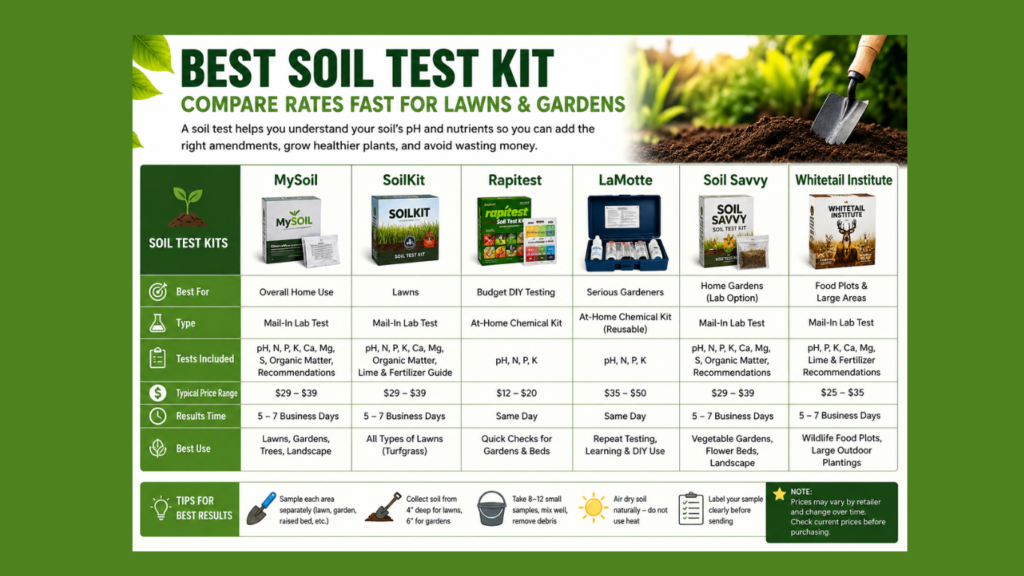
Check the sample name (make sure you are reading the right sheet for the right bed), the lab run date and sample date (vegetable gardens retested every one to two years, lawns and ornamental beds every two to three years once fertility is good), the crop or intended use (recommendations are calculated for that crop), and the units.
Units: ppm, Pounds per Acre, and Pounds per 1,000 Square Feet
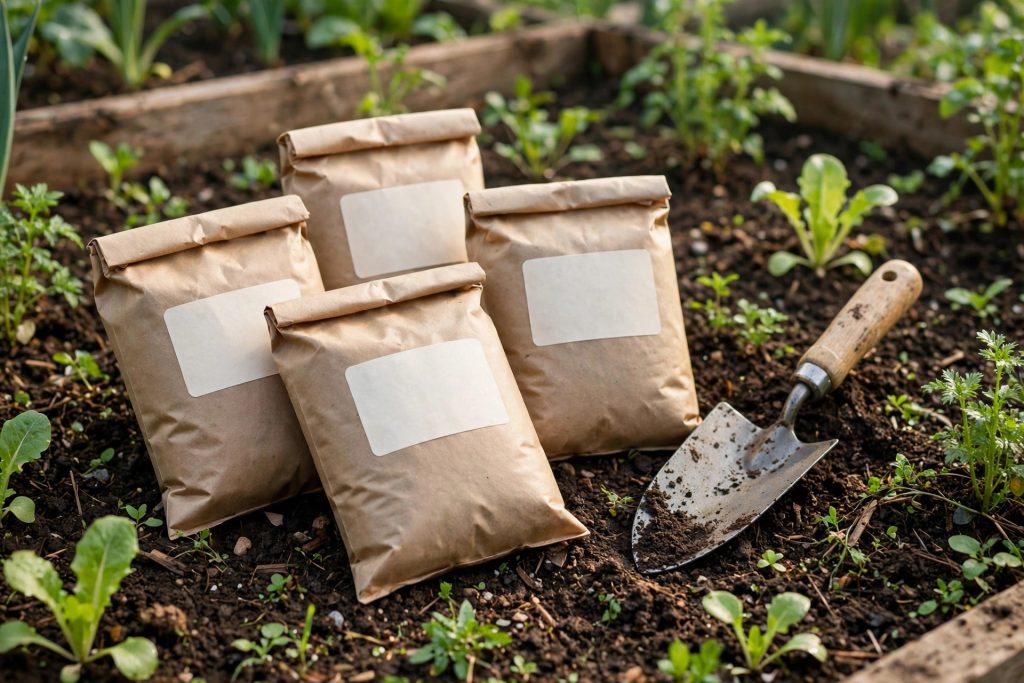
Parts per million (ppm) is a concentration. Pounds per acre is the same amount as weight over an acre. As a rule of thumb, 1 ppm in the top 6 to 7 inches of soil is often treated as about 2 pounds per acre. This rests on an assumed soil mass, the acre-furrow-slice of roughly 2 million pounds of topsoil, and it is an approximation, not an exact conversion.
Do not apply it indiscriminately: different labs, sampling depths, and test methods change the soil mass behind the number, so always use the units and recommendations printed on your own report. So 25 ppm phosphorus equals 50 pounds per acre. Some homeowner reports give recommendations in pounds per 1,000 square feet, which is the number you actually spread. Fertilizer recommendations list phosphorus as P2O5 and potassium as K2O, the forms printed on fertilizer bags, so use the report number and the bag number as they are.
Soil pH: Read This First, Fix This First
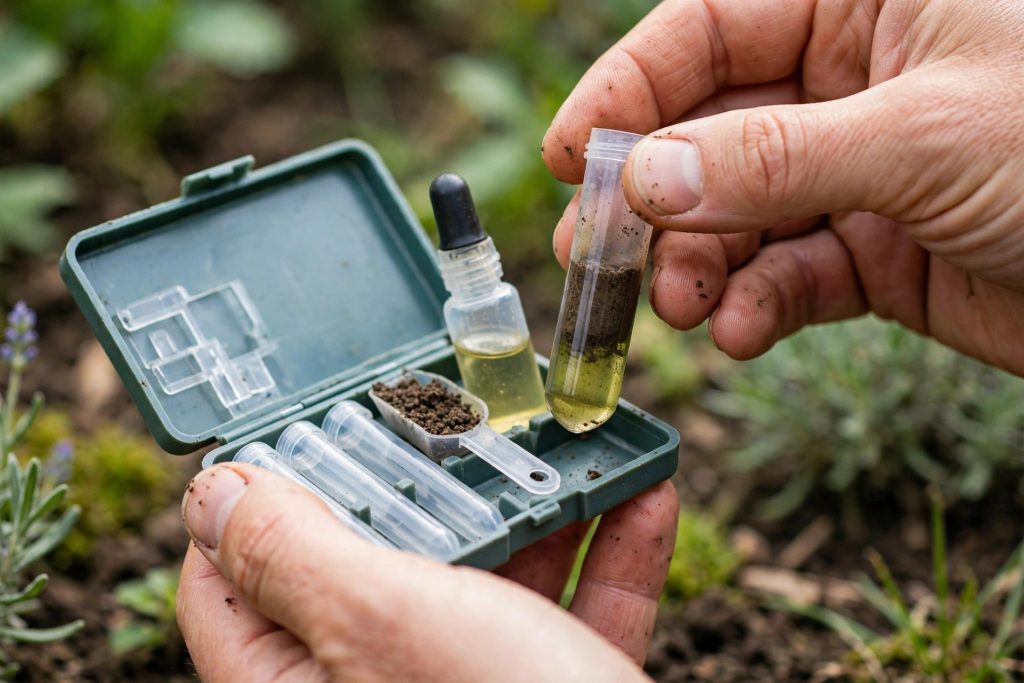
Soil pH measures acidity or alkalinity from 0 to 14, with 7 neutral. Most vegetables, lawns and garden flowers do best between about 6.0 and 7.0. Blueberries are the famous exception, preferring around 4.5 to 5.5. When pH sits outside the target range, nutrients can be locked up even when the soil test shows plenty of them. Iron, manganese and zinc become harder to take up above about 7.0, while phosphorus availability drops at both extremes. A pH below target usually calls for lime. A pH above target usually calls for elemental sulfur, which soil bacteria slowly convert to acid over several months. Neither works overnight, so retest after a season or two before adding more.
Buffer pH, Acidity, and Why Two pH Numbers Appear
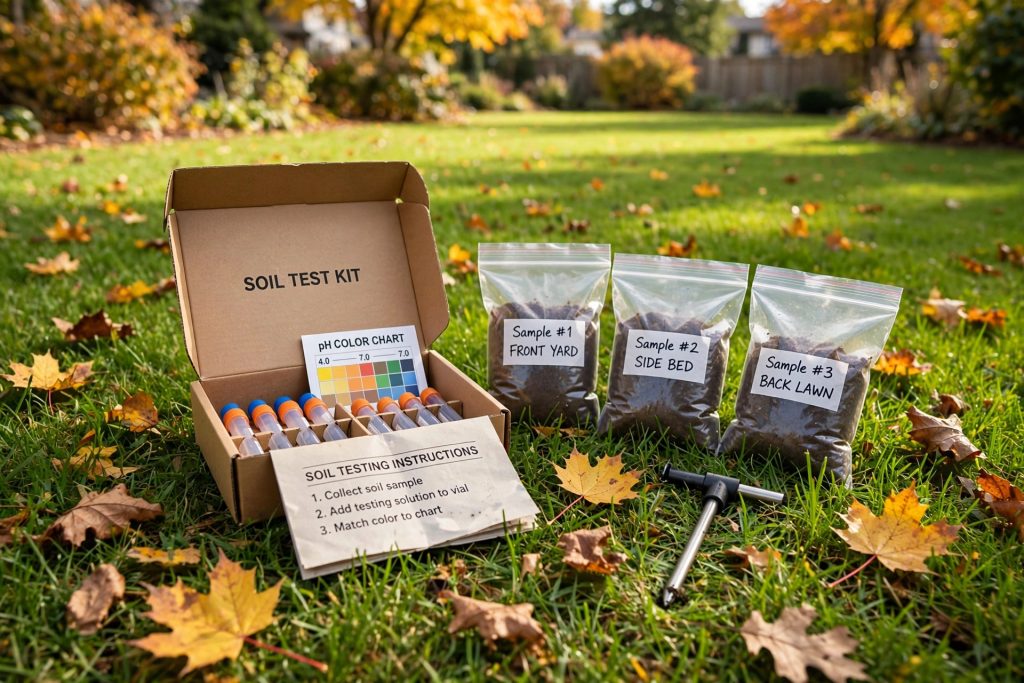
Soil pH is the acidity right now. Buffer pH comes from mixing your soil with a buffered solution and measures how much resistance your soil puts up against a pH change, which decides how much lime you need. Two soils can share a pH of 5.4 and need very different lime amounts, because heavy clay with organic matter buffers change far more than sandy soil. The lower the buffer pH, the more lime the lab recommends. If your report shows acidity in milliequivalents per 100 grams, that is the same idea in different units, not the pH itself. Use the lime recommendation the lab prints beside it.
Organic Matter and CEC: The Context Numbers
Organic matter (OM) is the percentage of soil made of decomposed plant and animal material. For most garden soils, 3 to 5 percent is healthy. Below 2 percent, soil holds water and nutrients poorly and benefits from steady compost. Above about 6 percent, drainage and nitrogen behavior deserve attention. Organic matter builds slowly over years with compost, mulch and cover crops. Cation exchange capacity (CEC), in milliequivalents per 100 grams, measures how well soil holds calcium, magnesium, potassium and ammonium and releases them to roots. Sandy soils often sit below 10, while clay and organic rich soils can reach 15 to 25 or higher.
The University of Illinois Extension notes a CEC of 15 to 20 is generally good. Low CEC means nutrients wash through faster, so smaller, more frequent applications work better. High CEC means corrections last longer but pH changes more slowly. Base saturation shows the share of exchange sites occupied by calcium, magnesium, potassium and sodium; you do not need to balance these percentages yourself.

Reading NPK: Nitrogen, Phosphorus and Potassium
Nitrogen is usually not measured on a standard soil test, because it moves quickly, changes form with temperature and microbes, and leaches with water. Labs recommend nitrogen based on the crop listed. Do not hunt for a nitrogen number and do not worry when you cannot find one. Phosphorus supports root growth, flowering and fruiting. Potassium supports vigor, water use, disease resistance and winter hardiness. Two warnings: high phosphorus is now common from years of balanced fertilizer and manure, so a zero middle number fertilizer such as 10-0-10 is often right when phosphorus reads High; and a low rating for one nutrient does not justify a balanced fertilizer if the other two are already high.
| Nutrient | Low or Very Low | Optimum or Medium | High or Very High |
|---|---|---|---|
| Phosphorus | Add phosphorus as recommended, a response is likely. | Maintain with modest inputs. | Skip phosphorus fertilizer, more will not help and can run off. |
| Potassium | Add potassium as recommended, split on sandy soil if advised. | Maintain. | Skip potassium for now. |
| Nitrogen | Follow the crop recommendation, split it across the season for heavy feeders, and do not add extra nitrogen on top of it. | Follow the crop recommendation, split it across the season for heavy feeders, and do not add extra nitrogen on top of it. | Follow the crop recommendation, split it across the season for heavy feeders, and do not add extra nitrogen on top of it. |
Calcium, Magnesium, Sulfur and the Micronutrients
Read these with pH in mind. Calcium is rarely deficient and usually arrives with lime. If calcium is low and pH is low, calcitic lime corrects both. If magnesium is low, the lab usually recommends dolomitic lime, which supplies calcium and magnesium. Magnesium sulfate (Epsom salts) can correct magnesium without changing pH, but do not add it routinely without a low magnesium reading. Sulfur is a plant nutrient and arrives in fertilizers such as ammonium sulfate; a low sulfur reading is corrected with a sulfate fertilizer, not elemental sulfur, which is used to lower pH.
Micronutrients iron, manganese, zinc, copper and boron are needed in tiny amounts, and overcorrection hurts, especially boron, where enough and too much are close. Iron deficiency shows as yellowing between leaf veins on new growth and is most often a high pH problem, not missing iron. If soluble salts (EC) are high, from salty water, heavy manure or container growing, leach with good water and ease off fertilizer rather than adding anything new.
The Lime Recommendation, Translated
Find the lime amount and target pH. If it says zero, skip lime entirely. Check the lime type: calcitic lime is mostly calcium carbonate, dolomitic lime supplies calcium and magnesium, recommended when magnesium is low. Convert the amount: Alabama Cooperative Extension notes one ton of limestone per acre is approximately 50 pounds per 1,000 square feet, so 2 tons per acre is about 100 pounds per 1,000 square feet, scaled to your bed (a 200 square foot bed needs about 20 pounds in that example). That example is arithmetic only.
The amount you actually spread is set by your lab’s recommendation, your soil type, and the product’s neutralizing value (CCE). A product with a lower CCE than the standard your lab assumed needs more material to do the same job, and a higher-CCE product needs less. Follow the rate on your report and on the bag, not this example. Split large applications on established lawns and beds, about 50 pounds per 1,000 square feet maximum in one application, half now and half in about six months if more is called for. Apply about two months before planting and water lightly.
Pelletized lime is the same chemistry in less dusty form. Gypsum supplies calcium and sulfur without changing pH, useful when calcium is low or sodium is high and pH is correct; it does not loosen clay on its own and is not a substitute for lime when the report calls for lime.
Turning Fertilizer Recommendations Into Bags
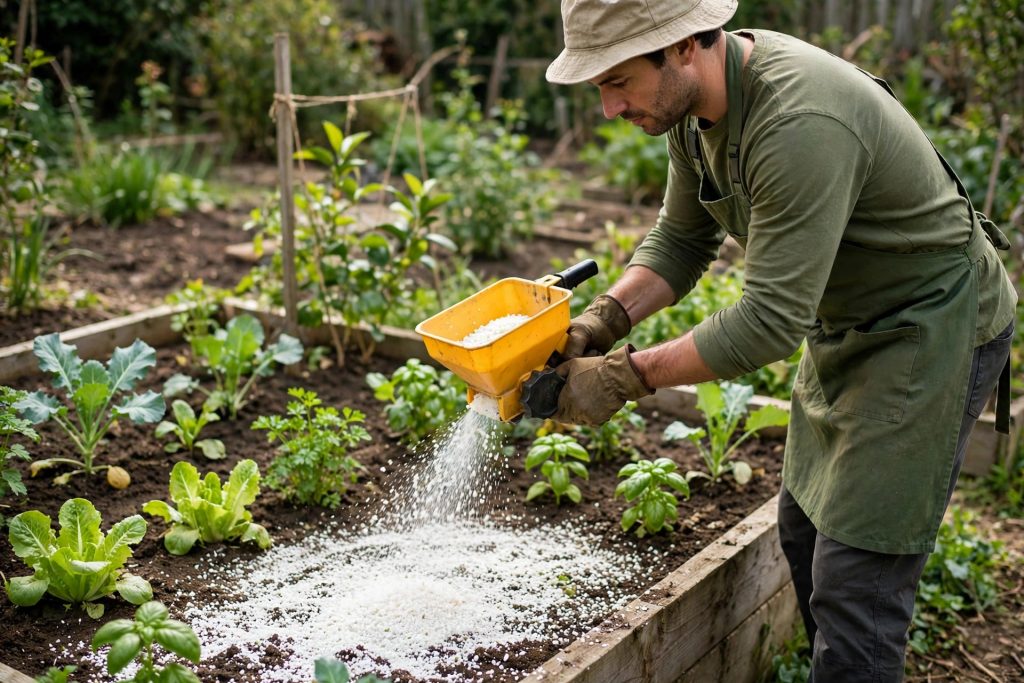
The calculation is correct: 3 pounds of nitrogen divided by 0.13 gives about 23 pounds of 13-13-13. But that bag also supplies about 3 pounds of phosphate (23 times 0.13) and about 3 pounds of potash (23 times 0.13). Before you spread, compare all three amounts the bag supplies against all three recommendations on your report. If the bag overshoots phosphorus or potassium, choose a different analysis, for example a high-nitrogen, low-phosphorus blend, or split the applications, rather than meeting the nitrogen target and ignoring the rest.
For a single nutrient, divide the recommended amount by the decimal percentage on the bag: muriate of potash at 60 percent potash, a 2 pound potash recommendation needs about 3.3 pounds of product; urea at 46 percent nitrogen works the same way. Scale to your real area: 4,000 square feet needs four times the 1,000 square foot amount, 100 square feet needs one tenth. Weigh fertilizer on small beds. Split nitrogen across the season for heavy feeders and lawns. Phosphorus and potassium, where needed, usually go down once, worked lightly in before planting or watered in.
| Nutrient | Amount needed | Material | Calculation | Material to spread |
|---|---|---|---|---|
| Nitrogen | 3 lb | 13-13-13 | 3 divided by 0.13 | About 23 lb. |
| Phosphate (P2O5) | 2 lb | Triple superphosphate 0-46-0 | 2 divided by 0.46 | About 4.3 lb. |
| Potash (K2O) | 1 lb | Muriate of potash 0-0-60 | 1 divided by 0.60 | About 1.7 lb. |
A Worked Example: One Report, Step by Step
This worked example shows how to read a soil test report from the first line to the action list. A mixed vegetable bed, sampled in fall: pH 5.4, buffer pH 6.2, organic matter 2.1 percent, CEC 11, phosphorus Low, potassium Medium, calcium Low, magnesium Low, zinc Low, soluble salts Low.
Recommendations: dolomitic lime 2 tons per acre, nitrogen 3 pounds per 1,000 square feet, phosphate 2 pounds, potash 1 pound. Read in order: pH 5.4 is below the 6.0 to 7.0 range most vegetables prefer, so lime comes first, dolomitic because calcium and magnesium are both low, about 100 pounds per 1,000 square feet split into two 50 pound applications, applied in fall for months to work. Phosphorus Low justifies a real phosphorus input at 2 pounds phosphate per 1,000 square feet.
Potassium Medium needs only maintenance. Medium does not mean zero input. This is a maintenance amount: it replaces what the crop removes and keeps the level from sliding to Low. A Low reading would call for a larger build-up rate, and a High reading would call for none. Nitrogen follows the crop recommendation split across the season. Organic matter at 2.1 percent is low, so compost is a multi-year project. CEC 11 is moderate and fits splitting fertilizer. Zinc Low gets a small correction at the lab rate, only after pH work is underway. For the zinc correction, use the specific rate printed in your own lab report.
This guide gives no zinc number, because the correct rate depends on the lab’s method, the crop, and how deficient the soil is; a borrowed number risks over- or under-correcting. Do not add extra lime, do not buy heavy balanced fertilizer that pushes potassium past maintenance, do not chase zinc with a large dose before lime has worked, and do not retest next month expecting a new pH. Retest after a season or two and compare the trend.
| Result | Reading | What it means |
|---|---|---|
| Soil pH | 5.4 | Acidic, lime needed. |
| Buffer pH | 6.2 | Basis for the lime requirement. |
| Organic matter | 2.1% | Low to moderate, build with compost. |
| CEC | 11 meq/100 g | Moderate nutrient-holding capacity. |
| Phosphorus | Low | Build-up needed. |
| Potassium | Medium | Maintenance only. |
| Calcium | Low | Lime will also supply calcium. |
| Magnesium | Low | Correct with dolomitic lime or a magnesium source if the lab advises. |
| Zinc | Low | Correct at the lab’s printed rate. |
| Soluble salts | Low | No salt problem. |
Read your report in this order:
- Read pH first: below 6.0, check the lime recommendation before anything else.
- Check soluble salts: if High, fix drainage and leaching before fertilizing.
- Read each nutrient rating: Low means build up, Medium means maintain, High means skip.
- Match the fertilizer bag to all three recommendations, not just nitrogen.
- Test again next season: one test a year shows whether the plan moved the numbers.
Common Mistakes When Reading a Soil Test Report
Treating High as a goal: excess phosphorus runs off, excess potassium blocks magnesium, excess nitrogen gives soft pest prone growth and leaches. Comparing numbers across labs without checking the method: Mehlich 3 and Bray phosphorus are not the same measurement. Fixing a micronutrient before fixing pH: pale leaves at pH 7.8 are often iron locked up by alkalinity. Applying one bed’s recommendation to another bed: soil varies across a yard, so sample each distinct area separately. Ignoring the notes section: timing, split application and crop warnings there are part of the recommendation.
What to Do After You Read Your Report
Action list in order: apply lime first if recommended and give it time; add compost steadily if organic matter is low; buy fertilizer to match the recommendation, skip phosphorus when it reads High and weigh the product for your bed size; split nitrogen for heavy feeders and lawns; write the retest date on the calendar, one to two years for vegetables, two to three years for lawns and ornamental beds in good shape. Keep the report and retest with the same lab if you can, comparing ratings across reports. If anything still confuses you, take the report to your local Extension office with the crop, bed size and what you applied in the last year.
Final Thoughts
A soil test report is not a verdict on your gardening. It is a map of one bed at one moment, with the lab’s best advice for what that bed needs next. Knowing how to read a soil test report means you can turn that map into a short, sensible action list instead of a shopping spree. Read pH first, trust the ratings over the raw numbers, translate lime and fertilizer recommendations to your actual bed size, and resist adding more of a nutrient that already reads High. Do that, and the next report should tell a better story: pH closer to target, phosphorus no longer climbing, organic matter creeping upward.
References
- Penn State Extension. Reading a Soil Test Report. Explains the four sections of a report, the below optimum, optimum and above optimum ratings, and why nitrogen recommendations are based on crop need rather than a soil nitrogen measurement.
- Mississippi State University Extension. Interpreting Your Soil Test Report, for Homeowners. Walks through the lime first rule, the fertilizer calculation from a blended product, and scaling recommendations to a home garden area.
- University of New Hampshire Extension. Understanding Your Soil Test Results. Describes what appears on a report form, including lab ID, sample name, test data and recommendations, and notes that nitrogen recommendations are based on crop need.
- Alabama Cooperative Extension System. Home Soil Testing: Using the Soil Test Report. Explains the nutrient ratings from Very Low to Extremely High, the lime recommendation, and the conversion of one ton per acre to about 50 pounds per 1,000 square feet.
- Iowa State University Extension and Outreach. Interpreting Soil Reports. Explains the pounds per acre to ppm conversion, phosphorus and potassium optimum levels for fruits and vegetables, and how to calculate an application amount from a report value.
FAQ
What does Low, Medium and High mean on a soil test report?
They are the lab’s rating of whether that nutrient is likely to limit plant growth for the crop you listed. Low means a response to fertilizer is likely. Medium means some response is possible. Optimum or High means the nutrient is adequate, and High or Very High means no additional fertilizer of that nutrient is needed.
Why is there no nitrogen number on my soil test report?
Most standard soil tests do not measure nitrogen, because nitrogen moves quickly through soil and changes form with temperature, water and microbial activity. A single measurement would not describe the season’s supply. Labs recommend nitrogen based on the crop and regional guidance instead. A separate nitrate test is available if you need a nitrogen measurement.
How do I convert ppm to pounds per acre?
As a rule of thumb, 1 ppm in the top 6 to 7 inches of soil is often treated as about 2 pounds per acre. This rests on an assumed soil mass, the acre-furrow-slice of roughly 2 million pounds of topsoil, and it is an approximation, not an exact conversion. Do not apply it indiscriminately: different labs, sampling depths, and test methods change the soil mass behind the number, so always use the units and recommendations printed on your own report. So 25 ppm of phosphorus equals 50 pounds per acre.
Should I add lime if my soil pH is a little low but the report says zero lime?
No. A zero lime recommendation means the lab judged your current pH acceptable for the crop you listed, or that your soil’s buffer capacity makes the small gap unimportant. Adding lime anyway risks overshooting pH and locking up iron, manganese and zinc.
What is buffer pH, and why is it different from soil pH?
Soil pH is your soil’s acidity right now. Buffer pH measures how strongly your soil resists a pH change, which decides how much lime is needed to reach the target. Two soils with the same soil pH can need very different lime amounts, and the buffer pH is what separates them.
How often should I retest my garden soil?
Vegetable gardens are usually retested every one to two years, and lawns and ornamental beds every two to three years once fertility is in a good range. Retest sooner if you made a major change, such as a large lime application, a new bed, or a switch to a very different crop.

Thesis Link : https://saulibrary.edu.bd/daatj/public/uploads/BAU200601_19-Pp_5.pdf
- How to Read a Soil Test Report: A Garden Guide - October 29, 2026
- Best Grow Lights for Seedlings - October 28, 2026
- How to Test Garden Soil: Step by Step Guide - October 28, 2026