Learning how to read a fertilizer label takes about ten minutes, and it changes how you shop for garden food forever. Once you can read the three numbers on the front of the bag, the guaranteed analysis on the back, and the small print about release speed, you stop buying on slogans and start buying on what your soil actually needs. This guide walks through every part of a typical United States fertilizer label in plain language, with worked examples you can repeat with any bag in your hand.
A fertilizer label is not marketing copy dressed up as science. In the United States, the nutrient percentages on the bag are regulated, and the order of the numbers never changes. That consistency is good news for gardeners. Learn the order once, and every bag, bottle, and box reads the same way.
The Quick Answer: Read a Fertilizer Label in 60 Seconds
If you only have a minute in the garden center, check these five things in this order.
| Label part | Where to find it | What it tells you |
|---|---|---|
| The three numbers, such as 10-10-10 | Front of the bag, in large print | The percentage by weight of nitrogen, phosphate, and potash, always in that order |
| Guaranteed analysis | Back or side panel | The full nutrient breakdown, including secondary nutrients and micronutrients |
| Net weight | Front or back, near the bottom | How many pounds of product you are buying, which you need for the rate math |
| Directions and coverage | Back panel | How much to apply, for which plants, and how often |
| Derived from | Below the guaranteed analysis | Which ingredients supply the nutrients, not how much of each is present |
Start with the numbers, then check the guaranteed analysis, then read the directions before you buy. A bag that looks perfect on the front can still be the wrong choice if its directions do not cover your plants or if it supplies a nutrient your soil already has in excess.
Ratio Versus Strength: Why 10-10-10 and 20-20-20 Are Not the Same Bag
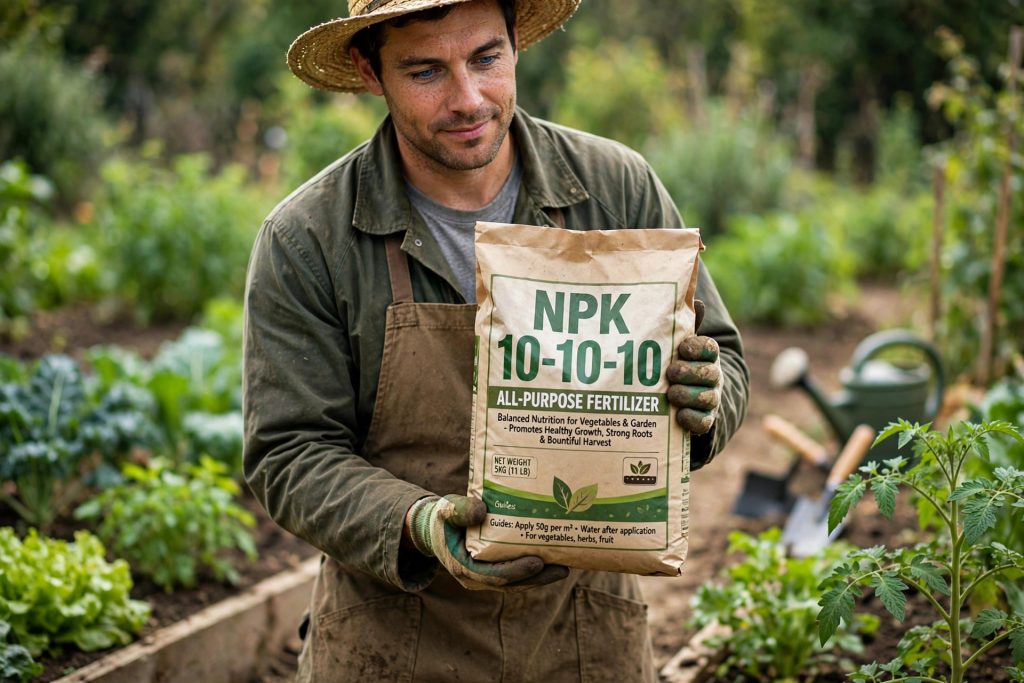
Two fertilizers can have the same ratio and very different strength. A 10-10-10 and a 20-20-20 both have a 1:1:1 ratio, but the second is twice as concentrated. You need half as much 20-20-20 by weight to deliver the same amount of each nutrient. That is why comparing bags by their numbers alone, without their weight and their directions, can mislead you.
A concentrated product is not automatically better. It is simply less product to carry and spread for the same nutrient dose, and it is easier to overapply if you treat it like a weaker bag. A dilute product is not automatically weaker in effect either, because the dose is set by the rate math, not by the size of the numbers. Judge a bag by the nutrients it delivers at the rate you will actually apply, and by whether its ratio matches your soil test.
The Guaranteed Analysis: Reading the Back Panel Line by Line
The guaranteed analysis is the legal heart of the label. It lists each nutrient as a guaranteed minimum percentage, in a fixed order. If a nutrient is not listed, it is not guaranteed, even if the ingredient list hints at it. Read it from the top down.
Total nitrogen comes first, and it is often broken down by form: ammoniacal nitrogen, nitrate nitrogen, urea nitrogen, and water insoluble nitrogen. Those forms tell you how fast nitrogen becomes available. Nitrate nitrogen is available almost at once. Ammoniacal nitrogen is held on soil particles and converted to nitrate within days.
Urea nitrogen must first break down into ammonium, which takes days and runs faster in warm, moist soil; urea left on the surface without water can lose nitrogen to the air. Coated ureas, ureaform, methylene urea, and water insoluble fractions release over weeks to months at different speeds, so two products with the same total nitrogen can feed very differently. Water insoluble nitrogen, often shortened to WIN, is the slow part. It needs microbial breakdown, so it feeds over weeks rather than days, and it releases very little in cold soil.
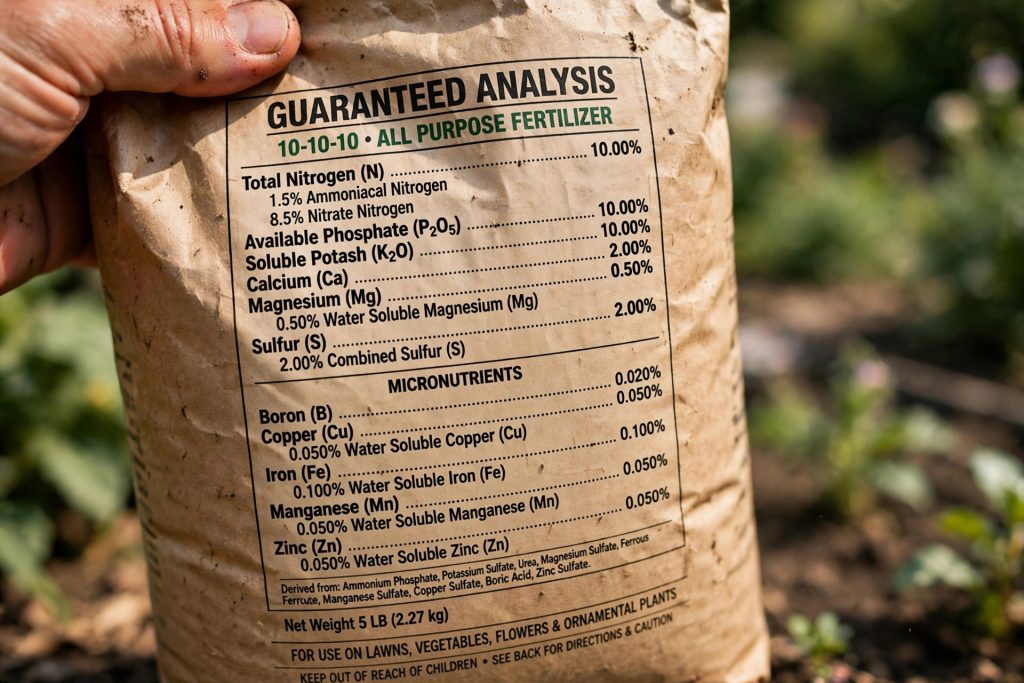
Available phosphate and soluble potash follow total nitrogen, using the same numbers as the front of the bag. After those three, the label lists secondary nutrients where they are guaranteed: calcium, magnesium, and sulfur. These are needed in smaller amounts than nitrogen, phosphorus, and potassium, but they are not optional for healthy plants. Calcium supports cell walls and soil structure. Magnesium sits at the center of the chlorophyll molecule, so it matters for green leaves. Sulfur is part of proteins and helps with overall growth.
Micronutrients come last, in very small percentages: iron, manganese, zinc, copper, boron, molybdenum, and sometimes chlorine. Small does not mean unimportant. Iron deficiency shows as yellowing between leaf veins on young growth, and zinc and boron shortages can distort new growth, but more is not better with micronutrients. They are needed in tiny amounts, and excess can harm plants. A label that guarantees a micronutrient is useful only if your soil test or a clear symptom points to that nutrient. Do not chase a long micronutrient list for its own sake.
One more line deserves attention: the percentage of water soluble nutrient shown under some micronutrients and magnesium. That sub-line tells you how much of that nutrient is in a form plants can take up right away, versus the total guaranteed amount. For nitrogen, the water insoluble share is the more useful figure, because it tells you how much of the nitrogen is slow.
Derived From: What the Ingredient List Does and Does Not Say
Below the guaranteed analysis, most labels carry a “Derived from” line. It names the raw materials that supply the nutrients, such as urea, ammonium phosphate, potassium sulfate, or bone meal. This line is useful, and it is also easy to overread.
The derived from line does not give amounts. It does not tell you that a product is mostly one ingredient or only a little of another, and it does not guarantee a nutrient that is not listed in the guaranteed analysis above it. What it does tell you is the source family. A product derived from feather meal, bone meal, and kelp behaves differently from one derived from urea and ammonium phosphate, because the organic sources need microbial breakdown before their nutrients become available, while the synthetic sources are mostly available much faster.
That difference matters for timing, not for honesty. Neither family is automatically better. Organic sources usually feed more slowly and add organic matter, which suits garden beds over a season. Synthetic sources give a faster, more predictable dose, which suits a quick correction. Choose by what your plants need now and how fast you need it, not by the romance of the ingredient name.
If you garden under organic rules, look for a separate certification mark rather than trusting the derived from line alone. A product that lists bone meal as an ingredient is not automatically allowed under every organic program. Check the certifier mark on the bag and confirm the exact product on the certifier list before you rely on it.
Fast Release Versus Slow Release: The Most Expensive Line to Misread
Fast release fertilizers dissolve quickly and feed plants within days. Slow release fertilizers meter nutrients out over weeks or months, through coatings, low-solubility materials, or microbial breakdown. The label tells you which you are holding, but you have to know where to look.
For nitrogen, look at the water insoluble share in the guaranteed analysis. A high water insoluble share means a larger slow portion. A label that claims slow release must identify and guarantee the slowly released nutrient at a meaningful share of that nutrient. The 15 percent figure in many state rules follows the AAPFCO model, but it is not the same everywhere: Maryland requires at least 20 percent water insoluble or controlled release nitrogen for a slow release nitrogen fertilizer, and some guidance uses one third of total nitrogen.
Read the guaranteed slowly available share on the label, and check your own state’s rule, rather than trusting the front claim alone. If the slow claim is only on the front and nowhere in the guaranteed analysis, treat it as marketing, not a guarantee.
Coated products, such as sulfur coated urea, release as the coating breaks down with moisture and temperature. Natural organic products release as microbes break them down, so they are slow in cold soil and faster in warm, moist soil. Both kinds reduce the risk of a sudden salt load on roots compared with a fully quick release product at the same rate, but neither makes overapplication safe. Slow release spreads the risk out, it does not remove it.
| Type | How it releases | Best use | Watch out for |
|---|---|---|---|
| Fast release, water soluble | Dissolves at once, available in days | Quick correction, containers, foliar feeding at label dilution | Easy to overapply, needs watering in, short feeding window. |
| Slow release, coated | Coating breaks down with moisture and warmth | Lawns, beds that need steady feeding | Release slows in cold soil, coating damage can dump nutrient. |
| Slow release, natural organic | Microbes break it down over weeks | Garden beds, soil building over a season | Very slow in cold soil, nutrient content varies by batch. |
| Controlled release, polymer coated | Engineered coating meters release over months | Long season containers, high value plantings | Cost, and release still depends on temperature and moisture. |
Choose fast release when a plant needs food now and you can control the dose and watering. Choose slow release when you want steady feeding and fewer applications. For most home garden beds, a slow release base feed plus a fast release correction only when a soil test or clear deficiency calls for it is a calmer, safer pattern than repeated fast doses.
Complete, Incomplete, Balanced, and Specialty: Sorting the Front of the Bag
A complete fertilizer contains all three headline nutrients: nitrogen, phosphate, and potash. An incomplete fertilizer lacks one or more of them, such as 34-0-0 or 0-20-20. Incomplete is not a flaw. It is a tool for a soil that needs one nutrient and not the others.
A balanced fertilizer has equal or near equal numbers, such as 10-10-10 or 5-5-5. Balanced sounds safe, and it is the most common mistake in home gardens, because it assumes your soil needs all three nutrients in equal amounts. Soils rarely do. After years of balanced feeding, phosphorus is often the nutrient in excess, while nitrogen is the one that needs topping up. Balanced is a starting point for a new bed with no soil test, not a permanent habit.
Specialty fertilizers are blended for a plant group or a job: rose food, tomato food, lawn food, acid loving plant food, starter fertilizer. The specialty name is a hint about ratio and added nutrients, not a guarantee that it suits your soil. A tomato food with a higher middle number may suit a bed that tests low in phosphorus, and it may be wasteful in a bed that already tests high. Read the numbers behind the specialty name every time, and compare them with your soil test before you trust the picture on the front.
Starter fertilizers deserve a special note. They are usually high in phosphate to support root establishment, and they are meant for planting time, not as an all season feed. Using a starter blend all season adds phosphate you may not need, and it is a good example of why the plant name on the front should never replace the numbers.
How Much to Apply: The Rate Math, Step by Step
This is the section that saves you money and spares your plants. Most fertilizer recommendations are given as pounds of nitrogen per 1,000 square feet, because nitrogen is the nutrient that drives the rate. The bag tells you the nitrogen percentage. The math turns one into the other.
Step 1: Find your target nitrogen rate. Use your soil test recommendation or your local extension guidance for your plant type. A common general guide for a single lawn application is about 1 pound of nitrogen per 1,000 square feet, and less for a fast release product in hot weather. That 1 pound figure is a general guide, not a rate for every lawn: cool season and warm season grasses differ, seasonal totals differ, and some states cap a single application, for example Maryland limits water soluble nitrogen to 0.7 pounds per 1,000 square feet per application.
Always follow your soil test and your local extension guidance for your grass and season. Garden beds are usually rated by the bed area and the crop, so follow the label directions for beds and containers rather than borrowing a lawn rate.
Step 2: Turn the nitrogen percentage into a decimal. A 24-0-6 fertilizer is 24 percent nitrogen, so the decimal is 0.24. A 10-10-10 is 0.10.
Step 3: Divide the target nitrogen rate by that decimal. That gives pounds of product per 1,000 square feet. For 1 pound of nitrogen per 1,000 square feet with a 24-0-6 product: 1 divided by 0.24 equals about 4.2 pounds of product per 1,000 square feet.
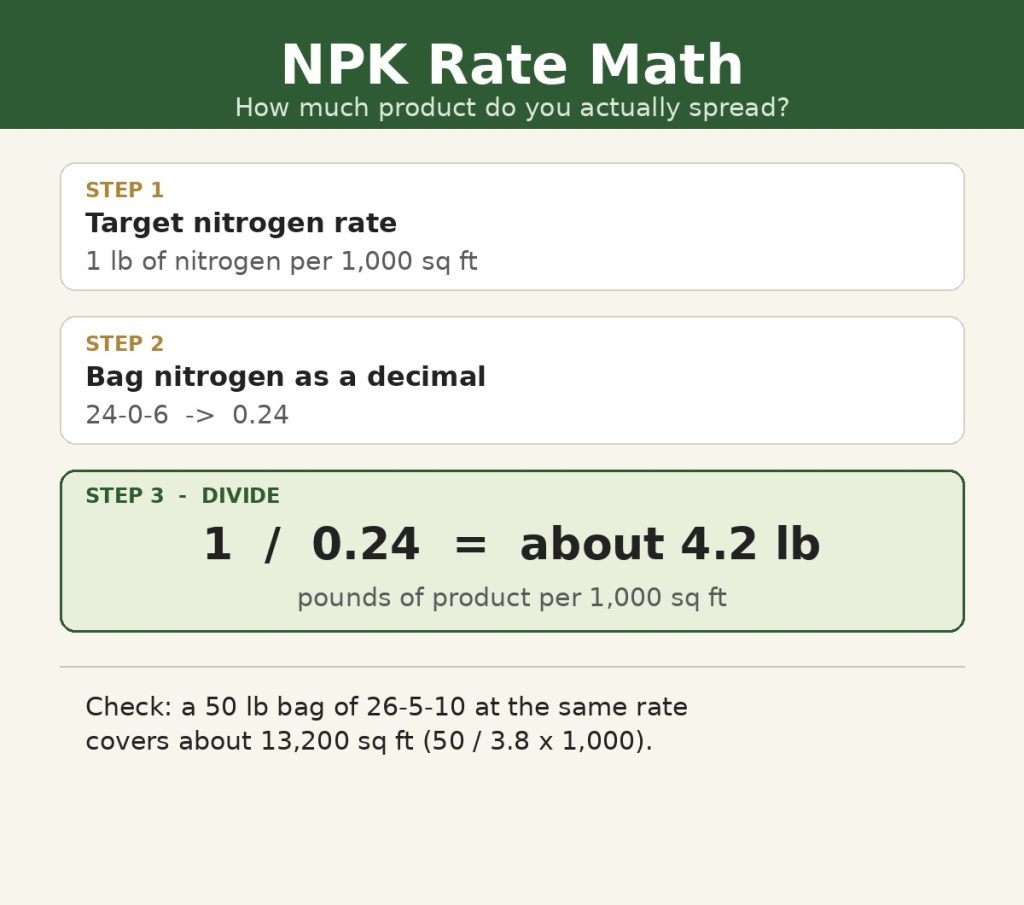
Step 4: Scale to your area. A 5,000 square foot lawn at that rate needs about 21 pounds of product (4.2 times 5). A 50 pound bag of 26-5-10 at 1 pound of nitrogen per 1,000 square feet needs 3.8 pounds of product per 1,000 square feet (1 divided by 0.26), so the bag covers about 13,200 square feet at that rate (50 divided by 3.8, times 1,000).
Step 5: Check what else you are applying at that rate. At 3.8 pounds of 26-5-10 per 1,000 square feet, you also apply about 0.19 pounds of phosphate (3.8 times 0.05) and about 0.38 pounds of potash (3.8 times 0.10) per 1,000 square feet. If your soil test says phosphate is already high, that extra phosphate is the cost of matching nitrogen with this bag, and a lower phosphate blend may be the better match.
For liquid and water soluble products, the same principle applies, but the label gives a dilution and a coverage area instead of a spreader weight. Follow the label dilution exactly, and do not assume that doubling the concentrate doubles the benefit. It doubles the salt load on roots, and it can burn foliage, especially in hot sun. Water soluble feeds are best applied to moist soil, not to dry, stressed plants, and never at a stronger mix than the label directs.
For containers and houseplants, the label rate is usually given per gallon of water or per pot size. Containers leach nutrients with every watering, so they need smaller, more frequent feeds than garden beds, but the same rule holds: the label rate is the starting point, and a weaker mix applied more often is safer than a strong mix applied once.
Matching the Label to Your Soil Test
A soil test and a fertilizer label are written to be read together. The test tells you what is low, adequate, or high. The label tells you what a bag supplies. Put them side by side before you buy.
| Soil test says | Look for on the label | Avoid |
|---|---|---|
| Nitrogen low, phosphorus high, potassium adequate | A nitrogen-led blend with a zero middle number, such as 10-0-10 | A balanced 10-10-10 that adds unneeded phosphate. |
| Phosphorus low, potassium low | A complete blend with meaningful second and third numbers | A nitrogen-only product that leaves the shortage untouched. |
| pH low, lime recommended | Lime first, then fertilizer; the label does not fix pH | Expecting fertilizer alone to correct an acid soil. |
| All nutrients adequate | Compost or a light maintenance feed, or nothing this season | A full rate balanced feed out of habit. |
| Micronutrient low, such as iron or zinc | A guaranteed amount of that micronutrient in the analysis | A general blend that does not guarantee it. |
Match nitrogen first, then compromise on phosphate and potash, because no bag will match a soil test exactly. Extension guidance for lawns puts it plainly: it is most important to match the nitrogen requirement and accept some compromise on the other two. If a bag matches nitrogen but overshoots phosphate badly, keep shopping. Another grade usually fits better.
Timing matters as much as ratio. Lime is slow, so it goes down before fertilizer, ideally weeks before planting. Nitrogen feeds active growth, so it belongs in the growing season, not in deep dormancy. A label that tells you when to apply is giving you useful information, not filler. Follow the seasonal window on the label and in your local extension calendar, and do not feed a dormant plant just because a bag is open in the shed.
Reading Labels for Different Gardens
Vegetable beds need a label read with the crop in mind. Leafy greens use nitrogen heavily. Fruiting crops, such as tomatoes and peppers, need phosphate and potash in balance once flowering starts, but they still need nitrogen for the plant that carries the fruit. A single balanced feed all season rarely matches both phases. Start with your soil test, feed for growth early, and let the label guide a shift toward a lower nitrogen, higher potash blend only if the test or the plant stage calls for it.
Lawns are rated by nitrogen per 1,000 square feet, as above, and the label coverage figure is only trustworthy at the stated spreader setting. Calibrate your spreader on a driveway or a measured strip before you cover the whole lawn, and sweep granules off paths and driveways back onto the grass. Granules left on hard surfaces wash into drains with the next rain, which wastes fertilizer and pollutes waterways.
Containers and houseplants need the most careful label reading, because a small pot has almost no buffer. Use the label dilution, feed when the plant is actively growing, and flush the pot occasionally with plain water if salts build up on the soil surface. A fertilizer that lists a high nitrogen number is not a stronger houseplant food. It is a more concentrated one, and it needs a correspondingly smaller dose.
Organic labels need the same scrutiny as synthetic ones. An organic blend still has a guaranteed analysis, and its numbers are percentages by weight just like any other bag. The difference is release speed and source, not honesty about content. Read the analysis, check the certification mark, and remember that a low number organic product may need a larger weight to deliver the same nitrogen as a concentrated synthetic one. That is arithmetic, not a flaw.
Red Flags and Common Mistakes
The biggest red flag on a fertilizer label is a promise that sounds too broad: bigger blooms, greener lawns, and healthier plants in every situation. Nutrients help plants that lack them. They do not fix poor light, compacted soil, wrong watering, or a plant in the wrong climate. If the front of the bag promises a result and the back does not supply the nutrient that result needs, the promise is marketing.
A second mistake is reading only the front. The front sells. The back guarantees. A bag that advertises iron for greener grass may guarantee only a trace of iron, or none at all. Check the analysis before you pay for a headline nutrient.
A third mistake is storing fertilizer like garden soil. Keep bags dry, sealed, and out of reach of children and pets, and keep the label with the product. The caution statements on the label, including skin and eye guidance and what to do if swallowed, are there for a reason, and they are hard to follow if the bag has been tipped into an unmarked bin. Liquid concentrates need the same care, and they should never be transferred to a food or drink container.
A fourth mistake is feeding on a calendar instead of on need. A plant that is dormant, stressed by drought, or newly transplanted does not need a full rate feed just because it is spring on the calendar. Feed actively growing plants, at the label rate, and let a soil test decide whether a second application is needed.
Finally, do not mix products to invent a ratio. Mixing two fertilizers can double up a micronutrient, change the salt load, or create a blend that no label describes. If no single bag matches your soil test, choose the closest match and adjust the rate by nitrogen, or ask your local extension service for a blend recommendation. Guessing a mix is how a small shortage becomes a toxicity problem.
Label Checklist Before You Buy
Use this checklist in the store, with your soil test in your pocket if you have one.
- The three numbers match your soil test ratio, or come as close as the shelf allows, with nitrogen matched first.
- The guaranteed analysis lists every nutrient you are paying for, including any micronutrient on the front.
- The water insoluble nitrogen share tells you the release speed you actually want, fast or slow.
- The directions cover your plants, your area, and a season when they are actively growing.
- The net weight and coverage let you work out how many bags you need, without guessing.
- The caution and storage lines are ones you can follow at home, with children and pets kept in mind.
- The derived from line and any certification mark match the kind of gardening you practice, organic or otherwise.
If a bag fails two or more of those checks, put it back and compare another grade. The right bag is usually on the same shelf, one ratio over.
Final Thoughts
Reading a fertilizer label is a quiet skill, but it pays for itself every season. The three numbers tell you the ratio. The guaranteed analysis tells you the full story. The derived from line tells you the source family. The directions tell you the dose, and the rate math turns all of it into pounds of product for your actual garden. None of that requires a chemistry degree, only the habit of turning the bag over before you buy.
Start with a soil test if you have not had one in the last few years. It is the only way to know whether the balanced bag in your hand is a good match or an expensive habit. Then read the label against it, match nitrogen first, and let phosphate and potash follow as closely as the shelf allows. Your plants will get what they lack, your soil will not collect what it already has in excess, and your fertilizer budget will go further.

How to Test Garden Soil: Step by Step Guide
Start here if you have not tested your soil yet.

How to Read a Soil Test Report: A Garden Guide
Read this next to make sense of your lab results.
How to Improve Clay Soil: A Garden Guide
Use this guide if your soil is heavy and slow draining.

How to Improve Sandy Soil: A Garden Guide
Use this guide if your soil dries out fast and drains quickly.
References
- University of Georgia Cooperative Extension, Turfgrass Fertility: Understanding Fertilizer Labels, Macronutrients, and Micronutrients (grade and guaranteed analysis definitions, secondary and micronutrient roles)
- Rutgers Cooperative Extension, How to Calculate the Amount of Fertilizer Needed for Your Lawn (converting a nitrogen recommendation into pounds of product per 1,000 square feet)
- Penn State Extension, Calculations Used to Determine the Amount of Fertilizer Needed to Treat Turf (worked rate examples for 26-5-10 and phosphate and potash delivered at that rate)
- University of New Hampshire Extension, Calculating Lawn Fertilizer Rates (bag weight times nitrogen percentage, coverage per bag, and single application guidance)
- Colorado State University Cooperative Extension, Calculating Fertilizer Application Rates (matching nitrogen first and compromising on phosphate and potash when no bag matches exactly)
- Wisconsin Administrative Code ATCP 40.10, fertilizer labeling rules (slowly released nutrient claims require at least 15 percent of the total guarantee for that nutrient, with a separate provision for nitrogen)
- University of Maryland Extension, Fertilizer Recommendations for Commercially Maintained Lawns and Turfgrass in Maryland (20 percent water insoluble or controlled release nitrogen for slow release fertilizer; 0.7 pounds water soluble nitrogen per 1,000 square feet per application limit)
What do the three numbers on a fertilizer bag mean?
They are percentages by weight of nitrogen, phosphate (P2O5), and potash (K2O), always in that order. A 10-10-10 bag is 10 percent of each by weight, and the rest is carrier and other ingredients.
What is the guaranteed analysis on a fertilizer label?
It is the regulated nutrient breakdown on the back or side panel, listing total nitrogen by form, available phosphate, soluble potash, secondary nutrients, and micronutrients as guaranteed minimum percentages.
Does a zero on a fertilizer label mean the product is weak?
No. A zero means none of that nutrient is guaranteed. A 10-0-10 can be exactly right for a soil that already tests high in phosphorus, because it supplies nitrogen and potassium without adding unneeded phosphate.
How do I work out how much fertilizer to apply?
Divide the nitrogen rate you want per 1,000 square feet by the nitrogen percentage as a decimal. For 1 pound of nitrogen with a 24-0-6 product, that is 1 divided by 0.24, or about 4.2 pounds of product per 1,000 square feet, then scale to your area.
What does water insoluble nitrogen mean on a label?
It is the slow release share of nitrogen, released by microbial breakdown over weeks rather than days. A higher water insoluble share means slower, steadier feeding, and very little release in cold soil.
Should I buy a balanced fertilizer like 10-10-10 for every garden bed?
Not as a habit. Balanced blends suit a new bed with no soil test, but most established soils need nutrients in unequal amounts. Match the bag to your soil test, with nitrogen matched first, and avoid adding phosphate your soil already has in exces.

Thesis Link : https://saulibrary.edu.bd/daatj/public/uploads/BAU200601_19-Pp_5.pdf
- Best Seed Starting Mix: 10 Mixes for Strong Seedlings - November 2, 2026
- How to Read a Fertilizer Label - November 2, 2026
- How to Improve Sandy Soil: A Practical Guide for Gardens - October 31, 2026