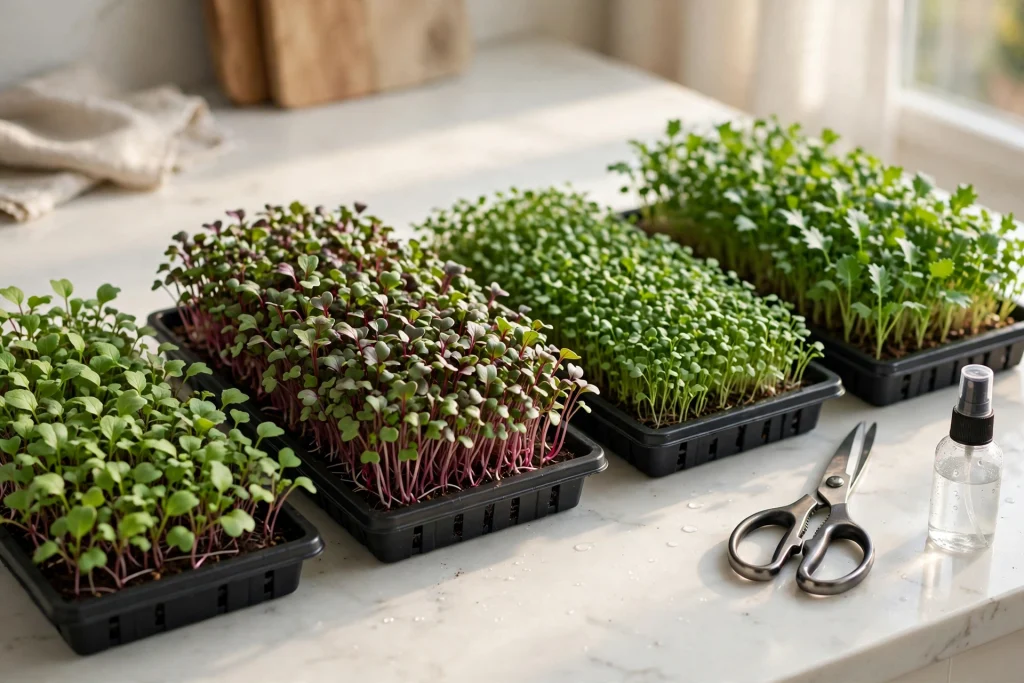

A tray of microgreens can turn a bare windowsill into a small salad bar in about ten days. That is the whole appeal of the best microgreen growing kit: you sow on a Sunday, and by the next weekend you are snipping radish greens over eggs and sandwiches. The trouble is that kits that look alike on the box can feed you very different amounts, cost very different sums to keep running, and behave very differently on a dim kitchen counter. Some give you a full 10 by 20 inch flat and loose seed you can buy anywhere. Others give you a single small tray and a refill you can only buy from one maker. This guide sorts out ten real kits, compares them on the things that decide your harvest, and scores each one openly so you can see exactly how its rating was reached.
Microgreens are young vegetable and herb seedlings harvested after germination, usually when their cotyledons are fully open and the first true leaves are beginning to develop. Depending on the crop and growing conditions, harvest generally takes place about 7 to 21 days after sowing. They are not sprouts. Sprouts grow in water and are eaten whole, roots and all, while microgreens grow in soil or on a mat, and only the stem and leaves are cut at harvest. Microgreens sit between sprouts and baby greens: baby greens are the same plants cut later, at 3 to 5 inches, after 21 to 35 days.
Our microgreen farming guide covers the growing method, varieties, and health benefits in full.
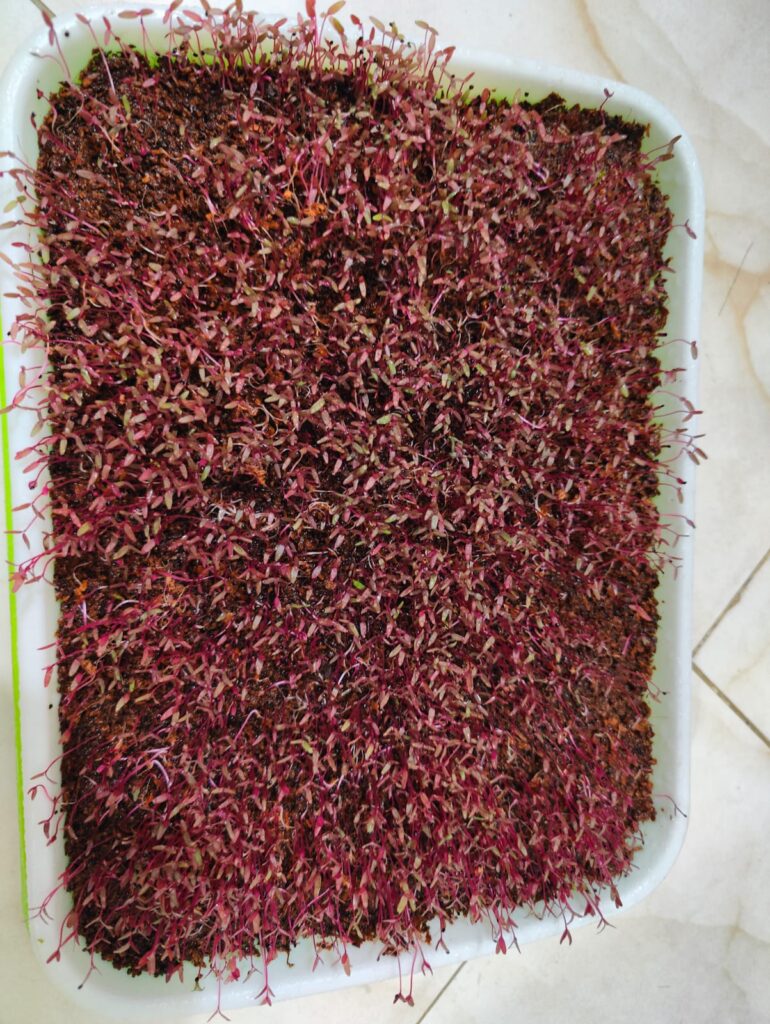
Quick Recommendation
If you want one answer fast, start here.
- For most beginners who want one complete purchase, choose the True Leaf Market Hydroponic Microgreens Starter Kit. Three full-size 10 by 20 inch trays, bamboo fibre mats, and six bags of seed cover 12 to 18 plantings, and every replacement part fits the standard tray size.
- For a kitchen where the kit sits in view and must look good, choose the ingarden Microgreens Growing Kit. Its stainless steel frame, ceramic bowl, wick watering, and timed LED light run almost by themselves.
- For a serious grower who wants trays that last for years, choose the Bootstrap Farmer 1020 Shallow Microgreens Tray Kit. Thick polypropylene flats, a two-year warranty, and a nested bottom-watering pair are the professional standard.
- For the easiest possible first harvest, choose the Hamama Home Microgreen Kit. Fill the tray once, lay in a pre-seeded quilt. The maker reports that many Seed Quilts are ready to harvest in approximately 7 to 10 days, although actual timing varies by variety and growing conditions.
- For a dark kitchen with no good window, choose a kit with a light built in: the AeroGarden Sprout or the SunBlaster Micro LED Grow Light Garden.
- For the smallest spend on a first try, choose the True Leaf Market Windowsill Self-Watering Microgreens Kit or the Back to the Roots Organic Microgreens Grow Kit. Both cost little, both teach the method, and both make clear whether you want to grow more.
Before you buy, measure the space and the light, not just the counter. A full-size 10 by 20 kit needs a shelf with room for a light above it. A 12 by 6 inch kit fits a windowsill but harvests a side dish rather than a salad.
Comparison Table
| Kit | Type | Tray size | Growing area | Light | Best for | Our rating |
|---|---|---|---|---|---|---|
| True Leaf Market Hydroponic Microgreens Starter Kit | Tray system, hydroponic mats | 3 x 10 x 20 in | 200 sq in per tray | None | Most beginners, full harvests | 8.9/10 |
| ingarden Microgreens Growing Kit | Countertop automated, wick fed | 3 seed pads | Not published | Yes, 13.5 W LED | Design-led kitchens, hands-off growing | 8.8/10 |
| Bootstrap Farmer 1020 Shallow Microgreens Tray Kit | Trays only | 20 x 10 x 1.25 in | 200 sq in | None | Serious growers, long-term use | 8.7/10 |
| Hamama Home Microgreen Kit | Seed-quilt tray | About 12 x 6 in | about 72 sq in | None | Easiest first harvest | 8.6/10 |
| AeroGarden Sprout | Countertop hydroponic pods | 3 pods | Not published | Yes, 10 W LED | Dark kitchens, herbs and greens | 8.6/10 |
| SunBlaster Micro LED Grow Light Garden | Lit tray garden, wicking | About 19 x 8 in | about 152 sq in (footprint) | Yes, LED strip | Tray growing under a real light | 8.5/10 |
| Urban Leaf Indoor Microgreens Growing Kit | Self-watering trays and mats | 3 small trays | Not published | None | Small kitchens, several varieties | 8.2/10 |
| True Leaf Market Windowsill Self-Watering Microgreens Kit | Self-watering wicking tray | Small windowsill tray | about 72 sq in | None | Cheapest proper start | 8.1/10 |
| Window Garden Microgreens Grow Kit | Acrylic windowsill tray | 15 x 6 x 2 in | 90 sq in | None | Sunny windowsills | 8.0/10 |
| Back to the Roots Organic Microgreens Grow Kit (6-Grow Variety Pack) | Single-grow compostable tray | Not published | Not published | None | Kids, gifts, first try | 7.9/10 |
How We Chose These Microgreen Growing Kits
A kit is judged here on five factors, weighted by how much each one decides your result. Ease of use counts most for beginners, because a kit that confuses you on day one usually ends up in a cupboard. Tray and growing medium quality decides yield, mess, and hygiene. Light decides whether the crop comes out stocky and green or tall and pale. Durability and reusability decide whether the purchase keeps paying after the first tray. Value weighs what the kit gives you against what it keeps costing you in refills.
| Factor | Weight | What it covers |
|---|---|---|
| Ease of use | 25% | Setup steps, watering routine, how much the kit decides for you |
| Tray and growing medium quality | 25% | Tray size and material, medium type, drainage and bottom watering |
| Light | 15% | Built-in light or none, light quality, timer control |
| Durability and reusability | 20% | Tray thickness and material, warranty, whether refills lock you to one maker |
| Value | 15% | What is in the box against the running cost of seed, mats, and refills |
| Total | 100% |
An honest note on method: no hands-on testing was done for this roundup. Scores come from an analysis of each maker’s published specifications and from owner feedback reported in the sources listed in References. Owner feedback was considered only in a limited way, and for products where no reliable feedback was found, the score rests mainly on published specifications. Where a maker does not publish a specification, this guide says “Not published” instead of guessing. Harvest figures quoted from makers are the makers’ own claims, not promises.
| Kit | Ease of use (25%) | Tray and medium (25%) | Light (15%) | Durability (20%) | Value (15%) | Weighted total | Our rating |
|---|---|---|---|---|---|---|---|
| True Leaf Market Hydroponic Starter Kit | 9.0 | 9.5 | 7.0 | 9.5 | 9.0 | 8.93 | 8.9/10 |
| ingarden Microgreens Growing Kit | 9.5 | 8.5 | 9.5 | 9.0 | 7.0 | 8.78 | 8.8/10 |
| Bootstrap Farmer 1020 Shallow Tray Kit | 8.0 | 9.5 | 6.5 | 10 | 9.0 | 8.70 | 8.7/10 |
| Hamama Home Microgreen Kit | 10 | 9.0 | 7.0 | 8.5 | 7.5 | 8.63 | 8.6/10 |
| AeroGarden Sprout | 9.5 | 8.0 | 9.0 | 8.5 | 8.0 | 8.63 | 8.6/10 |
| SunBlaster Micro LED Grow Light Garden | 8.5 | 8.0 | 9.5 | 8.5 | 8.5 | 8.53 | 8.5/10 |
| Urban Leaf Indoor Microgreens Growing Kit | 9.0 | 8.0 | 7.0 | 8.0 | 8.5 | 8.18 | 8.2/10 |
| True Leaf Market Windowsill Self-Watering Kit | 9.0 | 8.0 | 7.0 | 7.5 | 8.5 | 8.08 | 8.1/10 |
| Window Garden Microgreens Grow Kit | 8.5 | 8.0 | 7.0 | 8.0 | 8.0 | 7.98 | 8.0/10 |
| Back to the Roots 6-Grow Variety Pack | 9.5 | 7.5 | 7.0 | 6.5 | 8.5 | 7.88 | 7.9/10 |
The 10 Best Microgreen Growing Kits
1. True Leaf Market Hydroponic Microgreens Starter Kit
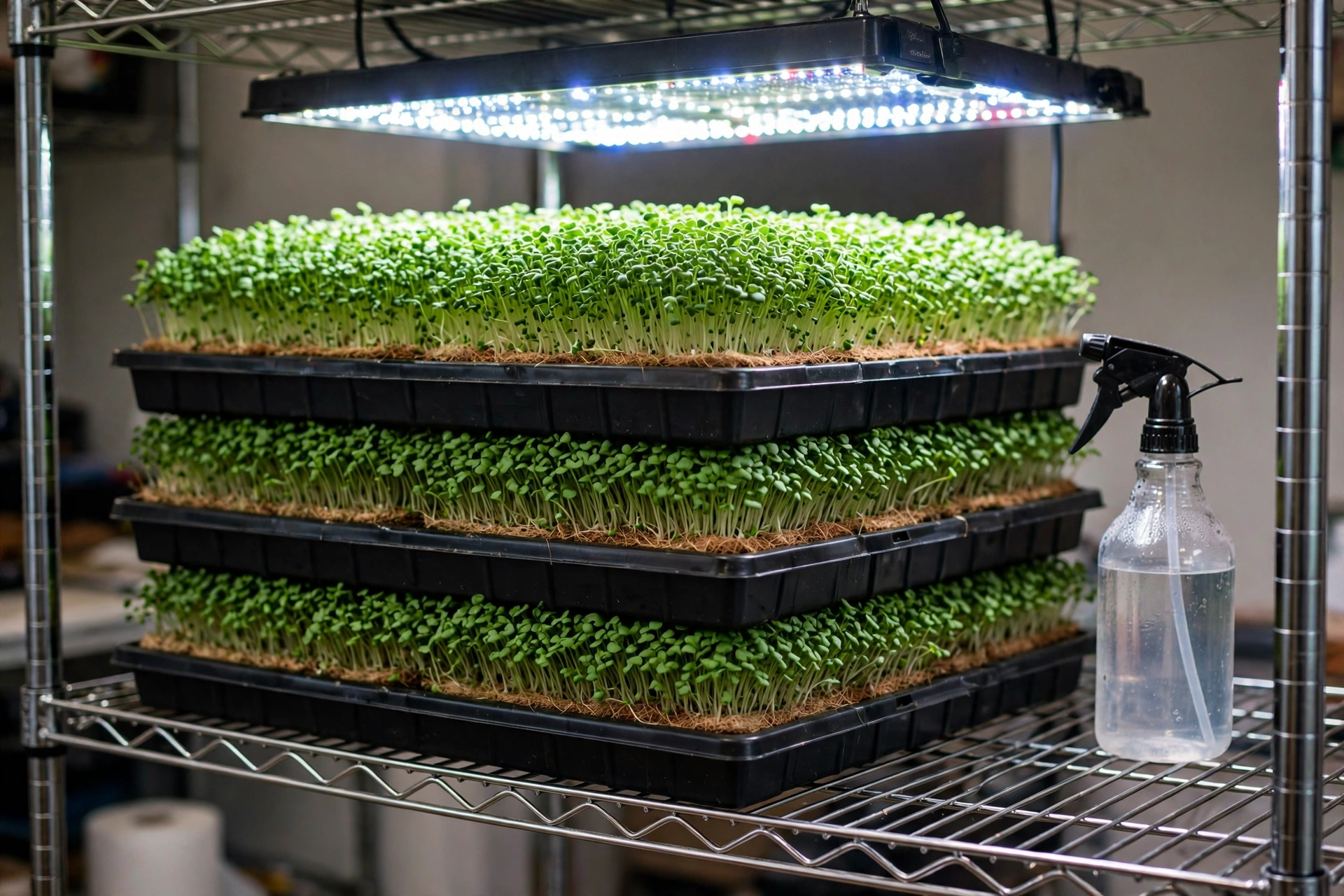
This is the kit that most resembles how microgreens are actually grown, scaled down to a counter. The maker lists three 10 by 20 inch trays without holes, three with holes, ten bamboo fibre grow mats, a pH test strip kit, a spray bottle, and six 4 ounce seed bags covering salad mixes, colourful radish, yellow mustard, and a hydroponic mix. That is enough seed for 12 to 18 plantings, which means the first box lasts well past the first month.
Two things make it the default recommendation. First, the 10 by 20 tray is the industry-standard flat, so every replacement mat, tray, lid, and rack you buy later will fit. Penn State Extension writes its microgreens production guide around exactly this format, with a seeding rate of 10 to 15 grams per flat. Second, the nested-tray design lets you bottom water, which Penn State recommends because it keeps leaves and stems dry and discourages disease.
The trade-offs are size and setup. Three full flats need a real shelf, and a full flat under a single small desk lamp will grow unevenly, so budget for a light bar that covers the whole tray. The included seed is mostly small-seeded brassicas and mustards suited to mats. Large seeds such as sunflower and pea do better in soil, which the maker sells as a separate kit.
What stands out: standard sizing. Nothing in this kit locks you into one maker’s refills, and that freedom is worth more than any single feature.
Pros: full-size standard trays, generous seed supply, bottom watering, open refill system. Cons: no light included, needs shelf space, large seeds need a different kit.
Real-world limitation: three full flats are a commitment of counter or shelf space, and without a proper light bar the outer edges of a flat can grow leggy while the centre stays stocky.
Who should buy: anyone who expects to keep growing past the first box and wants a system that grows with them.
Our rating: 8.9/10. Specifications source: True Leaf Market, https://trueleafmarket.com, with kit contents confirmed in the Grow With Hydroponics comparison at https://growwithhydroponics.com/best-microgreens-growing-kits/
2. ingarden Microgreens Growing Kit
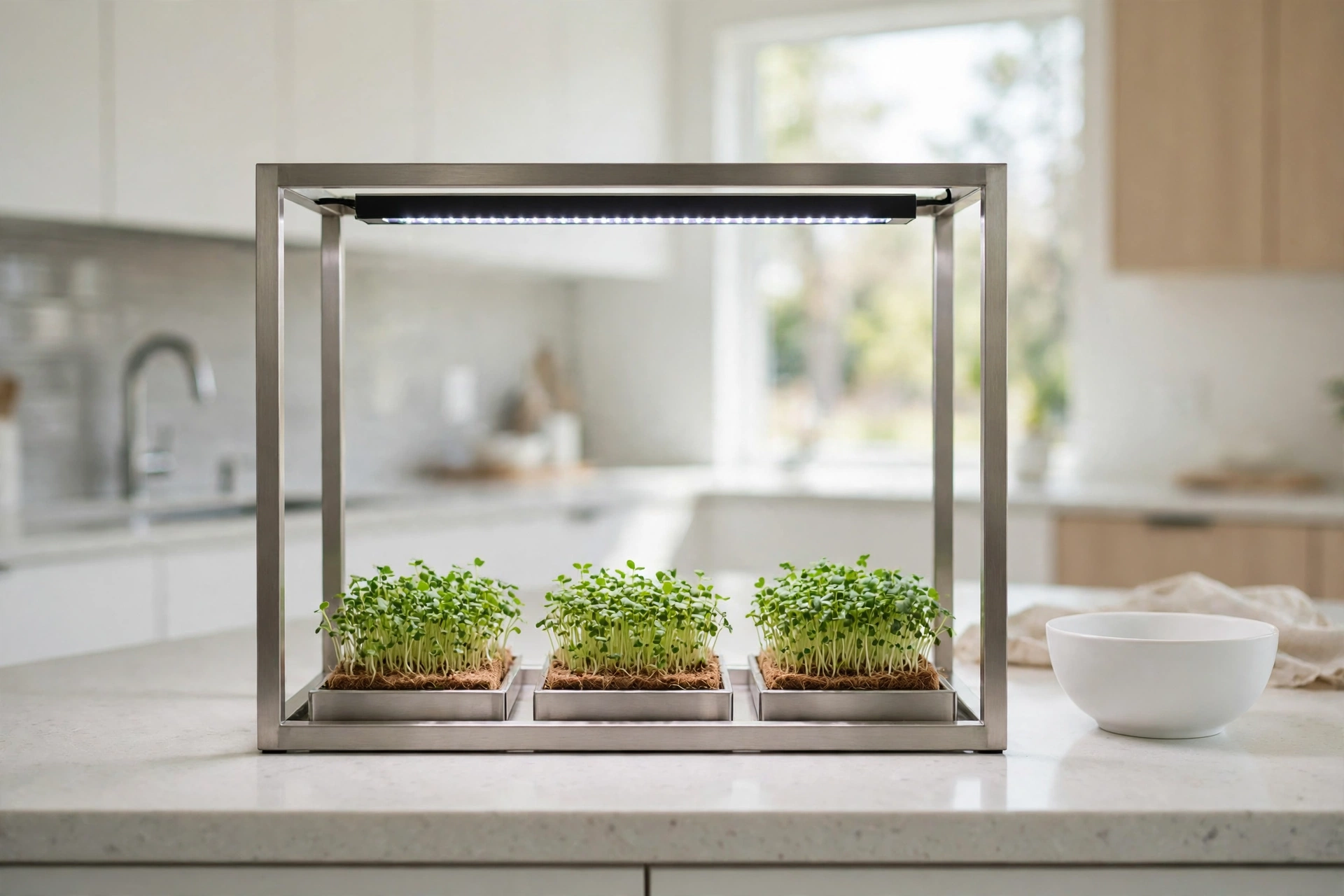
The ingarden is the most automated kit on this list, and also the most design-led. A stainless steel frame holds an LED grow light over a ceramic or recycled ocean plastic bowl. Three seed pads sit in steel trays above the bowl, and wicks draw water up to the pads. You insert the pads, add water once, press the timer button, and the light runs a 12-hour rhythm on its own. The maker says harvest comes in 7 days.
The numbers behind it are solid. The frame measures 20 cm high by 39 cm long by 15 cm wide and weighs 3.5 kg. The LED runs at 13.5 watts, draws 0.162 kWh in 12 hours, and is dimmable. The maker gives a 2-year warranty and a 95 percent germination rate for its pads, and the pads carry organic seed with no GMOs, herbicides, or pesticides. The starter set includes red cabbage, radish, and mustard pads.
The honest catch is the refill model. The system only grows on ingarden pads, so every harvest after the first three depends on buying more of them. The growing area is also small: three pads give you a garnish or a sandwich topping, not a salad bowl. And one figure needs flagging. The maker’s own page says 13.5 watts and 39 by 15 by 20 cm, while the Amazon listing for the same kit says 15 watts and 16.5 by 10.3 by 5 inches. This guide prints the maker figures and notes the conflict rather than picking the bigger number.
Best for: a kitchen where the kit stays on display, and a grower who wants the process to run itself. Skip if: you want a full flat of greens per round, or you dislike buying proprietary refills.
Real-world limitation: three small pads harvest a modest amount, so a household that eats microgreens daily will need to run the kit constantly or own two.
Who should buy: design-conscious beginners and busy households who will pay for automation and a kit that looks like furniture.
Our rating: 8.8/10. Specifications source: ingarden, https://ingarden.de/en-se/products/ingarden-starter-kit-variant-41946172752045. Amazon ASIN: B094CL622X.
3. Bootstrap Farmer 1020 Shallow Microgreens Tray Kit
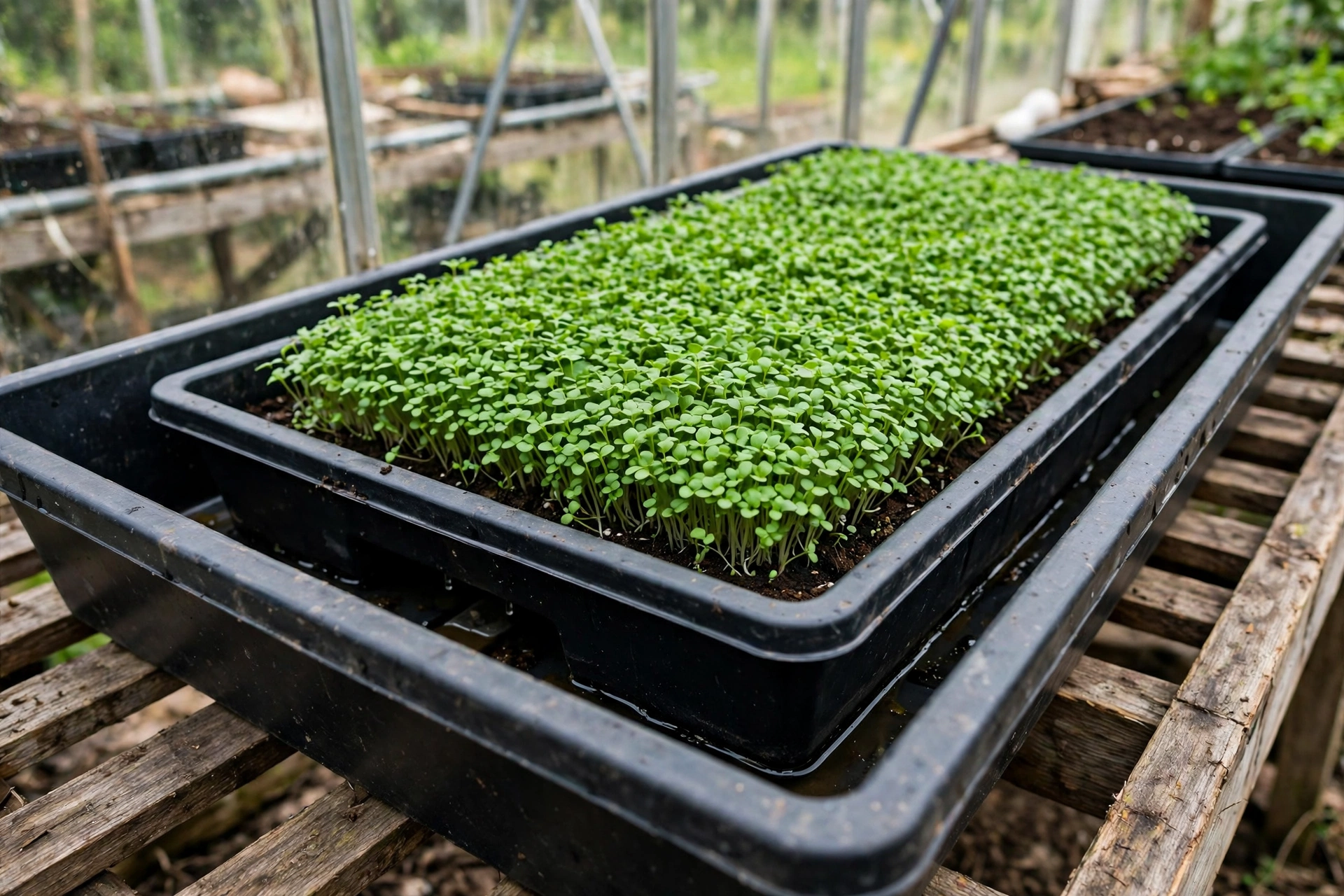
Bootstrap Farmer makes the tray that other growers measure trays against. The shallow 1020 runs 20 by 10 inches and 1.25 inches deep, moulded from heavy-duty, BPA-free number 5 polypropylene, rated to carry up to 50 pounds without warping, top-rack dishwasher safe, and backed by a limited 2-year warranty. The shallow depth is deliberate. More airflow crosses the surface of the crop, which helps keep mold and damping off at bay, and a low rim lets you cut cleanly at the soil line without fighting high sidewalls.
The system is a pair: one tray with holes nested inside one without holes. The holed tray holds your seed and medium. The solid tray catches drips and holds a reservoir for bottom watering. Buy them in pairs, because a single tray on its own is only half the system. Mesh versions of the same tray suit large-root crops such as pea and sunflower, which drain fast and benefit from top watering. A 2.5 inch deep version exists in the same family for crops that want more medium.
This is a tray kit, not a complete kit. No seed, no mats, no dome, and no light come in the box. That is a weakness for a first-time buyer who wants one purchase, and it is a strength for everyone else, because you choose your own seed and medium and pay nothing for parts you do not need.
Real-world limitation: the upfront cost of a pair of heavy trays is higher than a disposable flat, and you still need to buy seed, medium, and a light separately.
Who should buy: committed home growers running a steady rotation, and anyone who has already cracked a flimsy tray carrying a full flat of wet soil.
Our rating: 8.7/10. Specifications source: Bootstrap Farmer, https://www.bootstrapfarmer.com/blogs/microgreens/what-trays-do-you-need-for-microgreens-and-propagation. Amazon ASIN for the extra-strength 10-pack tray set in the same 1020 family: B074LS11PP (trays only, not a bundled kit).
4. Hamama Home Microgreen Kit
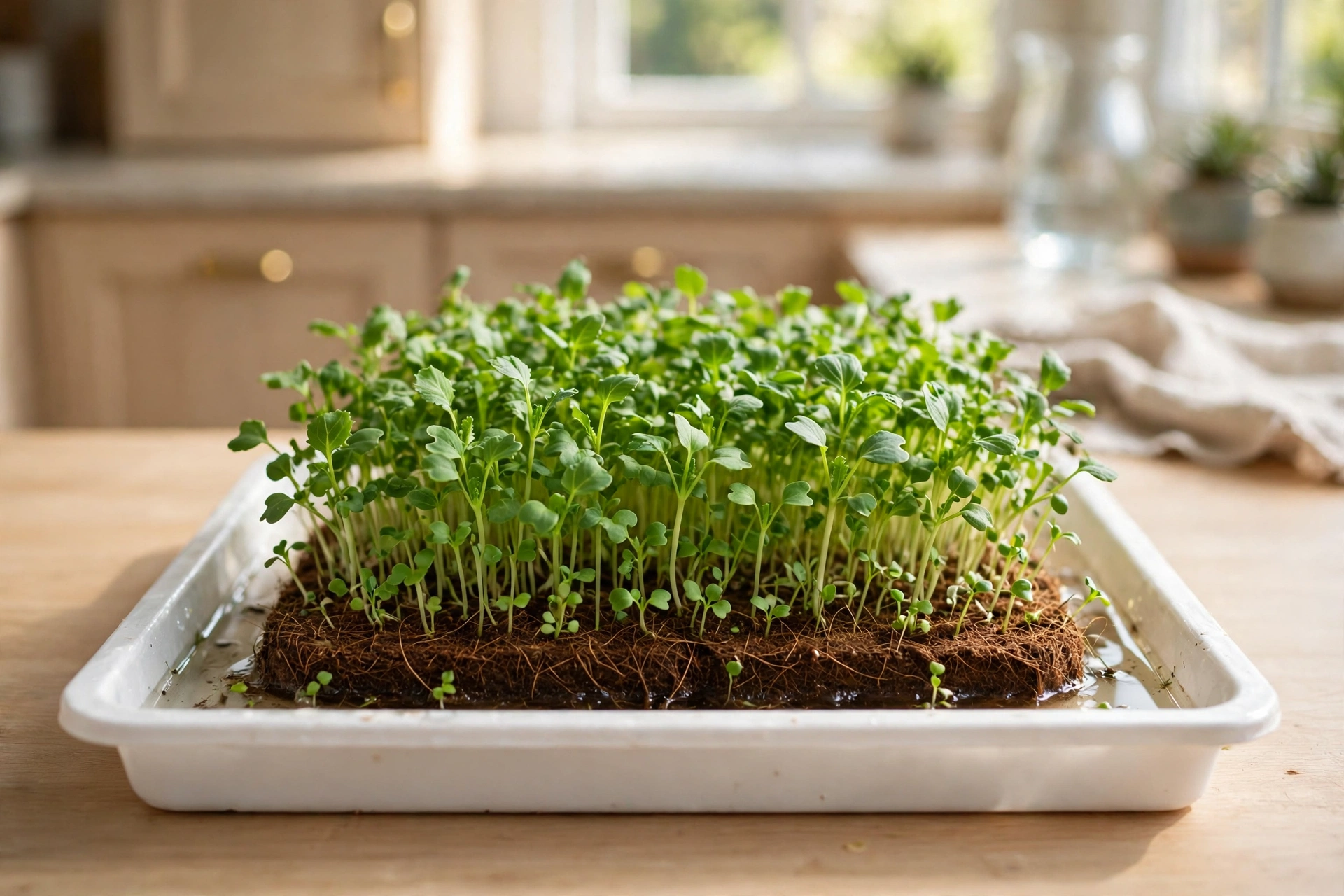
Hamama built its whole kit around one idea: the seed quilt. It is a coconut fibre pad with the seed already embedded, folded over evenly spaced pods of seed and growing medium. You fill the tray with water, lay the soaked quilt on top, and the maker says the greens are ready in 7 to 10 days with no further watering. The starter kit comes with a reusable tray in recyclable number 5 polypropylene, a riser that holds the quilt above the water line, three Seed Quilts in varieties you choose, and an instruction card. A ceramic tray version is sold separately.
For a reader who has killed every houseplant they own, this is the most forgiving design on the list. There is no seeding density to judge, no misting schedule, and no blackout step to get wrong. The range runs to 14 varieties, including broccoli, kale, cabbage, wheatgrass, fenugreek, clover, wasabi mustard, several radishes, and two salad mixes. The seeds are non-GMO and most varieties are organic. The quilts are compostable, and the maker offers a grow guarantee with replacement or refund.
The cost of that convenience is lock-in. The plants do not regrow after harvest, so every harvest uses a new quilt, and refills come only from Hamama. A bag of loose seed and a stack of mats grow the same crops for far less per tray. Hamama also tells buyers that a window or ordinary ceiling lighting is enough. Microgreens will grow in dim light, but that is not the same as growing well, and a tray under ceiling lights usually comes out taller, paler, and floppier than the same tray under proper light.
One size note: sources disagree slightly on the tray. This guide prints about 12 by 6 inches for the standard plastic tray. The ceramic tray measures 12.5 by 6.5 by 2 inches, which is a different product.
Real-world limitation: each harvest costs a new quilt, so the per-tray cost stays high no matter how long you own the kit.
Who should buy: gifts, offices, and anyone who will not remember to water.
Our rating: 8.6/10. Specifications source: Hamama, https://www.hamama.com/products/microgreens-kit. Amazon ASIN: none verified.
5. AeroGarden Sprout
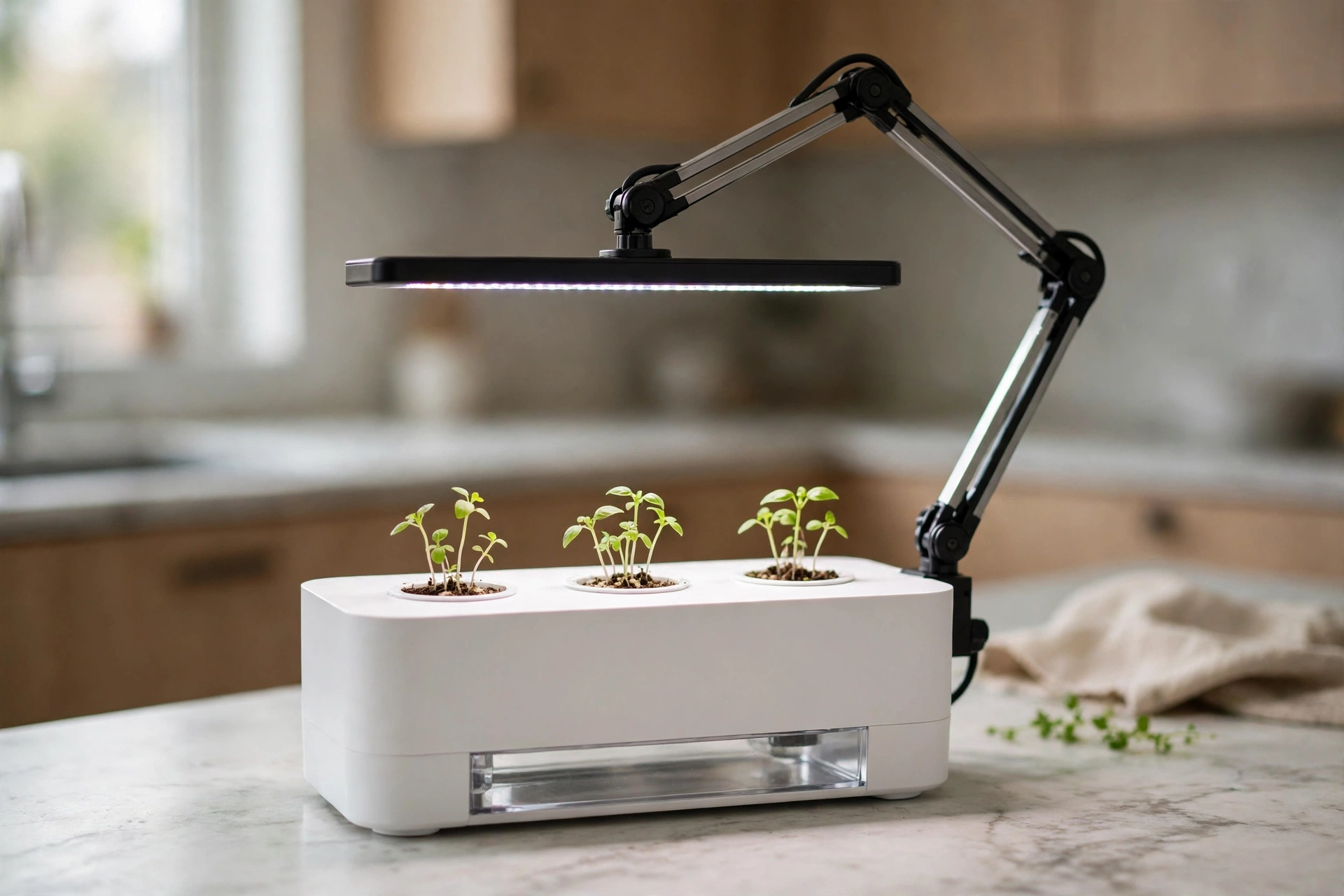
The AeroGarden Sprout is the smallest garden in AeroGarden’s current lineup, and the most approachable. It is a countertop hydroponic garden with a 10 watt LED grow light, a 3-pod deck, and one touch button. The maker includes a 3-pod seed kit, usually gourmet herbs, and a bottle of liquid plant food. Fill the reservoir, drop in the pods, snap on the domes, and the light runs on an automatic timer. The maker says most plants germinate within 7 to 14 days. Availability note: the Sprout is no longer offered for sale on the maker’s own site. When checked on 2026-11-23, the product page showed no price and no way to buy it, and the listing was flagged as clearance.
For microgreens, the Sprout works best with AeroGarden’s microgreen seed pod kits, which fit every AeroGarden model because all pods use the same standard basket. The Sprout holds 3 pods, the Harvest holds 6, the Bounty holds 9, and Farm models hold 12 or more. The Grow Anything kit is the other route: empty grow sponges and baskets for your own seed, with plant food included and no seed in the box.
The limit is scale. Three pods are three planting spots, not three guaranteed full-size plants, and a household that cooks with fresh greens daily will outgrow it fast. The grow height caps at about 10 inches, so tall crops are out, though microgreens are cut long before that matters.
If you want a genuinely productive microgreen setup from this family, the 6-pod Harvest is the better buy. The Sprout earns its place here as the cheapest, smallest way into a lit hydroponic system.
Real-world limitation: three pods harvest garnish quantities, and replacement pod kits keep costing after the first round.
Who should buy: one person with a small counter or desk who wants a few herbs or a little leaf lettuce under a built-in light, with almost no controls to learn.
Our rating: 8.6/10. Specifications source: AeroGarden (Scotts Miracle-Gro), https://scottsmiraclegro.com/en-us/brands/aerogarden/products/browse-all-aerogarden-products/aerogarden-sprout.html?dwvar_aerogarden-sprout_color=0045. Amazon ASIN (Cool Gray): B09S5MZCC9.
6. SunBlaster Micro LED Grow Light Garden
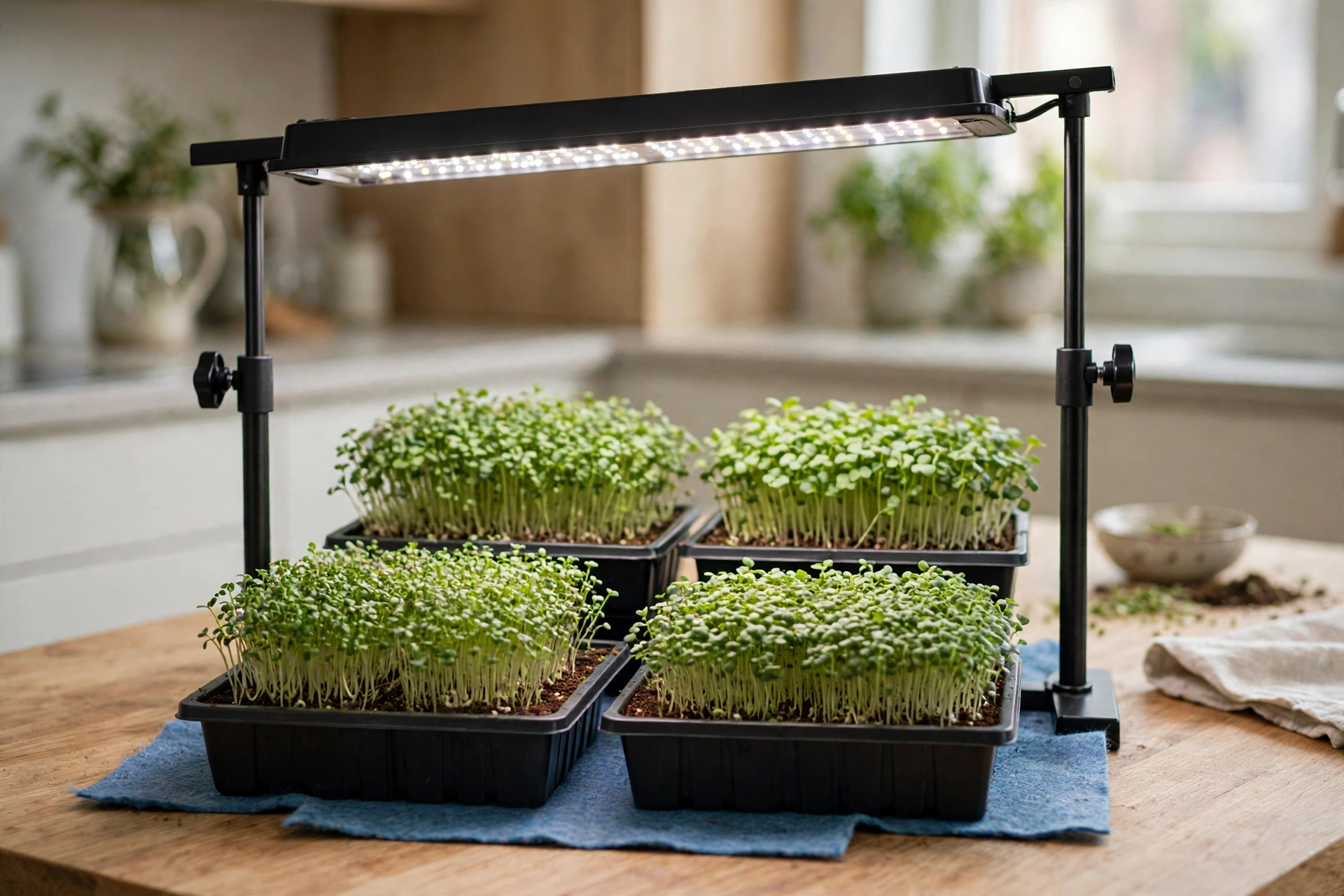
SunBlaster has sold lit tray gardens for years, and the Micro LED version is the compact one. It ships with a 12 inch 6400K LED strip light, a power cord with an on/off switch, a garden canopy that adjusts up to 18 inches, a heavy-duty base that doubles as a water reservoir, a raised platform, a wicking mat, and four seedling trays. The footprint is about 19 by 8 inches, so it fits a kitchen table or a narrow shelf where a full 10 by 20 setup would not.
The wicking system is the part that earns its keep. Water rises from the base reservoir through the mat by capillary action, and the maker says the garden can auto-water for 7 to 14 days depending on the plant and the climate. The trays are shaped to let air move between the wicking mat and the tray bottom, which keeps roots healthier than a tray sitting flat in water. The canopy rises as plants grow, so the same unit covers microgreens at two inches and herbs at ten.
What it does not include is seed, soil, or medium. You bring your own starting mix and your own seed, which keeps the purchase honest: you pay for hardware, not consumables. The older T5HO fluorescent version is still sold under a similar name, so check the listing says LED before you buy.
A wattage flag is worth noting. TrimLeaf lists a 12 watt LED strip for this garden, while an Amazon Canada listing for the same model says 11 watts. This guide prints 12 watts from the retailer listing and flags the conflict.
Real-world limitation: four small trays harvest less per round than a single 10 by 20 flat, and the light covers only its own footprint, so a second set of trays needs a second unit.
Who should buy: growers who want a real light over real trays without building a shelf system, and renters who need a complete garden that packs away.
Our rating: 8.5/10. Specifications source: SunBlaster via TrimLeaf, https://trimleaf.com/products/sunblaster-micro-led-grow-light-garden-black-12w. Amazon ASIN (Amazon.ca listing): B07CKPFR69.
7. Urban Leaf Indoor Microgreens Growing Kit
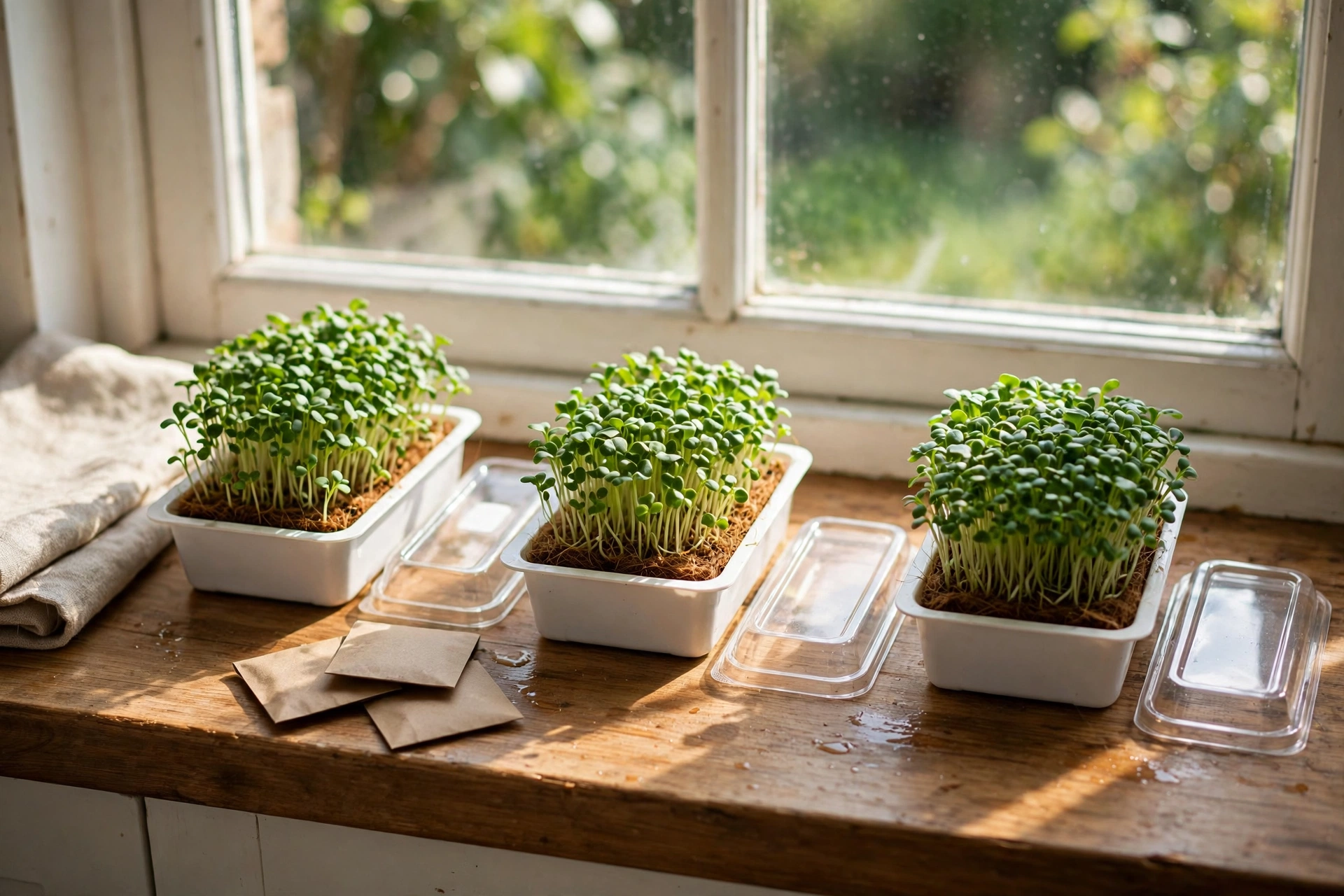
Urban Leaf’s microgreens kit is a small, tidy system built for a windowsill. The box shown in an unboxing holds three white rectangular trays, four seed packets covering lentil, kale, radish, and mustard, a brown fibre growing mat, clear plastic lids, and an instruction booklet. The routine is close to water once and watch it grow, as the unboxing shows. An unboxing video shows the setup clearly: water into the trays, the wet mat laid in, seed spooned evenly over the mat, and the clear lids set on top for germination.
Three trays are the smart part of this kit. You can sow one every few days and always have a tray coming ready, instead of one big batch arriving all at once and fading in the fridge. The varieties are well chosen for a first grower too. Radish and mustard germinate fast and forgive mistakes, kale is mild and steady, and lentil gives a crunchy, protein-rich shoot that feels different from the brassicas.
The gaps are the usual ones for a small kit. The maker does not publish tray dimensions, so this guide does not estimate them. No light is included, so a dim kitchen will give you taller, paler greens than a bright window. And the fibre mats are consumables: once you have used the included mat, you need more mats or a bag of medium to keep going. The maker’s store was unavailable when checked on 2026-11-23, so availability could not be confirmed from the maker.
Do not confuse this kit with Urban Leaf’s other product, the bottle-top herb garden, which turns a wine bottle into a self-watering planter with a soil plug and a suction cup. That is a different system for herbs, not the microgreens kit reviewed here.
Real-world limitation: three small trays harvest side-dish quantities, and the kit leans on your window for light, so winter growing in a north-facing kitchen will disappoint.
Who should buy: apartment dwellers with a sunny windowsill who want three small batches on rotation and a kit that looks neat while it grows.
Our rating: 8.2/10. Specifications source: kit contents as shown in the unboxing at https://www.instagram.com/reel/Dbg3LDEqHYa/; the maker’s own site could not be reached to confirm the contents. Amazon ASIN: none verified.
8. True Leaf Market Windowsill Self-Watering Microgreens Kit
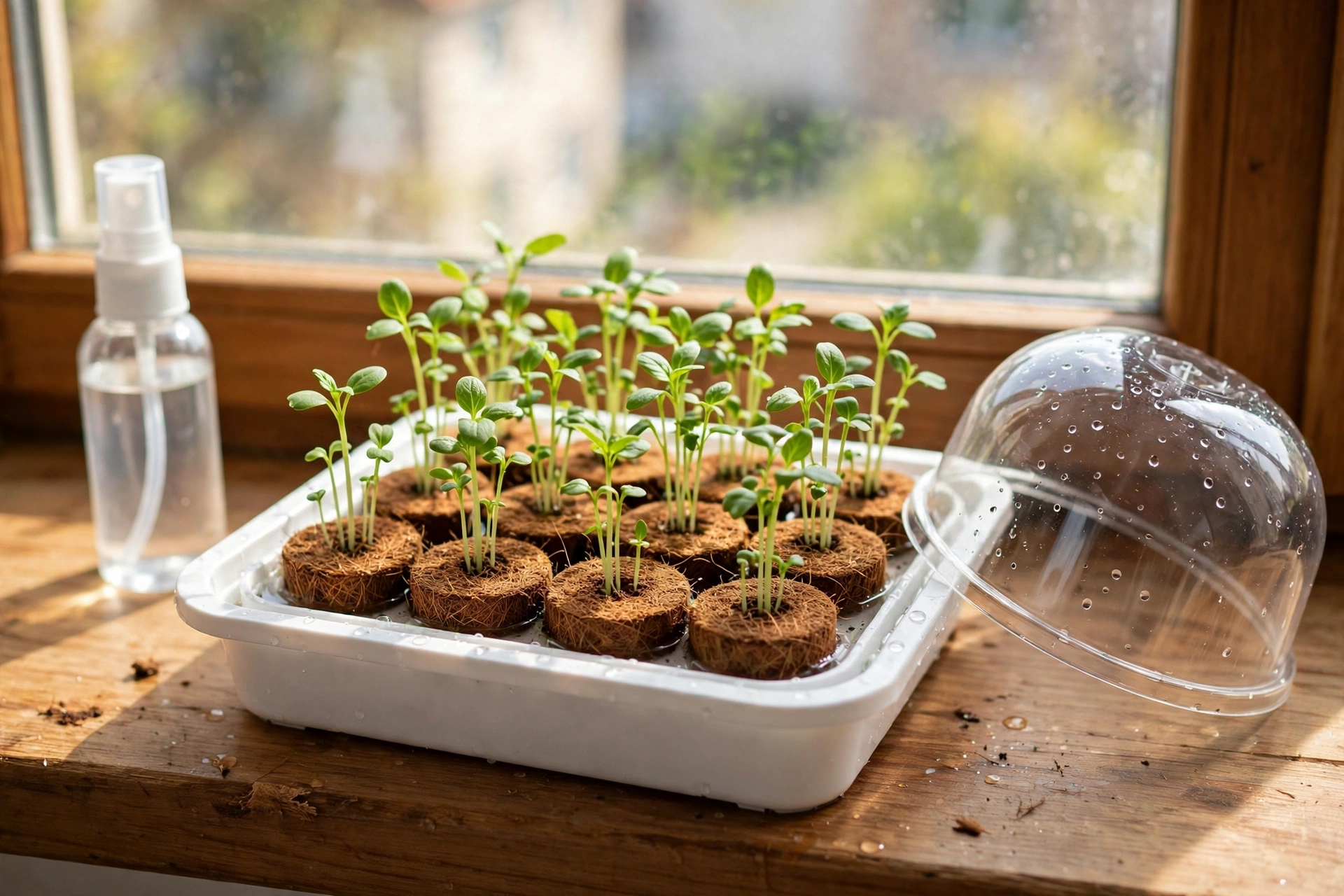
This is the cheapest proper start on the list, and the one that teaches the method with the least fuss. The kit includes enough organic seed for three harvests, broccoli, purple radish, and a spicy salad mix, plus coconut coir soil discs, a humidity dome, a spray bottle, and a self-watering wicking tray with a custom holding tray. You add two cups of water to the bottom, set the wicking insert on top, and the wicks draw moisture up to the soil. The maker says the greens are ready in 7 to 10 days, and the seed is certified organic.
Three harvests is the honest limit of the box. After that you need new seed and new coir discs, though the tray itself is reusable. The spicy salad mix may be swapped for a basic salad mix depending on stock, so the exact three varieties can vary. That is a small thing, but it is the kind of detail a buyer should know before ordering for a specific crop.
The kit suits a particular reader: someone who has never grown anything and wants to find out whether microgreens are for them, without spending much or clearing a shelf. It also suits a classroom or a gift, because the whole process fits on a windowsill and the instructions are short.
Real-world limitation: one small tray per round means one small harvest, and after three rounds the kit is only a tray until you buy refills.
Who should buy: first-time growers, gift buyers, and anyone who wants to test microgreens for the price of a takeaway lunch.
Our rating: 8.1/10. Specifications source: True Leaf Market via https://www.ondivulge.com/true-leaf-market-indoor-growing-kits/ and https://trueleafmarket.com/blogs/articles/growing-microgreens-at-home-a-beginners-experience. Amazon ASIN: none verified.
9. Window Garden Microgreens Grow Kit
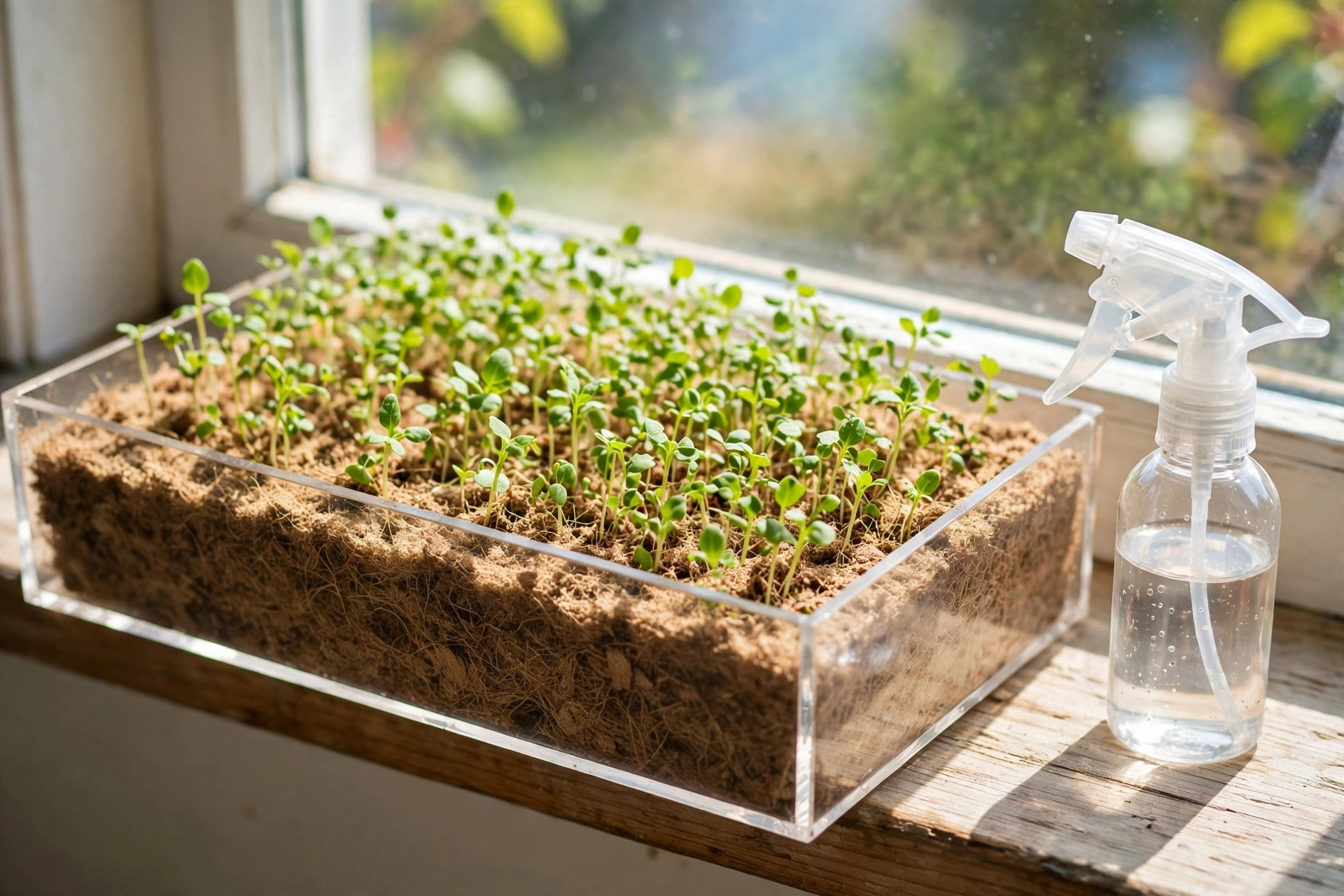
The Window Garden kit wins on one simple feature: you can see what is happening. The tray is clear acrylic, 15 by 6 by 2 inches, so moisture levels are visible at a glance instead of guessed. The box includes fibre soil, non-GMO seed packets, and a sprayer, and the kit is built to sit on a windowsill and use the sun. A second variant ships with 3 quarts of organic fibre potting soil and a pop-up bag instead of the sprayer, so check which version you are buying.
Six seed types are listed for this kit across retailer roundups: sunflower, pea, broccoli, mixed salad, red amaranth, and radish. That is a wider range than most windowsill kits offer, and it matters because sunflower and pea shoots taste completely different from brassica microgreens. The clear tray also helps beginners learn the watering rhythm, since dry fibre soil looks pale and wet soil looks dark through the wall.
The routine is hands-on. This system needs regular misting and a little daily attention, and there is no reservoir or wick to cover a forgotten day. The tray is also open-topped, so a dry room can dry the surface faster than a domed kit would. Optional suction cups to stick the tray to a window are sold separately, which is a nice idea for a narrow sill but an extra purchase.
Real-world limitation: no self-watering and no dome, so the kit depends on your daily attention and your window’s light.
Who should buy: sunny-windowsill growers who like to watch their crop and do not mind misting daily.
Our rating: 8.0/10. Specifications source: Window Garden via Amazon, https://www.amazon.com/dp/B01LWZL5MG. Amazon ASIN: B01LWZL5MG.
10. Back to the Roots Organic Microgreens Grow Kit (6-Grow Variety Pack)
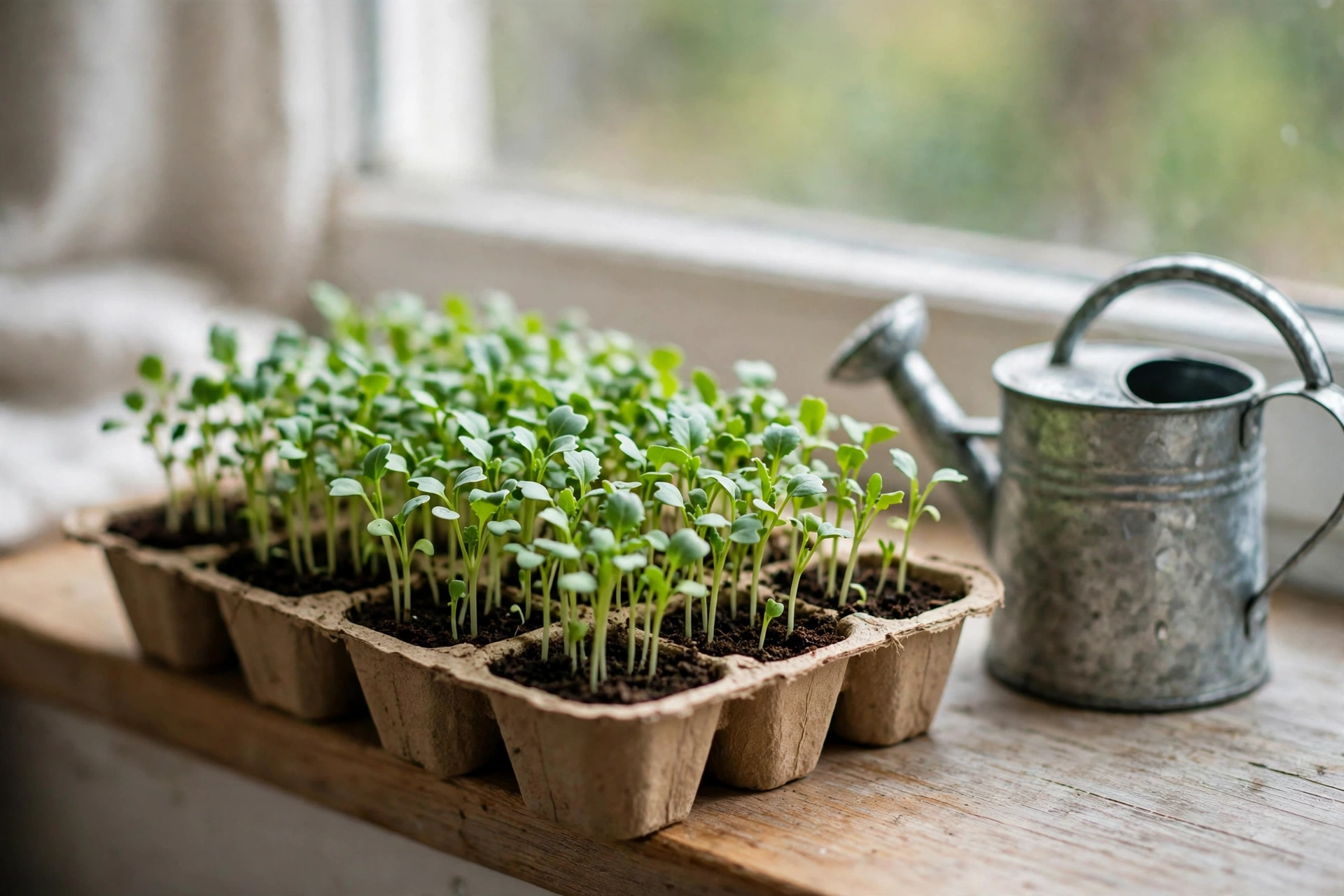
Back to the Roots sells the simplest first experience on this list, and the best one for kids. Each grow is one compostable tray, one expanding coconut coir soil disc, one packet of organic seed, and a tray cover. The 6-grow variety pack gives you six of everything: two each of Rainbow Mix, Mighty Mix, and broccoli. The method is written for a child to follow. Put the disc in the tray, add a third of a cup of water, sow the seed, cover for 48 hours, then water with 3 to 5 tablespoons a day and harvest in about 7 days. The maker backs it with a “Guaranteed to Grow” replacement promise.
The tray itself deserves a mention. It is made from 100 percent recycled cardboard plus a proprietary bio-based additive that helps the paper repel moisture, and it is certified compostable in both home and commercial facilities. When the grow is done, the whole tray goes in the compost. That is a genuine difference from the plastic kits on this list, and it suits buyers who want zero plastic in the kitchen.
As a food source it is small. One tray is garnish scale, the soil disc is messier to harvest cleanly than a fibre mat, and the tray is single-use by design, so the kit never becomes a permanent setup. Penn State notes that potting media particles are hard to remove from harvested microgreens, which matters more the smaller the tray. One stock note: the maker’s 6-Grow Variety Pack was sold out on the maker’s own site when checked on 2026-11-23.
Real-world limitation: a single small tray per grow, single-use trays, and daily spoon watering mean this kit teaches growing rather than feeding a household.
Who should buy: families with kids, teachers, gift buyers, and anyone who wants a no-commitment first try.
Our rating: 7.9/10. Specifications source: Back to the Roots, https://backtotheroots.com/pages/mggk-faq. Amazon ASIN: B085PWHM5J.
Easiest Microgreens to Grow
If this is your first tray, start with the forgiving crops and leave the slow ones for round two. Radish is the classic beginner crop: it germinates in about 36 hours at 72 degrees Fahrenheit per University of Maryland Extension, and it is ready in 8 to 12 days with a spicy crunch. Broccoli and kale are nearly as fast at 8 to 12 days, mild in flavour, and tolerant of imperfect light. Mustard and arugula follow the same pattern, with harvest around 6 to 12 days.
Pea shoots and sunflower shoots taste wonderful, sweet and nutty, but they ask more of you. Both are large seeds that benefit from a 6 to 12 hour soak before sowing, and both want a weighted cover for a few days during germination. They also grow better in a thin layer of soilless mix than on a fibre mat, because their roots are strong and their seeds are heavy.
Basil, cilantro, and beet are the slow lane. Basil can take 12 to 16 days and sometimes longer, cilantro is slow to germinate and fussy about moisture, and beet takes around 17 days. Save those for your third or fourth tray, once you trust your watering rhythm.
One rule covers every crop: sow one variety per tray. Different microgreens germinate and grow at different rates, and a mixed tray always leaves half the crop ready while the other half is still catching up.
Best Growing Medium for Microgreens
The medium is the second decision after the tray, and it decides mess, yield, and hygiene more than most buyers expect.
A lightweight soilless mix, peat or coir based, 1 to 1.5 inches deep, is the standard that extension guides recommend. It gives the highest yields in trials, it suits large seeds such as pea and sunflower, and it costs little. Its downside is mess: soil particles stick to stems at harvest, and the mix must be replaced or composted after each round.
Fibre mats, hemp, bamboo, coconut coir, and jute, trade a little yield for a much cleaner harvest. You lift the mat, cut above it, and the greens come away clean. Mats also hold water well, so they need watering less often. Trials led by Penn State researchers found peat and coir mats gave higher dry shoot weight than jute, bamboo, or recycled plastic mats across four species, while a separate study found peat-grown microgreens carried higher counts of Enterobacteriaceae than mat-grown crops. In plain terms, mats are cleaner and soil yields a little more.
Seed quilts and pre-seeded pads remove the sowing decision entirely. They are the cleanest option of all and the easiest for a beginner, but they lock you into one maker’s refills and cost the most per harvest.
The practical answer for most readers: grow small seeds on mats and large seeds, pea, sunflower, beet, and chard, in a thin layer of soilless mix. Avoid using ordinary garden soil in indoor microgreen trays. It can compact in shallow containers, drain poorly, and introduce soilborne organisms. Use a clean, lightweight growing medium intended for container growing instead.
Microgreen Kit With Light vs Without
Most kits on this list ship without a light, and that is the single most common reason a first harvest comes out pale and stretched. A tray under ceiling lights will produce something edible in ten days. It will usually be taller, paler, and floppier than the same tray under proper light, because the seedlings stretch looking for more.
University of Maryland Extension says microgreens generally grow best under grow lights, with about 16 hours of light a day and the fixture 6 to 12 inches above the foliage. Virginia Tech’s microgreen production guidance puts the recommended daily light integral at 9 to 16 moles per square metre per day. Penn State classes microgreens as a low-light crop, below a daily light integral of 20, and notes they will still grow under less-than-ideal conditions because the crop is so short.
What that means in practice depends on your window. A bright, south-facing window can work, especially in spring and summer. A north-facing window, a kitchen with small windows, or a winter grow will usually disappoint without a light. If your kit has no light, a simple LED shop light or a tray-sized full-spectrum LED bar on a timer is the upgrade that changes results most. Size it to the tray: a 12 by 6 inch kit needs a short bar, and a 10 by 20 flat needs something that covers the whole length evenly, not just the middle.
Choose a kit with a light built in if your kitchen is dark, if you grow in winter, or if you want one purchase that covers everything. Choose a kit without a light if you already own a grow light or a genuinely bright window, because you will get more tray and more seed for the same money.
Timing matters as much as equipment, so check when to start seeds indoors by zone before you sow your first tray.
Microgreen Growing Supplies Checklist
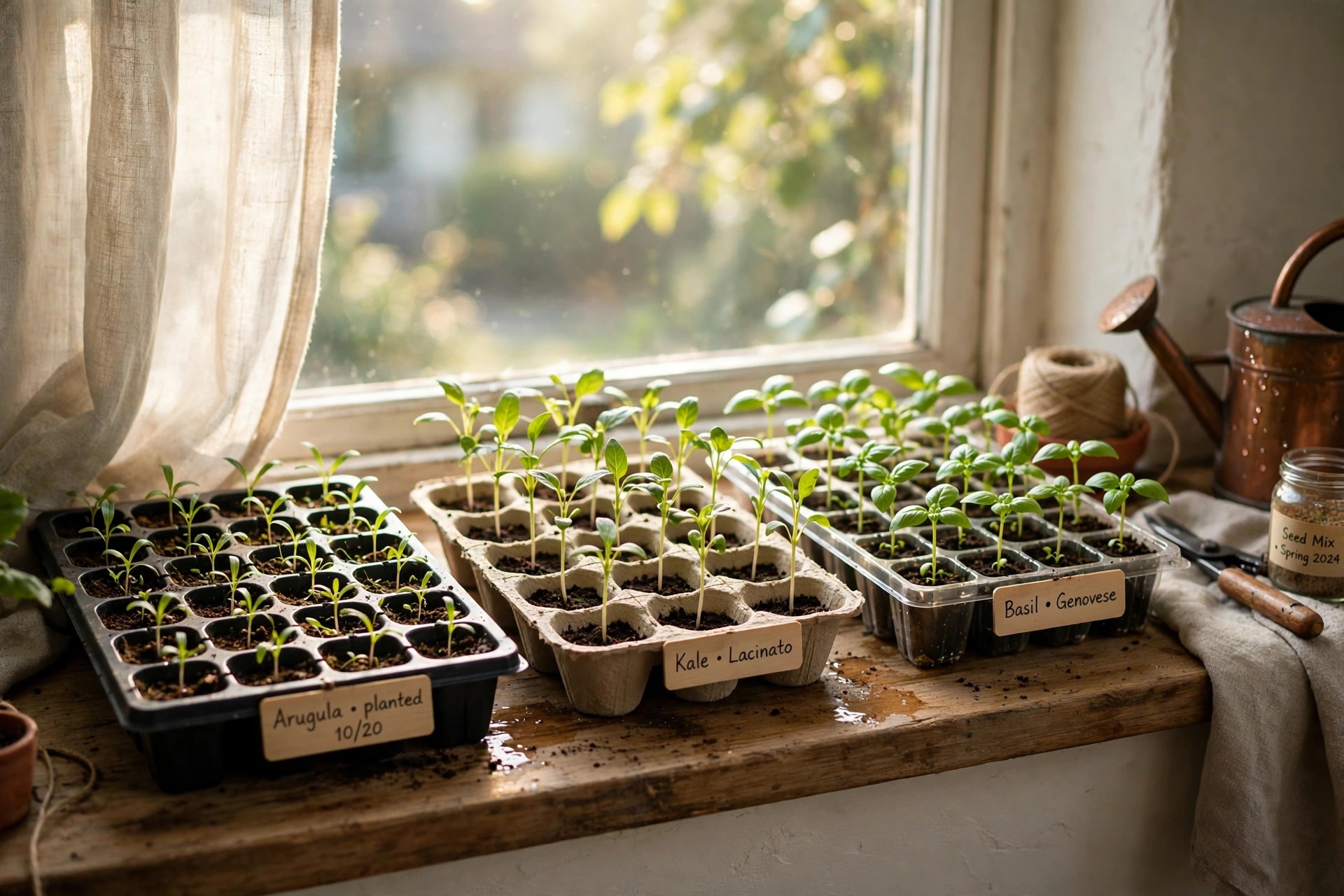
A kit covers the tray, the medium, and the seed. The rest of the setup is small, cheap, and easy to forget until harvest day. Keep this checklist beside your first order.
- Clean kitchen scissors or harvest shears. No kit on this list includes a cutting tool, and a clean cut above the medium is how you harvest.
- A spray bottle for misting seed on day one, before you switch to bottom watering.
- A second solid tray without holes, if your kit only includes one tray. It catches drips and holds water for bottom watering.
- Seed sold for microgreens or sprouting, untreated and uncoated. Penn State warns against treated seed for food crops eaten raw.
- A small kitchen scale or measuring spoons. Penn State’s starting rate is 10 to 15 grams of small seed per 10 by 20 inch tray, and weighing beats guessing.
- A timer for your light, if you add one. Consistent hours matter more than brightness alone.
- A clean tray and clean hands at every step. Wash trays between rounds, and sanitise reused containers in a mild bleach solution per extension guidance.
How to start seeds indoors well is a skill that carries straight over to microgreens, from sowing depth to hardening off, and our companion guide walks through the whole indoor process once you know your dates.
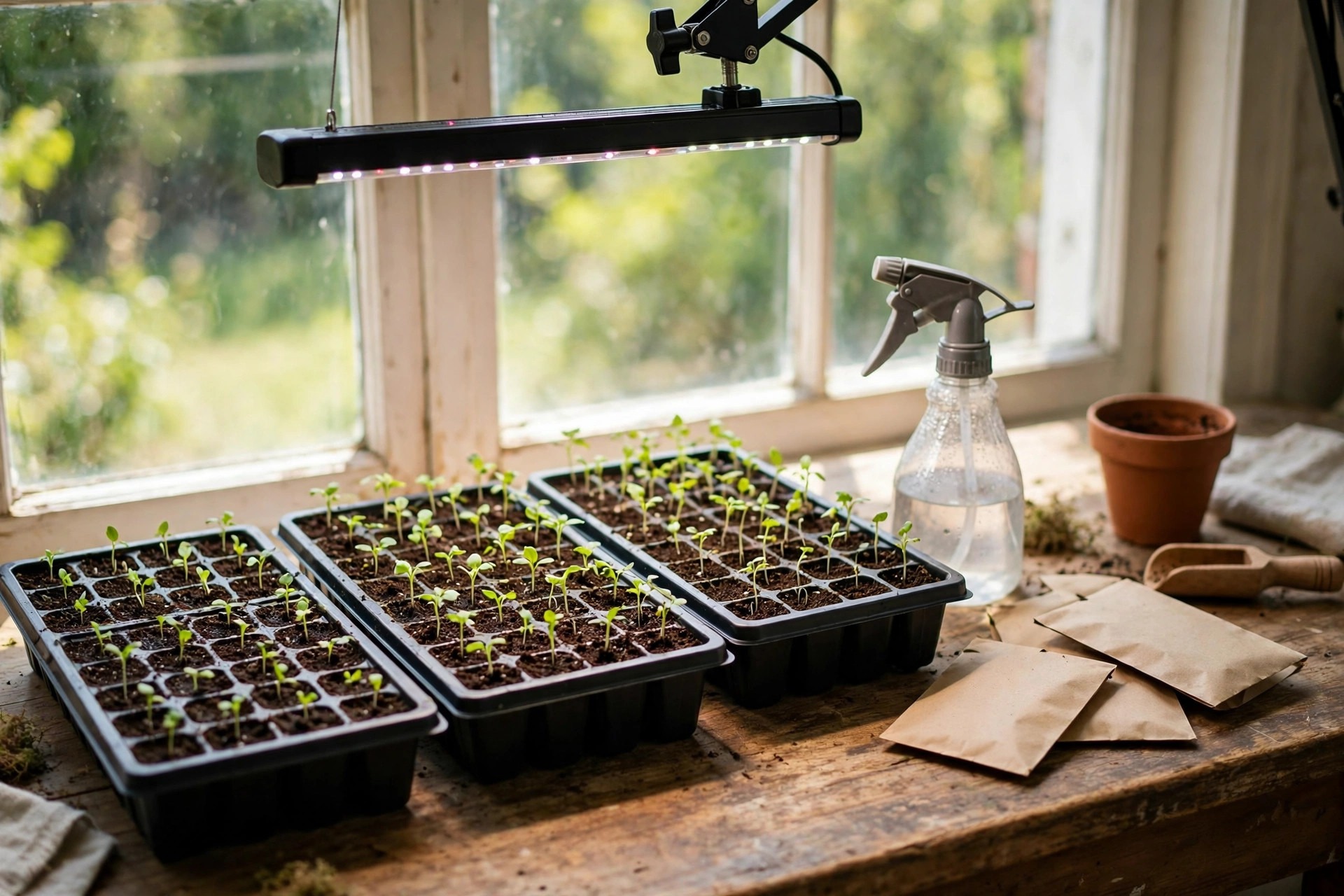
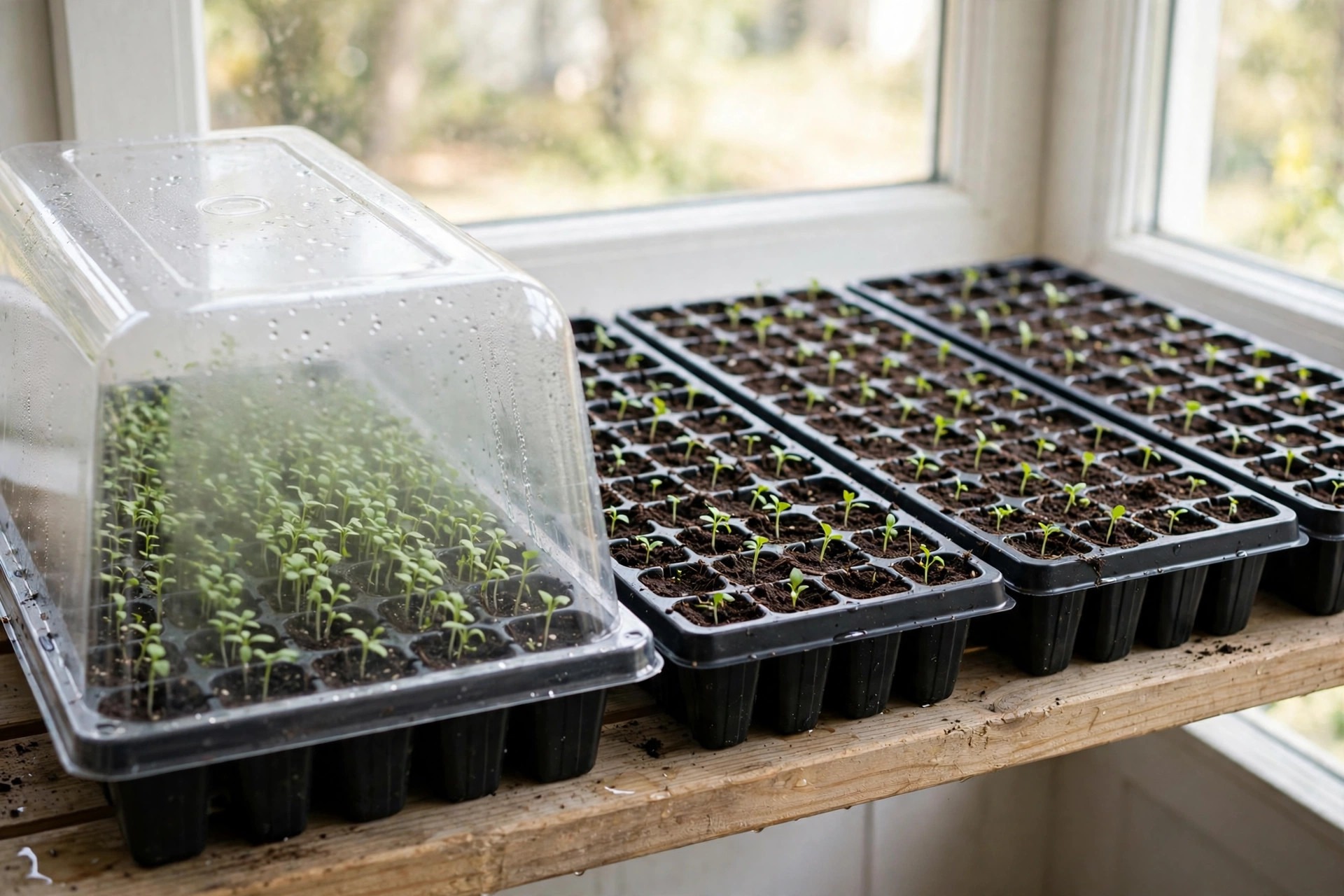
And when your microgreen trays share a shelf with your seed starts, the trays themselves matter as much as the seed. Sturdy flats with domes and bottom-watering reservoirs keep both jobs organised.
Final Choice
For most readers, the best microgreen growing kit is the True Leaf Market Hydroponic Microgreens Starter Kit. It gives you the standard 10 by 20 inch flat, three of them, with mats and enough seed for 12 to 18 plantings, and it leaves you free to buy refills anywhere. It scores 8.9 because it is strong everywhere except light, and light is the one part you can add yourself with a cheap LED bar.
If your kitchen is the room you live in and the kit will sit in view, buy the ingarden instead. It is the only kit here that looks like furniture, waters itself, and runs its light on a timer, and its 8.8 score reflects that polish. Accept that you will buy its pads for every harvest.
If you already know you will grow microgreens every week, skip both and buy the Bootstrap Farmer 1020 trays. They are the cheapest per harvest over a year, they will outlast every other tray on this list, and they pair with any seed and any medium you choose.
And if you only want to find out whether microgreens are for you, spend the least. The True Leaf Market Windowsill kit or a Back to the Roots 6-grow pack will teach you the whole method in a week, on a windowsill, for the price of a takeaway lunch. Whatever you choose, give the tray strong light, water from below after day one, and cut when the first true leaves appear. The greens will do the rest.
References
- Penn State Extension, “Growing Microgreens“, https://extension.psu.edu/growing-microgreens. Supports the seeding rate of 10 to 15 grams per tray, the 1020 tray standard, harvest at 7 to 21 days, and the low-light classification of microgreens.
- Penn State Extension, “A Step-By-Step Guide for Growing Microgreens at Home“, https://extension.psu.edu/a-step-by-step-guide-for-growing-microgreens-at-home. Supports the step-by-step method, trays with drainage holes, and bottom watering.
- University of Maryland Extension, “Growing Microgreens and Baby Greens Indoors“, https://extension.umd.edu/resource/growing-microgreens-and-baby-greens-indoors. Supports harvest at 2 to 3 inches tall in 7 to 21 days, soaking large seeds for 6 to 12 hours, and about 16 hours of light a day under grow lights.
- Xiao, Z., Lester, G. E., Luo, Y., and Wang, Q. (2012), “Assessment of vitamin and carotenoid concentrations of microgreens“, Journal of Agricultural and Food Chemistry, https://pubs.acs.org/doi/10.1021/jf300459b. Supports the vitamin and carotenoid concentrations measured in microgreens.
- True Leaf Market, “Best Growing Tray for Microgreens: How to Choose the Right One“, https://trueleafmarket.com/blogs/growing-zone/best-growing-tray-for-microgreens-how-to-choose-the-right-one. Supports the 1020 tray as the standard, the drainage decision, and shallow trays for airflow.
- Grow With Hydroponics, “Best Microgreens Growing Kits: 5 Picks Compared by Tray Size, Medium and Real Cost“, https://growwithhydroponics.com/best-microgreens-growing-kits/. Comparison used to confirm the True Leaf Market Hydroponic Starter Kit contents.
- TrimLeaf, “SunBlaster Micro LED Grow Light Garden – Black“, https://trimleaf.com/products/sunblaster-micro-led-grow-light-garden-black-12w. Retailer listing with owner feedback; supports the 12 watt LED strip.
- OnDivulge, “Five True Leaf Market Indoor Growing Kits and Gifts“, https://www.ondivulge.com/true-leaf-market-indoor-growing-kits/. Review roundup; supports the Windowsill kit contents.
What is the best microgreen growing kit for beginners?
The best microgreen growing kit for beginners is a full-size tray kit with grow mats and several seed varieties, such as the True Leaf Market Hydroponic Microgreens Starter Kit. It gives you room to learn, standard parts, and enough seed for many rounds. If you want the easiest possible first harvest with no decisions, the Hamama Home Microgreen Kit is simpler, because the seed comes pre-sown in a quilt and you only add water once.
What are the easiest microgreens to grow?
Radish, broccoli, kale, mustard, and arugula are the easiest microgreens to grow. They germinate fast, tolerate imperfect light, and are ready in 6 to 12 days. Pea and sunflower shoots taste wonderful but need soaking and a weighted cover, so save them for your second or third tray. Basil, cilantro, and beet are slower and fussier.
Do microgreen kits need a grow light?
Poor lighting is one of the common reasons home-grown microgreens become pale, stretched, or weak. A bright window may work in some conditions, but a suitable grow light provides more consistent results. A tray-sized full-spectrum LED bar on a timer is the upgrade that changes results most, and kits with a light built in, such as the AeroGarden Sprout and the SunBlaster Micro LED garden, suit dark kitchens.
What is the best growing medium for microgreens?
A lightweight soilless mix, 1 to 1.5 inches deep, gives the highest yields and suits large seeds such as pea and sunflower. Fibre mats made from hemp, bamboo, coir, or jute give a cleaner harvest and need watering less often, with a small yield trade-off. Grow small seeds on mats and large seeds in a thin layer of soilless mix. Avoid using ordinary garden soil in indoor microgreen trays: it can compact in shallow containers, drain poorly, and introduce soilborne organisms. Use a clean, lightweight growing medium intended for container growing instead.
How long do microgreens take to grow?
Most microgreens are ready 7 to 21 days after sowing, when they stand 2 to 3 inches tall and the first true leaves have appeared. Fast crops such as radish and arugula can be ready in 6 to 8 days, while slow crops such as basil and beet can take 16 to 21 days. Temperature, light, and variety decide where in the range your tray falls.
Can you regrow microgreens after cutting them?
No. Microgreens are cut above the growing medium and do not regrow after harvest, so every harvest uses fresh seed. That is why refill costs matter when you choose a kit: proprietary pads and quilts must be bought from the maker, while open tray kits let you buy any seed and any mat. Compost the used medium and start a fresh tray for the next round.

Thesis Link : https://saulibrary.edu.bd/daatj/public/uploads/BAU200601_19-Pp_5.pdf
- 10 Best Microgreen Growing Kits - November 23, 2026
- 10 Best Mosquito Traps for Yards - November 22, 2026
- 10 Best Insecticidal Soaps - November 22, 2026