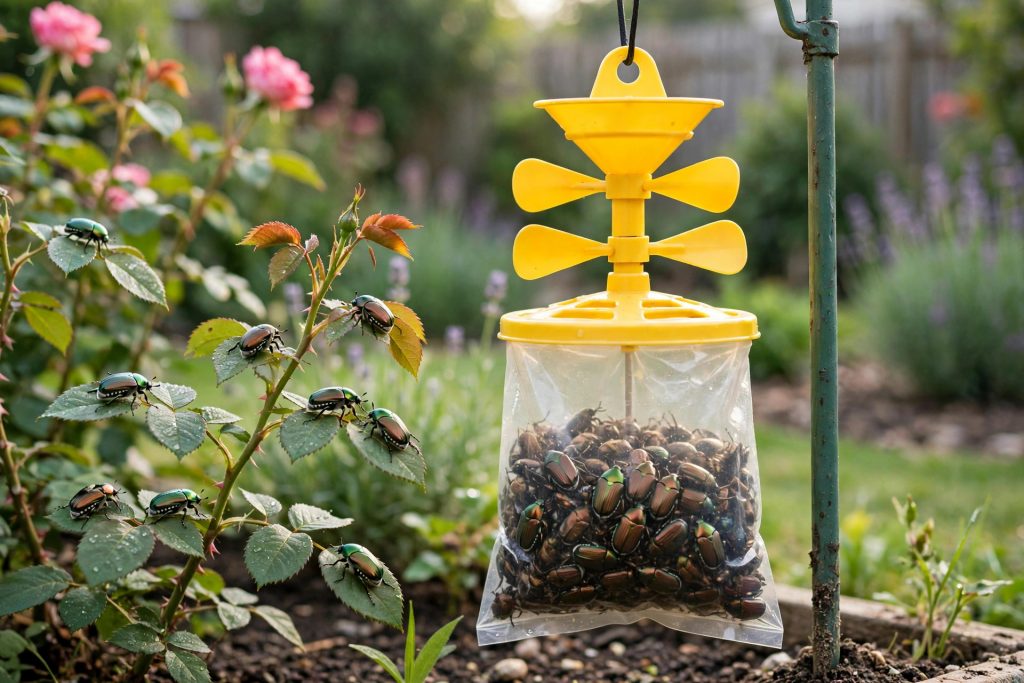

You walk out on a July morning and the rose bush that was in full bloom last week looks like lace. The leaves are skeletonized, nothing left but veins, and a dozen metallic green beetles are still feeding on the buds. That is the Japanese beetle, Popillia japonica, a 3/8 inch beetle that eats more than 300 kinds of trees and plants, and it arrives in American gardens every summer in numbers that make handpicking feel hopeless.
The best japanese beetle trap is the one with a dual lure, a bag you can change or empty without a mess, and a placement plan that keeps the lure far from the plants you are trying to save. That last point matters more than the brand on the box, because every university Extension service that has studied these traps reaches the same conclusion: traps catch a lot of beetles, and they can also draw more beetles into your yard. This guide gives you the honest picture first, then ranks the 10 best traps for a gardener who decides to use one anyway, with every figure checked against the manufacturer label or official product page in November 2026.
Quick Recommendation
Short on time? Start here.
- Best overall: Spectracide Bag-A-Bug. Dual lure, claimed to attract 2 to 5 times as many beetles as a floral lure alone, covers over 5,000 square feet, lure lasts about 12 weeks.
- Best reusable trap: RESCUE! Japanese Beetle Trap. Green cone with a double-layer nylon bag you empty and reuse for multiple seasons, lure lasts the full season, no killing agents or poisons.
- Best for two locations: Spectracide Bag-A-Bug 2-Pack. The same trap as our top pick, twice.
- Best for fast fills: Bonide Beetle Bagger. Hourglass disposable bags, a dual-release lure, and a label that tells you exactly how many traps your lot needs.
- Best reusable multi-pack: RESCUE! Japanese Beetle Trap 2-Pack. Two reusable cone traps for roses at one end and grapes at the other.
- Best new multi-pack: Catchmaster 3-Pack. Cross vanes, hourglass bags, and a rain-proof lid, with a dual lure and 5,000+ square feet per trap.
- Best bulk buy: Catchmaster 6-Pack. Six traps for a large property or a street that shares the problem.
- Best value single kit: Safer Brand Japanese Beetle Trap. Jumbo disposable bags, a controlled-release dual lure that lasts about 12 weeks, and the simplest kit.
- Best no-bag design: Tanglefoot Expandable. A reusable plastic cylinder with no bags to buy or throw away, though availability is uncertain, so check stock first.
- Best simple disposable: Lee Valley Japanese Beetle Trap. A dual-scent bag trap that assembles by hand with no tools and lasts one full season.
Japanese Beetle Traps at a Glance
| Product | Best For | Type | Coverage / Placement | Our Rating |
|---|---|---|---|---|
| 1. Spectracide Bag-A-Bug | Best overall | Vanes + disposable bag | 5,000+ sq ft; 30 ft downwind | 8.6 |
| 2. RESCUE! Japanese Beetle Trap | Best reusable trap | Cone + reusable nylon bag | 30 ft away; hang 4 ft high | 8.6 |
| 3. Spectracide Bag-A-Bug 2-Pack | Two locations | Vanes + disposable bag, 2 kits | Over 5,000 sq ft per trap; about 30 ft downwind | 8.5 |
| 4. Bonide Beetle Bagger | Fast fills | Vanes + hourglass bag | 5,000+ sq ft; 8 to 25 ft downwind | 8.5 |
| 5. RESCUE! Japanese Beetle Trap 2-Pack | Reusable multi-pack | Cone + reusable nylon bag, 2 traps | 30 ft away; hang 4 ft high | 8.5 |
| 6. Catchmaster 3-Pack | New multi-pack | Cross vanes + hourglass bag, lid | 5,000+ sq ft per trap; 30 ft away | 8.4 |
| 7. Catchmaster 6-Pack | Bulk buy | Cross vanes + hourglass bag, lid | 5,000+ sq ft per trap; 30 ft away | 8.3 |
| 8. Safer Brand 70102 | Best value single kit | X vanes + jumbo bag | 1 trap per 50 linear ft; 10 ft away | 8.3 |
| 9. Tanglefoot Expandable | No-bag design | Reusable plastic cylinder | Up to 5,000 sq ft; 10 ft downwind | 7.7 |
| 10. Lee Valley EM216 | Simple disposable | Disposable bag trap | Min 10 ft, ideally 30 ft away | 7.7 |
Do Japanese Beetle Traps Work
Answer this before you spend a dollar. Yes, Japanese beetle traps work at catching beetles: a bag can fill in a day or two during peak flight. The problem is what happens around the trap while it fills. University of Minnesota Extension states it plainly: “Don’t use Japanese beetle traps. Hanging a trap in a home garden is not an effective way to protect plants. And they may attract more insects to your yard.” The traps use a synthetic female sex pheromone and a strong floral scent, and research at the University of Kentucky showed that more beetles fly toward the traps than are actually caught. The beetles that miss the trap land on nearby plants and feed.
Purdue Extension agrees: pheromone traps “are not recommended for beetle management because they attract more beetles than they can control, resulting in increased plant damage.” Purdue entomologist Cliff Sadof adds that the lures can pull beetles from as far as a mile away.
So why rank 10 traps at all? Because many gardeners still choose to use them. Monitoring traps set in late June and early July can give early warning of emergence, and the traps do remove thousands of beetles when placed far from valued plants. The difference between a trap that helps and a trap that hurts is distance: hang it at the edge of the property, downwind, where the beetles it draws in have nothing valuable to eat on the way.
No manufacturer we checked publishes a beetle count per bag, so we do not print one.
1. Spectracide Bag-A-Bug Japanese Beetle Trap
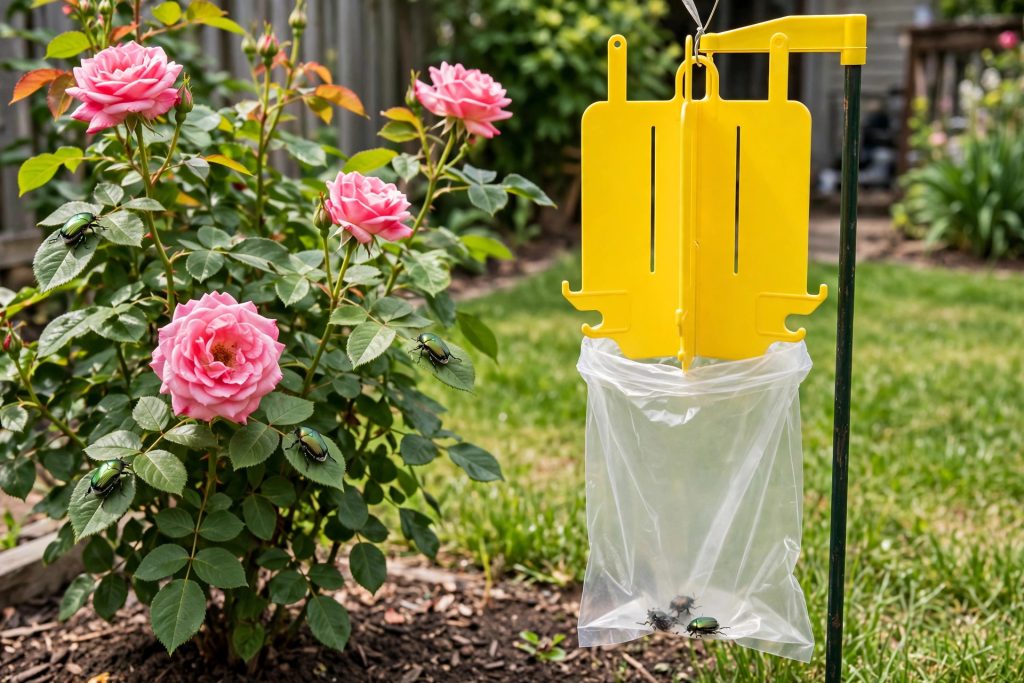
Type: Vanes + disposable bag. Lure: Dual, natural pheromone + floral lure. Kit: 1 lure, 1 set of vanes, 2 bags, 1 hang tie. EPA Reg. No.: 8845-129.
This is the trap most American gardeners will recognize, and it earns the top spot on the strength of its label. The dual lure combines a natural sex pheromone with a proven floral lure, and Spectracide claims it attracts 2 to 5 times as many beetles as a floral lure alone. The label prints the composition: eugenol 21.98 percent, geraniol 9.43 percent, 2-phenyl ethyl propionate 9.43 percent, and the pheromone at 0.02 percent. One honesty flag: the website lists eugenol at 21.95 percent, while the label PDF says 21.98 percent. We print the label figure. The label claims coverage over 5,000 square feet and a lure effective for about 12 weeks. Hang it about 30 feet downwind of foliage, with the bottom of the bag at least a foot above the ground, and change the bags every 4 to 5 days, because the odor of dead beetles repels new ones.
Our rating: 8.6. The dual lure, the coverage claim, and the clear label earn the top score; points off for disposable bags and the small lure-composition difference.
2. RESCUE! Japanese Beetle Trap
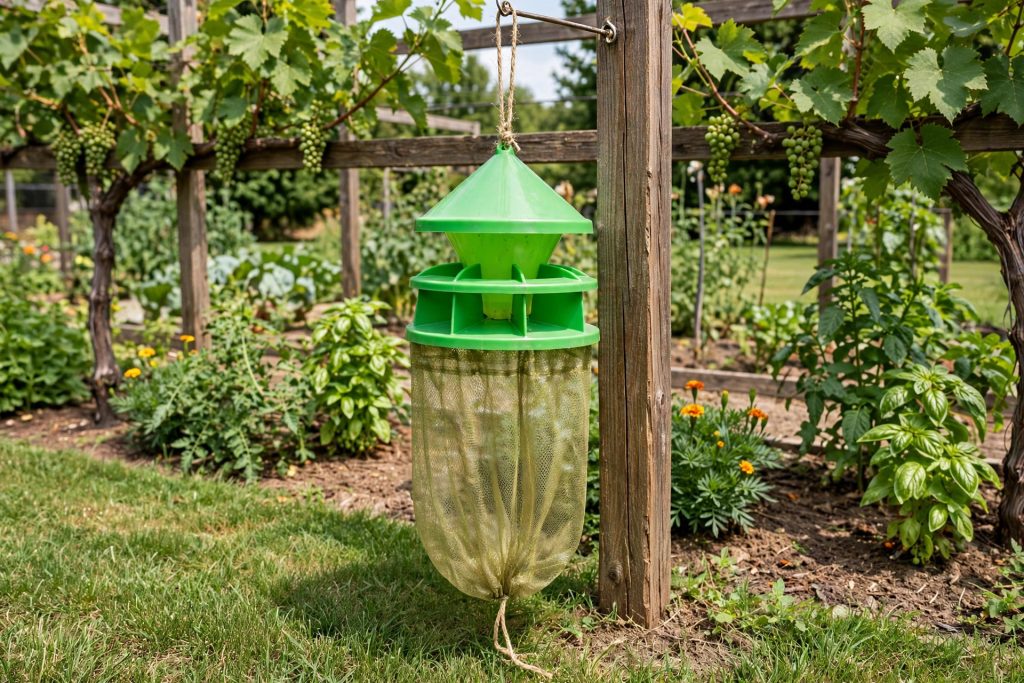
Type: Cone + reusable nylon bag. Lure: Dual, floral scents + natural sex pheromone cartridge. Bag: Double-layer nylon, easy-lock bottom, reusable. EPA Reg. No.: Not found on the manufacturer page or SDS; none is printed here.
RESCUE! is the reusable answer to the disposable-bag trap, and the only trap here that relies on trapping rather than a chemical killing agent. Beetles are lured into the bag and eventually die inside it, but the trap does not use a chemical insecticide to kill them. Beetles are lured by the floral and sex pheromone combination, funneled into the bag through the bright green panels, and expire on their own. The trap also catches Oriental beetles, which matters in the Northeast, and the maker states it does not attract or catch Asian lady beetles or ladybugs. The lure cartridge lasts the full beetle season, 6 to 8 weeks or more, and the double-layer nylon bag empties and reuses season after season. The maker claims the catch capacity is four times larger than the competition, but no baseline is given, so treat that as a relative claim, not a number. Hang it at least 30 feet from ornamental plants, four feet above the ground, and bring it to a protected location during heavy rain or wind. One gap to state clearly: no EPA registration number appears on the RESCUE! product page or in the safety data sheet, so we print none. A separate EPA label exists for a “Bull Run” trap listing the same model number, JBTZ, but its registrant is Bull Run Scientific, not Sterling International.
Our rating: 8.6. The reusable bag, the no-poison design, and the full-season lure earn the joint top score; points off for the unverified EPA number and the capacity claim’s missing baseline. It ties Spectracide at 8.6; Spectracide ranks first on coverage.
3. Spectracide Bag-A-Bug Japanese Beetle Trap, 2-Pack
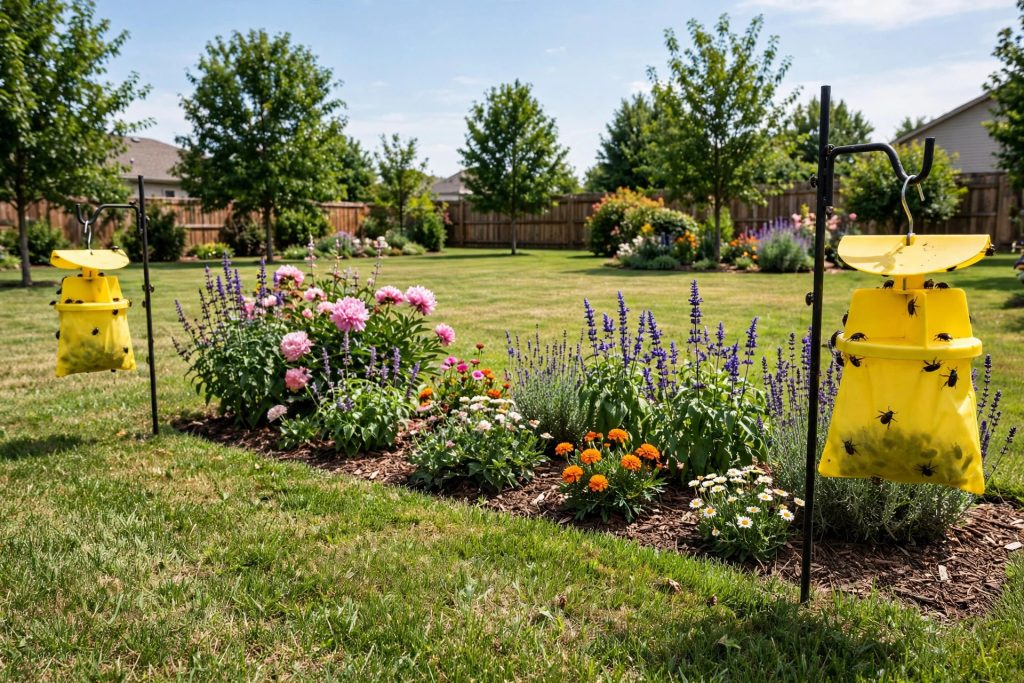
Type: Vanes + disposable bag, two complete kits. Lure: Dual, same as the single kit. Coverage: Over 5,000 square feet per trap.
This is the same trap as our top pick, sold as two complete kits. One trap covers one corner of a yard, and Japanese beetles do not respect property lines, so a gardener with roses at the front and grapes at the back, or a lot wider than 5,000 square feet, needs two stations. Everything in the single-kit section applies here: the same dual lure, 12-week lure life, 30-foot placement, and 4 to 5 day bag change. Spread the two traps to opposite edges of the property; do not hang both on the same rose bed.
Our rating: 8.5. The same strong trap as the single kit; points off because the second kit only helps with space to place it properly.
4. Bonide Beetle Bagger Japanese Beetle Trap Kit
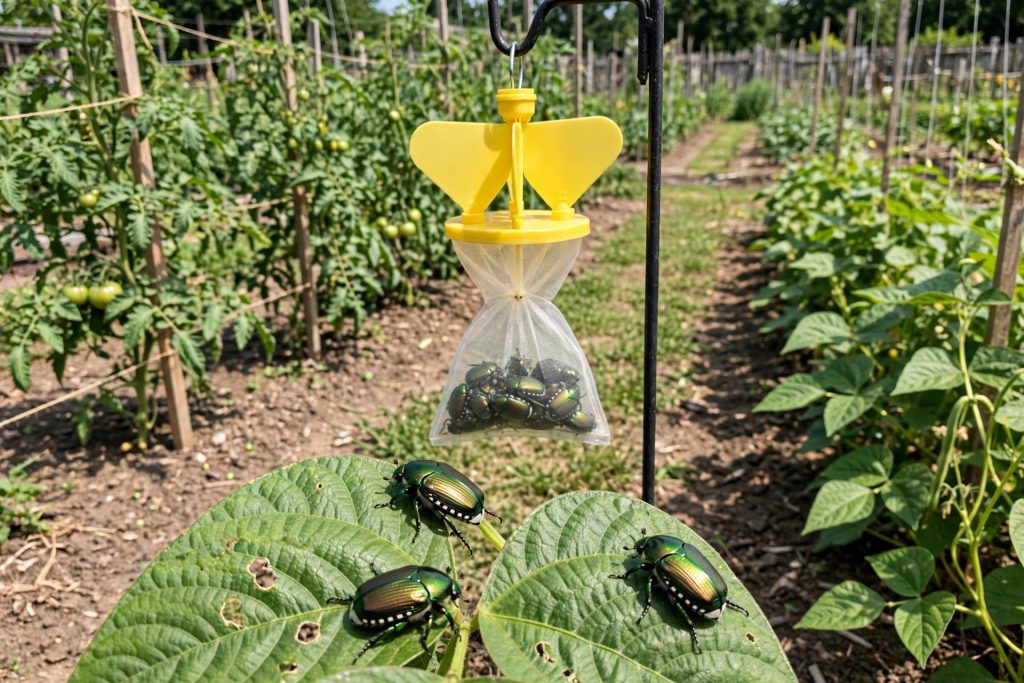
The Bonide Beetle Bagger uses hourglass-shaped bags in a vegetable garden.
Type: Vanes + disposable hourglass bag. Lure: Dual-release floral + pheromone. Kit: 1 trap, 1 lure, 2 bags. EPA Reg. No.: 51934-2-4.
Bonide has sold the Beetle Bagger longer than most brands here have existed, and its label is the most detailed about how many traps a property needs. The floral lure is eugenol 22.25 percent, geraniol 9.50 percent, and 2-phenyl ethyl propionate 9.50 percent, with the sex lure at 0.133 percent. The label says the trap protects over 5,000 square feet and the attractants last all season. The trap-rate table is worth quoting, because no other brand prints one: 1 trap for under 1/8 acre, 2 for 1/8 to 1/4 acre, 3 for 1/4 to 1/2 acre, 4 for 1/2 acre, and over 1/2 acre, 1 trap every 150 to 200 feet along the perimeter. The hourglass bags help too: the narrow waist keeps beetles in, and the perforations keep rainwater out. Two honesty flags. First, the label contradicts itself on placement: one section says 8 to 25 feet downwind, another says about 10 feet. We print the range and recommend the farther end. Second, Bonide has no product page for this trap; the strongest sources are the label PDF and the Bonide catalogs.
Our rating: 8.5. The detailed trap-rate table and the strong dual lure earn the score; points off for the label’s placement contradiction and the missing product page.
5. RESCUE! Japanese Beetle Trap, 2-Pack
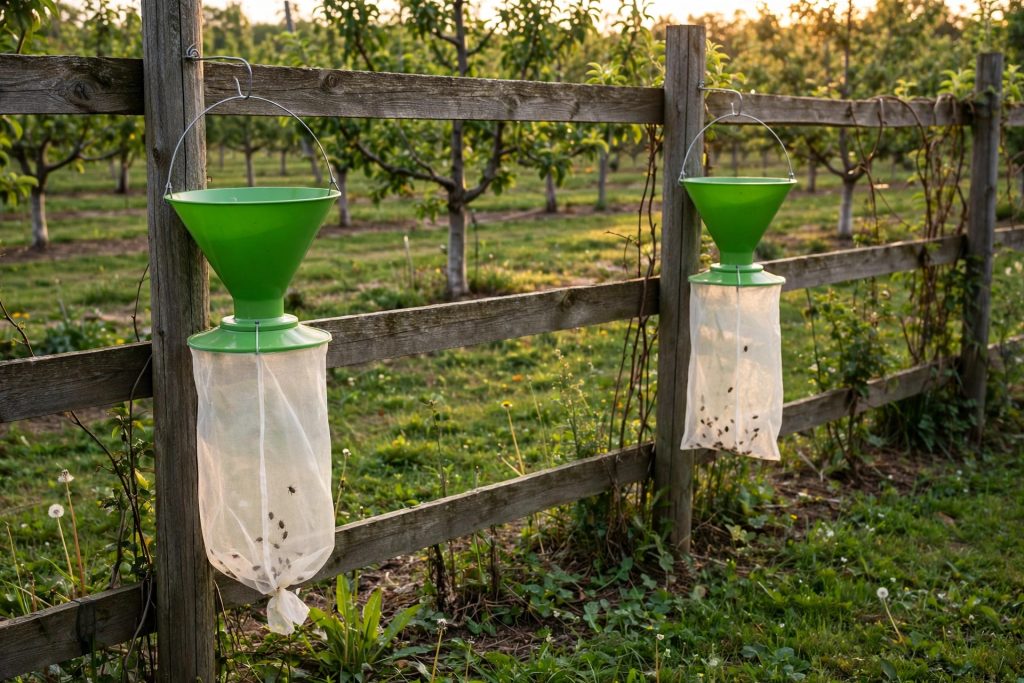
Type: Cone + reusable nylon bag, two traps. Lure: Dual, same as the single trap. Coverage: At least 30 feet from ornamental plants, hang 4 feet high.
This is the same reusable cone trap as our number 2 pick, sold as a pair: two stations cover a property better than one. The difference is the bag. Where the Spectracide two-pack means twice the disposable bags to throw away, the RESCUE! two-pack means two nylon bags you empty and reuse, season after season, with replacement lures sold separately. The pair suits a garden with two beetle magnets at opposite ends, such as roses near the house and a grape arbor at the back fence. Hang each trap at least 30 feet from the plants it guards, four feet above the ground, at the property edge. Two traps hung close together do not catch twice as many beetles; they just concentrate the lure in one spot. One caution carries over: no EPA registration number could be verified, so none is printed here.
Our rating: 8.5. The reusable bags and the no-poison design earn the score; points off for the unverified EPA number and twice the emptying.
6. Catchmaster Japanese Beetle Trap, 3-Pack
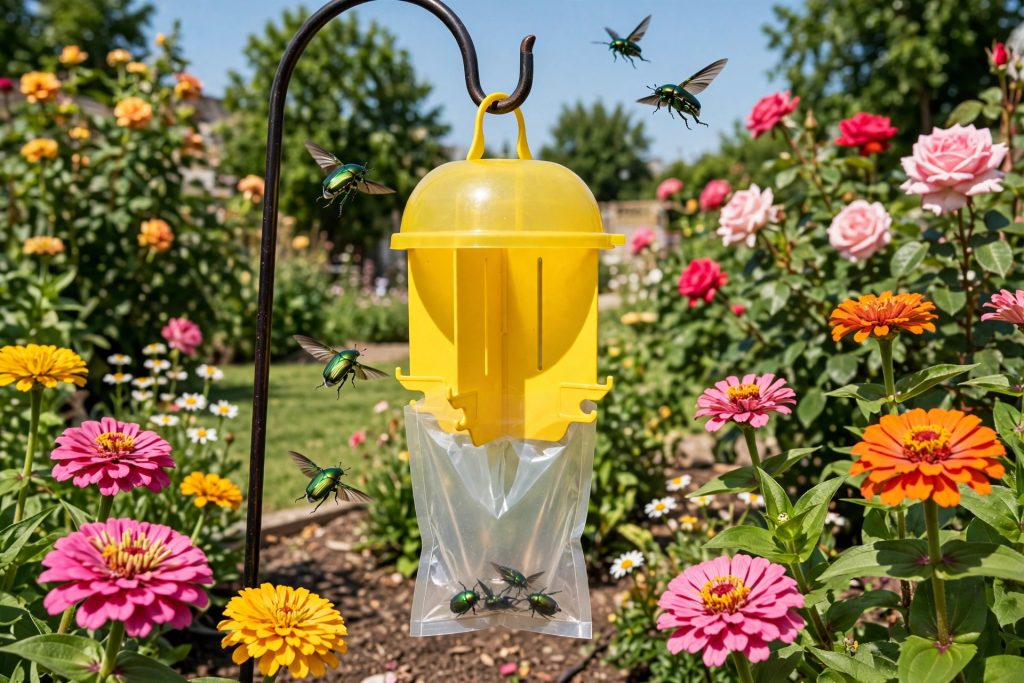
Type: Cross vanes + hourglass bag, with a rain-proof lid. Lure: Dual, sex + floral attractant. Kit: 3 traps, 3 lures, 3 bags, 3 vanes. EPA Reg. No.: 8730-57, from the AP&G lure SDS; verify on the physical label.
Catchmaster entered the beetle-trap market in 2025, so it has the shortest track record here, but among the traps reviewed here, it is the one that specifically includes a rain-proof lid. The trap has cross vanes for stability, an hourglass-shaped bag, and a rain-proof lid that keeps water out of the catch. The lures are dual: a sex attractant plus a floral attractant, said to attract up to 2 to 5 times more beetles than a single lure, though that figure is a manufacturer claim repeated across brands, not an independent test result. Each trap protects over 5,000 square feet, and the bags last the entire beetle season. One conflict to flag: the Amazon listing says 10 to 30 feet away from protected plants, while Catchmaster’s own blog says at least 30 feet. We use the blog’s 30-foot figure and note the listing’s range. Both agree on height: 3 to 5 feet off the ground, in sunny areas. The EPA number needs a careful note too: EPA Reg. No. 8730-57 comes from AP&G’s safety data sheet for the lure, not necessarily from the trap-bag packaging, so verify it on the physical label. Catchmaster has no dedicated product page for this trap; the specs rest on the Amazon listing, the safety data sheet, the blog, and the AP&G catalog.
Our rating: 8.4. The rain-proof lid and the dual lure earn the score; points off for the newest track record and the placement conflict.
7. Catchmaster Japanese Beetle Trap, 6-Pack
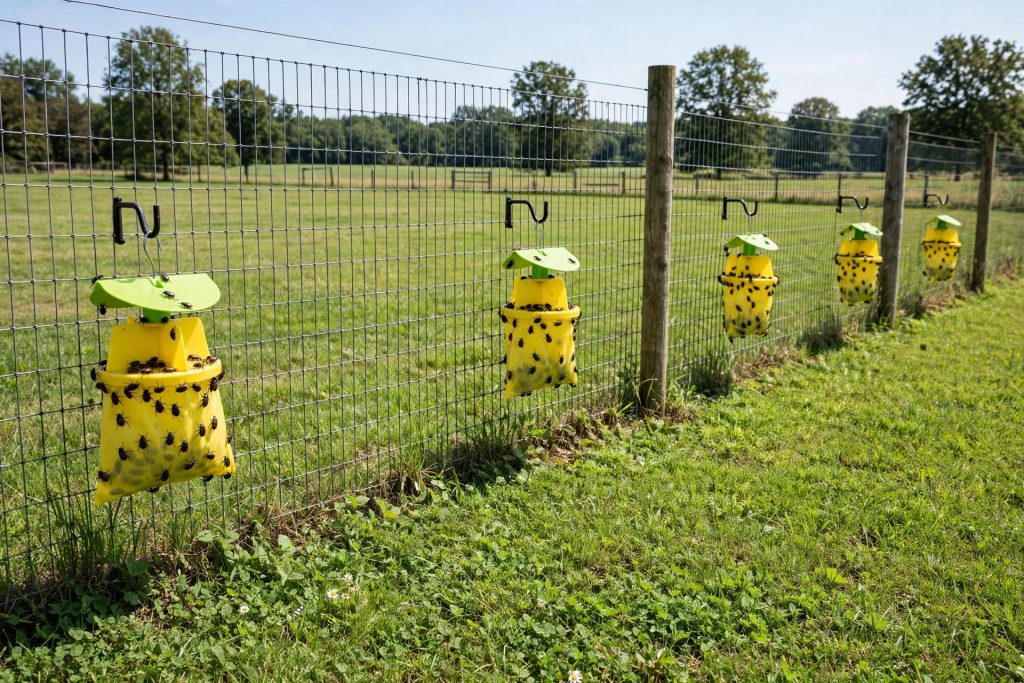
Type: Cross vanes + hourglass bag, with a rain-proof lid. Lure: Dual, same as the three-pack. Kit: 6 traps, 6 lures, 6 bags, 6 vanes.
This is the same Catchmaster trap as number 6, sold as six, and it is the bulk buy of the roundup. Six traps make sense in two situations: a large property over half an acre, or a street where neighbors split a pack. It does not make sense for a small yard: six lures on a quarter-acre lot pull beetles from every direction at once, and the Extension research says that is how a yard ends up with more damage, not less. The math is the same as the three-pack: each trap covers over 5,000 square feet, each bag lasts the season, and each trap goes at least 30 feet from the plants it protects, 3 to 5 feet off the ground in a sunny spot. Space them along the perimeter, roughly one every 150 to 200 feet, and do not cluster them.
Our rating: 8.3. The same strong trap as the three-pack; points off because six traps only help on a large property.
8. Safer Brand Japanese Beetle Trap 70102
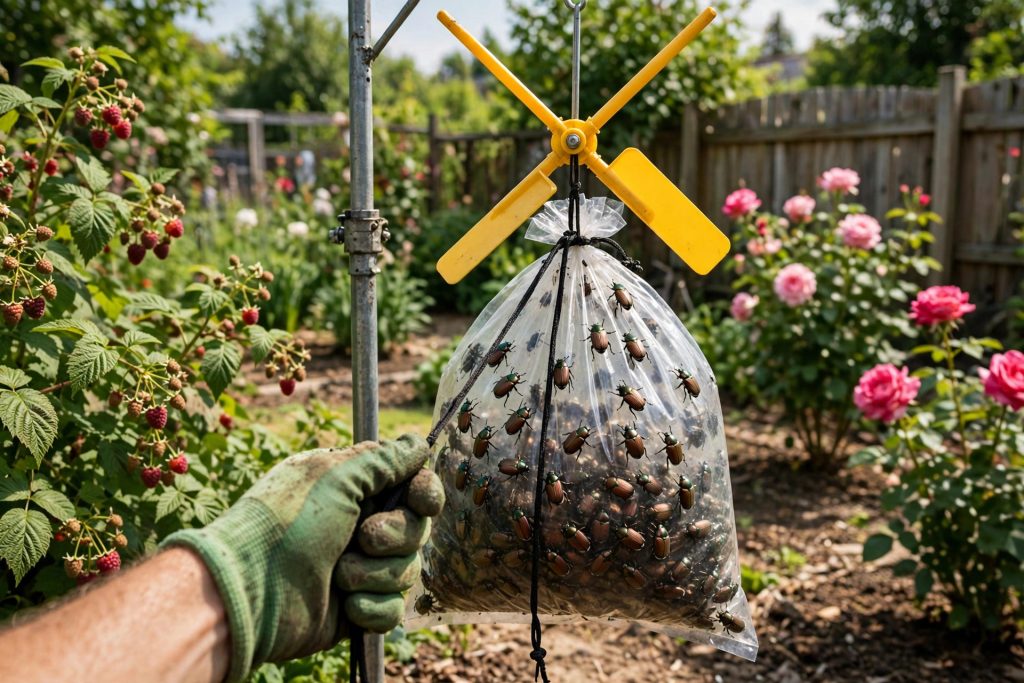
Type: X vanes + disposable jumbo bag. Lure: Dual, food + sex attractant. Kit: 1 trap, 1 lure, 2 bags. EPA Reg. No.: 56336-8-42697.
Safer Brand is the simplest kit in the roundup, and the cheapest way into a trap that uses no killing agents. The lure is a dual-release combination: a food lure of eugenol 25.233 percent and geraniol 10.698 percent, plus a sex pheromone at 0.017 percent. It lasts about 12 weeks, the whole season. The jumbo bags are the selling point: in a heavy year a full bag left hanging starts to smell and can repel new beetles. The label rate is one trap per 50 linear feet along two sides of plant perimeters, the most specific spacing guidance here after Bonide’s trap-rate table. Placement is the shortest distance in the roundup: at least 10 feet away from plantings, hung 3 to 5 feet above the ground in a sunny area. That 10-foot figure is shorter than the 30 feet Spectracide and RESCUE! print and the 50 feet the University of Maine recommends. We print Safer’s figure because it is the label figure, and we recommend hanging it farther, at least 30 feet. Safer’s instructions also say to place traps on the generally upwind side, the opposite of Spectracide and Bonide, who say downwind. The Safer product page has a flaw worth stating plainly. The body copy says the kit includes “a trap, 2 bags, 2 baits, and a stand to hang it on,” but the spec table on the same page says “1 trap, 1 lure, and 2 bags,” and a reviewer note on the page itself says the 2-baits-and-stand references are not currently true. The correct contents are 1 trap, 1 lure, and 2 bags, with no stand. The trap cannot ship to Alaska, California, or Hawaii.
Our rating: 8.3. The value, the jumbo bags, and the long lure life earn the score; points off for the shortest placement distance and the product page’s self-contradiction.
9. Tanglefoot Expandable Japanese Beetle Trap
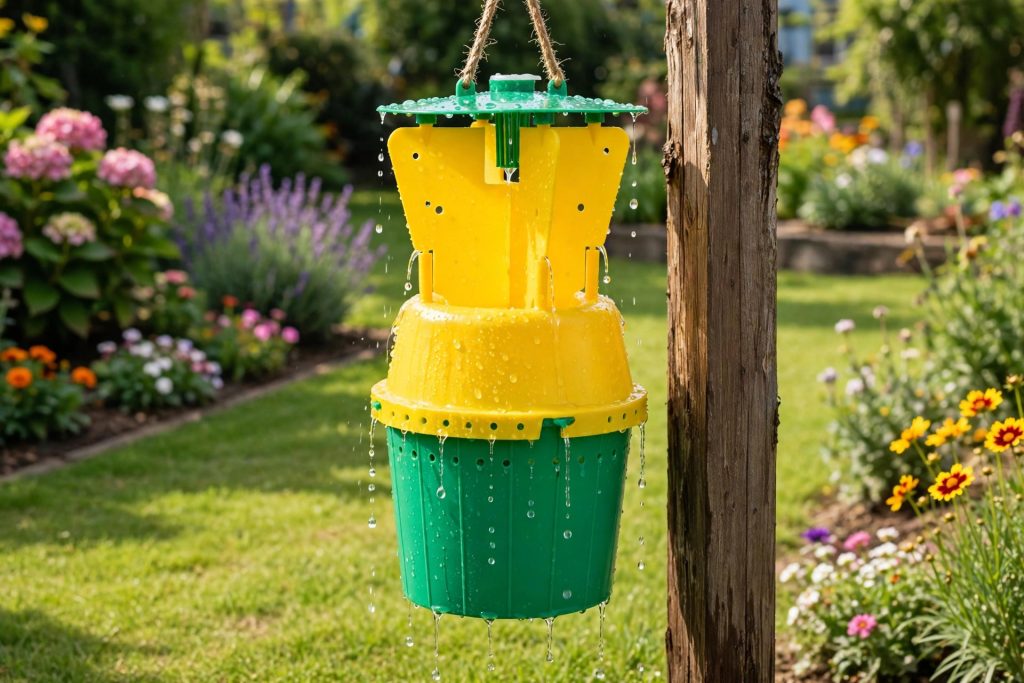
Type: Reusable plastic cylinder. Lure: Dual, floral + pheromone, effective for a full season of about 12 weeks. Coverage: Up to 5,000 square feet. EPA Reg. No.: Not found anywhere we looked; none is printed here.
Tanglefoot is the only trap in this roundup with no bag at all. The trap is an expandable plastic cylinder that you rinse and reuse, season after season, with no bags to buy, store, or throw away. The lure is the same dual system: one floral lure plus one pheromone lure in a single package, effective for a full season of about 12 weeks, covering up to 5,000 square feet. Placement guidance from the replacement-lure page is about 10 feet downwind of foliage, in direct sunlight. No height figure was found for this trap, so we print none. Now the warning, stated plainly. This trap appears to be discontinued, or at least not currently listed: the Amazon price history ends in 2015, the last tracking date is March 2023, and no current retail listing turned up in our searches. The replacement lure is still sold, so existing traps can keep running, but a gardener who wants a new trap may not find one. Treat “discontinued” as unconfirmed rather than proven, because a direct check of the Amazon listing was blocked, but do not order this trap without confirming stock first.
Our rating: 7.7. The no-bag design and the reusable cylinder earn the score; points off for uncertain availability and no EPA number.
10. Lee Valley Japanese Beetle Trap
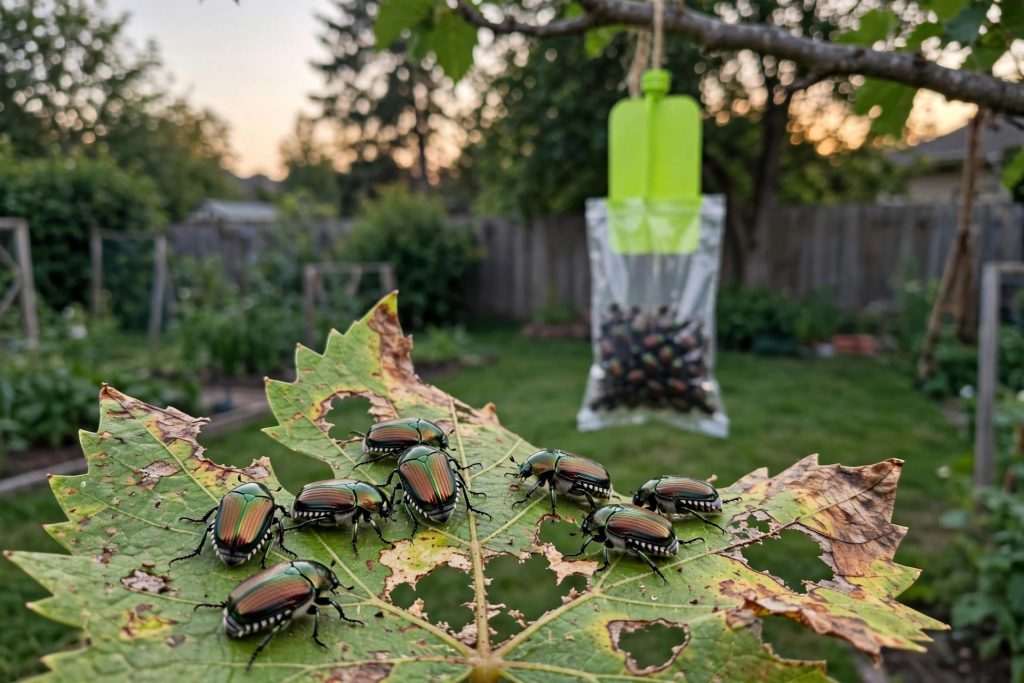
Type: Disposable bag trap. Lure: Dual, fruit + pheromone scent, one lure lasts the whole season, May to August. Placement: Minimum 10 feet, ideally about 30 feet away.
Lee Valley is the quietest entry in the roundup: no marketing claims, no capacity figures, just a disposable bag trap that works. The trap is a two-piece vane and bag assembly, held together by a wire you twist into place. Assembly takes a few minutes by hand, with no tools needed. The lure is a dual fruit and pheromone scent, and one lure lasts the whole season, May to August. The retailer page gives the most honest placement advice in the roundup: place the trap a minimum of 10 feet, and ideally about 30 feet, from the plants you are trying to protect, since the dual scent lure draws beetles in from a distance. The same page warns that the trap should not be used as a deterrent, because it will bring more pests to the area, and should only be used after an infestation has been confirmed. Two limits to state plainly. The manufacturer is not named on the retailer page, so we do not name one, and no EPA registration number is published there either. The trap is sold in Canadian dollars and ships from Canada, so a United States buyer should check shipping before ordering.
Our rating: 7.7. The honest placement advice and the simple tool-free design earn the score; points off for the unnamed manufacturer, no EPA number, and shipping from Canada.
Best Beetle Trap Placement
Start with distance. The manufacturers do not agree on one number. Spectracide says about 30 feet downwind; RESCUE! says at least 30 feet; Bonide’s label says 8 to 25 feet in one section and about 10 feet in another; Safer says at least 10 feet; Catchmaster’s blog says at least 30 feet; Lee Valley says a minimum of 10 feet, ideally 30. The Extension services are stricter: the University of Maine says at least 50 feet, and Missouri Extension says that without multiple acres and 30 feet of distance, traps will likely lure more beetles onto your property than they catch. On direction, Spectracide and Bonide say downwind, Safer says upwind; follow the box you buy.
Height comes next. RESCUE! says four feet above the ground; Bonide and Safer say 3 to 5 feet; Spectracide says only that the bottom of the bag should be at least a foot above the ground. Four feet is a safe middle figure, hung from a post or a stake, not from the rose bush itself.
A few rules apply to every trap here. Do not wait for the bag to fill completely; the University of Maine warns against that, and Spectracide says to change bags every 4 to 5 days because the odor of dead beetles repels new ones. Bring the trap in during heavy rain or wind, and keep traps away from children, pets, and vegetable beds. Never hang a trap in or near the plants it is supposed to protect: Purdue states that warning directly. The heaviest catch comes on sunny days between 70 and 95 degrees, from about 10:00 a.m. to 3:30 p.m.
When to Set Beetle Traps
Hang a trap when the first beetles appear, not before. Spectracide’s label says to begin as early in the season as possible, and notes that sexual activity is greater in June in Southern states and July in Northern states. For monitoring, set traps in late June and early July, then remove them after the first captures. A lure hung in May ages in the sun, and one hung in September catches stragglers after the damage is done.
Adults emerge in late June or early July, feed for 6 to 8 weeks, and the females lay eggs in the soil while they feed. The heaviest feeding runs from July through August, and most of it is finished by mid to late August. Check the roses and grapevines daily in late June, and when you see the first metallic green beetles, hang the trap at the property edge, downwind, at least 30 feet away. Lure life runs from 6 to 12 weeks by brand: Spectracide and Safer say about 12 weeks, RESCUE! says the full season of 6 to 8 weeks or more, and Bonide and Tanglefoot say all season.
Japanese Beetle Trap vs Handpicking
Handpicking sounds like the slow way, and on a bad year it is. It is also the control the University of Minnesota, Purdue, Wisconsin, and Maryland all recommend without reservation, and it costs nothing. Fill a bucket with soapy water, hold it under the leaf, tap the branch, and the beetles drop in. Beetles are slow and clumsy in the morning, before they warm up.
The University of Maryland explains why the morning matters. Beetles produce an aggregation pheromone that calls other beetles to the same plant, so removing them in the morning, before they can produce that scent, reduces the plant’s risk of damage for the rest of the day. The University of Minnesota adds that handpicking works best daily, morning and evening, when beetle numbers are small.
Handpicking has real limits. The University of Wisconsin says it works mostly for small areas, and only when few beetles are present or they are in isolated patches. It requires frequent collecting, because adults are mobile and keep showing up for most of the summer. That is the honest case for a trap: when the infestation is too big to pick by hand, a trap placed far from the plants at least removes beetles from the population.
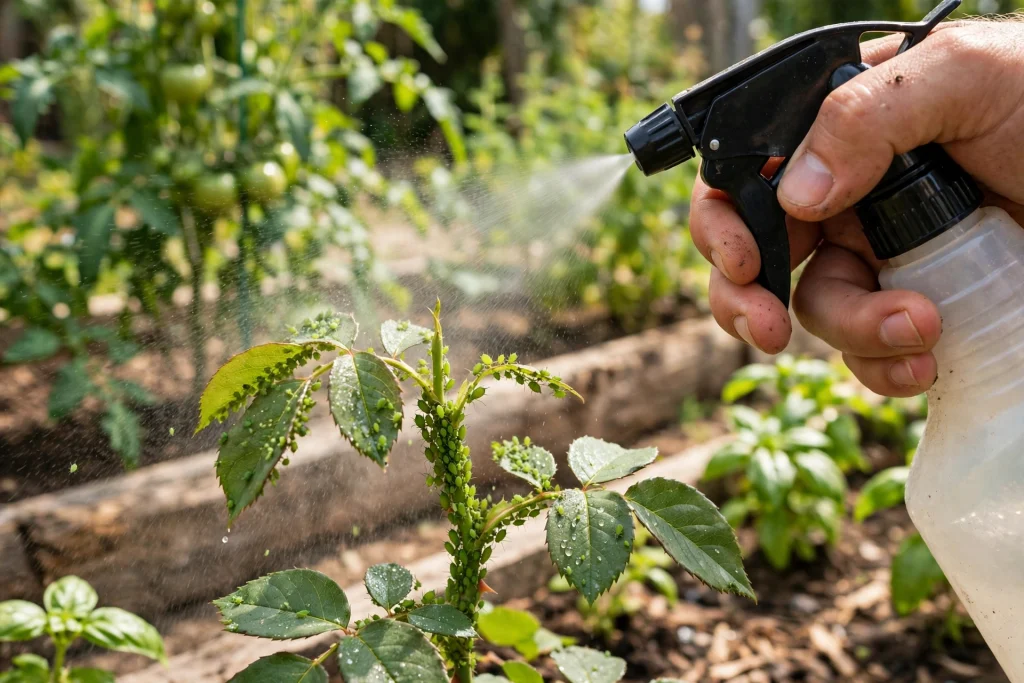
Milky Spore vs Traps
Milky spore and traps attack different life stages, so the comparison is not one or the other. Milky spore targets the grubs in the soil. Traps target the adults on the plants. The question is which one is worth your money, and the research gives a clear answer.
Milky spore is the bacterium Paenibacillus popilliae, which infects only Japanese beetle grubs. The idea is appealing: apply it to the lawn, the grubs eat it, and the grub population falls over time. The research does not support it. The University of Minnesota states that applying commercial milky spore products “has not been shown to provide any benefit in modern university research trials.” Maryland says field trials have found it is not reliably effective, and that several years of annual applications might be needed before any measurable change. Wisconsin cites research showing that additional applications seem unsuccessful at reducing larval populations.
Beneficial nematodes are the stronger grub control. The nematode Heterorhabditis bacteriophora seeks out grubs in the soil, infects them, and kills them. The University of Wisconsin cites research showing nematode applications can reduce the larval population by up to 90 percent in a year, though they must go onto moist soils in the morning or evening. Maryland calls nematodes more promising than milky spore, while warning they are perishable. The University of Minnesota is more cautious, calling their effectiveness inconsistent, and says to apply after the eggs have hatched, watering before and after.
The limit that applies to both is the one every Extension source repeats: controlling grubs in your lawn is unlikely to reduce the number of adults on your landscape plants, because beetles from untreated grass can fly long distances to your roses and grapes. The University of Minnesota puts it directly: only treat white grubs to protect lawns from damage, not to protect the roses. Healthy turf can typically tolerate up to 10 grubs per square foot.
Best Organic Japanese Beetle Control
Organic Japanese beetle control is not one product. It is a sequence, and the order matters more than any single step. The traps in this roundup look like the most organic option on the shelf, because most of them use no killing agent at all, but the Extension verdict is that they are also the riskiest, because the lure pulls beetles in.
First, handpick. A bucket of soapy water, a morning routine, and a daily check of the roses and grapes. This is the control the University of Minnesota, Purdue, Wisconsin, and Maryland all recommend without reservation, and it costs nothing. It works best when beetle numbers are small, and early in the morning before the beetles warm up and release the aggregation pheromone.
Second, treat the grubs with beneficial nematodes, not milky spore. The nematode Heterorhabditis bacteriophora is a living organism, not a chemical, and it is the grub control with the best research behind it, with larval reductions of up to 90 percent in a year. Apply it to moist soil in the morning or evening, water before and after, and time it for late summer. Do not expect it to save this year’s roses: it reduces next year’s grub population.
Third, and only if you can hang it at least 30 feet from the plants you care about, use a trap. The most organic trap design here is the RESCUE! trap, because it uses no killing agents or poisons at all. The trap is the last step, not the first. Neem oil and insecticidal soap have a limited role: neem smothers soft-bodied insects, and soap only kills what it touches, so neither one is a reliable Japanese beetle control on its own.
How We Chose
We scored each product on six factors, weighted by how much they matter for a home gardener; the weights add to 100 percent.
| Factor | Weight | What it measures |
|---|---|---|
| Lure strength and dual lure | 25% | Dual lure, published composition, claim strength |
| Bag capacity and reusability | 20% | Bag size, material, reusability, rain handling |
| Coverage and placement | 20% | Claimed area, placement distance, height |
| Ease of use | 15% | Assembly, hanging, emptying, bag changes |
| Safety | 10% | Killing agents, label warnings, EPA registration |
| Value and availability | 10% | Availability, kit contents, ease of buying |
The scores come from verified label specifications and owner feedback, not from hands-on testing.
| Product | Lure | Bag | Coverage | Ease | Safety | Value | Total |
|---|---|---|---|---|---|---|---|
| Spectracide Bag-A-Bug | 9.0 | 8.0 | 9.0 | 9.0 | 7.0 | 8.5 | 8.6 |
| RESCUE! Japanese Beetle Trap | 9.0 | 9.5 | 8.0 | 8.0 | 9.0 | 7.0 | 8.6 |
| Spectracide Bag-A-Bug 2-Pack | 9.0 | 8.0 | 9.0 | 8.5 | 7.0 | 8.5 | 8.5 |
| Bonide Beetle Bagger | 9.0 | 8.5 | 9.0 | 8.0 | 7.0 | 8.0 | 8.5 |
| RESCUE! Japanese Beetle Trap 2-Pack | 9.0 | 9.5 | 8.0 | 7.5 | 9.0 | 7.0 | 8.5 |
| Catchmaster 3-Pack | 9.0 | 8.0 | 9.0 | 8.0 | 7.0 | 8.0 | 8.4 |
| Catchmaster 6-Pack | 9.0 | 8.0 | 9.0 | 7.5 | 7.0 | 8.5 | 8.3 |
| Safer Brand 70102 | 8.5 | 8.5 | 7.5 | 8.5 | 7.5 | 9.0 | 8.3 |
| Tanglefoot Expandable | 8.5 | 7.5 | 8.0 | 7.5 | 7.0 | 6.0 | 7.7 |
| Lee Valley EM216 | 8.0 | 7.5 | 7.5 | 8.5 | 7.0 | 7.5 | 7.7 |
The top two tie at 8.6, and the next three tie at 8.5. Where the totals tie, the product with the higher coverage score ranks first, except the Spectracide 2-Pack, which leads Bonide on ease. The bottom two tie at 7.7, and Tanglefoot ranks first on coverage.
Final Choice
The best japanese beetle trap is the Spectracide Bag-A-Bug, with the RESCUE! Japanese Beetle Trap as a close second. Spectracide wins on the strength of its label: a dual lure with published composition, over 5,000 square feet of coverage, a lure that lasts about 12 weeks, and clear placement guidance. RESCUE! is the better trap if you want to stop buying disposable bags, because the double-layer nylon bag empties and reuses for multiple seasons, and it is the only trap here that uses no killing agents.
If your lot is large or your plants sit at two ends of the property, buy a two-pack: the Spectracide 2-Pack for disposable bags, or the RESCUE! 2-Pack for reusable ones. If your budget is tight, buy the Safer Brand trap, the best value single kit here, and hang it at least 30 feet out.
One last honest word. A trap is not the first step in Japanese beetle control, and for many gardens it is not the best step at all. Handpick the roses in the morning, cover the prized plants with netting, treat the lawn grubs with nematodes in late summer, and only then, if you still want a trap, hang it at the edge of the property, downwind, at least 30 feet out.
References
1. University of Minnesota Extension, “Japanese beetles in yards and gardens” (reviewed 2025). Traps attract more than they catch; handpicking and grub control. https://extension.umn.edu/yard-and-garden-insects/japanese-beetles
2. Purdue Extension, E-75-W, “Japanese Beetles in the Urban Landscape” (Douglas Richmond and Clifford S. Sadof). Traps not recommended; adults most active mid-June through August. https://extension.entm.purdue.edu/publications/E-75.pdf
3. Purdue Extension, “Japanese ‘Beetlemania’ Continues” (Cliff Sadof, 2019). Lures pull beetles from a mile away; traps increase plant damage; handpicking works if kept up. https://extension.purdue.edu/news/2019/08/Japanese-Beetlemania-Continues.html
4. University of Wisconsin Extension, “Japanese Beetle Management Without Insecticides” (2022). Traps bring in more than they kill; nematodes reduce larvae up to 90 percent; milky spore unsuccessful. https://fruit.wisc.edu/2022/07/28/japanese-beetle-management-without-insecticides/
5. University of Maryland Extension, “Q&A: How to Manage Japanese Beetles” (2024). Traps attract more than they capture; handpick in the morning; milky spore not reliably effective; nematodes more promising. https://marylandgrows.umd.edu/2024/05/08/qa-how-to-manage-japanese-beetles/
6. University of Maine Cooperative Extension, “What can be used to effectively repel Japanese beetles from plants?” (2022). Traps at least 50 feet away; nematodes best last 3 weeks of August. https://extension.umaine.edu/gardening/2022/07/21/what-can-be-used-to-effectively-repel-japanese-beetles-from-plants/
7. University of Missouri Extension, “Milky spore and Japanese beetles: a long-term tool with limits” (2025). Without multiple acres and 30 feet, traps lure more than they catch; milky spore takes years; nematodes need moisture. https://extension.missouri.edu/news/milky-spore-and-japanese-beetles-a-long-term-tool-with-limits
8. Spectracide Bag-A-Bug product page and replacement-lure label PDF. Dual-lure composition, 5,000 sq ft, 12-week lure, EPA 8845-129. https://www.spectracide.com/products/insect-killers/flying-and-stinging-insect-killers/bag-a-bug–japanese-beetle-trap2-1-ct
9. RESCUE! Japanese Beetle Trap product page and Sterling International SDS (rev. 22 Aug 2025). Dual lure, full season 6 to 8 weeks, reusable bag, no killing agents, no EPA number. http://www.rescue.com/products/traps/japanese-oriental-beetle-trap/
10. Bonide Beetle Bagger label PDF. Dual-release lure, 5,000 sq ft, trap-rate table, placement contradiction, EPA 51934-2-4. https://vanputte.com/wp-content/uploads/2022/01/Bonide-Beetle-Bagger-Japanese-Beetle-Trap-Kit.pdf
11. Safer Brand Japanese Beetle Trap product page and instructions PDF. Dual attractant, jumbo bags, 12-week lure, 1 trap per 50 linear feet, EPA 56336-8-42697, kit-contents contradiction. https://www.saferbrand.com/safer-brand-japanese-beetle-trap-1-trap-70102
12. Catchmaster Japanese Beetle Trap (Amazon listing and company blog) and AP&G lure SDS. Dual lure, rain-proof lid, 5,000+ sq ft per trap, placement conflict, EPA 8730-57 from the lure SDS. https://www.catchmaster.com/blogs/news/how-to-get-rid-of-japanese-beetles
FAQ
Do Japanese beetle traps work?
Yes, at catching beetles, and no, at protecting a home garden on their own. The traps use a sex pheromone and a floral scent that pull beetles from a long way off, and University of Kentucky research showed that more beetles fly toward the traps than are actually caught. Minnesota and Purdue both advise against them. If you use one, hang it at least 30 feet from the plants, ideally 50 feet.
Where should I place a Japanese beetle trap?
At least 30 feet from the plants you are protecting, and 50 feet is better. Spectracide and RESCUE! both say about 30 feet, the University of Maine says at least 50 feet, and Missouri Extension says that without multiple acres and 30 feet of distance, traps will likely lure more beetles onto your property than they catch. Safer says 10 feet and Bonide’s label says 8 to 25 feet, but every Extension source says farther is safer. Hang the trap 3 to 5 feet above the ground, in a sunny spot.
When should I set a Japanese beetle trap?
When the first adult beetles appear, late June or early July in most of the United States, with the heaviest feeding in July and August. Do not hang a trap in May; the lure will age in the sun before the beetles arrive. One lure lasts the whole season, about 6 to 12 weeks.
Do Japanese beetle traps attract more beetles to my yard?
Yes, that is the central finding of the Extension research. The lures are strong enough to pull beetles from as far as a mile away, depending on air currents, and not every beetle that is attracted gets into the trap. Plants in yards where traps are placed have shown greater damage. That is why placement distance matters, and why handpicking is the safer choice on a small lot.
What is the best organic Japanese beetle control?
Handpick first, treat grubs second, and trap last. Knock beetles into a bucket of soapy water every morning, when they are cool and sluggish and before they release the aggregation pheromone. Treat the lawn grubs with beneficial nematodes in late summer, on moist soil. Use a trap only if you can hang it at least 30 feet from the plants; the RESCUE! trap is the most organic design here because it uses no killing agent.
Is milky spore better than traps for Japanese beetles?
A trap, for this year’s adults, and neither one is a complete answer. Milky spore is a bacterium that infects only Japanese beetle grubs, but the University of Minnesota states it has not been shown to provide any benefit in modern university research trials. Beneficial nematodes are the stronger grub control, with larval reductions of up to 90 percent in a year. But grub control will not stop adults flying in from untreated ground, so use nematodes for the lawn and a properly placed trap, plus handpicking, for the adults.

Thesis Link : https://saulibrary.edu.bd/daatj/public/uploads/BAU200601_19-Pp_5.pdf
- 10 Best Japanese Beetle Traps - November 27, 2026
- 10 Best Grow Bags for Vegetables - November 27, 2026
- 10 Best Herb Growing Kits for Beginners - November 26, 2026