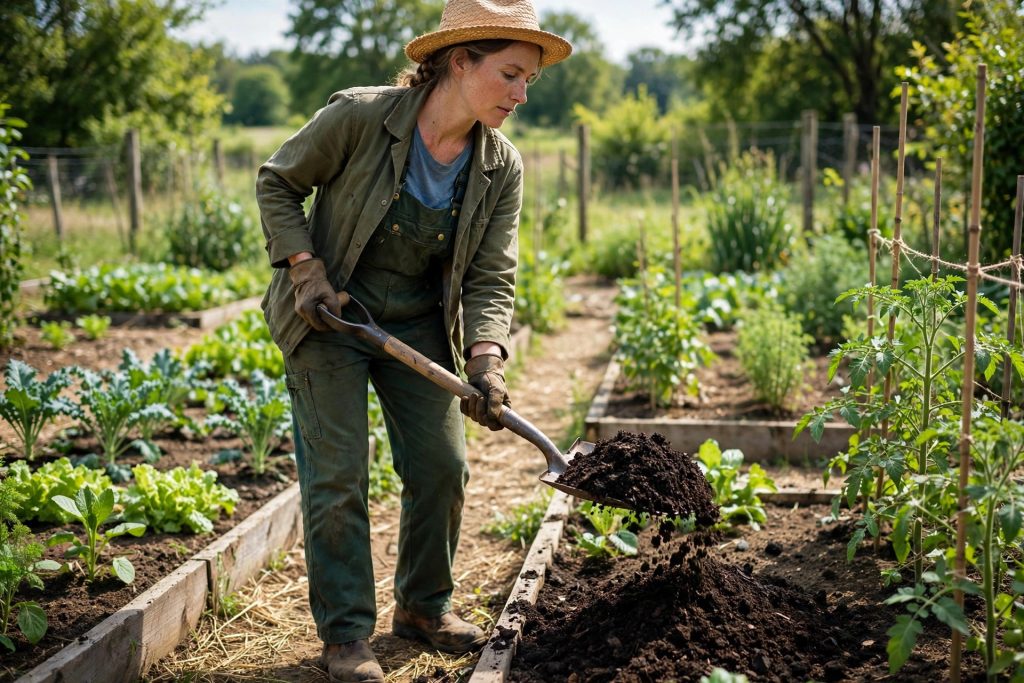

Every gardener meets the compost vs manure choice sooner or later, usually standing in front of two piles or two bags that look almost the same. One is dark, crumbly and smells like a forest floor. The other is also dark, also crumbly, and came from an animal. Both promise better soil, and both can deliver it. But they do not do the same job, they do not work at the same speed, and they are not equally safe around food crops. Picking the wrong one at the wrong time is how seedlings get burned, beds fill with weeds, and a vegetable patch ends up with a food safety problem that was easy to avoid.
The short answer is this. Compost is the safer, steadier soil builder for most home gardens, especially vegetable beds. Manure is the stronger fertilizer of the two, but only when it is aged or composted first, and only when you give it the right timing. Fresh manure is not a shortcut. It is a job that still needs doing, and doing it on a growing bed is where the trouble starts.
The Quick Answer: Which One, When
If you want one rule to carry into the garden centre, it is this: use finished compost when you want to improve soil, use composted or well aged manure when you also want a real nutrient lift, and never use fresh manure on a growing food crop.
Finished compost suits almost every bed, every year. It is gentle enough for seedlings, safe around crops eaten raw, and it keeps paying back in soil structure long after its modest nutrients are used up. Composted manure sits in the middle: stronger than plain compost, much safer than raw manure, and a good pick for hungry crops like tomatoes, squash and brassicas.
Aged manure, left in a pile for months but never properly composted, can work on ornamental beds and on vegetable beds prepared well ahead of planting, but it is the least certain of the three, because ageing alone does not guarantee that pathogens or weed seeds are gone. Fresh manure belongs only on a fallow bed, months before harvest, or in a compost pile where it can be treated properly.
What Compost Actually Is
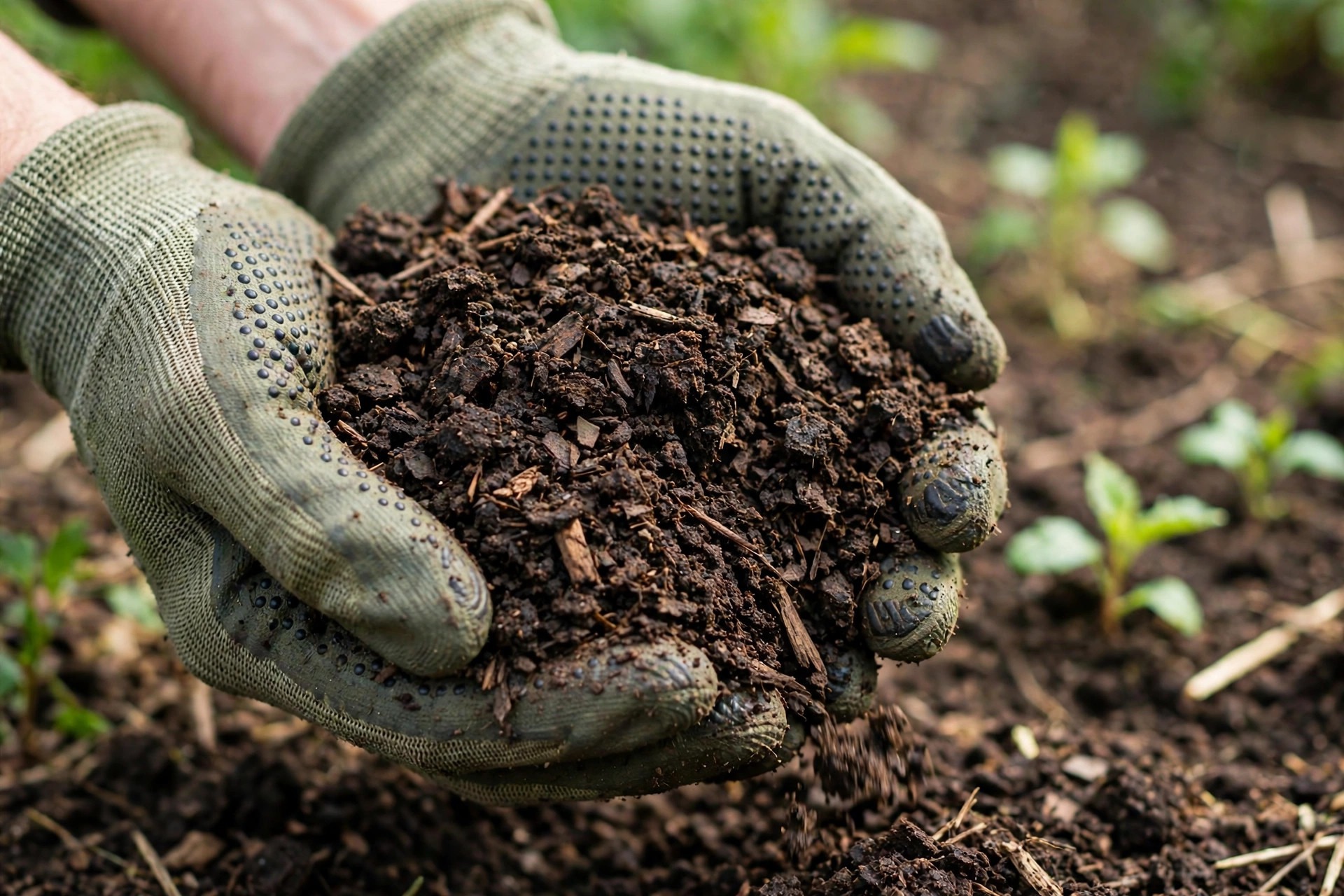
Compost is the finished product of managed decomposition. Kitchen scraps, leaves, grass clippings, straw and sometimes manure are broken down by microbes, with air, water and time, until the original materials are no longer recognizable. What comes out is dark, crumbly, and earthy smelling. A good batch feels like a wrung out sponge when moist, holds together loosely in the hand, and falls apart easily.
That stability is the whole point. Because the wild, fast phase of breakdown is already over, finished compost releases its nutrients slowly and does not rob nitrogen from the soil as it finishes decomposing. Unfinished compost is a different story: still hot, still sour smelling, still full of visible food scraps or wood chips, it can tie up nitrogen while it continues to break down in your bed. If a batch smells sharp or like ammonia, or if you can still tell what went into it, it is not finished yet. Let it cure longer.
Compost can be made from plants alone, or it can include manure as a feedstock. That distinction matters for the label on a bag. Plant only compost carries the lowest food safety concern. Compost that started with manure is still a safe, finished product when it was properly composted and cured, but it is worth knowing which kind you bought, especially if you grow a lot of salad leaves and root crops.
What Manure Actually Is, and Why the Form Matters
Manure is animal waste, with or without bedding such as straw or wood shavings. The word alone tells you almost nothing about safety, because manure comes in four very different forms, and gardeners confuse them all the time.
Fresh, or raw, manure is untreated. It is high in ammonia, it can burn roots and seedlings, it may carry weed seeds, and it can carry pathogens such as E. coli, Salmonella and Listeria. Extension services are blunt about it: never apply fresh manure to growing food crops.
Aged manure has simply sat in a pile for months. It looks darker and smells milder than fresh manure, and some of the ammonia has gone, but sitting is not composting. Without sustained heat and turning, ageing alone does not reliably kill pathogens or weed seeds. Treat aged manure as better than fresh, but not as safe as composted manure.
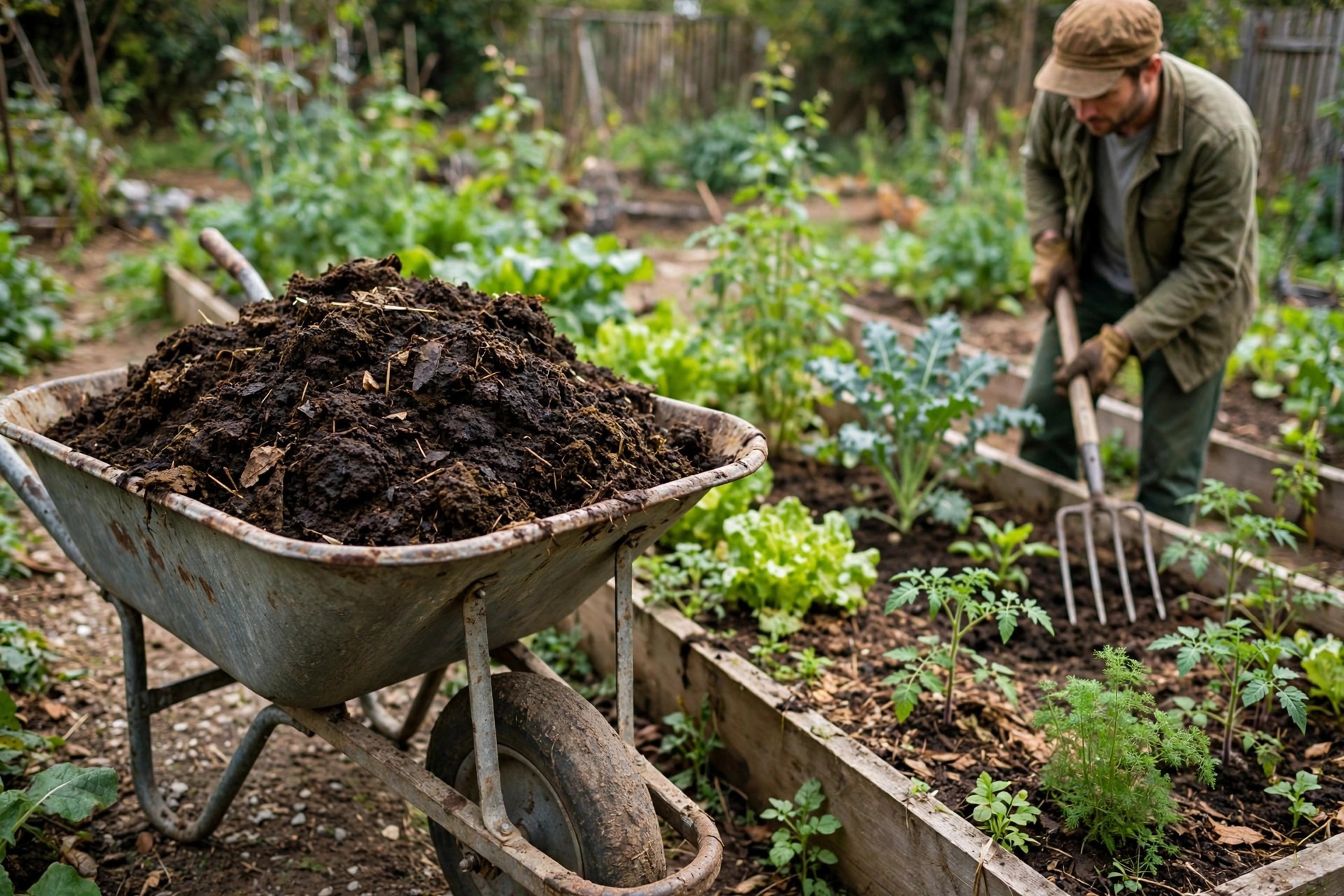
Composted manure has been through a controlled, hot composting process, with turning and curing. Proper composting cuts pathogens, weed seeds and odour, and leaves a stable product that is far easier and safer to handle. This is the form sold in most bags labelled composted manure, and it is the form to ask for if you are buying rather than making your own.
Dried or pelleted manure is a processed, bagged form, usually from poultry. It is concentrated, easy to spread, and strong, which is exactly why it needs a light hand, especially around seedlings. Treat it as a fertilizer with soil building benefits, not as a bulk soil improver you can pile on without thinking.
Compost vs Manure at a Glance
| Amendment | Best for | Nutrients | Safety timing | Watch out for |
|---|---|---|---|---|
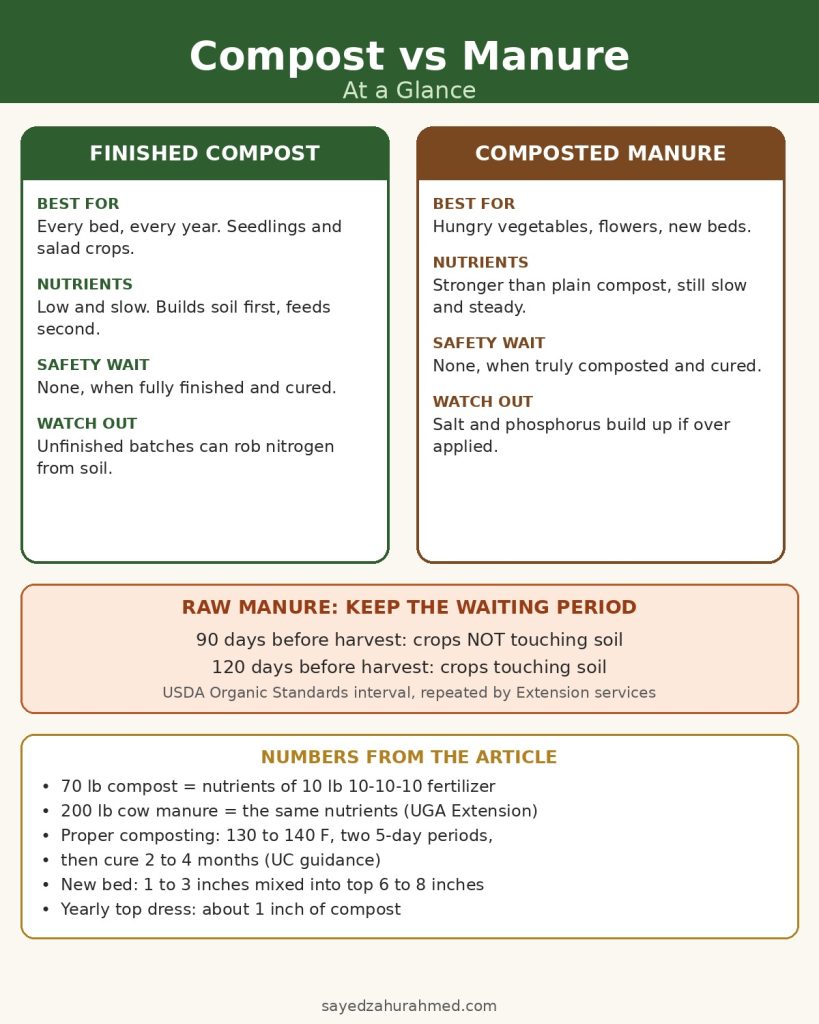
| Finished compost (plant based) | Every bed, every year; seedlings and salad crops | Low and slow; builds soil first, feeds second | No waiting period when fully finished | Unfinished batches can rob nitrogen; repeat yearly, it breaks down |
| Composted manure | Hungry vegetables, flowers and new beds that need fertility too | Stronger than plain compost; still slow and steady | Safe to use around growing crops when truly composted and cured | Salt and phosphorus can build up if you over apply, year after year |
| Aged manure (not composted) | Ornamental beds; vegetable beds prepared well ahead of planting | Variable; often stronger than compost | Keep a long gap before harvest; see the 90 and 120 day rules below | Weed seeds and pathogens may survive; quality varies by pile |
| Fresh or raw manure | Fallow beds only, or as compost pile feedstock | Fastest nitrogen, but uneven and easy to overdo | Never on growing food crops; 90 days before harvest for crops not touching soil, 120 days for crops that touch soil | Burns roots, smells, carries weed seeds and pathogens |
Nutrients: Manure Feeds Faster, Compost Lasts Longer
Neither material is a fertilizer in the bagged, labelled sense, and that is a useful thing to understand before you compare them. Both are low in nutrients compared with a mineral fertilizer, and both vary a lot from batch to batch. A soil test of your own batch beats any table of averages, and if you garden seriously, testing is worth doing before you size a big application.
Still, the direction of the difference is consistent. Manure, especially poultry manure, is the stronger feed. Compost is the gentler one. University of Georgia Extension puts the gap in plain terms: you would need about 70 pounds of compost to supply the same nutrients as 10 pounds of 10-10-10 fertilizer, and about 200 pounds of cow manure for the same amount. That is not a reason to avoid either material. It is a reason to judge them honestly. Compost earns its place by improving soil, not by replacing fertilizer for a heavy feeding crop. Manure earns its place by doing a bit of both.
The other difference is speed. Fresh manure releases nitrogen quickly, which is why it can burn plants when it is too fresh or applied too heavily. Finished compost releases nitrogen slowly, as microbes continue to work through stable organic matter. Composted manure sits between the two: steadier than raw manure, stronger than plain compost. For a long season crop, that middle speed is often ideal. For a quick salad crop that will be picked in a few weeks, the slow release of compost is safer and simpler, and any extra nitrogen can come from a labelled fertilizer applied at the recommended rate.
One nutrient deserves a warning of its own: phosphorus. Both compost and manure contain phosphorus, and both can build it up in soil if every load is sized to meet the nitrogen need. Washington State University Extension advises cutting back or stopping amendment applications when a lab soil test shows excessive phosphorus. If your soil test already shows high phosphorus, more manure is the last thing that bed needs, however organic the bag looks.
What Each One Does to Soil Structure
Here the two materials are much closer, and compost has a slight edge. Both add organic matter, and organic matter is what turns a hard, crusty bed or a loose, droughty one into soil that holds water, drains sensibly and lets roots breathe. Organic matter feeds microbes and earthworms, and their work glues soil particles into crumbs, called aggregates, that create pores for air and water.
Compost is the more reliable structure builder because it is already stable. Its organic matter lasts longer in the soil, and its low salt load makes it safe to repeat every year. Manure also builds structure, and over many years it can raise soil organic matter too, but its salts and its nutrient load limit how much you can keep adding.
In a sandy bed, either material helps, and compost plus a careful manure application is a sensible combination: compost for lasting structure, manure for the nutrient lift sand cannot hold on its own. In a clay bed, compost is the first choice, spread yearly, because it opens the soil without adding the salt and phosphorus load that heavy manure use brings.
There is one more structural point that surprises people. A bed that is half compost and half sand does not drain better than sand alone; it can hold too much water for plants that like sharp drainage. More is not always better. A measured layer, mixed into the top inches of soil, beats a deep, unmixed blanket that roots never properly join to the soil below.
Food Safety: The Rules That Matter Most
This is the section to read twice if you grow food, because it is where compost and manure differ most sharply.
Finished compost made from plants alone can go onto a vegetable bed at any time, with no waiting period. Fully treated composted manure is in the same low risk group. Raw or untreated manure is not.
The intervals of 90 days and 120 days are the USDA National Organic Program intervals, and they are a certification requirement for organic producers: 90 days between application and harvest when the edible part does not touch the soil, and 120 days when it does, for example lettuce, carrots and other leafy or root crops. For general home gardening, university Extension services repeat the same intervals as a safe minimum for home gardens. That is a minimum interval, not a guarantee, and it assumes the manure was worked into the soil, not left on the surface. Properly composted and cured material needs no waiting period.
Proper composting is what removes the need for that wait. University of California guidance describes the standard clearly: mix the pile regularly, hold it at 130 to 140 degrees Fahrenheit for at least two five-day periods, mix between cycles, and then cure the finished compost for 2 to 4 months before it goes near an edible garden.
A pile that never got hot, never got turned, and never got cured has not met that standard, so it should be treated as unfinished, and kept away from food crops until it is finished properly.
Aged manure deserves a special caution here. Gardeners often assume that a pile left over winter is safe, because cold must have killed everything. Extension specialists warn that bacteria can survive winter freezing, so a fall application of aged manure is no guarantee of a clean bed in spring. If you are unsure, compost the manure over winter instead, or use finished compost for the edible beds and keep the aged pile for ornamentals.
Simple hygiene closes the loop: wash hands well after handling manure or turning a pile, keep manure contaminated boots and gloves out of the kitchen, and wash produce thoroughly. None of this is dramatic. It is the ordinary care that makes an organic amendment routine safe.
The Manure Types, Briefly
Not all manures behave alike, and the animal matters.
Cow and dairy manure are the mildest common choices. They are moderate in nutrients and salt, widely available, and forgiving when composted. Horse manure is also mild in nutrients, but it is the classic weed seed carrier, because horses digest seeds less thoroughly than cows. Never use horse manure fresh, and compost it properly if weeds are a concern. Sheep and goat manure are a step stronger, pelleted by nature, and easy to handle once aged or composted. Poultry manure is the strongest of all, with the highest nitrogen and the highest salt load.
A little goes a long way, it should never go into a seedbed, and it is the type most likely to burn plants when over applied. For a beginner, composted cow manure is the easiest manure to start with. For an experienced gardener with a soil test in hand, poultry manure is a powerful tool, used sparingly.
How Much to Use, and How to Apply It
Rates depend on your soil, your crop and your soil test, so treat every number here as a starting range, not a prescription.
For a new garden bed, Washington State University Extension suggests 1 to 3 inches of organic amendment, incorporated to a depth of at least 6 to 8 inches. A bed that is low in organic matter, pale and poor in structure, takes the higher end. A bed that already has good organic matter, or where salts are a concern, takes less, or none at all. For yearly top dressing on an established bed,
Utah State University Extension gives a useful rule of thumb: about 1 inch of compost a year is sustainable for most soils there, with more possible depending on the compost and the soil. University of Georgia Extension, writing for a warmer climate where organic matter breaks down faster, suggests 3 to 4 inches of compost over a garden, mixed to 8 to 12 inches deep, repeated yearly for vegetable gardens.
The method matters as much as the amount. Mix the amendment into the top inches of soil for a new bed, rather than leaving a thick layer on the surface. For an established bed, a thinner surface layer, 1 to 2 inches, left for worms and weather to pull down, or forked lightly into the top few inches between crops, works well. Never leave fresh manure sitting on the surface of a food bed. Work any manure application into the soil, water it in lightly, and keep it away from plant stems and crowns.
If you buy bagged material, read the label for what it actually is. “Composted manure” should mean treated and stable. “Aged manure” means it sat, not that it was composted. “Manure” with no qualifier may be fresh or partially dried. When the label is vague, ask the supplier, or choose the finished compost bag instead.
Which Fits Your Garden? A Situation Guide
For a vegetable bed, especially one with salad leaves, herbs and root crops, finished compost is the default, with composted manure added for hungry crops. Keep fresh and aged manure out of this bed during the growing season.
For a flower bed or an ornamental border, aged or composted manure is fine, and often the better value, since food safety intervals do not apply and the nutrient lift shows in the blooms. Still avoid fresh manure around young plants, which it can burn.
For a new bed on poor soil, use both, in that order of thinking: compost for structure, composted manure for fertility, mixed into the top 6 to 8 inches before planting. Then soil test before you add more the following season.
For clay soil, compost every year is the backbone. Manure can join it, but keep the total modest and watch the phosphorus result on your soil test. For sandy soil, compost every year plus a measured manure application is a strong pair, because sand loses nutrients fast and needs both the sponge and the feed.
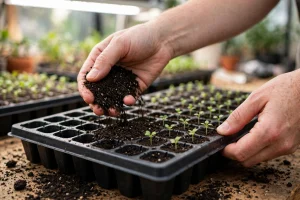
For seedlings and seed starting, compost only, and only a fine, finished compost mixed into a proper seed mix. No fresh manure, no poultry manure, and no coarse, unfinished compost in a seed tray.
For a gardener with free local manure, the smart move is to compost it first. A hot, turned pile over a season turns a risky, smelly material into the safest and most useful form, and it costs nothing but attention. If you cannot compost it properly, use it only on fallow or ornamental ground, well ahead of any harvest.
Mistakes That Undo the Good
The most common mistake is using fresh manure on a growing bed, because it was free, or because a neighbour swore by it. The second is over applying, year after year, until phosphorus and salts build up and plants start to struggle for reasons that look like a mystery. The third is using unfinished compost, which steals nitrogen from the very plants it was meant to feed.
The fourth is trusting a label that says aged when you needed composted, and skipping the waiting period on a salad bed. The fifth is treating compost as a complete fertilizer for a heavy feeder, then wondering why the tomatoes are pale while the soil looks beautiful. Compost builds the soil. Fertilizer, organic or mineral, feeds the crop. Most productive gardens need both, in the right amounts.
Final Thoughts
Compost vs manure is not a contest with one winner. It is a choice between a soil builder and a soil builder that also feeds, with a safety gap between them that you must respect. If you remember only three things, make them these. Finished compost is safe for every bed, every year. Manure must be composted, or at least aged and kept well away from harvest, before it earns that same trust. And a soil test tells you which one your bed actually needs, so you stop guessing with a shovel.
Start with compost on the beds you eat from. Add composted manure where crops are hungry. Compost any free manure before it goes near food. Do that, and both materials will do what gardeners have valued them for for generations: turn tired soil into soil that holds water, feeds plants steadily, and grows food you can pick with confidence.
Testing first saves guesswork, so the guide to testing garden soil below is a good place to start.
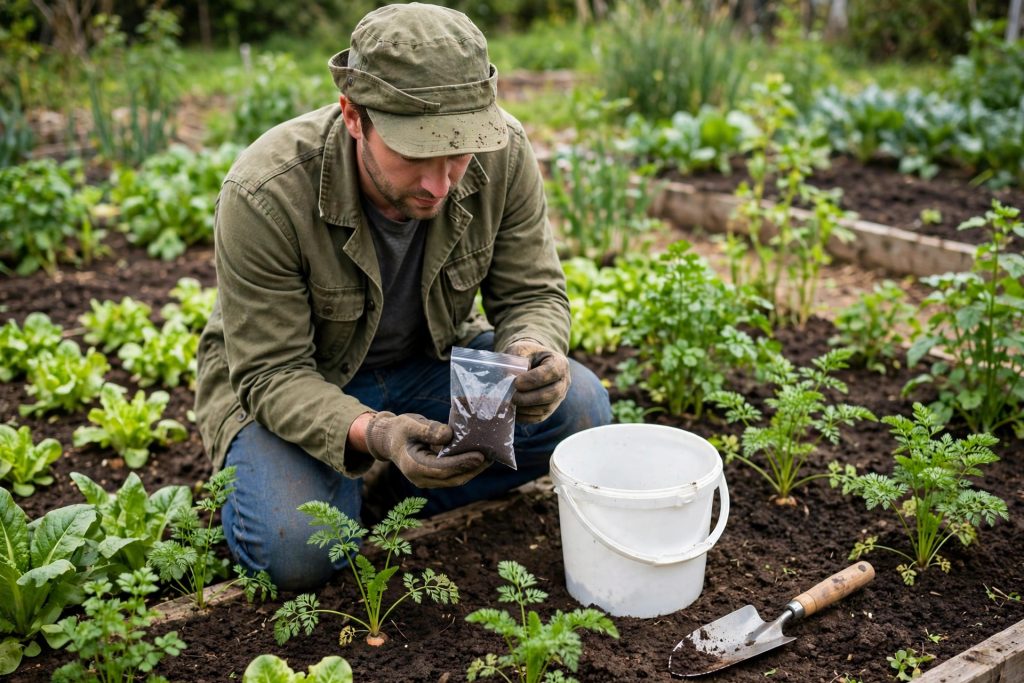
If your beds are heavy and sticky, the guide to improving clay soil below covers the routine in detail.
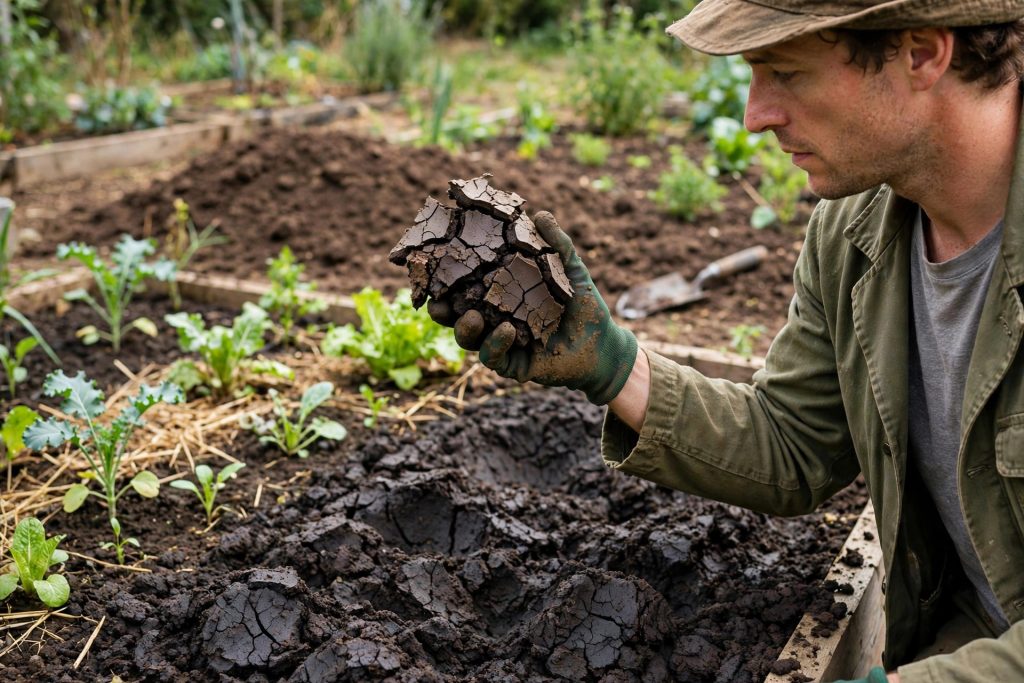
For beds that dry out fast, the guide to improving sandy soil below shows how to build lasting structure.
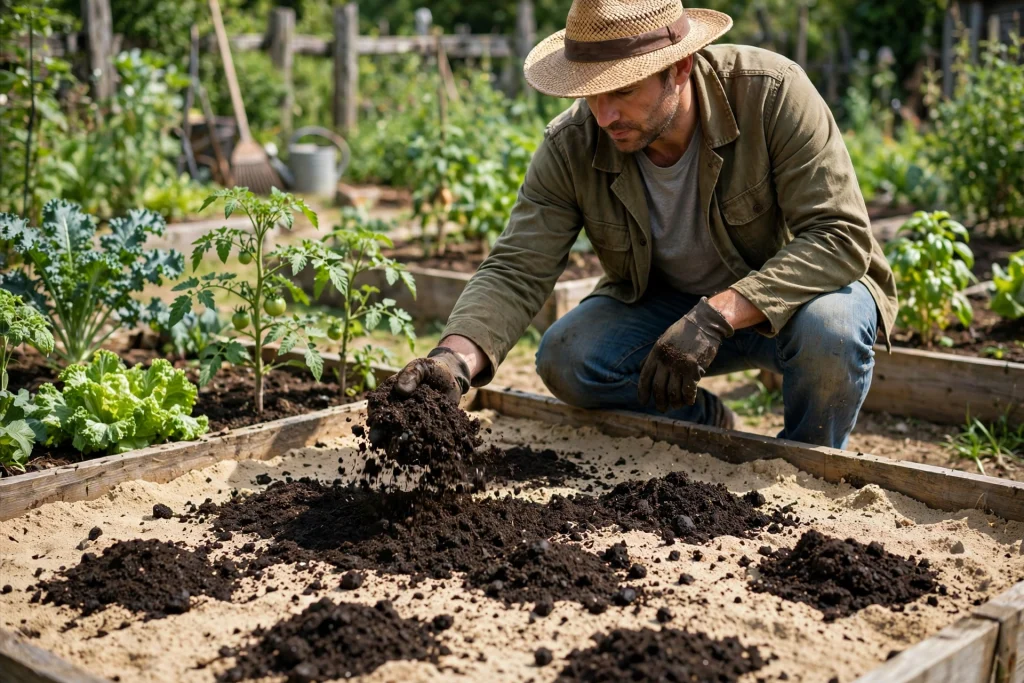
Once the soil is ready, timing matters, so the guide to when to fertilize your garden below explains the right windows.
If you want to turn kitchen waste into rich worm castings, the vermiculture guide below is a good place to start.

For more ways to use compost around growing plants, the compost for plants guide below is a good place to start.

References
- University of California Agriculture and Natural Resources, UC Master Gardeners of Placer County. Use of Manure in Vegetable Gardens
- Washington State University Extension. Organic Soil Amendments in Yards and Gardens: How Much Is Enough?
- University of Georgia College of Agricultural and Environmental Sciences. Compost Enriches Soil, but Does Not Replace Fertilizer
- Utah State University Extension. Are Organic Matter Soil Amendments Created Equal?
- University of Arizona Extension. Manure and Composted Manure Use in Arizona Agriculture
Frequently Asked Questions
Can I use fresh manure in my vegetable garden?
No, not on a growing crop. Fresh manure can burn roots, carry weed seeds, and carry pathogens. Use it only on a fallow bed well ahead of harvest, respecting the 90 day interval for crops that do not touch soil and 120 days for crops that do, or compost it properly first.
Can I mix compost and manure together?
Yes, and for many beds it is the best combination. Compost supplies lasting structure and gentle, slow nutrients, while composted manure adds a stronger nutrient lift. Mix them into the top inches of soil for a new bed, and keep the total amount within the ranges above, checking your soil test for phosphorus.
Which is better for vegetables, compost or manure?
For most vegetable beds, finished compost is the safer default, with composted manure added for hungry crops such as tomatoes, squash and brassicas. Fresh manure is not a better option for vegetables, however free it is, because of the burn and food safety risks.
How much compost or manure should I put on a bed each year?
As a starting range, 1 to 3 inches of amendment mixed into the top 6 to 8 inches for a new bed, and about 1 inch of compost a year as top dressing on an established bed. Reduce or skip applications when a soil test shows excess phosphorus or when salts are a concern.
Does compost replace fertilizer?
No. Compost improves soil structure, water holding and microbial life, but its nutrient content is low compared with a fertilizer. Heavy feeding crops still need a fertilizer, organic or mineral, applied at the recommended rate, on top of good compost.
Is bagged composted manure safe for salad leaves and root crops?
Yes, when it was truly composted and cured, which is what the label should mean. If the bag says only aged manure, or the supplier cannot say how it was treated, treat it as untreated and keep the 90 and 120 day intervals, or use finished plant compost for those beds instead.

Thesis Link : https://saulibrary.edu.bd/daatj/public/uploads/BAU200601_19-Pp_5.pdf
- Compost vs Manure: Which Amendment Fits Your Garden - November 3, 2026
- How to Harden Off Seedlings: A 10-Day Plan - November 3, 2026
- When to Fertilize Your Garden: Timing by Plant Type and Season - November 3, 2026