
Most lawns do not fail because the fertilizer was wrong. They fail because it went down at the wrong time. A heavy spring feeding on tall fescue pushes soft top growth just as summer heat arrives. Nitrogen spread on dormant Bermuda in March mostly feeds weeds and washes away, because the roots are not awake yet. The fix is simple once you see it: a lawn fertilizer schedule has to follow the grass, not the calendar on the store display.
This guide gives you a lawn fertilizer schedule by grass type, built from university extension recommendations. You will find the annual nitrogen target for each common US lawn grass, the months that matter, the months to leave alone, and a worked example that turns a bag label into the right amount for your yard. Rates are in pounds of actual nitrogen per 1,000 square feet, the unit every extension service uses.
The Lawn Fertilizer Schedule at a Glance
If you only read one section, read this table. Find your grass, note the yearly nitrogen total, and put the main feeding windows on your calendar. Everything after this section explains the reasoning and the adjustments.
| Grass type | Season type | Nitrogen per year (lb per 1,000 sq ft) | Main feeding windows | Applications |
|---|---|---|---|---|
| Tall fescue | Cool season | 2 to 3 | September, November, light in February | 2 to 3 |
| Kentucky bluegrass | Cool season | 2 to 3.5 | September, November, light in February | 2 to 3 |
| Perennial ryegrass | Cool season | 2 to 3 | September, November, early spring | 2 to 3 |
| Fine fescue | Cool season | 0 to 1.5 | September only, or none | 0 to 1 |
| Bermudagrass | Warm season | 2 to 4 | May through September | 3 to 4 |
| Zoysiagrass | Warm season | 1.5 to 2 | Late spring, midsummer, late summer | 2 to 3 |
| St. Augustinegrass | Warm season | 2 to 2.5 | May, July, August | 2 to 3 |
| Centipedegrass | Warm season | 0.5 to 1 | June only, light | 1 |
Two rules sit underneath every row. First, never put down more than 1 pound of nitrogen per 1,000 square feet in a single application, and 0.5 to 0.75 pound is a safer working rate for most home lawns. Second, feed only when the grass is actively growing and can take the nutrient up. Nitrogen applied to dormant turf is nitrogen lost to runoff and groundwater.
Exact windows shift with your region. A September feeding in Minnesota is a mid October feeding in Georgia. Use the growth signals in this guide, green-up in spring and the first frost date in fall, to slide the months to your zip code. Read every month named in this guide as a mid latitude month, written for the central United States, then slide it with those growth signals and the regional notes near the end of this guide.
Start With a Soil Test, Not a Guess
A lawn fertilizer schedule controls nitrogen timing, but nitrogen is only one part of the picture. Phosphorus, potassium, and soil pH decide whether the grass can use what you spread. Guessing at those is how lawns end up overfed with phosphorus they never needed, which many states now restrict unless a soil test shows a deficiency.
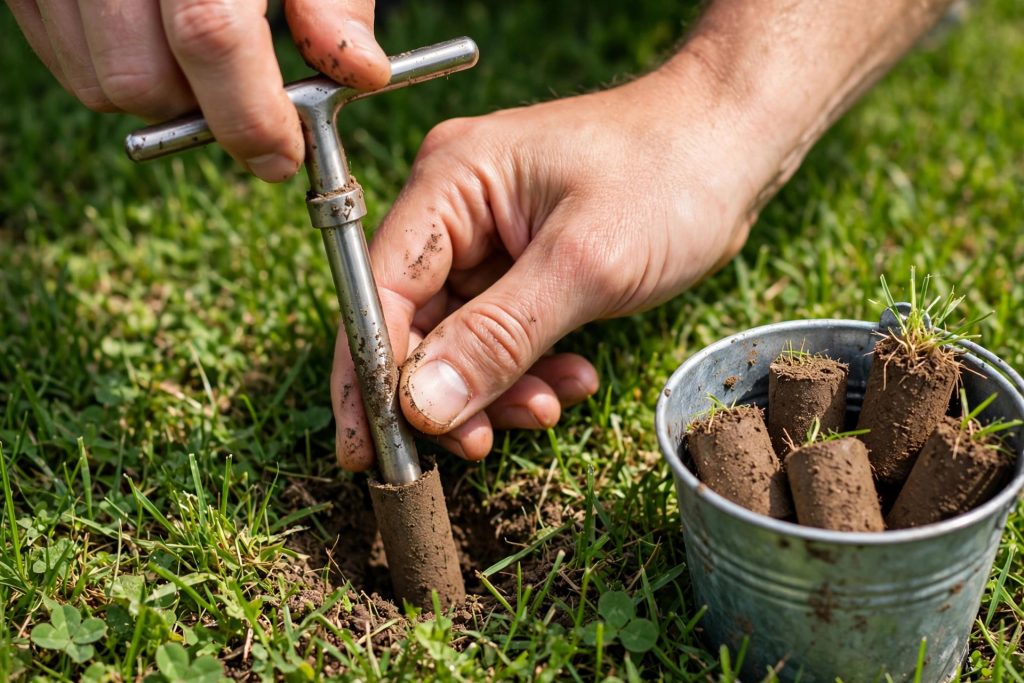
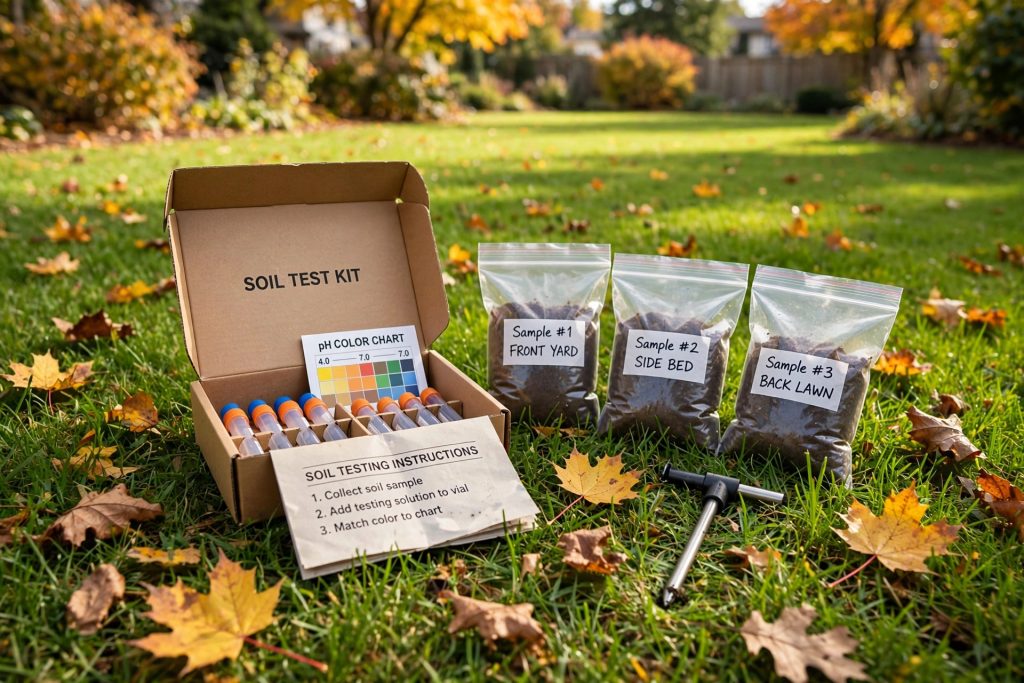
Test every 2 to 3 years. Pull 10 to 15 cores about 3 to 4 inches deep from different parts of the lawn, mix them in a clean bucket, and send a cup of the mix to your state extension lab or a reputable soil lab. The report gives you pH, phosphorus, and potassium levels with lime and fertilizer recommendations for your grass type. Fall is a practical time to test because you can apply lime before winter and plan the next season with the results in hand.
If your pH is far off, fix that first. Most lawn grasses grow best between pH 6.0 and 7.0, with centipedegrass the exception at 5.0 to 6.0. Grass in strongly acidic soil cannot absorb nutrients efficiently, so no feeding schedule will rescue its color until the pH moves.
A detailed walkthrough of testing and correcting pH is in our soil pH guide.
The Cool-Season Lawn Fertilizer Schedule
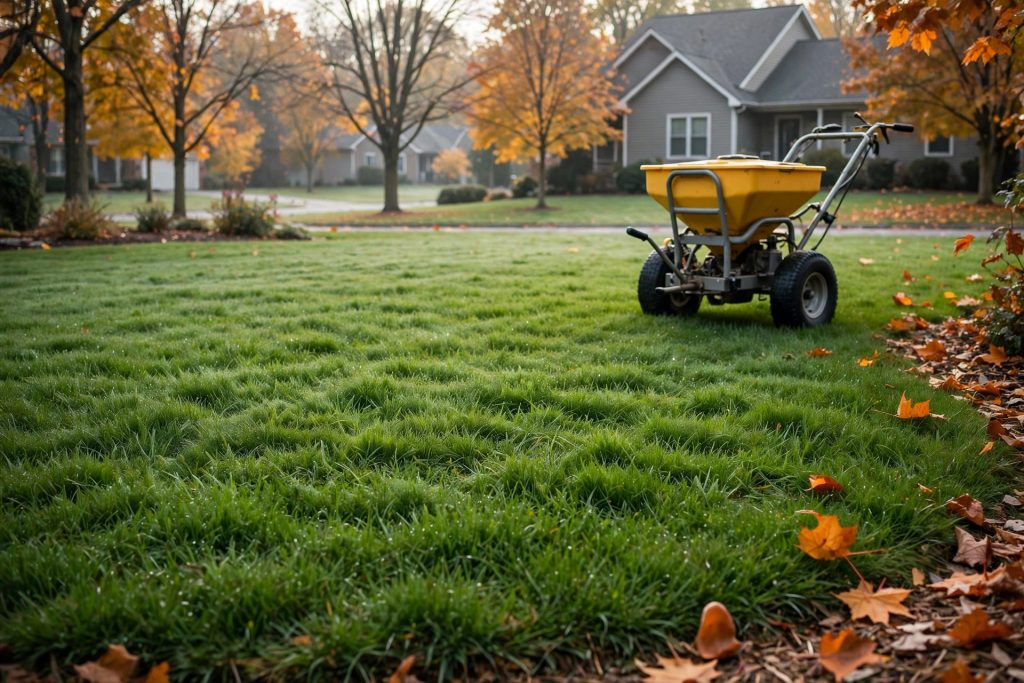
Cool-season grasses, tall fescue, Kentucky bluegrass, perennial ryegrass, and the fine fescues, grow hardest in spring and fall and slow down in summer heat. Their schedule is fall first. September is the single most valuable feeding of the year: roots are growing, temperatures are cooling, and the nitrogen goes into density and root reserves instead of a flush of blades you have to mow every four days.
Tall fescue and Kentucky bluegrass
Plan on 2 to 3 pounds of nitrogen per 1,000 square feet per year, at the lower end if you return clippings when you mow, because clippings hand back a meaningful share of nitrogen as they break down. NC State Extension splits it this way for the central Piedmont, and the pattern holds across the cool-season belt with a few weeks of regional shift:
- September: 1 pound of nitrogen per 1,000 square feet. This is the main event, timed with overseeding and aeration if you are doing them.
- November: 0.5 pound. A late fall feeding after top growth slows, while the grass is still green, builds the root reserves that drive early spring green-up.
- February: 0.5 pound, optional and light. Skip it if the lawn went into winter in good color, and never let a spring feeding grow into a full pound, because heavy spring nitrogen on cool-season grass trades summer disease resistance for a few weeks of dark green.
Add those three rounds up and you get 2 pounds, the low end of the 2 to 3 pound range. That is deliberate: this worked plan assumes clippings are returned when you mow. A lawn where clippings are bagged and removed, or a new or thin lawn, sits nearer the top of the range, reached through the November and February rounds, never by passing 1 pound in a single application and never by feeding in summer.
Then stop. No nitrogen in summer for fescue and bluegrass unless a soil or tissue problem has been diagnosed. Summer feeding on stressed cool-season turf invites brown patch and pythium, and the grass cannot use the nutrient while it is half dormant anyway.
Perennial ryegrass and fine fescue
Perennial ryegrass follows the same fall first pattern as bluegrass at 2 to 3 pounds of nitrogen a year. It germinates fast and is often overseeded into Bermuda lawns for winter color in the South, in which case it is fed lightly through winter on the warm-season lawn’s off season, a special case covered in our overseeding guide.
Fine fescue is the low input outlier. University of Maryland guidance puts established fine fescue at 0 to 1.5 pounds of nitrogen a year, and many shade lawns of fine fescue look best at the bottom of that range. One light September feeding of 0.5 pound, or none at all on a mature lawn with returned clippings, is usually enough. Overfeeding fine fescue thins it out, which is the opposite of what most people expect from fertilizer.
For month by month jobs beyond feeding, aeration, overseeding, and mowing heights, keep the full lawn care calendar beside this schedule.
The Warm-Season Lawn Fertilizer Schedule
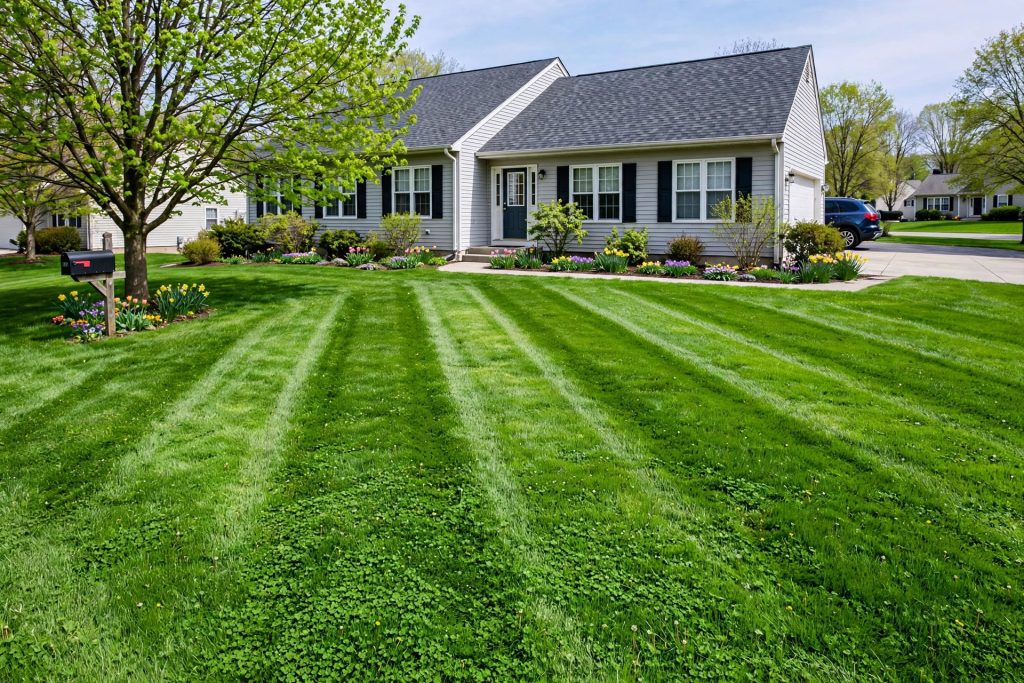
Warm-season grasses run on the opposite clock. Bermuda, zoysia, St. Augustine, and centipede sleep through winter, green up in late spring, and grow hardest in summer heat. Feeding them follows summer, with two hard boundaries: never feed before the lawn has fully greened up, and stop nitrogen 6 to 8 weeks before the first expected frost so the grass hardens off for dormancy instead of pushing tender growth.
The University of Georgia uses a soil temperature trigger worth borrowing: begin warm-season feeding when soil temperature at 4 inches deep reaches about 65 degrees F. That single check prevents the classic March mistake of feeding a lawn that is still asleep.
Bermudagrass
Bermuda is the heavy feeder of the group at 2 to 4 pounds of nitrogen per 1,000 square feet per year for a lawn you want to keep dense and fast repairing. Home lawns at 3 pounds a year, split three ways, stay thick without the excessive thatch and mowing load of a 4 pound program.
- May: 1 pound of nitrogen per 1,000 square feet, once the lawn has fully greened up.
- July: 1 pound.
- September: 1 pound. Higher input programs add a June round.
For seed choice, planting steps and day to day care, see our full Bermuda grass guide.

Zoysiagrass
Zoysia wants restraint: about 1.5 to 2 pounds of nitrogen a year. Push zoysia harder and you buy thatch, not beauty. Its slow growth is a feature, and the schedule should respect it. Three half pound rounds total 1.5 pounds, the low end of the 1.5 to 2 pound range, which is where most established zoysia lawns do best.
- Late spring: 0.5 pound of nitrogen per 1,000 square feet.
- Early summer: 0.5 pound.
- Late summer: 0.5 pound.
For varieties, planting and day to day care, see our full zoysia grass guide.

St. Augustinegrass
Plan on 2 to 2.5 pounds a year, split into applications from May through August.
- May: 0.5 pound, just after full green-up.
- July: 1 pound.
- August: 0.5 pound.
That example totals 2 pounds, the low end of the 2 to 2.5 pound range. If the lawn yellows in summer while the schedule says it has been fed, suspect iron before nitrogen: St. Augustine often shows iron chlorosis on alkaline soils, and a foliar iron spray greens it without adding growth.
Centipedegrass
Centipede is the lightest feeder in this guide at 0.5 to 1 pound of nitrogen a year, often a single light application in June. More is actively harmful. Overfertilized centipede is the classic setup for centipede decline, a slow thinning that owners then try to fix with still more fertilizer. If your centipede lawn looks hungry every year, test the soil and check pH first. It prefers acidic soil at 5.0 to 6.0, and a pH pushed up by repeated liming or high pH irrigation water explains a lot of pale centipede.
Choosing the actual product for each round, slow release against quick release and how to read the analysis on the bag, is covered in our lawn fertilizer guide.
How Much Fertilizer per Application: The Bag Math
Schedules are written in pounds of nitrogen, but bags are sold by analysis, the three numbers on the front. The first number is the percentage of nitrogen by weight. The conversion is one division:
Pounds of product per 1,000 square feet = pounds of nitrogen wanted ÷ (first number ÷ 100)
Worked example. Your schedule calls for 0.75 pound of nitrogen per 1,000 square feet and your bag reads 24-0-6, so it is 24 percent nitrogen. Divide 0.75 by 0.24 and you get about 3.1 pounds of product per 1,000 square feet. For a 5,000 square foot lawn, that is about 15.6 pounds of product for that round, roughly a third of a 45 pound bag.
Two habits keep the math honest. Measure the lawn first, even roughly by zones, because guessing the area is the biggest source of overapplication. And prefer a product with a good share of slow release nitrogen for the main fall and summer rounds: it feeds over weeks, lowers burn risk, and loses less to heavy rain. Keep each single application at or under 1 pound of nitrogen per 1,000 square feet, and at 0.5 to 0.75 pound when the product is mostly quick release.
Application Checklist for an Even Feeding
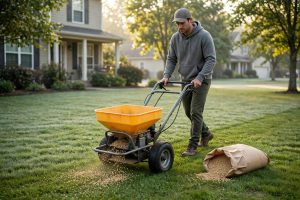
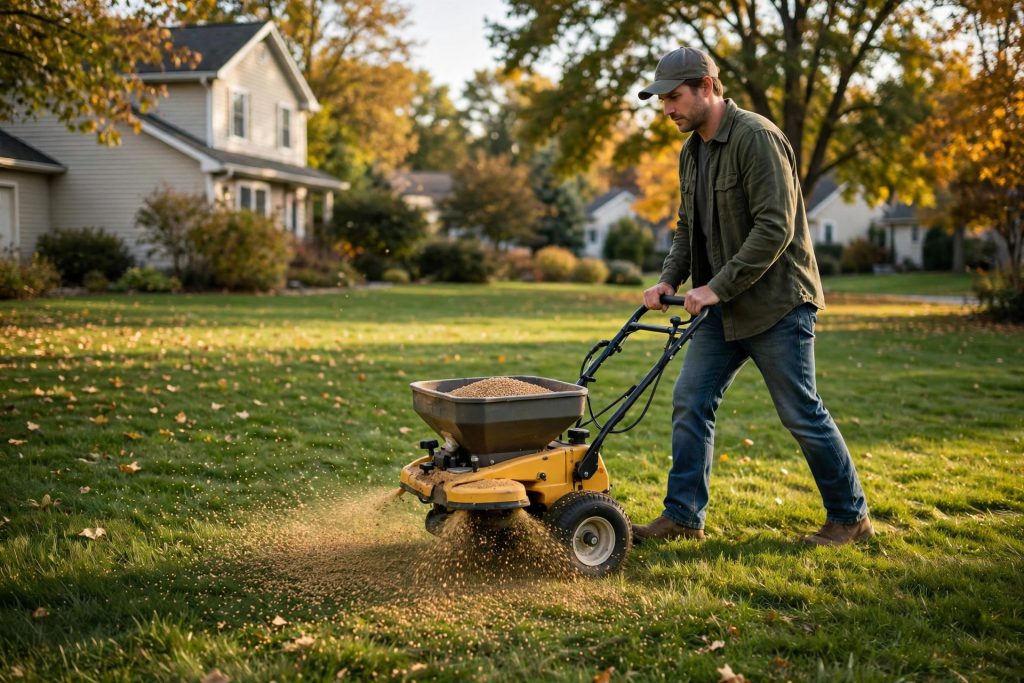
Even timing fails if the spread itself is patchy. Stripes of dark and pale green almost always trace back to application, not the product.
- Mow first, and apply to dry grass on a calm day so granules fall to the soil instead of sticking to wet blades.
- Set the spreader to about half the target rate and make two passes in perpendicular directions. Two light passes cover misses that one full rate pass leaves behind.
- Walk at a steady pace with consistent overlap, and shut the spreader off at turns and at the end of each pass.
- Keep granules off driveways, sidewalks, and streets, and sweep any strays back onto the lawn. Fertilizer on pavement washes straight to storm drains.
- Water in with about a quarter inch of irrigation unless the label says otherwise. Skip the application entirely if heavy rain is forecast within a day, because a downpour moves granules before roots can benefit.
- Wait at least 6 to 8 weeks between nitrogen rounds, and write each date and rate on the calendar. A simple log prevents the accidental double feeding that burns lawns in June.
Adjusting the Schedule for Your Region
The tables above are mid latitude patterns, written for the central United States. The further north or south you garden, the more the months move, as follows: Slide them with these anchors rather than copying months blindly:
- Upper Midwest and New England: compress the cool-season program. September and late October to November carry the year, and the optional February feeding usually drops off entirely.
- Transition zone: both clocks run in the same yard in some neighborhoods. Feed fescue in fall and Bermuda in summer, and accept that each looks rough in the other season.
- Deep South and Gulf Coast: warm-season green-up can arrive in April and the last feeding can run into early September, but the 6 to 8 weeks before frost rule still sets the stop date.
- Arid West: split the same annual total into smaller, more frequent rounds where irrigation is the only water source, and lean on slow release products to cut losses between waterings.
- Local rules win: several states and counties set blackout dates, phosphorus limits, and per application nitrogen caps. Maryland, for example, limits single applications and bans lawn fertilizer in winter months. Your local rule overrides any general schedule, including this one.
Common Lawn Fertilizer Schedule Mistakes
- Feeding by the store calendar. Spring displays push fertilizer in March because that is selling season, not because dormant Bermuda or cold fescue can use it.
- One giant spring application. Two pounds at once on cool-season grass buys a mowing problem in May and a disease problem in July. Split it, and move the weight of the program to fall.
- Feeding centipede like Bermuda. The two grasses can grow side by side in the South and want opposite programs. Centipede decline often starts with a generous neighborly rate.
- Skipping the soil test for years. pH drift silently locks nutrients away, and the owner responds by adding more of a fertilizer the grass cannot reach.
- Applying before a storm. A schedule date is a window, not a deadline. Moving a feeding three days to dodge a downpour loses nothing and keeps the nutrient on the lawn.
- Ignoring the stop dates. Late nitrogen on warm-season grass delays dormancy and raises winter kill risk. Late heavy spring nitrogen on cool-season grass does the mirror image damage in summer.
Final Thoughts
A good lawn fertilizer schedule is mostly a calendar discipline: fall first for cool-season grass, summer only for warm-season grass, a hard stop before frost, and never more than a pound of nitrogen at a time. Get the annual total for your grass type, write the two or three dates that carry it, and let a soil test every few years correct the course. Homeowners who do just that usually end up using less fertilizer than their neighbors, on a lawn that looks better in every season.
References
- Caring for Your Lawn and the Environment, NC State Extension: the monthly nitrogen table by grass type behind the schedules above, including tall fescue and Kentucky bluegrass at 2 pounds, Bermudagrass at 3 pounds, and centipedegrass at 1 pound per 1,000 square feet per year.
- Fertilizer Recommendations for Lawns and Turfgrass in Maryland, University of Maryland Extension: annual nitrogen ranges by species, including fine fescue at 0 to 1.5 pounds and turf type tall fescue at 2 to 3 pounds in established lawns.
- Spring Fertilization of Lawns Should Be Guided by Soil Testing, University of Georgia Extension: annual nitrogen ranges for centipede, zoysia, Bermuda, St. Augustine, and tall fescue, and the 65 degree F soil temperature trigger for warm-season feeding.
- Maintaining an Established Lawn, NC State Extension Organic Lawn Care: basic maintenance nitrogen rates and timing by month for North Carolina lawns, and the warning against fertilizing turf that is not actively growing.
- Lawn Maintenance Calendar, University of Maryland Extension: seasonal timing for warm-season lawn care, including feeding after green-up and a last summer application no later than mid August to reduce winter injury risk.
Frequently Asked Questions
What is the best lawn fertilizer schedule for tall fescue?
Feed tall fescue mainly in fall: about 1 pound of nitrogen per 1,000 square feet in September and 0.5 pound in November, with an optional light 0.5 pound in February. That totals 2 to 3 pounds a year. Avoid nitrogen in summer, when fescue is heat stressed and prone to disease.
When should I start fertilizing Bermudagrass in spring?
Wait until the lawn has fully greened up and soil temperature at 4 inches deep is around 65 degrees F, which is May in much of the South. Feeding dormant or half green Bermuda wastes nitrogen on weeds and runoff because the roots are not taking nutrients up yet.
How much nitrogen should a lawn get per application?
Keep any single application at or below 1 pound of actual nitrogen per 1,000 square feet. Most home lawns do well at 0.5 to 0.75 pound per round, especially with quick release products. Divide the bag math this way: pounds of product equals pounds of nitrogen wanted divided by the nitrogen percentage on the label.
Can I fertilize my lawn in summer?
Yes, if it is a warm-season lawn. Summer is the main feeding season for Bermuda, zoysia, St. Augustine, and centipede. No, for cool-season lawns: summer nitrogen on fescue or bluegrass encourages disease and weak growth. Their feeding season is fall, with light spring support only.
Why does my centipedegrass keep thinning even though I fertilize it?
Centipede needs very little nitrogen, about 0.5 to 1 pound per 1,000 square feet per year, and overfeeding is a leading cause of centipede decline. Check soil pH as well, because centipede prefers acidic soil around 5.0 to 6.0 and turns pale when pH climbs. Test first, then feed lightly once in June.
Do I need a soil test if I follow a fertilizer schedule?
Yes. A schedule controls nitrogen timing, but only a soil test shows phosphorus, potassium, and pH. Test every 2 to 3 years. If pH is off, grass cannot use the nutrients you apply, and many states only allow phosphorus when a test shows the lawn needs it.

Thesis Link : https://saulibrary.edu.bd/daatj/public/uploads/BAU200601_19-Pp_5.pdf
- Lawn Fertilizer Schedule by Grass Type - October 21, 2026
- 10 Best Grass Seed for Shade - October 21, 2026
- 10 Best Garden Carts for Heavy Loads - October 21, 2026