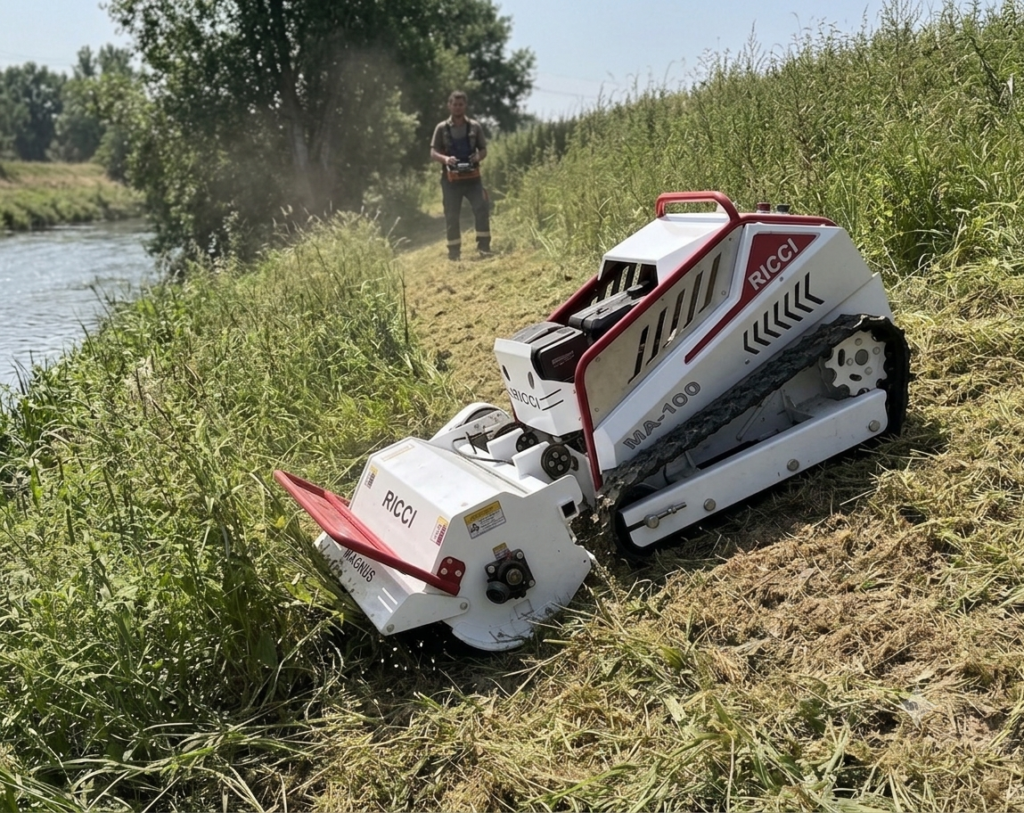

What to Look for in a Remote Control Lawn Mower
When searching for the best remote control lawn mower, most buyers focus on engine horsepower, track width, or advertised slope capability. This Remote Control Lawn Mower Buyer’s Guide looks beyond those basic specifications, as long term durability, operational reliability, and maintenance costs often depend on important engineering details that receive far less attention in marketing materials.
Operating a remote control lawn mower is fundamentally different from driving a riding mower or pushing a walk behind unit. Because the equipment is controlled remotely, these machines are often used in dense vegetation, on steep slopes, along riverbanks, and in other areas where direct operation may be difficult or unsafe.
These demanding environments can place significant stress on mechanical components, electrical systems, and engine cooling. Before making a purchasing decision, it is therefore important to look beyond headline specifications and examine how the machine is actually designed.
For buyers comparing heavy duty equipment and technical specifications, manufacturers such as Ricci Lawn Mower offer remote control mower designs that may be worth considering alongside other available options.
Here are four important technical features to inspect before buying a remote control lawn mower.
Remote Control Lawn Mower: Key Features at a Glance
| Critical Feature | What to Check | Why It Matters | Buyer’s Priority |
|---|---|---|---|
| Slope Lubrication | Engine operating-angle limits and lubrication system | Proper lubrication helps reduce the risk of excessive wear or engine damage during prolonged slope operation. | Verify the engine manufacturer’s approved slope range. |
| Control Box Protection | Sealed enclosure, IP rating, and protected or filtered cooling | Helps protect electronics from grass, dust, moisture, contamination, and overheating. | Look for a documented IP rating and proper thermal management. |
| Engine Air Intake | Intake location, protective screens, baffles, and easy cleaning access | Grass and debris can restrict cooling airflow and contribute to engine overheating. | Choose a design that limits debris buildup and is easy to maintain. |
| System Voltage | 12V, 24V, or 48V architecture and overall electrical design | Higher voltage can reduce current requirements for the same power, although overall system quality also matters. | Evaluate voltage with motors, controllers, wiring, batteries, and cooling. |
1. Slope Mowing: Look Beyond the Tracks to Engine Lubrication
Many tracked remote control lawn mowers are designed to operate on steep inclines. A heavy duty rubber track system can provide the traction needed to move across challenging terrain, but traction alone does not determine whether the engine is suitable for prolonged operation at a particular angle.
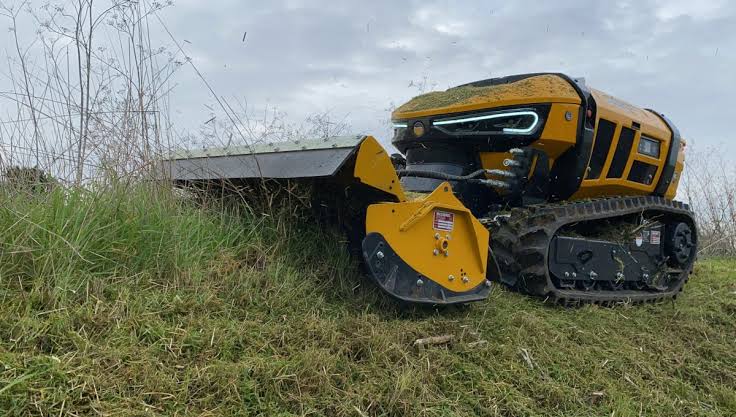
Engine Lubrication on Slopes
Small gasoline engines use different lubrication systems, and each engine may have manufacturer specified operating angle limits. When a mower works across a steep slope for an extended period, engine oil can shift within the crankcase.
If the engine is operated beyond its approved angle range, this may increase the risk of inadequate lubrication or oil starvation, depending on the engine and lubrication design.
Potential Engine Damage
Insufficient lubrication can increase friction and operating temperatures inside the engine. Over time, this may contribute to accelerated component wear, reduced compression, cylinder damage, or other serious mechanical problems.
The actual risk depends on several factors, including engine design, lubrication system, operating angle, oil level, and duration of use.
Buyer’s Tip
If you plan to use a remote control lawn mower on steep riverbanks, highway slopes, reservoir dams, or similar terrain, check the engine manufacturer’s approved operating angle specifications.
Also consider whether the engine uses a lubrication system specifically designed to maintain reliable oil circulation during extended slope operation.
2. Control Box Protection: Pay Attention to Cooling and Sealing
Commercial remote control lawn mowers often operate in much harsher environments than typical residential mowing equipment.
Dense weeds and heavy vegetation can produce large amounts of grass clippings, organic dust, and airborne debris. Moisture from morning dew, wet vegetation, or humid conditions can make the environment even more challenging for electrical components.
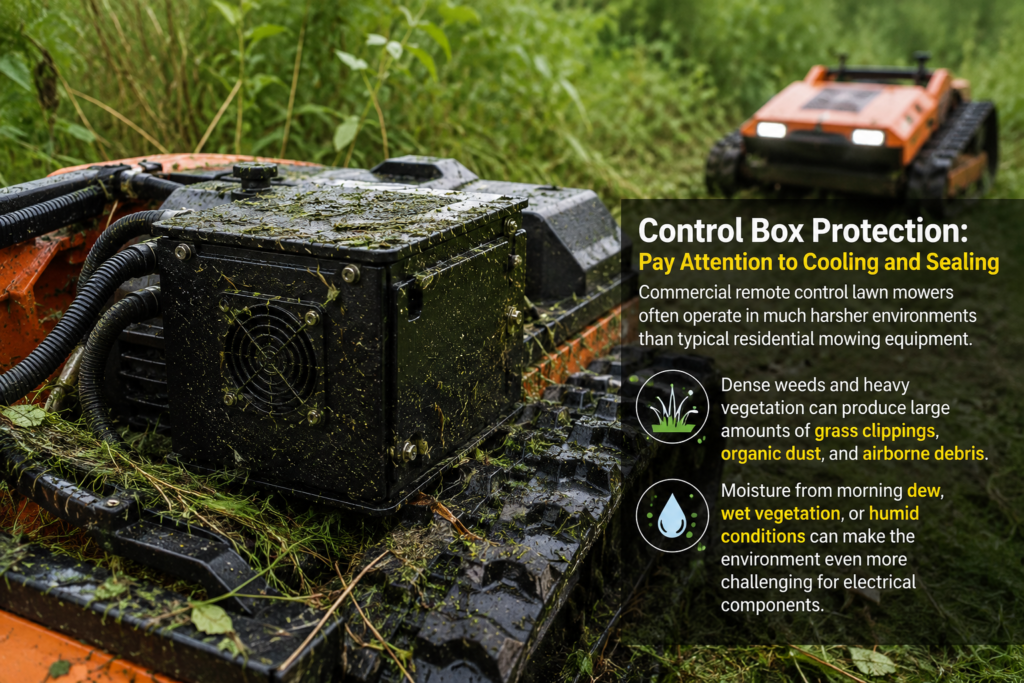
Moisture and Grass Chaff
If the electrical control box is poorly sealed, fine dust and grass particles may enter the enclosure and accumulate around circuit boards, connectors, and wiring terminals.
When combined with moisture, contamination can increase the risk of corrosion, electrical faults, overheating, or short circuits.
Open Fan Cooling Concerns
High power motor controllers generate heat and require effective thermal management. Some systems use ventilation openings and cooling fans to remove heat.
The problem is not necessarily the use of a cooling fan itself. The greater concern is an unfiltered or poorly protected ventilation design that allows grass chaff, dust, and moisture to be drawn directly into the electrical enclosure.
A properly engineered filtered or protected cooling system can reduce this risk while still providing necessary airflow.
System Reliability
Contamination inside the control box can shorten the service life of motor drivers, controllers, connectors, and other electrical components. It may also result in unexpected downtime and additional repair costs.
Buyer’s Tip
Look for a well protected electrical enclosure and ask whether the control box has a documented IP rating suitable for the intended working environment.
Do not rely only on general claims such as “waterproof” or “dustproof.” A documented protection rating and well designed thermal management system provide more useful information when comparing machines.
3. Engine Air Intake Design: Protect Air Cooled Engines from Debris
Many gasoline powered remote control lawn mowers use air cooled engines. These engines depend on a continuous flow of air around the engine’s cooling surfaces to control operating temperature.
During heavy mowing, however, airborne grass and debris can interfere with the cooling process.
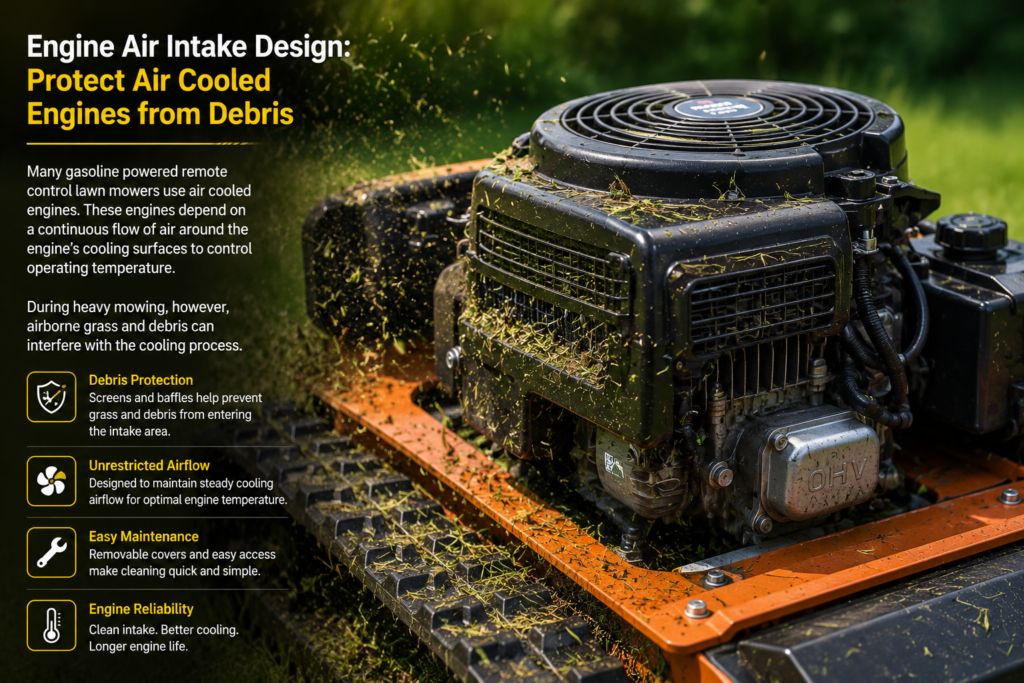
Debris and Chaff Accumulation
High speed cutting blades can break vegetation into small particles and create airborne chaff. The engine cooling fan may draw some of this material toward the engine housing.
Without adequate protection and regular cleaning, grass and debris can accumulate around air intake areas and cooling fins.
Restricted Cooling Airflow
As debris builds up around the cooling system, airflow can become restricted. Accumulated grass can also act as an insulating layer around hot engine components.
This reduces the engine’s ability to dissipate heat effectively.
Overheating Risks
Poor cooling can cause engine temperatures to rise beyond the normal operating range. Prolonged overheating may accelerate oil degradation, reduce engine performance, increase component wear, and potentially contribute to serious engine damage.
Buyer’s Tip
Inspect the location and design of the engine’s cooling air intake. A well designed mower should help limit direct exposure to grass debris while still providing sufficient airflow.
Protective screens, baffles, and accessible cleaning points can make routine maintenance easier and help keep the cooling system operating effectively.
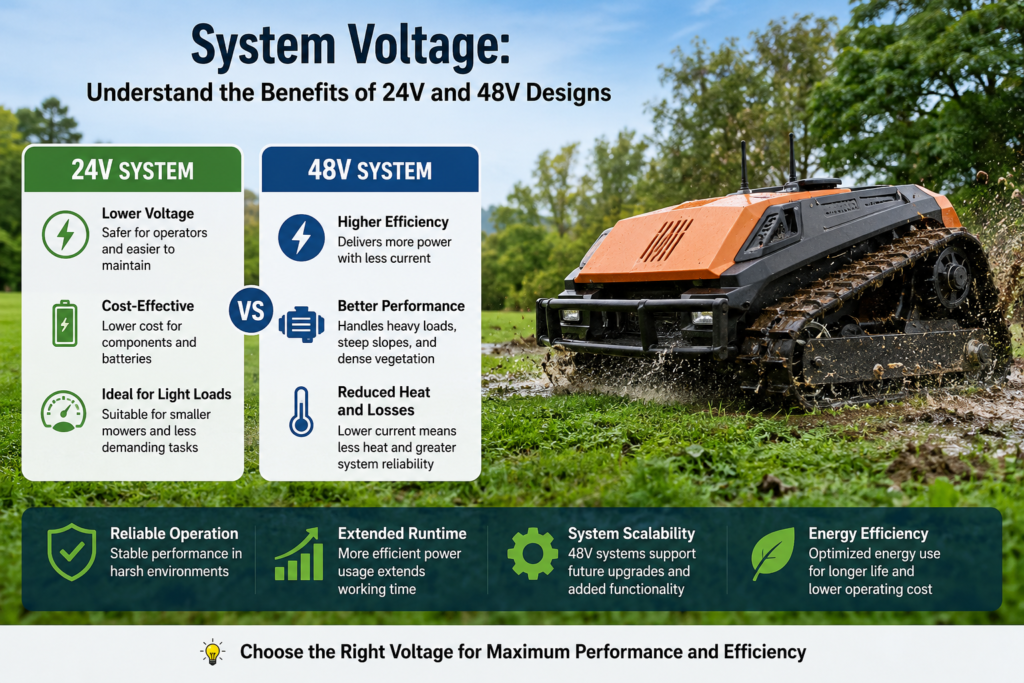
4. System Voltage: Understand the Benefits of 24V and 48V Designs
Remote control lawn mowers often rely on electric motors for propulsion and control functions. When the mower moves through muddy ground, uneven terrain, or dense vegetation, these motors may experience high electrical loads.
System voltage is therefore an important factor to consider, although it should not be evaluated in isolation.
Understanding 12V Systems
For a given power requirement, a lower voltage electrical system generally requires more current than a higher voltage system.
This means a high power 12V system may require heavier wiring and appropriately rated controllers, connectors, relays, and other electrical components to handle the additional current safely and efficiently.
Advantages of Higher Voltage Systems
Using a 24V or 48V architecture can reduce the current required to deliver the same amount of electrical power.
This can make it easier to manage wiring requirements and electrical losses in high power applications, provided the entire system is properly engineered.
Heat and Electrical Losses
Resistive electrical losses are related to the square of current (I²R). Reducing current can therefore significantly reduce resistive losses in wiring and electrical connections when other conditions remain comparable.
However, voltage alone does not determine the quality or durability of a mower. Motor efficiency, controller ratings, wire gauge, battery capability, connectors, thermal management, and overall system design are also important.
Buyer’s Tip
For demanding commercial applications, 24V or 48V drive systems may offer practical advantages, particularly where high electrical power is required.
Instead of automatically rejecting a mower based only on voltage, evaluate the complete drive system and confirm that its motors, controllers, batteries, wiring, and cooling components are appropriately rated for the intended workload.

Final Thought
Choosing a durable remote control lawn mower requires more than comparing horsepower, track dimensions, and advertised slope ratings.
Engine lubrication during slope operation, electrical enclosure protection, engine cooling air management, and drive system voltage can all affect long term reliability and maintenance requirements.
Before buying, compare these features carefully and verify important specifications with the mower and engine manufacturers. Looking beyond the headline specifications can help you select a remote control lawn mower that is better suited to demanding terrain and long term use.
References
- Honda Engines – GX25/GX35 Mini 4-Stroke Engine
- Briggs & Stratton – How to Clean a Lawn Mower or Snow Blower Engine
- OSHA – Electrical Wiring Methods, Components, and Equipment (1910.305)
- Fluke – What Is Ohm’s Law?
Frequently Asked Questions (FAQs)
1. Can a remote control lawn mower operate safely on steep slopes?
Many remote control lawn mowers are designed for slope operation, but the safe working angle depends on the complete machine design, including traction, stability, engine lubrication, and manufacturer specifications. Always check the mower and engine manufacturer’s recommended operating-angle limits before prolonged use on steep terrain.
2. Is a 24V or 48V remote control lawn mower better than a 12V model?
Higher voltage systems can reduce the current required to deliver the same amount of electrical power, which can be useful in high power applications. However, voltage alone does not determine mower quality. Motor efficiency, controller capacity, wiring, batteries, connectors, and thermal management should also be considered.
3. Why is control box protection important?
A remote control mower may operate around grass clippings, dust, moisture, and other debris. A properly designed electrical enclosure helps protect sensitive controllers, wiring, and connections from contamination and environmental exposure. Buyers should look for a documented IP rating where available.
4. Can grass and debris cause a mower engine to overheat?
Yes. Air cooled engines depend on proper airflow for cooling. Grass, chaff, and other debris can accumulate around cooling screens and fins, restricting airflow and reducing the engine’s ability to dissipate heat. Regular inspection and cleaning are important, especially when mowing tall or dry vegetation.
5. What should I check before buying a remote control lawn mower?
Look beyond horsepower and advertised slope capability. Check the engine’s approved operating angles and lubrication design, electrical enclosure protection, engine cooling and air-intake design, drive-system voltage, motor and controller ratings, battery capacity, and availability of replacement parts and technical support.
6. What type of remote control lawn mower is suitable for commercial use?
There is no single specification that determines whether a mower is suitable for commercial work. Buyers should consider the terrain, expected operating hours, vegetation type, slope requirements, drive-system design, engine specifications, electrical protection, cooling system, maintenance requirements, and manufacturer support before making a decision.

Thesis Link : https://saulibrary.edu.bd/daatj/public/uploads/BAU200601_19-Pp_5.pdf
- Why Are My Zucchini Leaves Turning Yellow? Causes & Fixes - August 31, 2026
- What Is Eating My Plants at Night? - August 27, 2026
- Why Are My Tomato Leaves Curling Up? Causes & Fixes - August 20, 2026