
5 Causes Besides Powdery Mildew
You walk out to check your zucchini plants and notice something odd: pale white or silvery patches across the leaves. Powdery mildew is probably the first thing that comes to mind. But look closely before reaching for a fungicide. White spots on zucchini leaves are not always powdery mildew. In fact, some perfectly healthy zucchini varieties naturally develop silver white markings on their foliage. Pests, sun damage, and even products sprayed on the plant can create similar symptoms.
The location and texture of the spots usually provide the best clues.
If you have zucchini leaves with white spots, this guide will help you narrow down five likely causes, tell harmless markings from a genuine problem, and decide what, if anything, you need to do.
Quick Answer: Why Does My Zucchini Have White Spots?
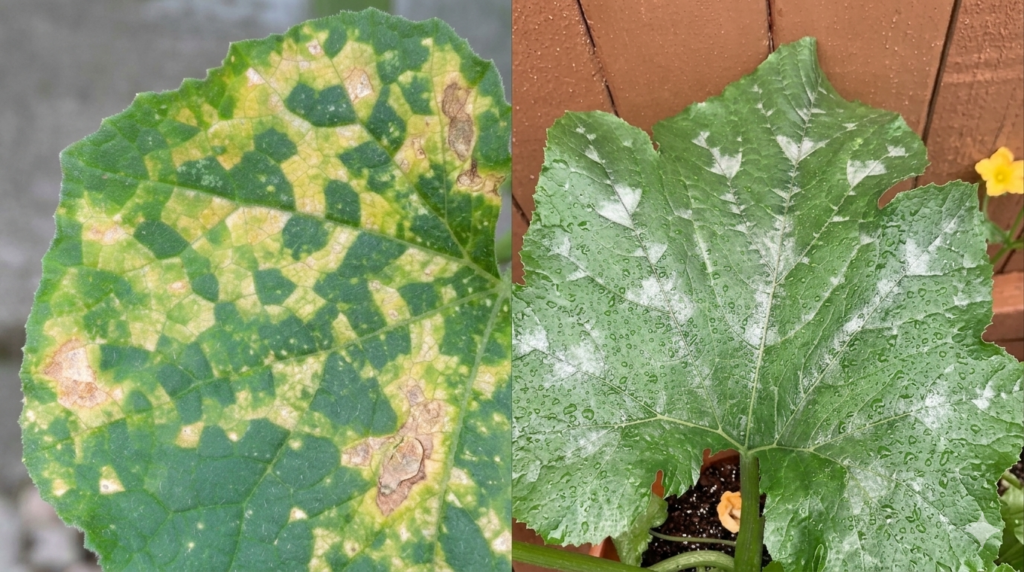
If the white markings are flat, symmetrical, and follow the veins of otherwise healthy leaves, they may simply be the zucchini plant’s natural coloration.
Other possible causes include:
- Natural leaf variegation
- Silverleaf whitefly damage
- Spider mite or thrips feeding
- Sunscald or leaf scorch
- Chemical or spray injury
Powdery mildew tends to look more like a dusty coating sitting on the leaf surface. The other problems usually create discoloration within the leaf tissue itself.
That distinction matters. Treating natural leaf coloration with a fungicide doesn’t help the plant and may introduce unnecessary chemicals into your garden.
White Spots on Zucchini Leaves: Quick Summary
Compare the symptoms, confirm the likely cause, and see what action your zucchini plant may need.
| Possible Cause | What It Looks Like | How to Confirm | What to Do |
|---|---|---|---|
| Natural Variegation | Symmetrical silver-white markings, often following the leaf veins. | Markings are flat, don’t wipe off, and similar patterns appear on otherwise healthy leaves. | No treatment needed. Leave healthy foliage on the plant. |
| Silverleaf Whiteflies | Developing leaves become silvery or whitish, sometimes beginning near the veins. | Check leaf undersides for tiny whiteflies, immature stages, or sticky honeydew. | Monitor the infestation and use an appropriate labelled control when necessary. |
| Spider Mites & Thrips | Tiny pale dots, fine stippling, silvery scars, fading, or bronzing. | Look underneath leaves for mites, tiny insects, feeding damage, or fine webbing. | Confirm the pest first. Dislodge pests with water when appropriate or use targeted controls if needed. |
| Sunscald & Heat Stress | Bleached white or pale patches that may eventually become tan or brown. | Symptoms appear after intense sunlight, high heat, transplanting, or other environmental stress. | Maintain consistent moisture and protect vulnerable plants during extreme conditions. |
| Chemical or Spray Injury | Bleaching, white spots, speckling, scorch, or distorted foliage. | Symptoms develop after pesticide, fertilizer, oil, soap, or possible herbicide exposure. | Stop the suspected treatment and monitor the plant for healthy new growth. |
| Powdery Mildew | Irregular, dusty white patches that can spread across the leaf surface. | The white material appears more like surface growth than natural coloration within the leaf tissue. | Confirm the disease first before choosing an appropriate treatment. |
If the white markings are flat, symmetrical, and follow the veins, your zucchini may simply have natural variegation. Dusty white growth that spreads across the leaf surface is more consistent with powdery mildew.
1. Natural Variegation: The Most Harmless Explanation
One of the first things to consider is also the easiest to overlook. Some zucchini and other squash plants naturally produce silver white patterns on their leaves. These markings are part of the plant’s normal coloration rather than a fungus, nutrient deficiency, or pest problem.
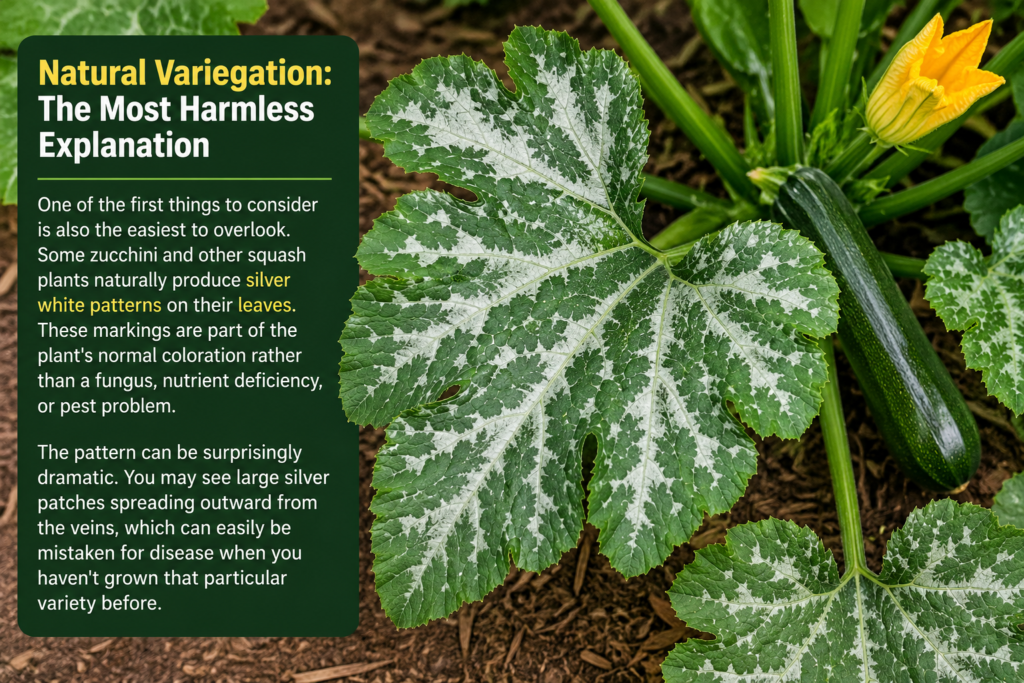
The pattern can be surprisingly dramatic.
You may see large silver patches spreading outward from the veins, which can easily be mistaken for disease when you haven’t grown that particular variety before.
How to recognize natural zucchini leaf markings
Look for these clues:
- White or silver areas follow the leaf veins.
- The pattern looks fairly symmetrical.
- Markings are flat rather than fuzzy.
- Several healthy leaves show similar patterns.
- The white areas don’t wipe away.
- New growth remains vigorous.
- Leaves aren’t rapidly yellowing or dying.
An Extension expert responding to a zucchini question described patterned white coloration following the veins as natural variegation and contrasted it with the more randomly distributed appearance of powdery mildew.
That vein-following pattern is one of the most useful clues.
Does natural variegation need treatment?
No.
If your plant is growing normally and the white markings are simply part of its natural foliage, leave the leaves alone.
Removing healthy leaves can actually reduce the plant’s photosynthetic capacity.
Before treating white marks on zucchini leaves, therefore, identify what you’re looking at first. Sometimes the best treatment is no treatment at all.
2. Silverleaf Whiteflies Can Turn Squash Leaves Silvery
A zucchini leaf that appears silver or whitish can also signal an insect problem. One particularly important culprit is the silverleaf whitefly.
These tiny insects feed on many vegetable crops, including squash. Their immature stages feed on the underside of leaves, and the plant’s response can produce a striking silver appearance.
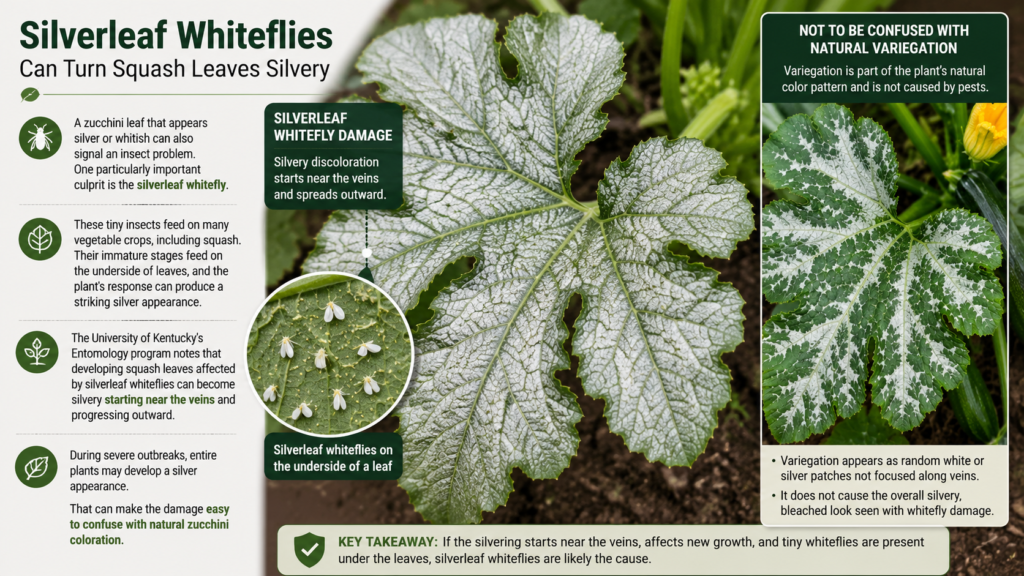
The University of Kentucky’s Entomology program notes that developing squash leaves affected by silverleaf whiteflies can become silvery starting near the veins and progressing outward. During severe outbreaks, entire plants may develop a silver appearance.
That can make the damage easy to confuse with natural zucchini coloration.
How to check for whiteflies
Don’t inspect only the top of the leaf.
Turn several affected leaves over and examine the undersides carefully.
Look for:
- Tiny white, winged insects
- Small immature stages attached to leaves
- Sticky honeydew
- Ant activity associated with honeydew
- A sudden increase in silvery foliage
- Reduced plant vigor during a heavy infestation
Gently disturbing an infested plant may cause adult whiteflies to flutter around the foliage.
What should you do about whiteflies?
Start with monitoring and lower-impact controls rather than automatically reaching for a broad-spectrum pesticide.
For home gardens, management can include removing heavily infested plant material when practical and using control products specifically labelled for the pest and crop.
Insecticidal soaps and horticultural oils may be options in some situations, but coverage is important because whiteflies commonly occupy leaf undersides.
Always follow the product label. Avoid assuming that a stronger concentration will work better; stronger-than-labelled mixtures can injure foliage.
Also consider beneficial insects before using broad-spectrum insecticides. Unnecessary pesticide applications can disrupt natural enemies that help suppress garden pests.
3. Spider Mites and Thrips Can Leave Pale Speckles
Not every pest creates large silver patches. Sometimes zucchini leaf discoloration starts as hundreds of tiny pale dots.
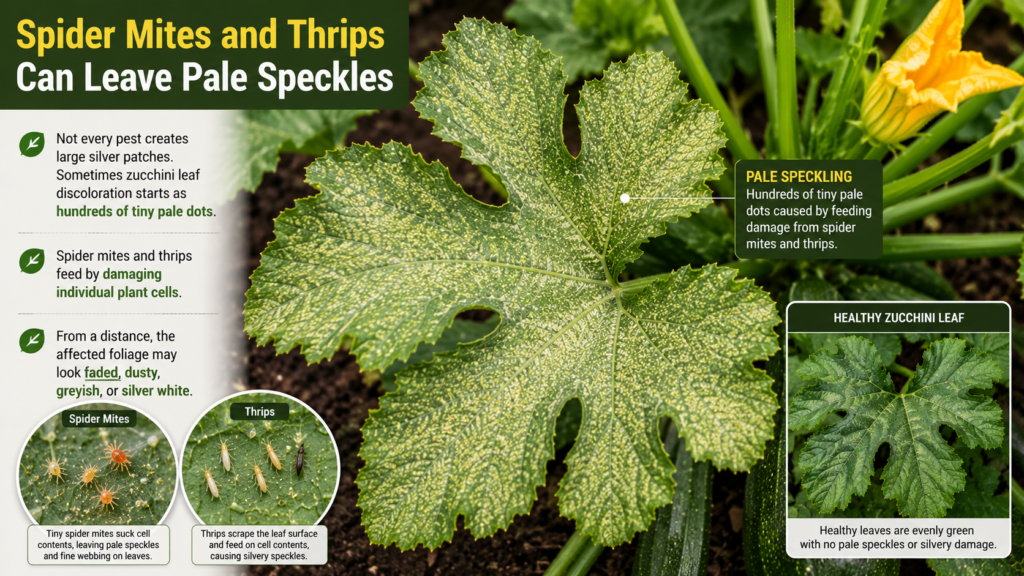
Spider mites and thrips feed by damaging individual plant cells. From a distance, the affected foliage may look faded, dusty, greyish, or silver white.
Spider mite symptoms
Spider mite feeding commonly causes a fine stippled appearance.
Look closely for:
- Numerous tiny pale dots
- Yellowing or bronzing as damage progresses
- Fine webbing, particularly under leaves
- Tiny moving mites when viewed closely
- Damage that becomes worse during hot, dry conditions
Spider mites can be difficult to see with the naked eye.
A simple check is to hold a sheet of white paper beneath an affected leaf and gently tap the foliage. Tiny moving dots on the paper can indicate mites, although a hand lens makes identification easier.
What does thrips damage look like?
Thrips can also produce pale, whitish, or silvery feeding scars. The pattern is generally more irregular than natural zucchini variegation. Damaged foliage may also become distorted or develop additional discoloration.
Again, inspect the undersides and protected portions of leaves rather than diagnosing the plant based solely on its overall colour.
Managing mites and thrips
First confirm that pests are actually present. A forceful stream of water can help dislodge some small pests. Maintaining appropriate irrigation also helps reduce plant stress, particularly during hot weather.
If further control is necessary, choose a product labelled for the specific pest and edible crop and apply it according to the label.
Pay particular attention to leaf undersides.
Repeatedly spraying a plant without identifying the pest can cause another problem: phytotoxicity, which happens to be another potential cause of white or bleached foliage.
4. Sunscald and Heat Stress Can Bleach Leaves
Think back to the weather when zucchini leaves start turning white.
- Was there a sudden stretch of intense heat?
- Were seedlings recently moved outdoors?
- Did something previously shading the plant disappear?
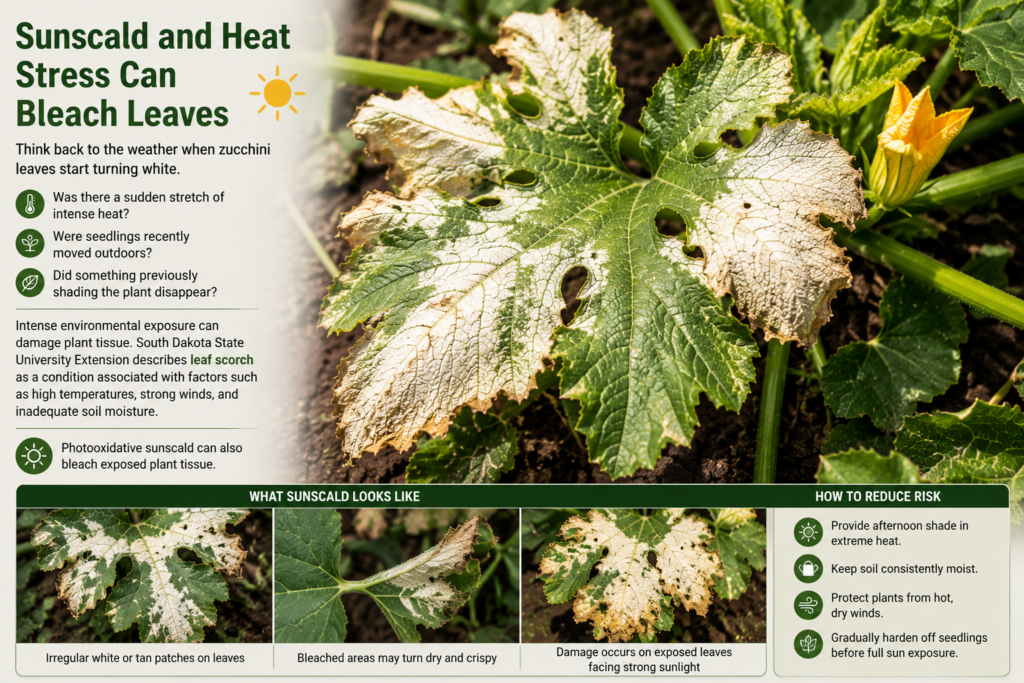
Intense environmental exposure can damage plant tissue. South Dakota State University Extension describes leaf scorch as a condition associated with factors such as high temperatures, strong winds, and inadequate soil moisture.
Photooxidative sunscald can also bleach exposed plant tissue.
What sun damage looks like
Sun related damage doesn’t usually resemble a dusting of flour.
Instead, you may notice:
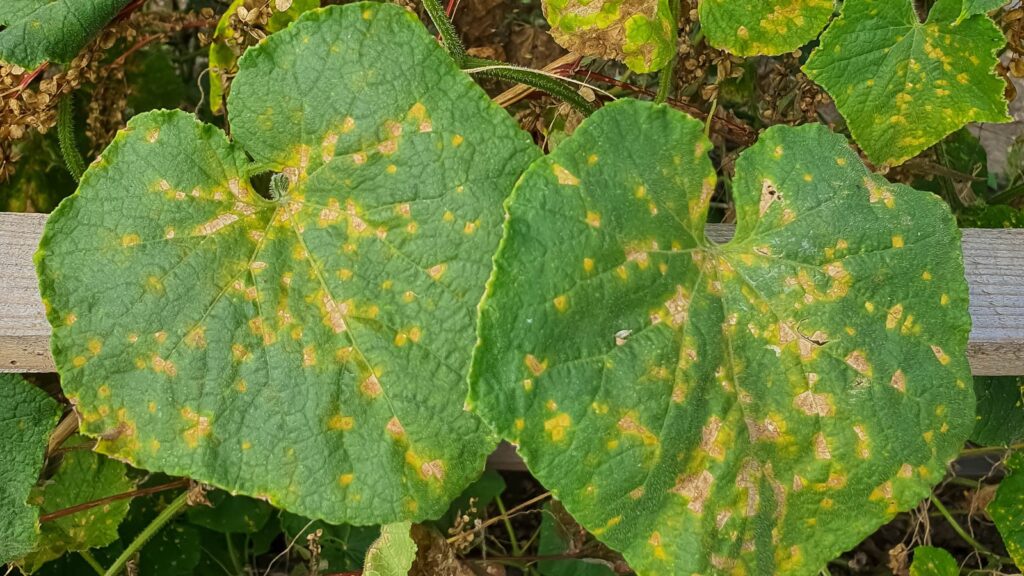
- Bleached white or pale patches
- Damage concentrated on exposed tissue
- Dry or scorched leaf edges
- Areas that later become tan or brown
- No powdery residue
- No insects associated with the spots
Timing is particularly useful for diagnosis.
If the symptoms appeared soon after transplanting seedlings from protected conditions into intense sunlight, inadequate hardening off may be involved.
Likewise, sudden exposure during extreme summer conditions can stress foliage.
Can a sunburned zucchini leaf recover?
Dead or severely bleached tissue generally won’t become green again. The goal is to protect healthy growth.
Keep the plant adequately watered without keeping the soil continuously saturated. Mulch can help moderate soil moisture and temperature, while young transplants should be gradually acclimated to outdoor conditions before being exposed to full summer sun.
Temporary shade may be useful during unusual heat events, especially for recently transplanted plants.
Don’t remove every damaged leaf immediately if substantial green tissue remains. The plant may still be using the healthy portion for photosynthesis.
5. Chemical or Spray Injury Can Cause White Patches
Here’s one cause gardeners sometimes miss completely. The treatment you applied to solve another problem may itself have damaged the leaves.
Chemical injury, also called phytotoxicity, can occur after exposure to pesticides, herbicides, fertilizers, horticultural oils, soaps, or other sprays.
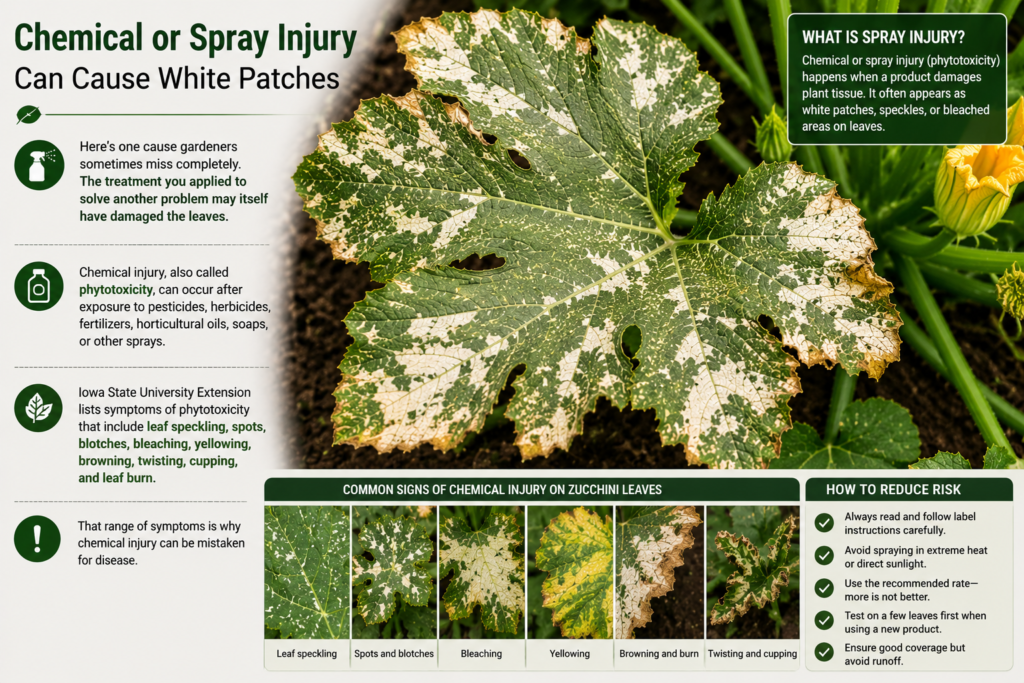
Iowa State University Extension lists symptoms of phytotoxicity that include leaf speckling, spots, blotches, bleaching, yellowing, browning, twisting, cupping, and leaf burn.
That range of symptoms is why chemical injury can be mistaken for disease.
Ask yourself what happened recently
Before diagnosing a new fungal infection, consider:
- Did I spray anything on the plant recently?
- Was the product mixed at the labelled rate?
- Was it applied during unusually hot weather?
- Could herbicide have drifted from a nearby lawn or weed treatment?
- Was the same sprayer previously used for another chemical?
- Did several plants develop symptoms at roughly the same time?
Chemical injury often has a sudden onset linked to an application or drift event.
Unlike an infectious disease, the damaged area itself doesn’t reproduce and spread from leaf to leaf. New symptoms can still appear if exposure continues or if already-injured tissue becomes more visibly damaged.
What to do after suspected spray injury
Stop applying the suspected product until you’ve identified the likely cause. Maintain normal plant care and watch the new growth.
Severely damaged tissue won’t repair itself, but a zucchini plant with a healthy root system can often continue producing normal foliage once the source of injury is removed.
Most importantly, follow pesticide and fertilizer labels exactly.
More product isn’t necessarily more effective.
White Spots on Zucchini Leaves vs. Powdery Mildew
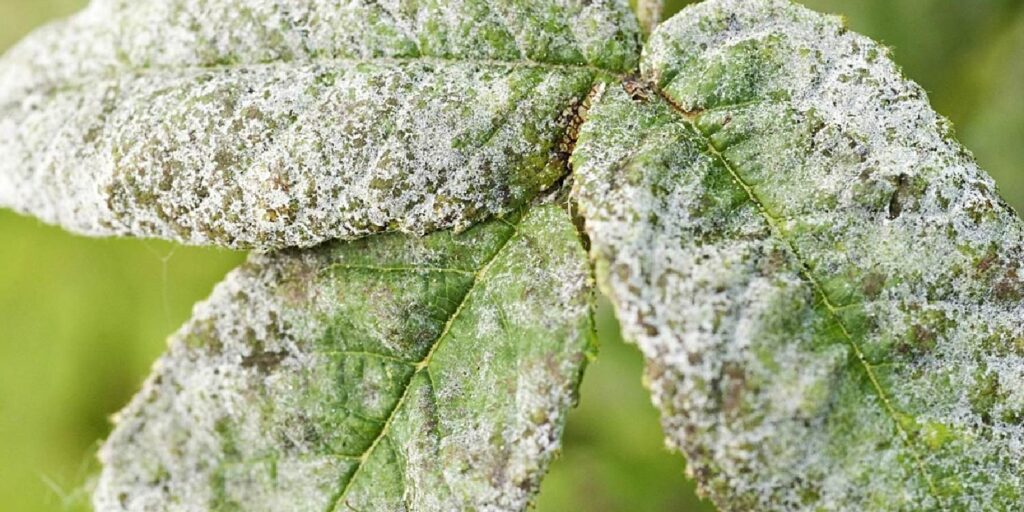
This is the comparison that can save you the most time. Natural white markings are usually part of the leaf tissue. Powdery mildew develops on the surface.
Try gently rubbing a suspicious area. If the white coloration remains unchanged and follows the veins in a regular pattern, natural variegation becomes more likely.
Powdery mildew generally has a powdery or dusty appearance and develops in irregular patches rather than following a neat vein pattern.
Use several clues together rather than relying on one test.
What Do the White Spots Mean?
Compare what you see on your zucchini leaves with the most likely cause.
| What You See | More Likely Cause |
|---|---|
| Symmetrical silver pattern along veins | Natural variegation |
| Silvery new leaves + whiteflies underneath | Silverleaf whitefly |
| Fine pale stippling + webbing | Spider mites |
| Irregular silvery scars + tiny insects | Thrips |
| Bleached patches after intense sun/heat | Sun or heat injury |
| Spots after spraying a product | Chemical injury |
| Dusty white growth that spreads | Powdery mildew |
This same diagnostic approach is useful when you encounter white spots on squash leaves, since zucchini belongs to the squash family and several related cucurbits can show similar symptoms.
A 5 Minute Zucchini Leaf Check
Still uncertain? Don’t spray anything yet. Take five minutes and inspect the plant systematically.
Look at the Pattern
Does the white coloration follow the veins or form a repeating pattern? Natural variegation moves higher on the list.
Touch the White Area
Is it flat within the leaf, or does it appear to sit on the surface?
Turn the Leaf Over
Check carefully for whiteflies, mites, thrips, webbing, eggs, or other pest evidence.
Review Recent Weather
Sudden heat, intense sunlight, wind, or transplanting can point toward environmental injury.
Remember What You’ve Sprayed
A recent pesticide, fertilizer, oil, soap, or nearby herbicide application may explain sudden bleaching.
Watch the Newest Leaves
Healthy new growth is encouraging. Rapidly worsening symptoms deserve closer investigation.
Identify the cause first. Treat only when you know what is affecting your zucchini plant.
If you’re still unable to identify the problem, take clear photos of the top and underside of several leaves and contact your local Cooperative Extension office or plant diagnostic service.
That is far more reliable than choosing a treatment based only on the colour of a spot.
How to Keep Zucchini Foliage Healthy
You can’t prevent natural variegation and there’s no reason to but good growing practices can reduce many genuine zucchini problems.
Inspect plants regularly
Check the foliage at least whenever you’re harvesting. Look underneath leaves as well as on top. Small pest populations are much easier to deal with before they become large infestations.
Give plants adequate space
Zucchini grows quickly and produces large foliage. Follow the spacing recommendations for your variety so plants receive adequate light and airflow.
Water the root zone
Provide consistent moisture around the roots instead of repeatedly wetting foliage unnecessarily. Soaker hoses and drip irrigation can make this easier.
Avoid unnecessary sprays
Don’t treat a plant simply because a leaf looks unusual. Identify the problem first. This prevents wasted treatments and reduces the risk of phytotoxicity or harm to beneficial organisms.
Learn what your variety normally looks like
Take a photo of healthy young foliage. Later in the season, you’ll have a useful reference when new white marks on zucchini leaves appear.
Final Thoughts
Finding white spots on zucchini leaves but not powdery mildew doesn’t automatically mean your summer squash is sick.
Start with the simplest possibility.
A regular silver pattern following the veins may be completely natural. If the discoloration appeared suddenly, inspect the undersides of leaves for whiteflies, mites, or thrips. Also consider recent heat, sun exposure, and anything you’ve sprayed nearby.
Most importantly, diagnose before you treat.
That small step can prevent you from removing healthy foliage or applying a product your zucchini never needed.
Have you found unusual white spots on your zucchini? Describe what the pattern looks like, when it appeared, and whether you found anything underneath the leaves in the comments. Sharing the article may also help another gardener avoid mistaking healthy zucchini markings for disease.
Frequently Asked Questions
1. Why does my zucchini have white spots but no powder?
If the white areas are flat and follow the veins, they may be natural leaf variegation rather than disease. Pest feeding, sun damage, and chemical injury can also cause pale or white areas without producing powder.
2. Are white spots on zucchini leaves always powdery mildew?
No. Healthy zucchini varieties can naturally have silver white leaf markings. Silverleaf whiteflies, spider mites, thrips, environmental injury, and phytotoxicity can also change leaf colour.
3. How can I tell natural zucchini markings from powdery mildew?
Natural markings are typically flat, patterned, and integrated into the leaf tissue. Powdery mildew appears more like superficial, irregular, powdery growth. Check several leaves and look for additional symptoms before treating the plant.
4. Should I remove zucchini leaves with white spots?
Not automatically. Healthy naturally variegated leaves should remain on the plant. Remove foliage only when it is badly damaged, clearly diseased, or removal is part of an appropriate pest or disease management strategy.
5. Can whiteflies make zucchini leaves turn white?
Yes. Silverleaf whitefly feeding can cause developing squash foliage to become silvery, beginning near the veins and moving outward. Check leaf undersides for insects when silvering develops unexpectedly.
6. Why are my zucchini leaves turning white after spraying them?
The leaves may have suffered phytotoxic injury. Some pesticides, fertilizers, oils, soaps, herbicide drift, or improperly mixed sprays can bleach, spot, scorch, or distort foliage. Review anything applied shortly before symptoms appeared.
7. Can zucchini recover from white leaf damage?
It depends on the cause. Natural variegation requires no recovery because the leaf is healthy. Plants affected by manageable pest or environmental problems may continue producing healthy new foliage once the underlying issue is corrected. Dead or severely bleached tissue itself generally won’t turn green again.
References
This article was prepared using guidance from university Extension programs and trusted horticultural resources in the United States.
University of Maryland Extension
Guidance on common squash problems, including normal silver or gray leaf variation and how it differs from powdery mildew.
Key to Common Problems of SquashUniversity of Kentucky Entomology
Expert information on silverleaf whitefly damage in squash, including the characteristic silvering of developing leaves.
Silverleaf Whitefly on SquashUniversity of Minnesota Extension
Identification guidance for spider mites, including pale stippling, bronzing, webbing, and inspection of leaf undersides.
Twospotted Spider Mites in Home GardensSouth Dakota State University Extension
Information on leaf scorch, extreme heat, moisture stress, intense sunlight, and photooxidative sunscald.
Leaf Scorch and Sunscald in the GardenIowa State University Extension and Outreach
Guidance on phytotoxicity and chemical injury caused by pesticides, fertilizers, herbicides, oils, soaps, and improper applications.
Chemical Injury to Garden PlantsCornell University – Cornell Vegetables
Expert guidance on identifying cucurbit powdery mildew, including its characteristic white, powdery fungal growth.
Cucurbit Powdery Mildew
Thesis Link : https://saulibrary.edu.bd/daatj/public/uploads/BAU200601_19-Pp_5.pdf
- Why Are My Zucchini Leaves Turning Yellow? Causes & Fixes - August 31, 2026
- What Is Eating My Plants at Night? - August 27, 2026
- Why Are My Tomato Leaves Curling Up? Causes & Fixes - August 20, 2026