


Phytophthora Root Rot in Fruit Trees
Fruit trees can look thirsty even when the soil is still wet, and that confusing pattern is one reason Phytophthora root rot frustrates so many growers. The leaves can droop and fade as if the tree needs water, yet adding more water only makes things worse. It is easy to mistake this for drought stress, a fertilizer problem, or simple poor drainage. Meanwhile the real damage may be happening out of sight, where the fine feeder roots are breaking down and the tree can no longer drink or feed itself properly.
This guide is written for home gardeners, homesteaders, and small orchard keepers who grow in warm, humid places and yards that hold water. Think heavy clay, low spots, shady corners, or anywhere that stays wet long after a storm. You will learn what to look for early, how to confirm what is really happening at the root level, and how to fix the underlying conditions that allow this disease to take hold.
The goal here is practical and realistic. You will not find miracle cures. Instead you will get clear steps that match the situation, from small changes in watering and soil setup to treatment options when a tree is already slipping. The sooner you connect the symptoms above ground to what is happening below ground, the better your chances of saving the tree and preventing the same problem in the next planting.
Disclosure:
This website participates in the Amazon Services LLC Associates Program. As an Amazon Associate, I earn from qualifying purchases. Affiliate links are included where appropriate and do not affect the price you pay.
Understanding the disease before you treat it
What root rot really means in fruit trees
“Root rot” is a practical label growers use when a tree’s root system starts failing and the decline is tied to soil conditions, disease organisms, or both. In fruit trees, the most important point is simple: when roots are injured, they stop doing their job. They cannot move water and nutrients into the tree efficiently, even if the soil is wet and even if you fertilize.
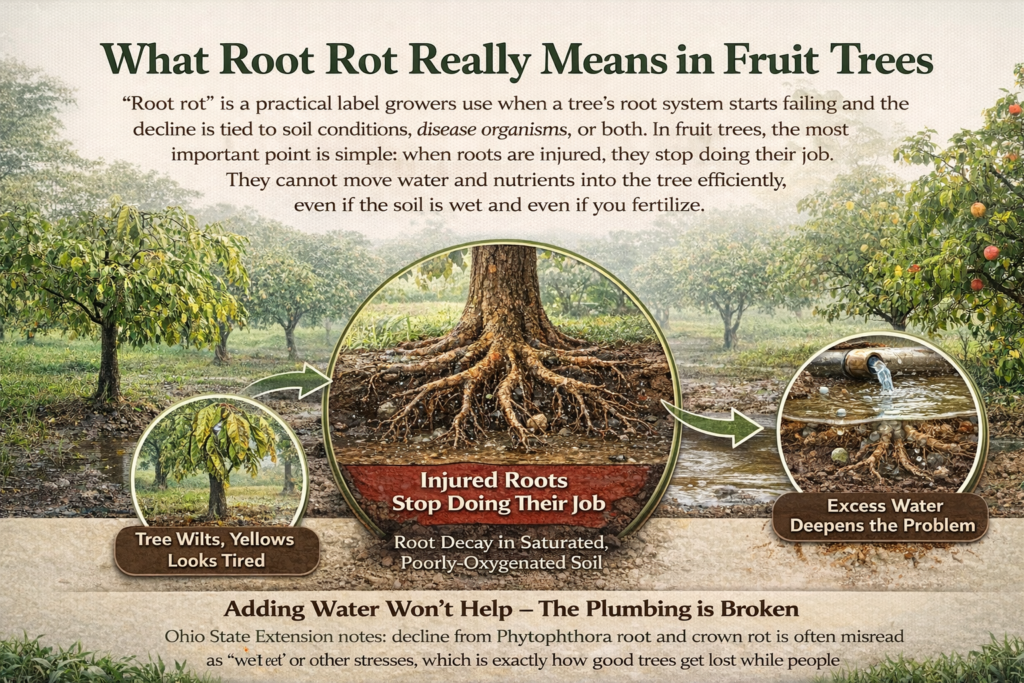
That is why water related root diseases can fool you. A tree may wilt, yellow, or look tired in the afternoon, then perk up only slightly or not at all after watering. With true thirst, irrigation usually brings a noticeable rebound. With root rot, the plumbing is broken, so adding water can actually deepen the problem by keeping the root zone saturated and low in oxygen. Ohio State Extension notes that decline from Phytophthora root and crown rot is often misread as “wet feet” or other stresses, which is exactly how good trees get lost while people chase the wrong fix.
Why wet sites keep getting hit year after year
In small orchards and home plantings, the trouble spots tend to repeat because the landscape repeats. The same low pocket holds water after every storm. The same irrigation pattern keeps the trunk base damp.
Phytophthora, one of the most common culprits in fruit tree root and crown problems, is a water mold that thrives when soil stays wet for long periods, especially around the crown area near the soil line. UC IPM explains that many fruit and nut trees can develop Phytophthora root or crown rot when soil around the base remains wet for prolonged periods or when trees are planted too deeply.
This is why location matters as much as the pathogen. Washington State University’s tree fruit guidance emphasizes crown and collar infections in apple and cherry and ties risk closely to soil moisture and conditions that favor the organism.
Where to look first on your property
If you are trying to figure out why one tree struggles while another thrives, Start with the site, not the leaves. One of the simplest ways to understand what is happening below ground is to check how long the soil stays wet after irrigation or rain. A reliable soil moisture meter can help you see whether the root zone is staying saturated longer than it should.
Common high risk zones include:
• Low areas where water collects and drains slowly
• Clay or heavily compacted soil where air exchange is poor
• Places where sprinklers repeatedly wet the trunk base or keep the crown zone saturated
• Trees planted with the root flare buried, which traps moisture against sensitive tissue at the soil line
If you remember only one thing from this section, make it this: treatments work best when you remove the conditions that keep roots wet and oxygen starved. Otherwise you are treating symptoms while the cause stays in place.
References
• Ohio State University Extension, Ohioline. Phytophthora Root and Crown Rot of Fruit Trees.
• Michigan State University Extension, Integrated Pest Management. root, crown, and collar rot.
• Washington State University Tree Fruit. Phytophthora Crown, Collar and Root Rot of Apple and Cherry.
What is Phytophthora Root Rot
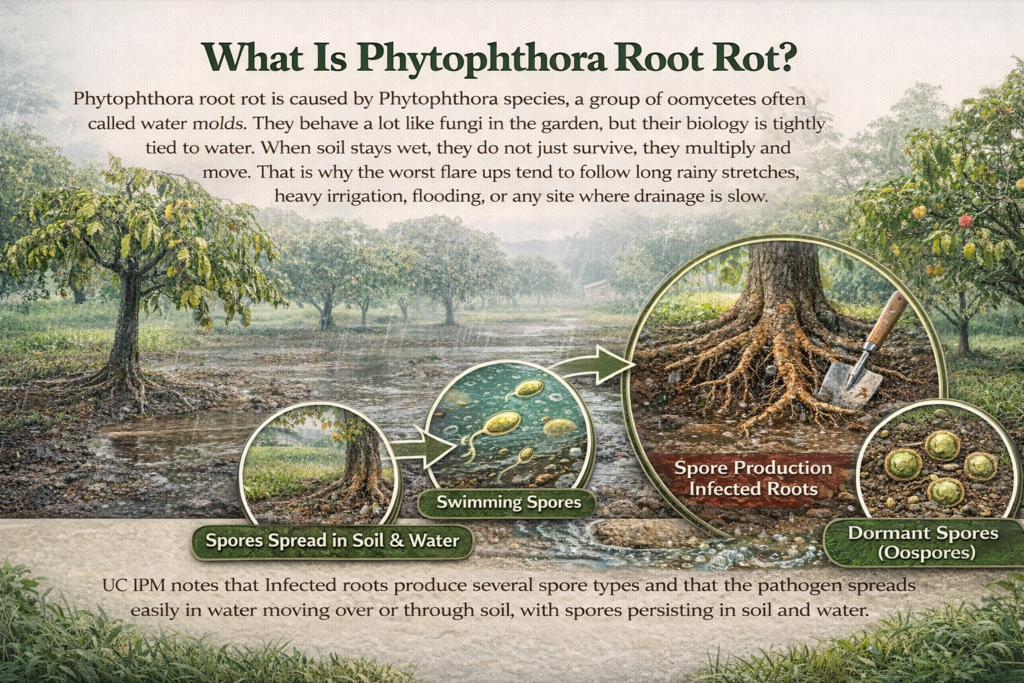
Phytophthora root rot is caused by Phytophthora species, a group of oomycetes often called water molds. They behave a lot like fungi in the garden, but their biology is tightly tied to water. When soil stays wet, they do not just survive, they multiply and move. That is why the worst flare ups tend to follow long rainy stretches, heavy irrigation, flooding, or any site where drainage is slow. UC IPM notes that infected roots produce several spore types and that the pathogen spreads easily in water moving over or through soil, with spores persisting in soil and water.
The Life Cycle in Phytophthora Root Rot
You do not need to memorize the Latin terms, but it helps to understand the pattern.
First, the organism waits. Many Phytophthora species can sit through unfavorable periods as resting spores such as oospores and chlamydospores, or persist in infected tissue. When soils become moist or puddled, those resting stages can produce sporangia. Michigan State University Extension describes this sequence clearly and explains that sporangia can then form and release zoospores under wet conditions.
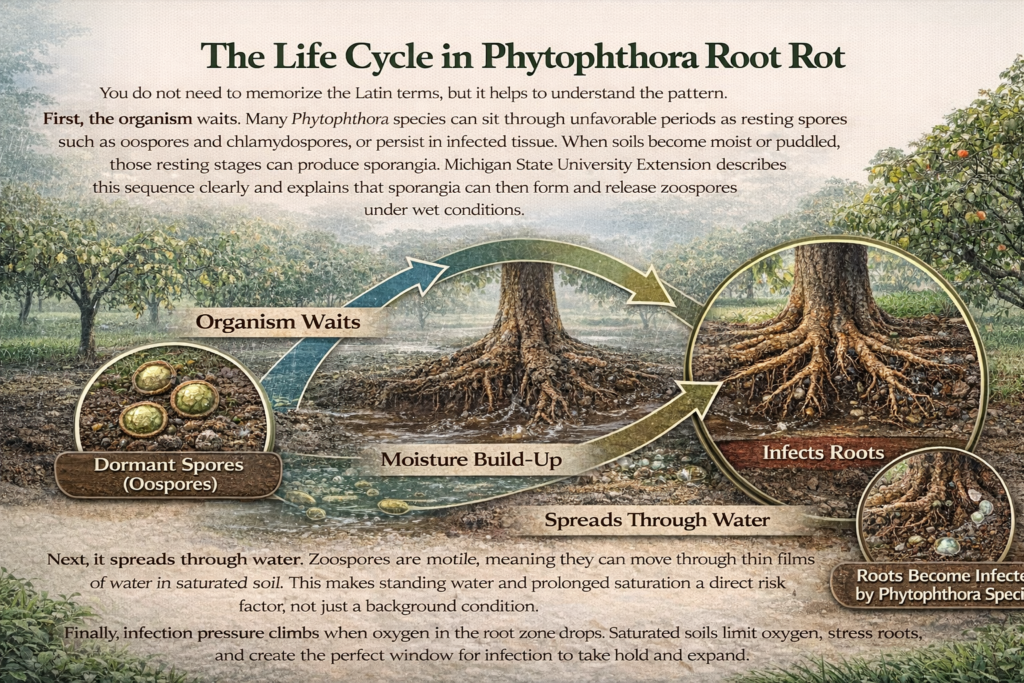
Next, it spreads through water. Zoospores are motile, meaning they can move through thin films of water in saturated soil. This makes standing water and prolonged saturation a direct risk factor, not just a background condition.
Finally, infection pressure climbs when oxygen in the root zone drops. Saturated soils limit oxygen, stress roots, and create the perfect window for infection to take hold and expand.
Why it looks different across fruit crops
Phytophthora is not one single organism, and different crops can be affected by different species and different infection sites such as feeder roots, crown tissue near the soil line, or bark at the base of the trunk. UC IPM emphasizes that different Phytophthora species attack different plants and that plants can sometimes be infected by more than one species.
A good example comes from citrus. UF IFAS describes Phytophthora fibrous root rot as an infection where the outer root tissue becomes soft and water soaked and may slough off, leaving a pale thread like inner stele. That detail matters because it gives you a physical clue you can actually look for when you wash off suspect feeder roots.
How it gets into a yard or orchard in the first place
Many homeowners assume the pathogen appears out of nowhere. In reality, it is commonly introduced on infested planting stock or moved around by water and soil.
UC IPM states directly that Phytophthora species are commonly introduced into gardens and landscapes through planting infested nursery stock and that spores spread readily in moving water.
USDA Forest Service authors also note that spread within landscapes and to new sites can occur through movement of infested soil and water.
Practical extension materials on nursery hygiene also highlight wet soil on shoes, tire treads, and runoff as real world pathways for moving Phytophthora from one place to another.
That is why prevention starts before you plant. If the site stays wet and the planting stock is questionable, the odds are stacked against the tree from day one.
References
- Michigan State University Extension. Phytophthora root and crown rot factsheet for stone fruit.
- University of Florida IFAS Extension. 2025 to 2026 Florida Citrus Production Guide, Phytophthora diseases.
- University of Florida IFAS Extension. Field Diagnosis and Management of Phytophthora Diseases.
Symptoms and field diagnosis
Root diseases can look the same from twenty feet away, so the goal is not to memorize a symptom list. The goal is to match what you see in the canopy with what you find at the soil line and in the fine roots, then compare all of that with the way water moves through the site. If those pieces line up, you can make a confident next step instead of guessing.
Above ground clues that matter
These are usually the first signs people notice, but they are only useful when you connect them to wet conditions.
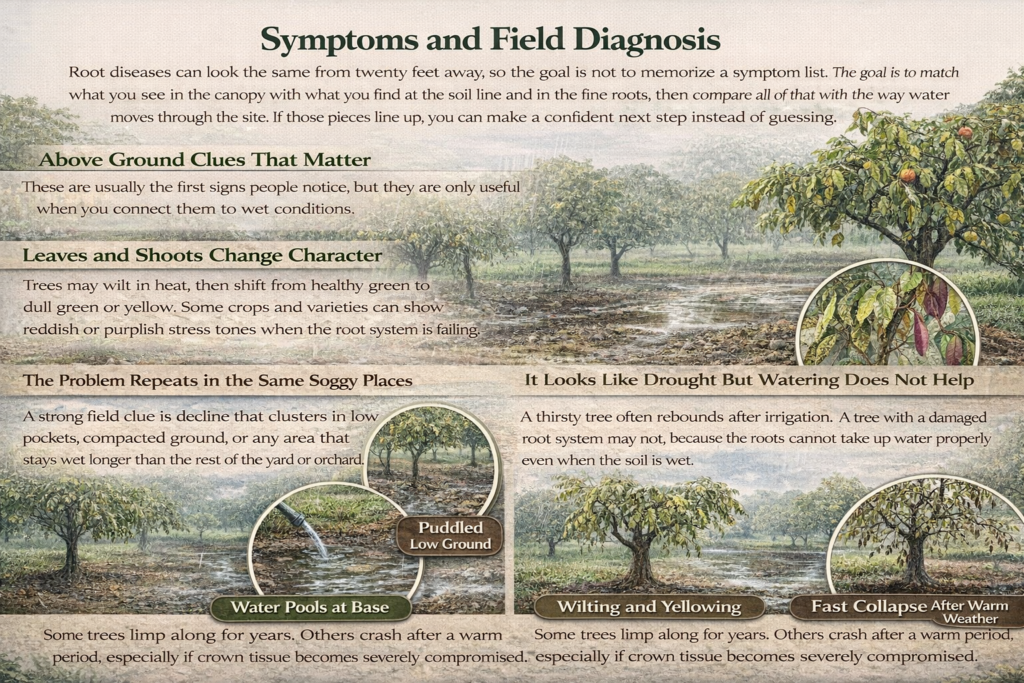
Leaves and shoots change character
Trees may wilt in heat, then shift from healthy green to dull green or yellow. Some crops and varieties can show reddish or purplish stress tones when the root system is failing. Michigan State describes infected stone fruit trees as unthrifty with short internodes, small off color leaves, and the possibility of wilting, collapse, and death.
The problem repeats in the same soggy places
A strong field clue is decline that clusters in low pockets, compacted ground, or any area that stays wet longer than the rest of the yard or orchard. Extension guidance for stone fruits notes that affected trees are often in low areas where water accumulates and soil drains slowly.
It looks like drought but watering does not help
A thirsty tree often rebounds after irrigation. A tree with a damaged root system may not, because the roots cannot take up water properly even when the soil is wet.
The timeline can be slow or fast
Some trees limp along for years. Others crash after a warm period, especially if crown tissue becomes severely compromised. Michigan State notes both patterns, with trees sometimes declining for years or collapsing within one growing season.
Below ground clues that actually confirm suspicion
If you only do one hands on check, make it this: inspect the crown and fine roots.
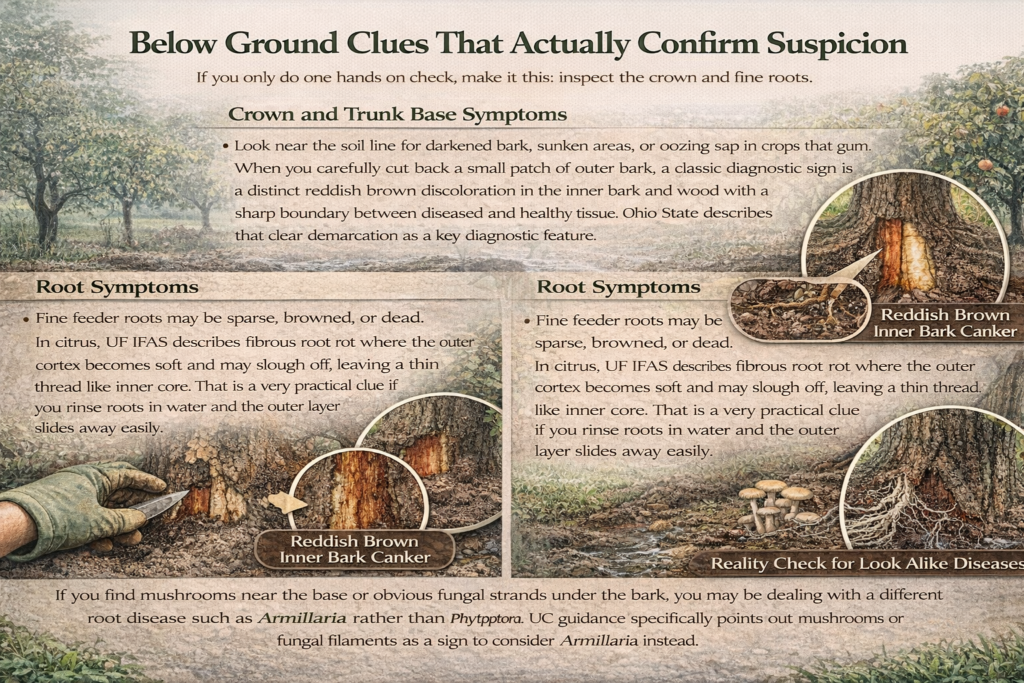
Crown and trunk base symptoms
Look near the soil line for darkened bark, sunken areas, or oozing sap in crops that gum. When you carefully cut back a small patch of outer bark, a classic diagnostic sign is a distinct reddish brown discoloration in the inner bark and wood with a sharp boundary between diseased and healthy tissue. Ohio State describes that clear demarcation as a key diagnostic feature.
Root symptoms
Fine feeder roots may be sparse, browned, or dead. In citrus, UF IFAS describes fibrous root rot where the outer cortex becomes soft and may slough off, leaving a thin thread like inner core. That is a very practical clue if you rinse roots in water and the outer layer slides away easily.
Reality check for look alike diseases
If you find mushrooms near the base or obvious fungal strands under the bark, you may be dealing with a different root disease such as Armillaria rather than Phytophthora. UC guidance specifically points out mushrooms or fungal filaments as a sign to consider Armillaria instead.
Do not skip confirmation
Before you spend money or lose a season, confirm what you are fighting.
Michigan State’s stone fruit guide emphasizes that diagnosis matters because severe cases often do not recover and because other issues can mimic the symptoms.
UF IFAS citrus guidance also cautions that chemical control should not be considered until other potential causes of decline are evaluated and corrected, and it discusses sampling as part of decision making.
If you manage several trees, lab confirmation becomes even more valuable because it can reveal which pathogens are present and help you plan drainage changes, irrigation adjustments, and replant decisions with evidence.
Practical field tip
Map your wet spots. After a heavy rain, mark where water stands for a day or where soil stays saturated. Then compare that map to which trees decline first. When the pattern matches, you are no longer guessing. You are diagnosing.
References
- Ohio State University Extension, Ohioline. Phytophthora Root and Crown Rot of Fruit Trees.
- Michigan State University Extension, Stone Fruit IPM. Phytophthora root and crown rot.
- University of Florida IFAS Extension. 2025 to 2026 Florida Citrus Production Guide, Phytophthora foot rot, crown rot, and root rot.
- UC Agriculture and Natural Resources, Over the Fence. Landscape Trees, Managing Phytophthora Root and Crown Rot.ater pools—is one of the most consistent clues in extension guidance across crops.
Why humid regions see more cases
Causes of root rot in humid regions
Humidity by itself does not rot roots. The real issue is how often the soil stays wet long enough for roots to lose oxygen and for water loving pathogens to activate. In many humid regions, rain comes in frequent cycles, evaporation is slower, and heavy soils hold moisture longer. Add a high water table, compaction from foot traffic or equipment, or irrigation that is set like a lawn schedule, and you get the one condition that shows up again and again in extension guidance: extended saturation.
UC IPM is blunt about the trigger. Periods of about 24 hours or more of saturated soil favor Phytophthora infection, while good drainage and shorter irrigation sets reduce risk.
UC IPM also emphasizes that the most important prevention lever is proper irrigation and avoiding prolonged wetness around the crown and root zone.
Even in places that do not seem “rainy,” irrigation can create the same disease pressure. Washington State University notes that Phytophthora problems can occur where irrigation water carries the pathogen or where irrigation and overhead cooling practices keep soil wet for extended periods.
The most common setup in humid areas
In real yards and small orchards, Phytophthora rarely needs a dramatic flood event. It usually takes advantage of small, repeatable mistakes that keep the crown zone wet.
Tree planted too deep
When the root flare is buried or soil is piled up later, moisture sits against crown tissue that should stay drier. UC IPM repeatedly links disease risk to prolonged wetness around the base and planting conditions that keep the crown wet.
Water hitting the trunk base
Sprinklers that wet the trunk or emitters placed tight to the trunk keep the crown area damp and raise risk. UC IPM flags irrigation practices as the key prevention point.
Flat ground with nowhere for water to go
In humid regions, a yard can stay saturated simply because it has no slope, no berm, and no outlet after heavy rain. When soil remains saturated, spores spread more easily and infection pressure climbs.
Hidden issues in planting stock
Phytophthora is often introduced through infected nursery plants, then becomes a long term problem once it is established. UC IPM notes spread can occur through contaminated plants, soil, water, and equipment.
Oregon State Extension also identifies shipment and planting of infected nursery stock as a common pathway for introducing Phytophthora to new sites.
The takeaway to remember
Humid weather matters because it makes it easier for soil to stay wet longer, especially in clay or compacted ground. And Phytophthora is built to exploit that. If you shorten the time the root zone stays saturated and keep the crown area from staying wet, you remove the condition the pathogen depends on.
Prevention that protects your trees
How to prevent root rot in fruit trees
Most people hear “do not overwater” and stop there. Real prevention is built on two things you can control: the way water moves through your site and the way your irrigation keeps the crown zone dry. The best time to get this right is before planting, because once Phytophthora is established in a wet spot, it can be difficult to manage long term.
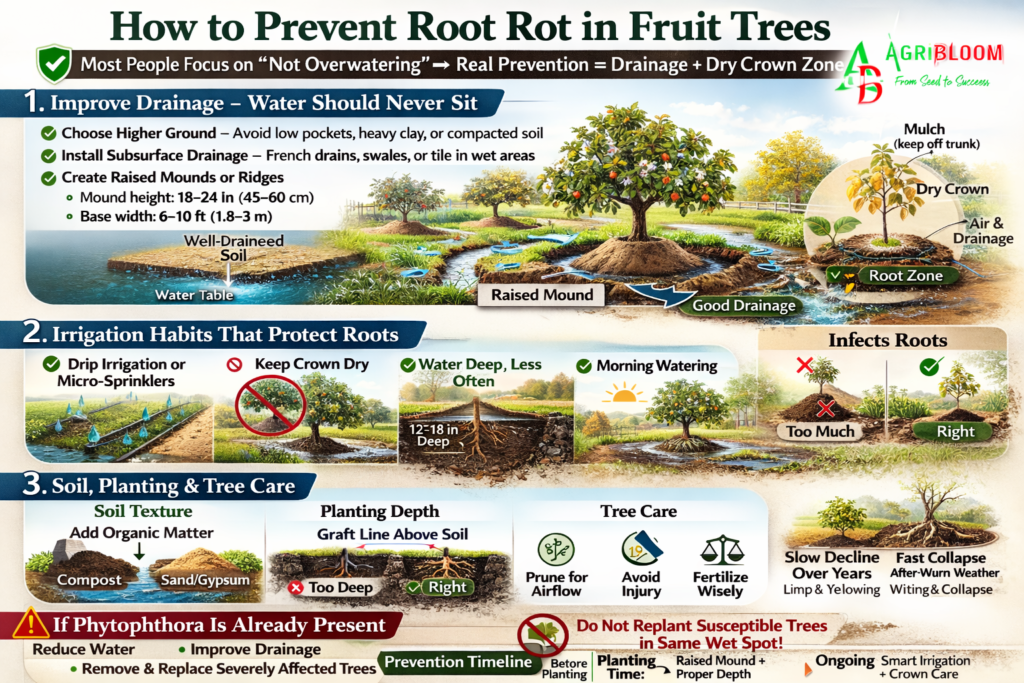
Start with the soil and the site
In extension guidance, drainage is not a side note. It is the foundation.
UC IPM explains that root and crown rot becomes likely when soil around the base stays wet for prolonged periods or when trees are planted too deeply, and their crop guidelines emphasize that saturated soil for about 24 hours or more favors infection.
When you can shorten saturation time, you reduce disease pressure.
High impact drainage upgrades that work on real properties
- Plant on a raised berm or mound so the feeder roots sit above the wettest layer during rainy weeks. This is a standard approach in high risk sites because it keeps the crown zone from staying soaked.
- Shape the surface so water leaves the tree row. Even a gentle grade can stop puddling around trunks.
- Fix compaction before planting. Compacted soil holds water and limits oxygen. If you are setting up a small orchard, addressing compaction before trees go in is one of the biggest long term wins.
Planting depth and crown zone rules that prevent silent losses
Many failures start with a tree that is only slightly too deep. That mistake keeps the crown wet, especially after soil settles.
UC IPM cautions that prolonged wetness at the base and deep planting set up root and crown rot problems.
UF IFAS citrus guidance also highlights cultural practices such as proper irrigation and disease exclusion using Phytophthora free planting stock and tolerant rootstocks, which pairs naturally with correct planting depth and keeping the bud union above soil.
A simple before you backfill checklist
- Find the graft union and keep it above the final soil line.
- Make sure the trunk base will not end up sitting in a bowl after settling.
- Keep mulch pulled back so the trunk base can dry between rains.
Irrigation strategy that prevents disease pressure
In humid regions, irrigation can either protect the tree or recreate the perfect environment for a water mold.
UC IPM notes that good drainage plus more frequent but shorter irrigations reduce risk compared with long soaking cycles, and that 24 hours or more of saturated soil favors infection.
WSU adds that problems can show up when irrigation water carries the pathogen or when irrigation and overhead cooling create wet soil conditions for extended periods.
Practical irrigation rules that hold up in the real world
- Place emitters so the trunk base and crown zone stay dry.
- After heavy rain, delay irrigation until the top layer begins to dry, while still avoiding severe drought stress.
- Group trees by water needs so one species does not force overwatering of another.
- Avoid long irrigation sets on heavy soils. Shorter cycles reduce time spent in saturation.
Use better planting stock and smarter rootstocks
A surprising number of outbreaks begin in the nursery pipeline.
UC IPM Pest Notes states that Phytophthora can be introduced through infested nursery stock and then spread via water and soil movement.
UF IFAS also stresses disease exclusion using Phytophthora free planting stock, along with tolerant rootstocks and proper irrigation practices.
If you are choosing rootstocks, UC IPM crop guidance notes that susceptibility varies and none are resistant to all pathogenic species, so matching the rootstock and the site matters.
If you only have budget for one upgrade, put it into drainage first, then choose the most tolerant rootstock available for your crop and region. That combination removes the condition the pathogen depends on and gives your tree a better baseline for wet years.
References
- Washington State University Tree Fruit. Phytophthora Crown, Collar and Root Rot of Apple and Cherry, irrigation water and prolonged wet soil conditions.
- University of Florida IFAS Extension. 2025 to 2026 Florida Citrus Production Guide, CG009, integrated cultural practices including Phytophthora free stock, tolerant rootstocks, and irrigation practices.
Phytophthora Root Rot – Treatment that actually works
How to treat root rot
It helps to say this out loud before you buy anything: you cannot fix root rot with chemistry if the soil stays saturated. When water fills the pore space, roots lose oxygen, the tree stalls, and water mold pathogens get the exact conditions they prefer. That is why the most reliable programs use products as support, not as the main plan.
UF IFAS makes the same point in its citrus guidance. Chemical control is part of management, but decisions should follow a careful look at other decline factors and a correction of the cultural issues that created the problem in the first place.
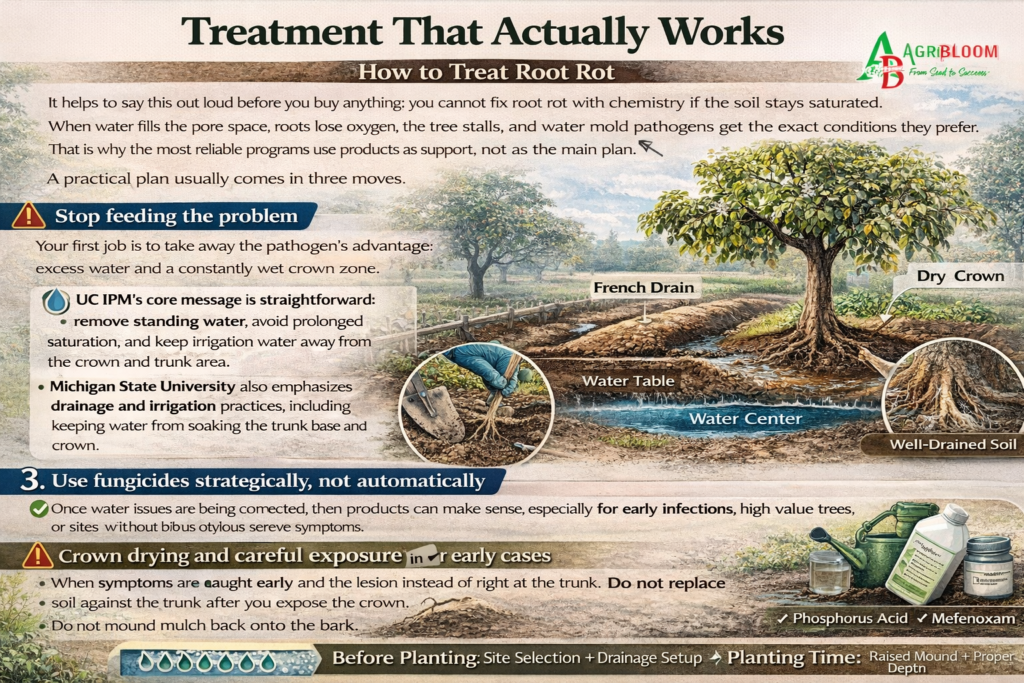
A practical plan usually comes in three moves.
Step 1 : Stop feeding the problem
Your first job is to take away the pathogen’s advantage: excess water and a constantly wet crown zone.
UC IPM’s core message is straightforward: remove standing water, avoid prolonged saturation, and keep irrigation water away from the crown and trunk area.
Michigan State University also emphasizes drainage and irrigation practices, including keeping water from soaking the trunk base and crown.
In real yard terms
Pause irrigation when the soil is already wet.
Move emitters outward so the trunk base can dry.
Get water moving off the site, even if it is just shallow surface shaping that prevents puddling.
If the soil never gets a chance to re oxygenate, nothing else you do will hold.
Step 2 : Crown drying and careful exposure in early cases
When symptoms are caught early and the lesion is limited, some trees can be stabilized by drying the crown zone rather than keeping it buried in wet soil.
UC IPM notes that trees can sometimes be saved by removing soil from the base down to the tops of the main roots and allowing the crown tissue to dry, while keeping water away from the crown and trunk.
This approach is most useful when the tree still has an active root system and the damage has not girdled the crown.
A practical way to support this
Keep irrigation farther out near the dripline instead of right at the trunk.
Do not replace soil against the trunk after you expose the crown.
Do not mound mulch back onto the bark.
Step 3 : Use fungicides strategically, not automatically
Once water issues are being corrected, then products can make sense, especially for early infections, high value trees, or sites with a known history.
Soil sampling can help you decide whether you are dealing with background levels or a true pressure problem. UF IFAS notes that populations above about 10 to 20 propagules per cubic centimeter of soil are considered damaging, and it describes composite sampling approaches used in groves.
Michigan State University also cautions that trees with severe symptoms rarely recover even when treated, and that treatments work best on trees without obvious severe symptoms.
Chemistry groups you will see for oomycetes
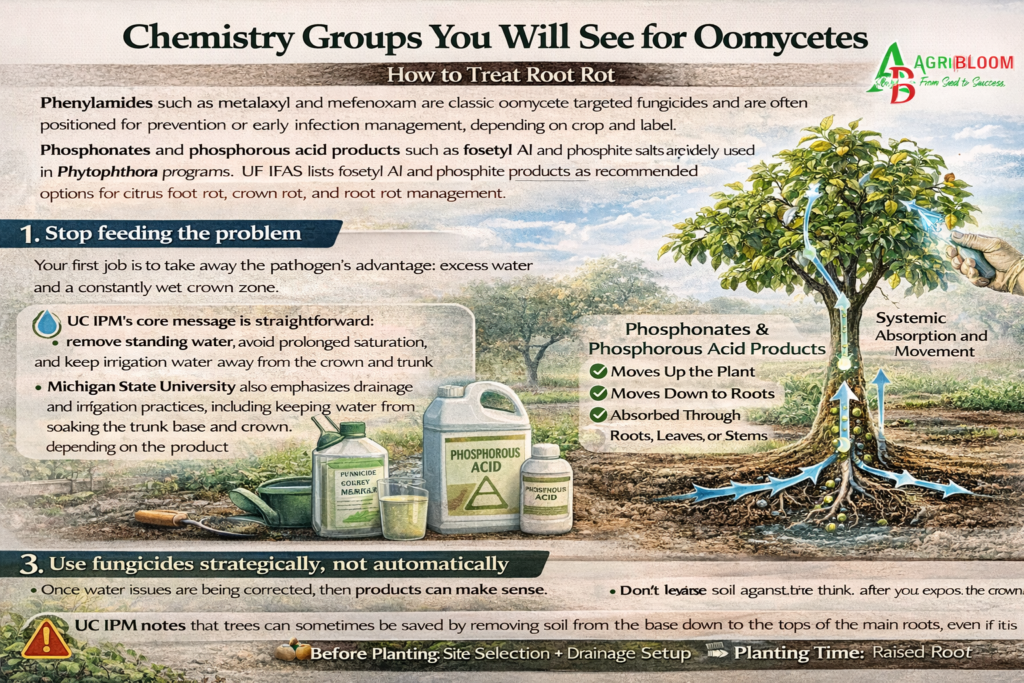
Phenylamides such as metalaxyl and mefenoxam are classic oomycete targeted fungicides and are often positioned for prevention or early infection management, depending on crop and label.
Phosphonates and phosphorous acid products such as fosetyl Al and phosphite salts are widely used in Phytophthora programs. UF IFAS lists fosetyl Al and phosphite products as recommended options for citrus foot rot, crown rot, and root rot management.
On movement inside the plant, Oregon State resources note that phosphonates can move both up and down in the vascular system, through xylem and phloem, and can be taken up through roots, leaves, or stems depending on the product and application method.
A quick note on FRAC codes
FRAC updates codes over time. The FRAC 2025 Code List places phosphonates and phosphorous acid products in P07 under host plant defense induction, reflecting a reclassification from earlier coding you may still see in older articles. Always follow the code and directions printed on your product label for your crop, and rotate modes of action where the label recommends it.
Safety and compliance reminder
Fungicide availability, allowed uses, and timing are crop and state specific. Many products that are common in commercial settings are not accessible or not labeled for backyard fruit. Extension recommendations and the label are the decision tools here, especially for bearing trees and pre harvest restrictions.nonbearing trees, preharvest intervals (PHI), and water protection requirements.
Organic and natural treatment options
If you garden organically, or you simply want the lowest risk path, the strategy does not change. Phytophthora problems are driven by wet soil and a wet crown zone. When those conditions persist, even the best products struggle to make a meaningful difference. UC IPM repeatedly emphasizes water management as the central lever and notes that plants can be hard to treat effectively when the site stays wet.
NC State Extension makes a similar point for many landscape settings: chemical management is often expensive or impractical, so the most effective approach is improving drainage and preventing spread.
Phytophthora Root Rot – Organic first actions
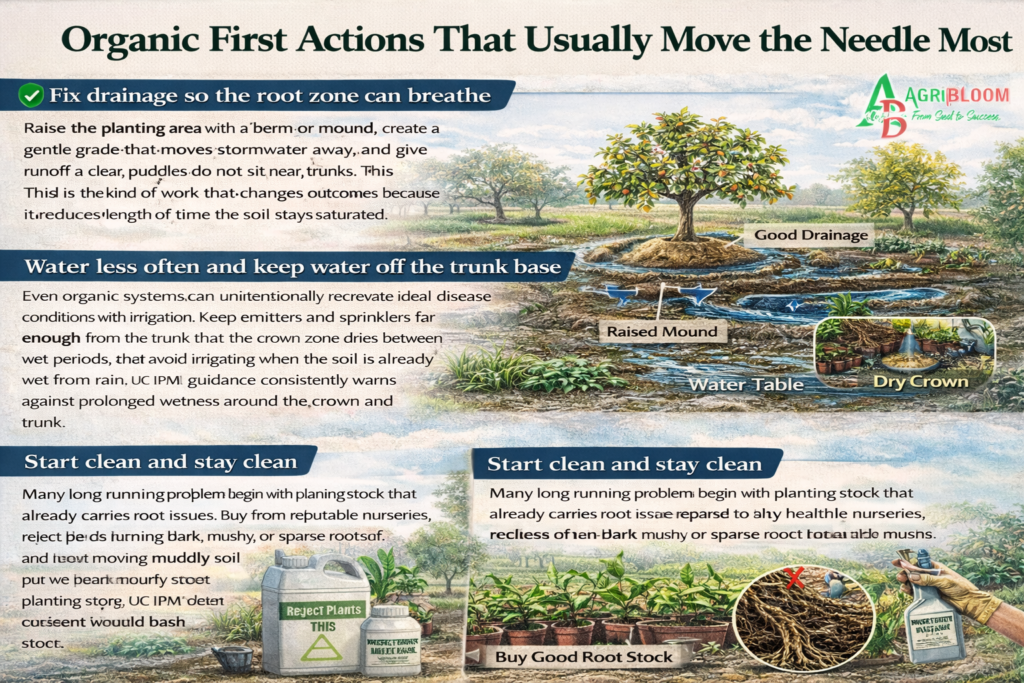
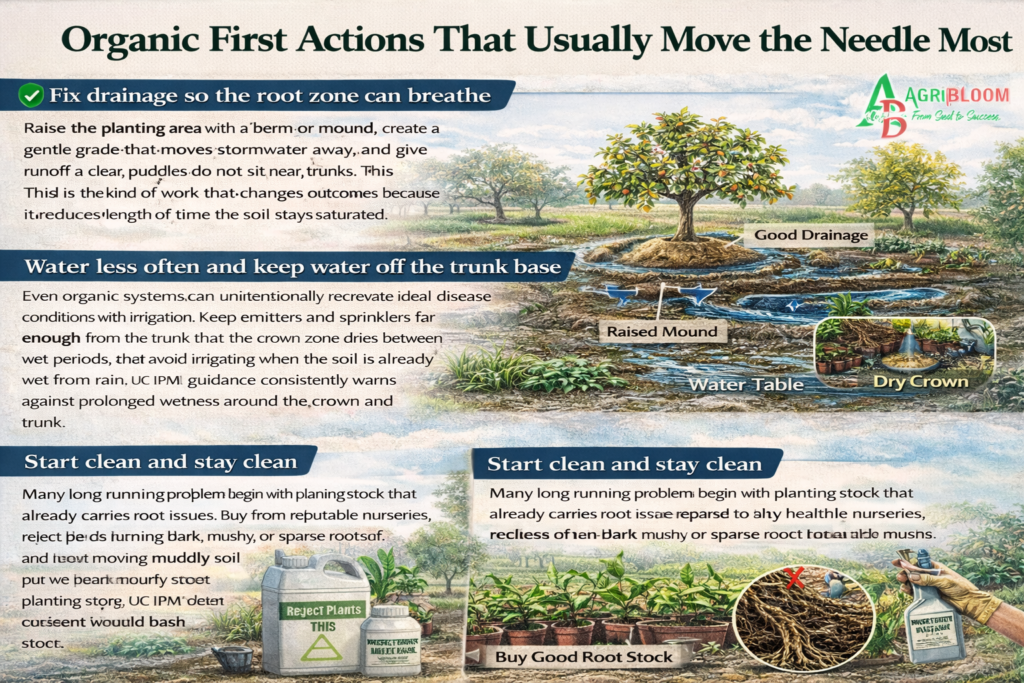
Fix drainage so the root zone can breathe
Raise the planting area with a berm or mound, create a gentle grade that moves stormwater away, and give runoff a clear path so puddles do not sit near trunks. This is the kind of work that changes outcomes because it reduces the length of time the soil stays saturated.
Water less often and keep water off the trunk base
Even organic systems can unintentionally recreate ideal disease conditions with irrigation. Keep emitters and sprinklers far enough from the trunk that the crown zone dries between wet periods, and avoid irrigating when the soil is already wet from rain. UC IPM guidance consistently warns against prolonged wetness around the crown and trunk.
Start clean and stay clean
Many long running problems begin with planting stock that already carries root issues. Buy from reputable nurseries, reject plants with dark, mushy, or sparse roots, and avoid moving muddy soil from a problem area to new planting spots. UC IPM notes that Phytophthora is commonly introduced through infested nursery stock and can spread through soil and water movement.
Phytophthora Root Rot -About biological products and soil amendments
You will see many products marketed as beneficial microbes, compost inoculants, and disease suppressive blends. Some growers report benefits in specific situations, but results vary widely because the site conditions still dominate. If you use biologicals, treat them as supportive tools, not a replacement for drainage and irrigation correction. UC IPM’s broader guidance on these diseases reinforces that the environment must be fixed first for any treatment to hold.
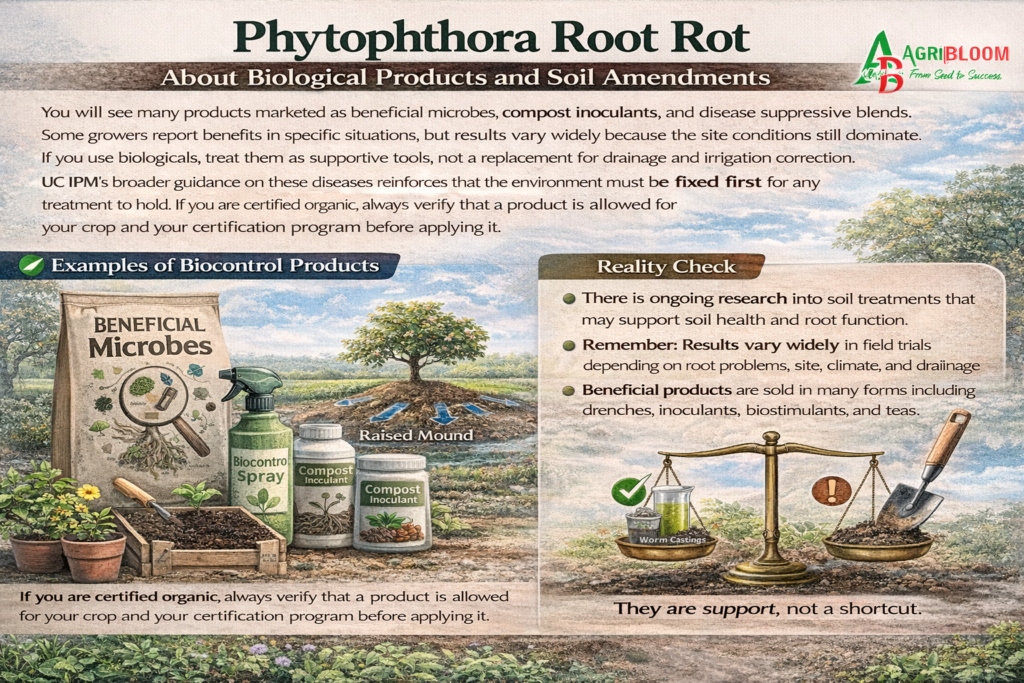
If you are certified organic, always verify that a product is allowed for your crop and your certification program before applying it.
References
- University of California Agriculture and Natural Resources, UC IPM. Phytophthora Root and Crown Rot management guidance, emphasizing water management and the difficulty of effective treatment when sites stay wet.
- North Carolina State Extension. Guidance highlighting drainage improvement and prevention as primary tools in many landscape settings where chemical management may be impractical.
Recovery, replanting decisions, and smarter choices for wet ground
Can a tree recover from root rot
Sometimes, yes. Sometimes the most honest answer is no. The outcome usually comes down to two things: how much healthy root system is still working, and whether you can stop the repeated wetness that keeps the root zone oxygen starved and keeps Phytophthora active.
Extension guidance paints a consistent picture. Early infections can sometimes be slowed or stabilized if you dry the crown area and keep water off the trunk base. UC IPM notes that trees can sometimes be saved by removing soil from the base down to the tops of the main roots so crown tissue can dry, combined with keeping the crown area from being watered directly.
The hard part is knowing when you are past the rescue window. Michigan State University’s stone fruit guidance is blunt: trees showing severe symptoms rarely recover when treated, and treatments tend to help most when symptoms are not yet severe or when you are protecting healthier trees.
A practical way to think about it
Recovery is most realistic when damage is localized, the crown is not close to being girdled, feeder roots still exist, and you can fix drainage so the site does not stay saturated again.
Odds drop fast when you have repeated flooding, major feeder root loss, or crown rot that is spreading around the trunk, because even a good product program cannot replace missing roots or undo chronic saturation.
If you are deciding whether to keep a struggling tree, include the site reality in your decision. If you cannot prevent the root zone from staying saturated after storms, replanting without redesigning drainage usually repeats the same failure cycle.
Best fruit trees for wet or humid soil
There is no perfect fruit tree for wet ground, but there are better fits, especially when you combine smarter crop choice with a rootstock that tolerates risk.
Ohio State Extension notes that in their region, apple, cherry, and peach are usually attacked, while pear and plum appear relatively resistant.
Michigan State’s stone fruit resource also flags plum as relatively resistant compared with other common hosts.
Rootstock choice often matters as much as the fruit type. UC IPM prune guidance explains that rootstocks vary in susceptibility to different Phytophthora species and none are resistant to all pathogenic species. It also notes that, in general, plum rootstocks are more resistant than peach or apricot in their production context.
If your property stays wet after storms, do not rely on “a different tree” alone. Raise the planting area, keep the crown zone dry, and then choose the most tolerant rootstock and crop you can source for your region. That pairing is what gives you the best odds in wet years.
References
- Michigan State University Extension, Stone Fruit IPM PDF. Notes on decline patterns and that severely symptomatic trees rarely recover when treated.
- Ohio State University Extension, Ohioline. Phytophthora Root and Crown Rot of Fruit Trees, pear and plum relatively resistant in Ohio.
Summery Table for Phytophthora Root Rot
| Section | Plain meaning | Check | Next step |
|---|
| Quick overview | Wet soil can still mean a thirsty looking tree because feeder roots are failing | Wilt or yellowing that does not improve after watering | Focus on oxygen and drainage, not more water |
| Root rot meaning | Root decline can come from pathogens, waterlogging, or both | Tree stays stressed even when soil is moist | Stop extra watering and inspect crown and roots |
| Repeat problem spots | The same low, compacted areas keep triggering decline | Low pockets, clay, compaction, trunk kept wet by irrigation | Redirect water and improve drainage first |
| What Phytophthora is | A water mold that thrives and spreads when soil stays saturated | Flooding, long wet spells, slow drainage | Treat it as a water management problem |
| Key symptom pattern | Above ground stress is generic, below ground confirms | Crown discoloration, dark bark, missing feeder roots | Document signs and consider lab confirmation for valuable trees |
| Humid region risk | Humidity helps soil stay wet longer, increasing pressure | Soil stays wet for days after rain | Reduce saturation time with berms and grading |
| Prevention | Best prevention is site design plus irrigation discipline | Planting depth, water pooling, emitter placement | Keep graft union above soil, keep mulch off trunk, keep crown dry |
| Treatment | Products help only after water issues are corrected | Does the site still saturate after rain or irrigation | Step 1 fix water, step 2 dry crown early, step 3 targeted fungicides only if justified |
| Organic options | Same priorities, lower risk tools | Saturation and trunk wetting | Drainage, smart watering, clean stock, biologicals only as support |
| Recovery and replanting | Early cases may recover, severe crown or root loss rarely does | Crown girdling, repeated flooding, major feeder root loss | If you cannot fix saturation, redesign site before replanting |
| Final takeaway | Water management first, chemistry second | Will your plan prevent repeat saturation | Verify cause, fix site, then protect new plantings with clean stock and smart irrigation |
Summary Tables for Action Plan
1) Quick Summary Table
| Topic | Key point | Best next step |
|---|---|---|
| What it is | Phytophthora is a water mold that attacks roots and crown tissue when soil stays wet | Treat it as a water and site problem first |
| Why it happens | Long periods of saturated soil and poor drainage create the disease window | Improve drainage and shorten saturation time |
| How it spreads | Moves with water and contaminated soil, and can arrive on nursery stock | Start with clean plants and avoid moving wet soil |
| What you see above ground | Wilt, yellowing, slow growth that does not improve after watering | Use canopy symptoms as a clue, then inspect roots |
| What confirms it | Crown lesions, discolored inner bark, loss of feeder roots | Check the crown and fine roots or use a lab test |
| Biggest risk factor | Wet crown zone and repeated saturation | Keep trunk base dry and redirect water away |
| Best prevention | Site design plus smart irrigation | Berms, grading, correct planting depth, dry crown zone |
| Treatment reality | Products help only after water issues are fixed | Fix drainage first, then treat early cases strategically |
| Recovery odds | Early cases can recover, severe cases rarely do | Decide based on crown damage and remaining feeder roots |
| Replant success | Replanting fails if the site stays wet | Redesign drainage before replanting |
2) Action Plan Table: What To Do This Week
| Timeframe | What to do | Why it matters |
|---|---|---|
| Today | Stop irrigating if soil is already wet | Reduces saturation and root stress immediately |
| Today | Check emitter or sprinkler placement and keep water off the trunk base | Wet crown tissue increases infection risk |
| Today | Dig a small inspection hole near the dripline and check how long soil stays soggy | Confirms whether the site stays saturated |
| Next 2 days | Inspect the crown at the soil line and rinse a few fine roots | Helps confirm root and crown damage early |
| Next 3 days | Pull mulch back from the trunk and remove soil piled against the crown | Helps the crown area dry out |
| Next week | Create a shallow diversion path so rainwater does not pool near the tree | Reduces repeat saturation after storms |
| Next week | If the site is chronically wet, plan a berm or raised planting area for future trees | Keeps feeder roots above the wettest layer |
| Next week | If multiple trees are involved, contact extension or a lab about confirmation testing | Prevents wasted treatment and guides replant decisions |
Final Thoughts
If you want an approach you can repeat on any property, start by treating Phytophthora problems as a water and site issue first, and only then consider products. When the root zone stays saturated, roots lose oxygen and the pathogen gets the advantage it is built to use. Extension guidance across regions keeps returning to the same fundamentals because they work: improve drainage, prevent standing water, keep irrigation off the trunk base, and avoid leaving the crown wet for long periods. UC IPM frames water management as the most important factor in preventing and managing Phytophthora root and crown rot.
Good planting practices make those gains stick. Plant at the correct depth, keep the graft union above the soil line, use clean nursery stock, and choose the most tolerant rootstock you can for your crop and region. Rootstocks vary in susceptibility and none are resistant to every Phytophthora species, which is why matching the plant to the site matters.
If this article helped you, share it with someone planting fruit trees this season. And if you want a more tailored next step, leave a comment with two details: your tree type and your soil situation. The most reliable path forward stays the same in every climate: confirm what you are dealing with, then redesign the site so the problem cannot repeat itself.

FAQs for Phytophthora root rot
1. Is Phytophthora root rot the same as “wet feet”?
Not exactly. “Wet feet” often refers to root asphyxiation (oxygen deprivation), while Phytophthora is a pathogen that thrives in wet conditions. OSU Extension notes these are commonly confused, which is why examining roots/crown and confirming diagnosis matters.
2. How fast does Phytophthora spread in an orchard or yard?
It can spread quickly when water moves across soil. UC IPM explains that spores spread readily in water and that disease is often introduced on infected nursery stock and then moved by drainage water, soil movement, and contaminated shoes/equipment.
3. What’s the single best prevention step?
Every major guide returns to the same answer: water management and drainage. UC IPM explicitly states that good water management / proper irrigation is the most important factor in preventing Phytophthora root and crown rots.
4. Should I treat with fungicide “just in case”?
Usually not. UF/IFAS and MSU both emphasize integrating cultural fixes first and confirming the disease before spending on chemical treatment; MSU warns severe cases rarely recover and fungicides are more effective as protection/early intervention.
5. Can I replant a fruit tree in the same spot?
You can, but you should assume the site still supports disease unless you redesign drainage and start with clean stock. UC IPM notes persistence and spread via soil/water, and orchard guidance stresses selecting good planting sites and managing irrigation water.

Thesis Link : https://saulibrary.edu.bd/daatj/public/uploads/BAU200601_19-Pp_5.pdf
- 10 Best Loppers for Thick Branches - October 14, 2026
- Fall Lawn Care Checklist – 9 Jobs Before Winter - October 14, 2026
- 10 Best Garden Tool Sets for Beginners - October 13, 2026




[…] Phytophthora Root Rot – Prevention, Diagnosis and Treatment […]