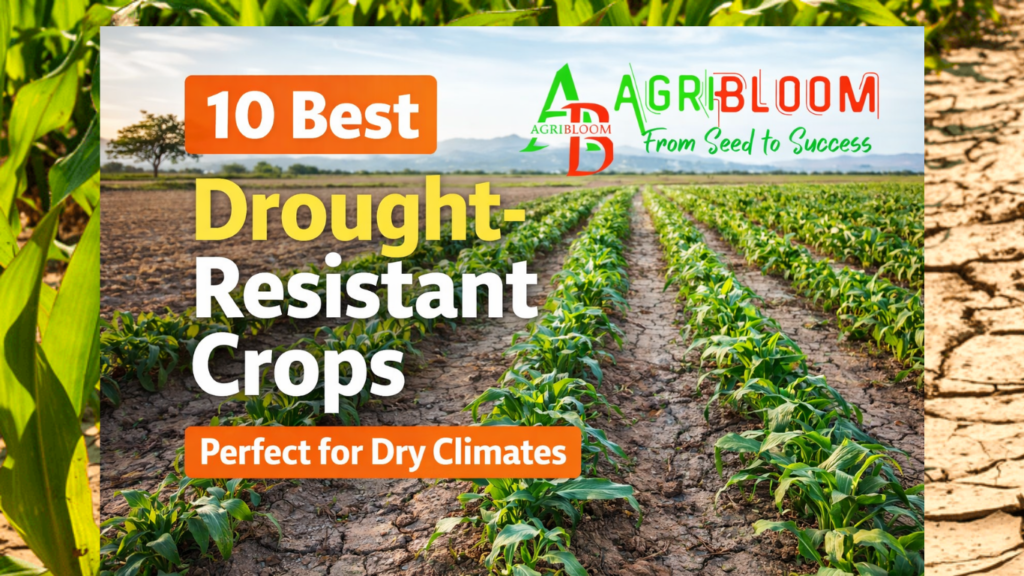

Drought Resistant Crops – A Practical Guide for Dry Gardens
Unpredictable rainfall is no longer only a problem for large farms. It now affects backyard gardens, homesteads, and community growing spaces as well. When rain arrives late, watering restrictions begin, or wells produce less than usual, crop choice becomes one of the smartest decisions you can make before the season even starts.
To make better choices, many gardeners use simple tools like soil moisture meters and drip irrigation kits to manage water efficiently and avoid wasting water.
That is where drought resistant crops become useful. These crops are better at coping with dry spells, heat, and uneven moisture. They will not grow without any water at all, but they can keep producing with less stress than thirsty crops that need constant irrigation.
In simple terms, drought resistant crops are plants that can survive and still produce reasonably well during periods of limited water. Some do this by sending roots deeper into the soil. Others have smaller leaves, waxy surfaces, or growth habits that reduce water loss. Some finish their life cycle quickly, which helps them avoid the worst part of a dry season. Crop choice matters because agriculture already uses around 70 percent of global freshwater withdrawals, so growing plants that need less water is both practical and increasingly necessary.
Disclaimer: This post may contain affiliate links. This means I may earn a small commission if you purchase through these links, at no extra cost to you. I only recommend products that I believe are useful and relevant.
Why this matters now
Dryland growing is becoming more important because drought pressure is rising in many regions. A widely cited UN drought summary notes that since 2000, the number and duration of droughts has increased by 29 percent. The same body of reporting also links drought to major economic losses, water stress, and long term food security risks.
Climate assessments from the IPCC also show that climate change is already affecting food production through shifting rainfall, higher temperatures, and more frequent extreme events. The IPCC further warns that drought risk and damage are expected to increase as warming continues, with agricultural drought becoming more likely in many regions.
So yes, mulch, compost, soil cover, and drip irrigation all help. But the crop itself is still your first line of defense. Picking varieties that can handle water stress often gives the biggest benefit before planting even begins.
How drought resistant crops handle stress
Not all dry tolerant crops survive in the same way. A few common traits show up again and again:
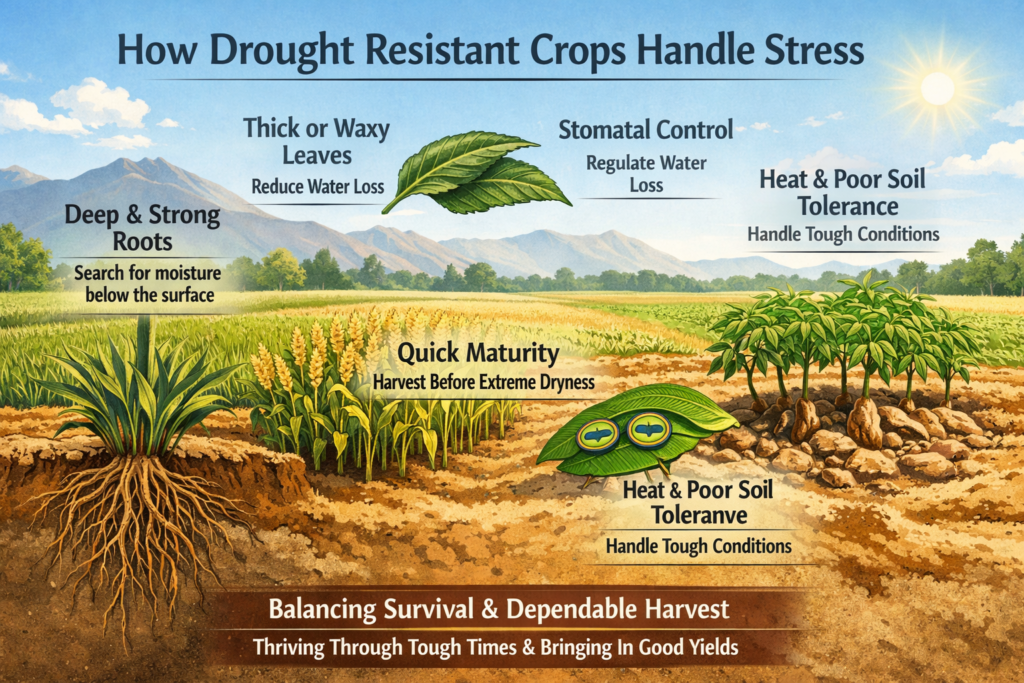
- Deep or aggressive root systems that search for moisture below the surface
- Thick, narrow, or waxy leaves that lose less water
- Faster maturity, allowing harvest before severe late season dryness
- Better stomatal control, which helps regulate water loss
- Greater tolerance to heat, poor soils, or irregular watering
This matters because drought resistance is not only about surviving. It is also about staying useful. A crop that remains alive but produces almost nothing is not much help to a gardener or grower. The best choices balance survival with dependable harvest.
How to choose the right crops
Before planting, ask a few basic questions.
First, what kind of dry stress do you actually have? Simple tools like soil moisture meters can help you understand how quickly your soil dries and how much water it holds. Some places get long, hot summers. Others get uneven rainfall with cool nights. Some soils dry out fast because they are sandy, while clay soils may hold water longer but crack badly once they dry.
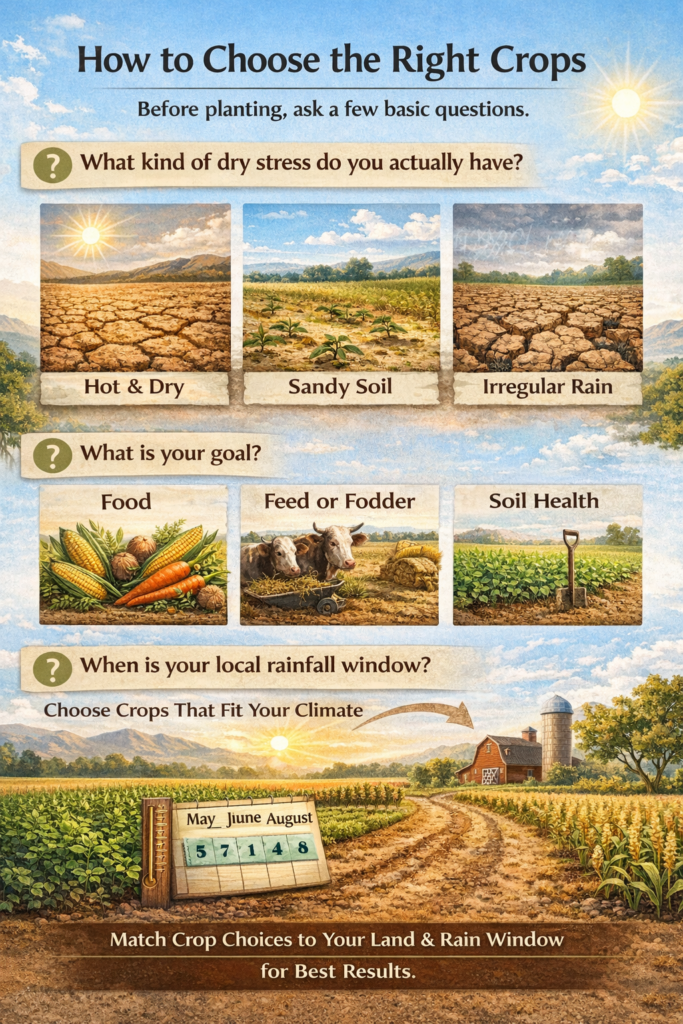
Second, what is your goal? If you want calories, grains and legumes may matter most. If you want regular kitchen harvests, focus on reliable vegetables and herbs. If you want animal feed or soil improvement, your crop list may look different.
Third, look at timing. In many dry areas, the smartest plan is not just choosing drought tolerant crops but matching them to the local rainfall window. Sometimes the best grower is not the crop that tolerates the most heat, but the one that matures before the harshest stress arrives.
A note on biotechnology and GMO drought traits
You also asked about biotechnology. This topic should be handled carefully. Traditional plant breeding remains the main path for improving drought performance in many crops. Breeders select plants that root well, mature reliably, and yield better under stress. Biotechnology can add another layer by helping identify traits linked to drought response or by introducing specific genetic changes.
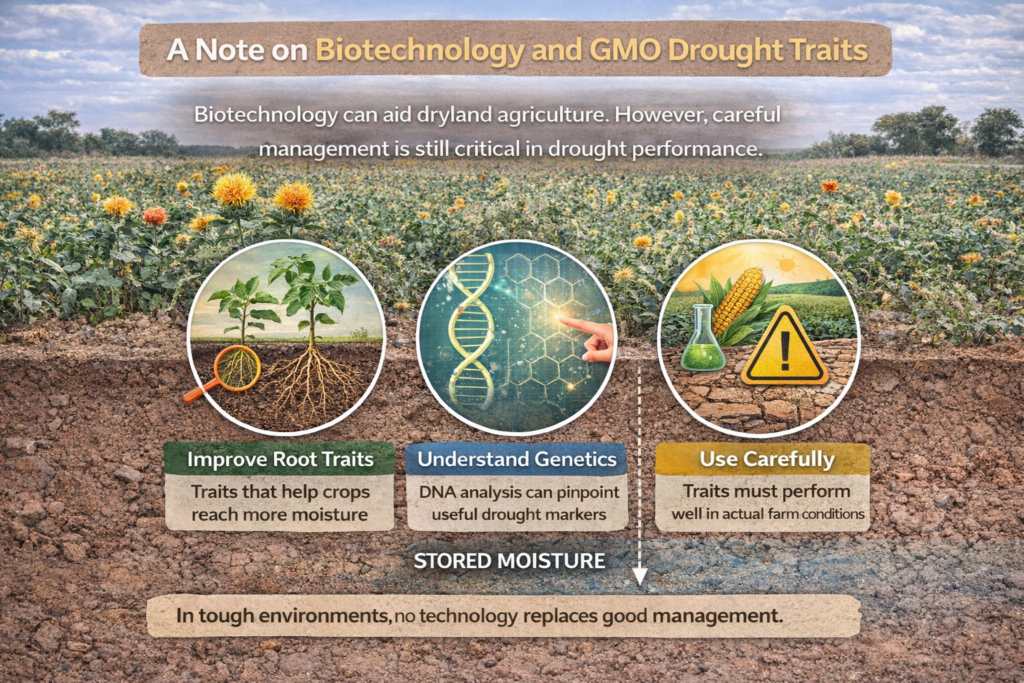
That said, drought tolerance is a complicated trait. It is controlled by many genes and strongly shaped by local conditions such as heat, soil type, planting date, and fertility. Because of that, there is no single technology that solves dryland production everywhere. In real world growing, management still matters just as much as genetics.
What drought resistant crops are and how they work
If you want a simple Drought resistant crops meaning, think of crops that can still give you a worthwhile harvest when water is limited. They are not crops that grow without water. They are crops that handle dry conditions better than many other options. In practical terms, they usually lose less yield during dry spells, recover faster after stress, or finish growing before drought becomes severe.
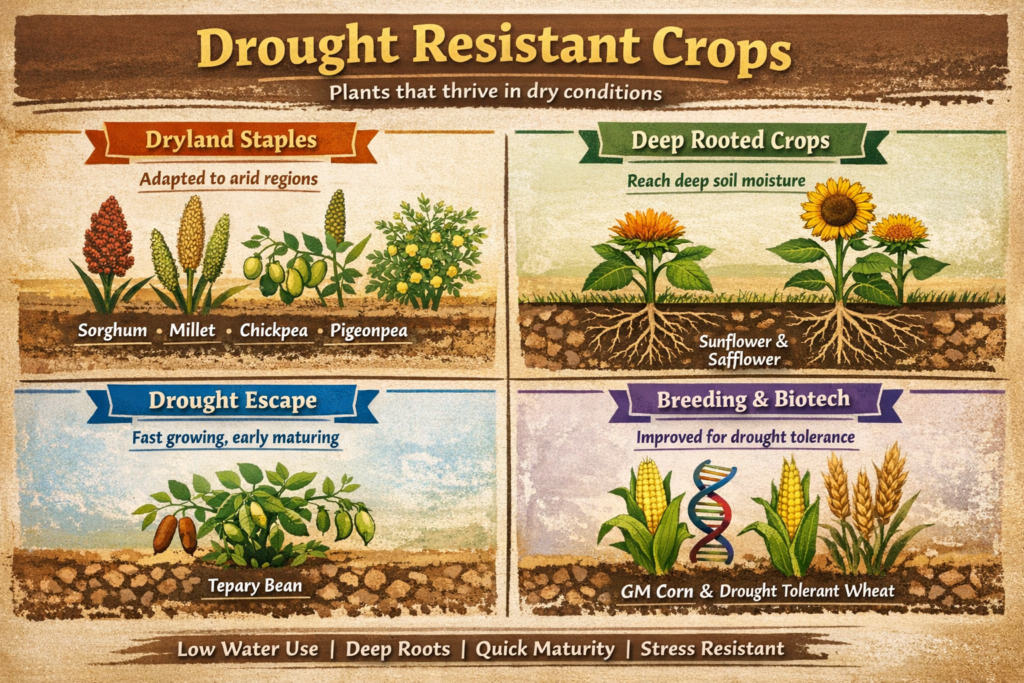
When people ask, what are drought resistant crops, they are usually talking about four broad groups.
First, there are dryland staples. These are crops that have been grown for generations in semi arid regions, such as sorghum, pearl millet, finger millet, chickpea, and pigeonpea. Their value comes from long adaptation to hot climates, uncertain rainfall, and lower input farming systems.
Second, there are deep rooted crops. These plants can reach moisture stored deeper in the soil profile when the surface dries out. Sunflower and safflower are good examples, and some legumes show this trait as well.
Third, some crops survive by timing. They grow fast, flower early, or complete grain filling before the harshest part of the season arrives. This is often called drought escape, and it can be just as important as physical toughness. Tepary bean is a classic example.
Fourth, there are crops improved through plant breeding and biotechnology. These include varieties selected for better stress performance and, in a smaller number of cases, genetically modified crops developed to perform more steadily under water stress.
How drought resistant crops work inside the plant
The phrase how do drought resistant crops work sounds technical, but the core idea is straightforward. These plants usually survive dry weather in one of three ways. They find more water. They lose less water. Or they finish their life cycle before drought causes serious damage.
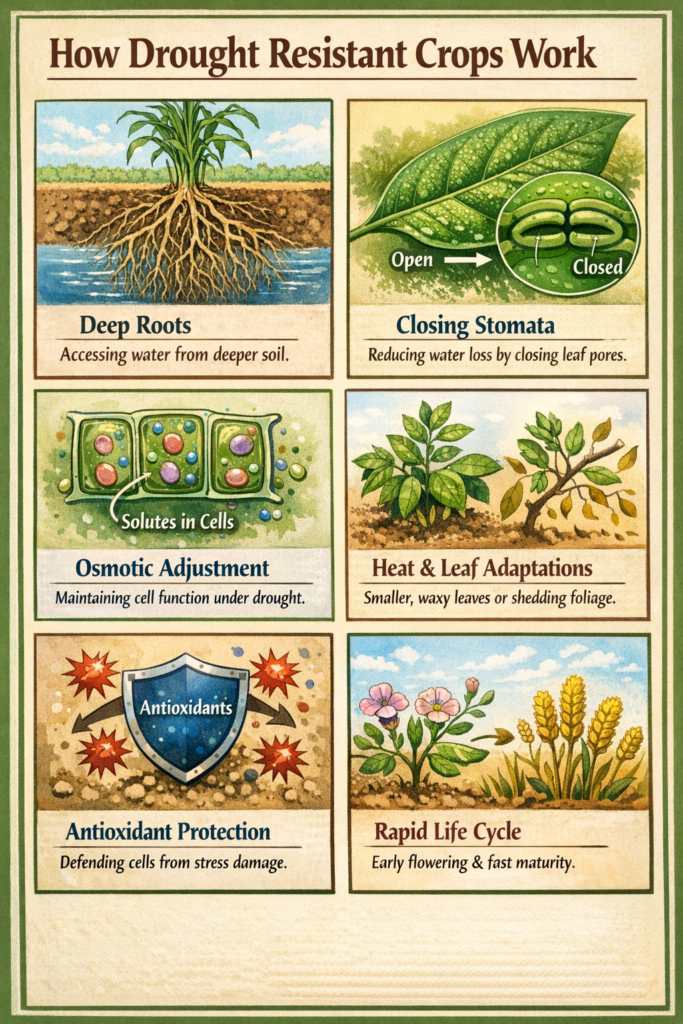
One of the biggest advantages is a stronger root system. Drought resilient crops often develop roots that are deeper, denser, or better able to explore the soil. That gives them access to water that shallow rooted crops cannot reach.
Another mechanism is stomatal regulation. Plants have tiny pores on their leaves called stomata. When conditions turn hot and dry, many drought adapted crops close these pores to reduce water loss. This helps conserve moisture, though it can also slow growth if it continues for too long.
They also use osmotic adjustment. In plain language, this means they build up certain compounds inside their cells so the cells can keep functioning even when water pressure drops. Many also strengthen their antioxidant systems, which helps reduce damage caused by heat and drought stress.
Some plants manage heat at the leaf level. They may have smaller leaves, waxier surfaces, altered leaf angles, or a tendency to shed leaves during severe stress. Tepary bean, for example, can angle its leaflets and move quickly through reproduction so it avoids the worst part of the dry period.
Timing matters too. Early flowering and faster maturity can make the difference between a crop that fills grain and a crop that fails at the finish line. This is one reason short season dryland crops are so valuable in unpredictable climates.
Familiar drought resistant crops
Some drought resistant crops examples are already well known in dryland farming.
Sorghum and millets are among the best known cereal choices for semi arid areas because they handle heat and irregular rainfall better than many common grains.
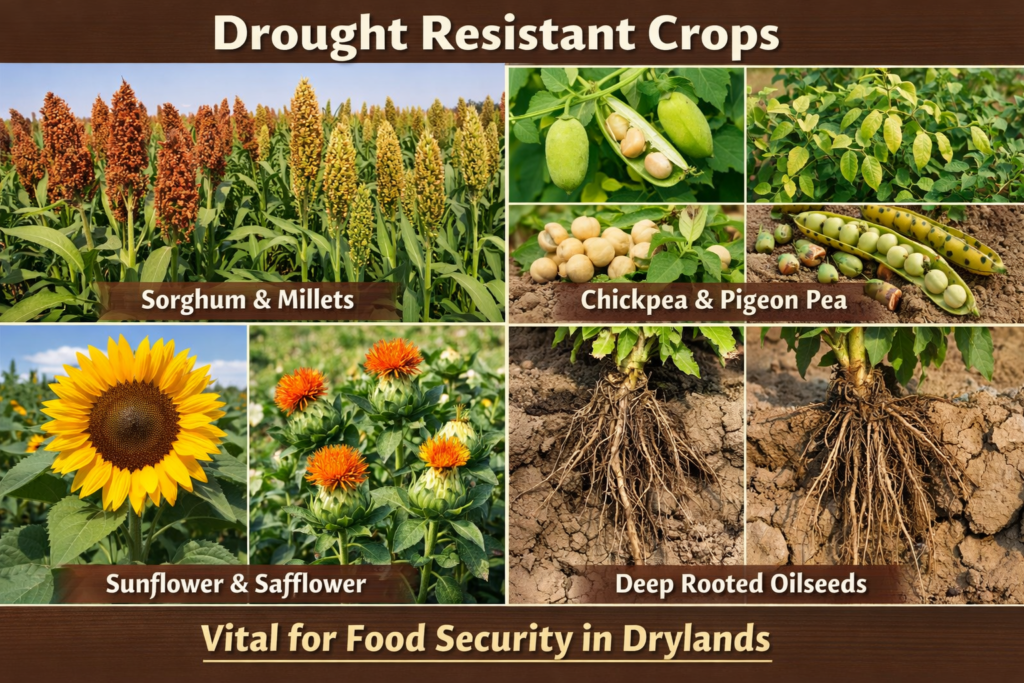
Chickpea and pigeonpea are widely used in rainfed systems because they combine food value with resilience under lower moisture conditions.
Sunflower and safflower are strong examples of deep rooted oilseeds that can tap moisture below the surface when topsoil dries out.
So, Drought Resistant Crops are not niche or unusual. In many parts of the world, they are central to food security and farm survival when rainfall cannot be trusted.
How drought resistant crops are produced
A common reader question is how are drought resistant crops produced. The answer is a mix of farmer knowledge, plant breeding, and modern science.
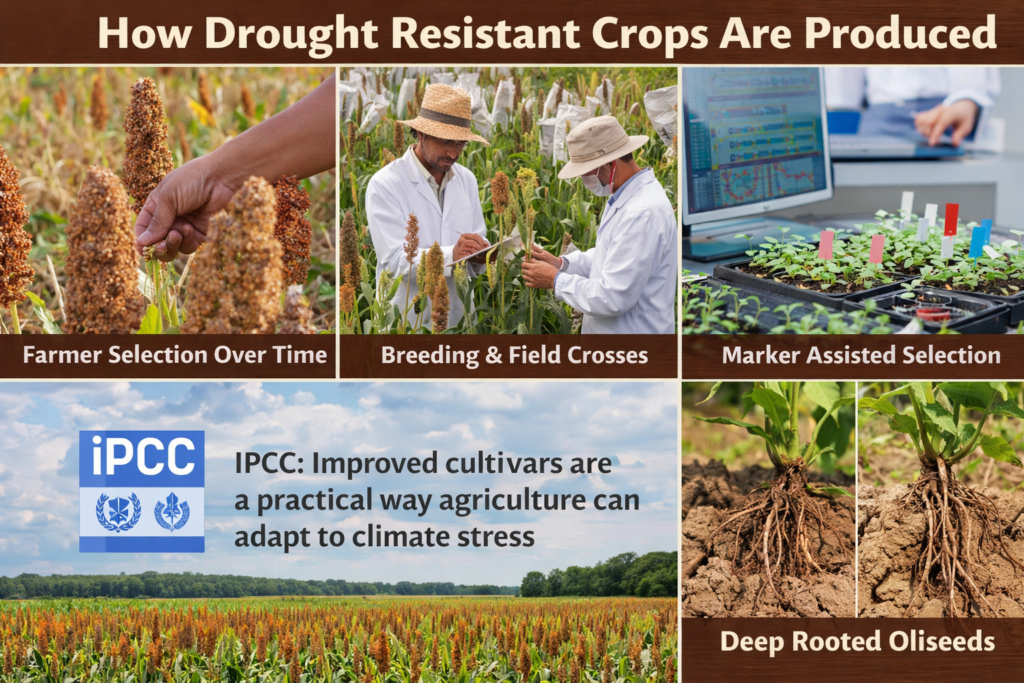
For a long time, farmers created tougher crops simply by saving seed from plants that performed well in difficult years. That process still matters. Over time, repeated selection helps build locally adapted varieties that fit a region’s soil, heat, and rainfall pattern.
Today, breeders use that same principle in a more systematic way. They cross promising parents, test thousands of lines under field stress, and keep the plants that hold yield better under dry conditions. This is still the foundation of most drought improvement work.
Modern programs often add marker assisted selection and other genomic tools. These methods help breeders track useful genes or genomic regions linked with drought related traits, especially when the trait is controlled by many genes at once. That matters because drought tolerance is rarely controlled by one simple switch. It is usually shaped by root growth, flowering time, stress chemistry, and many interactions with soil and weather.
The IPCC has highlighted improved cultivars as one of the practical ways agriculture can adapt to climate stress, especially when better genetics are combined with sound soil and water management.
Drought resistant crops biotechnology
Drought resistant crops biotechnology covers a range of tools used to improve stress performance at the molecular level. This can include molecular markers, genomic selection, gene editing, and transgenic approaches. The goal is not to create a magical crop that ignores drought. The goal is to make plants hold yield more steadily under water stress or recover better after dry periods.
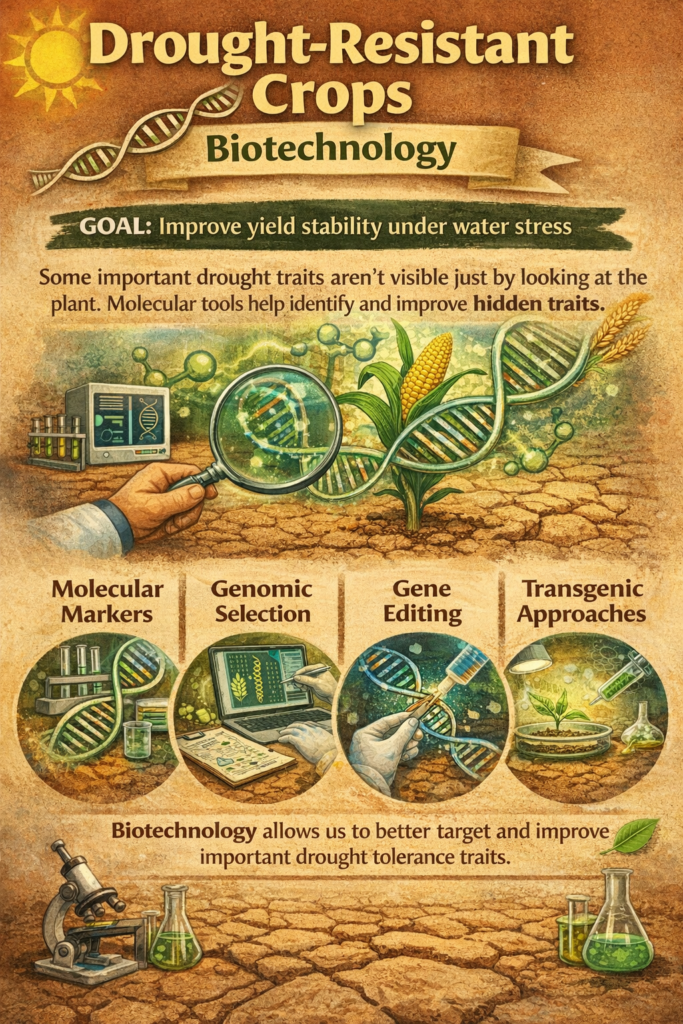
Biotechnology matters because some drought related traits are hard to improve by looking at the plant alone. A crop may appear similar in the field, yet differ a lot in root behavior, stress signaling, or cell protection. Molecular tools help breeders work with those hidden traits more accurately.
Drought resistant crops GMO and well known examples
Search interest around drought resistant crops gmo and drought resistant genetically modified crops is high, but the number of commercial examples is smaller than many people expect.
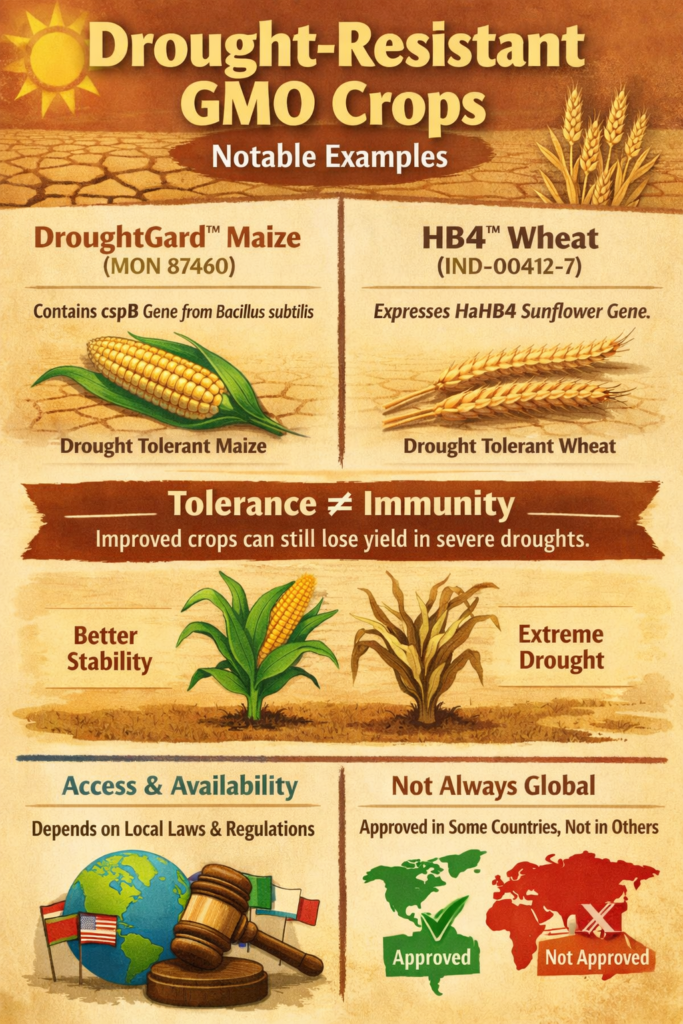
One of the best known examples is DroughtGard maize, event MON 87460. The OECD BioTrack Product Database lists it as drought tolerant maize and identifies the cspB gene as part of the trait package. The ISAAA database explains that this gene came from Bacillus subtilis and was used to help the plant maintain cellular function under drought stress.
Another important example is HB4 wheat, event IND 00412 7. USDA APHIS describes this wheat as modified for increased drought tolerance through expression of HaHB4, a sunflower transcription factor. The same review also notes the presence of bar/PAT for glufosinate tolerance and states that APHIS did not identify a plausible pathway for increased plant pest risk compared with conventional wheat.
These examples are useful, but they need context.
First, drought tolerance does not mean immunity. Even improved crops can lose yield when drought is long, intense, or badly timed. In most cases, tolerance means better stability, not total protection.
Second, access depends on local law, regulation, seed supply, and market acceptance. What is approved or available in one country may not be approved or sold in another.
Drought resistant crops advantages and disadvantages
A useful discussion of Drought resistant crops advantages and disadvantages should stay practical.
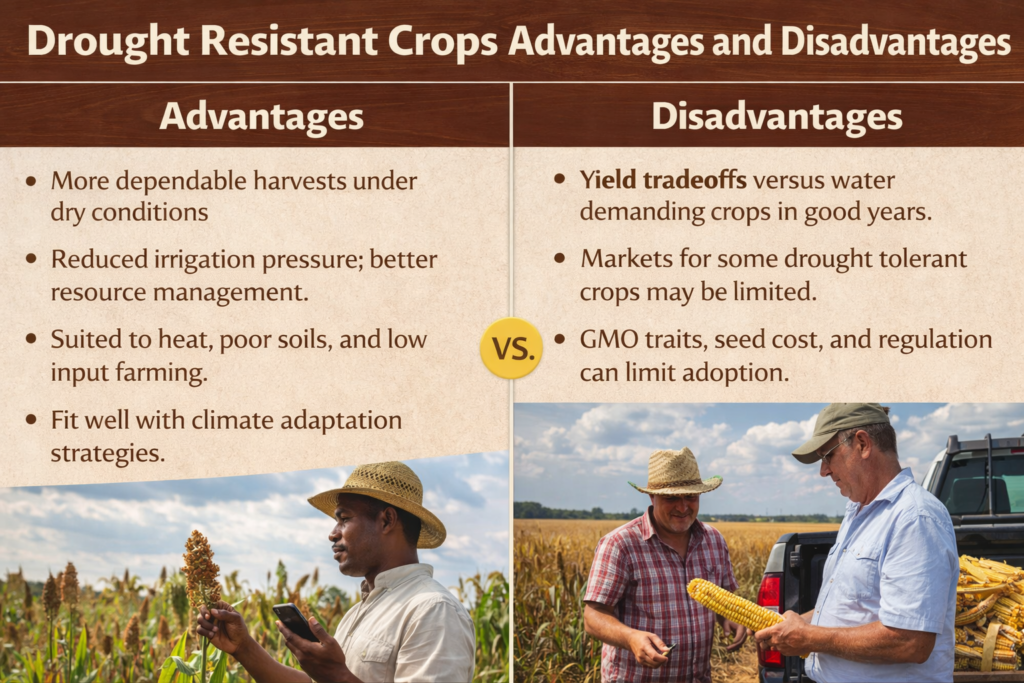
Advantages
Drought resilient crops can make harvests more dependable in years with below average rainfall. For many growers, that reliability matters more than chasing the highest possible yield in a perfect season.
They can also reduce irrigation pressure. That is important because agriculture already uses a large share of freshwater withdrawals worldwide. Crops that need less water or use it more efficiently can support better long term resource management.
Many are naturally suited to heat, marginal soils, and low input systems. That makes them valuable in regions where water, fertilizer, and infrastructure are limited.
They also fit climate adaptation goals. When combined with mulching, soil moisture conservation, and diversified cropping, they give farmers a stronger response to unpredictable weather.
Disadvantages
There can be tradeoffs. Some drought tolerant crops may not match the top yield of more water demanding crops in a very favorable season. You are often choosing stability over peak output.
Market demand can also be an issue. Sorghum, millets, tepary bean, or safflower may grow well in dry conditions, but selling them depends on local demand, processing capacity, and consumer familiarity.
With GMO drought traits, seed cost, regulation, and public opinion can all affect adoption. A trait may be scientifically valuable and still face commercial limits because of policy or market resistance.
References
- FAO. Water and agriculture overview.
- IPCC AR6 WGII. Food and water fact sheet.
- ICRISAT. Sorghum overview.
- ICRISAT. Pearl millet overview.
- ICRISAT. Finger millet overview.
- ICRISAT. Chickpea overview.
- ICRISAT. Pigeonpea overview.
- South Dakota State University Extension. Sunflower production guide.
The Ten Best Drought Smart Crops to Grow
Choosing the right crop can make dry season growing much easier. Some plants are simply better built for heat, low rainfall, and limited irrigation. They still need moisture to sprout and establish, but once rooted, many of them perform far better than thirsty crops that struggle under the same conditions. That is why drought smart crop selection matters so much for home gardens, homesteads, and low irrigation farms.
A practical rule is to focus on two stages. First, help the crop establish well. Good germination and early root growth are critical. Second, once the plant is established, use water carefully and at the most important growth stages. This approach usually gives better results than frequent shallow watering. Guidance from Kansas State notes that grain sorghum, for example, needs warm, moist soil with good seed to soil contact for rapid germination.
1. Sorghum
Why sorghum is a smart drought crop
Sorghum is one of the best known dryland cereals in the world. It is widely grown in semi arid and tropical regions because it can handle heat, lower rainfall, and poorer soils better than many other grains. ICRISAT describes sorghum as a crop that thrives in semi arid and tropical climates with limited water, high temperatures, and challenging soil conditions. FAO also notes that sorghum is more drought resistant than many crops, including maize, because of its extensive root system, its control of water loss through stomata, and its ability to recover after periods of water stress.
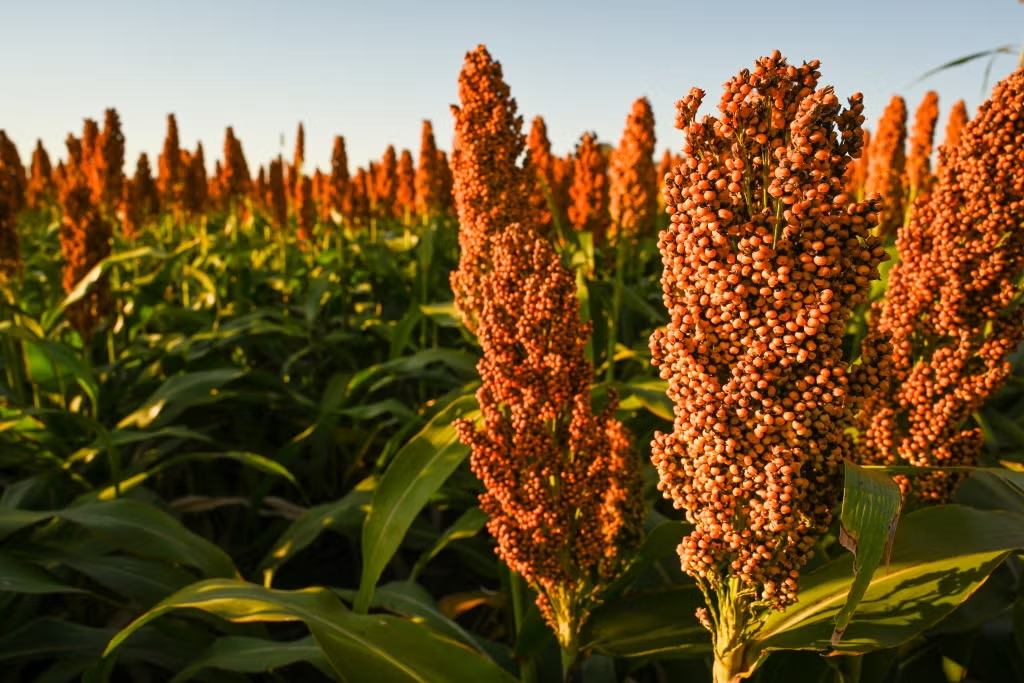
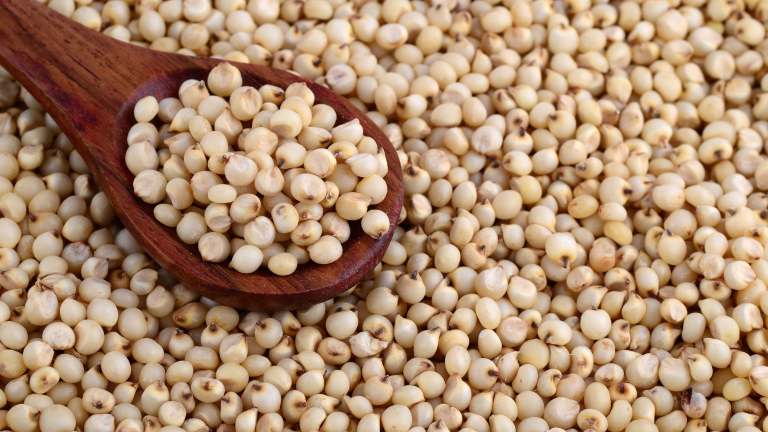
In plain terms, sorghum works well in dry weather because it is efficient. It develops a strong root system, uses water more carefully than many crops, and often keeps going when hotter conditions would slow other cereals. Oregon State Extension notes that grain sorghum is commonly grown in areas that are simply too hot and dry for corn, which says a lot about where this crop fits best.
Where sorghum fits best
Sorghum is a strong choice for dry gardens, rainfed plots, and farms in hot summer climates. It is especially useful in places where corn often struggles because rainfall is inconsistent or summer heat arrives early. It can serve as a grain crop, a forage crop, or even part of a broader resilience strategy in areas with water limits. USDA also lists sorghum as a drought tolerant summer annual used in dry conditions and warm season cover systems.
How to grow sorghum more successfully with limited water
The first priority is establishment. These tools can help improve early growth and soil conditions:
Sorghum is a warm season crop, so it should be planted when soil temperatures are warm enough for fast emergence. Slow emergence in cool soil can weaken the stand before the season really begins. Kansas State guidance emphasizes warm, moist soil and strong seed to soil contact for rapid germination.
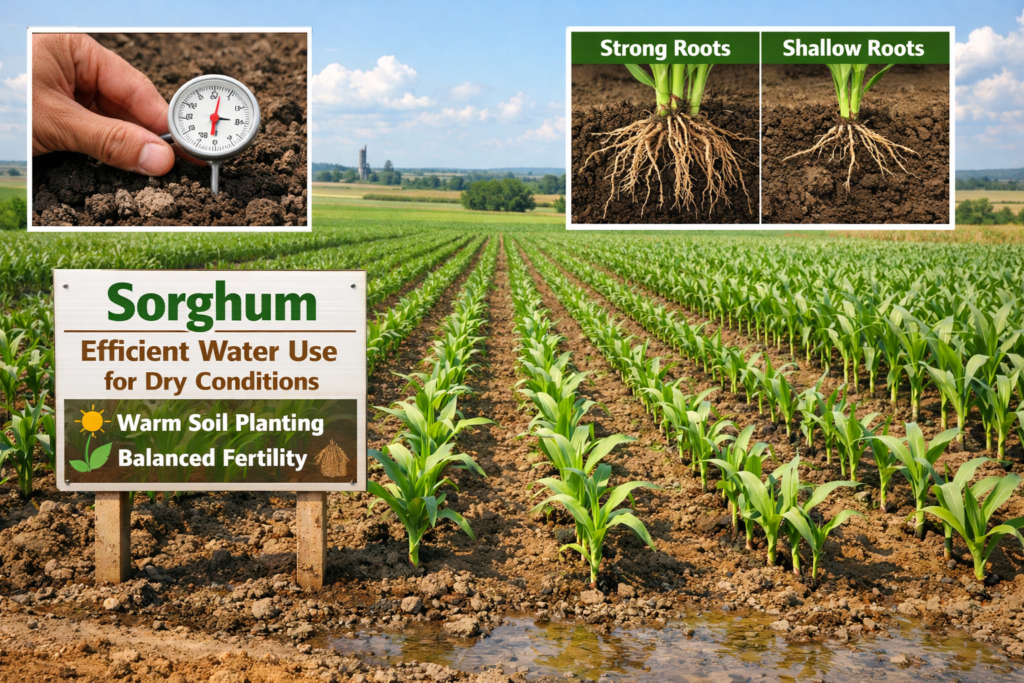
It also helps to avoid pushing too much lush top growth early in the season. Heavy fertilization can create a leafier plant that demands more water later. In dry conditions, steady balanced growth is usually better than soft rapid growth. The goal is to help the plant build roots before peak heat arrives. This is one reason sorghum often performs best when growers match fertility and planting time to local rainfall patterns rather than trying to force maximum top growth. That pattern is consistent with dryland extension guidance and with ICRISAT’s focus on sorghum as a crop for water limited systems.
Variety choice matters
Not all sorghum performs the same way. Maturity length matters, and so does local adaptation. In lower rainfall areas, an earlier maturing type may finish more reliably. In areas with a slightly longer moisture window, a medium maturity type may offer better yield. Oregon State Extension notes that genetic improvements and early maturing varieties have expanded where sorghum can be grown successfully.
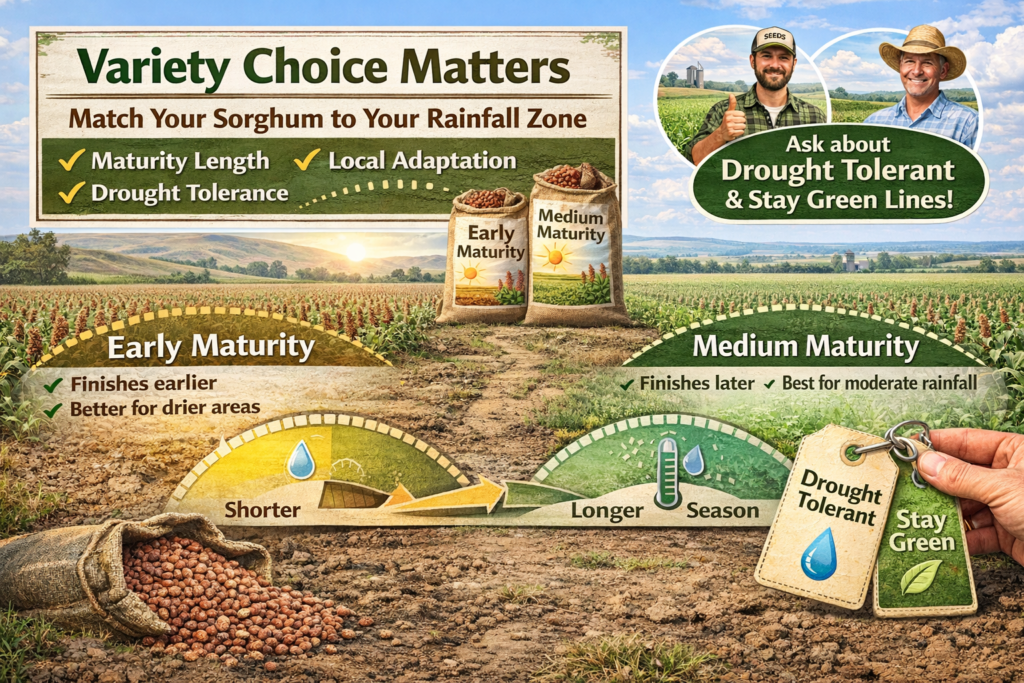
If you are buying seed, ask local suppliers or extension advisers about drought tolerant or stay green sorghum lines suited to your rainfall zone. The best variety is usually the one matched to your season length, soil type, and expected moisture, not just the one with the highest yield potential on paper.
References
- USDA Plants Database. Sorghum is used as a drought tolerant summer annual cover crop.s.
- ICRISAT. Sorghum overview. Sorghum thrives in semi arid and tropical climates with limited water, high temperatures, and poor soils.
- FAO. Sorghum crop information. Sorghum is relatively more drought resistant than many crops because of its root system, stomatal control, and recovery after water stress.
- Oregon State University Extension. Dryland cropping systems: Grain sorghum. Grain sorghum is cultivated in areas that are too hot and dry for corn, and early maturing varieties have expanded adaptation.
- Kansas State University. Grain Sorghum Production Handbook. Grain sorghum needs warm, moist soil and good seed to soil contact for rapid germination.
2. Pearl Millet
Why pearl millet deserves a place in dry growing systems
Pearl millet, often known as bajra, is one of the most dependable crops for low rainfall areas. It has earned that reputation over time in places where heat is intense, soils are often poor, and rain can be irregular. ICRISAT describes pearl millet as a hardy, drought tolerant crop that performs well in arid and semi arid regions and can handle prolonged water scarcity and erratic rainfall. Research reviews also describe pearl millet as one of the most drought tolerant cereals, especially in regions where annual rainfall is low and unreliable.
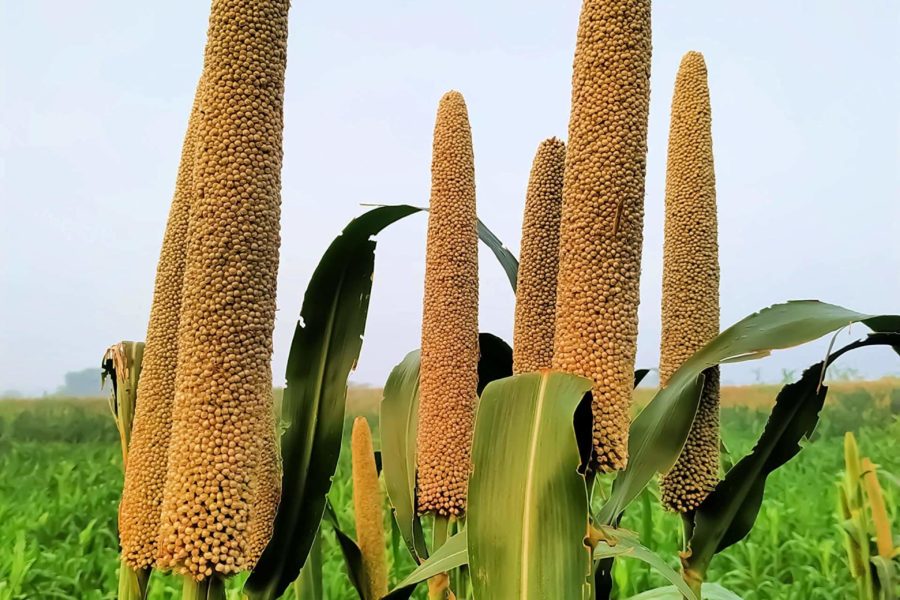
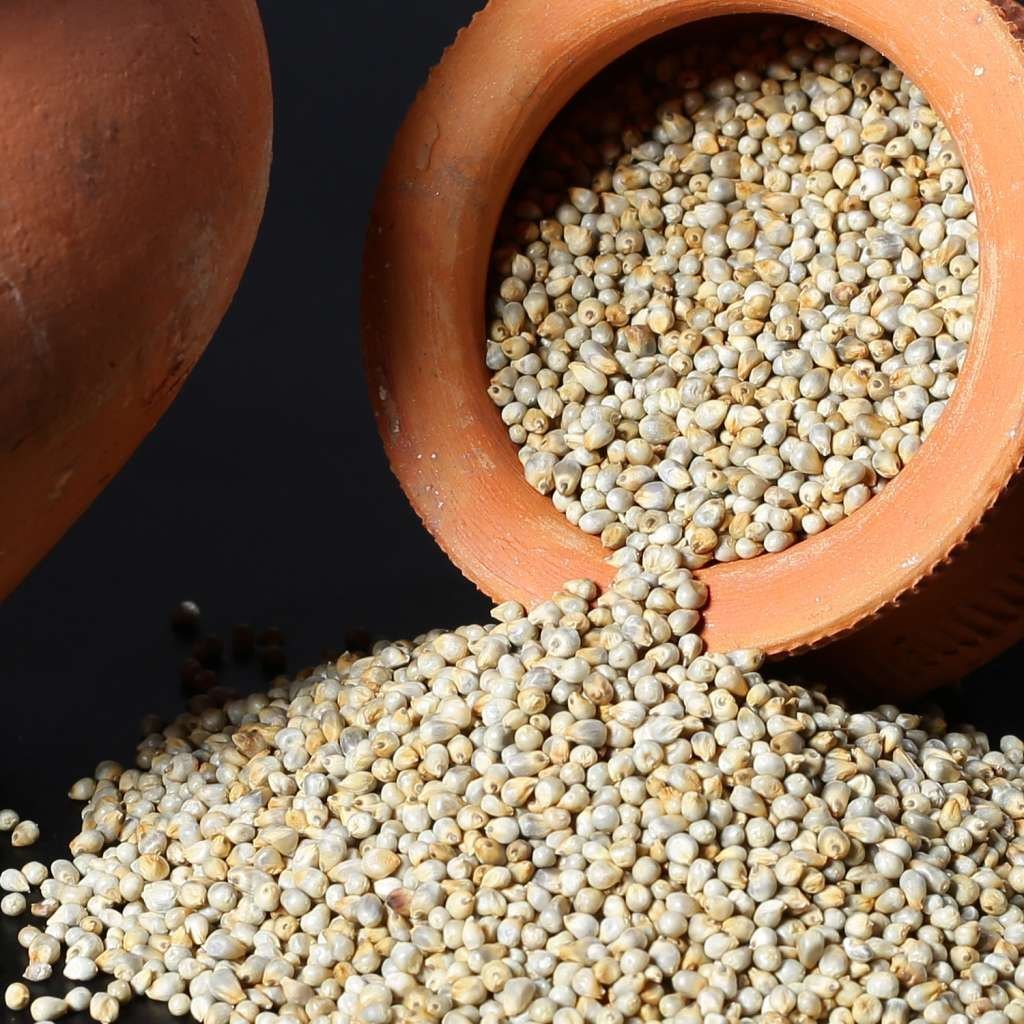
What makes pearl millet so useful is not only survival, but usefulness. It can serve as a grain crop, a fodder crop, and in many regions a food security crop. That matters for growers who need something reliable rather than something that only performs in a perfect season. USDA and extension sources also note that pearl millet performs well in moisture limited conditions and is among the more drought resistant summer grain options.
Where pearl millet fits best
Pearl millet is a strong option for hot summer climates where rainfall is uncertain and irrigation is limited. It is especially well suited to dryland systems, lighter soils, and areas where other grains may struggle. One useful advantage is its flexibility. It can be grown for grain where food use matters, or for fodder where livestock support is just as important. That dual purpose makes it a practical choice for small farms and homesteads trying to get more value from one planting.
How to grow pearl millet smart in dry weather
The first job is establishment. Like almost every drought smart crop, pearl millet still needs enough moisture to germinate and root properly. Once it is established, it is much better able to cope with dry spells than many other summer grains. That is why early moisture matters so much. Good stand establishment often decides whether the crop merely survives or produces well.

Pearl millet generally performs best where summers are warm and the crop can get off to a quick start. In a dry year, it helps to conserve soil moisture before planting and avoid unnecessary disturbance that dries the seedbed. After establishment, many growers let the crop run mostly on rainfall unless stress becomes severe. This crop is often chosen not because it needs no water, but because it makes better use of limited water than thirstier alternatives.
Kitchen value and everyday use
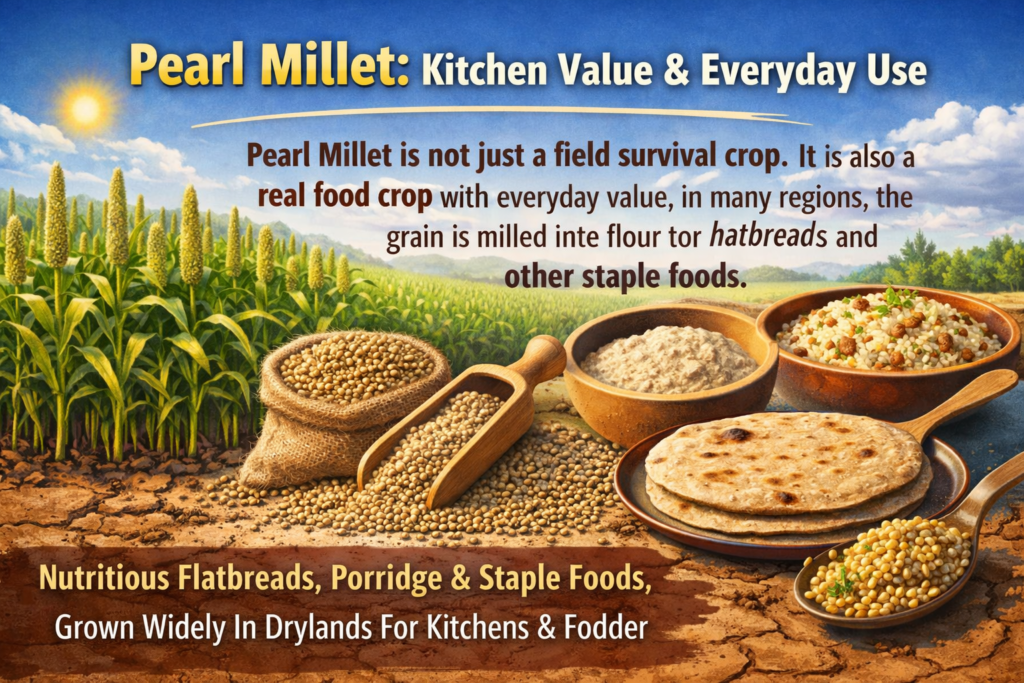
Pearl millet is not just a field survival crop. It is also a real food crop with everyday value. In many regions, the grain is milled into flour for flatbreads and other staple foods, and it can also be cooked whole. That makes it especially attractive for growers who want resilience in the field and usefulness in the kitchen. Its importance in food and fodder systems across arid and semi arid regions is one reason it remains so widely grown.
References
- Crops that Feed the World 11. Pearl Millet. Notes its value for grain, fodder, and adaptation to arid and semi arid regions.
- ICRISAT, Pearl Millet Overview. Pearl millet is described as a hardy, drought tolerant crop for arid and semi arid regions.
- Frontiers in Plant Science, Pearl millet response to drought: A review. Pearl millet is described as one of the most drought tolerant cereals grown in low and intermittent rainfall regions.
- USDA ARS, Pearl Millet for Grain. Pearl millet is described as one of the most drought resistant grains in commercial production.
- UF IFAS, Pearl Millet Overview and Management. Pearl millet is described as probably the most drought resistant of the summer grain crops.
3. Finger Millet
Why finger millet stands out in dry regions
Finger millet, often called ragi, is one of those crops that earns trust slowly and keeps it for a long time. It performs well in low input farming systems, handles dry conditions better than many common cereals, and brings another advantage that growers often overlook until a hard year arrives. It stores exceptionally well. ICRISAT highlights finger millet’s fit in low input farming systems and notes that its grains are free from storage seed pests, which makes it an important risk management crop in drought prone regions of Eastern Africa and South Asia. That storage strength matters because food security is not only about what you harvest. It is also about what you can safely keep.
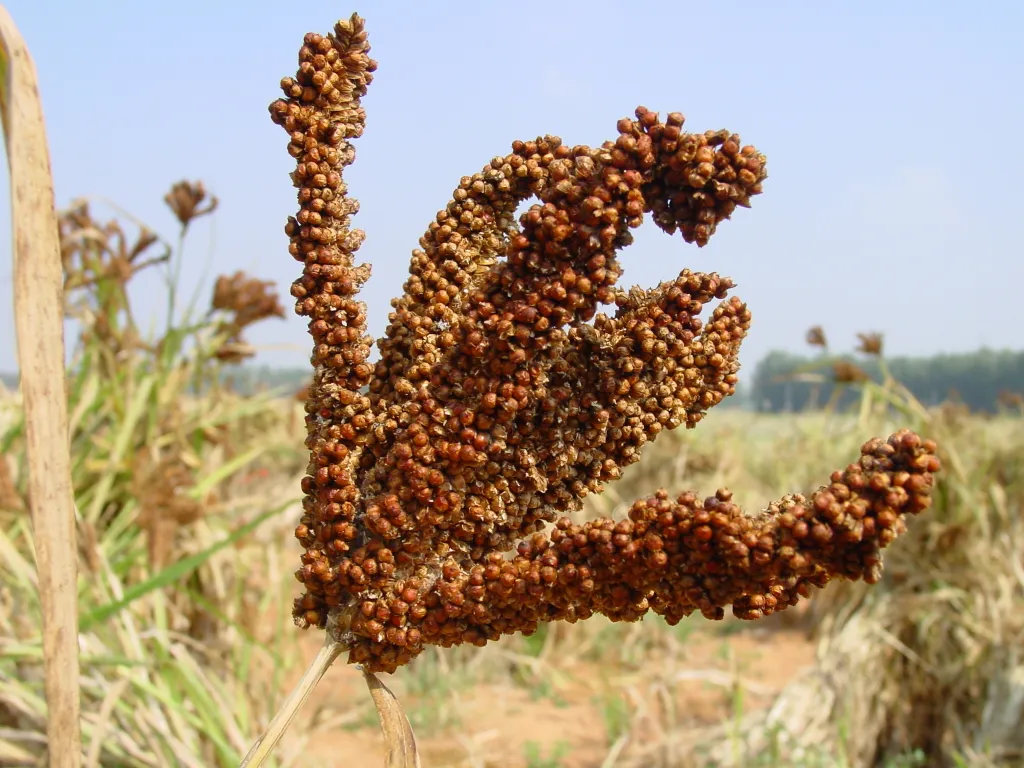
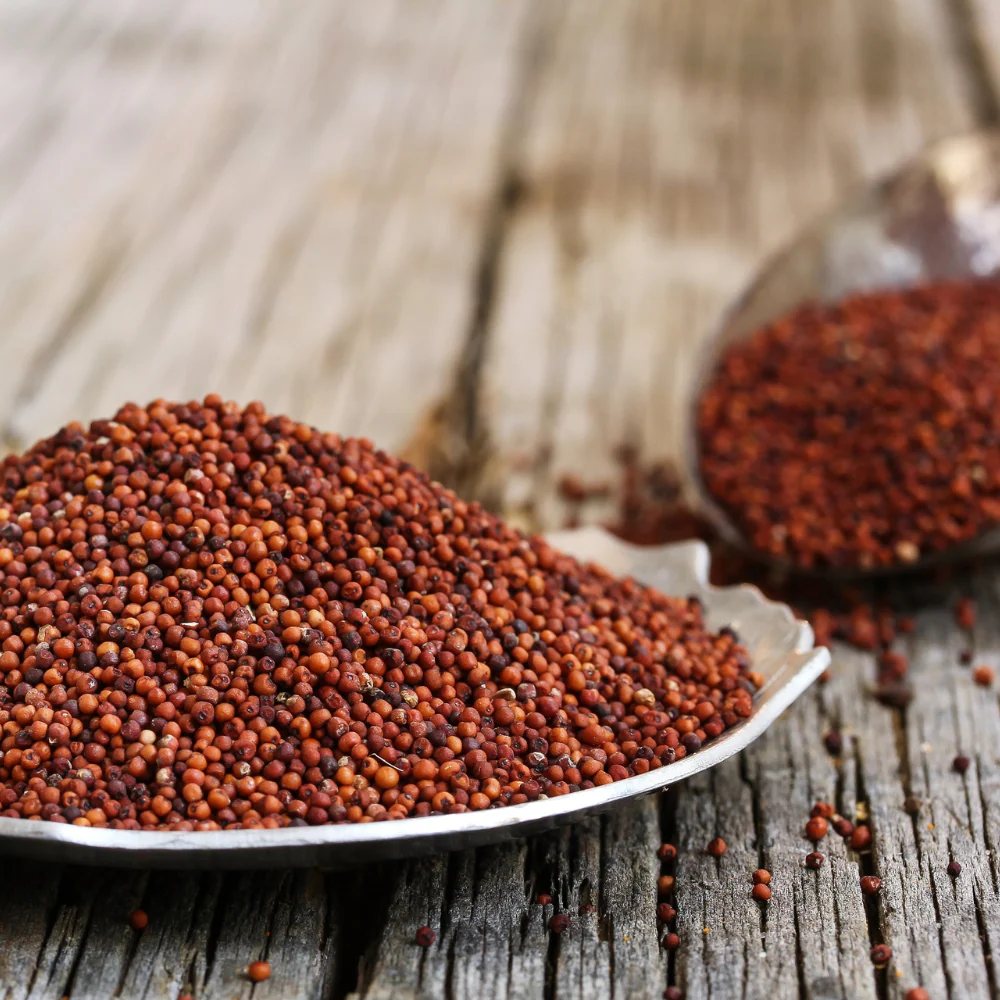
This is one reason finger millet remains important in semi arid farming communities. In a season with poor rain, a crop that yields modestly but stores safely can be more valuable than a crop that performs better in the field but is harder to keep. Crop Trust also describes finger millet as drought tolerant, adapted to low fertility soils, and resistant to a wide range of pests and diseases, including in storage.
Where finger millet fits best
Finger millet is especially useful in semi arid areas, on smaller farms, and in places where growers need a dependable staple rather than a high input crop. It is well suited to systems where fertilizer use is low, rainfall is uncertain, and storage losses can make a bad season even worse. ICRISAT describes it as particularly well suited for harsh agro climatic conditions and emphasizes its role in supporting food security for millions of people.
For growers, the appeal is practical. Finger millet is not just a field crop. It is a food reserve crop. That makes it a smart option for homesteads and smallholders who want resilience in the field and stability after harvest.
How to grow finger millet well in dry weather
Finger millet rewards patience early in the season. A fine seedbed helps because the seed is small and benefits from good seed to soil contact. Early weed control also matters. Young seedlings compete poorly if weeds get ahead, especially when soil moisture is limited. Once the crop establishes a good root system, it becomes much tougher and better able to handle dry spells than many other cereals. Reviews of finger millet describe it as a climate resilient crop with strong drought adaptation in arid and semi arid conditions.

The most important stage is establishment. Give the crop enough moisture to germinate evenly and root well. After that, it often performs steadily with limited water. This is why growers in drier regions often treat finger millet as a reliable, slow and steady crop rather than a fast, high response crop. It may not look dramatic in the field, but its consistency is exactly what makes it valuable.
Why storage matters as much as drought tolerance
One of the smartest things about finger millet is that its value does not end at harvest. ICRISAT specifically notes its exceptional storage capability and explains that this helps protect food supplies during environmental stress.
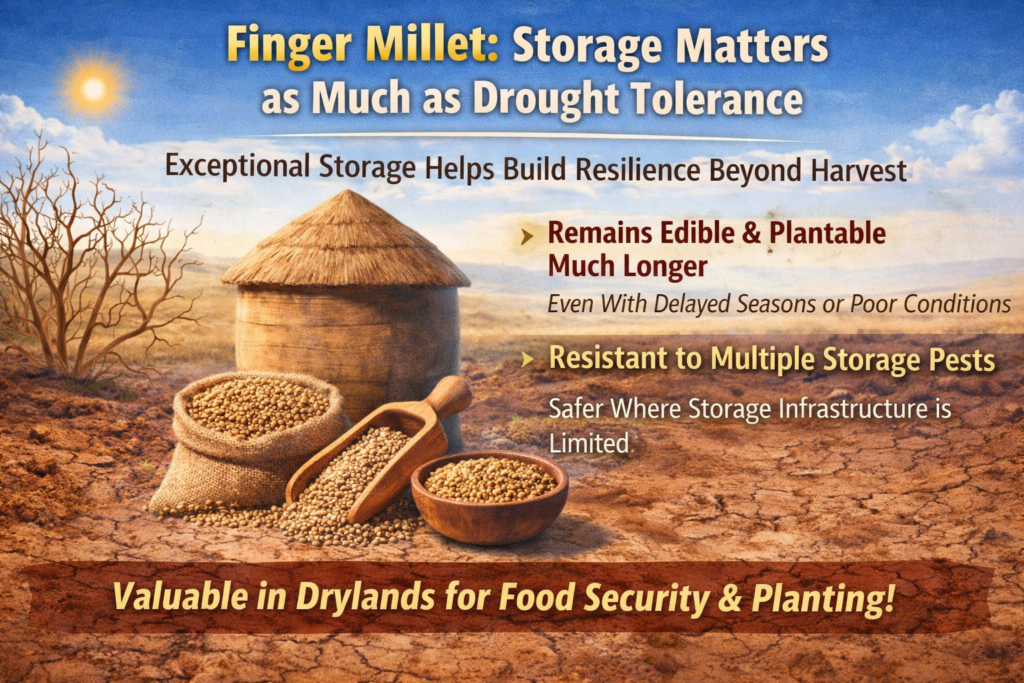
That point deserves attention. In uncertain climates, resilience is not only about surviving drought during the growing season. It is also about having grain that remains safe to eat or plant when the next season is delayed or difficult. Finger millet’s storage quality gives it an edge that many other cereals do not have, especially in places where storage infrastructure is limited. Crop Trust echoes this practical advantage by noting resistance to storage pests.
References
- Crop and Pasture Science review on finger millet. Describes finger millet as a climate resilient cereal with strong drought tolerance mechanisms in arid and semi arid regions.
- ICRISAT, Finger Millet Overview. Notes finger millet’s role in low input farming systems and highlights its exceptional storage capability and freedom from storage seed pests.
- Crop Trust, Finger Millet. Describes finger millet as drought tolerant, adapted to low fertility soils, and resistant to pests and diseases including in storage.
4. Cowpea
Why cowpea is a smart crop for dry regions
Cowpea, widely known as black eyed pea, is one of the most useful legumes for hot and dry growing conditions. It is valued not only because it handles drought better than many crops, but also because it provides food, fodder, and soil benefits in one planting. IITA describes cowpea as an important crop in many developing regions because of its high protein content, adaptability to different soils and intercropping systems, drought resistance, and ability to improve soil fertility and reduce erosion.
Cowpea also has a strong place in dryland farming systems across Africa. A recent JIRCAS press release on joint work with IITA describes cowpea as a key crop in the West African dry savanna and highlights ongoing breeding work focused on drought resistance, including the identification of lines with tolerance to drought and excess moisture. That tells you two things at once. First, cowpea already matters in harsh climates. Second, researchers still see room to improve its resilience further.
Where cowpea fits best
Cowpea fits especially well in places with hot summers, uncertain rainfall, and limited irrigation. It can be grown for dry grain, green pods, tender leaves, or animal feed, depending on local food habits and farming goals. That flexibility is one of its biggest strengths. A crop that can feed people, support livestock, and enrich the soil earns its place quickly in low input systems. FAO also notes that cowpea supports soil fertility through nitrogen fixation, which makes it useful beyond the harvest itself.
How to grow cowpea well in dry weather
The first job is establishment. Like most drought smart crops, cowpea still needs enough moisture early in the season to germinate evenly and build roots. Once it is established, it usually handles dry spells better than many more demanding crops. Early weed control is especially important. Weeds compete for the same limited soil moisture, and that competition can reduce growth before the crop has a chance to settle in.

Nitrogen should be used carefully. Cowpea is a legume, so it can fix its own nitrogen through symbiosis with rhizobia. Too much added nitrogen can push unnecessary vegetative growth and reduce the practical benefit of growing a nitrogen fixing crop in the first place. In dry conditions, balanced fertility and clean early growth are usually better than forcing lush foliage. IITA’s crop overview supports this practical value by emphasizing cowpea’s adaptability and role in sustainable systems.
Variety choice makes a difference
Not all cowpeas grow the same way, and this matters more than many growers expect. Some varieties stay compact and bushy, while others vine more aggressively. Some are better for dry grain harvest, while others are chosen for fresh pod use or leaf production. Matching the variety to your purpose is one of the easiest ways to get better performance with less stress.
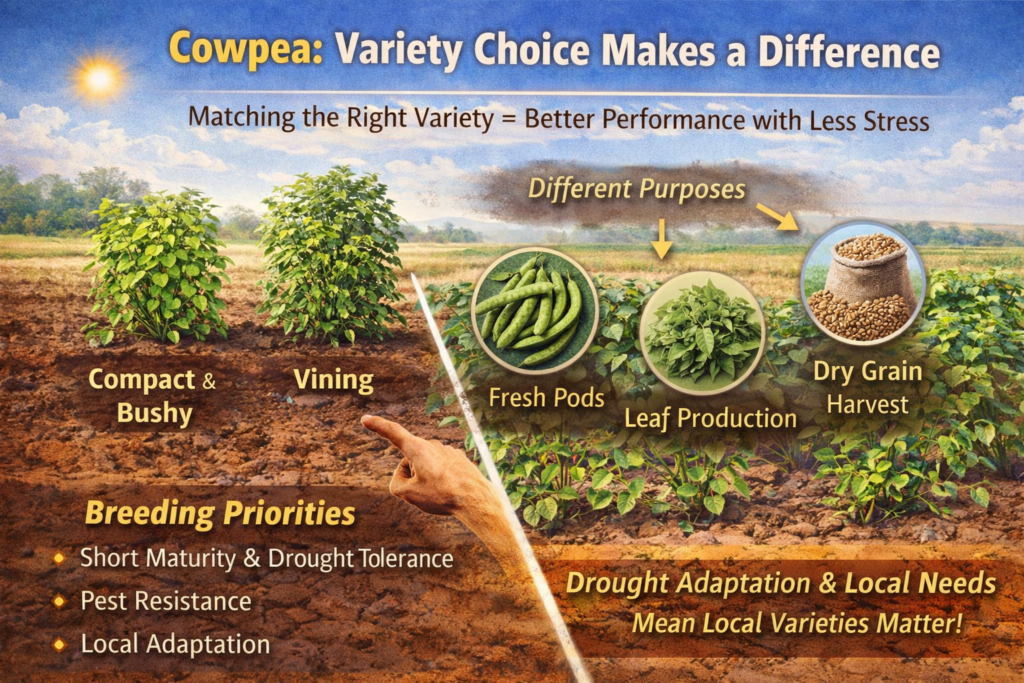
Breeding programs continue to focus on drought adaptation because cowpea, while drought tolerant overall, still shows real variation among lines. Reviews of cowpea improvement note that breeding priorities often include short maturity, drought tolerance, pest resistance, and better adaptation to local farming systems. In simple terms, local variety choice matters just as much as the crop name on the seed bag.
Why cowpea matters beyond drought
Cowpea is not only a survival crop. It is a protein rich food crop with real value for households and local markets. IITA notes that cowpea grains are rich in protein, and conference coverage from the 7th World Cowpea Research Conference states that protein can make up about 25 percent of dry grain weight. That makes cowpea especially important in regions where diets rely heavily on starch based staples.
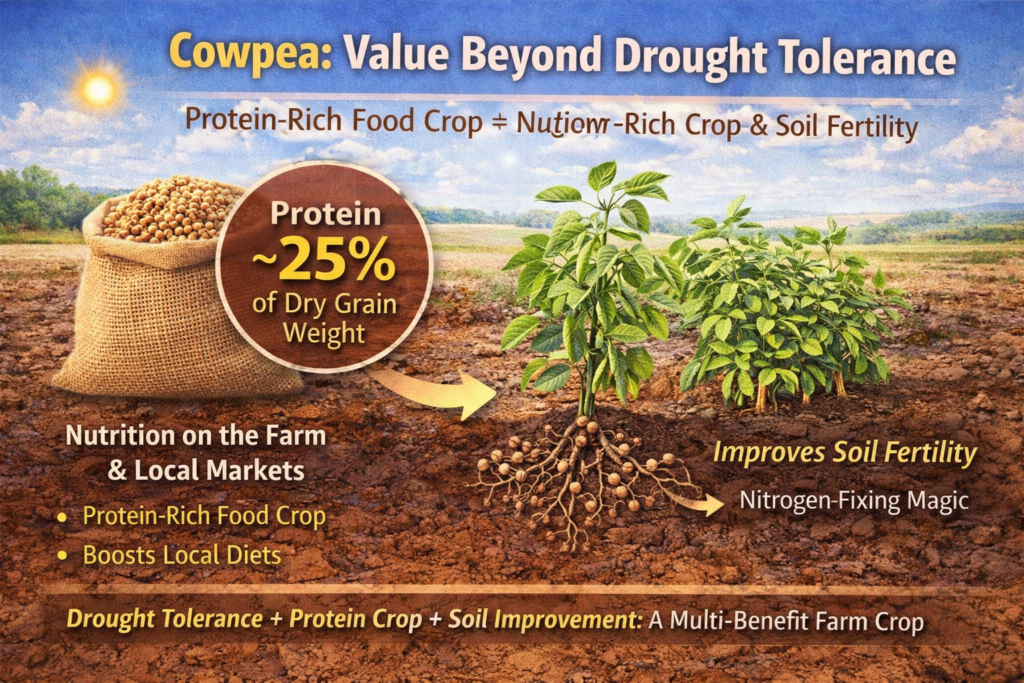
This combination of drought tolerance, food value, and soil improvement is what makes cowpea stand out. It is one of those crops that helps a farm in more than one way.
References
- IITA World Cowpea Research Conference coverage. Cowpea grains are highlighted as an important protein source in African diets.
- JIRCAS press release. Cowpea is described as a key crop in the West African dry savanna, with breeding work focused on drought resistance and tolerant lines.
- IITA cowpea overview. Cowpea is noted for high protein content, drought resistance, adaptability, and soil fertility benefits.
- FAO agroecology database. Cowpea contributes to soil fertility through nitrogen fixation and supports sustainable farming.
- Review on cowpea improvement. Breeding priorities include short maturity, drought tolerance, and adaptation to stress.
5. Pigeonpea for dry weather growing
Pigeonpea, also known as toor or arhar, is one of the most dependable pulse crops for hot and water limited regions. It is widely grown in South Asia and across parts of Africa because it can stay productive in conditions that challenge many other food crops. Research and breeding work at ICRISAT continue to focus on traits such as drought tolerance and heat tolerance, which shows how important pigeonpea is for farming systems exposed to climate stress.
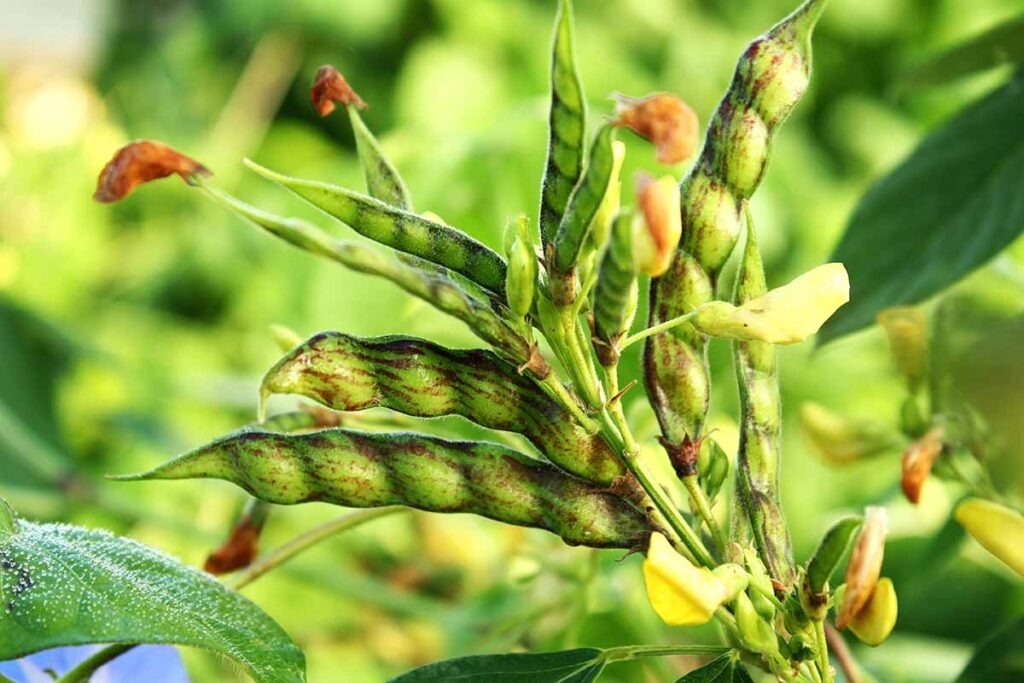

What makes pigeonpea valuable is not just survival. It is the way the crop fits real farm conditions. In areas where rainfall is uncertain, growers often need a plant that can handle dry spells, stand through heat, and still deliver grain, fodder, or both. Pigeonpea has earned that reputation over time, which is why it remains a practical choice in rainfed agriculture.
Why pigeonpea suits drought prone areas
Pigeonpea has a growth habit that helps it cope with difficult seasons. It is commonly used in mixed and diversified farming, and in many places farmers plant it with cereals or other companion crops instead of growing it alone. This approach spreads risk and makes better use of land, soil moisture, and seasonal rainfall. ICRISAT highlights pigeonpea as an important crop for harsh environments and breeding programs continue to improve resilience traits for these settings.
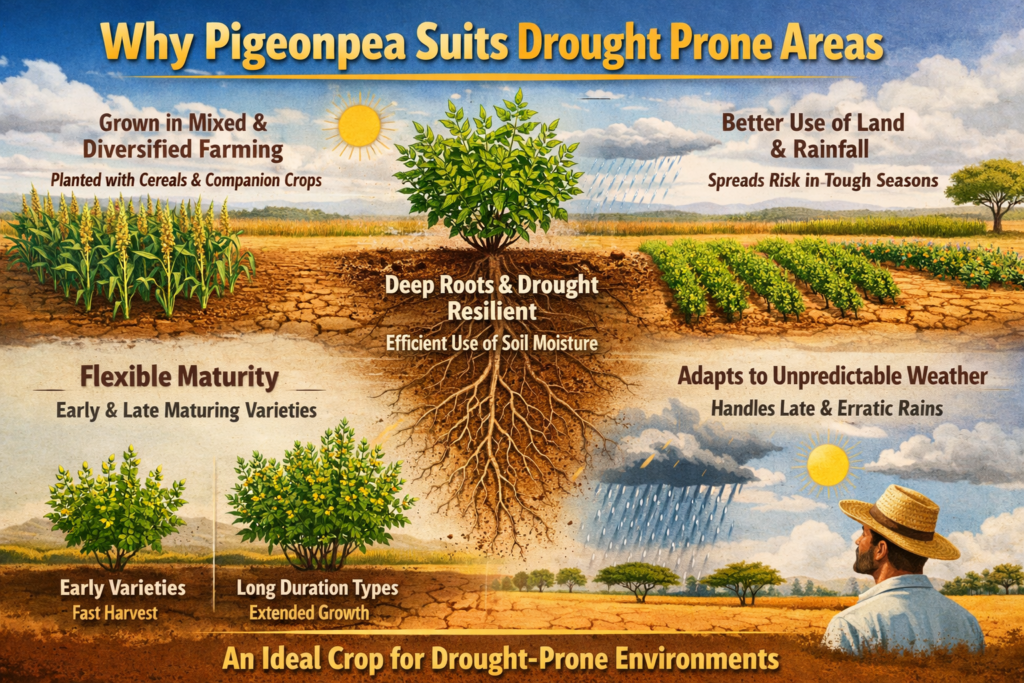
Another strength is flexibility in maturity. Some pigeonpea types take longer to mature, while earlier lines can reduce the risk of late season drought. That matters in places where rains start late, stop early, or behave unpredictably. Choosing the right maturity group is often one of the most important decisions a grower can make.
How to grow pigeonpea well in dry conditions
Pigeonpea usually performs best when it is matched carefully to local rainfall and season length. In lower rainfall zones, early maturing varieties are often the safer option because they reduce exposure to terminal drought. In regions with a longer rainy season, medium duration or long duration types may perform well if the crop has enough time to establish and fill pods properly.

It also tends to do well in diversified fields. Intercropping is common for a reason. It helps farmers spread climate risk and often improves overall system stability. Good field planning matters more than pushing maximum plant population.
For dry weather growing, the smartest approach is usually simple. Choose a variety suited to your local season. Plant on time so roots establish before serious moisture stress begins. Keep early weed pressure low because weeds compete for the same limited water. Then let the crop use its natural resilience rather than forcing lush growth that the season may not support.
Practical takeaway
If you want a pulse crop that brings food value and dependable field performance, pigeonpea deserves serious attention. It is not a miracle crop, and it still needs the right variety, the right timing, and realistic management. But in stress prone environments, it remains one of the soundest options for growers looking for resilience without giving up usefulness. That balance is exactly why pigeonpea continues to matter in dryland farming today.
References
- IPCC AR6 WGII Food and Water fact sheet.
- ICRISAT. Pigeonpea overview.
6. Chickpea
Why chickpea belongs in a drought smart planting plan
Chickpea is one of the most practical legumes for dry growing regions. It has been cultivated for generations in places where rainfall is limited, temperatures can rise quickly, and crops often have to finish on stored soil moisture rather than regular irrigation. ICRISAT describes chickpea as well adapted to the semi arid tropics and notes its resilience under stressful conditions including heat and drought. That alone explains why it remains such an important crop in dryland farming systems.
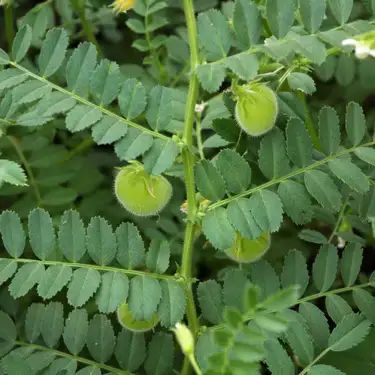
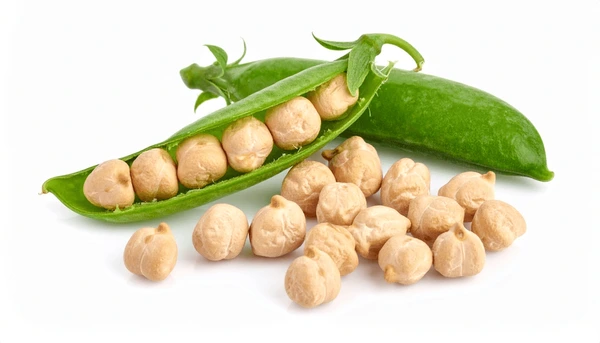
What makes chickpea especially useful is that it does not need a perfect season to justify its place. It can perform under tougher field conditions than many other legumes, and breeders continue to focus on drought and heat tolerance because these stresses are major limits to production in semi arid environments. ICRISAT notes that terminal drought is a major production constraint for chickpea, which is why strong root systems, early maturity, and stress adapted varieties matter so much.
Where chickpea fits best
Chickpea fits best in areas with a relatively dry growing period and soils that drain well. In many regions it is planted in the cooler season, often after the main rains, and grows on residual soil moisture. That pattern is one reason chickpea is so closely tied to semi arid production systems. It is often more comfortable with moderate dryness than with wet feet. ICRISAT’s chickpea materials and breeding summaries both point to drought and heat as major adaptation targets in the environments where this crop is grown.
How to grow chickpea smart in dry weather
The best chickpea crops usually start with early root development. Good establishment matters because the crop often depends on stored soil moisture later in the season. Once it is rooted, the goal is usually steady growth rather than lush top growth. Too much irrigation can create a dense canopy, delay maturity, and increase disease pressure, especially where humidity rises or rainfall arrives unexpectedly. ICRISAT notes that many chickpea systems rely on residual moisture, while research summaries describe early maturity and better soil water extraction as important drought adaptation strategies.

Chickpea also has a well known weakness that growers should respect. It is generally more sensitive to waterlogging than to moderate dryness. Guidance from New South Wales DPI advises growers to avoid poorly drained paddocks and fields prone to waterlogging, and it stresses variety choice as a major disease management tool. Separate agronomy guidance on irrigated chickpeas likewise notes that even short periods of waterlogging can hurt crop performance.
That is why drainage matters so much. In drought prone areas that sometimes get heavy rain, chickpea often succeeds or fails based on how quickly water can move away from the root zone. A well drained field, clean seed, and disease resistant variety can be more important than adding extra irrigation. If wet conditions are likely, good drainage is not just helpful. It is part of drought smart management because the crop still needs to survive the whole season, not only the dry weeks.
Practical growing chickpea
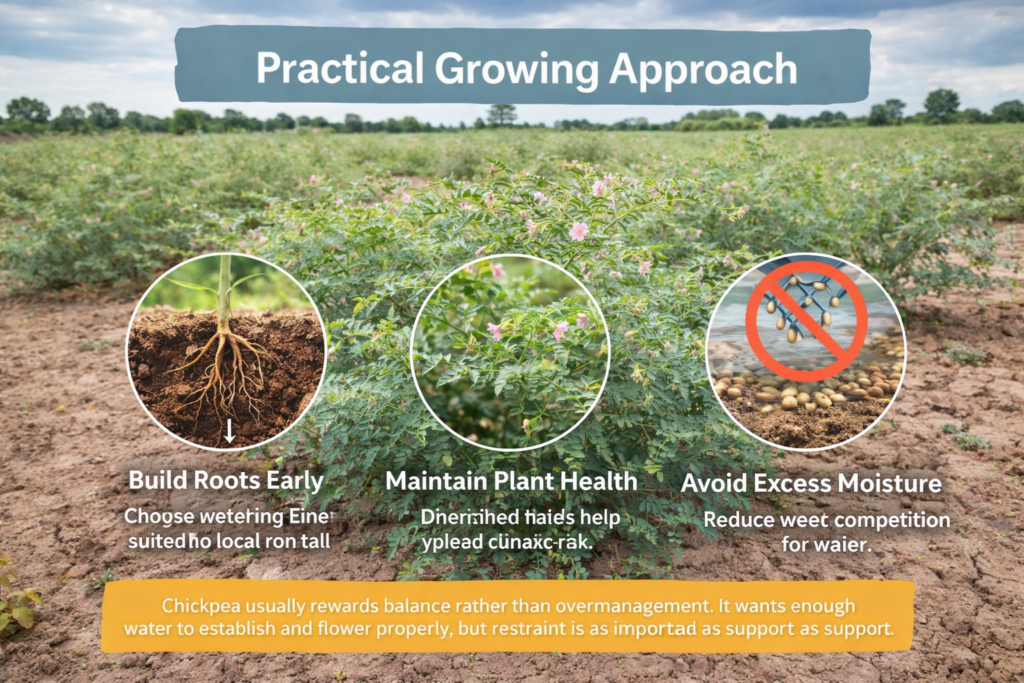
A sensible chickpea strategy is simple. Build roots early, keep the stand healthy, and avoid pushing excess moisture later in the season. This crop usually rewards balance rather than overmanagement. It wants enough water to establish and flower properly, but it does not respond well to soggy soil. In other words, chickpea is often a crop where restraint is as important as support. That is one reason it remains valuable in regions where growers cannot count on frequent irrigation but can manage timing and drainage carefully.
References
- ICRISAT, Chickpea Overview. Chickpea is described as adapted to the semi arid tropics and resilient under heat and drought.
- ICRISAT, Drought and Heat Tolerance in Chickpea. Notes that chickpea is largely grown rainfed on residual soil moisture and that terminal drought is a major production constraint.
- ICRISAT, Integrated breeding approaches for improving drought and heat tolerance in chickpea. Describes breeding focus on stress adaptation in semi arid environments.
- New South Wales DPI, Managing diseases of chickpea 2025. Advises avoiding poorly drained and waterlogged fields and emphasizes variety choice for disease management.
7. Tepary Bean – A Smart Crop for Hot and Dry Gardens
Tepary bean is one of the most practical crops for growers who face heat, low rainfall, and poor soil moisture. It is not a trendy new plant. It is an old desert crop with a long history in the American Southwest and northern Mexico. What makes it stand out today is how well it handles the kind of weather that ruins many other beans. USDA guidance notes that tepary bean is adapted to very hot and dry environments, can finish its reproductive cycle quickly to escape later drought, and develops deep roots that reach moisture common bean cannot use.
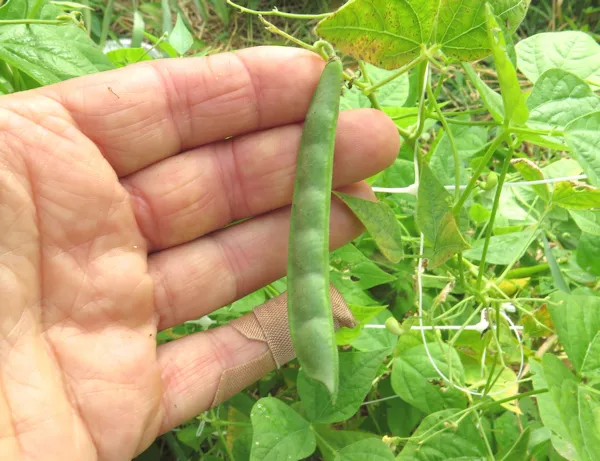
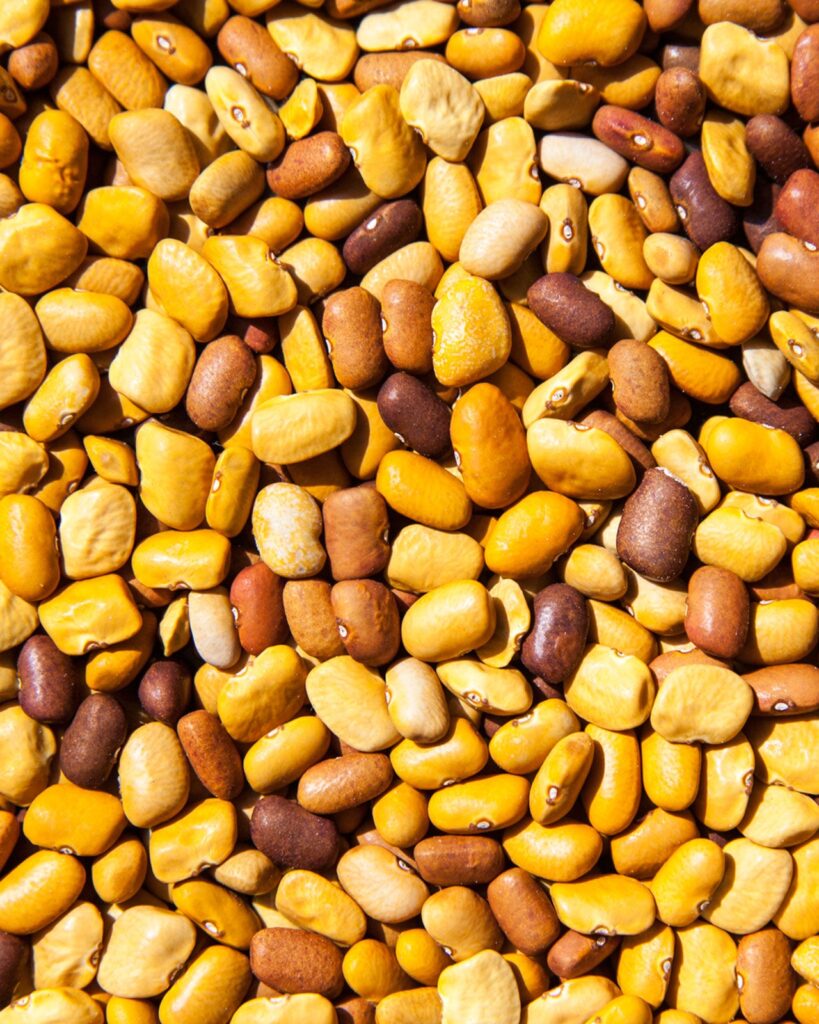
For gardeners and small farmers in dry regions, that matters. A crop that can produce in hard conditions is more than interesting. It is useful.
Why tepary bean deserves attention
Many beans struggle when temperatures stay high for long periods. Tepary bean is different. It evolved in desert conditions and is known for handling heat, drought, and even alkaline soils better than many familiar bean types. Native Seeds SEARCH describes it as a fast maturing bean that tolerates low desert heat and drought very well.
This makes tepary bean a good choice for growers who want a reliable warm season legume without heavy irrigation. It is especially appealing if you are trying to build a dryland garden or reduce water use.
How to grow tepary bean in dry weather
Start with moisture at planting time. Seeds need enough water to germinate evenly. That early moisture helps young plants establish strong roots.

After the plants are up and growing, step back. This is where many growers make mistakes. Tepary beans often perform better when they are not overwatered. In fact, some seed guides warn that too much water can lead to lush leafy growth with poor bean production.
In desert and monsoon climates, traditional planting often follows the first strong summer rains. Native Seeds SEARCH notes that tepary beans have long been dry farmed and are commonly planted after the first soaking rain of the summer monsoon season.
That traditional timing makes sense. The crop is built to take advantage of a short window of moisture, then move quickly toward flowering and seed set before harsher dry conditions return.
What to expect in the field of Tepary bean
Tepary bean is not the crop to pamper. It suits growers who can give it a good start, then let it do what it was made to do. In the right setting, it can be one of the most sensible legumes for heat stressed gardens and low water systems.

It is also a crop with real agricultural value beyond the home garden. USDA ARS has highlighted tepary bean as an underused North American crop with strong heat and drought tolerance, and researchers continue to use it in breeding work to improve resilience in common bean.
References
- Native Seeds SEARCH growing note on avoiding overwatering.
- USDA NRCS Plant Guide for tepary bean.
- USDA ARS publication summary on tepary bean adaptation to hot and dry climates.
- Native Seeds SEARCH collection page for tepary beans.
- Native Seeds SEARCH article on traditional monsoon planting of tepary beans.
8. Cassava in Dry Weather: A Practical Crop for Warm Climates
Cassava is one of the most important staple crops in many tropical and subtropical regions. Farmers value it because it can keep growing when rainfall is unreliable and temperatures stay high. That reputation is well earned, but it needs a careful explanation. Cassava is drought tolerant in the sense that it can stay alive under stress better than many crops. At the same time, drought can still reduce root yield, especially when stress is severe or arrives at the wrong stage of growth. Research reviews describe cassava as generally drought tolerant, while also noting that the plant may shed leaves during drought, which can lead to much lower yields.
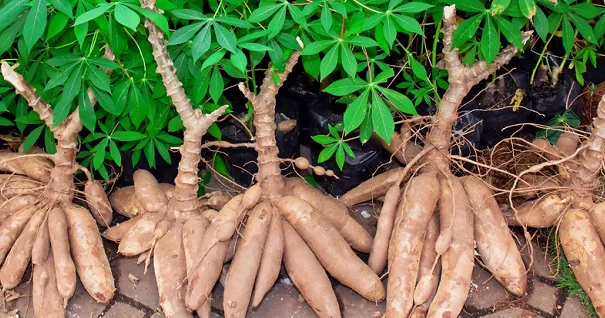
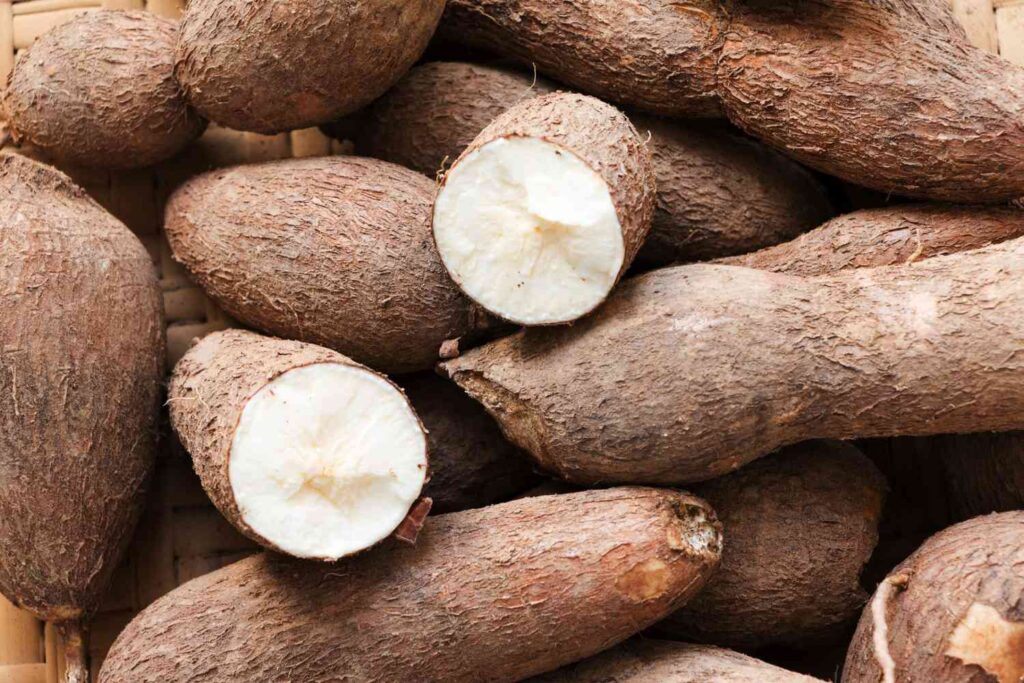
That distinction matters for anyone thinking about planting cassava in a dry area. A crop that survives is not always a crop that produces well. If your goal is dependable harvests rather than simple survival, the real focus should be on crop establishment, variety choice, and rainfall timing.
Why cassava works in water limited conditions
Cassava has several traits that help it handle dry weather. It can reduce water loss by adjusting leaf growth and leaf angle, and it may shed older leaves when moisture becomes scarce. These responses help the plant conserve resources and remain alive during stress. Researchers have described leaf shedding and canopy reduction as important drought response mechanisms in cassava.
This is one reason cassava is often considered a food security crop in regions with erratic rainfall. It is more forgiving than many other staples when the season turns difficult. Reviews of cassava physiology also note that the crop performs relatively well in marginal environments and under irregular rainfall compared with many alternatives.
How to grow cassava more wisely in dry areas
The most important stage is the beginning. Cassava needs a good start. Strong establishment helps the plant build enough canopy and root development before moisture becomes limiting. Field based reviews note that cassava generally needs about three months of rainfall or irrigation for establishment, after which its drought tolerance becomes more useful.
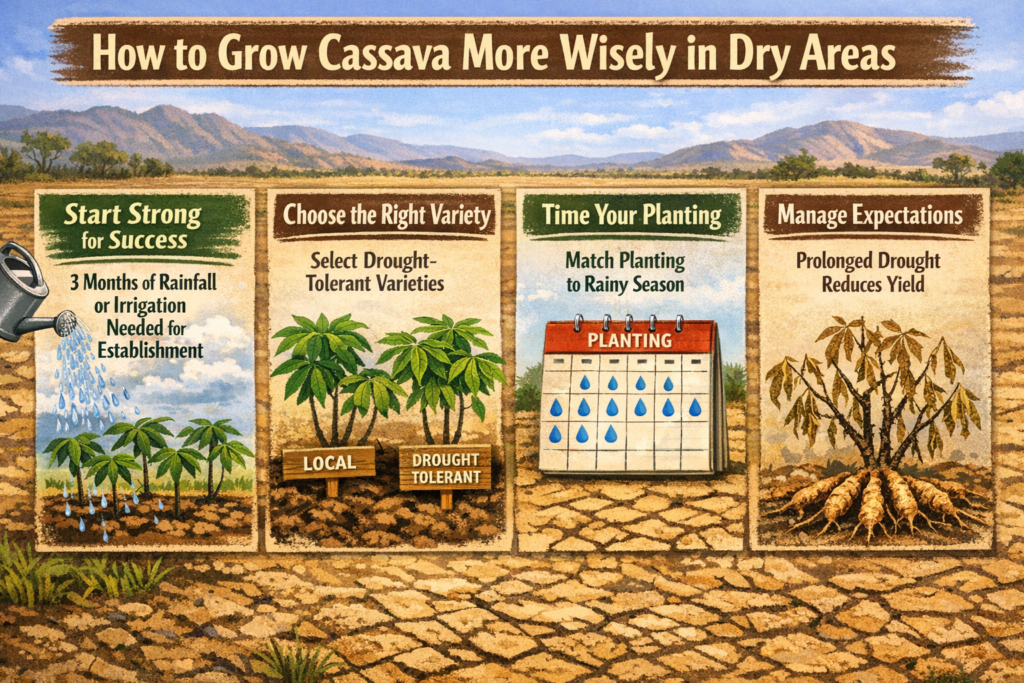
That is why variety choice and planting date matter so much. In dry regions, growers should match the crop cycle to the local rainfall pattern instead of planting whenever land is available. FAO guidance on cassava production also stresses the importance of varieties that are adapted to local conditions and production systems, especially where water is limited and external inputs are low.
Good management also means being realistic. Cassava can produce useful calories with less irrigation than many crops, but prolonged drought still threatens root size, quality, and final yield. Recent reviews make this clear: cassava is resilient, but seasonal water stress still affects productivity.
Is cassava the right crop for you
Cassava makes the most sense in warm regions with a long frost free season. It is especially useful where growers need a hardy staple that can handle uneven rainfall. But it is not a universal answer. Local food habits, processing knowledge, and regulations should be part of the decision. Cassava is a strong option when it fits both the climate and the community.

In simple terms, cassava is a crop worth considering if you want dependable survival in dry weather and reasonable production with modest water. Just remember the key lesson: drought tolerance helps the plant endure stress, but smart management is what turns endurance into harvest.
References
- Recent review on cassava productivity under water stress.
- ScienceDirect review on cassava drought tolerance and leaf shedding.
- Frontiers review on phenotypic approaches to drought in cassava, including establishment needs and rainfall timing.
- FAO Save and Grow cassava guide.
- CGIAR resource on canopy reduction and leaf shedding under prolonged drought.
9. Sunflower
Sunflower has a strong reputation as a crop that can handle dry conditions, and that reputation is supported by extension research. South Dakota State University Extension explains that sunflower is a deep rooted crop that can pull water from deeper parts of the soil profile. The same source also notes that sunflower has good drought tolerance because of its well developed roots and its ability to withstand temporary wilting. Even so, moisture stress can still cut yields, especially during bud initiation, flowering, and seed filling.

That is the key point many growers miss. Sunflower is resilient, but resilience does not mean immunity. A crop can stay alive in a dry season and still fall short at harvest.
Why sunflower performs better than many crops in dry fields
Sunflower is built to search for water. Its root system can move deeper into the profile than many shallow rooted crops, which gives it an advantage when the topsoil dries out. That is one reason it remains a dependable option in dryland production systems. SDSU Extension specifically describes sunflower as a deep rooted crop that can extract water from deeper soil layers under dryland conditions.
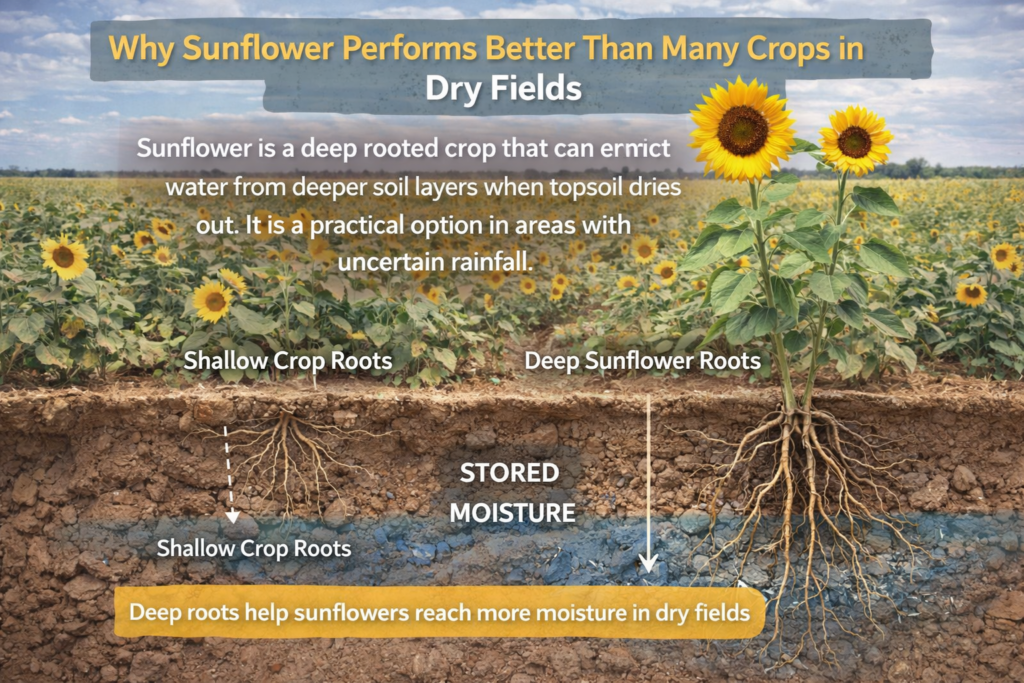
This makes sunflower a practical choice for growers who farm in areas with uncertain rainfall. If there is stored moisture deeper in the soil, sunflower has a better chance of using it than many other summer crops.
How to grow sunflower more wisely in dry weather
The smartest way to think about sunflower is this: it is not just a drought tolerant crop, it is a deep soil water user. If you want the crop to handle dry weather well, you need to protect and store moisture before the season gets tough.

That is why mulch, crop residue, and rotations that reduce water loss can make a real difference. These practices help keep moisture in the soil profile, which gives sunflower something to draw on later. This is especially important because the most sensitive stages are not early vegetative growth alone, but the reproductive stages. According to SDSU Extension, bud initiation, flowering, and seed filling are the periods when moisture stress is most damaging.
In simple terms, if your soil profile starts the season dry and stays exposed, sunflower may survive but it may not reward you with strong seed set or full heads.
Why small growers should pay attention
Sunflower is useful beyond grain farming. For small growers, it can serve more than one purpose in the same field or garden. Depending on the variety, it may be grown for seed, oil production, or cut flowers. It also has value for pollinators. SDSU Extension notes that sunflower attracts bees and other native pollinators, which adds ecological value for diversified growers.
That gives sunflower an edge for homesteads, market gardens, and small farms that want one crop to do several jobs at once.
References
- South Dakota State University Extension, Bees and Other Pollinators Visiting Sunflower.
- South Dakota State University Extension, Chapter 6: Water Management in Sunflower.
- South Dakota State University Extension, Sunflower Production.
10. Safflower – A Deep Rooted Crop That Handles Dry Conditions Well
Safflower deserves more attention from growers who farm in low rainfall areas. It is one of the strongest oilseed options for dryland production because it is built to search for water deep in the soil. North Dakota State University Extension notes that safflower has a taproot that can reach 8 to 10 feet in deep soils, and that this deep root system makes it more drought tolerant than small grains and many other oilseed crops.
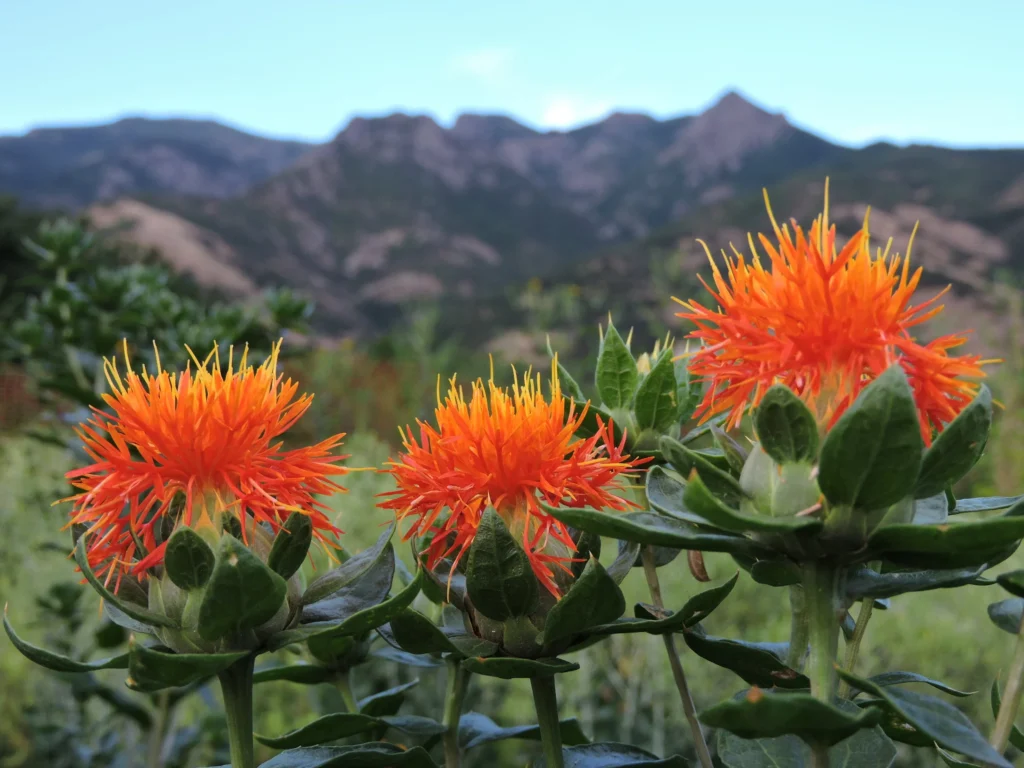
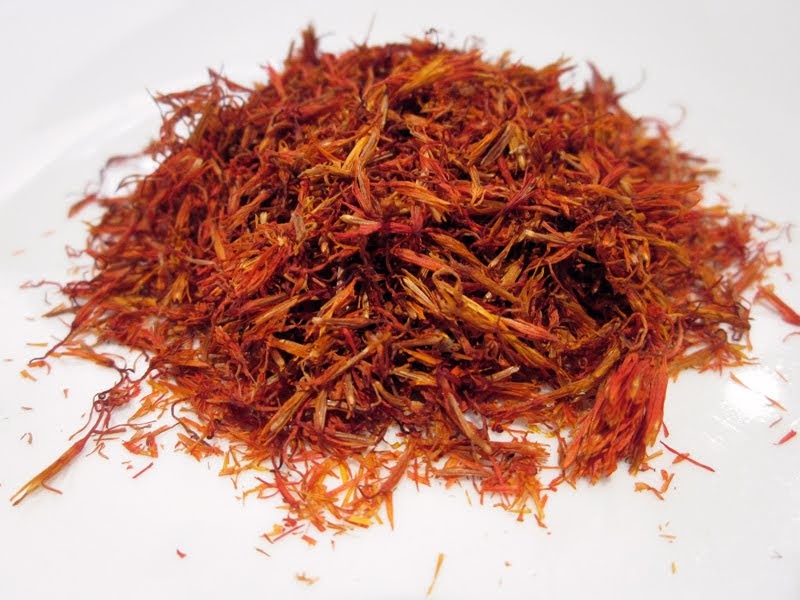
That deep rooting habit is the main reason safflower performs so well in tough conditions. It is not simply a crop that survives dry weather by slowing down. It actively explores deeper layers of the soil profile where moisture may still be available after the surface has dried out. For growers with deep soils and limited rainfall, that is a valuable trait. University and extension sources consistently describe safflower as a strong fit for dryland systems for exactly this reason.
Still, drought tolerance does not mean careless management. Safflower needs a solid start. Early establishment matters because young plants are not especially aggressive competitors. NDSU Extension describes an early rosette stage while the plant develops leaves and its taproot, and research literature notes that safflower seedlings grow slowly for several weeks after emergence, which makes early weed control essential.
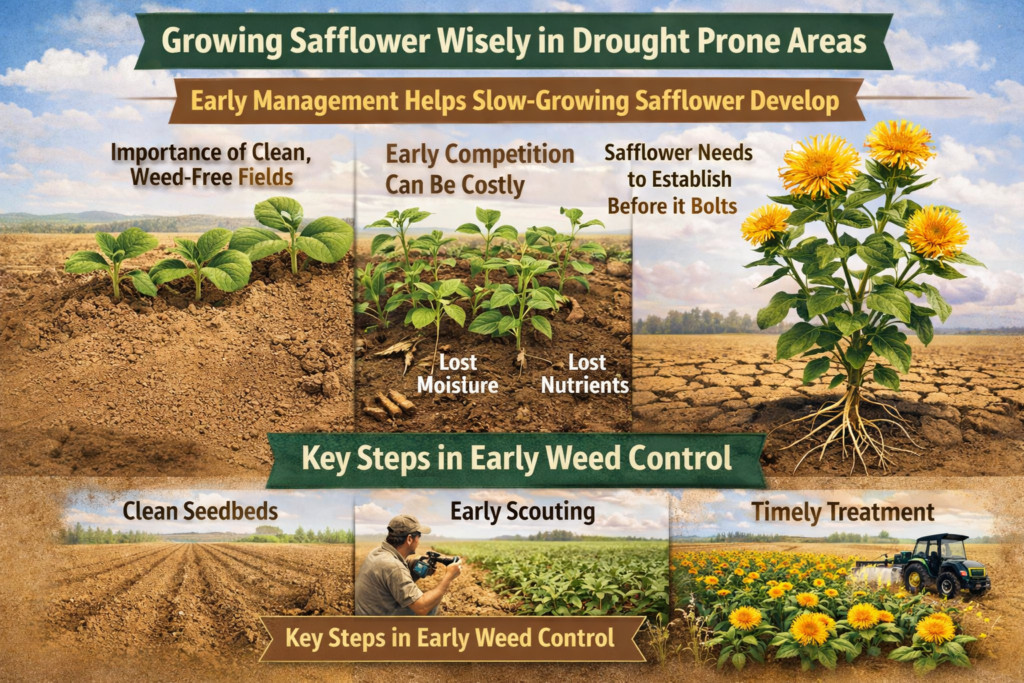
That is why safflower is often best suited to growers who can keep fields clean during the early part of the season. If weeds get ahead of the crop, they can rob moisture, light, and nutrients before safflower has fully established. Studies on safflower weed management repeatedly point out that slow early growth is one of the crop’s main production challenges. In practical terms, that means clean seedbeds, early scouting, and timely control matter more than many people expect.
Safflower makes the most sense where rainfall is uncertain but soils are deep enough to store moisture below the surface. In shallow soils, its biggest advantage is limited. In deeper profiles, however, safflower can act like a crop that hunts for water long after many others begin to struggle. That is why it remains such a strong candidate for dryland growers looking for an oilseed that can perform where frequent rain is not guaranteed.
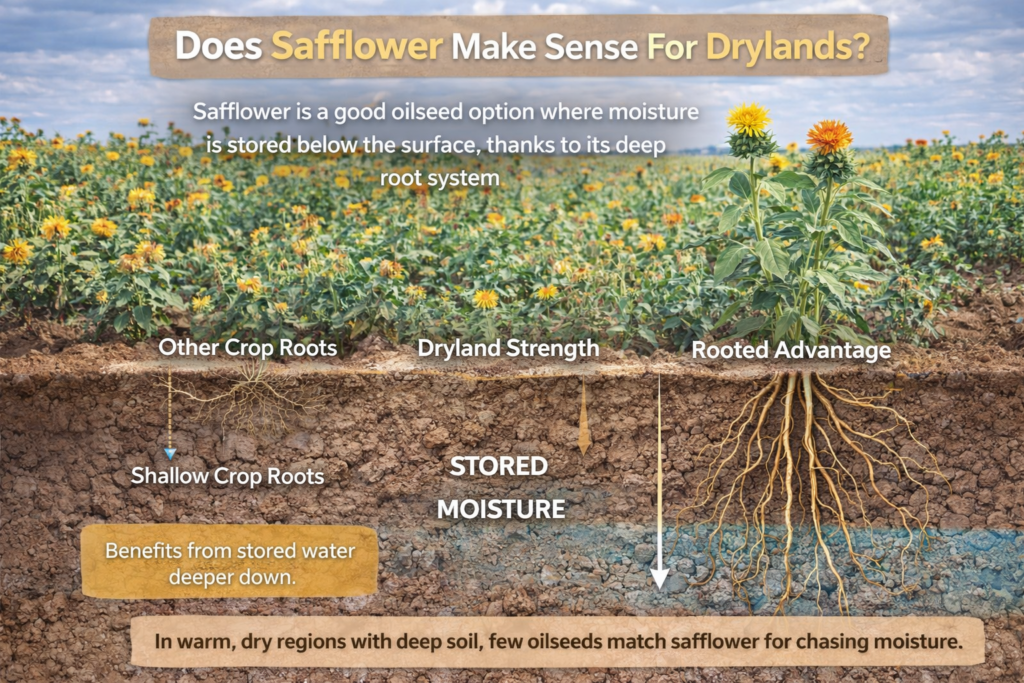
For practical farm planning, the takeaway is simple. Safflower is a smart choice in warm, dry regions when you have deep soil, a decent early start, and a weed control plan. It is not the fastest crop out of the ground, but once established, its rooting depth gives it a clear advantage. If your goal is to grow a crop that can chase moisture rather than wait for it, safflower is one of the best options available.
References
- Agronomy Journal, early weed control in rain fed safflower.
- North Dakota State University Extension, Safflower Production A870.
- University of Wisconsin, Safflower.
- Oregon State University Extension, Safflower.
- MDPI Agronomy, weed control and slow early growth in safflower seedlings.
A Practical Growing Plan for Dry Seasons
Choosing drought resistant crops is only the beginning. The bigger question is whether your soil and watering habits actually help those crops handle stress. In a dry season, success usually comes from three basics. You need rain to move into the soil, you need that moisture to stay there longer, and you need to stop losses from evaporation, weeds, and poor irrigation timing. Climate assessments from the IPCC identify on farm water management, water storage, soil moisture conservation, and irrigation as common adaptation responses that can reduce vulnerability in agriculture.
That sounds technical, but the idea is simple. A dry weather plan works best when you treat the field like a water bank. You want to collect moisture, store it, and spend it carefully.
Start with soil moisture conservation
The first job is to protect the soil surface. Bare soil loses water quickly, especially in hot and windy weather. A mulch layer or crop residue can reduce evaporation and help more rain soak into the ground. FAO guidance on conservation agriculture explains that soil cover helps limit moisture loss and improves water infiltration into the soil profile.
Organic matter matters too. Over time, compost, manure where appropriate, and green manures can improve soil structure and help soil hold more water. Research on mulching and soil management in dry areas also shows that organic materials support water retention in the root zone and help reduce surface evaporation.
Compaction is another hidden problem. When the soil is tight and dense, roots cannot move down to reach stored moisture. Water may also run off instead of soaking in. In practical terms, dry season growing is easier when roots can travel deep and freely.
Water for establishment, then become selective
Even very tough crops usually need moisture to germinate and get started. This early stage is where many growers should focus their limited irrigation. Once plants are established, the goal often shifts from frequent watering to deeper, less frequent irrigation. That pattern encourages deeper rooting and makes better use of stored moisture.
But not every growth stage matters equally. Sunflower is a good example. South Dakota State University Extension notes that sunflower has good drought tolerance because of its deep root system, but drought can still reduce yield, especially during bud initiation, flowering, and seed filling.
So if water is limited, it makes sense to protect the crop during its most sensitive stages and allow mild stress during less critical periods.
Density, timing, and weeds can decide the season
In a dry year, weeds are not just a nuisance. They are direct competitors for water. If weeds establish early, they can take moisture that your crop will need later. That is why early weed control is often one of the most valuable drought management steps you can take.
Planting density matters too. In very low rainfall areas, too many plants can increase competition for the same stored moisture. A slightly lower population can sometimes improve the performance of each plant.
Timing is just as important. Crops and varieties should match the rainfall pattern of the place where they are grown. In some cases, earlier maturity helps a crop finish before severe late season drought arrives. Tepary bean is a strong example. The USDA NRCS Plant Guide notes that tepary bean completes its reproductive cycle rapidly, which helps it avoid later drought, and that its roots can reach moisture unavailable to common bean.
Drought Resistant Crops Summary Table
| Crop | Crop Type | Why It Handles Drought | Best Fit | Main Strength | Main Risk or Limitation |
|---|---|---|---|---|---|
| Sorghum | Cereal | Deep roots, good stomatal control, recovers after stress | Hot, semi arid regions | Strong option where corn struggles | Poor stand if planted in cool soil |
| Pearl Millet | Cereal | Very strong drought tolerance, handles erratic rainfall | Arid and semi arid zones | Reliable in low rainfall areas | Needs good early establishment |
| Finger Millet | Cereal | Performs well in low input dry systems | Semi arid small farms | Excellent storage quality and food security value | Slow early growth, early weed pressure matters |
| Cowpea | Legume | Handles heat and dry conditions well once established | Hot regions with limited irrigation | Food, fodder, and soil improvement in one crop | Early weeds can reduce performance |
| Pigeonpea | Legume | Good resilience in rainfed systems, maturity flexibility | Warm rainfed areas | Works well in mixed farming and intercropping | Wrong maturity choice can reduce yield |
| Chickpea | Legume | Uses stored soil moisture well, often escapes terminal drought | Cooler dry seasons, well drained soils | Strong pulse crop for residual moisture systems | Sensitive to waterlogging |
| Tepary Bean | Legume | Deep roots and fast maturity help it escape later drought | Very hot, dry, desert style climates | Excellent for extreme heat and low water | Too much watering can hurt yield |
| Cassava | Root crop | Survives dry stress better than many staple crops | Tropical and subtropical long seasons | Strong food security crop with modest irrigation | Can survive drought but still lose yield badly |
| Sunflower | Oilseed | Deep rooted and can pull water from lower soil layers | Warm climates with stored deep soil moisture | Good dual use crop for seed, oil, or flowers | Drought during flowering and seed fill cuts yield |
| Safflower | Oilseed | Very deep taproot helps mine moisture from deep soils | Warm, low rainfall areas with deep soils | One of the best dryland oilseed choices | Weak early vigor and poor weed competition |
Quick Decision Table
| If you want… | Best Crop Choices |
|---|---|
| Best cereal for hot dry weather | Sorghum, Pearl Millet |
| Best grain for storage and food security | Finger Millet |
| Best pulse for rainfed systems | Chickpea, Pigeonpea |
| Best crop for extreme heat and very low water | Tepary Bean, Sorghum |
| Best crop for food, fodder, and soil improvement | Cowpea |
| Best deep rooted oilseed | Safflower, Sunflower |
| Best staple calorie crop for warm climates | Cassava |
Practical Growing Priorities Summary
| Priority | What To Do | Why It Matters |
|---|---|---|
| Establishment | Give crops enough moisture for germination and early rooting | Even drought tolerant crops need a strong start |
| Soil Cover | Use mulch, residue, or living cover | Reduces evaporation and improves infiltration |
| Organic Matter | Build soil steadily with compost or other organic inputs | Improves water holding and soil structure |
| Weed Control | Remove weeds early | Weeds compete directly for limited soil moisture |
| Watering Strategy | Water deeply and less often after establishment | Encourages deeper roots and better drought resilience |
| Crop Timing | Match maturity to rainfall pattern | Helps crops finish before severe late season drought |
| Plant Density | Avoid overcrowding in low rainfall zones | Too many plants increase competition for stored moisture |
Final Thought
If you want steadier harvests in a changing climate, choosing drought resistant crops is one of the most practical decisions you can make. In many cases, the right crop choice does more for long term success than adding more irrigation tools or relying on quick fix soil products. The best results usually come when the crop fits your local rainfall pattern. Millets and sorghum suit hot and dry areas. Chickpea and pigeonpea work well in many rainfed systems. Deep rooted crops such as sunflower and safflower are useful where plants need to pull moisture from lower soil layers.
Crop choice alone is not enough. The basics still matter. Give the crop a strong start, protect the soil surface, remove weeds early, and use water carefully when the plant needs it most. These are the kinds of practical steps that make dry season growing more reliable. They also reflect the broader climate adaptation approach often recommended in agriculture, where better crop selection is paired with stronger soil and water management.
In the end, drought resilience is rarely about one big solution. It usually comes from a series of smart, grounded choices made before stress begins. When you combine suitable crops with careful field management, you give your garden or farm a much better chance of producing even when rainfall is uncertain.
If this article was useful, share it with someone planning for a dry season. You can also leave your location and typical rainfall pattern, and I can help suggest which drought resistant crops may fit your area best.
References
- IPCC Fact Sheet on Food and Water, discussing on farm water management, water storage, soil moisture conservation, and irrigation as adaptation options.
- European Commission summary of the IPCC AR6 Synthesis Report, noting effective adaptation options in agriculture.
- FAO Conservation Agriculture guidance on soil organic cover and moisture conservation.
- Frontiers in Agronomy review on mulching and soil moisture retention in dry areas.
- Agronomy review on mulching as a water saving practice.
- South Dakota State University Extension guide on sunflower water management and moisture sensitive growth stages.
- USDA NRCS Plant Guide for tepary bean.
FAQ for Drought Resistant Crops
1. What are drought resistant crops?
Drought resistant crops are plants that handle dry conditions better than most others. They still need moisture to start and grow, but they are better equipped to keep going when rainfall is low or watering is limited. Some manage this through deep roots, some by maturing quickly, and others by losing less water from their leaves.
2. Which crops do well in hot, dry weather?
A few crops stand out in hot and dry areas. Sorghum and pearl millet are strong grain choices. Tepary bean is well suited to extreme heat. Sunflower and safflower are useful where crops need to pull moisture from deeper soil layers. The best option depends on your climate, soil, and what you want to harvest.
3. Can drought resistant crops grow without watering?
No crop grows well with zero water. Even tough crops need enough moisture for germination and early root growth. What makes them different is that once they are established, they usually cope better with dry spells and often produce more reliably than water hungry crops.
4. Which drought resistant crops are most useful for food security?
For dependable household food supply, finger millet, cassava, sorghum, and cowpea are often practical choices. Each offers something valuable. Finger millet stores well, cassava provides calories, sorghum is dependable in dry heat, and cowpea adds protein. The right choice depends on local climate and food habits.
5. How do you make a garden or field more drought resilient?
Start by protecting the soil. Keep it covered with mulch, residue, or living cover whenever possible. Build organic matter slowly so the soil can hold more moisture. Remove weeds early because they compete for water. Then water deeply at the stages that matter most instead of giving light, frequent irrigation. Those small decisions often make a bigger difference than people expect.

Thesis Link : https://saulibrary.edu.bd/daatj/public/uploads/BAU200601_19-Pp_5.pdf
- 10 Best Loppers for Thick Branches - October 14, 2026
- Fall Lawn Care Checklist – 9 Jobs Before Winter - October 14, 2026
- 10 Best Garden Tool Sets for Beginners - October 13, 2026