
Goat Breeds for Milk and Meat – Best Choices for Small Farms
A productive goat herd usually shines in two places: the pail and the kidding pen. If your does milk steadily and your kids hit growth targets without constant babysitting, you have the foundation of a profitable, low stress program. That is the goal of this guide to 10 Best Goat Breeds for Milk and Meat Production: help small farms and homesteads choose goats that deliver dependable milk while raising vigorous kids.
Goat milk remains a small slice of the global dairy picture, but it punches above its weight for families, niche creameries, and local buyers. A 2022 FAOSTAT based breakdown published in a peer reviewed review paper puts goat milk at about 2.06 percent of worldwide milk production, with cattle and buffalo making up most of the rest.
Why this matters for your herd planning
Because goat milk is a specialty market in many regions, the best results often come from matching breed strengths to your outlet. Some breeds excel at high volume, others at richer milk, and some do both well enough while also producing meaty kids. If you are building toward 10 Best Goat Breeds for Milk and Meat Production, keep records from day one: kidding dates, kid weights, udder health notes, and basic milk yield. Those real world notes are what turn a “good breed choice” into a consistently good herd.
Disclosure: This post may contain affiliate links. As an Amazon Associate, I earn from qualifying purchases at no extra cost to you.
How to pick the Best Goat Breeds for Milk
Choosing the Best Goat Breeds for Milk is not about chasing a popular name. The real winners are the goats that fit your forage, your labor, and the kind of buyers you serve. A homestead selling raw milk locally may value calm temperament and easy hand milking, while a small creamery may prioritize butterfat for cheese yield. In both cases, the Best Goat Breeds are the ones that stay healthy, kid reliably, and produce milk you can actually market.
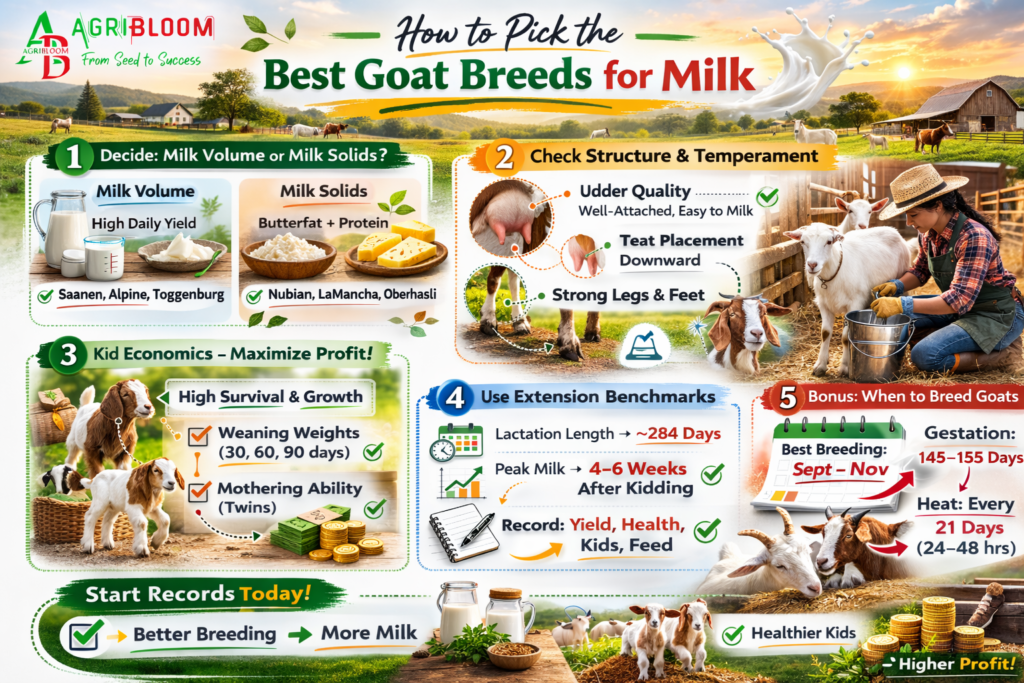
Here is a practical way to choose.
1) Decide what matters more: milk volume or milk solids
Milk volume fills the jar. Milk solids, meaning butterfat plus protein, drive cheese yield and richness.
Ask yourself:
• Are you selling fluid milk by the liter, or making cheese, yogurt, and soap
• Do you have feed resources to support higher producing does
• Do you need steady daily volume, or premium components
A useful benchmark for comparisons is the typical dairy lactation length used in extension materials. Penn State Extension notes dairy goats average about 284 days of lactation, with peak production commonly four to six weeks after kidding. That gives you a clean window for evaluating production across breeds and herds.
2) Put structure and temperament ahead of hype
Great udders and solid feet matter more than most new owners expect. A doe that is hard to milk or breaks down in her legs costs you time every single day.
When evaluating does, prioritize:
• Teats that are easy to grasp and point downward for clean milking
• A strong udder attachment that holds up through multiple lactations
• Sound legs and feet that handle your terrain
• A calm, consistent temperament, especially if you hand milk
These traits support long term production, reduce mastitis risk, and make chores faster. That is why experienced breeders often say “easy milking is underrated.”
3) Run the numbers on kid economics
Milk sales are only half the story on many small farms. The kid crop often determines profit, especially if you sell weaned kids, breeding stock, or finished meat animals. Penn State Extension specifically highlights that income from kids is important and that producers should plan kid marketing, including target weights and seasonal demand.
Track these basics:
• Kid survival from birth to weaning
• Average daily gain or weights at 30, 60, and 90 days
• Parasite resistance and overall hardiness in your environment
• Mothering ability and udder capacity to raise twins well
Keeping accurate 30, 60 and 90 day weights is much easier with a reliable livestock hanging scale.
If you are aiming for 10 Best Goat Breeds for Milk and Meat Production, kid performance is not optional. A doe that milks well but consistently raises weak kids can quietly drain your margins.
4) Use extension benchmarks instead of guesses
For on page clarity, breed selection claims should be tied to real benchmarks. Extension publications commonly provide breed comparisons and DHIR style tables for milk yield and butterfat, plus management guidance for lactation length and peak timing. Penn State Extension provides exactly this kind of reference point for production planning.
A simple herd plan that works for many small farms:
- Pick your base doe breed for the milk style you want, volume or solids
- Select replacements only from does that prove it on your farm
- If meat value matters, consider a terminal sire strategy using a meat breed buck on dairy does, then market the crossbred kids
5) Bonus: when is the best time to breed goats
Even the best genetics struggle if breeding is mistimed. Goats are commonly seasonal breeders, and the estrous cycle averages about 21 days. Standing heat often lasts roughly 24 to 48 hours, with an average near 36 hours depending on breed and conditions.
A practical takeaway:
• Watch for heat signs early and record dates
• Plan breeding so kidding lands in your best forage season or strongest market window
• Match breeding dates to your labor schedule, especially if you assist kiddings
Quick call to action
If you want a herd that produces consistently, start a simple record sheet this week. Track kidding dates, milk notes, and kid weights. Then compare your results to extension benchmarks and refine your breeding decisions next season.
References
• Penn State Extension, Dairy Goat Production, lactation averages and production notes.
• MSD Veterinary Manual, Puberty and Estrus in Goats, estrous cycle and estrus duration.
• Merck Veterinary Manual table, Features of the Reproductive Cycle, goat estrus duration and cycle length.
• MSD Veterinary Manual, Breeding and Parturition of Goats, seasonal breeding and estrus characteristics.
The Top 10 Best Goat Breeds for Milk and Meat and Kid Value
To keep 10 Best Goat Breeds for Milk and Meat Production genuinely useful, it helps to mix two types of goats in one shortlist.
First are dairy focused breeds that reliably fill the pail, giving you saleable milk and replacement doelings. Second are meat focused breeds that add kid growth, carcass value, and tough maternal traits. In the real world, many profitable herds blend both goals by running dairy does and using a meat buck for market kids, while keeping replacements only from proven milkers.
When you want numbers that are not based on guesswork, start with milk recording data. The USDA DHI goat herd averages provide a reality check on what herds actually average by breed in the United States. In the 2021 DHI report, Saanen herds averaged about 2,522 pounds of milk per doe year, Alpine about 2,473 pounds, and Toggenburg about 2,086 pounds. Nubian and Oberhasli averages were lower in that dataset, which is normal for many component rich or smaller population breeds.
Below are ten breeds that consistently show up in practical milk and kid value conversations, with benchmarks and extension based guidance where available.
Dairy first picks for dependable milk
1) Saanen
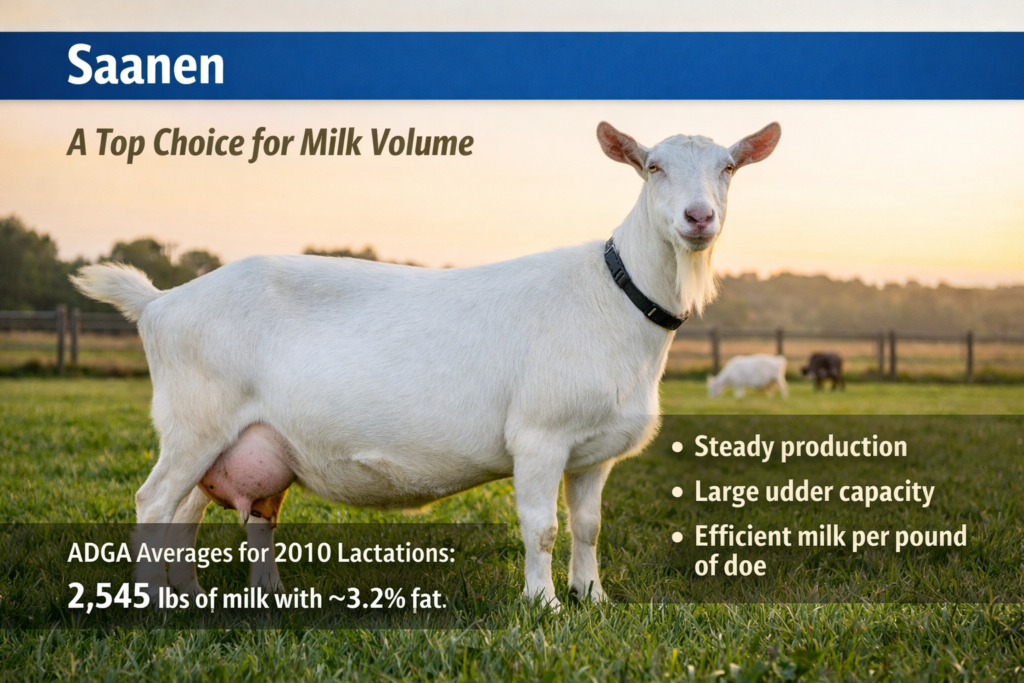
If your priority is volume, Saanen is a classic choice. Purdue’s breed summary lists ADGA averages for 2010 lactations at about 2,545 pounds of milk with roughly 3.2 percent fat.
Because high volume dairy breeds like Saanen require consistent milking and record keeping, having the right basic equipment matters.
Why people keep them: steady production, large udder capacity, efficient milk per pound of doe.
2) Alpine
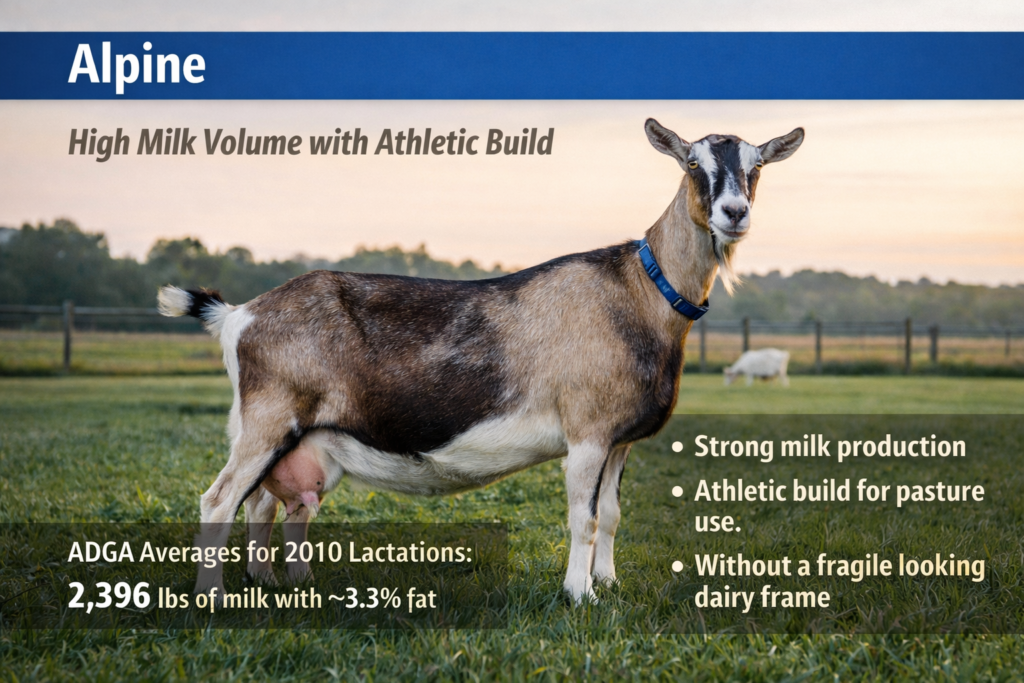
Alpines are often chosen for strong production with athletic bodies that handle pasture well. Purdue lists ADGA averages for 2010 lactations at about 2,396 pounds of milk with around 3.3 percent fat.
Good fit for: farms that want strong milk volume without a fragile looking dairy frame.
Because Alpines thrive on pasture and active movement, proper fencing and handling equipment can make daily management much easier.
3) LaMancha
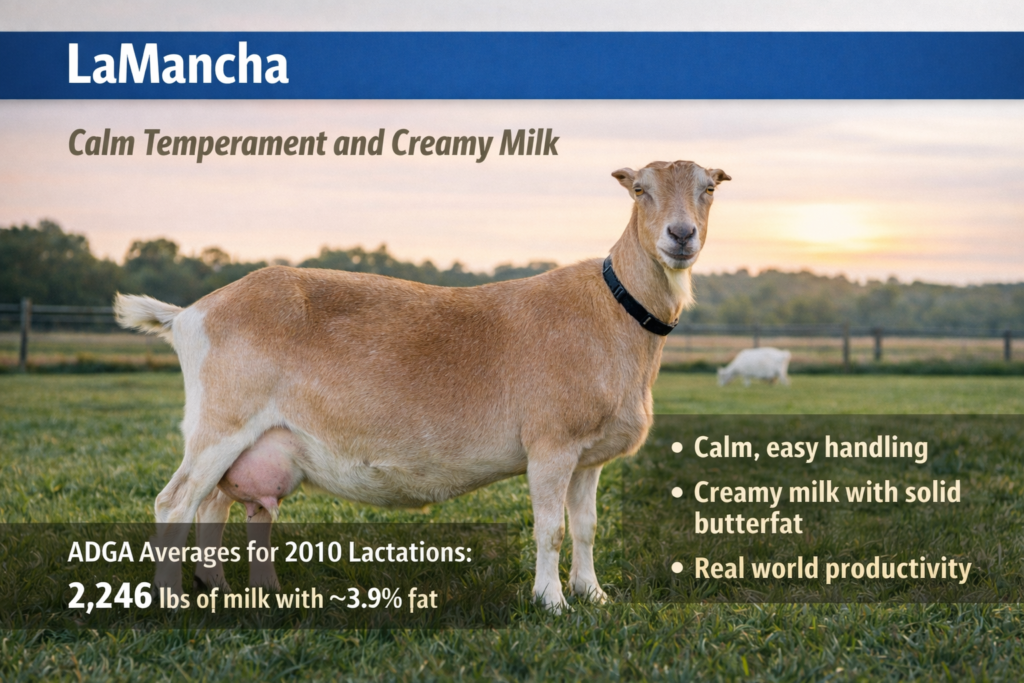
LaManchas are known for calm manners and creamy milk, which matters when you are milking twice a day. Purdue lists ADGA averages for 2010 lactations at about 2,246 pounds of milk with about 3.9 percent fat.
Practical advantage: temperament and easy handling can raise your real world productivity.
For small farms that hand milk twice a day, a sturdy and comfortable milking stand can make chores faster and less stressful for both the doe and the handler.
4) Oberhasli
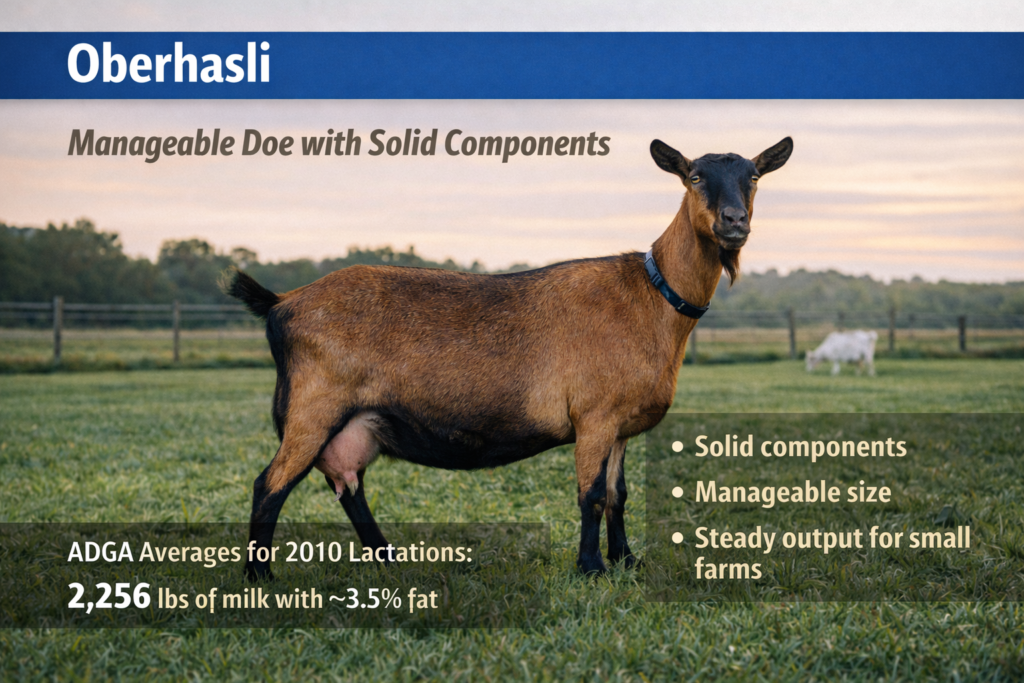
Oberhasli often land in the sweet spot for smaller farms that want a manageable doe with solid components. Purdue lists ADGA averages for 2010 lactations at about 2,256 pounds of milk with around 3.5 percent fat.
Good for: homesteads that value steady output and a moderate size doe.
5) Toggenburg
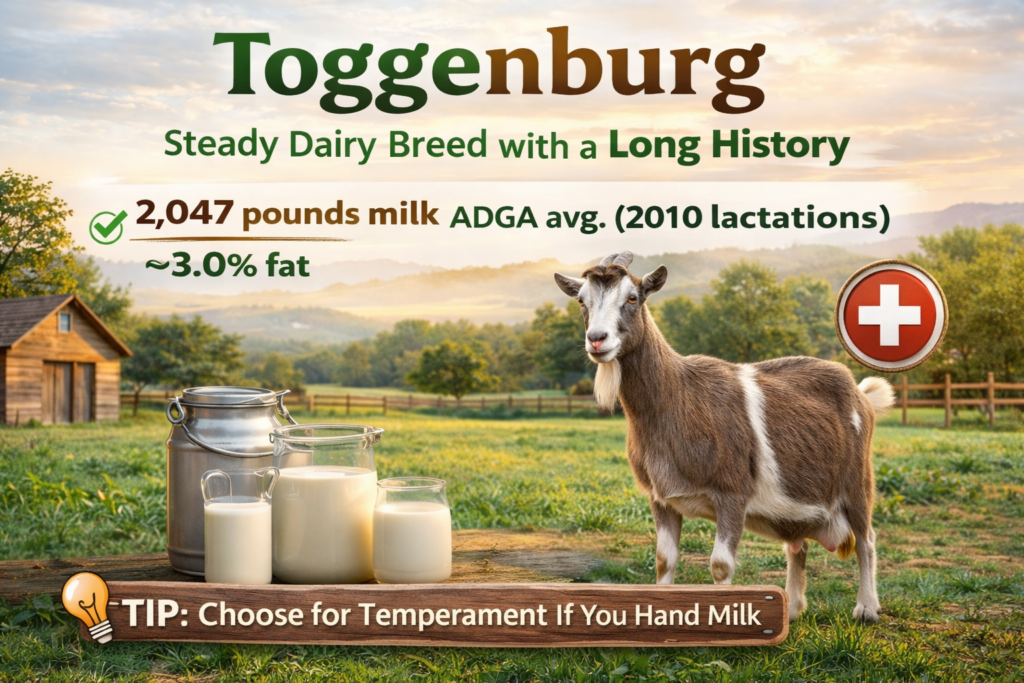
Toggenburg is a steady dairy breed with a long history and predictable performance. Purdue lists ADGA averages for 2010 lactations at about 2,047 pounds of milk with around 3.0 percent fat.
Tip: some lines are more spirited, so choose for temperament if you hand milk.
6) Nubian
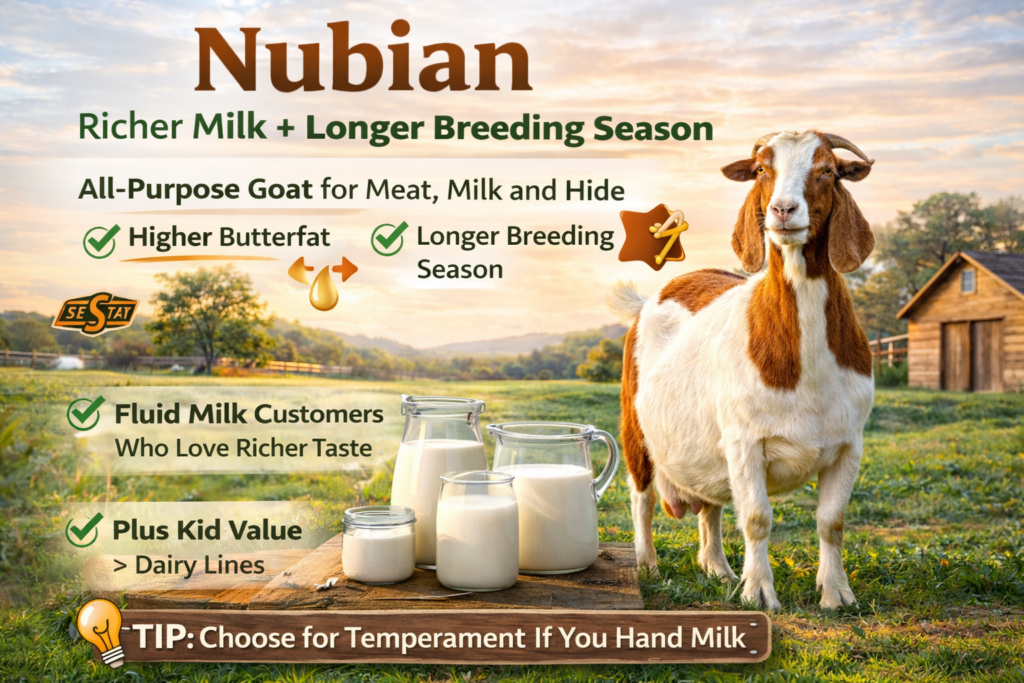
Nubians are often selected for richer milk and longer breeding season potential compared to many Swiss types. Oklahoma State describes the Anglo Nubian as an all purpose goat for meat, milk, and hide, noting higher butterfat and a longer breeding season.
Where they shine: fluid milk customers who love richer taste, plus kid value that can be better than strictly dairy lines.
Meat forward picks that still support strong maternal milk
These are not “dairy breeds,” but they can be powerful tools when kid value matters. Many producers use them as sires over dairy does to produce fast growing crossbred kids.
7) Boer
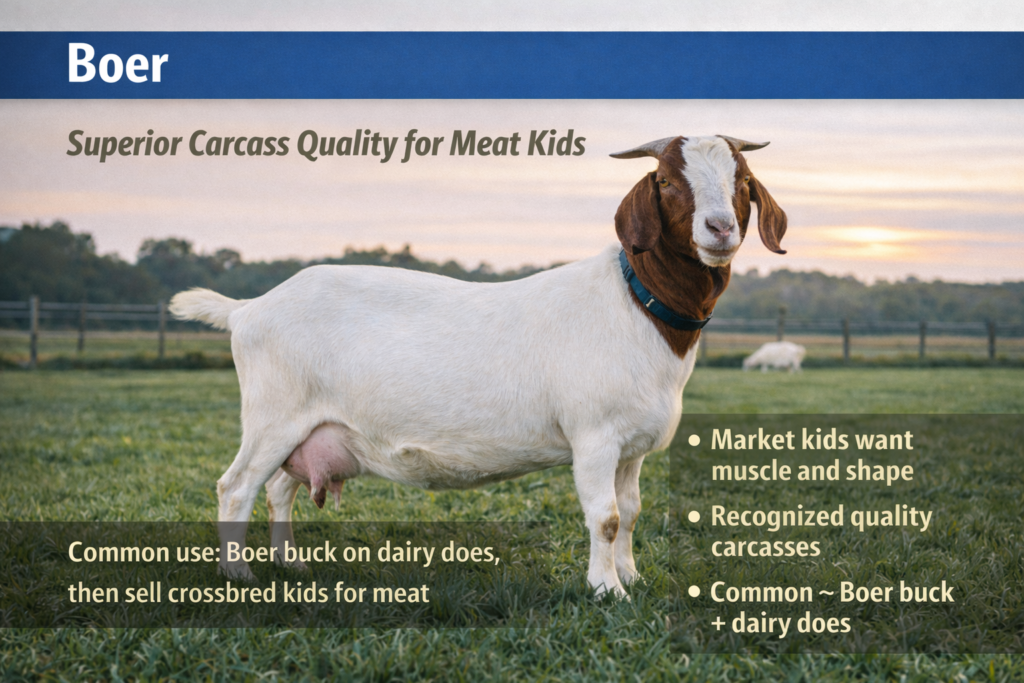
Boer influence is widely used for market kids because buyers tend to pay for muscling and shape. NC State notes that buyers and consumers have recognized superior carcasses in animals with Boer genetics.
Common use: Boer buck on dairy does, then sell crossbred kids for meat.
8) Kiko
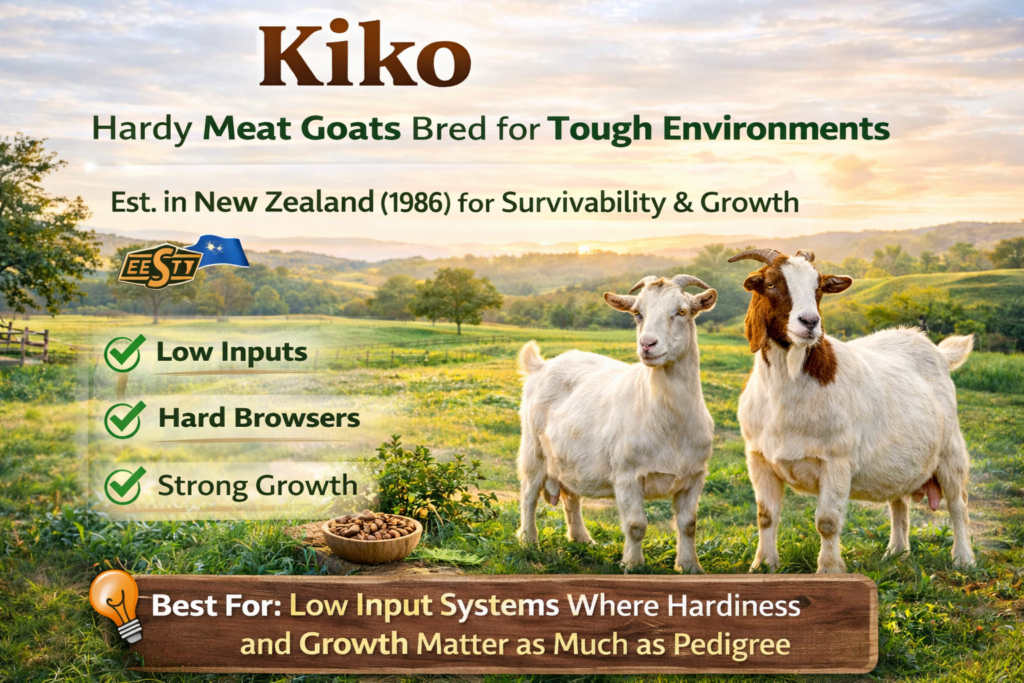
Kikos were designed for survivability and growth under practical conditions. Oklahoma State explains Kikos were established by 1986 after selection for survivability and growth rate in a hill country environment, and the breed was purpose bred in New Zealand for meat.
Best for: low input systems where hardiness and growth matter as much as pedigree.
9) Spanish, also called brush goat
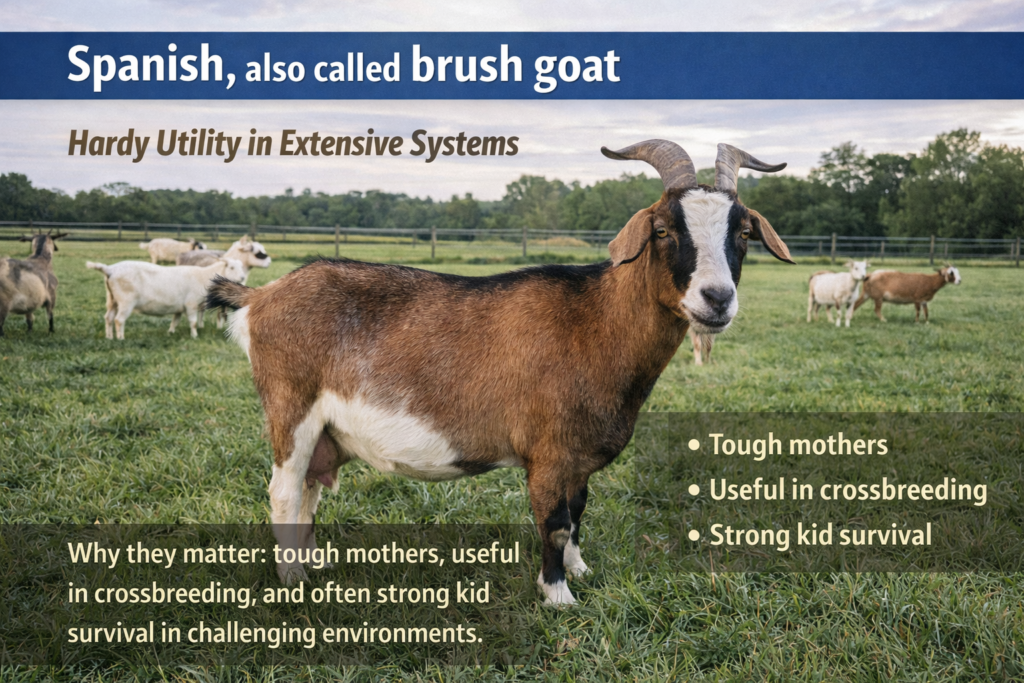
Spanish goats are a workhorse option in extensive systems. NC State describes Spanish goats as hardy, suited to range conditions, and notes they have the ability to breed out of season.
Why they matter: tough mothers, useful in crossbreeding, and often strong kid survival in challenging environments.
10) Myotonic, also called Tennessee fainting goat
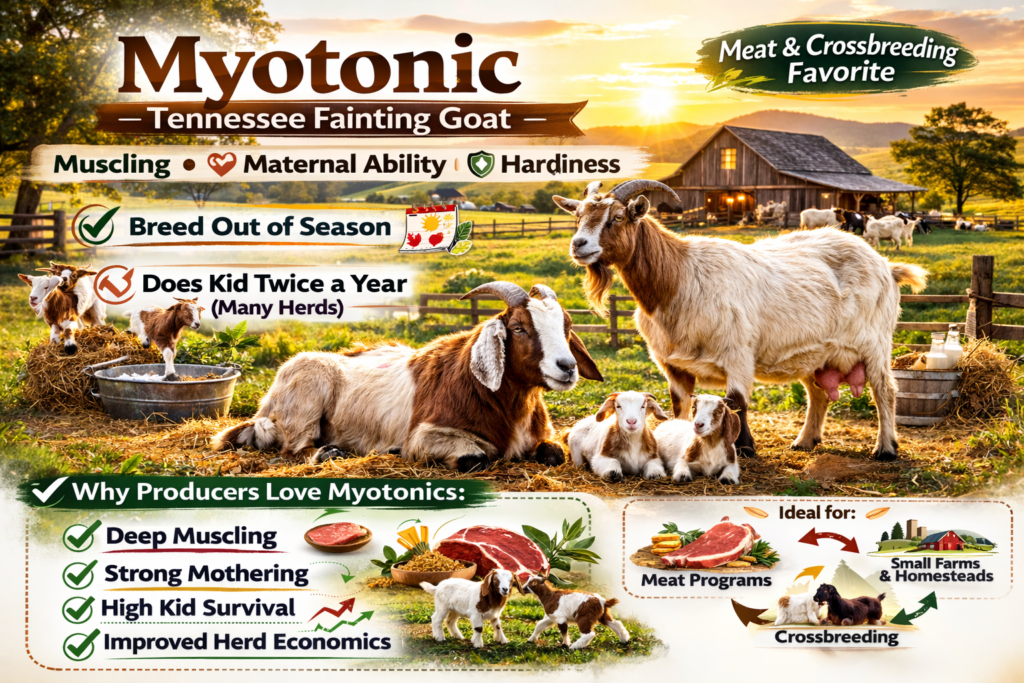
Myotonic goats are used in many meat and crossbreeding programs for muscling and maternal ability. NC State notes Myotonic goats can breed out of season and that in many herds does kid twice a year.
Value point: kid survival and mothering are often strong, which can improve whole herd economics.
A practical system that hits both goals
In many herds, the most reliable way to achieve 10 Best Goat Breeds for Milk and Meat Production is a simple structure:
- Build a base doe herd from dairy breeds that milk well in your management
- Use milk records and udder quality to decide replacements
- Use a meat breed buck for market kids when carcass value is a priority
- Sell crossbred kids at the weight your buyers pay best for
That approach keeps milk income stable and turns the kid crop into a predictable profit center.
References
- Purdue University Dairy Goats Information, breed factsheets with ADGA averages for 2010 lactations for Saanen, Alpine, LaMancha, Oberhasli, Toggenburg.
- USDA DHI Goat Herd Averages, 2021, breed level herd averages for milk and components.
- Oklahoma State University breed pages, Anglo Nubian and Kiko background and purpose.
- NC State Extension, Breeds and Production Traits of Meat Goats, notes on Boer carcass recognition, Spanish out of season ability, and Myotonic reproduction traits.
Which goat gives the most milk
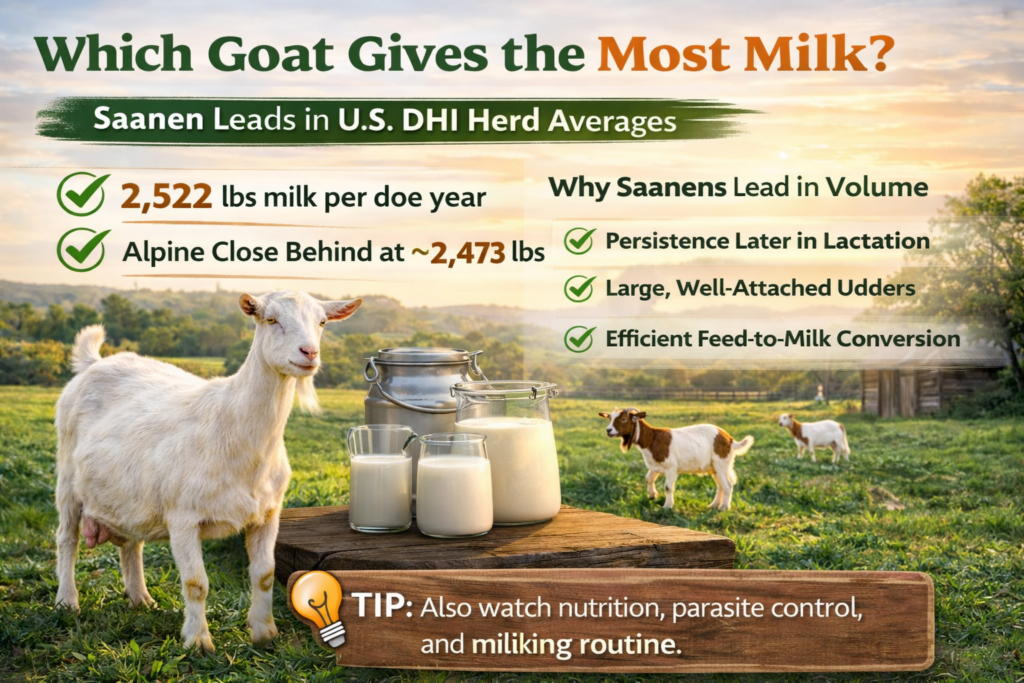
If you are chasing maximum milk volume per doe per year, Saanen is a safe bet in real world U.S. milk recording data. In the 2021 DHI herd averages published by the Council on Dairy Cattle Breeding, Saanen herds averaged about 2,522 pounds of milk per doe year, with Alpine close behind at about 2,473 pounds.
Why Saanen often leads in volume
Most high volume Saanen programs succeed for the same reasons:
• Strong lactation persistence, meaning they hold production later into lactation
• Big, well attached udders that support higher daily output
• Efficient conversion of quality feed into milk
A quick reality check
“Most milk” is not a breed only question. Even elite dairy lines can disappoint if management is weak. High producers usually require:
• Balanced nutrition and enough energy in early lactation
• Consistent parasite control
• Clean milking routine and good udder health management
If your system can support that level of care, Saanen and Alpine are usually the most reliable starting point for sheer volume in the U.S. DHI averages.
Best goat for a small farm
For small farms and homesteads, the best goat is not always the highest producer. It is the doe that stays healthy, milks steadily, and fits your daily routine.
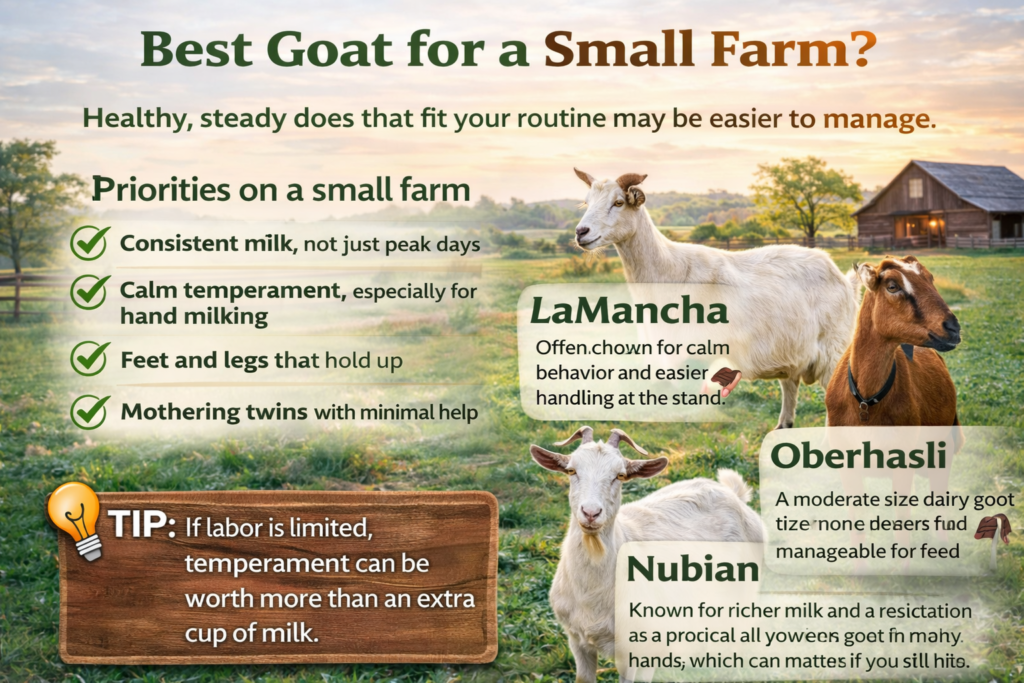
What to prioritize on a small farm
• Consistent milk supply, not just peak days
• Calm temperament, especially for hand milking
• Feet and legs that hold up on your terrain
• Mothering ability that raises twins without constant intervention
Small farm friendly picks to consider
LaMancha
Often chosen for calm behavior and easier handling at the stand.
Oberhasli
A moderate size dairy goat that many owners find manageable for feed intake and daily chores.
Nubian
Known for richer milk and a reputation as a practical all purpose goat in many herds, which can matter if you sell kids as well as milk.
Tip: if labor is limited, temperament can be worth more than an extra cup of milk. A doe that is easy to milk every day usually beats a higher producer that fights the stand.
Best dual purpose goat breed
True dual purpose goats are rare because genetics usually specialize. The most profitable “dual purpose” result often comes from a smart breeding system rather than a single pure breed.
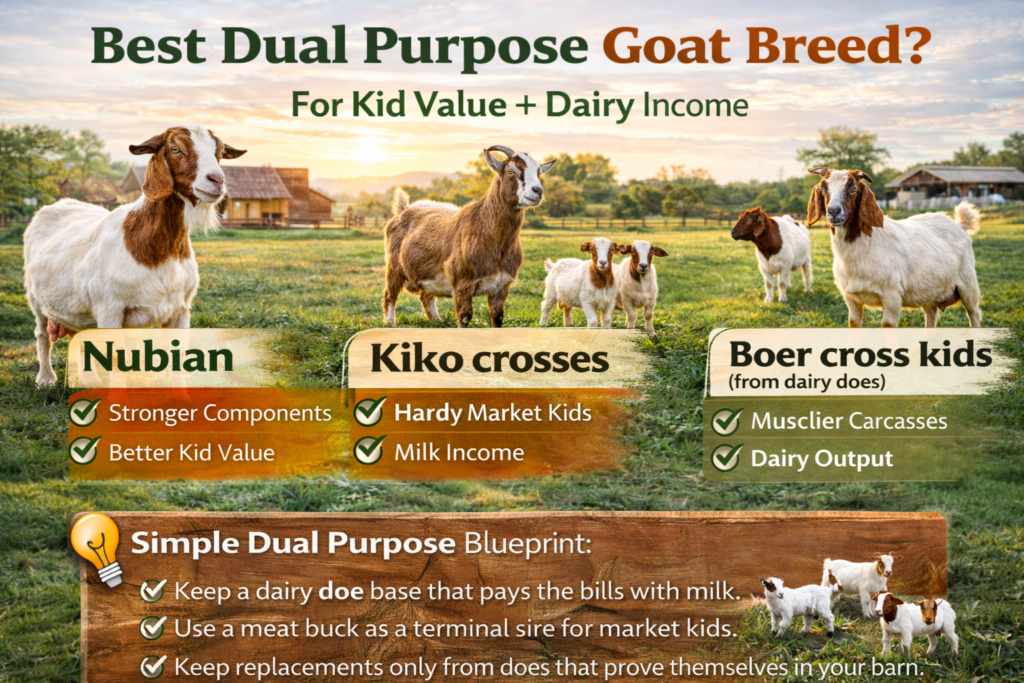
Practical dual purpose contenders
Nubian
Often treated as the most workable dual purpose option on small farms because of stronger components and better kid value than many dairy first Swiss types in typical farm conditions.
Kiko crosses
A common strategy is dairy does bred to a Kiko buck, producing hardy market kids while keeping the milk income from the dam. Oklahoma State notes Kiko was purpose bred in New Zealand for meat production and selected for survivability and growth, with the breed established by 1986.
Boer cross kids from dairy does
This is one of the most common commercial approaches because buyers often pay for muscling and carcass shape in crossbreds carrying Boer influence. NC State Extension notes that buyers and consumers have recognized superior carcasses in animals with Boer genetics being sold for meat.
A simple dual purpose blueprint
• Keep a dairy doe base that pays the bills with milk
• Use a meat buck as a terminal sire for market kids
• Keep replacements only from does that prove themselves in your barn
This keeps milk performance from drifting while still improving kid value.
Which goat grows fastest for meat
When the goal is fast growth and muscling, meat breeds dominate, but the dam still matters more than most people expect. A heavy milking doe can make kids grow faster than genetics alone.
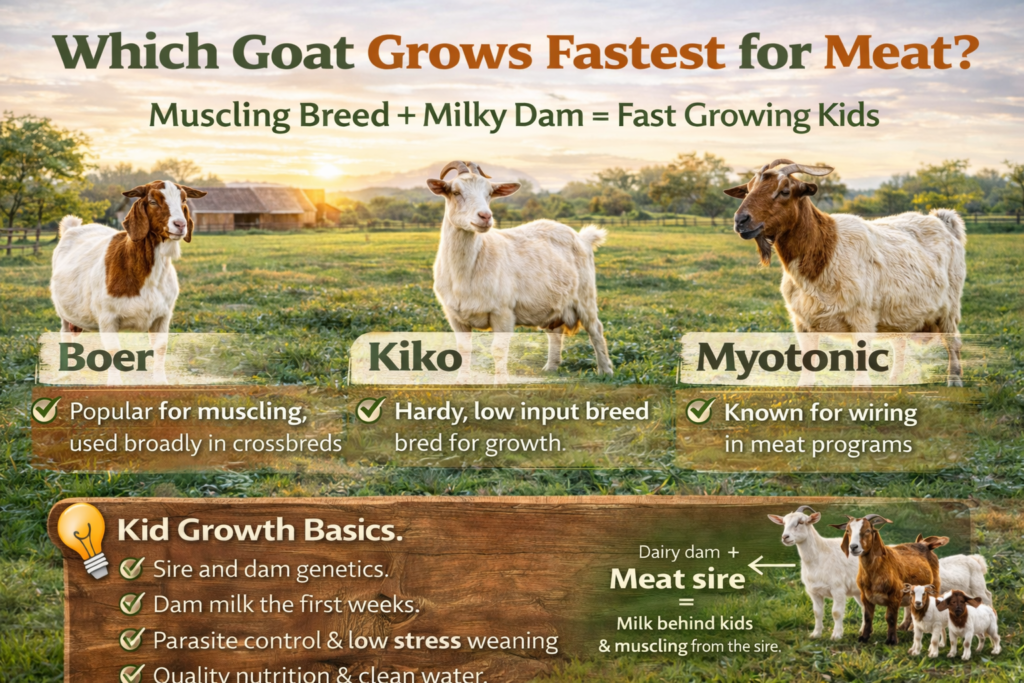
Growth focused options
Boer
Popular for shape and muscling, and widely used to upgrade carcass traits in crossbreds.
Kiko
Selected for survivability and growth in practical conditions, making them attractive for lower input systems.
Myotonic
Often used in meat and crossbreeding programs, and discussed by NC State Extension among specialized meat focused breeds in the U.S. context.
What really drives kid growth on your farm
• Genetics of sire and dam
• Dam milk production in the first weeks of life
• Parasite control and low stress weaning
• Quality nutrition and clean water
A proven dairy doe bred to a strong meat sire often produces very marketable crossbred kids, because you get both milk behind the kids and muscle from the sire.
Quick call to action
If you want better results this season, start recording three numbers for every doe: kidding date, kid weaning weight, and basic milk output. After one year, your own data will tell you which breed lines truly fit your land and your market.
References
• 2021 DHI Goat Herd Averages, Table 7, CDCB, showing Saanen about 2,522 pounds and Alpine about 2,473 pounds per doe year.
• Oklahoma State University, Kiko goats, breed history and selection for survivability and growth, established by 1986.
• NC State Extension, Breeds and Production Traits of Meat Goats, notes on Boer influence and carcass recognition, and discussion of meat oriented breeds.
When is the best time to breed goats
When is the best time to breed goats? In many temperate regions, most goats are short day breeders, meaning fertility improves as days get shorter in late summer and fall. Extension.org explains that goats begin cycling during the shorter days of fall, and notes the normal breeding season is September, October, and November, with timing varying by breed and location.
That said, many herds see an extended window beyond the peak months. Another Extension.org resource describes the broader season for many goats as late August through mid March, while still calling September through November the most optimal stretch.
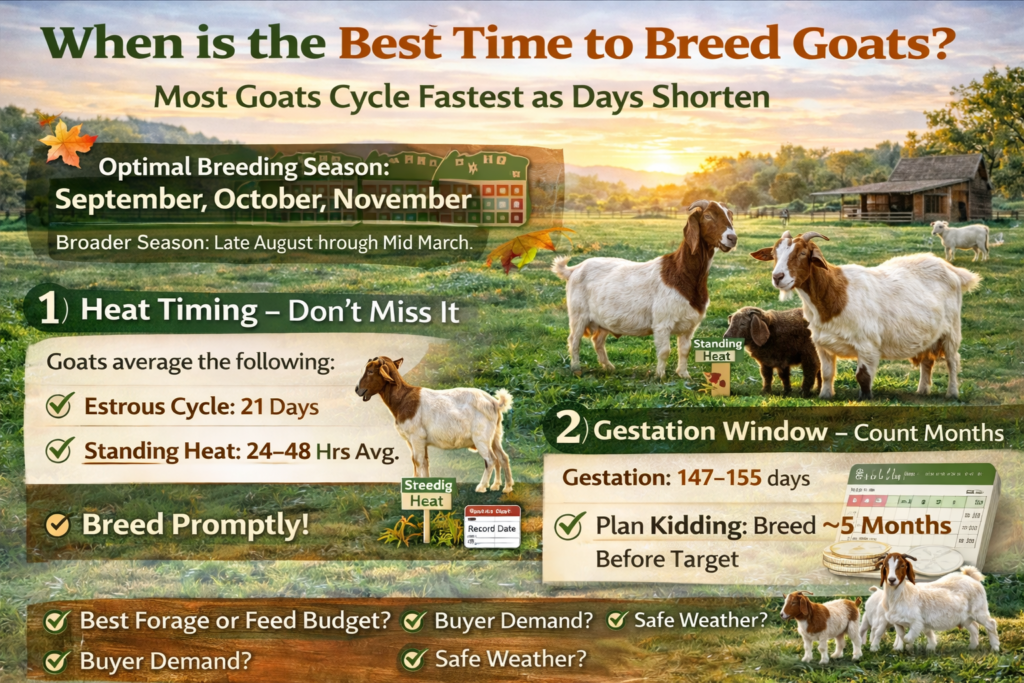
Two planning anchors you can trust
1) Heat timing, so you do not miss your window
If you are watching heats for natural service or planning AI, the key is knowing how often does cycle and how long standing heat lasts.
The MSD Veterinary Manual reports:
- The estrous cycle averages 21 days in goats, though it can vary with breed and conditions.
- Mean standing estrus is about 36 hours, and commonly ranges 24 to 48 hours.
Practical takeaway: once you see clear standing heat, breed promptly and record the date. Good records are the difference between a tight kidding season and weeks of staggered births.
2) Gestation length, so you can set your kidding season
Most owners plan breeding backward from the month they want kids on the ground.
University of Georgia Extension lists a gestation range of 147 to 155 days, averaging about 150 days.
That is why many producers use the simple rule of thumb: count roughly five months from breeding to kidding, then add a small buffer for natural variation.
A simple way to choose your breeding month
To answer “when is the best time to breed goats” for your farm, start with these questions:
- When do you have the best forage or the best feed budget for late pregnancy and early lactation
- When do your buyers pay best for kids
- When is weather safest for newborns on your property
Then align that target kidding month with the breeding season guidance above, using the 147 to 155 day gestation window as your calendar anchor.
References
- Reproductive Biology Goat Reproductive Physiology, seasonality and normal breeding season September through November.
- General Goat Behavioral Patterns, broader breeding season late August through mid March and best months September through November.
- MSD Veterinary Manual, Puberty and Estrus in Goats, estrous cycle length and standing estrus duration.
- University of Georgia Extension, Meat Goat Production in Georgia, gestation length range and average.
Summary Table for Best Goat Breeds for Milk and Meat
| Goal | Best breed or strategy | Why it works | Useful benchmark to cite |
|---|---|---|---|
| Most milk per doe per year | Saanen | Consistently top tier milk volume in recorded herds | 2021 DHI herd averages show Saanen about 2,522 pounds milk per doe year |
| Close second for volume | Alpine | High milk output with strong functional frames in many herds | 2021 DHI herd averages show Alpine about 2,473 pounds milk per doe year |
| Calm, easy hand milking on a small farm | LaMancha | Easy handling and solid dairy performance for homestead routines | Penn State notes typical dairy lactation planning benchmarks for comparing breeds and herds |
| Moderate size, steady producer | Oberhasli | Manageable intake and consistent dairy type | Purdue ADGA averages for 2010 lactations list Oberhasli around 2,256 pounds milk and 3.5 percent fat |
| Predictable dairy performance | Toggenburg | Steady milk production and long history in dairying | 2021 DHI herd averages show Toggenburg about 2,086 pounds milk per doe year |
| Richer milk with practical kid value | Nubian | Often chosen when components and kid value matter | 2021 DHI shows Nubian averages lower for volume in recorded herds, so choose for goals beyond volume |
| Fast growing market kids from dairy does | Dairy doe plus Boer buck | Adds muscling and carcass value to crossbred kids | Common commercial approach highlighted in extension breed trait discussions (see your earlier NC State reference) |
| Low input hardiness plus growth | Dairy doe plus Kiko buck | Emphasis on survivability and growth under practical conditions | Kiko history and selection goals are summarized by Oklahoma State |
| Tough range style maternal traits | Spanish type does or Spanish influence | Hardiness and utility in extensive systems | Often discussed in extension meat goat breed trait guides |
| Tight breeding and kidding calendar | Breed in fall, manage heat windows | Matches short day seasonality and improves conception | Penn State lactation timing helps align kidding to peak milk planning |
Final Verdict
If you want the cleanest path to 10 Best Goat Breeds for Milk and Meat Production, build a dairy doe base first, then add meat value through a terminal sire.
- For maximum milk volume, Saanen is usually the safest pick, with Alpine as the most consistent runner up in U.S. DHI averages.
- For small farms, choose the doe that fits your labor. Easy milking temperament and durable feet often beat peak yield on paper. Penn State’s lactation benchmark of about 284 days, with peak four to six weeks after kidding, gives you a simple framework for comparing your own does across breeds.
- For strong kid value without sacrificing milk income, use a meat buck over proven dairy does, then keep replacements only from the best milkers. This protects your milk line while still producing heavier, more marketable kids.
And zooming out, goat milk is a specialty market globally, which is exactly why matching breed strengths to your outlet matters. A FAOSTAT based review reported goats at about 2.06 percent of global milk production in 2022.
FAQs for Best Goat Breeds for Milk and Meat
1) Which goat gives the most milk?
In U.S. recorded herds, Saanen is typically at the top for volume. The 2021 DHI herd averages report shows Saanen at about 2,522 pounds milk per doe year, with Alpine close at about 2,473 pounds.
2) Is higher milk always better for profit?
Not always. Higher producing lines usually need stronger nutrition, tighter parasite control, and better udder management. For many homesteads, a slightly lower producer that is calm and easy to milk can yield a better daily routine and fewer health costs. Penn State’s production planning notes emphasize that milk output is influenced by genetics and diet, and that kid income also matters.
3) What is the best goat breed for a small farm?
The best choice is the one that matches your labor and forage. Many small farms do well with manageable, steady dairy breeds and strong mothering. Use your own records against a consistent benchmark like the average 284 day lactation and peak at four to six weeks after kidding to judge what performs best in your system.
4) What is the best dual purpose approach, one breed or crossbreeding?
On many farms, the most reliable dual purpose result comes from a system: dairy does for milk, meat buck for market kids, and replacements selected only from proven milkers. This keeps milk income stable while improving kid value.
5) How do I compare breeds fairly if my feeding changes seasonally?
Compare does at the same stage of lactation and keep notes on diet. Penn State’s guidance on typical lactation length and peak timing helps you compare apples to apples even when seasons change.

Thesis Link : https://saulibrary.edu.bd/daatj/public/uploads/BAU200601_19-Pp_5.pdf
- Why Are My Pepper Plant Leaves Curling? 9 Causes & Fixes - September 17, 2026
- Why Are My Zucchini Leaves Turning Yellow? Causes & Fixes - August 31, 2026
- What Is Eating My Plants at Night? - August 27, 2026