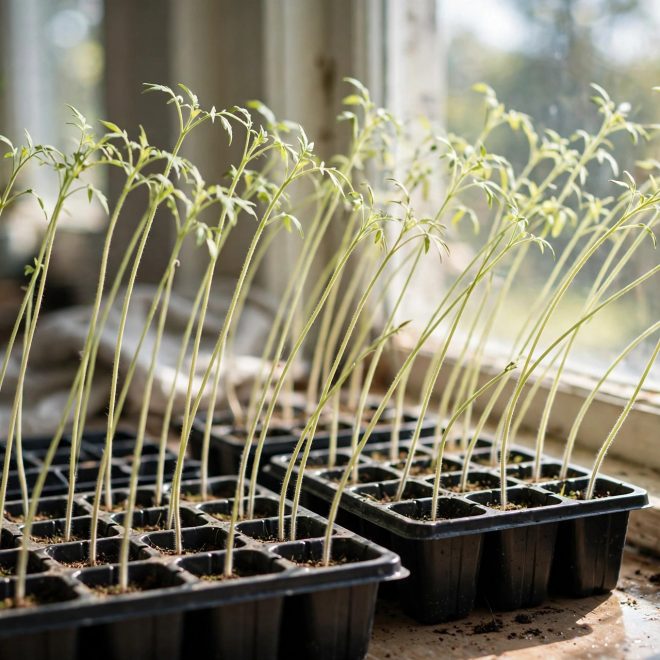

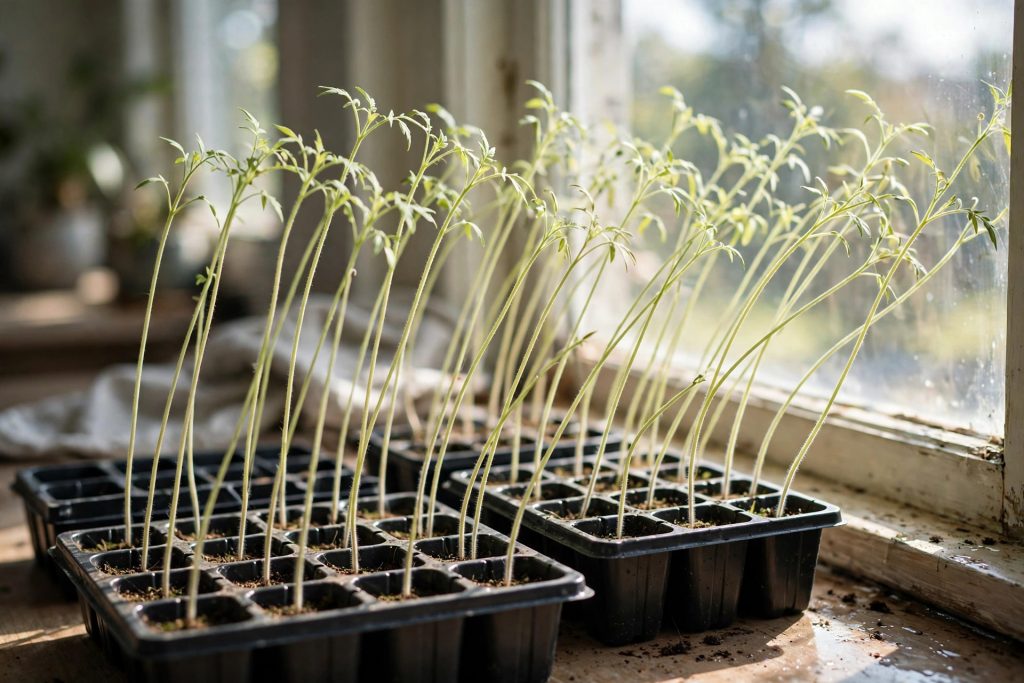
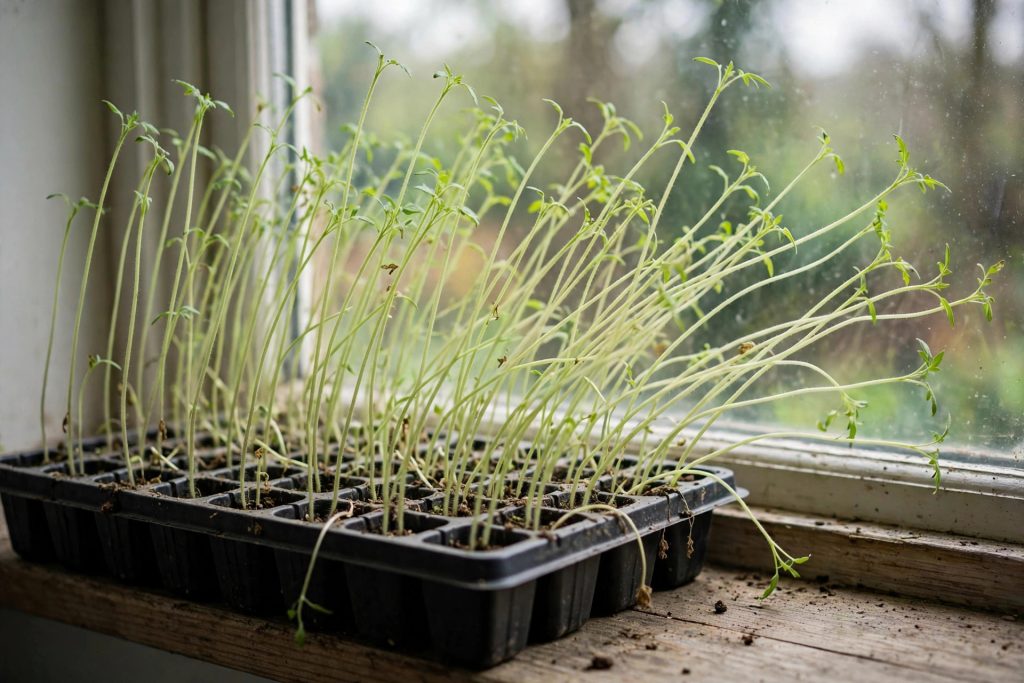
You sowed the seeds, set the tray on the windowsill, and for a few days everything looked right. Then the stems kept growing, thin as thread, pale, and leaning hard toward the glass. By week three your tomato seedlings are six inches tall and flop over at a touch, and they look nothing like the sturdy plants on the seed packet. If that sounds familiar, you are looking at tomato seedlings leggy from weak light, warm air, crowding, or an early start.
A leggy seedling is not a sick seedling. It is a healthy plant stretching toward the light it needs, and the problem is the setup around it, not the seed. This guide shows you how to match the symptom to the cause in about a minute, fix the setup the same day, and rescue the plants you already have.
Quick Answer
Short on time? Here is the whole diagnosis in one paragraph. Tomato seedlings leggy in most homes are short of light: a windowsill is not enough, and the fix is a grow light hung 2 to 4 inches above the leaves for fluorescent tubes, or at the height the maker gives for an LED fixture, on a timer for 14 to 16 hours a day. Cool the tray after germination to 60 to 70 degrees, take it off the heat mat, and thin to one seedling per cell. If the plants are already tall, pot them up deeper, because tomatoes grow roots along a buried stem, and at planting time set them deep or lay the stem in a shallow trench. Start over only if the stem is pinched and dark at the soil line, which is damping off, not legginess, or if the stem has snapped.
What Leggy Really Means
A leggy seedling has a long, thin stem, small leaves, and wide gaps between the leaf sets. It is an ordinary survival reflex: a seedling short of light puts its energy into getting taller, hoping to reach a brighter spot. Clemson Extension says vegetable seedlings under low light become leggy and weak and tend to topple over once they are a few inches tall. The University of Minnesota Extension adds that lack of light is the major cause of elongated, skinny stems.
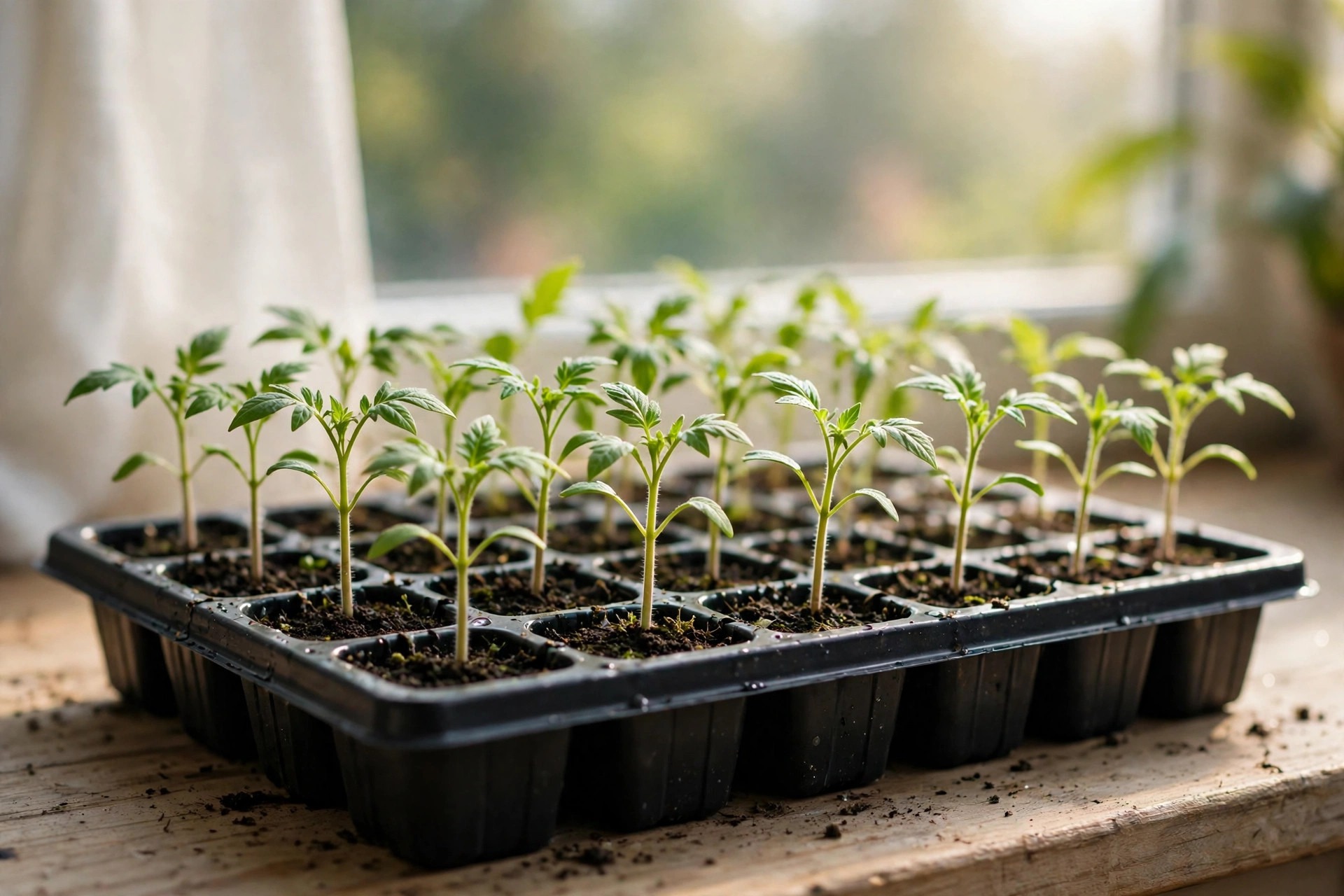
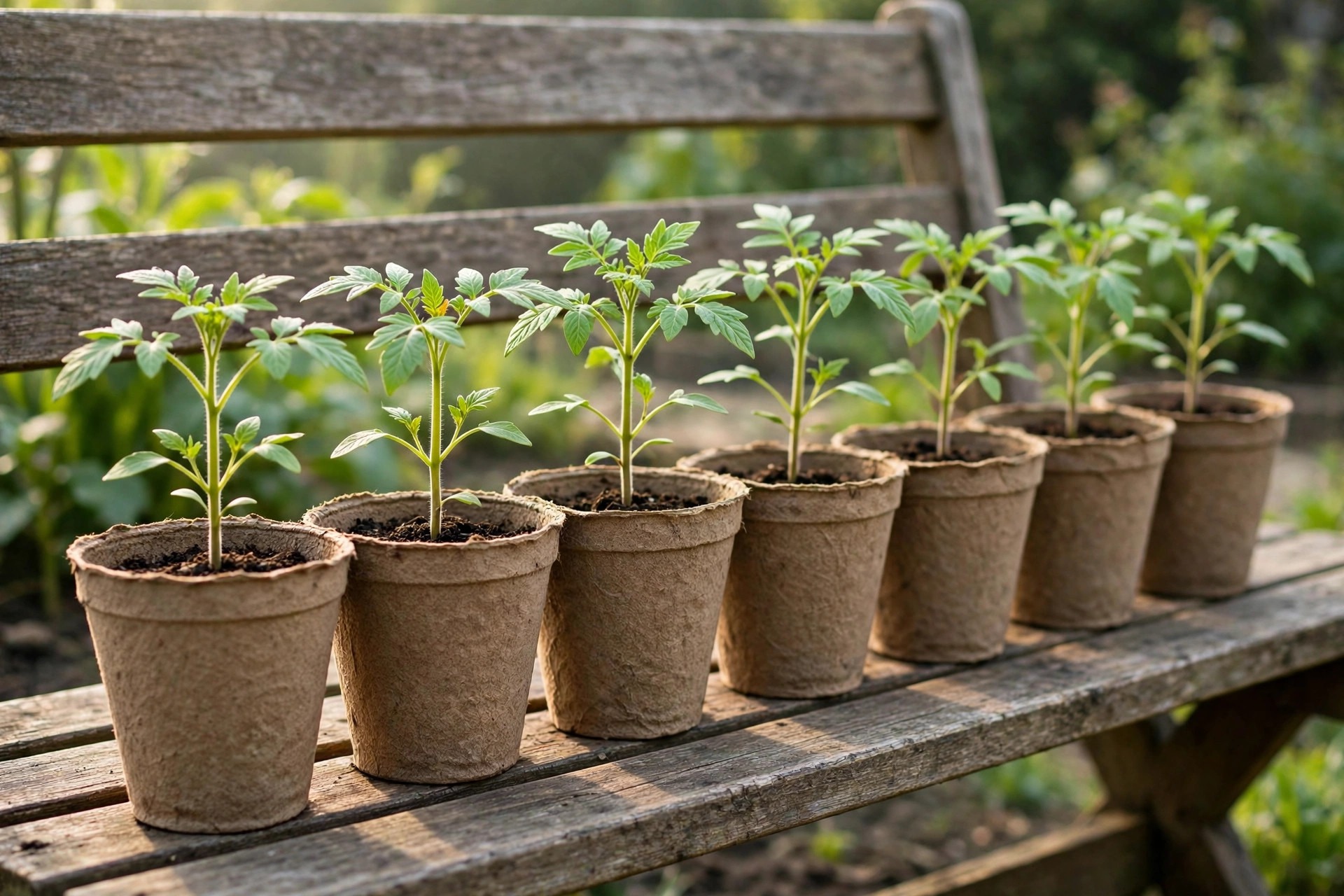
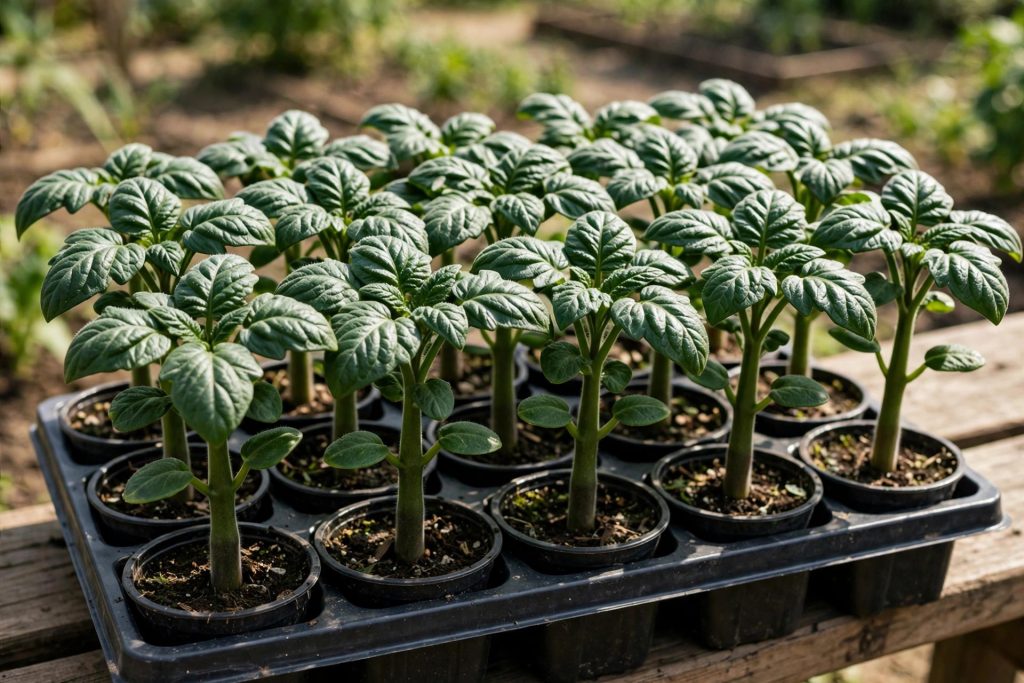
A healthy tomato seedling looks different in three ways. The stem is thick and sturdy, strong enough to support the plant on its own, by the time the plant has four or five sets of true leaves. The leaves are full size and dark green, not small and pale. The gaps between leaf sets are short, so the plant looks compact rather than stretched.
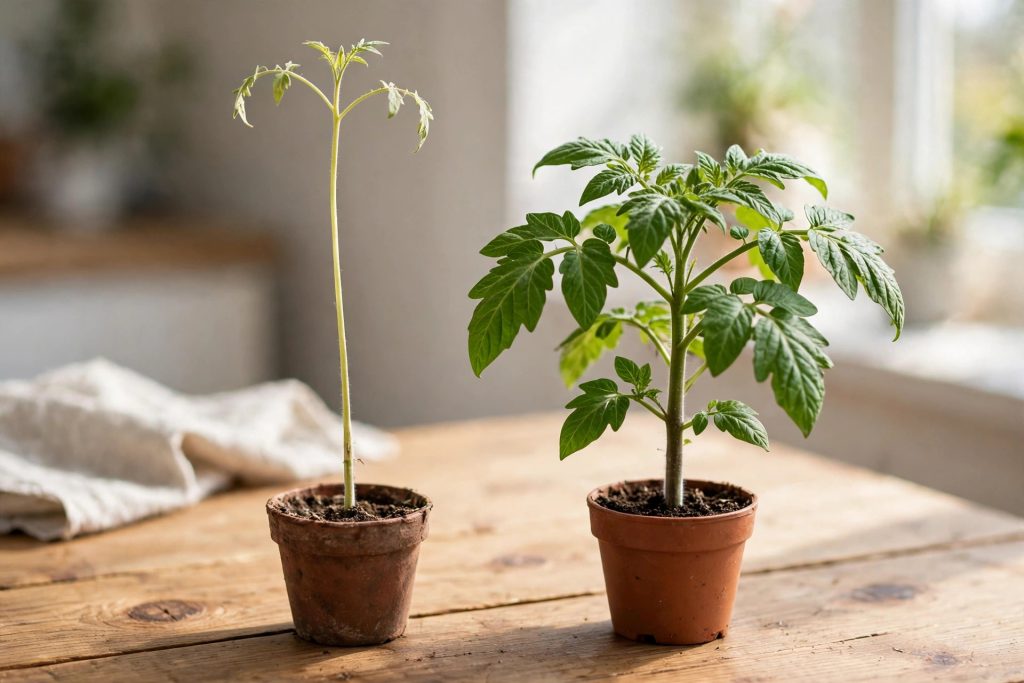
Age matters when you judge a seedling, but these heights are rough guides, not fixed rules: they vary with the variety, the light, the temperature, and the growing conditions. As a guide, at one week a seedling is about 2 inches tall, at three weeks 4 to 5 inches and bushy, and at five to six weeks 8 to 10 inches and as wide as it is high. A plant that hits 8 inches in three weeks has grown fast in the wrong direction.
Diagnose Your Seedlings in 60 Seconds
Match what you see to the cause. Check the light first, then the temperature, then the spacing.
| What you see | Likely cause | Quick check | Fix |
|---|---|---|---|
| Tall, pale, thin stems leaning toward the window | Not enough light | Light more than a few inches away, or plants on a windowsill? | Grow light 2 to 4 inches above the leaves, 14 to 16 hours a day |
| Long stems even under a grow light, leaves still green | Light too far away or too few hours | Measure the gap and check the timer | Lower the fixture, set the timer to 14 to 16 hours |
| Stems long and soft, tray feels warm, heat mat still on | Too warm after germination | Thermometer at seedling height reads above 70 degrees | Take the tray off the heat mat, move to 60 to 70 degrees |
| Every seedling leggy, leaves overlap | Overcrowding | More than one plant per cell | Thin to one seedling per cell, snip extras at the soil line |
| Seedlings fine, then shot up in week five or six | Started too early | Count back from your last frost date | Pot up deeper, cool the tray, hold with more light |
| Tall and floppy plus yellow leaves, mix always wet | Too much water and feed | Mix wet an inch down, watered daily | Let the surface dry between waterings, stop feeding |
| Stem pinched, dark, and water-soaked at the soil line | Damping off, not legginess | Thin dark ring at the soil line | Remove the plant, improve air and drainage, start fresh |
The last row matters, because damping off looks like legginess and the fix is the opposite. A leggy stem is thin but firm, and the plant stays green. A damped-off stem is pinched and dark at the soil line, and the seedling collapses overnight.
Cause 1: Not Enough Light
Light is the main cause, and it is the first thing to check. A tomato seedling needs bright light from the moment it emerges, and a windowsill almost never gives it enough. The University of Minnesota Extension says it plainly: a windowsill is not a good location for starting seeds, and it is much better to grow seedlings under fluorescent or LED lights than to rely only on natural light, even in a greenhouse. Clemson Extension agrees, saying that window light is not sufficient and produces leggy seedlings. Maryland and Iowa State give the same warning.
A window gives light from one side only, so the seedling leans and stretches. A grow light hung directly above the tray gives even light from the top. Three numbers decide whether the light is enough: how close it hangs, how many hours it runs, and whether it covers the whole tray.
| Source | Lamp height above seedlings | Hours of light per day |
|---|---|---|
| University of Minnesota Extension | No more than 4 inches, as close as 2 inches is ideal | 12 to 16 |
| Clemson Extension, HGIC 1259 | 2 to 4 inches, fluorescent | 16 to 18 total |
| Clemson Extension, seed-starting FAQs | 2 to 4 inches, fluorescent | 12 to 16 |
| Iowa State University Extension | 4 to 6 inches, fluorescent; 18 inches for a 4-foot LED shop fixture at 3,000 lumens | 14 |
| University of Maryland Extension | 2 to 6 inches, fluorescent and LED; 1 to 2 inches after potting up | 14 to 16 |
The range across the sources runs 12 to 18 hours a day. 14 to 16 hours is a practical starting point, though some recommendations vary: Clemson gives 16 to 18 hours of total light in one factsheet, while Minnesota gives 12 to 16, Iowa State gives 14, and Maryland gives 14 to 16. Use a timer, and give the plants a dark period every night.
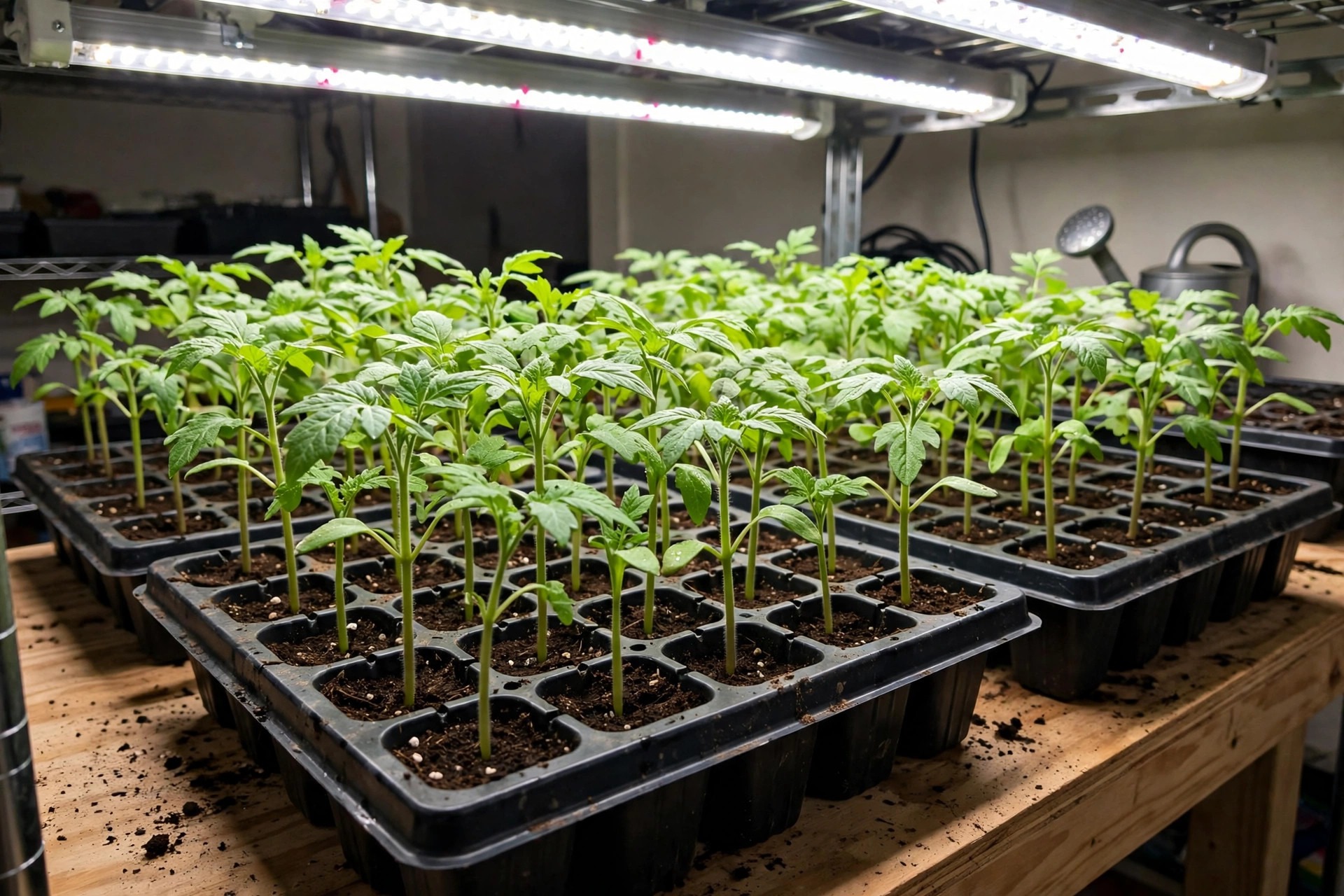
For a standard fluorescent shop light, hang the fixture 2 to 4 inches above the leaves and raise it as the plants grow. For a bright LED panel, follow the maker’s height, because powerful LEDs can scorch leaves if they hang too close. Iowa State gives one concrete example for one specific fixture, a 4-foot LED shop fixture giving at least 3,000 lumens, hung 18 inches from the foliage, on for 14 hours a day. That 18 inches applies to that fixture only, not to every LED grow light, so always follow the height on your own light’s label.
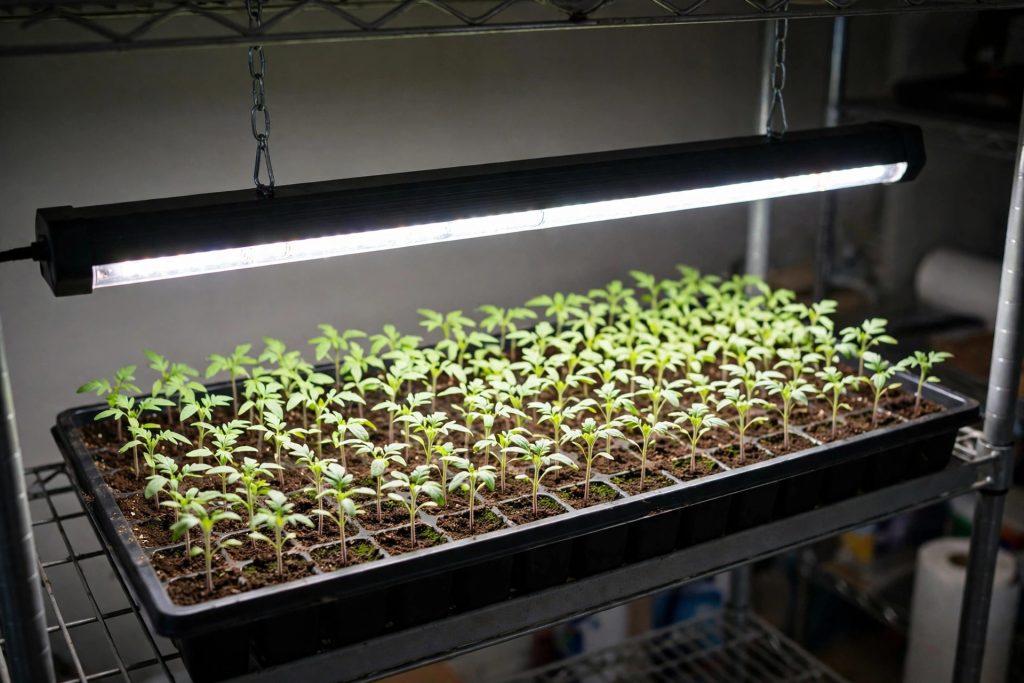
If your seedlings are already leggy, fix the light first and fix it today. Lower the fixture to 2 to 4 inches above the leaves for a fluorescent tube, set the timer to 14 to 16 hours, and turn the tray every day or two. New growth should come in shorter and thicker. The stretched stem will not shrink back, so the rescue plan below deals with the height that is already there.
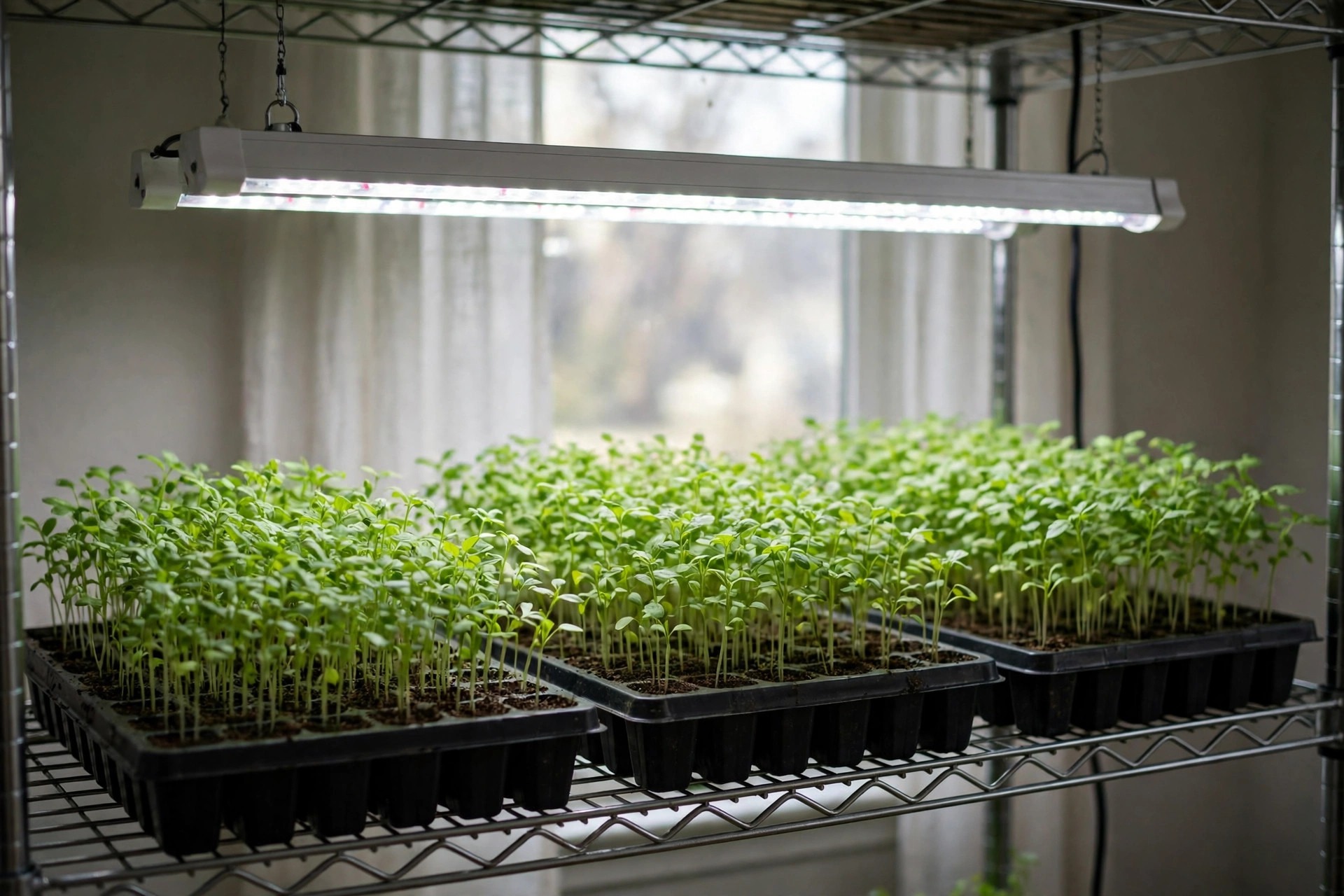
Cause 2: The Tray Is Too Warm
Warmth is the second cause, and it works quietly, because a warm tray looks like a comfortable tray. Seeds do want warmth to sprout: Iowa State says most seeds germinate best at 70 to 75 degrees, and Clemson gives 65 to 75 degrees. The trouble starts the day after germination, when the same warmth that helped the seeds sprout starts pushing the seedlings to stretch.
Once the seedlings are up, they grow best cooler than they germinated. Iowa State says to move them to 60 to 70 degrees immediately after germination, and to place them under supplemental lights at the same time. Maryland gives the same idea in day and night numbers: after germination, seedlings can have a night temperature of 55 to 60 degrees and a day temperature of 65 to 70 degrees.
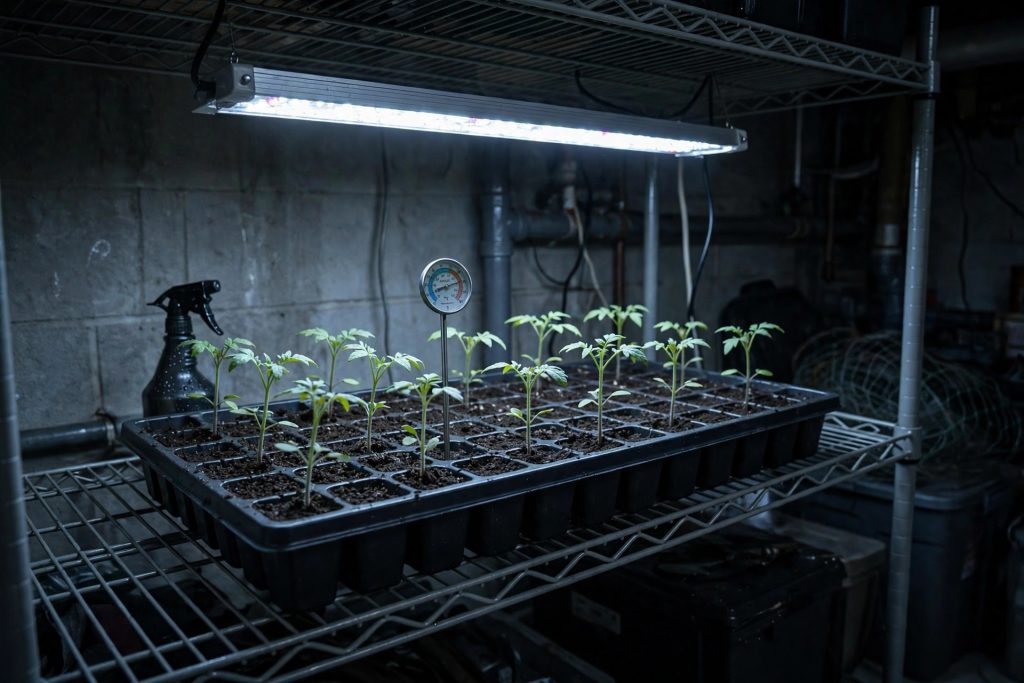
The heat mat is the usual culprit. It stays plugged in for weeks after germination because nobody remembers to switch it off, and the tray sits at 75 to 80 degrees day and night. Take the tray off the heat mat the day the seedlings emerge, and move it to a cooler spot: a basement shelf, a cool spare room, or a spot away from a heat vent. Put a thermometer at seedling height.
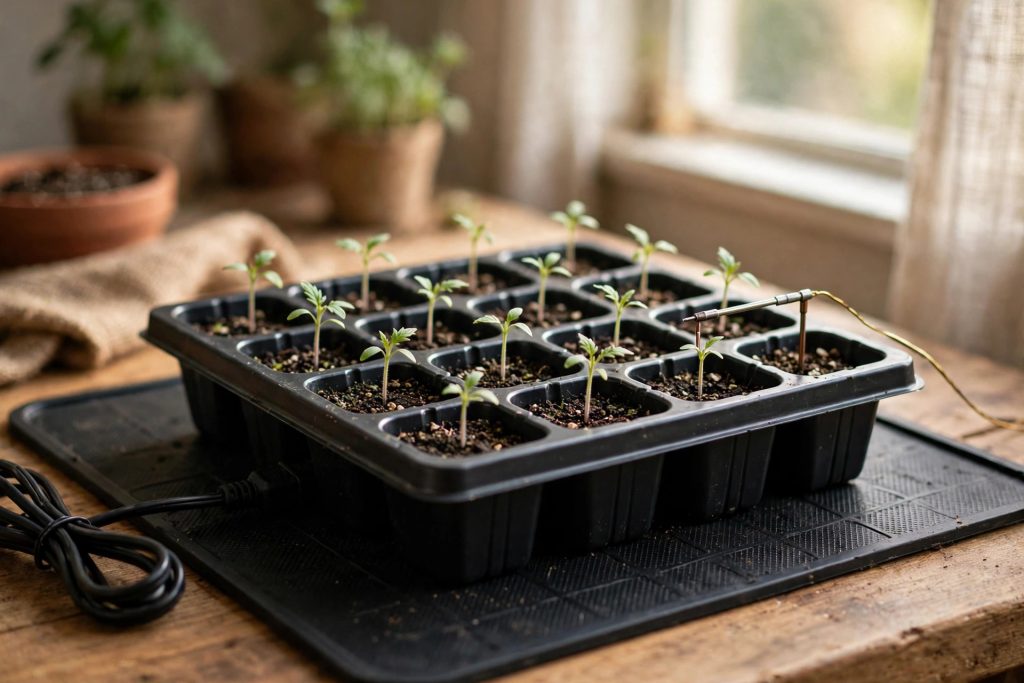
Cause 3: Crowded Seedlings
Crowding is the third cause, and it is the one growers feel worst about, because thinning means killing healthy-looking plants. But a cell with three seedlings in it grows three leggy plants, not three good ones. The seedlings shade each other, stretch for the light above the crowd, and tangle their roots together underground. Iowa State lists crowding alongside poor light, excess water, high temperatures, and excess feed as contributors to spindly growth.
The fix is to thin early and thin once. When the seedlings have their first true leaves, keep the strongest one in each cell. Minnesota gives the method: cut all but the healthiest one off at ground level with scissors, and avoid pulling the unwanted seedlings, because pulling can damage the roots of the one you want to keep.
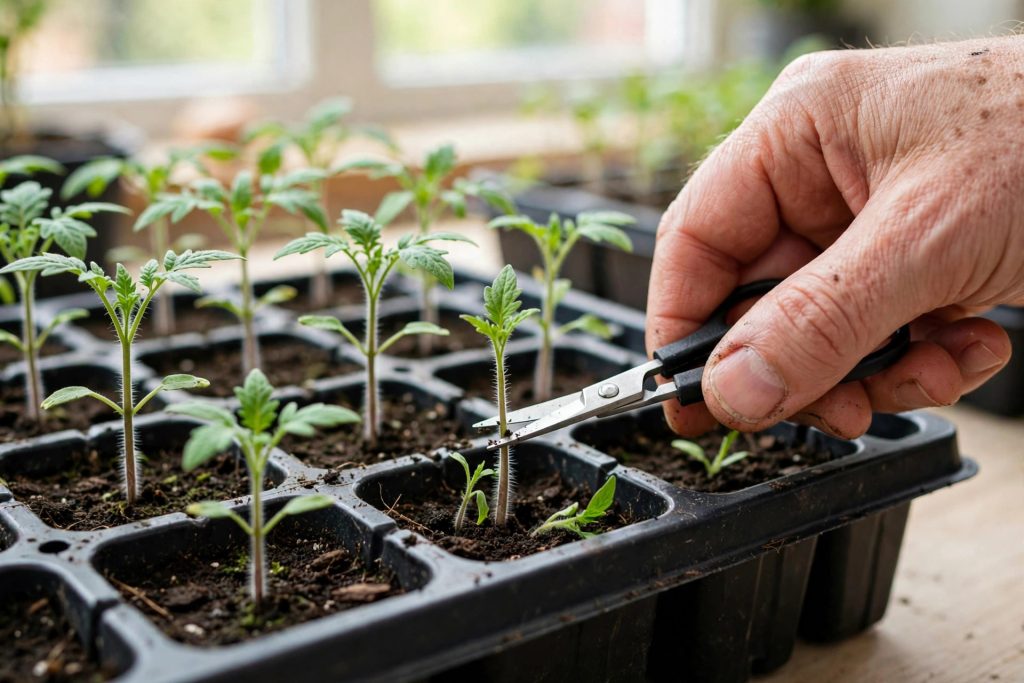
Snipping feels wasteful, but it is the cheapest insurance in the whole seed-starting routine. A seed costs a few cents. A seedling that grows up tangled with two neighbors costs you the whole plant. If you cannot bring yourself to cut them, pot the extras into their own cells instead, but do it early, while the roots are still small.
Space matters after thinning too. Maryland recommends 9 to 16 square inches per cell for tomato, eggplant, and pepper seedlings, and advises potting up 2 to 3 weeks after germination. Iowa State says to move seedlings in flats into individual pots when the first true leaves appear.
Cause 4: Seeds Started Too Early
Starting too early is the timing mistake behind many leggy trays, and it is the hardest one to admit, because the sowing felt like getting ahead. Tomatoes need only 5 to 6 weeks indoors before they move outside. Maryland gives that number directly: tomatoes sown 5 to 6 weeks before planting out grow into stocky plants 8 to 10 inches tall. Sow in early March for a mid-April last frost, and the plants are ready to go out after that date, once the soil has warmed, not on the last frost day itself. Sow in early February, and they sit indoors for ten weeks, outgrowing their cells, their light, and their space.
Purdue names starting seeds too early as the likely culprit behind leggy transplants, and Iowa State warns that seedlings planted too early get large and lanky by the time they can be planted outside. The plants are not weak because you did something wrong in week eight. They are weak because they spent eight weeks in a space built for five.
Count back from your average last frost date. Find the date for your zip code, count back 5 to 6 weeks for tomatoes, and write the sowing date on the calendar before you open a single seed packet. Peppers need 8 to 10 weeks, which is why they get sown earlier, but tomatoes grow fast, and an extra two weeks indoors costs more than it saves.
If the seeds are already sown too early, do not throw them out. Pot them up deeper, cool the tray, and give them the strongest light you have. The goal is to keep them alive and compact until the garden is ready. Make a note for next year, as Purdue suggests: start the seeds a little later, and keep them on the cool side.
Cause 5: Too Much Water and Feed
Water and feed are secondary causes: they rarely make a seedling leggy on their own, but they make a borderline tray worse, and they are the first thing many growers reach for when the real problem is light. A leggy seedling short of light will not become sturdy because it got more nitrogen. The fix is light, and no amount of feed compensates for light that is too weak or too far away.
Iowa State University Extension lists excessive watering and excessive fertilization alongside poor light, high temperatures, and crowding as contributors to spindly growth. Water thoroughly when the soil surface becomes dry to the touch, as Iowa State advises, then let the mix dry somewhat before you water again. Maryland gives the same rule: wait until the top of the media is nearly dry before watering, because too much water displaces the oxygen roots need.
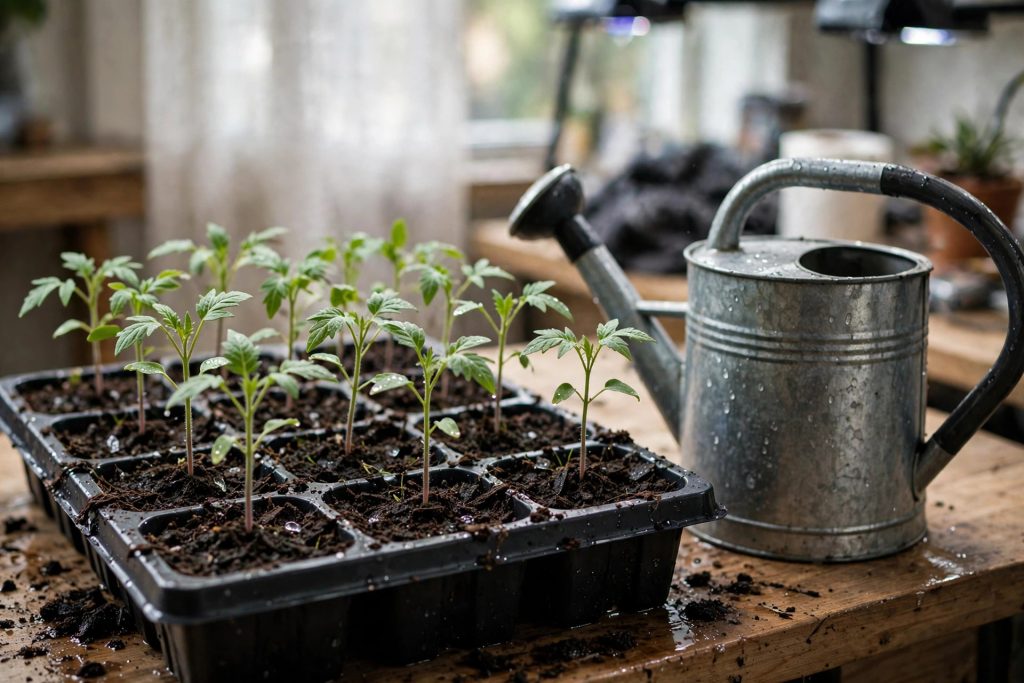
Feeding needs the same restraint. Seedlings draw their first energy from the nutrients stored in the seed, and they do not need fertilizer until they have several sets of true leaves. When you do feed, use a weak water-soluble fertilizer at one quarter strength, once a week, and water with plain water the rest of the week. The University of Maryland Extension adds that most potting mixes contain enough fertilizer for at least six weeks without any extra feed. Water from the bottom when you can, by setting the tray in a shallow pan of water and letting the mix wick it up, then drain the excess.
How to Rescue Leggy Tomato Seedlings
Most leggy tomato seedlings can be saved, because tomatoes grow roots along any part of the stem that touches soil. Purdue Extension states the reason plainly: we can usually get away with planting tomatoes deeper, since they will root along the stem. Work through the steps in order, and do the first three today.
Step 1: Fix the light now
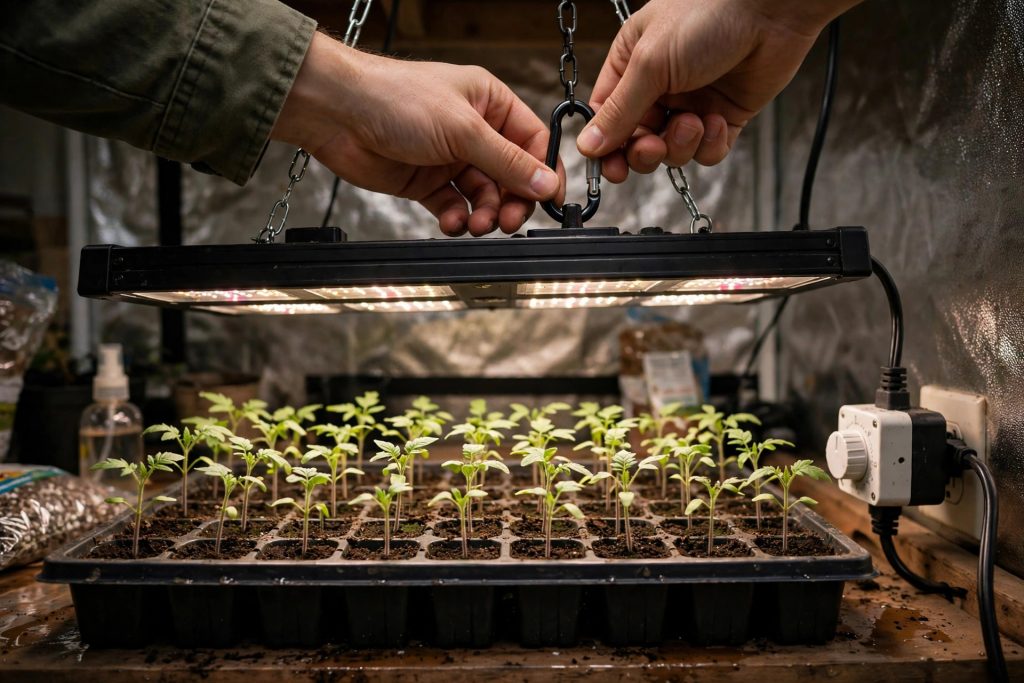
Lower the light to 2 to 4 inches above the leaves for a fluorescent fixture, or to the maker’s height for an LED panel, and set the timer to 14 to 16 hours a day. This is the single most important step. New growth should come in shorter and thicker within a week. The University of Minnesota Extension says standard fixtures with two cool white fluorescent tubes give plants adequate light and are inexpensive.
Step 2: Cool the tray down
Take the tray off the heat mat and move it to a spot at 60 to 70 degrees, checking with a thermometer at seedling height, because it is cool and stable.
Step 3: Add air movement
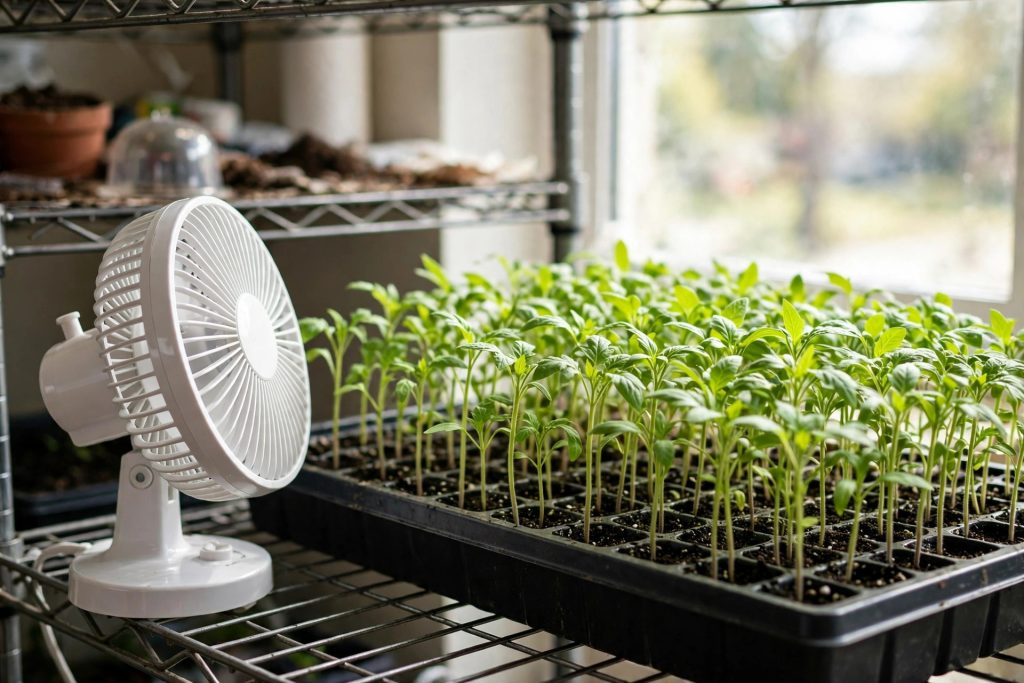
Still air grows soft stems, and gentle movement makes them thicker. Set a small fan on low a few feet from the tray and run it for a few hours a day. The University of Maryland Extension gives the hands-on version: gently brushing the tops of tomato transplants with your hand or a wooden stick will help control their height and increase stockiness.
Step 4: Thin and give them room
If the tray is still crowded, thin to one seedling per cell now, snipping the extras at the soil line, and spread the plants out. Pot up any plant that has outgrown its cell into a pot 1 to 2 inches wider.
Step 5: Pot up deeper
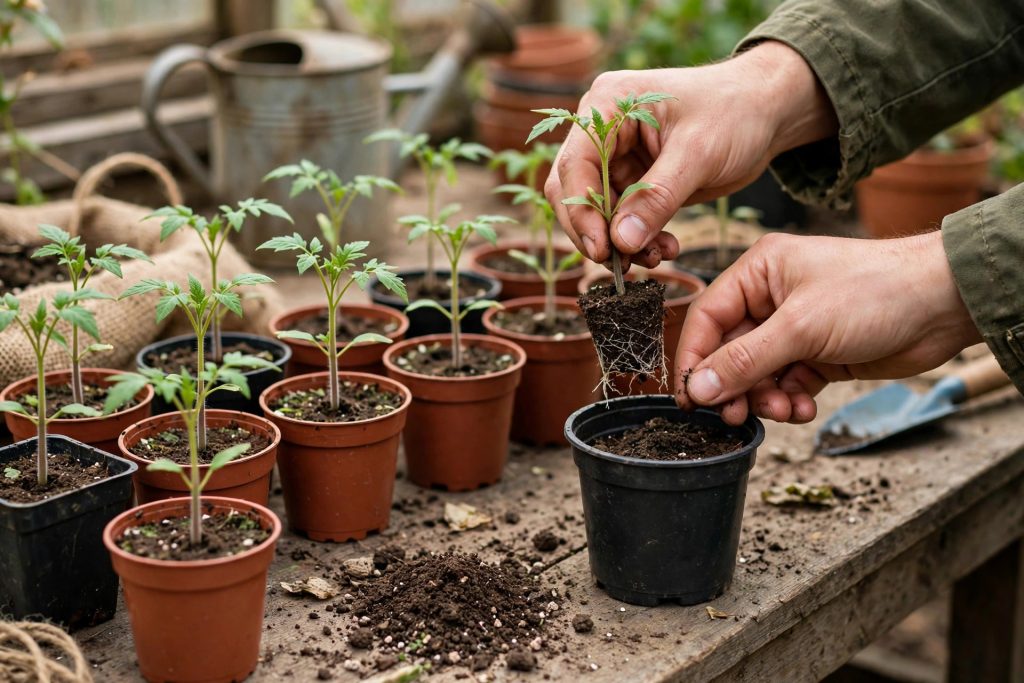
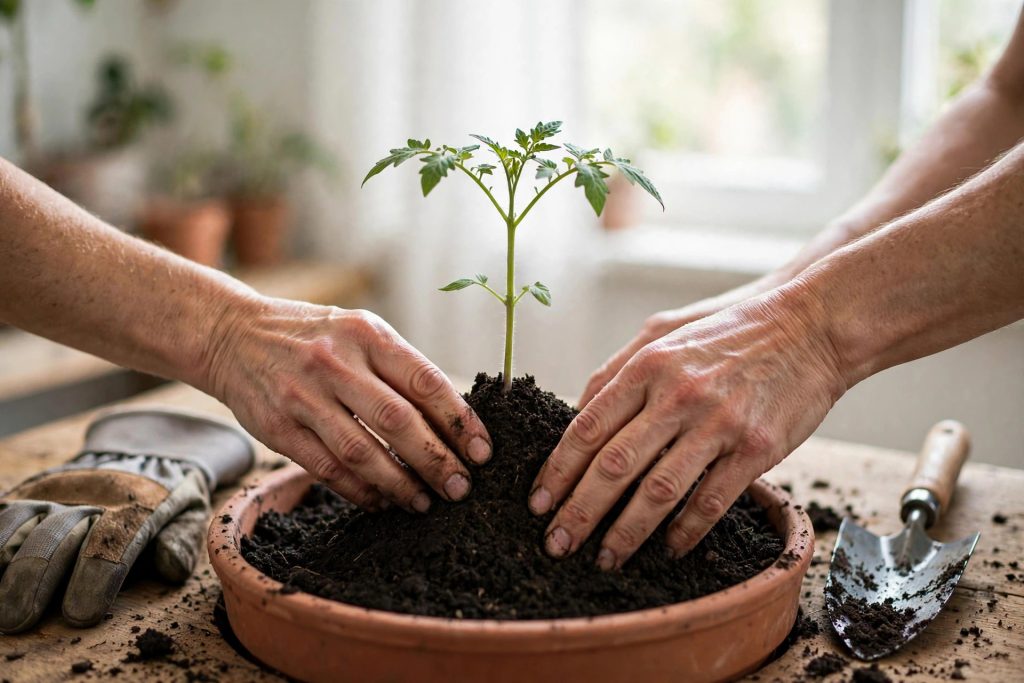
This step uses the tomato’s special trick: bury most of the bare stem when you pot up. Maryland describes the method: set the seedlings so that the leaves and growing point are only slightly above the soil line, because most of the stem can be buried. Strip off the lower leaves, set the plant into a deeper pot so only the top two or three sets of leaves stay above the mix, and water it in.
Step 6: Plant deep or trench at planting time
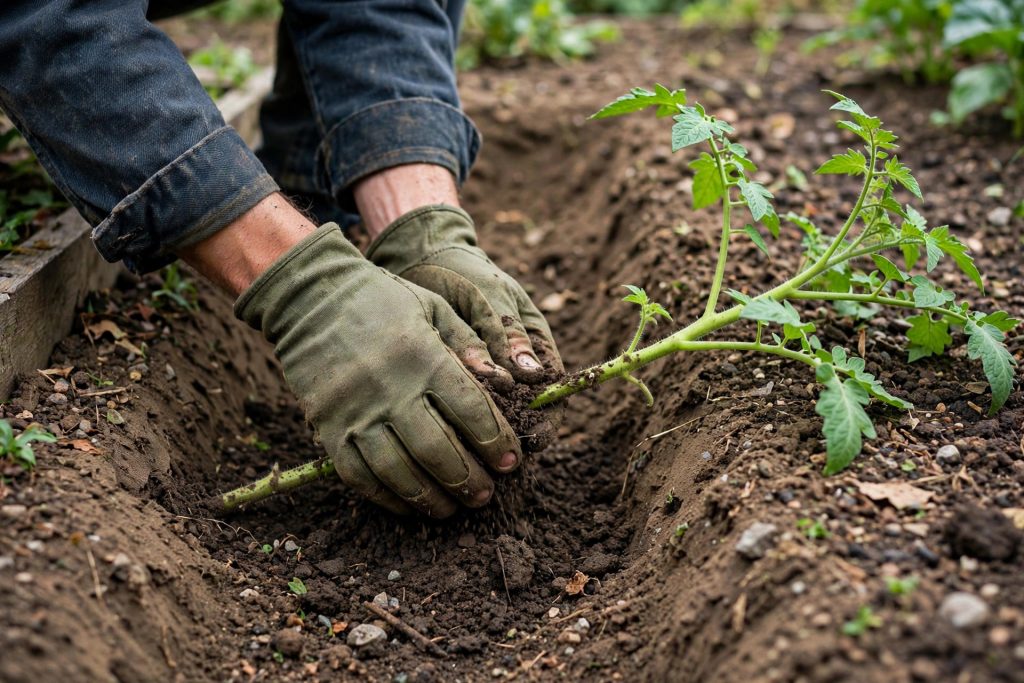
At planting time, bury the stem again. Purdue advises setting leggy tomato transplants deeper, and laying them at an angle in a trench if they are very tall, so the roots are not placed too deeply, where the soil is cooler and holds less oxygen. Dig a trench for the bare stem, strip off any leaves that would sit below the soil, lay the plant at an angle with the top leaves above the surface, and cover the stem. In a few weeks the top bends upright and looks normal.
| How bad is it | What to do | What to expect |
|---|---|---|
| Mildly leggy: stems a little long, leaves green, plant stands alone | Fix the light, cool the tray, add a fan or brush the tops daily | New growth comes in shorter and thicker within a week |
| Moderately leggy: stems 6 to 8 inches, leaning, leaves small | Mild fixes, then pot up deeper, burying the stem to just below the top leaves | Plant looks shorter at once, roots grow along the buried stem |
| Very leggy: stems 10 inches or more, flopping over, leaves pale | All of the above, then trench plant at planting time | Top bends upright in a week or two, buried stem roots along its length |
| Stem pinched and dark at the soil line, plant collapsed | Damping off, not legginess: remove the plant, start fresh | The plant cannot be saved |
| Stem snapped or bent flat, leaves wilted and dry | Stem cannot heal: remove the plant, sow more seed | A fresh sowing is faster than nursing it |
One rule runs through the whole rescue: burying the stem deeper works for tomatoes only. Peppers, eggplant, and most other crops should go in at the same depth they grew in the pot, because a buried stem may rot.
When to Start Over
Sometimes the honest answer is to sow again, and it is better to decide that early. Start over if the stem is pinched and dark at the soil line, or if it has snapped. If the leaves have gone yellow and papery, check the watering, the roots, and whether any disease signs are present first, because yellow leaves alone do not mean the plant cannot be saved. If a seedling still cannot stand on its own after a week under good light and cool air, look at the stem, the roots, and whether any new growth is coming before you decide: a firm stem with healthy roots and fresh leaves at the top is still worth keeping, while a soft or dark stem with no new growth is not.
Check the calendar before you decide. Tomatoes need only 5 to 6 weeks indoors, so if your last frost is still more than six weeks away, a fresh sowing has plenty of time. Sow the new batch under the fixed light setup from day one, one seedling per cell. If the last frost is less than four weeks away, buying a few stocky transplants may be the better move. Purdue advises looking for short, stocky plants with a thick stem, and avoiding plants that have already begun to flower or set fruit.
Prevention Checklist for the Next Tray
Legginess is almost entirely preventable. Run through the list before you sow, not after the seedlings stretch.
- Sow tomatoes 5 to 6 weeks before your average last frost date, and write the date down before you open the seed packet.
- Hang the light on chains before you sow, and set it 2 to 4 inches above the soil for a fluorescent fixture, or at the maker’s height for an LED panel.
- Put the timer on 14 to 16 hours a day, and give the plants a dark period every night.
- Keep the tray at 60 to 70 degrees after germination, and take it off the heat mat the day the seedlings emerge.
- Sow two to three seeds per cell and thin to one seedling per cell with scissors once the first true leaves appear.
- Pot up into larger containers when the first true leaves appear, and give each plant 9 to 16 square inches of space.
- Water when the surface feels dry, and wait to feed until the plants have several sets of true leaves.
- Run a small fan on low for a few hours a day, or brush the tops lightly with your hand once or twice a day.
- Check the tray from above once a week: if you cannot see potting mix between the plants, they are too close together.
Leggy Tomato Seedlings: Cause and Fix at a Glance
| Cause | Sign | Fix |
|---|---|---|
| Not enough light | Tall, pale stems leaning toward the window | Grow light close above the leaves, 14 to 16 hours a day |
| Light too far away or too few hours | Long stems even under a grow light | Lower the fixture, set the timer to 14 to 16 hours |
| Tray too warm | Soft stems, heat mat still on | Take the tray off the heat mat, move to 60 to 70 degrees |
| Crowded seedlings | Every plant leggy, leaves overlapping | Thin to one seedling per cell with scissors |
| Started too early | Plants shot up in week five or six | Pot up deeper, cool the tray; sow on time next year |
| Too much water and feed | Tall and floppy, yellow leaves, mix always wet | Let the surface dry between waterings, stop feeding |
| Damping off, not legginess | Stem pinched and dark at the soil line | Remove the plant, improve air and drainage, start fresh |
Final Thoughts
Tomato seedlings leggy on a windowsill are not a failure. They are a message, and the message is almost always about light. Give them a close light on a timer, a cool tray, one plant per cell, and a sowing date counted back from the last frost, and the next tray will grow short, stocky, and strong. If the plants you have are already tall, fix the light today, cool the tray, and pot them up deeper, because a tomato grows roots along a buried stem.
References
- Purdue University, Indiana Yard and Garden, Consumer Horticulture. Leggy Tomatoes. Supports low light in most homes causing tomatoes to stretch and get long and leggy, warm temperatures aggravating spindly growth, starting seeds too early as the likely culprit, setting transplants deeper because tomatoes root along the stem, and planting at an angle in a trench. https://www.purdue.edu/hla/sites/yardandgarden/leggy-tomatoes/?cat=21
- University of Minnesota Extension. Starting seeds indoors. Supports lack of light as the major cause of elongated, skinny stems, keeping lights no more than 4 inches above the tops with 2 inches ideal, 12 to 16 hours of light daily with a dark period each night, a windowsill as a poor location for starting seeds, and thinning to one seedling per cell by cutting extras at ground level with scissors. https://extension.umn.edu/garden-and-home/yard-and-garden/gardening-in-minnesota/starting-seeds-indoors
- Clemson University Cooperative Extension Service, Home and Garden Information Center. FAQs about Starting Vegetable Seeds Indoors. Supports window light as not sufficient, producing leggy seedlings that lean toward the light, fluorescent lights 2 to 4 inches above the seedlings for 12 to 16 hours a day, soil at 65 to 75 degrees for germination, tomatoes sown 6 weeks before the last frost, and thinning to one seedling per cell. https://hgic.clemson.edu/faqs-about-starting-vegetable-seeds-indoors/
- Iowa State University Extension and Outreach, Yard and Garden. Addressing Issues with Starting Seeds Indoors. Supports tall, spindly growth coming from poor light, excessive watering, high temperatures, excessive fertilization, and crowded conditions, moving seedlings to 60 to 70 degrees right after germination, a 4-foot LED shop fixture at 18 inches giving at least 3,000 lumens for 14 hours a day, and seedlings started too early getting large and lanky. https://yardandgarden.extension.iastate.edu/how-to/addressing-issues-starting-seeds-indoors
- University of Maryland Extension. Starting Vegetable Seeds Indoors. Supports window light seldom being enough for strong seedling growth, tomatoes as prone to stretching, 55 to 60 degree nights and 65 to 70 degree days after germination, fixtures 2 to 6 inches above plants for 14 to 16 hours a day, brushing tomato transplant tops to control height and increase stockiness, potting up with most of the stem buried, sowing tomatoes 5 to 6 weeks before planting out into stocky 8 to 10 inch plants, and trenching very tall transplants. https://extension.umd.edu/resource/starting-vegetable-seeds-indoors
Frequently Asked Questions
Why are my tomato seedlings leggy?
Tomato seedlings go leggy when they do not get enough light, and the usual setup is a windowsill with weak, one-sided light. Warm air, crowding, an early sowing date, and too much water or feed make it worse. The fix is a grow light hung close above the leaves for 14 to 16 hours a day, a cooler tray at 60 to 70 degrees, and one seedling per cell.
Can leggy tomato seedlings be saved?
Yes, in most cases. Fix the light first, cool the tray, and add gentle air movement so the stems thicken. Then pot the seedlings up deeper, burying most of the bare stem. At planting time, set them deep or lay the stem in a shallow trench with only the top two or three sets of leaves above the soil. Start over only if the stem is pinched and dark at the soil line, which is damping off, or if the stem has snapped.
How close should grow lights be to tomato seedlings?
For a standard fluorescent fixture, hang the light 2 to 4 inches above the leaves and raise it as the plants grow. For an LED panel, follow the height on the maker’s label, because powerful LEDs can scorch leaves if they hang too close. Run the lights 14 to 16 hours a day on a timer, and give the plants a dark period every night.
How many hours of light do tomato seedlings need?
Fourteen to 16 hours a day is a practical starting point, though some recommendations vary. Minnesota gives 12 to 16 hours, Clemson gives 12 to 16 hours, and 16 to 18 hours of total light in its longer factsheet, Iowa State gives 14 hours, and Maryland gives 14 to 16 hours. Do not leave the lights on 24 hours.
Should I bury leggy tomato seedlings deeper?
Yes. Tomatoes are one of the few crops that grow roots along a buried stem, so burying the stem turns the problem into a bigger root system. When you pot up, set the seedling so only the top two or three sets of leaves stay above the mix. At planting time, dig a deep hole or a shallow trench and lay a very tall stem sideways. Do not use this trick on peppers, because a buried stem may rot.
What temperature should tomato seedlings grow at?
After germination, keep tomato seedlings at 60 to 70 degrees. Maryland gives 55 to 60 degrees at night and 65 to 70 degrees during the day after germination, and Iowa State says to move seedlings to 60 to 70 degrees right after germination. Take the tray off the heat mat the day the seedlings emerge. Seeds do want warmth to sprout, but the seedlings that follow want it cooler.

Thesis Link : https://saulibrary.edu.bd/daatj/public/uploads/BAU200601_19-Pp_5.pdf
- Best Tomato Varieties to Grow from Seed - November 15, 2026
- Why Are My Tomato Seedlings Leggy - November 15, 2026
- 10 Best Mulches for Vegetable Gardens - November 14, 2026