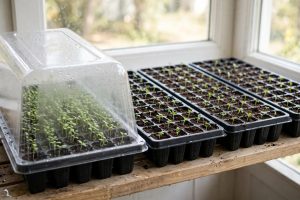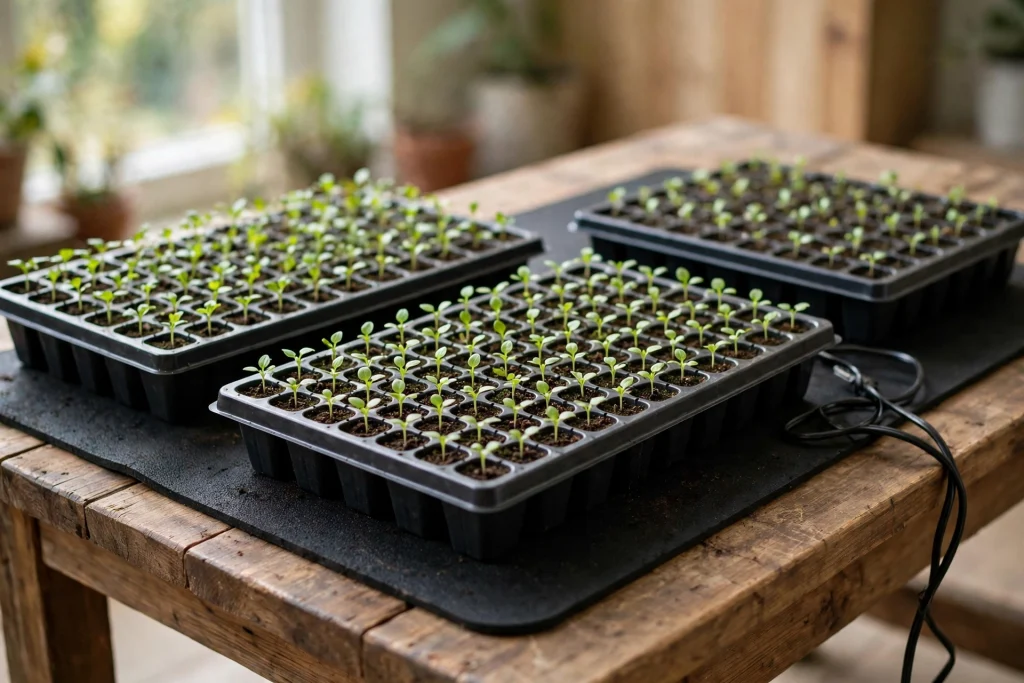

A cold windowsill can stall a whole tray of seeds. The mix looks damp, the packet promised sprouts in a week, and nothing happens. A seedling heat mat fixes the most common cause of that delay: soil that is cooler than the seed expects. It sits under the tray, warms the root zone from below, and gives warm season crops the steady temperature they need to germinate.
This guide compares 10 seedling heat mats for US home growers. It covers single tray mats for a first seed starting setup, two packs for growers who start several trays at once, thermostat combos for peppers and other heat lovers, and large mats for four tray benches. No prices are listed here, because prices change by retailer and season. No affiliate links are included. The ratings are editorial scores based on verified specifications, control type, size, safety listing, and reported owner feedback patterns, not on hands on lab testing by Agribloom.
If you only start one tray of tomatoes or peppers each spring, the short answer is simple: buy a 10 by 20.75 inch mat with a digital thermostat. It fits a standard 1020 tray, it lets you set a real soil temperature, and it prevents the two classic mistakes, soil that is too cold in a basement and soil that gets too warm in a sunny room. If you start four trays at once, skip the single mats and buy one large mat or a thermostat that can run several mats safely.
Table of Contents
- Quick Recommendation
- Best Seedling Heat Mats Compared
- 1. VIVOSUN Seedling Heat Mat and Digital Thermostat Combo
- 2. AC Infinity SUNCORE S3 Seedling Heat Mat
- 3. Seedfactor Seedling Heat Mat, 2 Pack
- 4. MARS HYDRO Seedling Heat Mat and Digital Thermostat Combo
- 5. BN-LINK Seedling Heat Mat
- 6. iPower Seedling Heat Mat, 2 Pack
- 7. VIVOSUN 48 Inch Seedling Heat Mat and Digital Thermostat Combo
- 8. iPower 48 Inch Seedling Heat Mat with Controller
- 9. Hydrofarm Jump Start Seedling Heat Mat, 20 by 48 Inches
- 10. Hydrofarm Jump Start Germination Station with Heat Mat
- How to Choose a Seedling Heat Mat
- Germination Temperatures by Crop
- How We Chose These Mats
- How to Use a Heat Mat Safely
- Common Seedling Heat Mat Mistakes
- Final Choice
- References
- Frequently Asked Questions
Quick Recommendation
For most growers, start with the VIVOSUN 10 by 20.75 inch mat and digital thermostat combo. It fits one standard 1020 tray, it uses 20 watts, it is IP67 rated, and its thermostat lets you set and hold a soil temperature instead of guessing from room temperature. That control matters most for peppers, eggplant, and tomatoes, which germinate best in warm soil.
For a second tray on a budget, the Seedfactor 2 pack gives you two fixed warmth mats at a low cost per mat. You will still want a separate thermostat if your room temperature swings a lot, but for a steady indoor room they are a practical pair.
For cuttings and growers who dislike digital menus, the AC Infinity SUNCORE S3 uses a simple low, medium, and high dial. The dial ramps heat output instead of switching fully on and off, which helps avoid sharp temperature swings.
For a four tray bench, the VIVOSUN 48 inch combo is the cleanest single purchase. It covers four standard trays, it uses 105 watts, and it includes thermostat control. If you already own a thermostat, the Hydrofarm Jump Start 20 by 48 inch mat is the simpler large option, with UL listing and a 6 foot cord.
For a complete first setup, the Hydrofarm Jump Start Germination Station bundles a 17 watt mat with a watertight tray, a 72 cell insert, and a 7 inch humidity dome. It is a good gift style starter kit, though serious growers will outgrow the single tray size fast.
Best Seedling Heat Mats Compared
| Product | Size | Control | Best For | Our Rating |
|---|---|---|---|---|
| VIVOSUN Seedling Heat Mat and Digital Thermostat Combo | 10 x 20.75 in | Digital thermostat | Most growers, one tray | 9.6 |
| AC Infinity SUNCORE S3 Seedling Heat Mat | 10 x 20.75 in | Low, medium, high dial | Cuttings and simple control | 9.3 |
| Seedfactor Seedling Heat Mat, 2 Pack | 10 x 20 in each | Fixed warmth | Two trays on a budget | 9.2 |
| MARS HYDRO Seedling Heat Mat and Digital Thermostat Combo | 10 x 20.75 in | Digital thermostat | Grow tent growers | 9.1 |
| BN-LINK Seedling Heat Mat | 10 x 20.75 in | Fixed warmth | Simple single tray setup | 9.0 |
| iPower Seedling Heat Mat, 2 Pack | 10 x 20.5 in each | Fixed warmth | Two trays, rugged use | 8.9 |
| VIVOSUN 48 Inch Seedling Heat Mat and Digital Thermostat Combo | 48 x 20.75 in | Digital thermostat | Four tray benches | 9.5 |
| iPower 48 Inch Seedling Heat Mat with Controller | 48 x 20 in | Digital thermostat, 40 to 108 F | Large runs with control | 9.4 |
| Hydrofarm Jump Start Seedling Heat Mat | 20 x 48 in | Fixed warmth | Simple large bench | 9.0 |
| Hydrofarm Jump Start Germination Station with Heat Mat | 11 x 22 in tray | Fixed warmth | Complete starter kit | 8.8 |
1. VIVOSUN Seedling Heat Mat and Digital Thermostat Combo
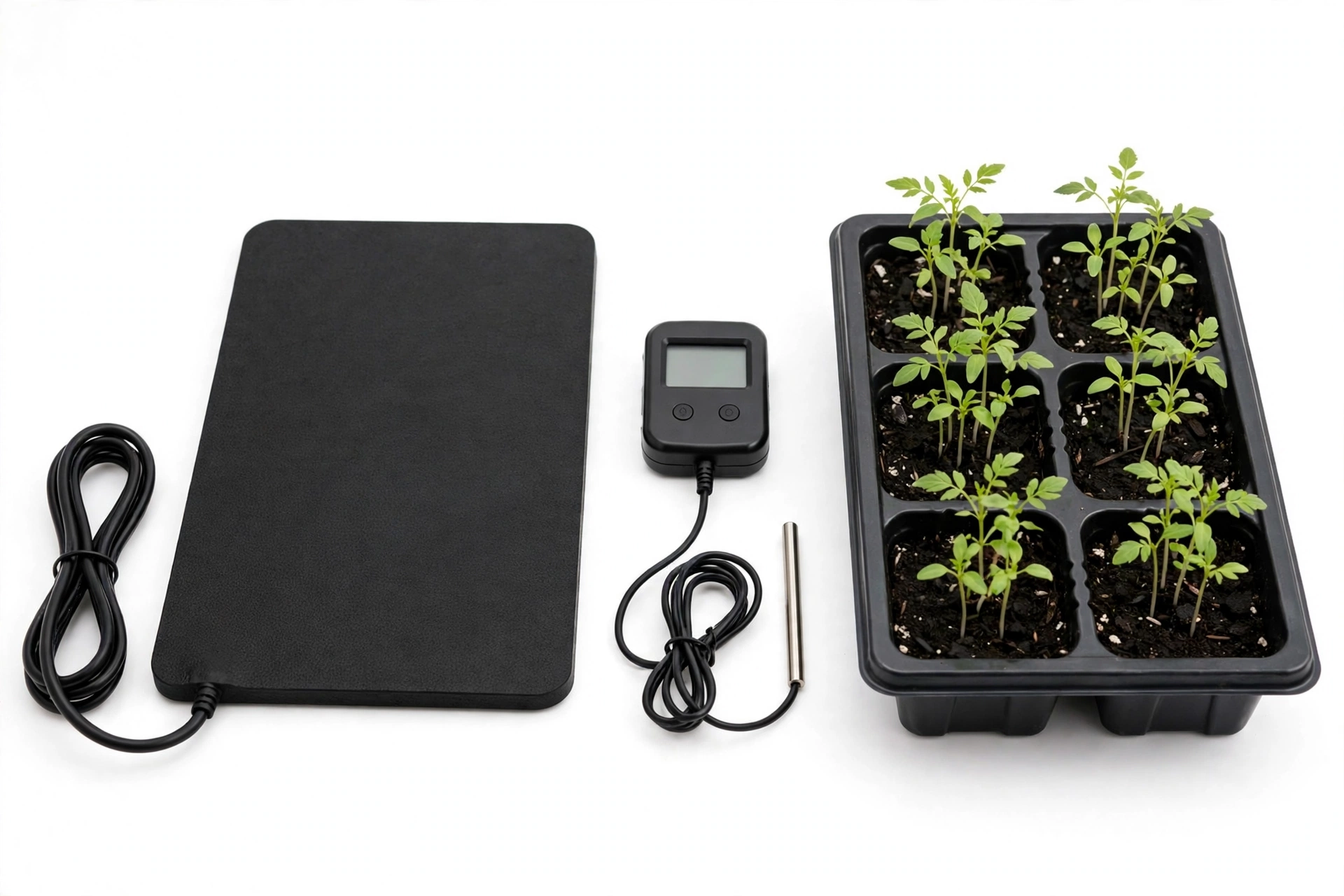
Best for most growers, one standard tray.
The VIVOSUN combo pairs the familiar 10 by 20.75 inch mat with a digital thermostat and a soil probe. The mat itself uses 20 watts on 120 volt power, it is made from flexible PVC, and it carries an IP67 waterproof rating, so splashes and bottom watering cleanup are not a worry. Do not submerge the mat, even with that rating. Wipe it clean and keep standing water off the controller.
In use, the thermostat is the point. A fixed warmth mat raises soil about 10 to 20 degrees Fahrenheit above room temperature, which is fine in a steady 68 degree room but unpredictable in a cold basement or a warm sunroom. With this combo you set a target, place the probe in the mix about 1 to 1.5 inches deep in a representative cell, and let the controller hold that target.
VIVOSUN describes the mat temperature range as 68 to 86 degrees Fahrenheit, with a thermostat range of 32 to 104 degrees Fahrenheit. That distinction matters: the thermostat can be set wider than the mat will usefully hold in a cold room, so check soil temperature with a thermometer during the first run.
This is the mat to buy if you grow peppers, eggplant, or tomatoes and you want one purchase that covers the whole germination window. It also fits the standard 1020 tray used in the seed starting trays guide, so your tray, dome, and mat line up without overhang.
Quick verdict: the best all round single tray choice, because thermostat control removes the main variable in seed starting, soil temperature.
2. AC Infinity SUNCORE S3 Seedling Heat Mat
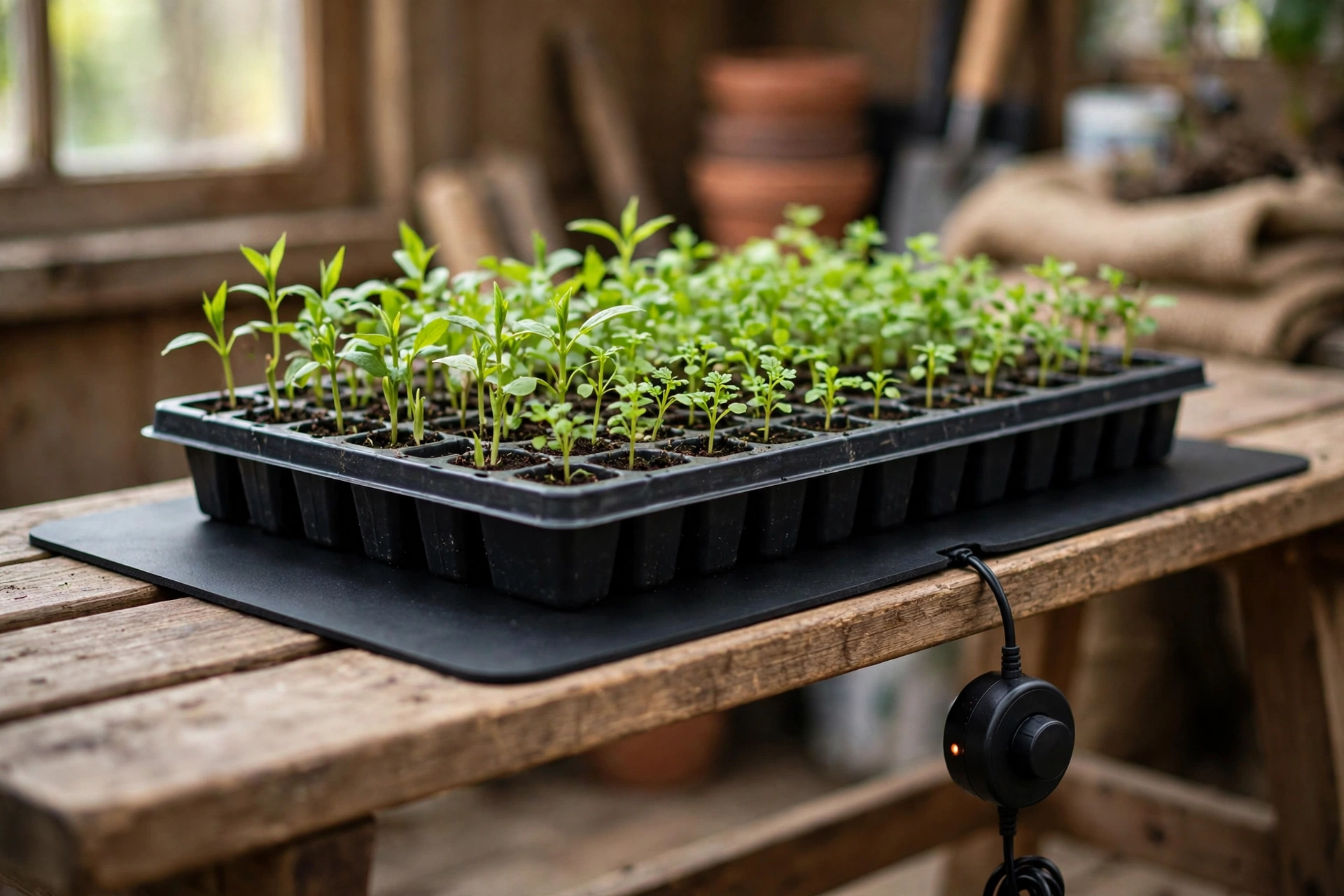
Best for cuttings and growers who prefer a dial to a digital menu.
The SUNCORE S3 is also a 10 by 20.75 inch mat, and it uses 20 watts. Its difference is control. Instead of a digital thermostat with a probe, it has a built in dial with low, medium, and high settings. The manual describes the dial as gradually adjusting heat level, and AC Infinity uses far infrared film for even heat. The mat is built from quad layer PVC and is IP67 rated, and it is only 0.09 inch thick, so it rolls up tight for storage and fits a narrow shelf gap.
The trade off is precision. There is no digital readout of soil temperature, so you must use a soil thermometer to learn what low, medium, and high mean in your room. In testing summaries, Bob Vila reported a temperature range of 80 to 87 degrees Fahrenheit for AC Infinity mats used for cuttings, which shows why a thermometer check matters: the same dial setting will read differently in a 60 degree basement and a 72 degree living room.
Choose this mat if you root cuttings, you start a modest number of trays, and you want steady, simple heat without programming a controller. Pair it with a separate thermostat later if you move to heat sensitive crops.
Quick verdict: a well built dial mat for growers who value simplicity and even heat over exact set points.
3. Seedfactor Seedling Heat Mat, 2 Pack
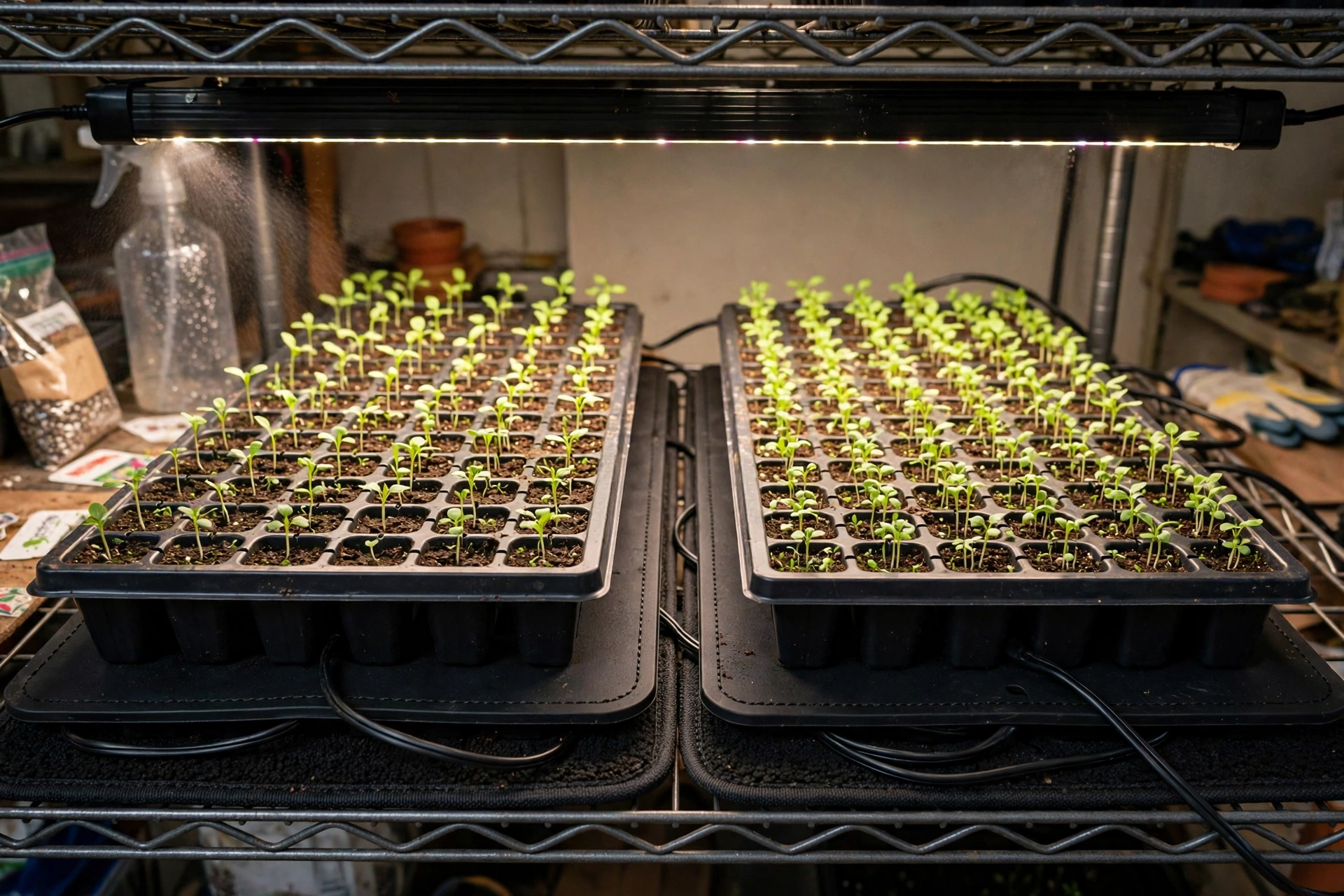
Best for two trays on a budget.
Seedfactor sells this mat as a two pack, each mat measuring 10 by 20 inches and using 17.5 watts. The mats are MET certified to UL 499, they are waterproof, and they hold a stated range of 70 to 85 degrees Fahrenheit. Two mats cover two standard trays for less than two separate single purchases usually cost, which makes them a smart pick for succession sowing, one tray of brassicas and one tray of flowers, for example.
The limit is the same as with every fixed warmth mat: there is no thermostat in the box. In a room that stays near 68 to 72 degrees, that is usually fine. In a cold garage or an unheated spare room, soil temperature will follow the room, and germination will be slower than the packet suggests. A single separate thermostat can run both mats if the controller rating allows it, so check the controller wattage limit before you daisy chain anything.
Quick verdict: the best value pair for steady indoor rooms, with a thermostat as the obvious upgrade.
4. MARS HYDRO Seedling Heat Mat and Digital Thermostat Combo
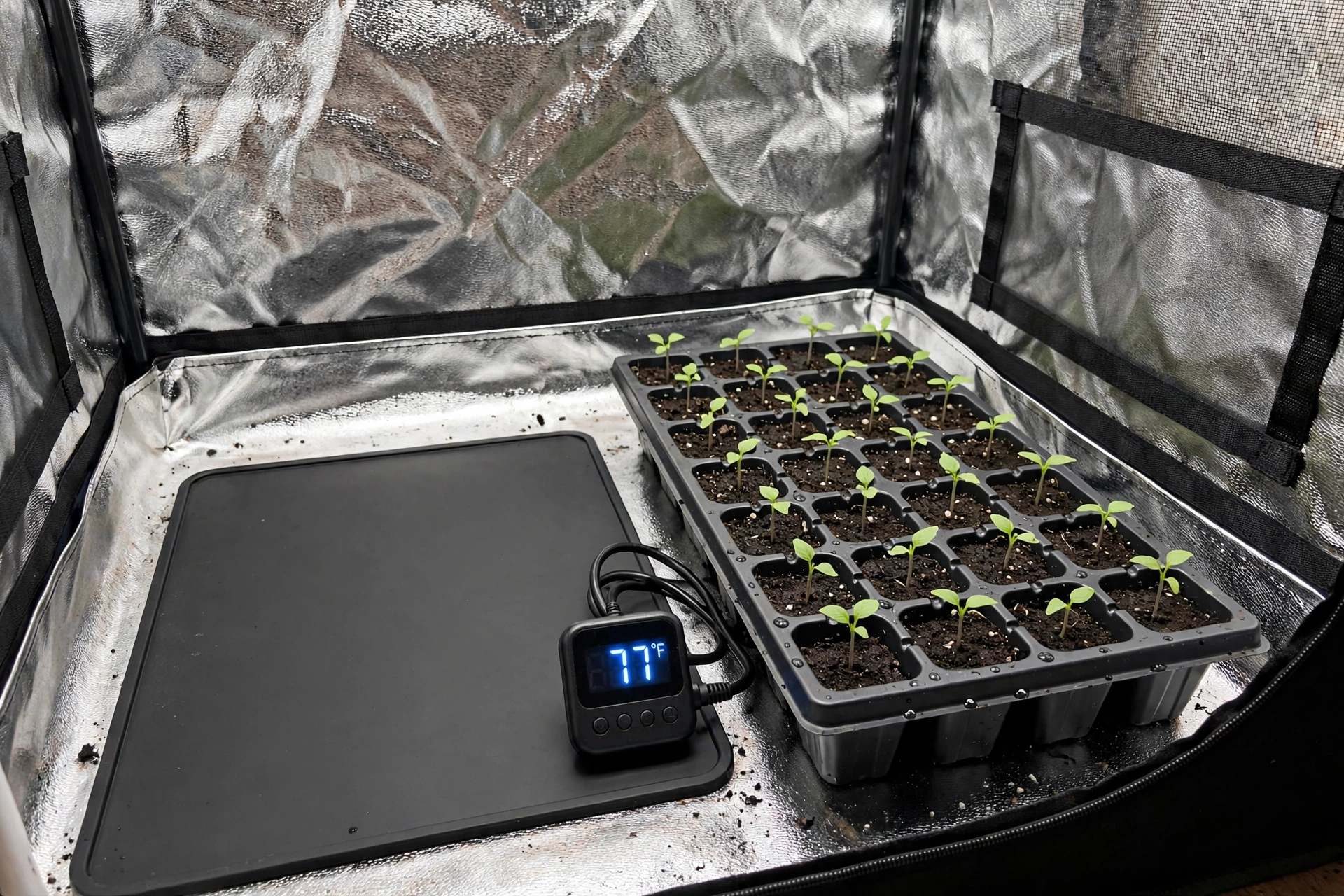
Best for grow tent growers.
MARS HYDRO pairs a 10 by 20.75 inch mat with a digital thermostat, a remote probe, and overheat protection. Listings for the combo describe a 20 watt mat, a thermostat range of 32 to 110 degrees Fahrenheit, and UL and FCC certification. The mat uses far infrared heating, which the maker presents as a gentler, more even heat than a simple wire coil.
For a grow tent, the appeal is integration. The mat fits the same 1020 footprint as most propagation trays, the controller display is easy to read in a tent, and the probe lets you confirm root zone temperature instead of trusting tent air temperature. Tent air can read warm under lights while the mix below stays cool, especially on a metal shelf, so probe placement in the mix, not in the air, is essential.
Watch the same caution as with every thermostat combo: set the target for the crop, not for the maximum the controller allows. Lettuce and spinach will stall or go dormant in soil held near 80 degrees, while peppers need that warmth. Group crops by temperature, or use a second mat for cool season trays.
Quick verdict: a strong thermostat combo for tent growers who already think in terms of controlled environments.
5. BN-LINK Seedling Heat Mat
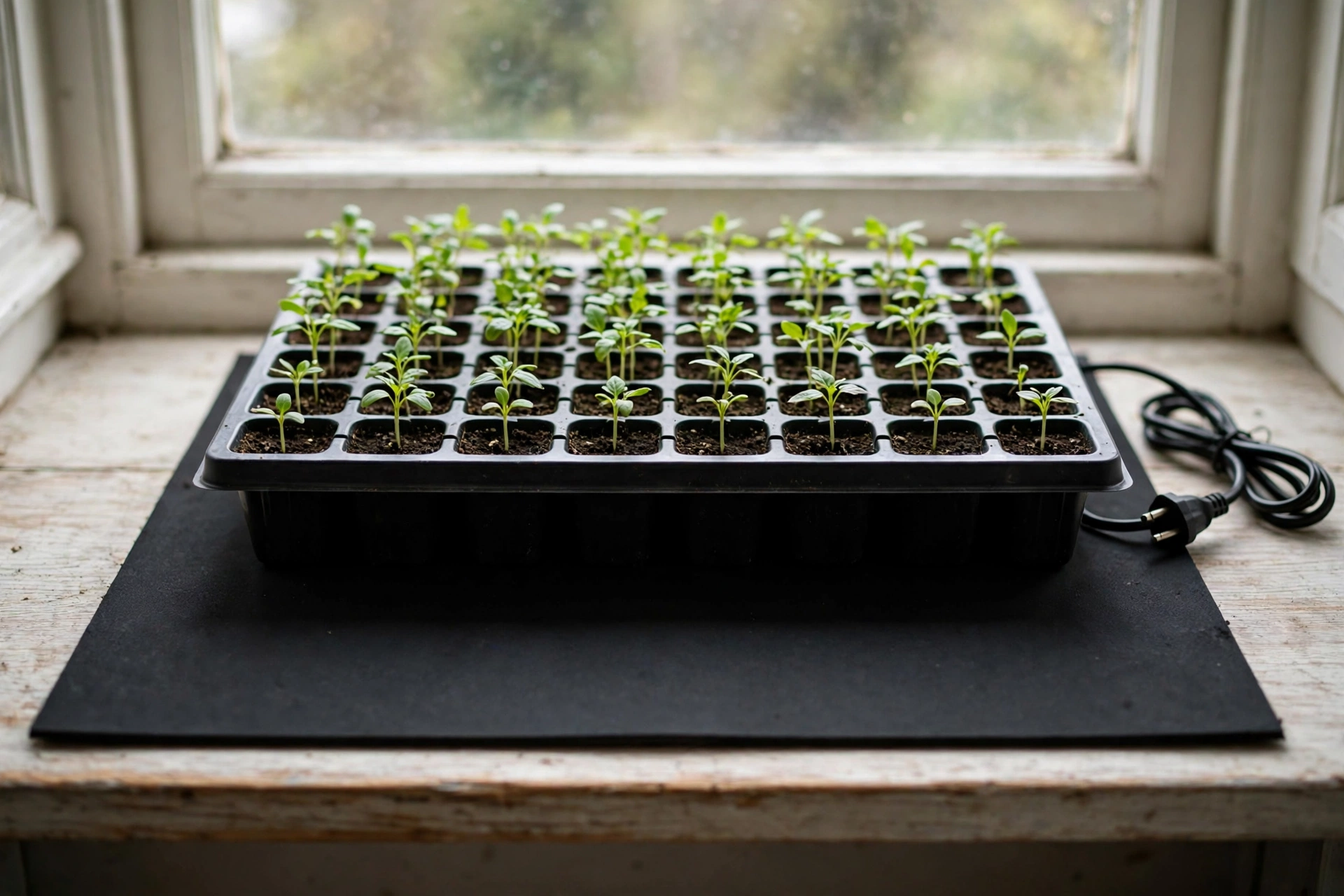
Best for a simple single tray setup.
BN-LINK makes a straightforward 10 by 20.75 inch mat rated at 20 watts, with a stated range of 70 to 85 degrees Fahrenheit, IP67 waterproof PVC, and ETL listing. It fits a standard 1020 tray exactly, it wipes clean, and it has no controller to learn. For a first time seed starter in a heated home, that simplicity is a feature, not a flaw.
The honest limit is control. Without a thermostat, the mat will warm soil relative to room temperature, and a warm spring afternoon can push soil higher than you planned. That is rarely a problem for tomatoes and peppers, but it is a reason to move lettuce, spinach, and other cool season crops off the mat early, or to a separate unheated tray.
BN-LINK also sells a larger 48 by 20.75 inch mat with a digital thermostat, rated for a 40 to 108 degree Fahrenheit controller range, if you later scale up and want to stay with the same brand. For this single tray pick, though, judge it on what it is: a reliable, low fuss mat for one tray.
Quick verdict: buy this if you want the simplest possible mat and your room temperature is already steady.
6. iPower Seedling Heat Mat, 2 Pack
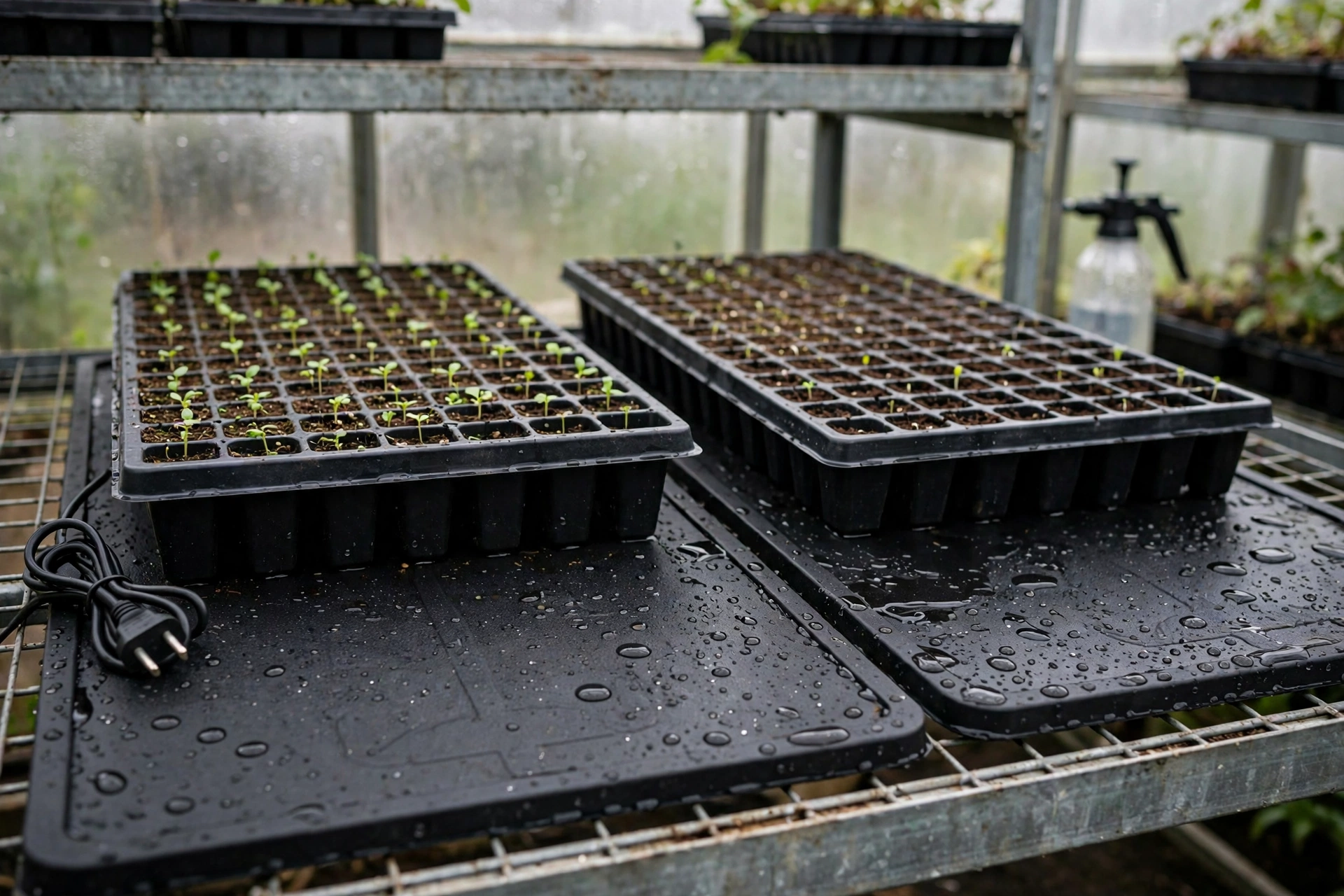
Best for two trays and rugged greenhouse use.
iPower lists its 10 by 20.5 inch mat at 17.5 watts, with heavier multi layer construction, internal insulated wiring, and a waterproof, wipe clean surface. The mats warm the root area 10 to 20 degrees Fahrenheit above ambient temperature, and they carry MET safety certification. A 5.9 foot cord gives reasonable reach to an outlet without an extension lead draped across a wet bench.
Owner feedback patterns for iPower mats often mention uses beyond seedlings, including terrariums and home brewing, which tells you two things. First, the build is sturdy enough for repeated seasonal use. Second, a mat that works for many jobs is not automatically tuned for seed germination, so a thermostat is still the right partner if you need a precise soil temperature for peppers or eggplant.
As a two pack, this is a practical choice for a grower who starts two trays at the same time every year and wants spares that survive storage, transport, and a damp greenhouse bench.
Quick verdict: a sturdy pair for repeat growers, best with a thermostat for heat loving crops.
7. VIVOSUN 48 Inch Seedling Heat Mat and Digital Thermostat Combo
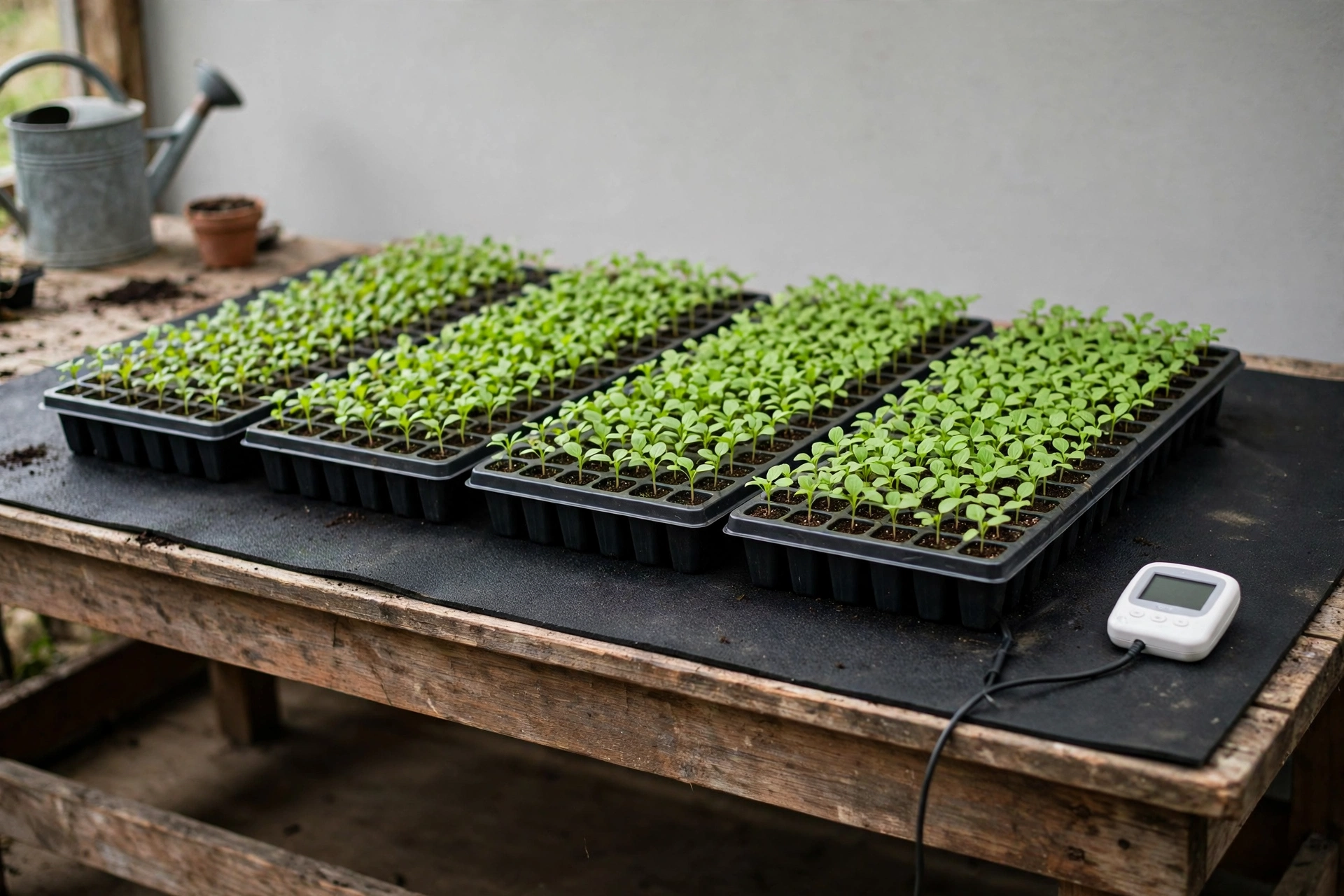
Best for four tray benches.
This is the large version of the top pick, and it solves a different problem: scale. The mat measures 48 by 20.75 inches, it uses 105 watts, it fits four standard 1020 trays side by side, and it includes a digital thermostat. The PVC construction is IP67 rated, and VIVOSUN describes the mat range as 68 to 86 degrees Fahrenheit. A carrying bag is included, which helps with off season storage, since a four foot mat is awkward to fold and stash.
A large mat only works on a flat, level bench. A sagging shelf or slatted bench creates air gaps, and cells over a gap will run cooler than cells in the center. Lay the mat on a solid board if your bench is uneven, keep the thermostat probe in a middle tray, and rotate tray positions if you notice one tray germinating days ahead of the others.
The main caution is grouping. Four trays on one mat share one temperature. Do not put lettuce on the same large mat as peppers at 80 degrees and expect both to thrive. Run cool season trays on a separate unheated bench, or set the large mat to a compromise temperature near 70 degrees and accept slower pepper germination.
Quick verdict: the cleanest large bench purchase, because one mat, one thermostat, and four trays stay in step.
8. iPower 48 Inch Seedling Heat Mat with Controller
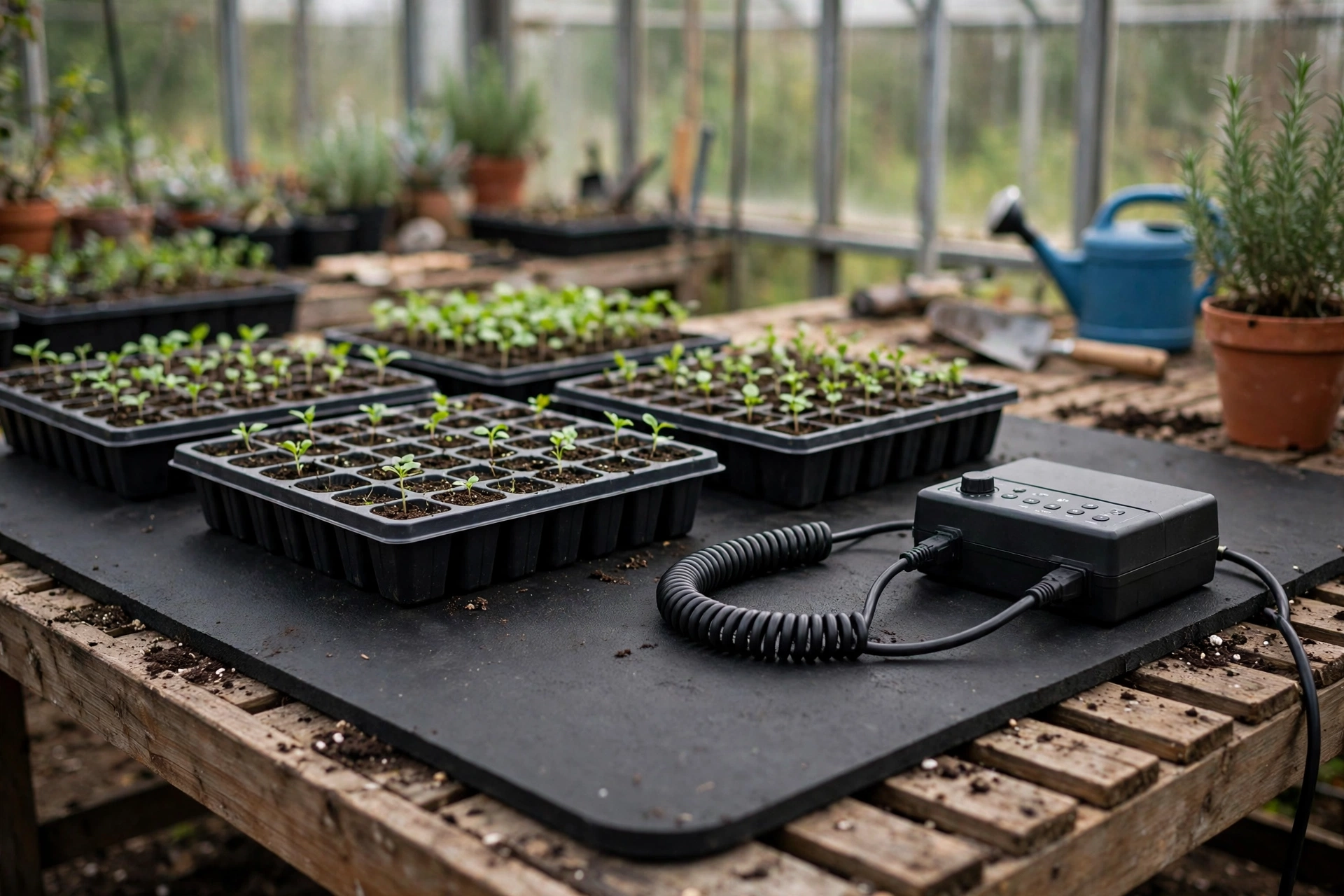
Best for large runs where you want controller flexibility.
iPower sells its 48 by 20 inch mat in a combo with a digital thermostat controller. The mat itself is listed at 100 watts, plus or minus 10 watts, and it warms the root area 10 to 20 degrees Fahrenheit above ambient temperature when used without control. The controller range is 40 to 108 degrees Fahrenheit, with a display range of 32 to 140 degrees Fahrenheit, and the controller is rated to 1,000 watts, which means it can run more than one mat if you stay within that limit and follow the maker instructions.
That controller rating is the practical advantage here. A grower with two large mats, or a large mat plus a small mat, can control them from one controller instead of buying a controller for each mat, provided the combined wattage and the probe placement make sense. Place the probe in the tray that matters most, usually the heat loving crop, and check the other trays with a soil thermometer.
The build follows the same iPower pattern as the smaller mats: waterproof, multi layer, wipe clean, with a cord near 6 feet. For a market gardener or a serious home grower starting hundreds of seedlings, that combination of size and controller headroom is worth more than a slightly lower wattage figure on paper.
Quick verdict: a flexible large mat combo for growers who plan to expand beyond one bench.
9. Hydrofarm Jump Start Seedling Heat Mat, 20 by 48 Inches
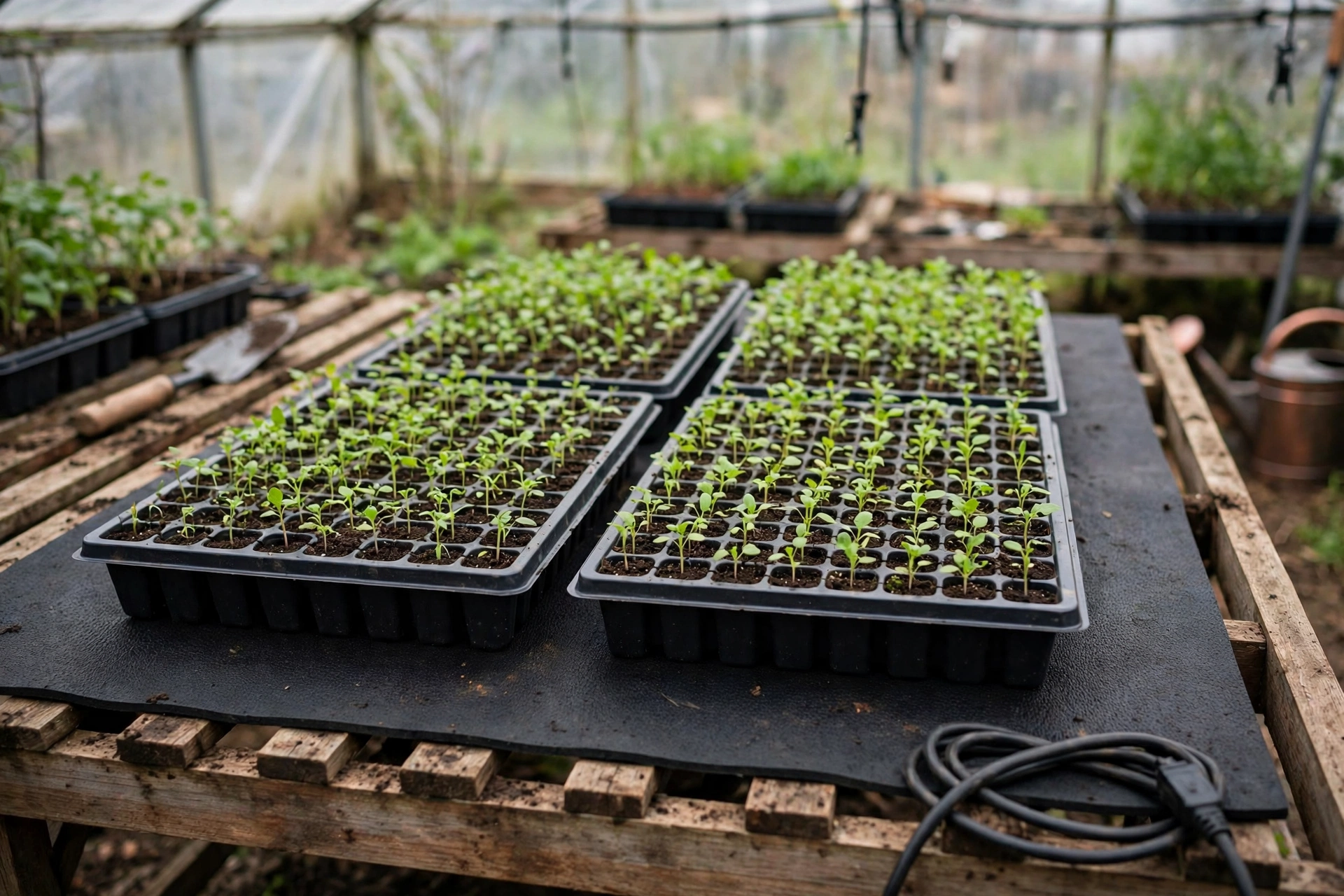
Best for a simple large bench without a controller in the box.
Hydrofarm is a long established hydroponics maker, and its Jump Start mats are UL listed, waterproof, and built for greenhouse benches. The 20 by 48 inch size covers four standard trays, it has a 6 foot cord, and it warms the root area 10 to 20 degrees Fahrenheit above ambient temperature. There is no thermostat included, so you pair it with a separate Hydrofarm or universal heat mat thermostat if you need set point control.
Why pick this over a thermostat combo? Simplicity and bench proven build. If your propagation room already has a thermostat, or you grow mostly tomatoes and brassicas in a steady room, a fixed warmth large mat is one less controller to program. If your room swings cold at night, add the thermostat, because a fixed mat cannot compensate for a 55 degree night the way a controlled mat can.
Check the mat size against your bench before ordering. A 48 inch mat needs a full four foot flat surface, and it should not overhang the bench edge, where it can bend, cool unevenly, or create a trip hazard with the cord.
Quick verdict: a dependable large mat for growers who already own a thermostat or grow in a steady room.
10. Hydrofarm Jump Start Germination Station with Heat Mat
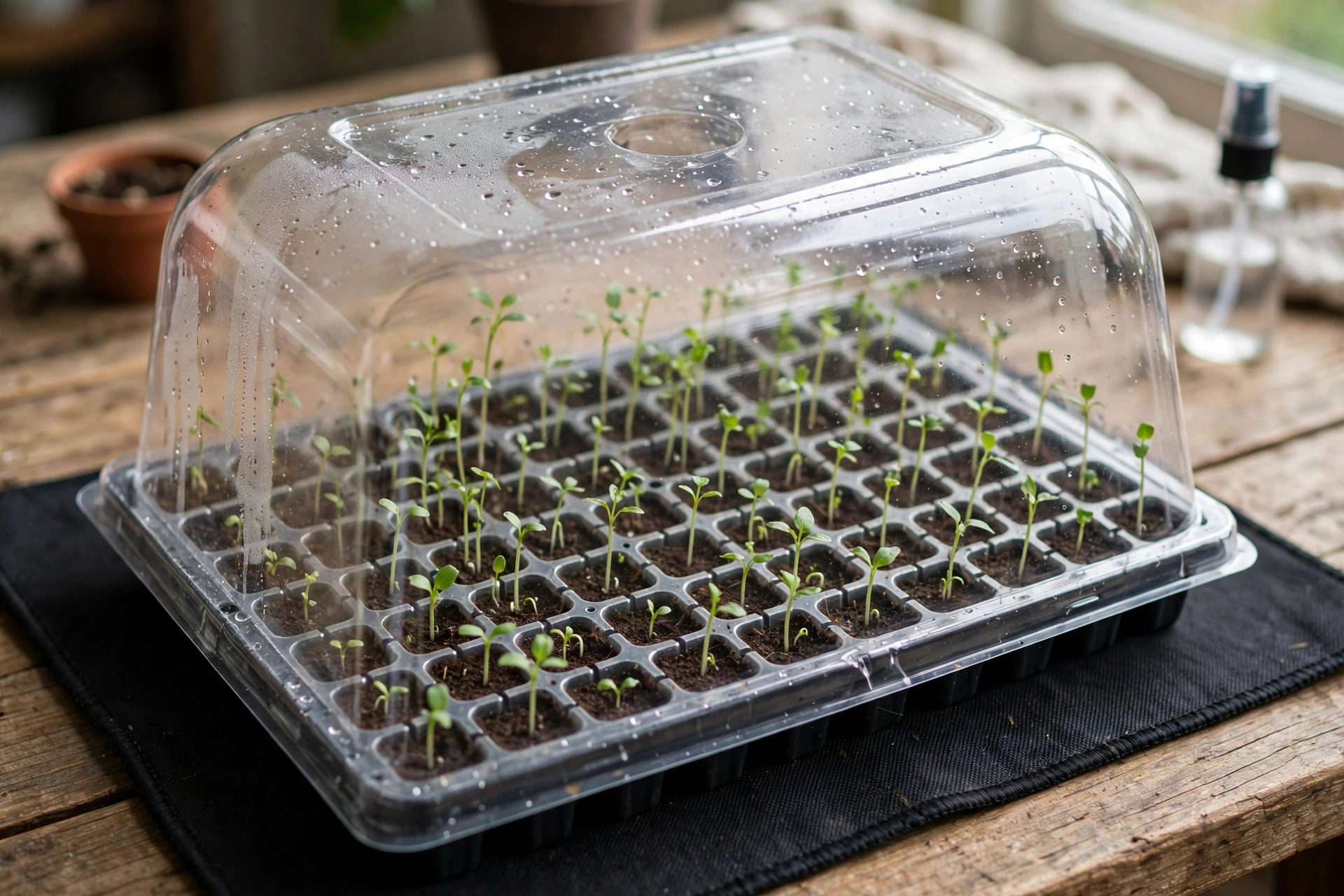
Best as a complete starter kit.
The Germination Station is not just a mat. It bundles a 17 watt, UL listed, waterproof heat mat with an 11 by 22 inch watertight base tray, a 72 cell seed insert, and a 7 inch humidity dome with adjustable vents. The mat operates 10 to 20 degrees Fahrenheit above ambient temperature, and Hydrofarm recommends a thermostat for precise regulation, which is not included.
For a beginner, the value is completeness. You do not need to match tray, insert, dome, and mat sizes, because they are sized to work together. The dome holds humidity while seeds germinate, the vents let you harden seedlings off gradually, and the watertight tray protects a windowsill or table from watering runoff.
The limit is scale. One 72 cell tray is enough for a first spring sowing, but a gardener who grows a full vegetable garden will need more trays within a season. Treat this as a starter kit that teaches the routine, then add single mats or a large mat as your garden grows. Remove the dome and move the tray off the mat once about half the seeds have germinated, so seedlings get light and air instead of continued bottom heat and humidity.
Quick verdict: the best gift or first kit, with a clear upgrade path to a thermostat and more trays.
How to Choose a Seedling Heat Mat
Match the mat to your tray count
Standard 1020 trays measure about 10 by 20 inches, and most single mats are made to that size. Count your trays first. One tray needs one single mat. Two trays need a two pack or two singles. Four trays need a 48 inch mat. A mat that is smaller than the tray leaves cold corners, and a mat that is larger than the tray wastes heat and bench space.
Thermostat or fixed warmth
A thermostat combo costs more, but it is the only way to hold a set soil temperature through a cold night and a warm afternoon. Fixed warmth mats are simpler and cheaper, and they work well in a heated home where room temperature stays near 68 to 72 degrees. If you grow peppers, eggplant, or other heat lovers, or your seed starting room is a basement or garage, choose a thermostat. If you grow mostly easy crops in a steady room, a fixed mat is enough.
Safety listing and waterproofing
Look for a UL, MET, or ETL listing, and for waterproof construction that can be wiped clean. Seed starting is wet work, and a mat will get splashed. IP67 means the mat can handle splashes and brief immersion in the rating test, but makers still tell you not to submerge a heat mat and not to use it in standing water. Follow that instruction. Keep the controller and plug away from water, use a grounded outlet, and never wrap a mat in insulation or fold it while it is on, because trapped heat can damage the mat.
Wattage and running cost
Single mats use about 17.5 to 20 watts, which is a small load even if left on for weeks. Large mats use about 100 to 105 watts. A thermostat reduces total energy use, because it cycles the mat off once the set temperature is reached, instead of running at full power all the time. Do not choose a mat by wattage alone. A higher wattage large mat is not better than a lower wattage single mat, it is simply larger.
Probe placement
With a thermostat, the probe is the measurement. Place it in moist mix, about 1 to 1.5 inches deep, in a middle cell of a representative tray. Do not leave the probe in air, on top of the dome, or pressed against the mat itself, because each of those positions reads a different temperature from the soil your seeds sit in. Check with a separate soil thermometer on the first run, and move the probe if the two readings disagree by more than a few degrees.
Germination Temperatures by Crop
Most seeds germinate between 65 and 85 degrees Fahrenheit, but the best temperature varies by crop. The University of Massachusetts Extension recommends 70 to 75 degrees until seeds sprout for general indoor seed starting, with packet instructions taking priority for a specific variety. The Old Farmer’s Almanac notes that heat lovers such as okra prefer soil near 85 to 95 degrees, while lettuce germination drops sharply in soil above 70 degrees. Group trays by these ranges instead of putting every packet on one mat at one temperature.
| Crop group | Best soil temperature | Heat mat advice |
|---|---|---|
| Peppers, eggplant, tomatoes | 75 to 85 F | Use a thermostat mat, hold steady until sprouting |
| Cucumbers, squash, melons | 75 to 85 F | Use a thermostat mat, remove heat after sprouting |
| Brassicas, onions, leeks | 65 to 75 F | Mat helps only in a cold room, set near 68 to 70 F |
| Lettuce, spinach, parsley | 60 to 70 F | Keep off a warm mat, heat can cause dormancy |
| Flowers, herbs, general mix | 65 to 75 F | Single mat or thermostat set near 70 F |
How We Chose These Mats
We compared mats on factors that affect germination in a real home setup, not on marketing claims. The scoring below is editorial, based on verified specifications and reported owner feedback patterns. It is not a lab test, and Agribloom did not run controlled germination trials for this guide.
| Factor | Weight | What we checked |
|---|---|---|
| Temperature control | 30 percent | Thermostat with probe, dial control, or fixed warmth only |
| Size fit for standard trays | 25 percent | Single, two pack, or four tray coverage without overhang |
| Safety and build | 20 percent | UL, MET, or ETL listing, waterproof rating, cord and construction |
| Ease of use | 15 percent | Setup, probe placement, storage, and cleaning |
| Value for the setup | 10 percent | What the purchase covers, single mat, pair, combo, or full kit |
Temperature control carries the highest weight because it is the factor that most often decides whether seeds germinate on time. Size fit comes next, because a mat that does not match the tray creates cold corners. Safety and build matter in wet, indoor use, and ease of use matters for a tool that is stored for most of the year and unpacked in a busy spring week.
A note on conflicting figures: makers sometimes list a thermostat range and a mat range separately, and retailers sometimes round sizes. Where a listing and a manual disagreed, this guide uses the manual figure and notes the distinction, as with the VIVOSUN thermostat range versus the mat range. Where a wattage figure was not published in the sources checked, this guide does not invent one.
How to Use a Heat Mat Safely
Set up the mat on a flat, well drained surface, never in standing water. Place an insulation board under the mat if your bench is a cold metal shelf or a concrete floor, because a cold surface steals heat from below. Put the tray on the mat, water the mix before sowing if the packet or guide calls for it, and cover the tray with a dome or plastic cover to hold humidity until seeds sprout.
Set the thermostat to the crop temperature, or if you use a fixed mat, check soil temperature with a thermometer after 30 minutes and again the next morning. Keep the mix moist but not waterlogged. Bottom heat dries the surface faster, so check daily, and water from below when the surface looks light brown.
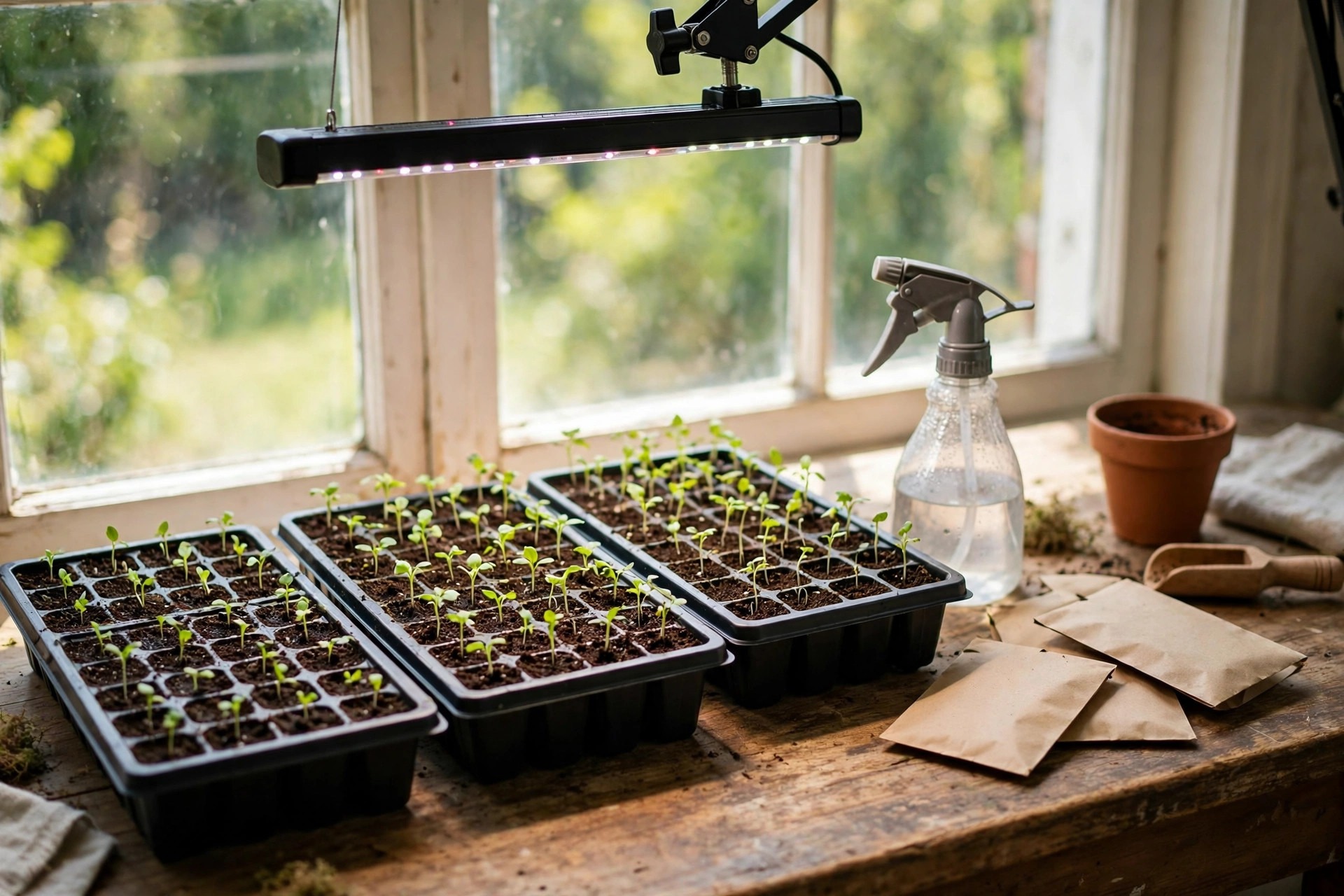
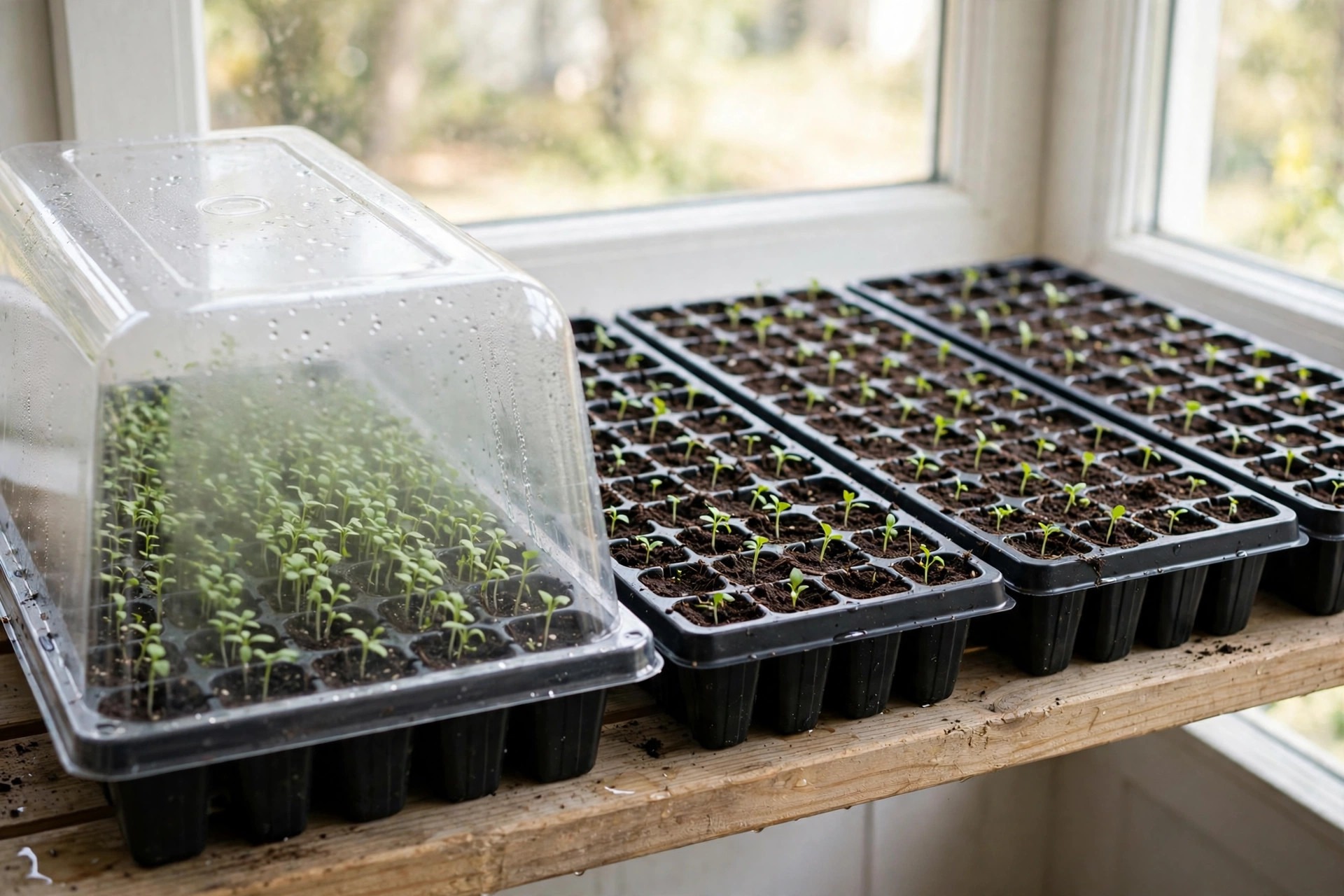
Remove the tray from the mat and take off the dome once about half the seeds have germinated. Seedlings need light and air after sprouting, and continued bottom heat can stretch stems and dry the mix too fast. Move the tray under grow lights, close to the lights but not touching them, and begin hardening off before transplanting outdoors, as covered in the seed starting hub guide.
Never use a seedling heat mat outdoors in rain, never fold or crease it while it is plugged in, and never place heavy objects on top of a mat that is in use. Unplug the mat, wipe it clean, roll it loosely, and store it in a dry place at the end of the season. Inspect the cord and surface before the next season, and retire a mat with cracked PVC, exposed wire, or a damaged plug.
Common Seedling Heat Mat Mistakes
The most common mistake is leaving every tray on heat after germination. Heat helps seeds sprout, but seedlings grow better at normal room temperature with strong light. Move sprouted trays off the mat promptly.
The second mistake is putting all crops on one temperature. Peppers at 80 degrees and lettuce at 80 degrees are not the same crop. Lettuce can go dormant in warm soil, while peppers stall in cool soil. Group by temperature, even if that means one tray stays unheated.
The third mistake is trusting air temperature. A room thermometer on the wall does not tell you soil temperature in a damp tray. Use a soil thermometer, place the thermostat probe in the mix, and recheck after a cold night.
The fourth mistake is overwatering on a warm mat. Bottom heat speeds evaporation from the surface, but it does not mean the mix needs constant watering. Water when the mix is light brown on top, let excess drain, and empty the watertight tray so roots do not sit in water.
The fifth mistake is buying size before counting trays. A beautiful large mat is wasted on one tray, and a single mat under a four tray bench leaves three trays cold. Count trays, then buy the mat that matches.
Final Choice
For most US home growers, the VIVOSUN 10 by 20.75 inch mat and digital thermostat combo is the best first seedling heat mat. It fits a standard tray, it holds a set soil temperature, it is waterproof and safety listed, and it covers the crops that benefit most from bottom heat, peppers, eggplant, and tomatoes.
If you start two trays, add the Seedfactor 2 pack for the second tray, or buy a second thermostat combo if that tray holds heat lovers. If you run a four tray bench, move to the VIVOSUN 48 inch combo and keep cool season crops on a separate bench. If you are buying a first kit for a new gardener, the Hydrofarm Germination Station gives a complete, easy start, with a thermostat as the next upgrade.
Whichever mat you choose, the routine is the same: set the temperature for the crop, place the probe in the mix, check soil temperature on the first run, and move seedlings off heat once they sprout. Done that way, a heat mat is a small, low cost tool that turns a cold windowsill into a reliable spring start.
References
- University of Massachusetts Extension. Starting Seeds Indoors: timing by crop, containers, soilless mix, and the five planting steps. https://www.umass.edu/agriculture-food-environment/home-lawn-garden/fact-sheets/starting-seeds-indoors
- University of Minnesota Extension. How and when to start your seeds: monthly start windows, light, heat, humidity, and soil contact. https://extension.umn.edu/news/how-and-when-start-your-seeds
- University of New Hampshire Extension. Seed Starting Basics: starting media, bottom watering, light, temperature, timing, and hardening off. https://extension.unh.edu/blog/2018/03/seed-starting-basics
- The Old Farmer’s Almanac. Using Seedling Heat Mats to Start Seeds Indoors: soil temperature ranges, heat loving crops, and lettuce limits. https://www.almanac.com/using-seedling-heat-mats-start-seeds-indoors
- VIVOSUN. Seedling Heat Mat Instruction Manual: 10 by 20.75 inch mat, 20 watts, 68 to 86 degrees Fahrenheit, IP67, MET certification. https://manuals.plus/vivosun/vivosun-10×20-75-seedling-heat-mat-and-digital-thermostat
Do I need a seedling heat mat to start seeds indoors?
No, not for every crop. Many seeds germinate well in a room near 68 to 72 degrees. A heat mat helps most for warm season crops such as peppers, eggplant, and tomatoes, and for seed starting in a cold basement or garage where soil stays below 65 degrees.
What temperature should I set a seedling heat mat to?
Set it to the crop, not to a single number for all trays. Most seeds germinate between 65 and 85 degrees Fahrenheit. Use 75 to 85 degrees for peppers, eggplant, and tomatoes, 65 to 75 degrees for brassicas and general crops, and 60 to 70 degrees for lettuce and spinach, which can go dormant in warm soil. Always follow the seed packet if it lists a different temperature.
Should I leave the heat mat on after seeds sprout?
No. Remove the tray from the mat once about half the seeds have germinated, and take off the humidity dome at the same time. Seedlings need strong light and air after sprouting, and continued bottom heat can dry the mix and stretch stems.
Can I use one heat mat for several trays?
Yes, if the sizes match and the controller rating allows it. A 48 inch mat covers four standard 1020 trays. A single 10 by 20 inch mat covers one tray. Do not daisy chain mats through a thermostat unless the maker and the controller rating both allow the combined wattage.
Is a seedling heat mat safe to leave on overnight?
Yes, if it is a listed, indoor rated mat used as directed: on a flat, dry surface, not in standing water, not folded, and not wrapped in insulation. Use a thermostat for precise control, keep the controller away from water, and inspect the cord and mat surface before each season.
Do seedling heat mats use a lot of electricity?
No. Single mats use about 17.5 to 20 watts, and large mats use about 100 to 105 watts. A thermostat further reduces use by cycling the mat off at the set temperature. Running a single mat for a few weeks of germination is a small load compared with grow lights.

Thesis Link : https://saulibrary.edu.bd/daatj/public/uploads/BAU200601_19-Pp_5.pdf
- How to Improve Sandy Soil: A Practical Guide for Gardens - October 31, 2026
- Best Seedling Heat Mats: 10 Picks for Faster Germination - October 31, 2026
- How to Improve Clay Soil: A Practical Guide for Gardens - October 29, 2026