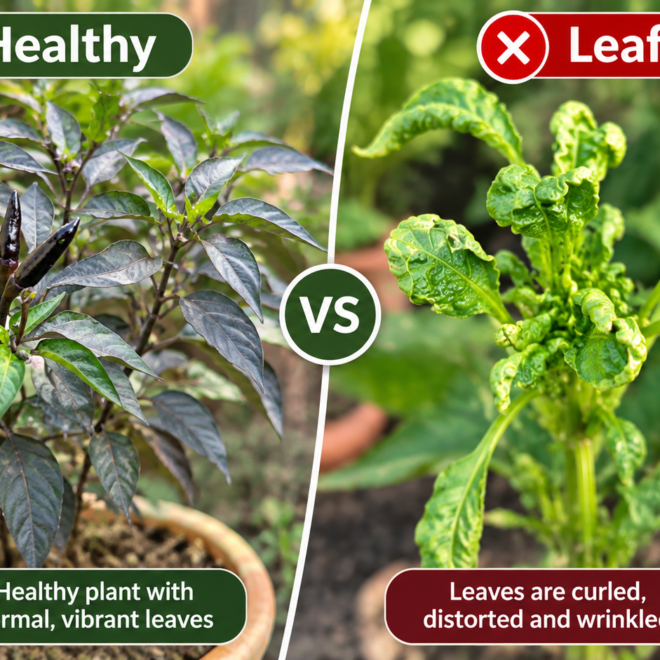
Pepper Plant Leaves Curling is one of the most common and confusing problems gardeners face. The challenge is that leaf curling is not a disease by itself , it is a symptom caused by many different issues, ranging from simple heat stress and watering problems to pests, nutrient deficiencies, herbicide damage, or even viral infections.
The biggest mistake gardeners make is treating the symptom without finding the real cause. Giving extra water when the problem is overwatering, adding fertilizer when the roots are damaged, or spraying pesticides when the issue is environmental can waste valuable time and may make the plant stress worse.
The key to solving pepper leaf curling is learning to read the plant’s signals. By looking at how the leaves curl, when the curling appears, which leaves are affected, and what other symptoms appear alongside it, you can quickly identify the problem and choose the right solution.
In this guide, we’ll explore the 9 most common causes of Pepper Plant Leaves Curling, how to recognize each issue, and the practical steps you can take to help your pepper plants recover and grow healthy again..
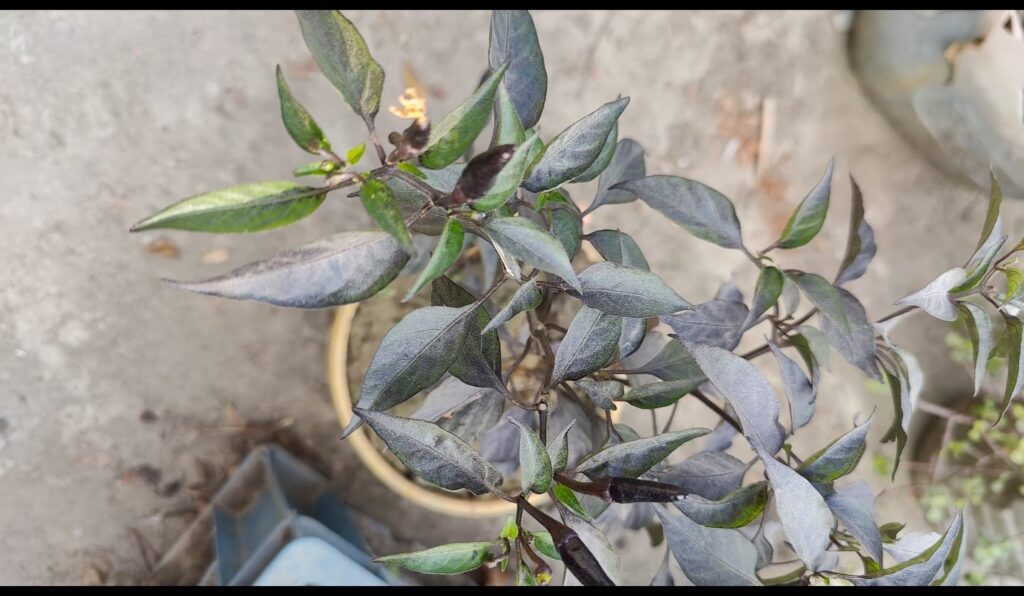
Quick Diagnosis: Match the Curl Pattern First
Before you read through all nine causes, use this shortcut. Look closely at your plant and find your symptom below:
| What You See | Likely Cause | Jump To |
|---|---|---|
| Leaves curl upward like a taco, midday, then recover by evening | Heat or light stress | Cause 1 |
| Leaves curl downward, feel thick or leathery | Herbicide drift | Cause 2 |
| New growth is curled, yellowed, and stunted; sticky residue on leaves | Aphids or other sap-sucking pests | Cause 3 |
| Leaves curl and feel papery or crispy at the edges | Underwatering | Cause 4 |
| Leaves curl and look dark, waterlogged, or yellow at the base | Overwatering / root stress | Cause 5 |
| Curling with purple-tinged veins or undersides | Phosphorus or magnesium deficiency | Cause 6 |
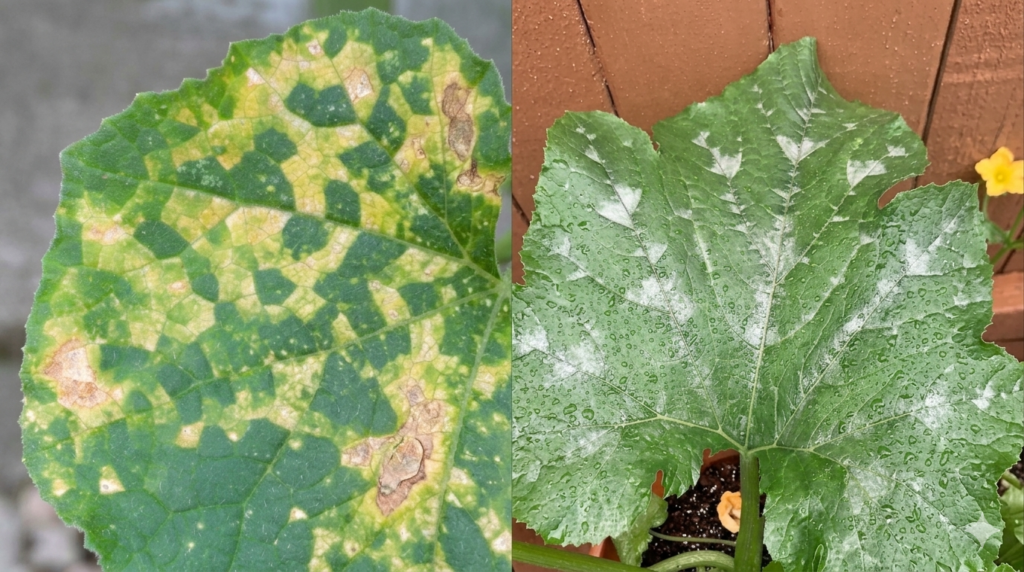
| Leaves curl upward with a mottled yellow-green pattern | Viral infection | Cause 7 |
| Curling right after transplanting, otherwise plant looks fine | Transplant shock | Cause 8 |
| Curling with silvery streaks or scarring on leaves | Thrips damage | Cause 9 |
1. Heat or Light Stress
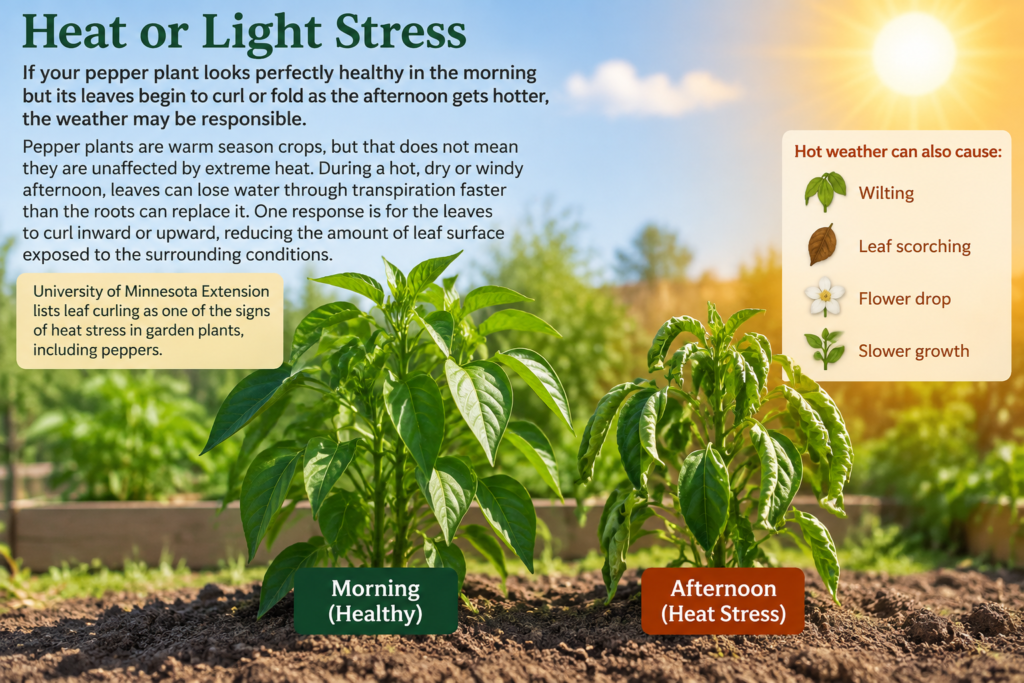
If your pepper plant looks perfectly healthy in the morning but its leaves begin to curl or fold as the afternoon gets hotter, the weather may be responsible.
Pepper plants are warm season crops, but that does not mean they are unaffected by extreme heat. During a hot, dry or windy afternoon, leaves can lose water through transpiration faster than the roots can replace it. One response is for the leaves to curl inward or upward, reducing the amount of leaf surface exposed to the surrounding conditions.
University of Minnesota Extension lists leaf curling as one of the signs of heat stress in garden plants, including peppers. Hot weather can also cause wilting, leaf scorching, flower drop and slower growth.
How to tell whether heat is actually the problem
The timing of the symptoms is one of the most useful clues. Look at your pepper plant early in the morning, before the temperature rises. Then check it again during the hottest part of the afternoon.
If the leaves are relatively flat and healthy in the morning but curl during intense afternoon heat, then recover as temperatures fall, environmental stress is a strong possibility.
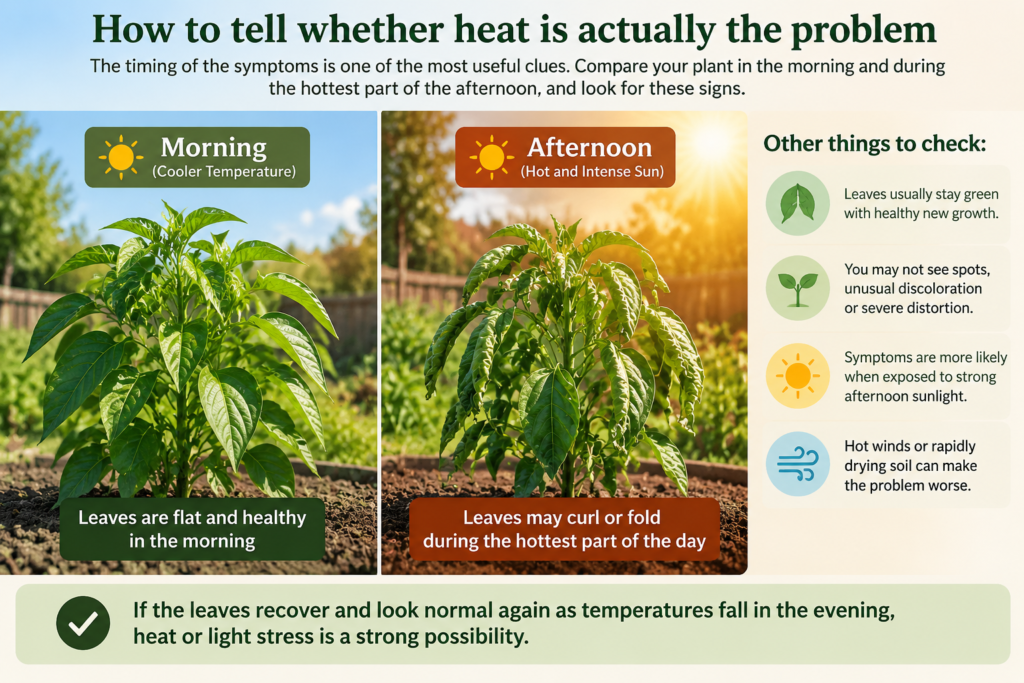
Also examine the rest of the plant. Heat stressed peppers may still have good green color and healthy new growth. You may not see spots, unusual discoloration or severe distortion.
The pattern becomes more suspicious when the plant is exposed to strong afternoon sunlight, hot winds or rapidly drying soil.
What to do
Water the root zone thoroughly
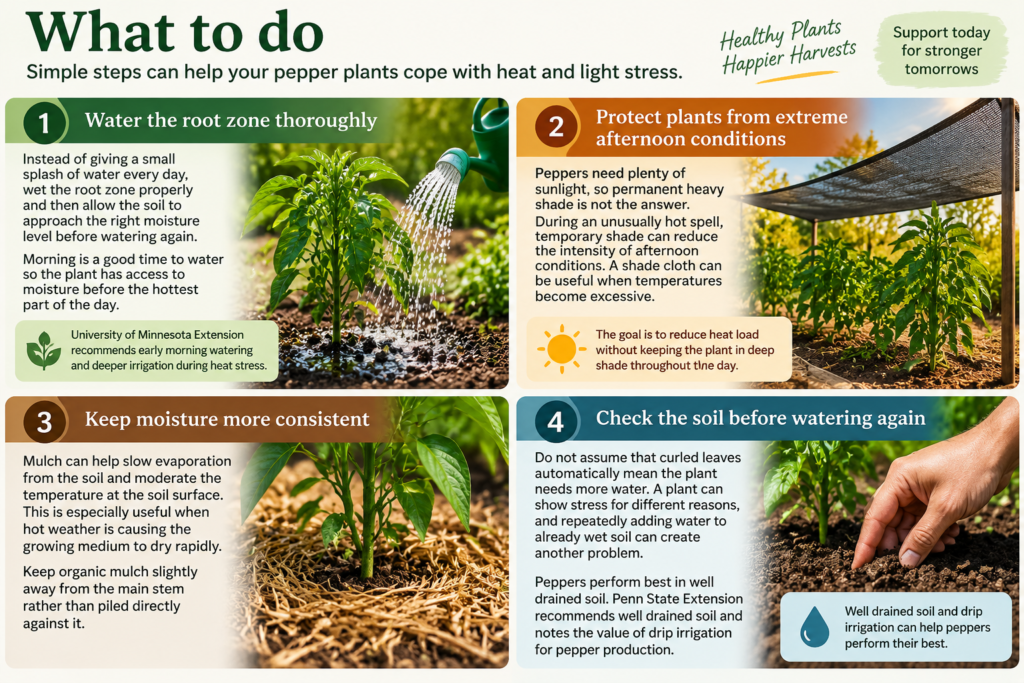
Instead of giving the plant a small splash of water every day, aim to wet the root zone properly and then allow the soil to approach the appropriate moisture level before watering again. The exact frequency depends on soil type, container size, weather and plant maturity.
Morning is generally a good time to water because the plant has access to moisture before the hottest part of the day. University of Minnesota Extension recommends early morning watering and deeper irrigation during periods of heat stress.
Protect plants from extreme afternoon conditions.
Peppers generally need plenty of sunlight, so permanent heavy shade is not the answer. During an unusually hot spell, however, temporary shade can reduce the intensity of afternoon conditions. A shade cloth can be useful when temperatures become excessive.
The goal is to reduce heat load without keeping the plant in deep shade throughout the day.
Keep moisture more consistent.
Mulch can help slow evaporation from the soil and moderate the temperature at the soil surface. This is particularly useful when hot weather is causing the growing medium to dry rapidly.
Organic mulch should be kept slightly away from the main stem rather than piled directly against it.
Check the soil before watering again.
Do not assume that curled leaves automatically mean the plant needs more water. A plant can show stress for very different reasons, and repeatedly adding water to already wet soil can create another problem.
Peppers perform best in well drained soil. Penn State Extension specifically recommends well drained soil and notes the value of drip irrigation for pepper production.
One important warning
Not every curled pepper leaf is caused by hot weather. If the leaves remain curled in the morning, become increasingly distorted, develop yellow or light green patterns, or the plant stops growing normally, investigate further.
Aphids can cause curling, discoloration and sticky foliage. Pepper viruses can also produce curled or distorted leaves, often accompanied by mottling, stunted growth or abnormal fruit.
Herbicide exposure is another possibility. University of Utah Extension notes that exposure to growth regulator herbicides such as 2,4 D can produce pointed, cupped, twisted or irregular pepper leaves.
That is why the pattern and progression of the symptoms matter more than the curl itself.
Quick diagnosis
If your pepper leaves:
• Curl mainly during hot afternoons
• Look much better in the morning
• Remain green without unusual spotting
• Recover when temperatures fall
• Grow normally once the weather improves
then heat and temporary water stress are reasonable first suspects. If the leaves stay curled, become distorted or mottled, or the entire plant begins to lose vigor, look beyond heat and check for insects, herbicide injury, nutrient or root problems, and viral disease.
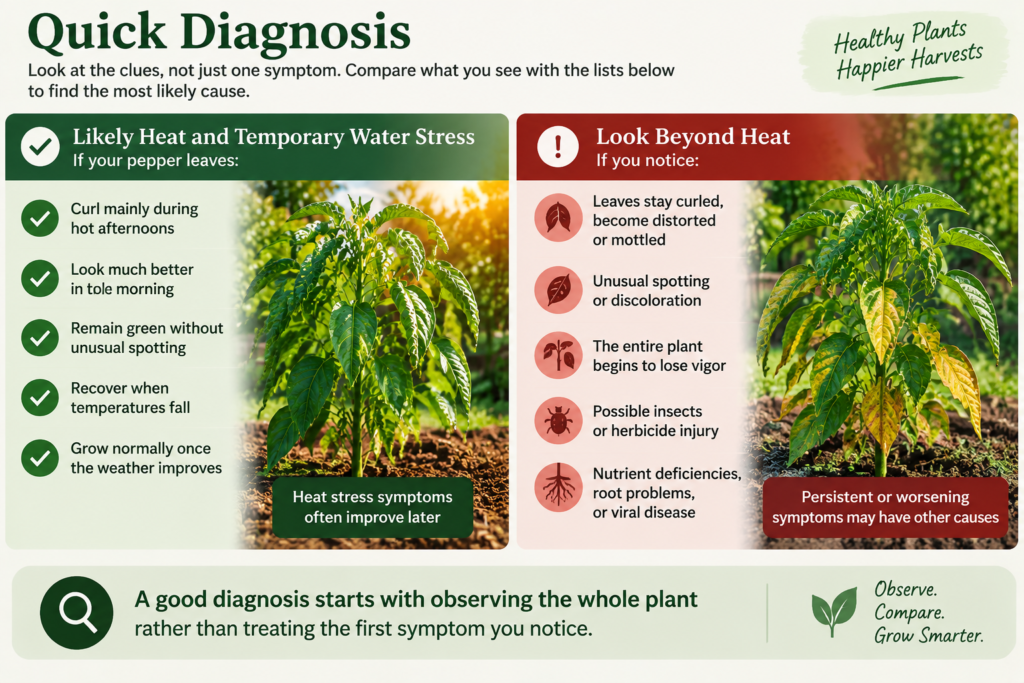
A good diagnosis starts with observing the whole plant rather than treating the first symptom you notice.
2. Herbicide Drift
Sometimes the problem is not coming from the pepper plant, its soil, or even your garden.
A nearby lawn, field, roadside, or garden may have been treated with a weed killer, and a small amount of that herbicide can reach your pepper plants through spray drift or, with certain products, movement of herbicide vapors. Peppers are broadleaf plants and can be particularly sensitive to growth regulating herbicides such as 2,4 D and dicamba.

This type of injury can be surprisingly confusing. The plant may look healthy one day and then produce strange, twisted new leaves several days later. The newest growth is often where the damage becomes easiest to see.
What herbicide injury looks like on pepper plants
Herbicide injury does not usually look like ordinary dehydration.
Instead of simply folding upward during a hot afternoon, affected pepper leaves may become cupped, twisted, narrow, distorted, or unusually shaped. Leaf stems can bend or twist as well. In more serious cases, new growth may become stunted and leaves can eventually develop yellowing or dead tissue.
The pattern of damage can provide another useful clue.
Suppose a pepper plant is growing beside a lawn that was recently sprayed. If several plants near that area begin developing distorted new growth while plants farther away remain normal, herbicide exposure becomes much more plausible.
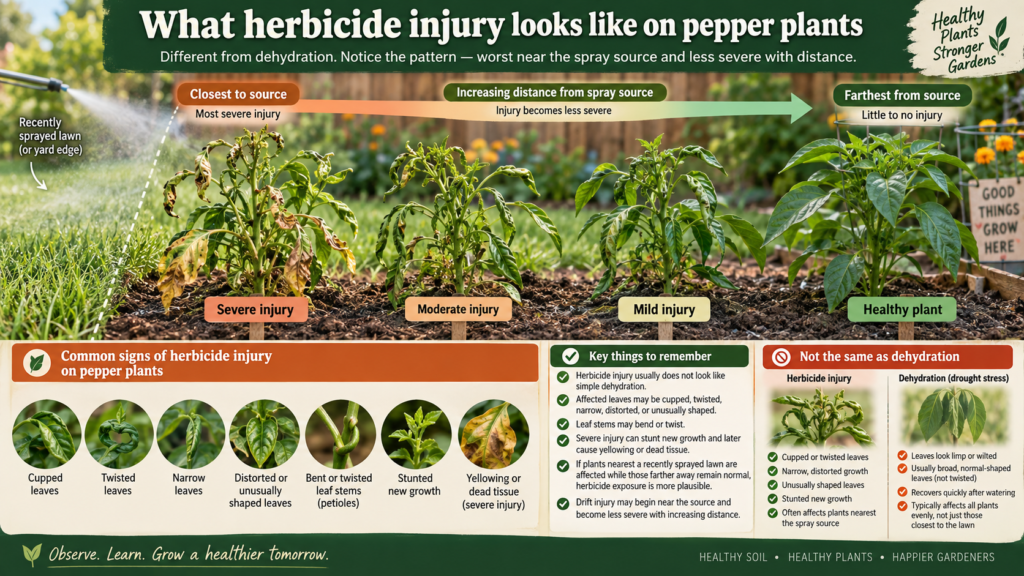
Researchers at Penn State note that drift injury can produce a pattern that begins near the source and becomes less severe with increasing distance.
2,4 D and dicamba deserve special attention
Two herbicides worth considering are 2,4 D and dicamba.
Both belong to groups of herbicides that interfere with normal plant growth by mimicking or disrupting plant hormone activity. Their effects are particularly noticeable on sensitive broadleaf plants because they can cause abnormal growth rather than simply burning the foliage.
University of Utah Extension specifically identifies 2,4 D or similar growth regulator herbicides as a possible cause of pointed, cupped, twisted and irregular pepper leaves.
That makes the timing of the symptoms important.
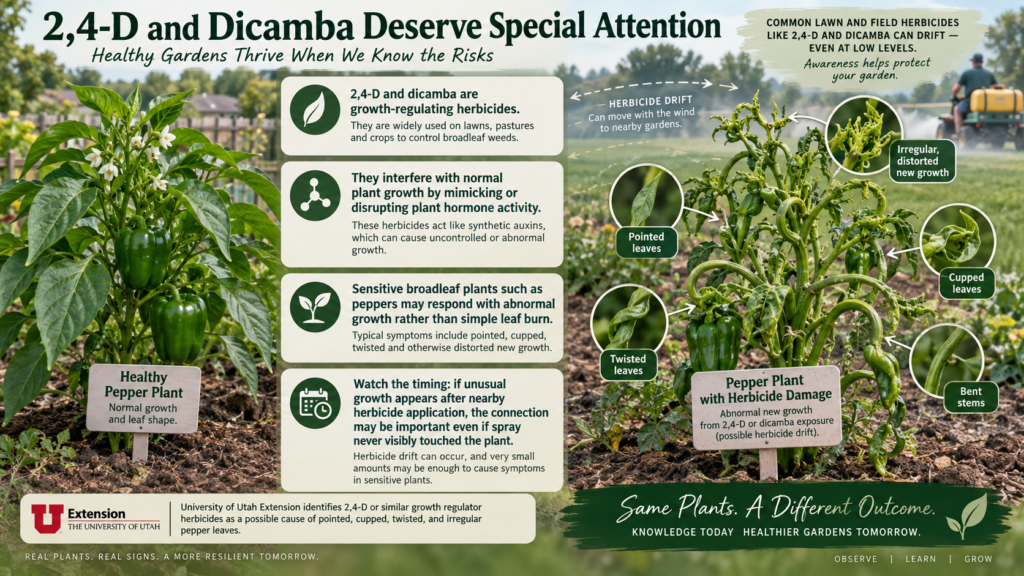
If the unusual growth appeared after herbicide was applied nearby, do not dismiss the connection simply because the spray never visibly touched your pepper plant.
How to investigate the problem
Start with the newest leaves rather than the oldest foliage.
Look for:
• Newly emerging leaves that are twisted or tightly cupped
• Bent or distorted leaf stems
• Narrow or unusually shaped new leaves
• Stunted shoots
• Yellowing or browning that develops after the distortion
• Several different broadleaf plants showing similar symptoms
The last clue can be particularly useful. If peppers, tomatoes, beans, grapes, ornamentals, or other sensitive broadleaf plants in the same area begin showing unusual new growth around the same time, an environmental exposure deserves investigation. Growth regulator herbicides can affect a wide range of broadleaf plants.
Also consider what happened during the previous several days. Ask yourself whether a neighbor treated a lawn, whether a nearby field was sprayed, or whether a roadside weed control application took place.
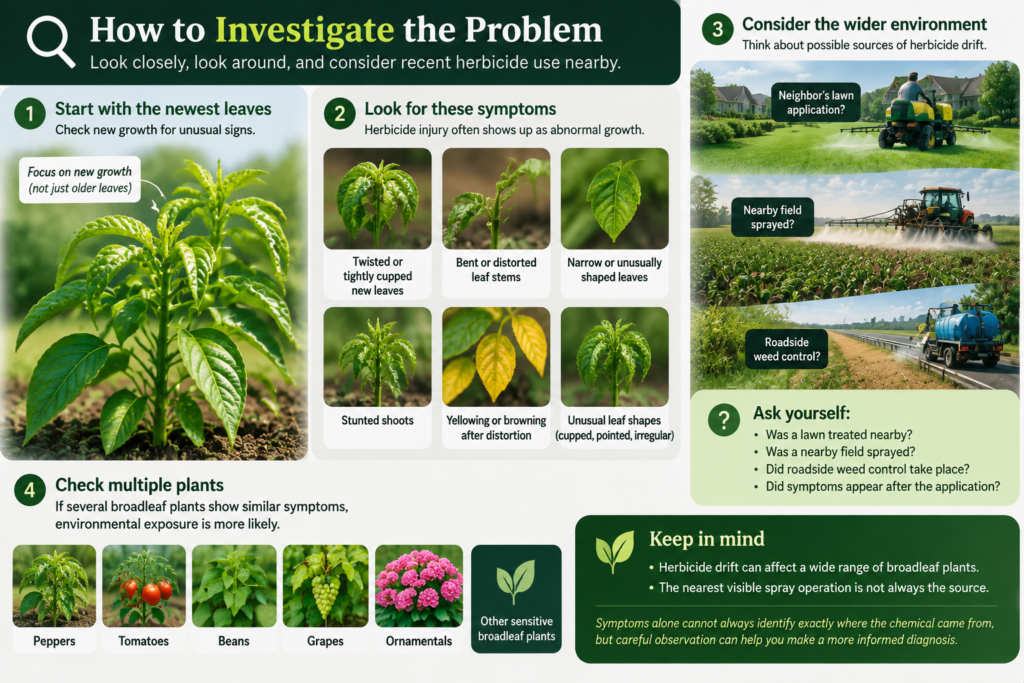
Do not assume the nearest visible spray operation is automatically the source. Herbicide movement can occur through different pathways, and the symptoms alone cannot always identify exactly where the chemical came from.
Can a pepper plant recover?
That depends on the amount of exposure and the plant’s stage of growth.
Leaves that have already been badly distorted will not necessarily return to their original shape. The more useful thing to watch is what happens next.
If the plant survives the exposure and begins producing normal leaves, that is an encouraging sign. If new growth continues to emerge severely twisted, narrow or stunted, the injury may be more serious.
There is no reliable home treatment that can simply reverse herbicide damage after the chemical has affected plant tissue. The practical approach is to reduce additional stress and give the plant time to produce new growth.
Avoid adding fertilizer simply because the leaves look abnormal. Fertilizing a chemically injured plant will not remove the herbicide and can create additional stress if the plant’s roots are already struggling.
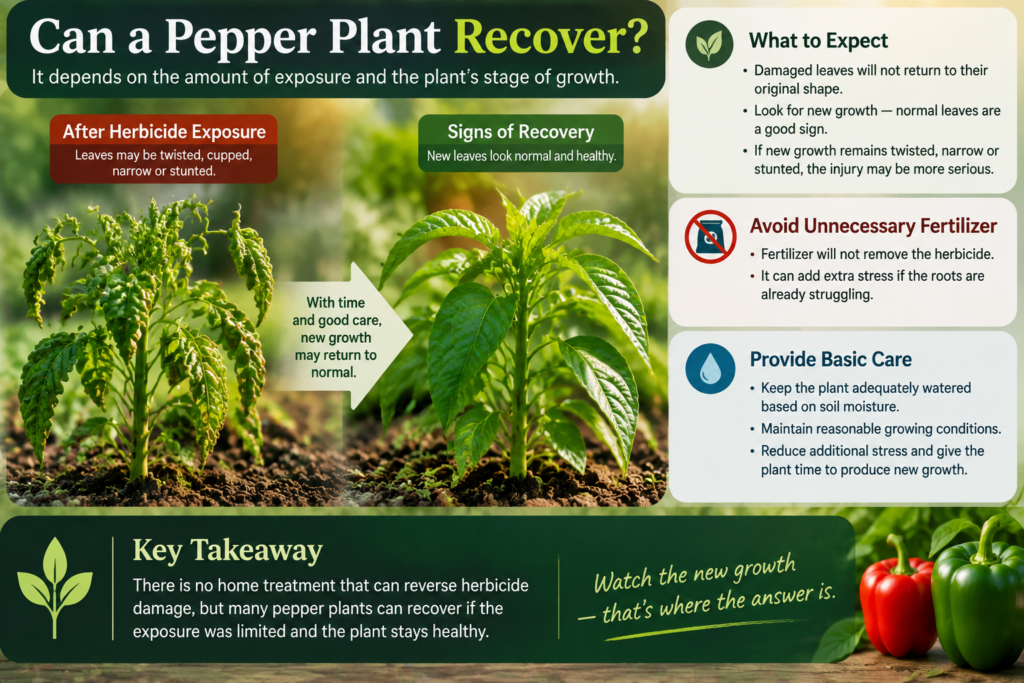
Keep the plant adequately watered according to soil moisture and maintain reasonable growing conditions while you monitor the new growth.
Should you remove the damaged leaves?
Not necessarily. A badly distorted leaf may look unpleasant, but removing every affected leaf does not make the herbicide disappear from the plant.
If a leaf is completely dead or damaged tissue could encourage other problems, removing it may make sense. Otherwise, it is often better to leave partially functional foliage in place while watching the plant’s new growth.
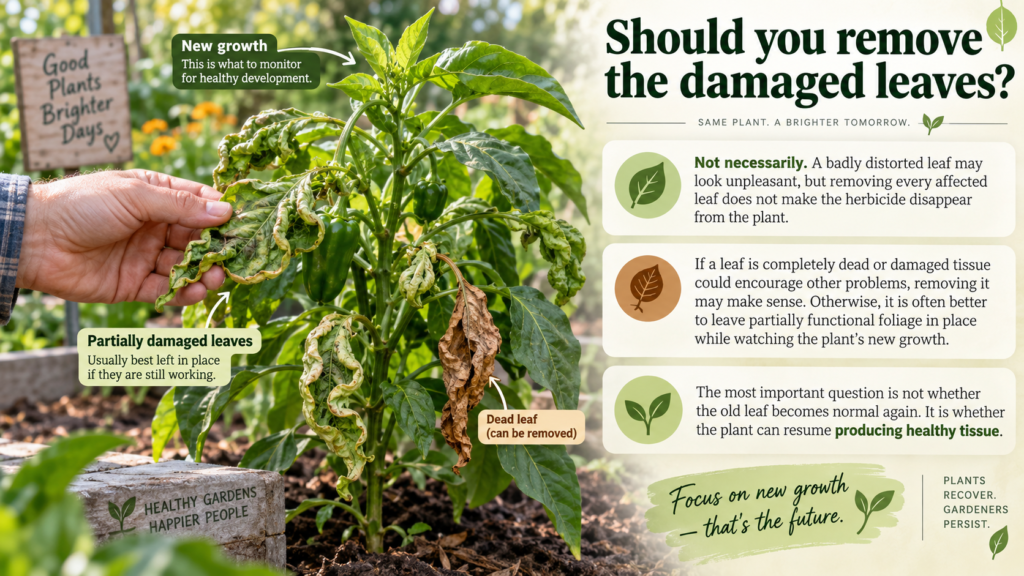
The most important question is not whether the old leaf becomes normal again. It is whether the plant can resume producing healthy tissue.
Preventing future herbicide injury
Prevention is much easier than trying to repair a pepper plant after exposure.
If you or someone nearby uses herbicides, pay close attention to the product label, wind conditions, temperature and application method. Herbicide drift can occur when spray droplets move away from the intended treatment area, while some products can also move through volatilization after application.
Penn State Extension recommends considering weather conditions, formulation, spray equipment and droplet size when reducing drift risk.
For a home vegetable garden, one simple precaution is especially important: never use a sprayer for weed control and then use the same equipment on peppers or other vegetables unless it has been properly cleaned according to the product label.
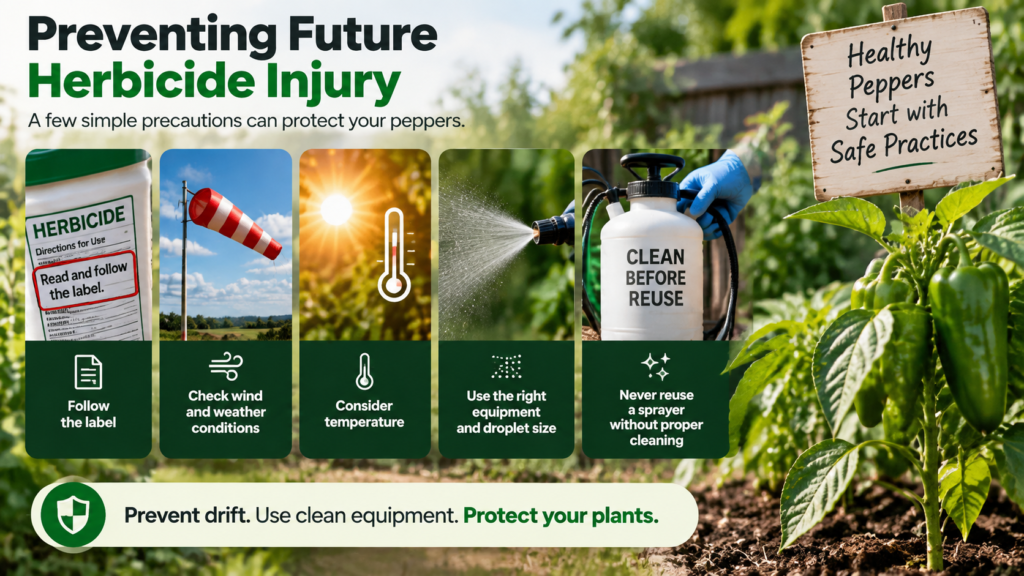
University of Utah Extension specifically warns gardeners against using the same sprayer for lawn weed control and vegetable gardening because residues from growth regulator herbicides can injure peppers.
Do not mistake herbicide injury for every type of leaf curl
This is where diagnosis becomes important.
Heat stress usually follows hot environmental conditions and may improve when temperatures fall. Herbicide injury tends to produce abnormal new growth that remains distorted rather than simply returning to normal overnight.
Aphids can also cause curled or distorted leaves. Viral diseases may cause curling together with mottling, yellowing, stunting or other unusual symptoms.
So before blaming a neighbor’s herbicide application, look at the complete pattern:
When did the symptoms begin? Which leaves are affected? Are several plant species showing the same problem? Was there a recent spray application? And is the newest growth becoming more distorted over time?
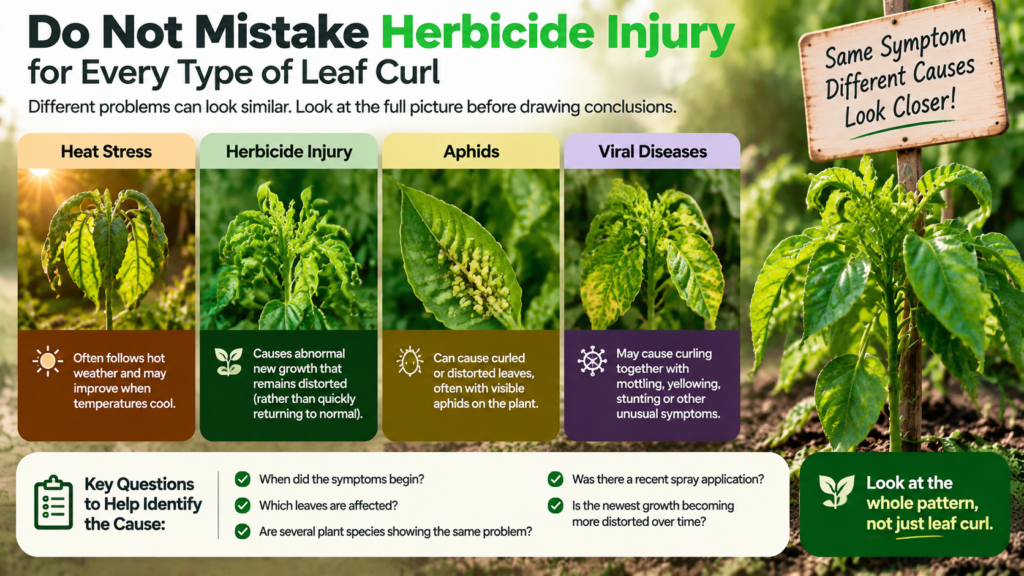
Those clues are far more useful than leaf curl alone.
Quick diagnosis
Herbicide exposure becomes more likely when:
• The newest leaves are the most distorted
• Leaves are cupped, twisted or unusually narrow
• Leaf stems or young shoots are bent or twisted
• Several broadleaf plants nearby show similar symptoms
• Symptoms appeared after a nearby herbicide application
• Damage is worse on the side of the garden closest to the suspected source
• The plant continues producing abnormal new growth even after weather conditions improve
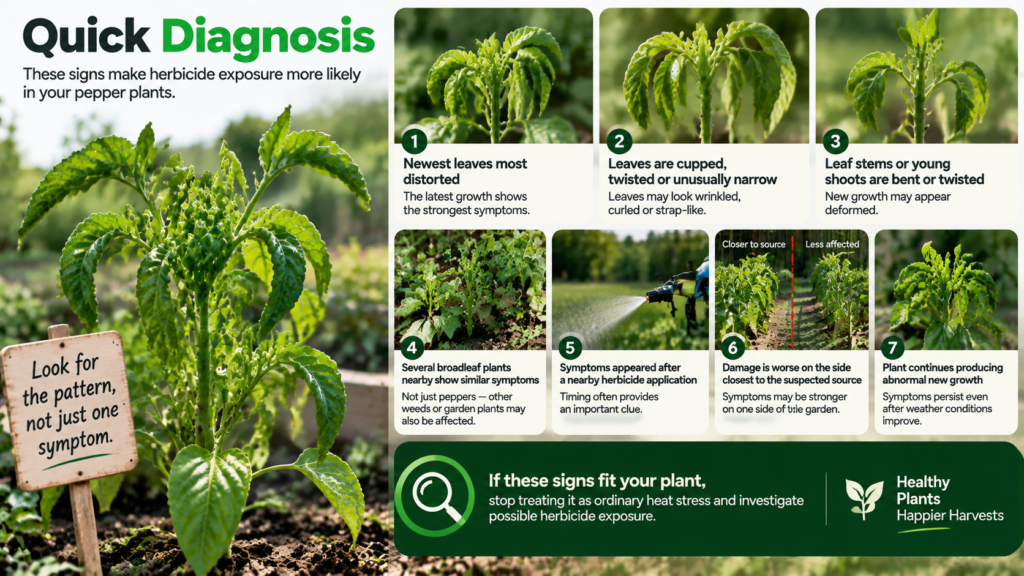
If those signs fit your pepper plant, stop treating the problem as ordinary heat stress and investigate possible herbicide exposure.
3. Aphids and Sap-Sucking Pests
Pepper leaves that suddenly begin curling, folding or looking distorted can sometimes be reacting to a much smaller problem hiding underneath the foliage.
Aphids are among the first pests worth checking.
These tiny, soft bodied insects feed by inserting their needle like mouthparts into plant tissue and removing sap. They are especially attracted to tender shoots and newly developing leaves. When feeding is concentrated around this young growth, the leaves may fail to expand normally. Instead, they can become puckered, curled, twisted or noticeably smaller than healthy leaves.
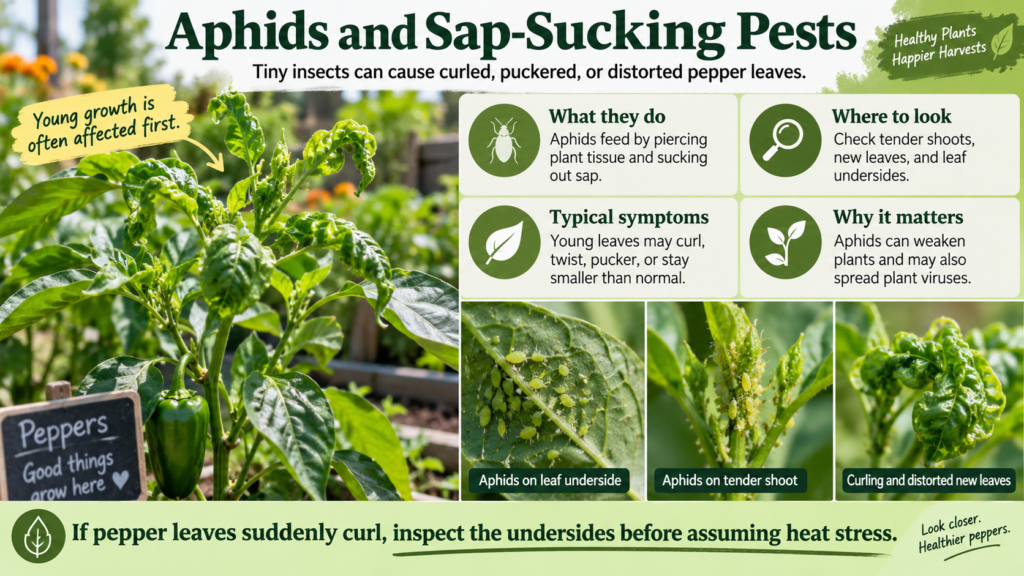
Utah State University lists aphids as a common pepper pest and notes that their feeding can cause leaves to crinkle or curl. Aphids can also transmit plant viruses, which is one reason an infestation should not automatically be dismissed as harmless.
How to Tell If Aphids Are Causing the Curling
Do not rely on the curled leaf alone. The insects are usually much easier to find than the damage they create.
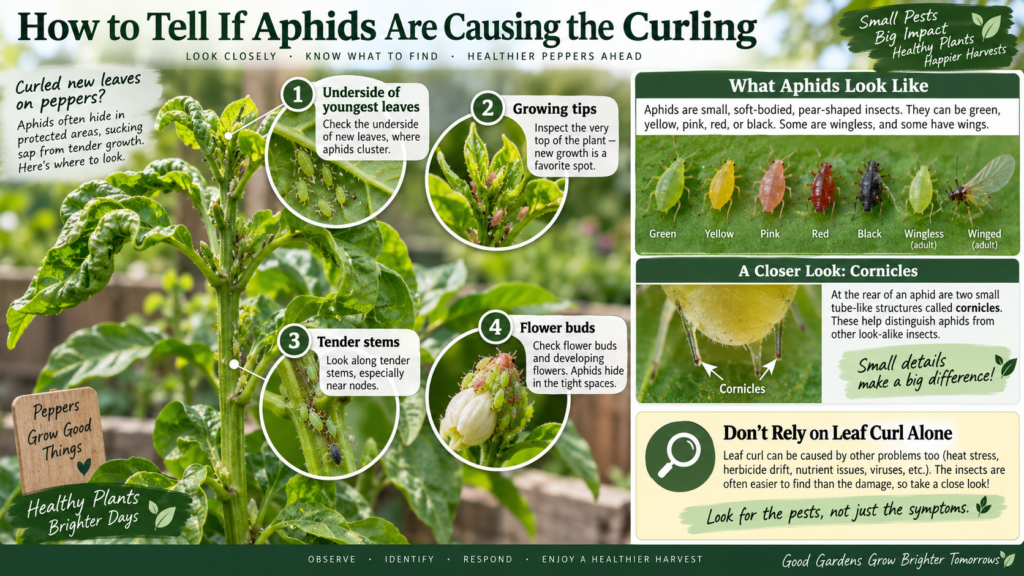
Start by examining the underside of the youngest leaves. Then inspect the growing tips, tender stems and flower buds. Aphids commonly gather in clusters in these protected areas.
They are usually very small, soft bodied and pear shaped. Depending on the species, they may appear green, yellow, pink, red or black. Some have wings, while others do not. If you look closely, you may also notice two small tube like structures projecting from the rear of the insect. These are called cornicles and are a useful clue when identifying aphids.
There are several other signs worth checking.
Sticky Leaves
Aphids consume large quantities of plant sap and excrete a sugary substance called honeydew. Leaves beneath an infestation can therefore feel unusually sticky.
Black Sooty Growth
Honeydew can provide a food source for sooty mold fungi. If a pepper plant has a black coating developing on leaves or nearby surfaces, look above it for aphids or another honeydew producing insect. The mold itself is not usually the original problem. It is often evidence that sap sucking insects have been feeding there.
Ant Activity
A steady trail of ants moving around the stems or leaves can also be a useful warning sign. Some ants collect honeydew from aphids and may protect aphid colonies from predators in return. Ants do not prove that aphids are present, but their presence around sticky plant growth is worth investigating.
Look at the Newest Leaves First
This is particularly important with pepper plants.
Older leaves may remain relatively normal while the newest growth becomes curled or distorted. If you find aphids concentrated around the growing tips at the same time that the newest leaves are becoming misshapen, the connection becomes much more convincing.
However, curled leaves do not automatically mean aphids. Herbicide exposure, heat stress, mites, viruses and other environmental problems can produce similar symptoms. A good diagnosis should therefore be based on several clues rather than leaf shape alone.
What to Do About Aphids
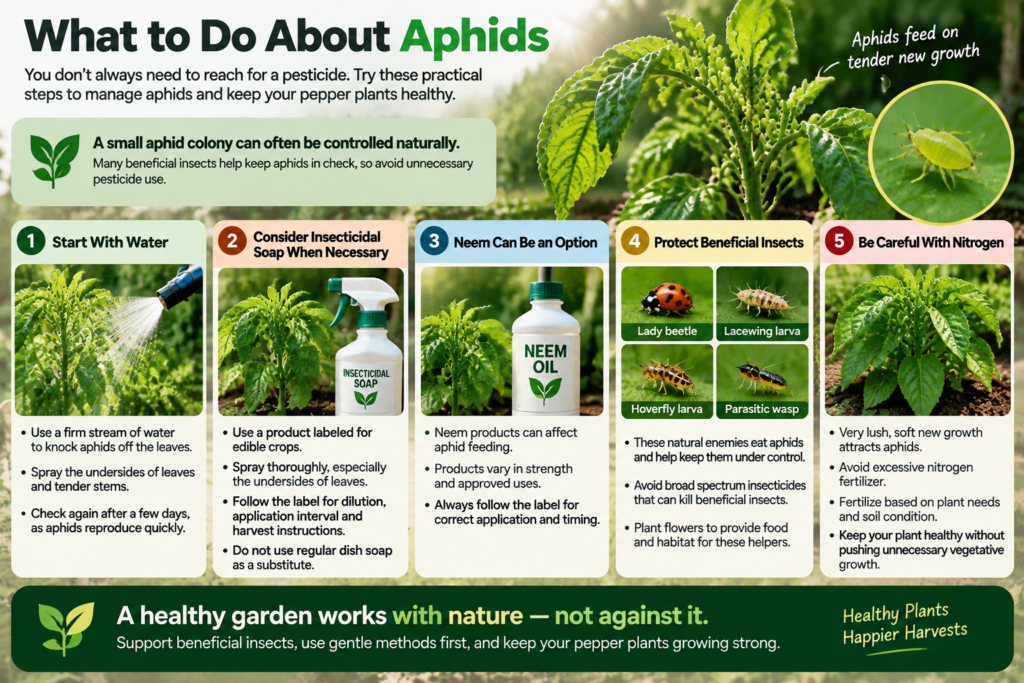
The good news is that a small aphid colony does not always require immediate pesticide treatment.
Aphids have many natural enemies, including lady beetles, lacewing larvae, hoverfly larvae and parasitic wasps. In a healthy garden, these beneficial insects can sometimes bring an aphid population back under control without intervention. University of Minnesota Extension recommends protecting these natural enemies and avoiding unnecessary pesticide applications.
1. Start With Water
For a light infestation, a firm stream of water can be surprisingly effective.
Direct the spray toward the undersides of affected leaves and the tender stems where aphids are concentrated. The goal is to physically knock the insects from the plant.
Utah State University specifically recommends a strong stream of water as one method for removing aphids from peppers.
Check the plant again after a few days. Aphids reproduce quickly, so one treatment may not be enough if a colony has already become established.
2. Consider Insecticidal Soap When Necessary
If water alone is not keeping the population under control, an insecticidal soap labeled for use on edible crops can be considered.
Insecticidal soap works primarily through direct contact with exposed insects. That means spraying only the upper surface of the leaves is unlikely to give good coverage when aphids are hiding underneath.
Thorough coverage is important, particularly on the undersides of leaves and around growing tips.
University of Minnesota and Utah State University both list insecticidal soap among the lower risk options that can be used against aphids.
Always follow the product label for dilution, crop approval, application interval and harvest instructions. Do not assume that ordinary household dish soap is equivalent to a properly formulated insecticidal soap.
3. Neem Can Be an Option, But Read the Label
Neem based products containing azadirachtin can affect aphid feeding and are another option used in some pest management programs.
However, neem products are not all identical. Their active ingredients, permitted crops and application directions can vary. For that reason, the label should determine how and when the product is used rather than following a universal spraying schedule.
University of Minnesota Extension lists neem among the lower risk options for aphid management.
4. Protect the Insects That Eat Aphids
Before reaching for a broad spectrum insecticide, look carefully at the plant.You may find that aphids are already surrounded by predators.
Lady beetle larvae can look nothing like the familiar adult ladybug, yet they are aggressive aphid predators. Lacewing larvae and hoverfly larvae also feed on aphids, while parasitic wasps can develop inside aphids and leave behind characteristic aphid mummies.
This is one reason indiscriminate spraying can sometimes make an aphid problem worse. Killing the predators along with the aphids removes part of the garden’s natural control system.
Providing flowering plants can also help support beneficial insects. University of Minnesota recommends maintaining flowers throughout the growing season, while Penn State Extension notes that flowering plants can provide resources for natural enemies.
5. Be Careful With Nitrogen
Very lush, soft new growth can be particularly attractive to aphids.
That does not mean nitrogen fertilizer directly causes an aphid infestation, but excessive fertilization can produce the kind of tender growth that aphids readily colonize. Avoid repeatedly applying high nitrogen fertilizer when the plant is already growing vigorously.
Instead, base fertilization on the needs of the pepper plant and the condition of the soil.
The goal is not to starve the plant. A healthy pepper plant needs adequate nutrition. The goal is to avoid pushing excessive vegetative growth simply because the leaves look pale or growth seems slow.
What About Mites?
Aphids are not the only sap feeding pests that can distort pepper foliage.
Mites can also cause abnormal growth, but their symptoms often look different. Depending on the species, mite damage may include stippling, bronzing, distorted new growth or fine webbing.
If you cannot find aphids despite repeated inspections, examine the plant closely for other tiny pests rather than assuming the curling is caused by aphids.
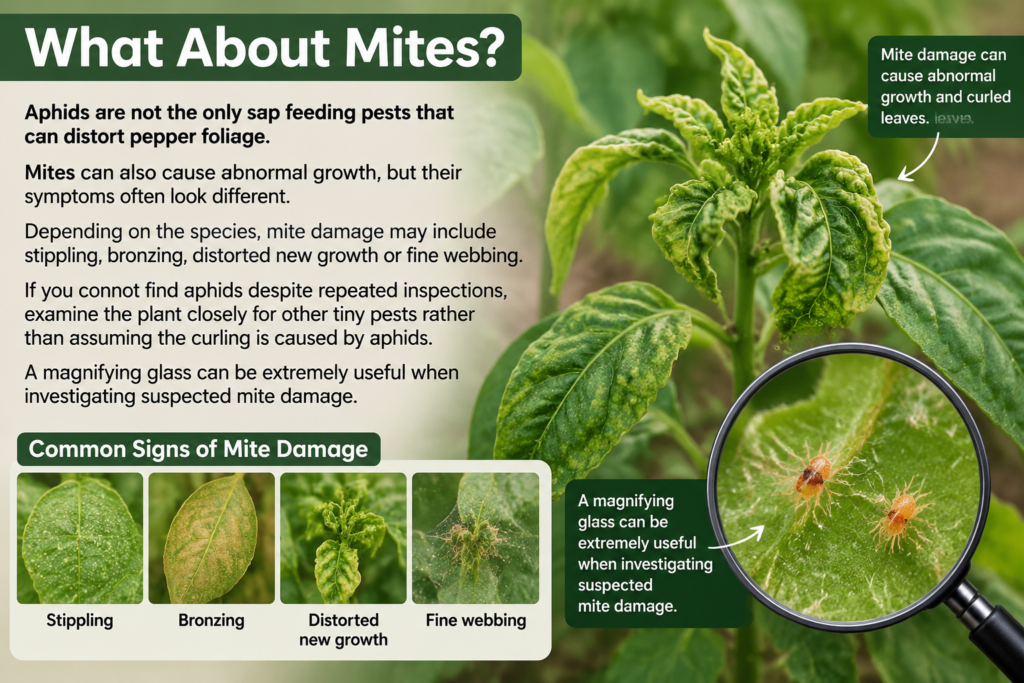
A magnifying glass can be extremely useful when investigating suspected mite damage.
One Important Warning: Aphids Can Spread Viruses
There is another reason aphid infestations deserve attention on pepper plants.
Some aphid species can transmit plant viruses while feeding. This means the problem is not limited to the sap being removed from the plant. An aphid can potentially acquire a virus from one plant and introduce it into another during feeding.
This is particularly important if several pepper plants are growing close together and one plant begins showing unusual mosaic patterns, severe distortion, stunting or other symptoms that do not match a simple insect infestation.
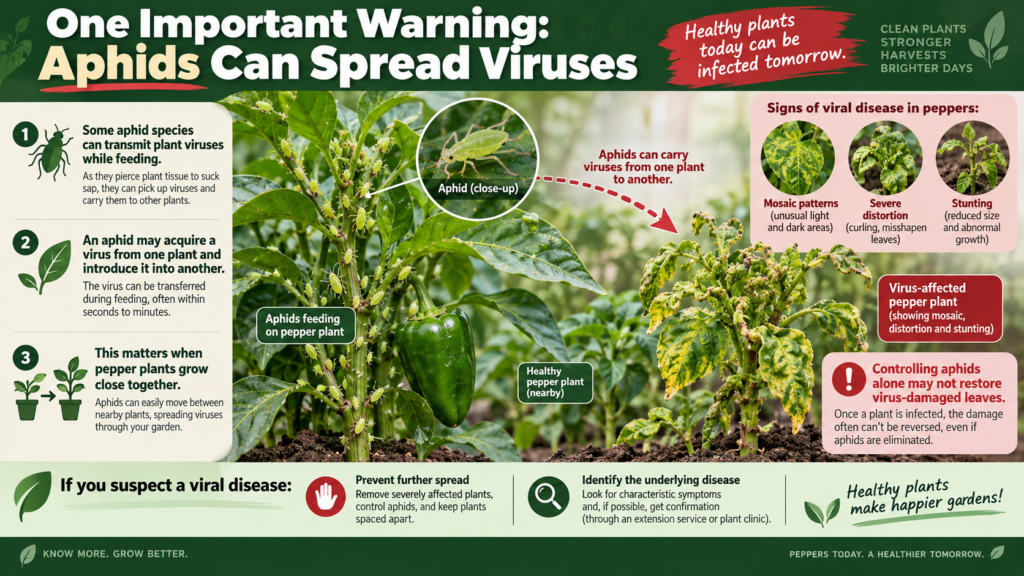
If the plant shows signs that suggest a viral disease, controlling aphids alone may not restore the affected leaves. The goal then becomes preventing further spread and identifying the underlying disease.
Quick Diagnosis
If your pepper leaves are curling and you suspect aphids, look for this combination:
- Curling new leaves + visible clusters of small insects + sticky honeydew = aphids are highly likely.
- Curling leaves + black sooty coating = check for aphids or another honeydew producing pest.
- Curling leaves + many ants around the plant = inspect the plant carefully for aphid colonies.
- Curling leaves + no visible aphids + severe distortion of new growth = investigate mites, herbicide exposure, viruses or environmental stress.
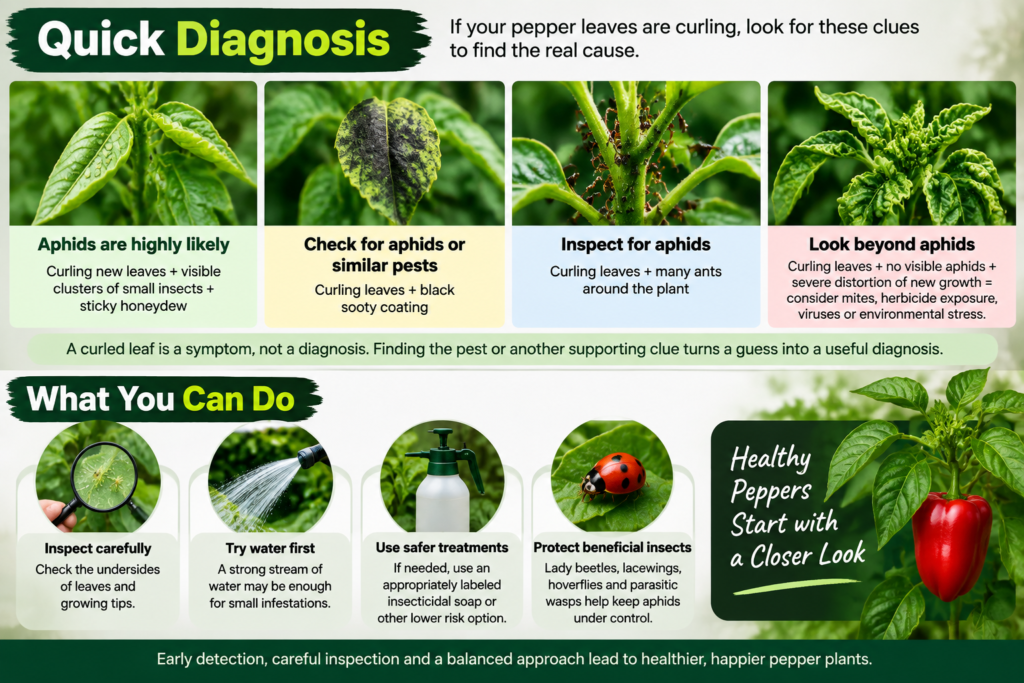
The important point is that the curled leaf is a symptom, not a diagnosis. Finding the pest or another supporting clue is what turns a guess into a useful diagnosis.
Aphids can make pepper leaves curl, wrinkle and develop abnormal new growth, but they are usually easier to control when discovered early.
Start by inspecting the undersides of leaves and growing tips. If the infestation is small, a strong stream of water may be enough. If the population continues to build, an appropriately labeled insecticidal soap or other lower risk treatment can be considered.
Most importantly, do not destroy the beneficial insects that are already working for you. Lady beetles, lacewings, hoverflies and parasitic wasps can play an important role in keeping aphid populations under control.
A careful inspection before spraying is often the simplest and most effective first step.
4. Underwatering: A Common Reason Pepper Leaves Start Curling
Sometimes pepper plants make the problem very clear. Their leaves begin folding, curling inward, and looking slightly tired. In many cases, the reason is simple: the plant is running low on water.
Pepper plants lose water every day through their leaves. When the roots cannot replace that lost moisture fast enough, the plant tries to protect itself. Curling the leaves helps reduce water loss, especially during hot and dry conditions.
This usually happens when the soil stays dry for too long. It is common with peppers growing in small pots, raised beds, or gardens during periods of high heat.
A pepper plant that needs water often looks different from one suffering from other problems. The leaves may curl, but they also tend to feel softer and the whole plant may look slightly droopy. The soil around the roots is usually dry, which is the biggest clue.
The easiest way to check is not by looking at the leaves first. Check the soil.
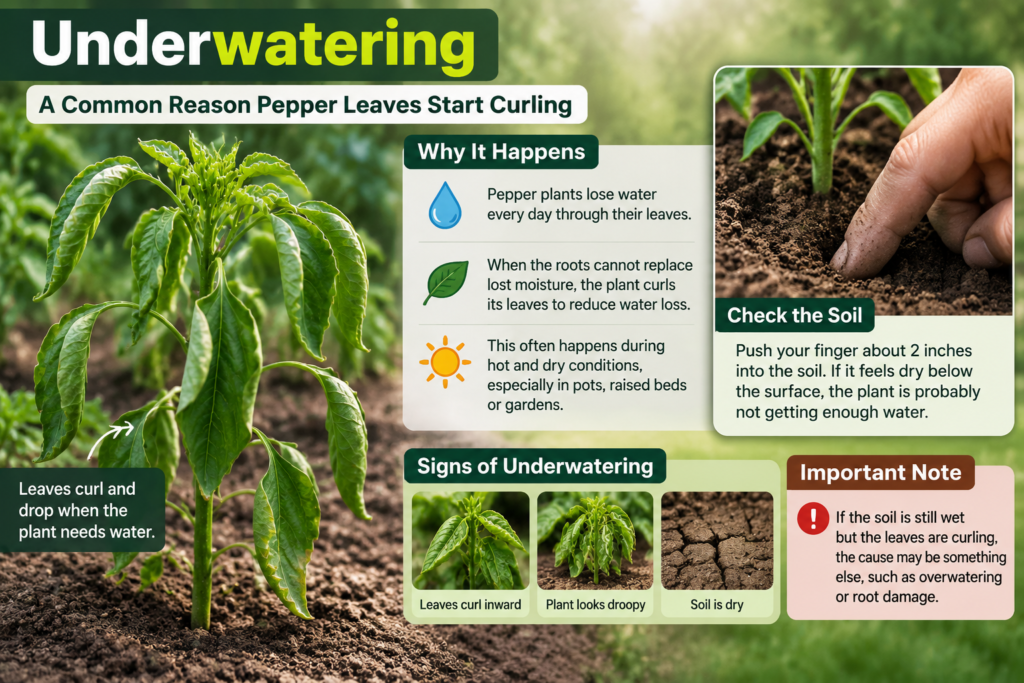
Push your finger about 2 inches into the soil. If it feels dry below the surface, the plant is probably not getting enough moisture. If the soil is still wet but the leaves are curling, the cause may be something else, such as overwatering or root damage.
How to Bring an Underwatered Pepper Plant Back
When pepper plants become thirsty, a quick splash of water is usually not enough. Watering only the top layer of soil may make the surface look wet while the deeper roots remain dry.
Instead, give the plant a slow and deep watering.
For garden peppers, water long enough for moisture to move several inches down into the soil. For container plants, continue watering until you see a small amount of water leaving through the drainage holes.
After the plant recovers, the goal is to avoid repeating the same stress.
Pepper plants prefer regular moisture. They do not perform well when the soil completely dries out and then becomes flooded with water later.
In general, peppers need around 1 to 2 inches of water per week, but the exact amount changes depending on weather, soil, and plant size. A mature pepper plant loaded with fruit will usually need more water than a young plant.
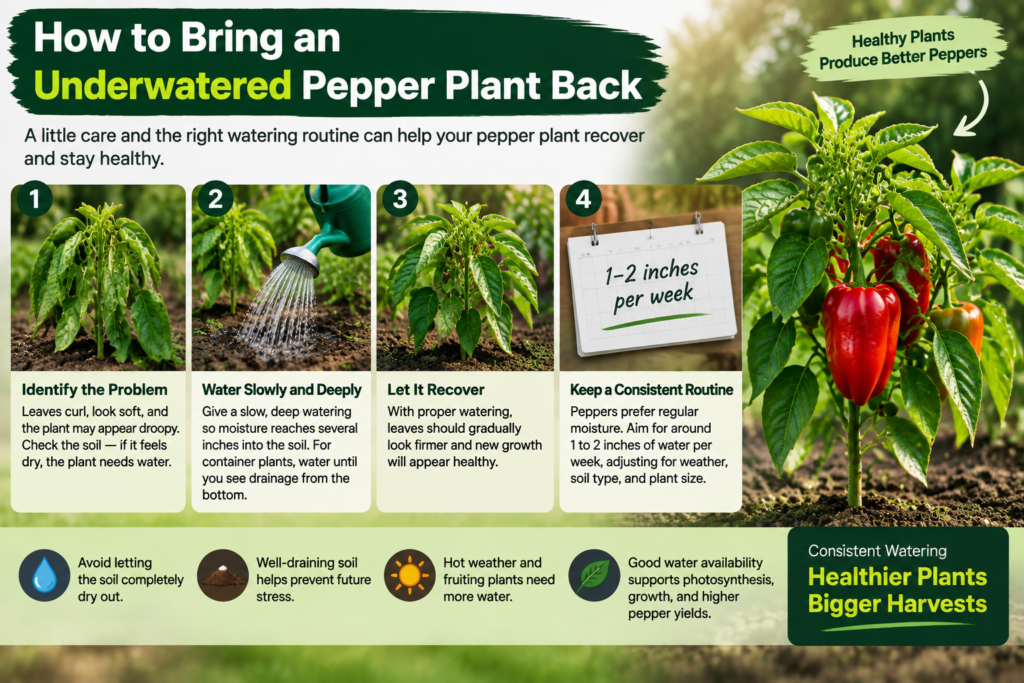
Research has shown that drought stress can reduce photosynthesis in pepper plants and affect growth and fruit production. Water availability plays an important role in how efficiently pepper plants develop and produce crops.
Simple Ways to Stop Pepper Plants From Drying Out
One of the easiest improvements is adding mulch around the plant. A layer of straw, compost, or shredded leaves helps slow evaporation and keeps the soil temperature more stable.
Container peppers need extra attention because pots dry much faster than garden soil. During hot weather, checking the soil once a day can prevent many problems before they start.
It also helps to improve the soil itself. Soil mixed with compost usually holds moisture better while still allowing excess water to drain away.
The main thing to remember is that pepper leaves curling from underwatering are not the disease itself. They are a warning sign from the plant that the roots are struggling to supply enough water.
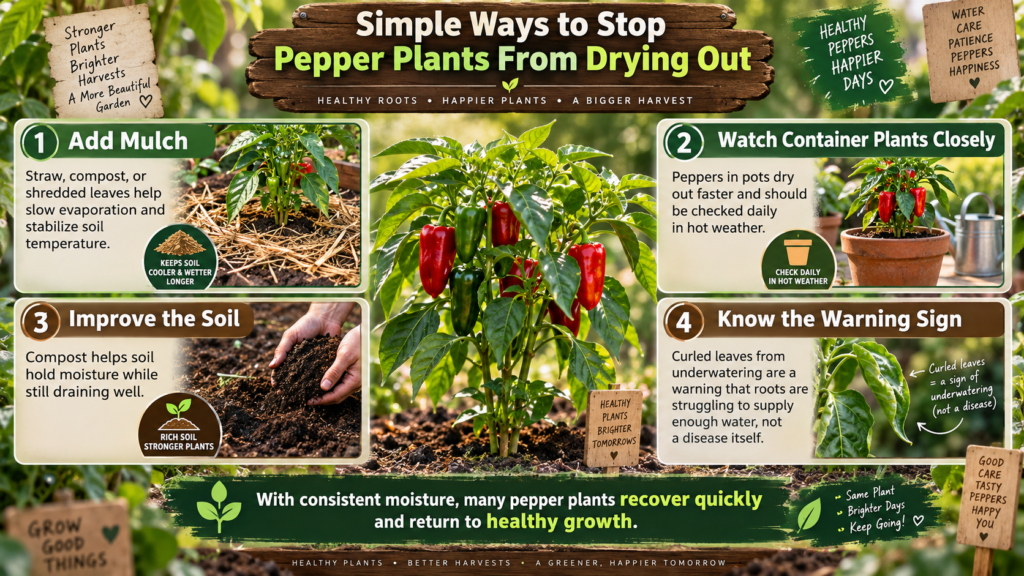
Once moisture levels become consistent again, many pepper plants recover quickly and return to healthy growth.
5. Overwatering and Root Stress: Too Much Water Can Also Curl Pepper Leaves
Many gardeners see curled pepper leaves and immediately think the plant needs more water. But sometimes the opposite is true. The soil may be wet, yet the leaves still start folding or curling because the roots are struggling.
Pepper roots need two things to work properly: moisture and oxygen. When the soil stays soaked for too long, the spaces between soil particles fill with water instead of air. Without enough oxygen, the roots become stressed and cannot absorb water and nutrients efficiently.
This is why an overwatered pepper plant can look surprisingly similar to an underwatered one. The plant has plenty of water around its roots, but the damaged roots cannot move that moisture upward to the leaves.
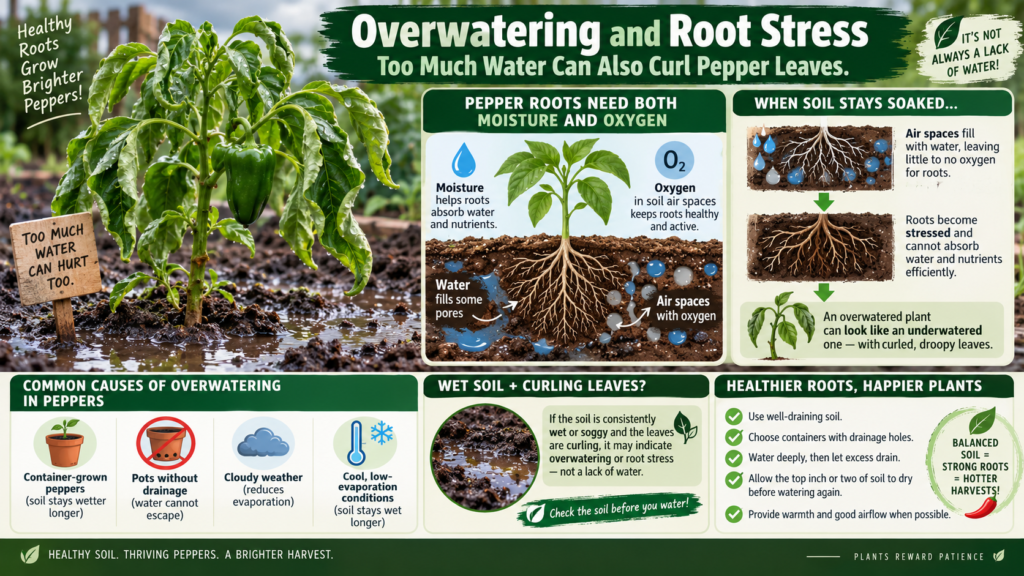
This problem is especially common with container-grown peppers. Pots without proper drainage can stay wet for days, especially during cloudy weather or when the plant is placed in a cool area where evaporation is slow.
How to Check If Your Pepper Plant Is Being Overwatered
The easiest mistake to make is judging the problem only by looking at the leaves. Leaf curling can happen for several reasons, so the soil and roots tell a much clearer story.
Start by checking the soil.
If it still feels wet several days after watering, the plant may be getting too much moisture. Other signs often appear along with curled leaves:
- Older leaves near the bottom start turning yellow
- The plant grows slowly despite having enough water
- Soil smells unpleasant or “stale”
- Leaves feel soft instead of firm
- The stem near the soil line looks weak
If you suspect root problems, gently remove the plant from its container and inspect the roots.
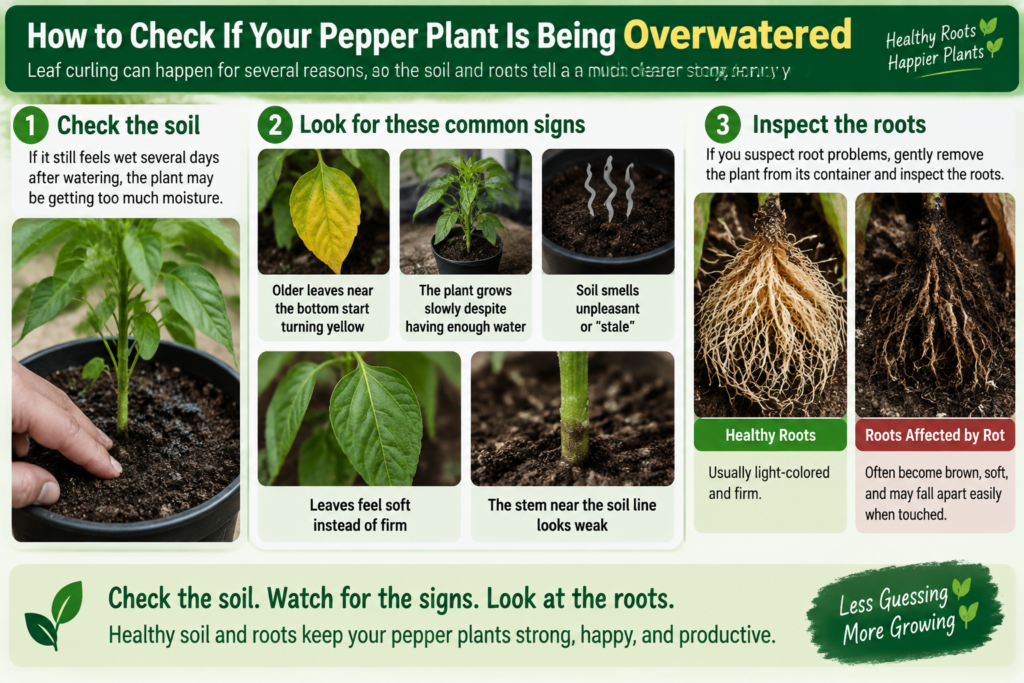
Healthy roots are usually light colored and firm. Roots affected by rot often become brown, soft, and may fall apart easily when touched.
What to Do When Pepper Plants Are Overwatered
The first thing to do is simple: stop watering for a while.
Give the soil time to dry before adding more moisture. Many plants recover once the roots get access to oxygen again.
For future watering, avoid following a strict calendar. A pepper plant does not need water just because it has been three or four days since the last watering. Weather conditions, pot size, and soil type all change how quickly moisture disappears.
Before watering, check the soil a few inches below the surface. If it is still damp, wait.
If the soil itself is the problem, improve the drainage.
For garden beds, adding compost can help improve soil structure and prevent water from sitting around the roots. In heavy clay soil, raised beds or better drainage may be necessary.
For container peppers:
- Use a quality potting mix that drains well
- Make sure drainage holes are open
- Avoid keeping the pot in standing water
- Choose a container size that matches the plant
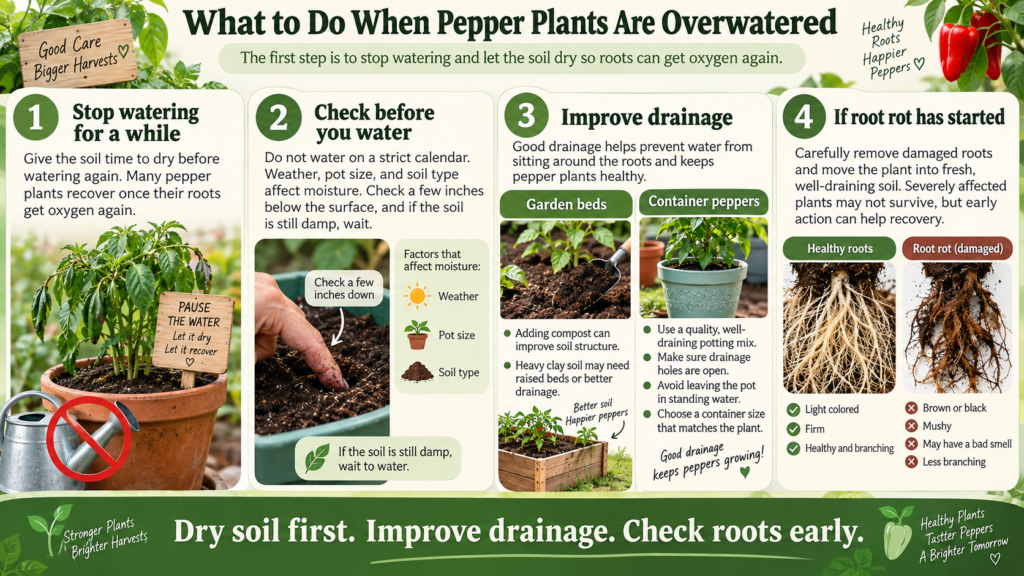
If root rot has already started, remove the damaged roots carefully and move the plant into fresh, well draining soil. Severely affected plants may not survive, but early action gives them a chance to recover.
The Balance Pepper Plants Need
Pepper plants are not difficult to grow, but they do not like extremes. Soil that becomes completely dry stresses the plant, but soil that stays constantly wet creates a different kind of stress.
The goal is simple: keep the roots moist, but allow them to breathe.
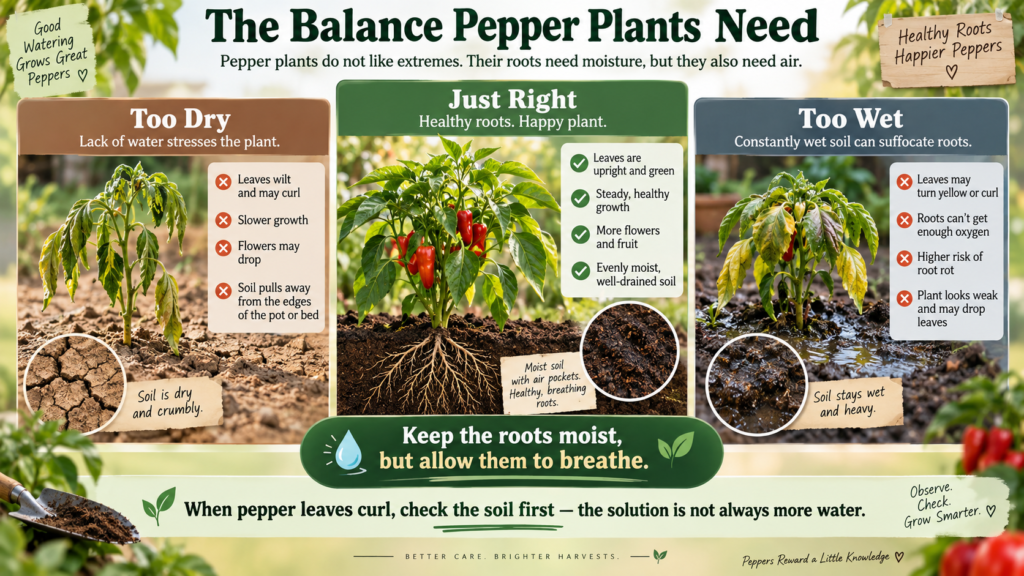
When pepper leaves curl, do not automatically reach for the watering can. Check the soil first. Sometimes the solution is not more water,
6. Nutrient Deficiency: Phosphorus or Magnesium
Not every curled pepper leaf points to a watering problem. Sometimes the plant is short of a nutrient it needs, and the leaves begin to change shape and color at the same time.
Phosphorus and magnesium are two nutrients worth checking, especially when the older leaves are the first ones to look unusual.
A pepper plant low in phosphorus may develop unusually dark foliage, sometimes with a reddish, bronze, or purple tint. Growth can also slow down. Phosphorus deficiency generally appears on older foliage first because the plant can move this nutrient from older tissue to newer growth.
Magnesium deficiency looks different. The tissue between the veins begins to turn pale or yellow while the veins remain green. Again, the change usually starts on older leaves. As the deficiency becomes more serious, brown areas can develop and affected leaves may curl upward or eventually drop.
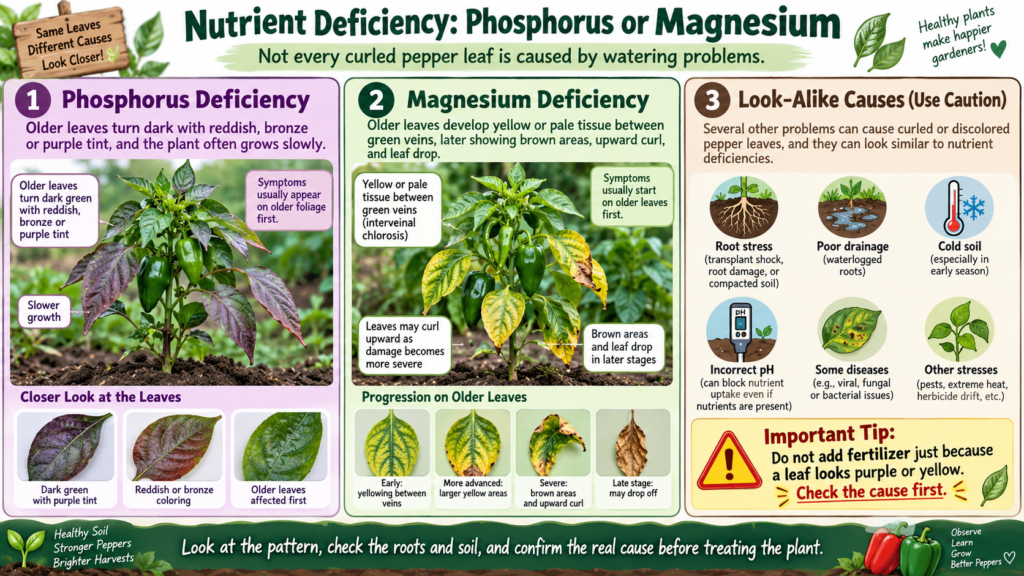
The difficult part is that these symptoms are not unique to nutrient problems. Root stress, poor drainage, cold soil, incorrect pH, and even some diseases can produce similar looking leaves. That is why adding fertilizer simply because a leaf looks purple or yellow is not a good first move.
Check the Soil Before Adding Anything
Start with the older leaves near the bottom of the pepper plant. Look at the pattern rather than one damaged leaf.
If the leaf remains green along the veins but turns yellow between them, magnesium becomes a stronger possibility. Dark or purplish older foliage together with weak growth can point toward phosphorus trouble.
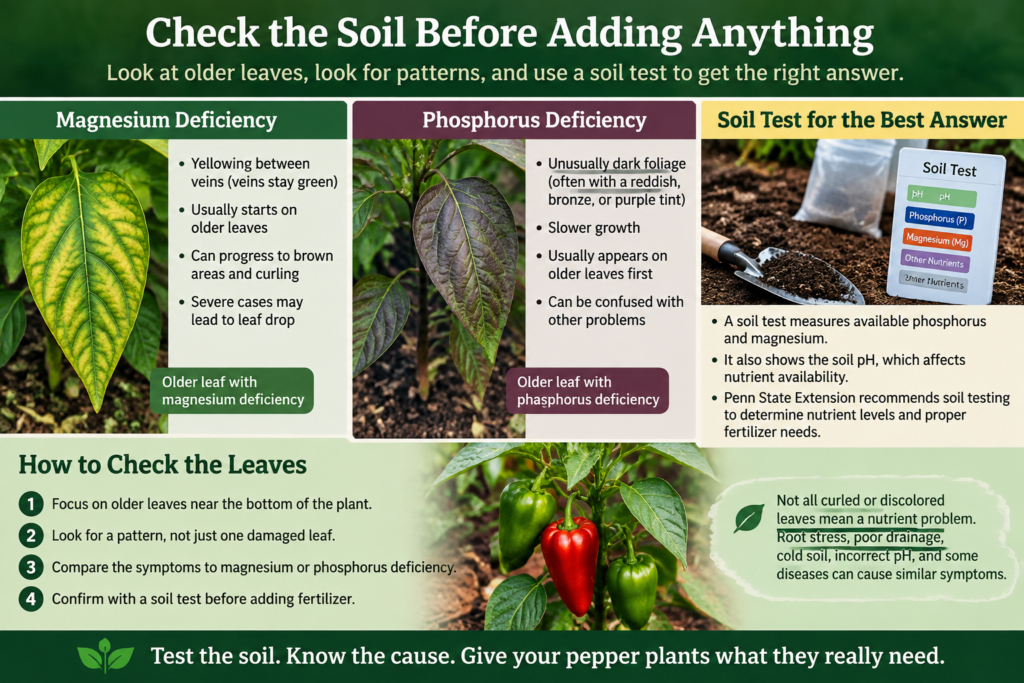
A soil test gives you a much better answer than appearance alone. It can measure available phosphorus and magnesium and also show the soil pH, which matters because nutrient availability changes as pH changes. Penn State Extension recommends soil testing as a way to determine both nutrient availability and appropriate fertilizer needs.
Correcting a Phosphorus Shortage
If testing shows that phosphorus is actually low, use a fertilizer that supplies phosphorus according to the soil test recommendation. Bone meal can supply phosphorus too, but it works relatively slowly and should not be added simply because a pepper leaf has turned purple.
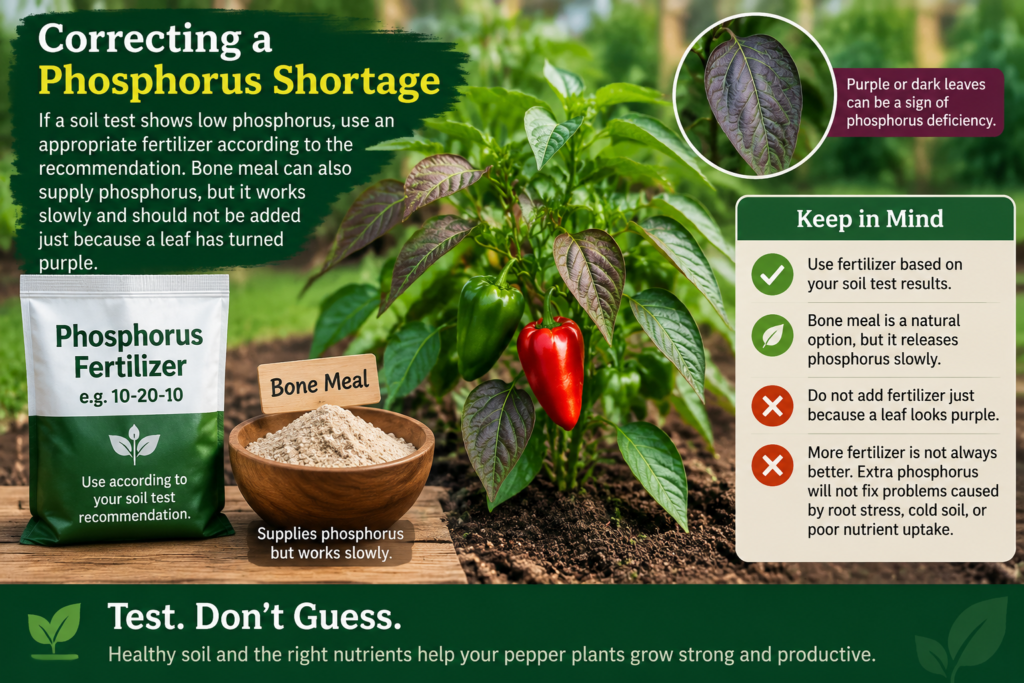
More fertilizer is not always better. If phosphorus is already present in the soil, adding extra will not solve a problem caused by unhealthy roots, cold soil, or poor nutrient uptake.
What About Magnesium?
When magnesium is genuinely low, magnesium sulfate, commonly sold as Epsom salt, can supply it. Agricultural extension guidance recognizes Epsom salt as a source of magnesium, but that does not mean every yellow pepper plant needs it.
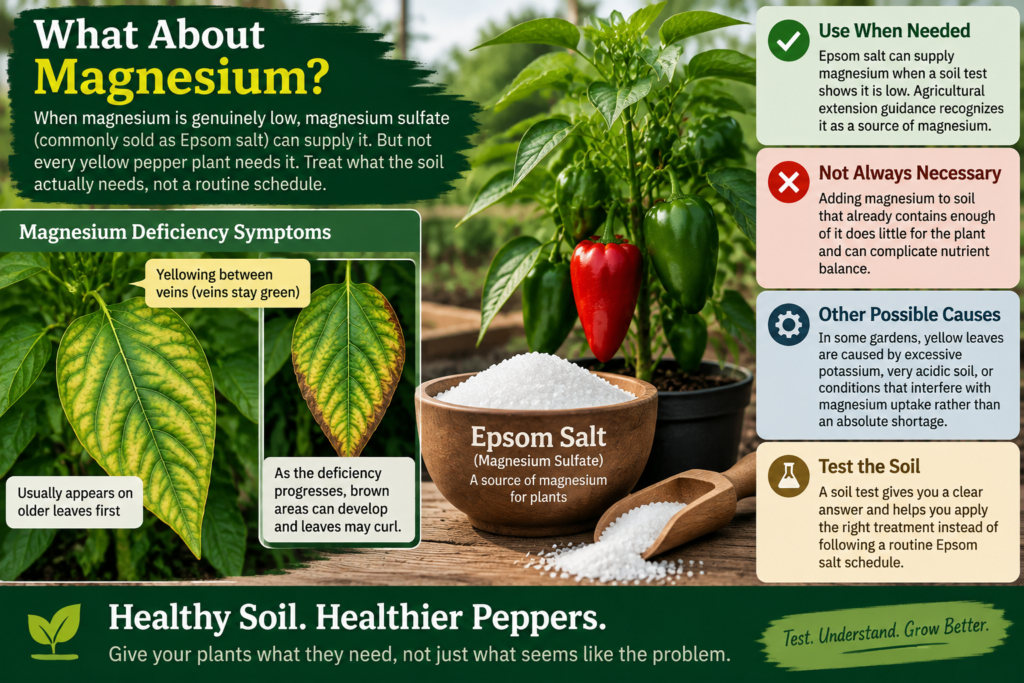
This distinction matters. Adding magnesium to soil that already contains enough of it does little for the plant and can complicate nutrient balance.
In some gardens, the underlying issue is excessive potassium, very acidic soil, or conditions that interfere with magnesium uptake rather than an absolute shortage of magnesium.
For that reason, treat what the soil actually needs rather than following a routine Epsom salt schedule.
Do Not Forget Soil pH
A pepper plant can sit in soil containing plenty of nutrients and still struggle to use them if conditions around the roots are poor. Soil pH, excess water, temperature, and competing nutrients all influence nutrient uptake.
If several plants are developing the same unusual coloring or leaf distortion, checking the soil is usually more useful than adding one fertilizer after another.
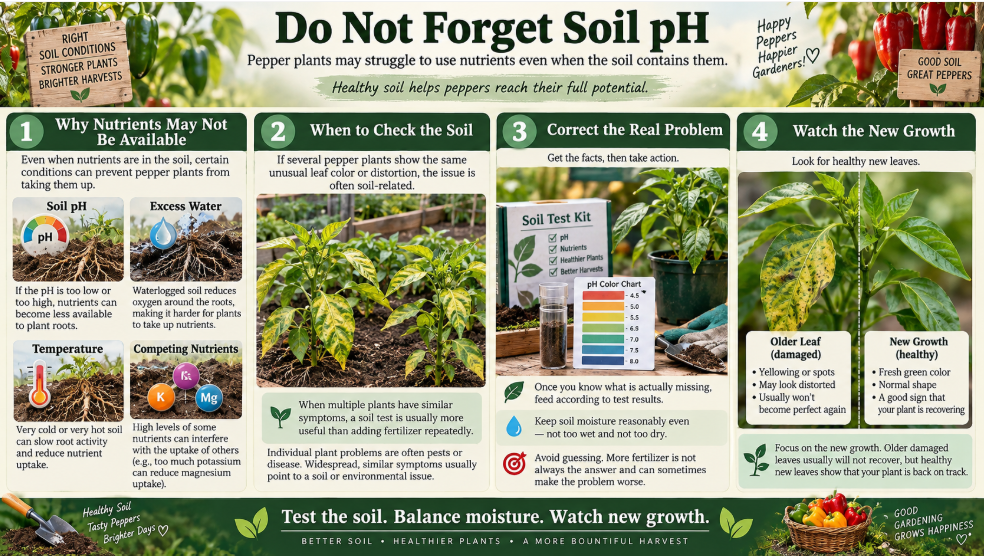
Once you know what is actually missing, correcting the deficiency becomes much simpler. Feed the soil according to the test results, keep moisture reasonably even, and watch the newer growth. Healthy new leaves are often a better sign of recovery than waiting for badly damaged old leaves to become perfect again.
7. Viral Infection: When Pepper Leaf Curling Is Caused by a Virus
Sometimes curled pepper leaves are not caused by watering, fertilizer, or growing conditions. In some cases, the plant is dealing with a viral infection.
Viruses such as Pepper Mosaic Virus and Curly Top Virus can affect pepper plants and create symptoms that look very different from simple stress. Instead of only curling, the leaves often develop unusual patterns, including yellow and green patches, distorted growth, and a generally unhealthy appearance.
These viruses are commonly spread by small sap-feeding insects. Aphids, whiteflies, and leafhoppers can pick up viral particles from an infected plant and transfer them to healthy plants while feeding. Once a pepper plant becomes infected, the virus spreads inside the plant tissue and cannot be removed with fertilizer, extra water, or other normal plant care methods.
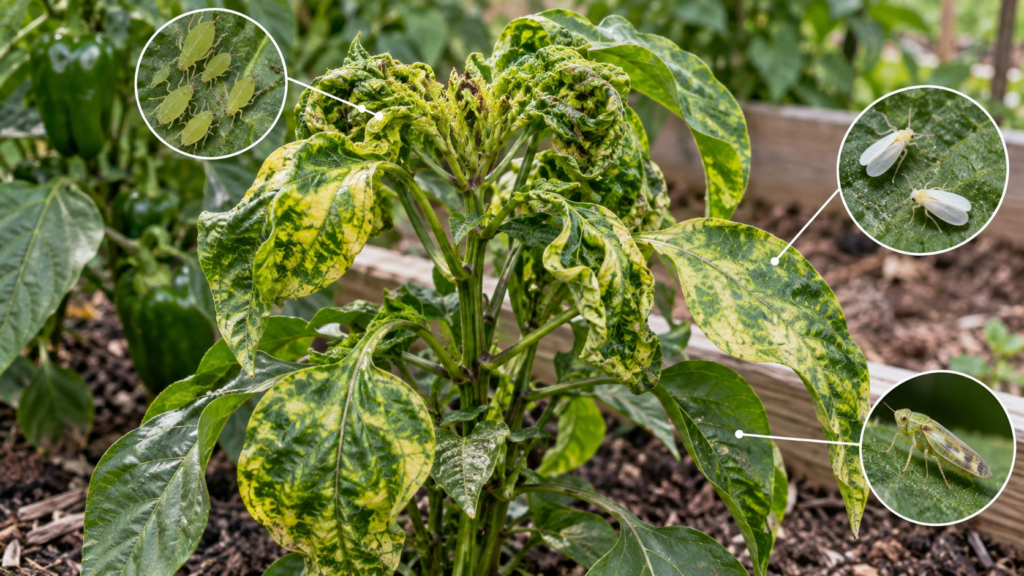
One reason viral problems are frustrating is that the early symptoms can look similar to nutrient deficiencies or environmental stress. However, the combination of leaf curling, strange color patterns, and poor new growth is usually a strong warning sign.
How to Recognize a Viral Infection
Look closely at the newest leaves and overall plant growth.
A pepper plant affected by a virus may show:
- Leaves curling upward or becoming twisted
- Yellow and green mosaic-like patterns on leaves
- Small, distorted new leaves
- Slow or stunted growth
- Misshapen or undersized fruits
- Poor flowering or reduced harvest
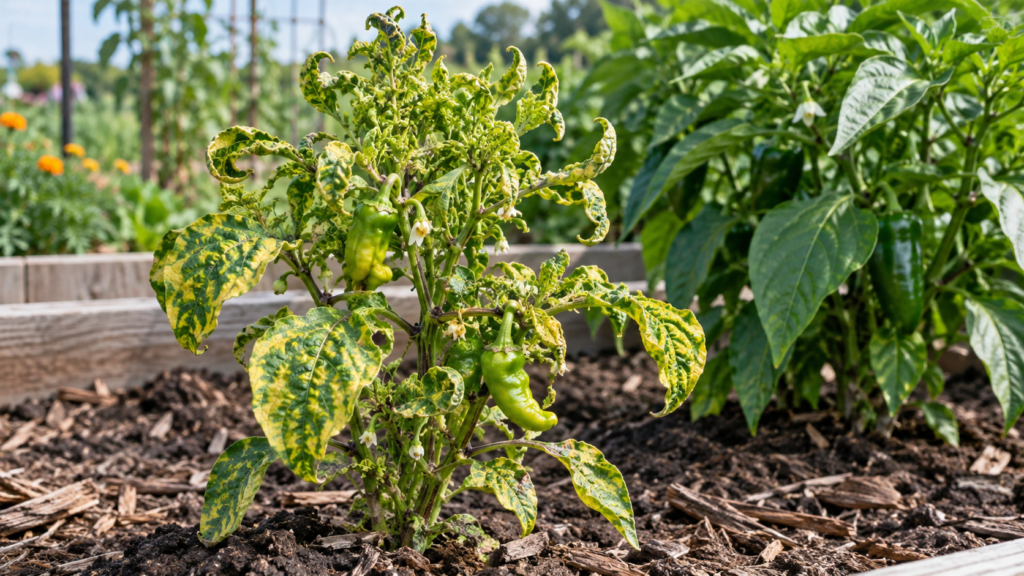
The biggest clue is that the problem does not improve after correcting normal care issues. If you adjust watering, improve nutrition, or provide better growing conditions and the plant continues declining, a viral infection becomes more likely.
Unlike underwatering or nutrient problems, viral leaf curling usually continues because the cause is inside the plant itself.
What to Do If Your Pepper Plant Has a Virus
Unfortunately, there is no treatment that can remove a virus from an infected pepper plant. Fungicides and fertilizers will not cure the problem.
The best step is to remove badly infected plants to reduce the chance of spreading the virus to nearby peppers. Avoid placing infected plants in compost piles because some plant pathogens may survive and create problems later.
When removing infected plants:
- Pull out the entire plant, including roots if possible
- Dispose of infected material away from healthy plants
- Wash your hands after handling affected plants
- Clean pruning tools before using them on another plant
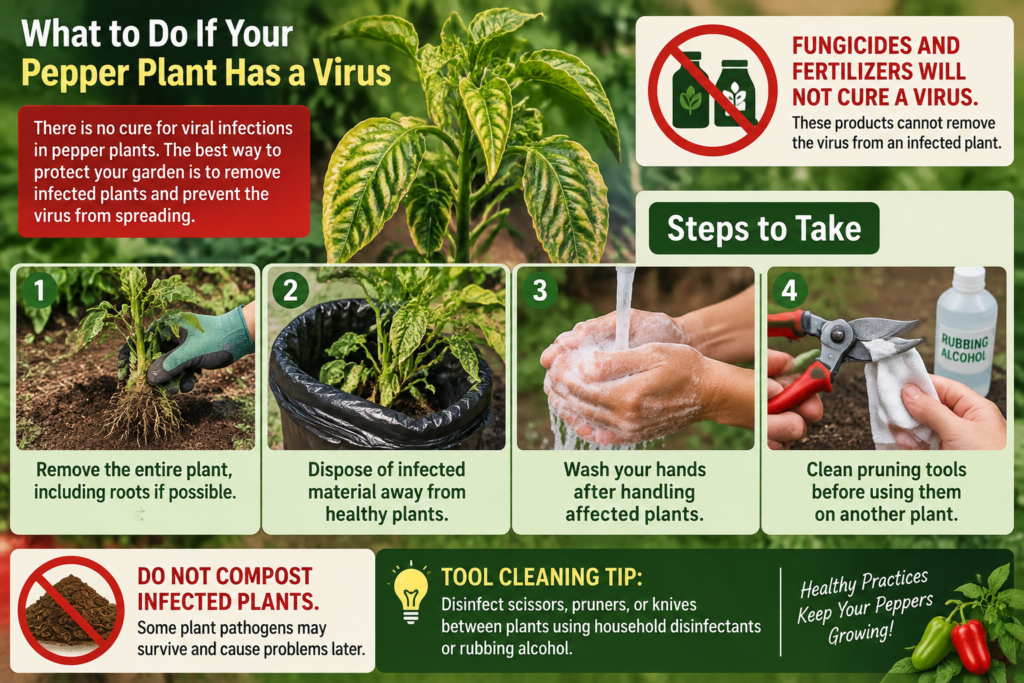
A simple tool-cleaning step can make a big difference. Disinfect scissors, pruners, or knives between plants using household disinfectants or rubbing alcohol to reduce the risk of transferring plant pathogens.
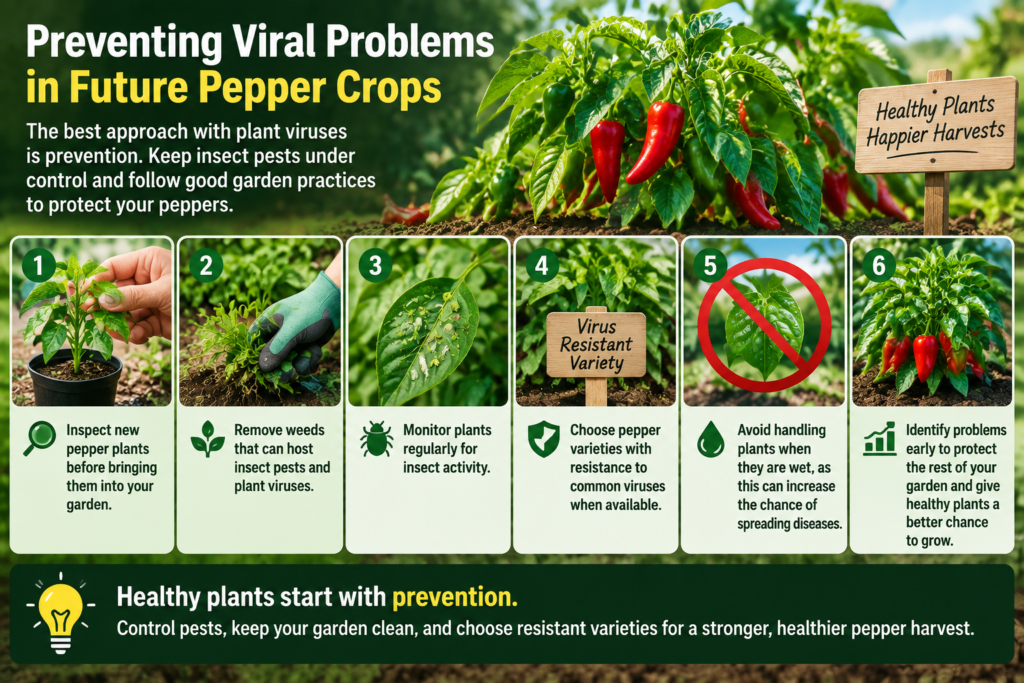
Preventing Viral Problems in Future Pepper Crops
The best approach with plant viruses is prevention.
Start by controlling the insects that spread viruses. Aphids, whiteflies, and leafhoppers can move quickly between plants, so keeping their populations low helps protect healthy peppers.
Useful prevention steps include:
- Inspect new pepper plants before bringing them into your garden
- Remove weeds that can host insect pests and plant viruses
- Monitor plants regularly for insect activity
- Choose pepper varieties with resistance to common viruses when available
- Avoid handling plants when they are wet, as this can increase the chance of spreading some plant diseases
A pepper plant with curled leaves does not always mean the plant is lost. Many causes of curling can be corrected. But when curling appears together with mosaic patterns, distorted growth, and poor fruit development, it is important to consider viral infection.
Identifying the problem early helps protect the rest of your garden and gives healthy plants a better chance to grow without being exposed.
8. Transplant Shock: Why Pepper Leaves Curl After Moving
Moving a pepper plant from one place to another can be stressful, even when everything is done correctly. A healthy plant that looked fine in a nursery pot may suddenly develop curled or drooping leaves a few days after being planted in the garden or moved into a larger container.
This reaction is known as transplant shock.
Pepper plants are especially sensitive because their roots do not like being disturbed. During transplanting, some tiny feeder roots can be damaged or exposed to new conditions. These small roots are responsible for absorbing water and nutrients, so the plant may temporarily struggle to support its leaves.
Leaf curling is one way the plant responds while it adjusts. By reducing the leaf surface area, the plant loses less moisture while the root system works on recovery.
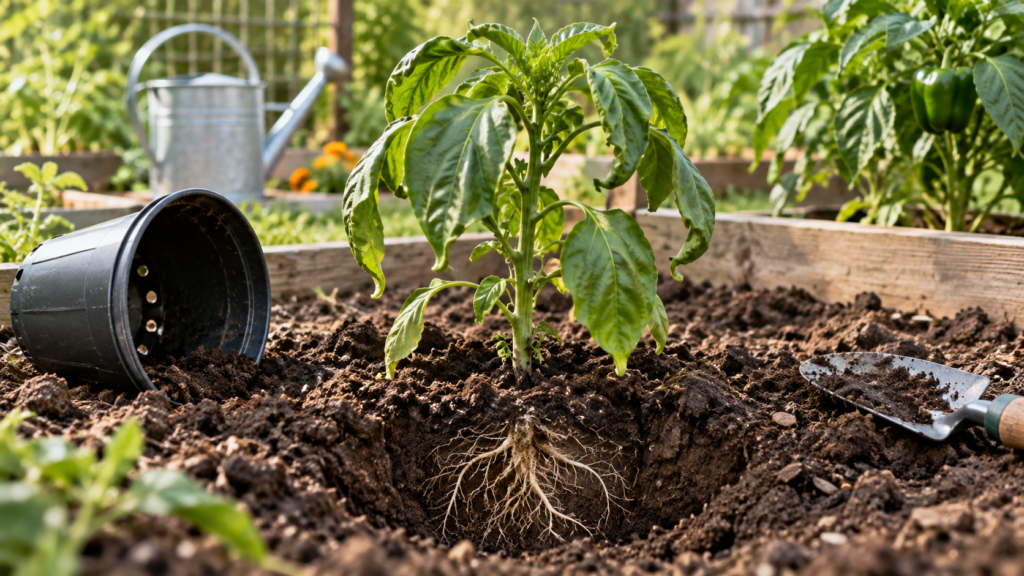
The good news is that transplant shock is usually temporary. Unlike diseases or serious nutrient problems, a stressed pepper plant can often recover with proper care and a little patience.
How to Tell If Transplant Shock Is the Cause
The timing is usually the biggest clue.
If the leaves started curling within a few days after moving the plant, transplant shock is a likely explanation, especially if the plant was healthy before the move.
Other signs may include:
- Slightly curled or drooping leaves
- Slower growth for a short period
- Mild wilting during hot afternoons
- No obvious pest damage or unusual leaf spots
- Leaves returning to normal as the plant adjusts
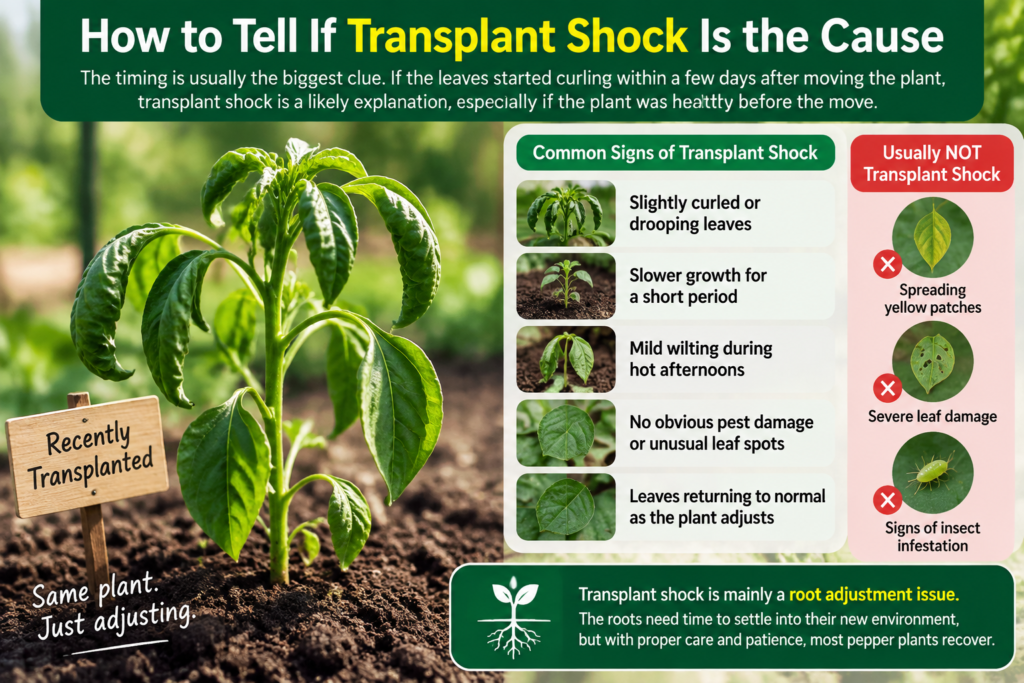
A plant experiencing transplant shock usually does not show spreading yellow patches, severe leaf damage, or signs of insect infestation. The problem is mainly that the roots need time to settle into their new environment.
How to Help a Pepper Plant Recover From Transplant Shock
The biggest mistake after transplanting is trying to “fix” the plant too aggressively. Adding extra fertilizer, watering constantly, or disturbing the roots again can create more stress.
The best approach is simple: give the plant stable conditions while it recovers.
Keep the soil evenly moist, but avoid keeping it constantly wet. The roots need moisture to rebuild, but they also need oxygen. Water deeply when the soil begins drying rather than adding small amounts repeatedly.
Avoid feeding immediately after transplanting. Freshly disturbed roots are sensitive, and strong fertilizer can create additional stress. Once the plant begins producing healthy new growth, normal feeding can gradually resume.
During the first week or two, try to reduce environmental stress:
- Protect young plants from extreme heat
- Provide temporary shade during very hot afternoons if needed
- Avoid unnecessary pruning or moving the plant again
- Keep the soil temperature stable with a light layer of mulch
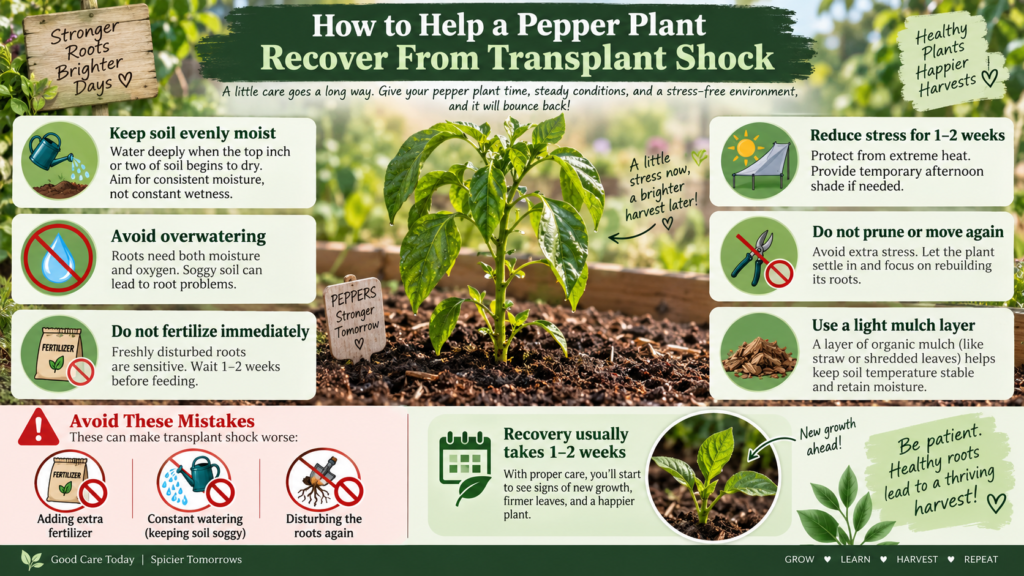
Most pepper plants recover within one to two weeks once the roots begin functioning normally again.
Preventing Transplant Shock Before It Happens
The easiest way to deal with transplant shock is to reduce the stress before moving the plant.
Seedlings grown indoors or in protected environments need time to adjust before being placed outside. This process, called hardening off, involves gradually exposing plants to outdoor conditions over several days.
Before transplanting:
- Introduce seedlings to outdoor temperatures slowly
- Avoid transplanting during extreme heat
- Water the plant before moving it
- Handle the root ball gently and avoid breaking roots unnecessarily
- Choose a calm, cloudy day or late afternoon for planting when possible
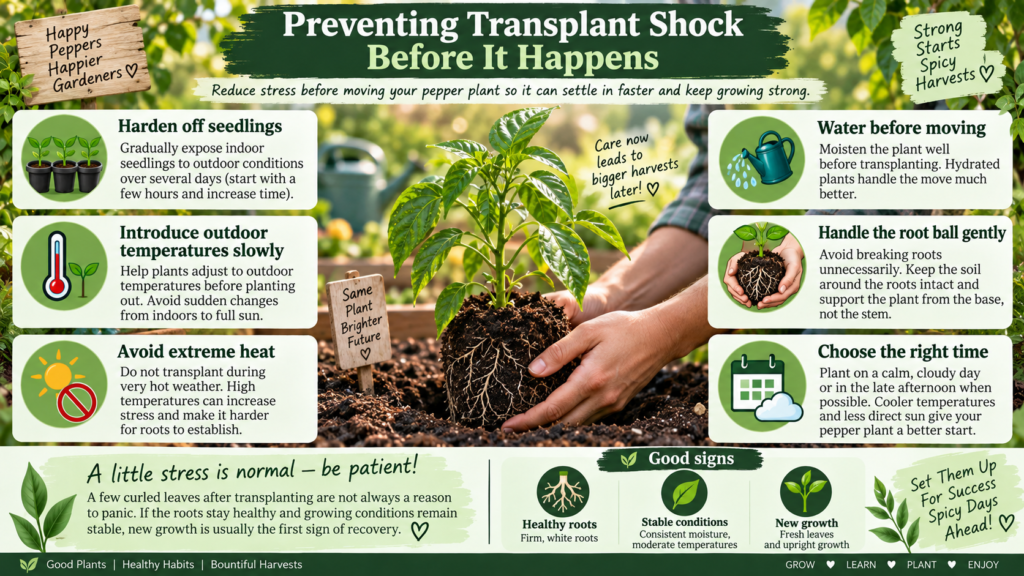
A few curled leaves after transplanting are not always a reason to panic. Pepper plants often need time to adapt. If the roots remain healthy and the growing conditions are stable, new growth is usually the first sign that the plant has successfully recovered.
9. Thrips Damage: Tiny Insects That Can Make Pepper Leaves Curl
Not every curled pepper leaf is caused by watering problems or nutrient issues. Sometimes the damage comes from a pest so small that many gardeners do not notice it until the plant already shows signs of stress.
Thrips are tiny, slender insects that feed by scraping the surface of leaves and sucking out plant fluids. Because they damage the outer layer of the leaf, the affected areas cannot function normally. The result is often curled, distorted, or unhealthy-looking foliage.
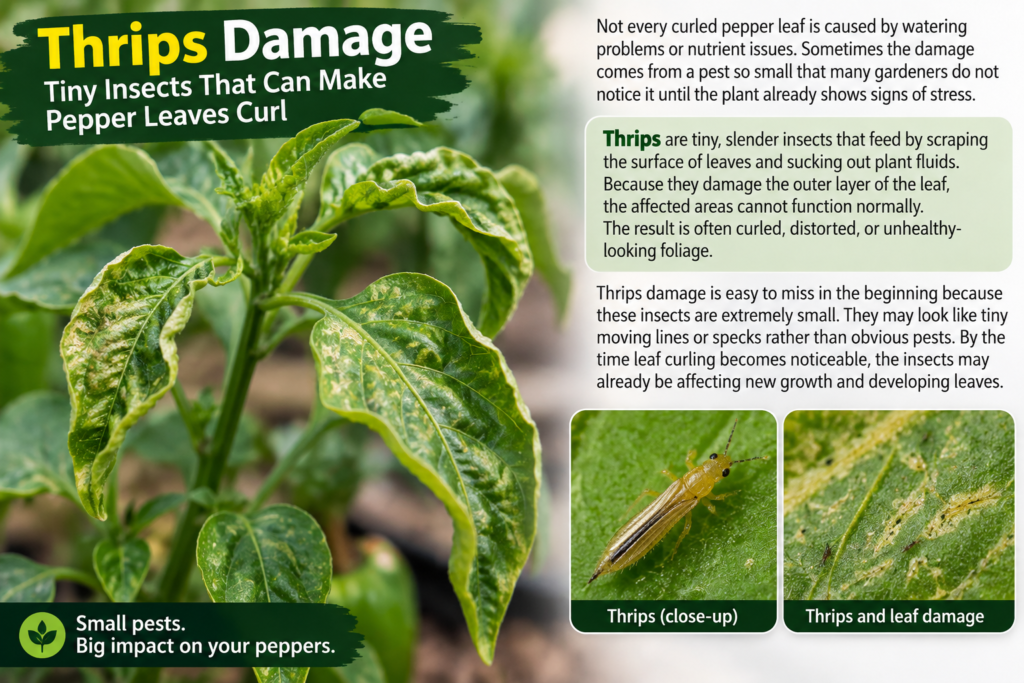
Thrips damage is easy to miss in the beginning because these insects are extremely small. They may look like tiny moving lines or specks rather than obvious pests. By the time leaf curling becomes noticeable, the insects may already be affecting new growth and developing leaves.
How to Identify Thrips on Pepper Plants
The damage pattern usually gives the first clue.
Pepper leaves affected by thrips may develop:
- Curling or twisting leaves
- Silvery or bronze-colored streaks on the surface
- Scraped-looking patches
- Small black dots from insect droppings
- Distorted new growth
The easiest way to check for thrips is with a simple paper test.
Place a white sheet of paper underneath a suspicious leaf and gently tap the plant. If thrips are present, some of them may fall onto the paper and begin moving. They are very small, but their movement makes them easier to spot.
Also check the underside of leaves and around new shoots because thrips often hide in these protected areas.
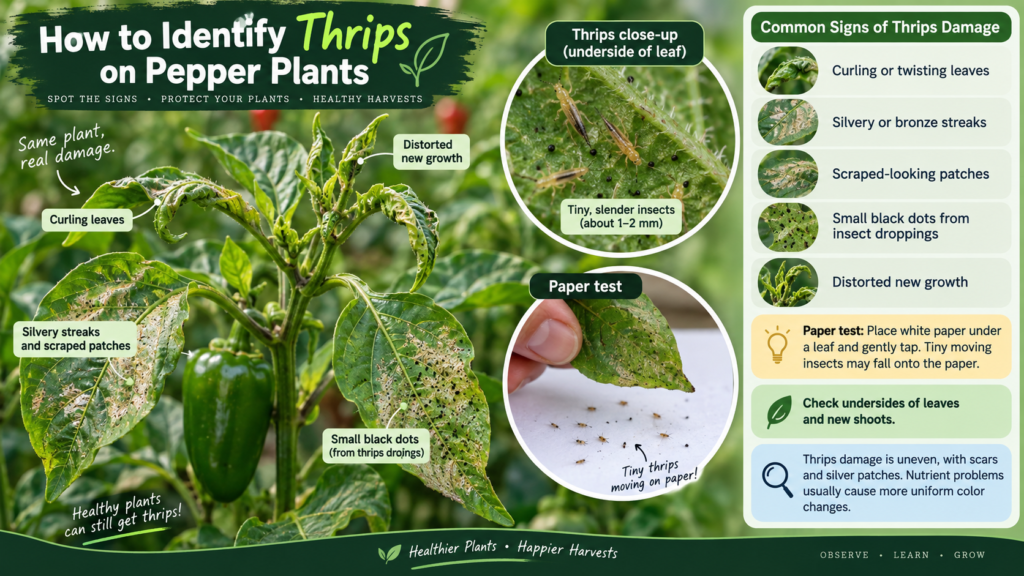
Thrips damage can sometimes be confused with nutrient problems. However, nutrient deficiencies usually create more uniform color changes, while thrips often leave uneven scars, silver patches, or rough, looking areas on the leaf surface.
How to Control Thrips on Pepper Plants
Getting rid of thrips usually requires patience because they can hide in plant crevices and reproduce quickly.
Start by targeting the areas where they spend most of their time:
- Spray the undersides of leaves where thrips often hide
- Pay extra attention to young leaves and growing tips
- Repeat treatments when necessary because new insects may hatch later
Insecticidal soap can help reduce thrip populations by damaging soft-bodied insects. Products containing spinosad are also commonly used for controlling thrips because they work on many common garden pests.
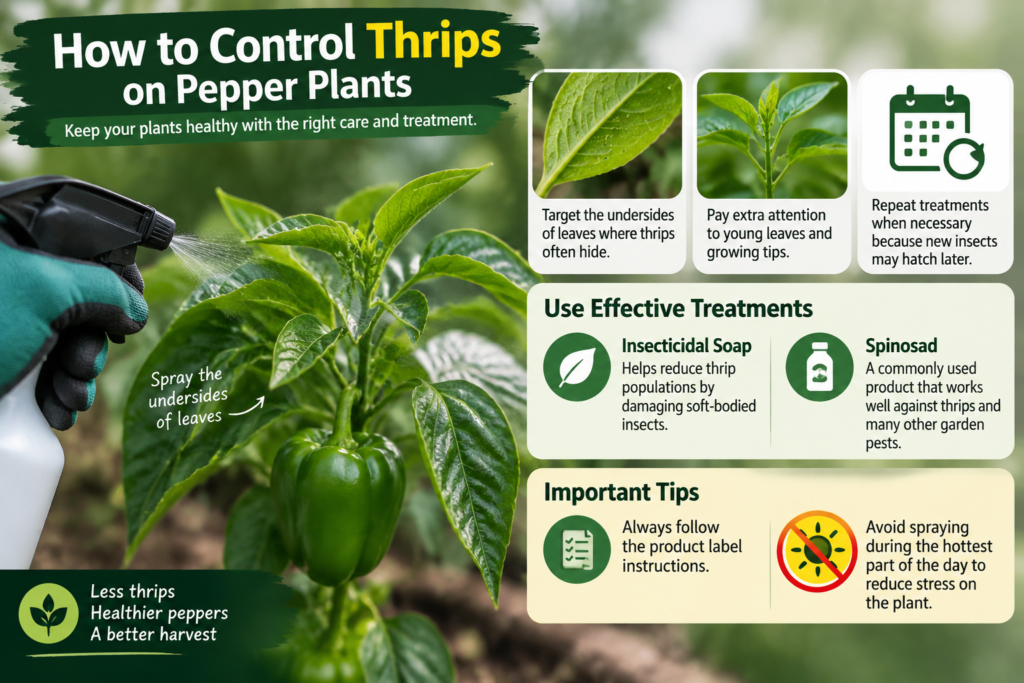
Always follow the product label instructions and avoid spraying during the hottest part of the day to reduce stress on the plant.
Other Ways to Reduce Thrips Problems
Chemical control is only one part of managing thrips. Garden conditions also play an important role.
A few helpful steps include:
Use sticky traps for monitoring
Blue or yellow sticky traps can help detect adult thrips activity and reduce some of the population.
Remove heavily damaged leaves
Severely damaged leaves usually will not recover. Removing them can help the plant focus energy on healthier growth.
Keep weeds under control
Many weeds can act as hiding places and alternative hosts for thrips. Cleaning up nearby weeds reduces the number of places where these pests can survive.
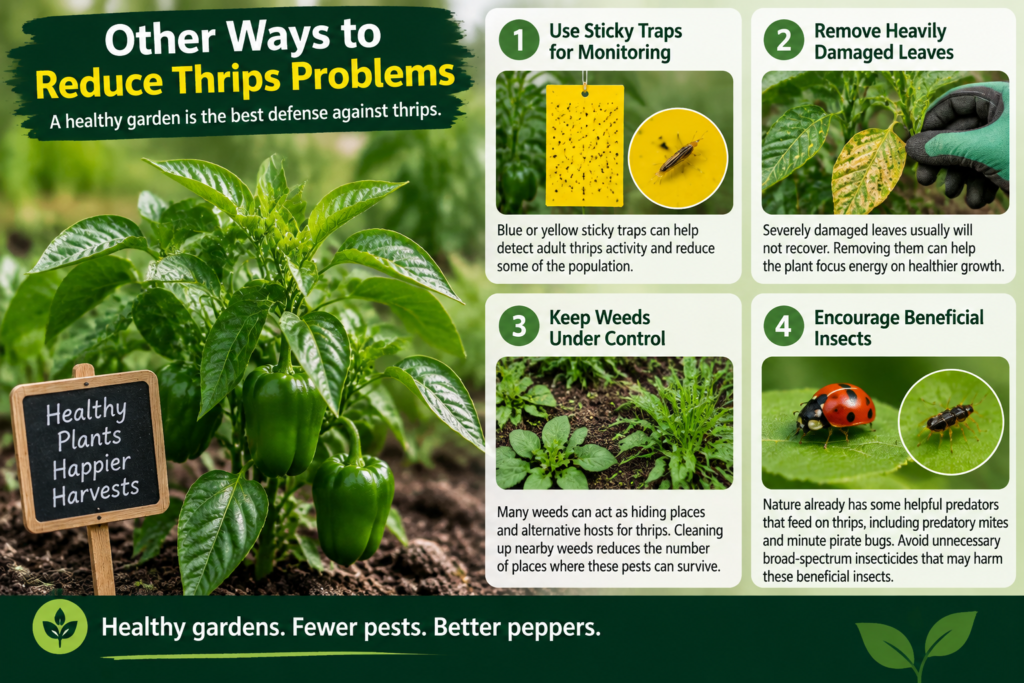
Encourage beneficial insects
Nature already has some helpful predators that feed on thrips, including predatory mites and minute pirate bugs. Avoid unnecessary broad-spectrum insecticides that may harm these beneficial insects.
Preventing Future Thrips Damage
Regular inspection is one of the best defenses against thrips. Spend a few minutes each week checking new leaves, leaf undersides, and growing tips.
Healthy plants can tolerate some pest pressure, but young pepper plants and plants under stress are much more vulnerable. Keeping plants properly watered, providing balanced nutrition, and maintaining good garden hygiene can reduce the chance of serious thrips damage.
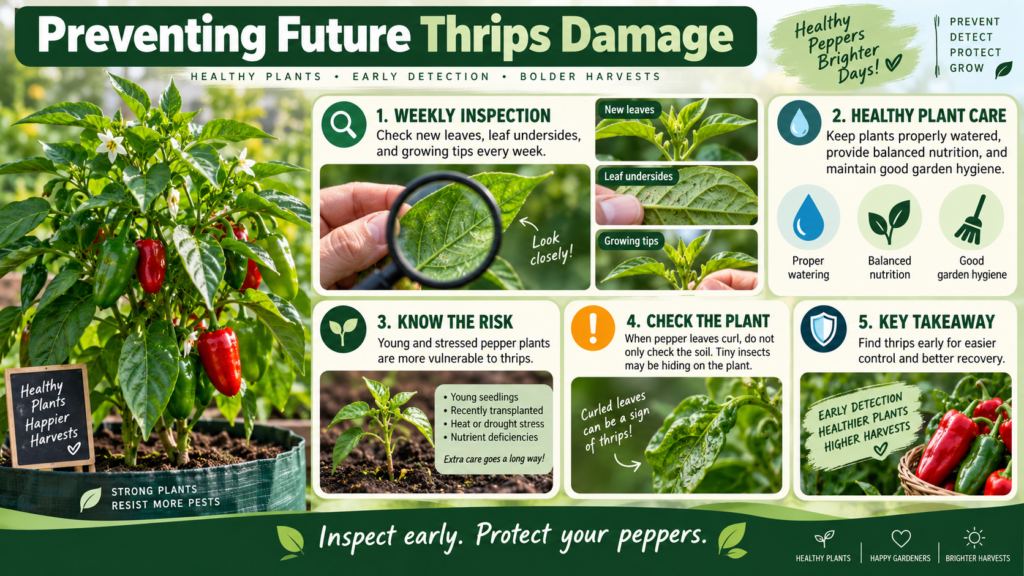
When pepper leaves curl, do not only look at the soil. Sometimes the real problem is a tiny insect hiding on the plant. Finding thrips early makes control much easier and gives your pepper plants a better chance to recover.
Summary Table: Causes of Pepper Leaf Curling
| Cause | Main Symptoms | How to Identify | Solution |
|---|---|---|---|
| Heat or Light Stress | Leaves curl upward like a taco, mainly during hot afternoons. | Leaves recover by evening; plant remains green and healthy. | Deep watering, temporary shade, mulch, and consistent soil moisture. |
| Herbicide Drift | Leaves become twisted, narrow, cupped, or distorted. | New growth is most affected; nearby plants may show similar damage. | Avoid further exposure, maintain plant care, and wait for healthy new growth. |
| Aphids & Sap-Sucking Pests | Curling, puckered leaves, sticky residue, and distorted new growth. | Check leaf undersides and growing tips for aphids or honeydew. | Use water spray, insecticidal soap, and encourage beneficial insects. |
| Underwatering | Leaves curl inward, become soft, and the plant looks tired. | Soil feels dry several inches below the surface. | Deep watering, mulch application, and improved moisture consistency. |
| Overwatering / Root Stress | Curling with yellowing lower leaves and weak growth. | Soil remains wet; roots may become brown and soft. | Improve drainage, reduce watering, and check root health. |
| Phosphorus or Magnesium Deficiency | Purple tint, yellowing between veins, and curled leaves. | Older leaves are affected first; soil testing confirms deficiency. | Correct nutrients based on soil test results. |
| Viral Infection | Curling with yellow-green mosaic patterns and stunted growth. | Poor growth continues even after correcting care issues. | Remove infected plants, control insect carriers, and sanitize tools. |
| Transplant Shock | Curling shortly after moving the plant. | Plant was healthy before transplanting with no pests or spots. | Keep soil evenly moist, avoid fertilizer stress, and allow recovery time. |
| Thrips Damage | Curling with silver streaks, scars, and black dots. | Tap leaves over white paper to detect moving thrips. | Use insecticidal soap/spinosad, sticky traps, and remove damaged leaves. |
Prevention Checklist
| Prevention Step | Why It Helps |
|---|---|
| Water deeply and consistently | Prevents both drought stress and root problems. |
| Add mulch around plants | Stabilizes soil temperature and moisture levels. |
| Inspect leaf undersides weekly | Helps detect pests before serious damage occurs. |
| Test soil and maintain balanced nutrition | Prevents unnecessary fertilizer problems. |
| Avoid herbicide exposure near vegetables | Reduces chemical injury risk. |
| Harden off seedlings before transplanting | Reduces transplant shock and improves survival. |
Final Thoughts
Pepper leaf curling is not a single disease , it is a visible symptom caused by many different problems. The fastest way to solve it is not to treat the curl itself, but to identify the pattern, timing, and additional signs.
A simple diagnosis approach:
- Check when the curling happens
- Afternoon only → possible heat stress
- After transplanting → possible transplant shock
- Check the direction and appearance
- Upward taco curl → heat, water stress, or virus
- Downward twisted curl → possible herbicide injury
- Inspect the plant carefully
- Sticky leaves → aphids
- Silver scars → thrips
- Yellow/purple patterns → nutrient or viral issues
Most environmental problems can be corrected with proper watering, soil care, and stable growing conditions. However, viral infections and severe chemical damage require a different approach and may not be reversible.
References
- University of Minnesota Extension – Growing Peppers in Home Gardens
Pepper plant care, watering, heat stress, aphids, viruses, and common pepper problems.
University of Minnesota Extension – Growing Peppers - University of Minnesota Extension – Keep Gardens Thriving Through the Heat
Heat stress, leaf curling, moisture loss, and watering practices.
University of Minnesota Extension – Heat Stress in Gardens - University of Minnesota Extension – Aphids in Home Yards and Gardens
Aphid identification, curled leaves, honeydew, and pest management methods.
University of Minnesota Extension – Aphids Guide - University of Minnesota Extension – Pepper Plant Diagnostic Guide
Pepper leaf distortion, viruses, pests, and symptom identification.
University of Minnesota Extension – Pepper Diagnosis Guide - University of Minnesota Extension – Pepper Disorder & Pest Diagnosis
Common pepper problems including distorted leaves, insects, and diseases.
University of Minnesota Extension – Pepper Problems
Frequently Asked Questions
Will curled pepper leaves go back to normal?
Yes, in most cases , heat stress, underwatering, and transplant shock are all reversible once the underlying cause is corrected. Viral infections and severe herbicide damage are the main exceptions.
Is leaf curl always a sign of a problem?
Not always. Mild midday curling that fully uncurls by evening is a normal, healthy response to heat and sun, not a disease or deficiency.
Can I still eat peppers from a plant with curled leaves?
If the cause is environmental (heat, water, nutrients) or pest-related, yes — the fruit is generally safe once pests are controlled. If the plant has a confirmed viral infection, it’s best to remove the plant, since fruit yield and quality are usually already compromised.
How long does it take for a pepper plant to recover from curling?
Environmental causes like heat or water stress typically resolve within a few days of correction. Nutrient deficiencies take 1–3 weeks after treatment. Pest, related curling improves within 1–2 weeks of consistent treatment, though already, curled leaves usually don’t fully flatten again — new growth will look normal.
What’s the difference between upward and downward curling?
As a general rule, upward curling (like a taco shell) points to heat, light, water stress, or viral infection, while downward curling points more often to herbicide exposure. It’s a useful first clue, but always confirm with the other symptoms described above.

Thesis Link : https://saulibrary.edu.bd/daatj/public/uploads/BAU200601_19-Pp_5.pdf
- Why Are My Pepper Plant Leaves Curling? 9 Causes & Fixes - September 17, 2026
- Why Are My Zucchini Leaves Turning Yellow? Causes & Fixes - August 31, 2026
- What Is Eating My Plants at Night? - August 27, 2026