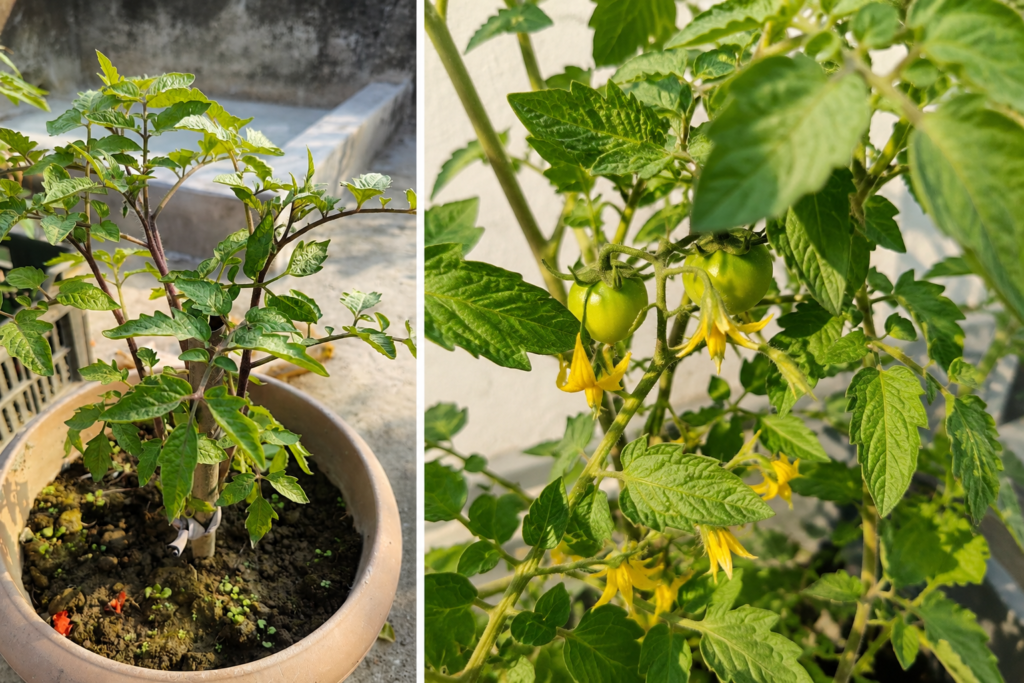

Causes, Signs and Simple Fixes
There is something especially worrying about seeing a healthy tomato plant suddenly change overnight. One day, the leaves are open, green, and looking perfectly normal. The next morning, you walk into the garden with your coffee and notice the edges rolling upward. Tomato leaves curling up can make the lower leaves look like little tubes, twist the new growth, or leave the whole plant looking slightly stressed.
Your first thought is probably: What’s wrong with my tomato plant?
The good news is that curled tomato leaves do not always mean disease. In fact, one of the most common forms of tomato leaf roll is a physiological response to weather or plant stress and may not noticeably reduce growth or yield. Recent University of Minnesota Extension guidance from the summer of 2026 also noted that hot weather can quickly cause older tomato leaves to curl and become leathery.
But there is an important catch.
Not all leaf curling is harmless.
Aphids, viruses, herbicide exposure, watering problems, root stress, and excessive heat can all produce curled or distorted leaves. That is why the best approach is not to immediately spray the plant with something. First, look at the pattern.
- Are only the old leaves curling?
- Are the leaves still green?
- Is the plant growing normally?
- Are the new leaves twisted?
- Do you see insects?
- Are the leaves yellow as well as curled?
The answers to those questions can tell you a lot.
This guide will walk through the most common reasons tomato leaves curl up, what the symptoms usually look like, what you can do about each problem, and when you should simply leave the plant alone.
Tomato Leaf Curl: Quick Summary
A simple guide to help identify why your tomato leaves are curling.
| Possible Cause | Common Symptoms | Severity | What to Do |
|---|---|---|---|
| Heat Stress | Leaves curl upward during hot weather, especially older leaves. | Usually Mild | Provide consistent water and reduce heat stress. |
| Physiological Leaf Roll | Older leaves roll upward and may feel thick or leathery. | Usually Harmless | Avoid stress, heavy pruning, and sudden watering changes. |
| Inconsistent Watering | Leaves curl after repeated dry-to-wet soil changes. | Moderate | Keep soil moisture reasonably consistent. |
| Overwatering / Root Stress | Curled or drooping leaves, yellowing, slow growth, and constantly wet soil. | Can Be Serious | Improve drainage and avoid unnecessary watering. |
| Aphids | Curled young leaves, sticky honeydew, and tiny insects underneath. | Treatable | Inspect leaves closely and control aphids early. |
| Viral Disease | Curling with yellowing, mottling, stunting, or distorted growth. | Serious | Inspect carefully and manage affected plants and insect vectors. |
| Mosaic Virus | Light and dark green mosaic patterns with curled or distorted leaves. | Serious | Watch for mottling and abnormal new growth. |
| Herbicide Damage | Twisted, cupped, crinkled, or severely distorted leaves. | Depends on Exposure | Check for nearby spraying or chemical exposure. |
| Leaf rolling after too much foliage has been removed. | Usually Temporary | Avoid excessive pruning, especially during hot weather. | |
| Too Much Nitrogen | Very dark green, leafy growth with fewer flowers than expected. | Moderate | Reduce excessive fertilizer use and follow recommended rates. |
| Curly Top Disease | Curled, yellow, stunted, and misshapen growth. | Serious | Seek local diagnosis if symptoms are severe. |
If older leaves are curling but remain green and the plant is growing normally, stress or physiological leaf roll is more likely. If new growth is twisted, yellow, mottled, or stunted, inspect more carefully for pests, viruses, or chemical damage.
What I Observed in My Own Rooftop Tomato Garden
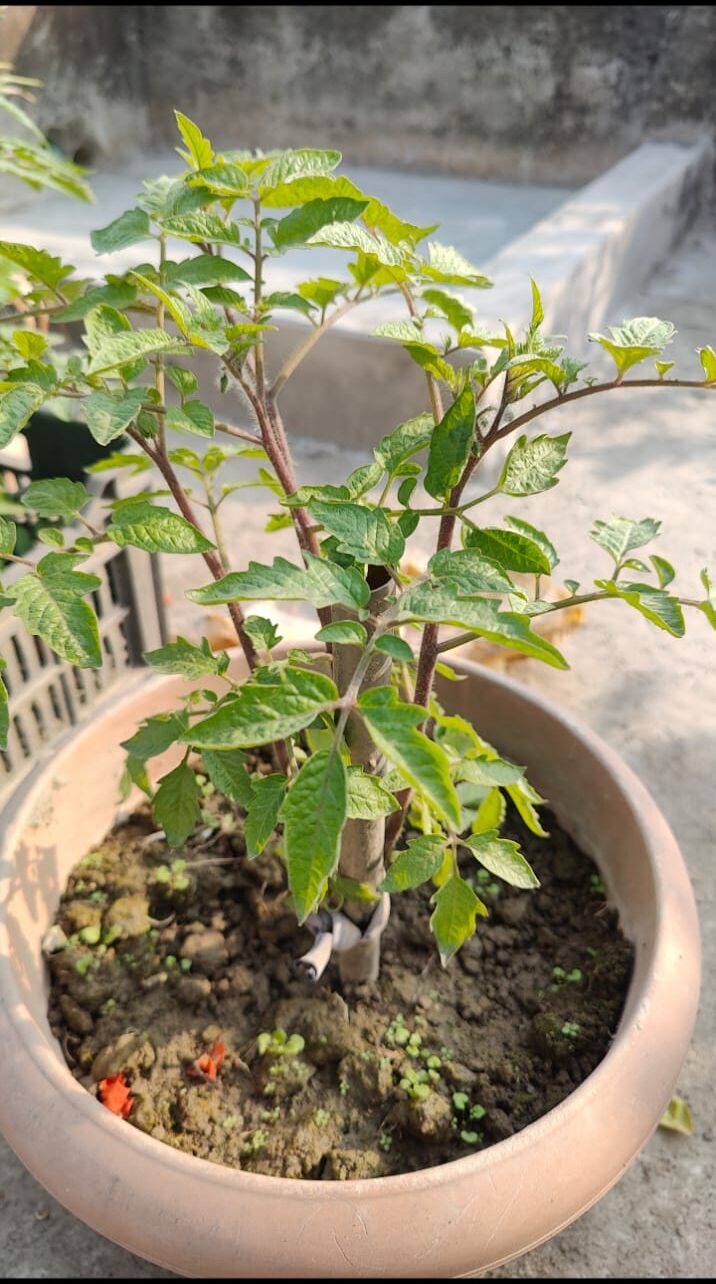
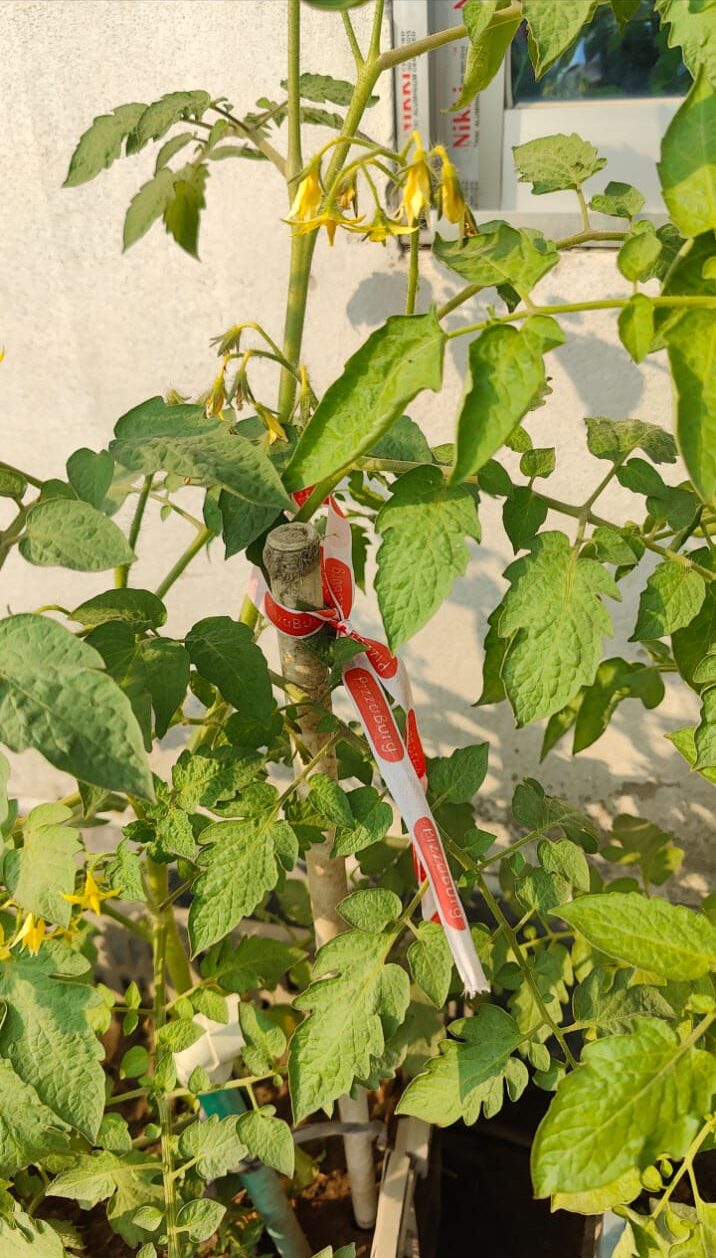
The photos in this article come from my own rooftop garden. I grew and observed these tomato plants over different stages, from vegetative growth to flowering and early fruit development.
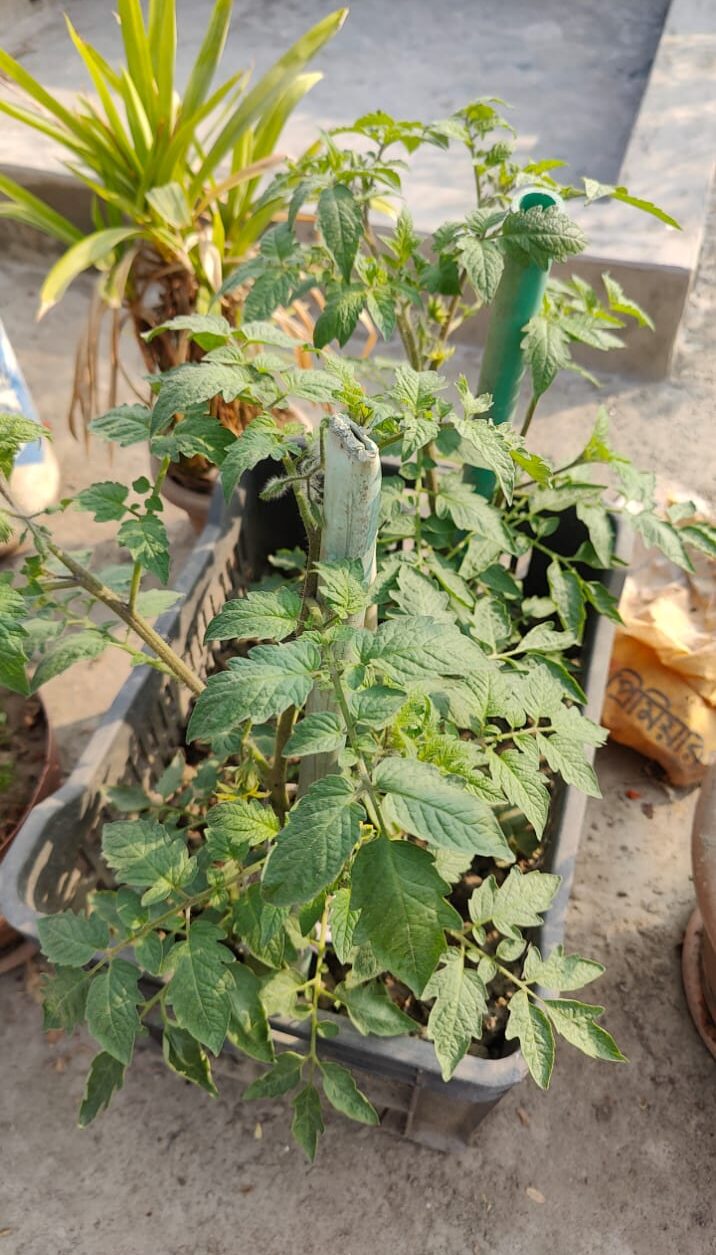
While observing the plants, I noticed that leaf shape and curling could vary depending on sunlight, watering, plant growth, and the condition of new leaves. This reminded me that curled tomato leaves should not always be treated as a disease immediately. Looking closely at the whole plant including new growth, leaf color, pests, soil condition, flowers, and fruit is important before deciding what the problem might be.
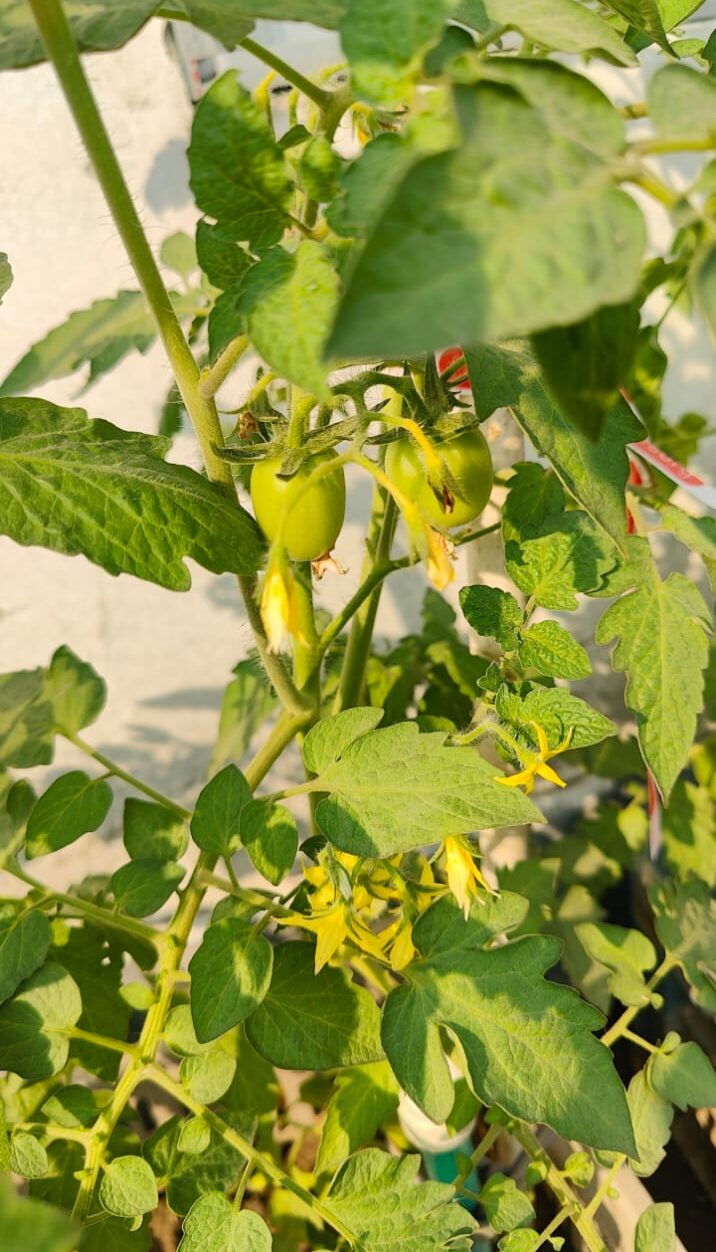
This article combines those practical observations with plant pathology knowledge and research based information.
Quick Answer: Why Are My Tomato Leaves Curling Up?
Tomato leaves can curl for several reasons, and the curl itself does not always mean the plant has a disease.
Heat stress, inconsistent watering, physiological leaf roll, aphids, viral infections, herbicide exposure, root problems, and excessive fertilization can all affect the shape of tomato leaves.
The easiest way to narrow down the cause is to look at the full symptom pattern. Check whether the old or new leaves are affected first. Look for insects underneath the leaves. Notice whether there is yellowing, mottling, stunted growth, or unusual twisting.
A healthy tomato plant with a few curled older leaves during hot weather is very different from a stunted plant with yellow, distorted new growth.
That difference matters.
Before watering more, adding fertilizer, or spraying anything, take a few minutes to inspect the plant.
First, Don’t Panic – Tomato Leaf Curl Is Not Always a Disease
Many gardeners make the same mistake when they see curled tomato leaves: they assume the plant has a serious disease.
Sometimes it does. Often, it doesn’t.
Tomato plants are surprisingly responsive to their environment. Hot afternoons, dry soil, sudden weather changes, pruning, and rapid growth can all affect the way the leaves behave.
A common example is physiological leaf roll.
According to University of Minnesota Extension, this type of leaf roll is associated with hot, dry weather and other stresses. The leaf edges roll upward and inward, the leaves may become firm and leathery, and lower leaves are often affected first. Importantly, the condition generally does not noticeably reduce tomato growth or yield.
That is why looking at the entire plant matters more than looking at one curled leaf.
A plant with a few rolled lower leaves but healthy new growth and developing fruit is very different from a plant with yellow, twisted, stunted new growth.
What Does Tomato Leaf Curl Look Like?
“Leaf curl” can mean different things to different gardeners.
Your tomato leaves may:
- Curl upward from the edges
- Roll inward into a tube like shape
- Cup upward
- Curl downward
- Twist or become distorted
- Become thick and leathery
- Turn yellow around the edges
- Develop pale and dark green patterns
- Become narrow or unusually shaped
These differences are useful clues.
Quick Tomato Leaf Curl Diagnosis Guide
| What You See | Possible Cause | First Thing to Check |
|---|---|---|
| Older leaves rolling upward but staying green | Heat stress or physiological leaf roll | Recent heat and soil moisture |
| Leaves feel thick or leathery | Physiological leaf roll | Weather and plant stress |
| Young leaves are curled and distorted | Aphids, virus, or herbicide exposure | Underside of leaves and recent chemical use |
| Curled leaves with yellowing | Disease or root stress | Whole plant and root-zone conditions |
| Light and dark green patches on leaves | Possible viral disease | New growth and spread to other plants |
| One side of the plant looks more distorted | Possible herbicide drift | Nearby spraying or chemical exposure |
| Plant is curled, small, and growing poorly | Virus, root damage, or severe stress | Overall symptom pattern |
This table is only a starting point. A single symptom is rarely enough to diagnose a tomato problem with certainty.
For example, upward rolling of older, otherwise healthy leaves often points toward physiological leaf roll. Curled leaves combined with mottling, stunting, or abnormal new growth can suggest a virus. Twisted and severely distorted leaves may indicate herbicide injury. Large aphid populations can also cause curling, stunting, and wilting.
So before trying to fix the problem, take a closer look.
1. Hot Weather and Heat Stress
One of the simplest explanations is also one of the most common: your tomato plant is hot and trying to cope.
Recent 2026 gardening guidance from the University of Minnesota reported that hot, windy conditions can pull moisture from leaves faster than roots can replace it. Tomatoes may respond by folding or curling their leaves inward to conserve moisture.
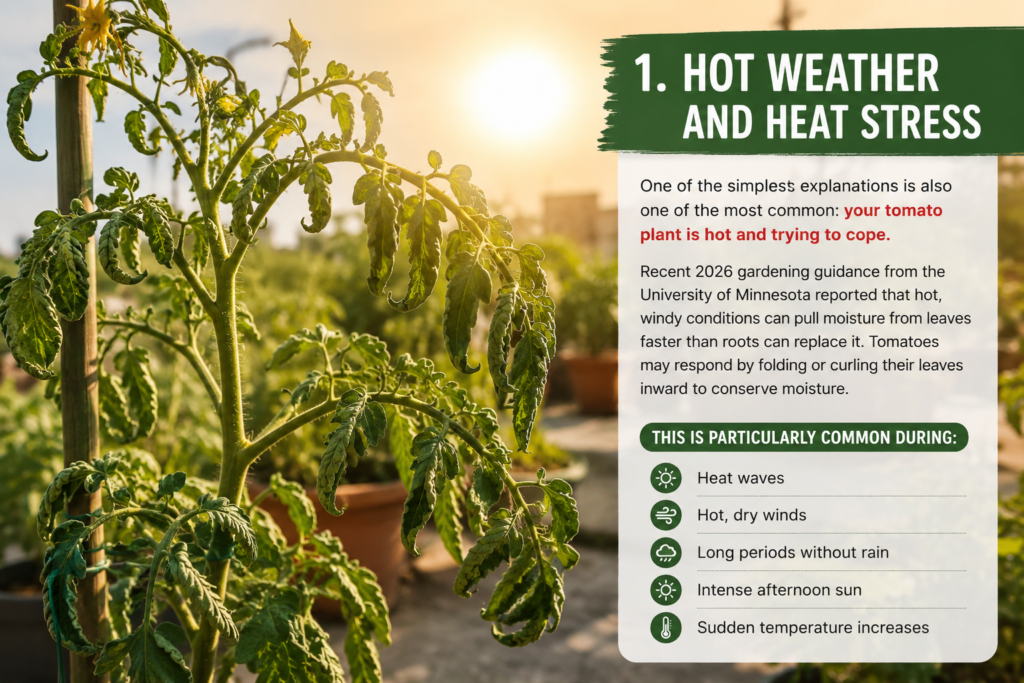
This is particularly common during:
- Heat waves
- Hot, dry winds
- Long periods without rain
- Intense afternoon sun
- Sudden temperature increases
In July 2026, Minnesota Extension also reported widespread tomato leaf curl during periods of intense heat, describing it as a heat-stress response.
What heat related curling usually looks like
You may notice that:
- Older leaves curl first
- Leaves remain mostly green
- The plant otherwise looks healthy
- Curling is worse during hot weather
- The leaves may feel thicker or leathery
What to do
Don’t rush to fertilize or spray.
Instead:
- Check the soil moisture.
- Water deeply at the root zone if the soil is dry.
- Add mulch to reduce moisture loss.
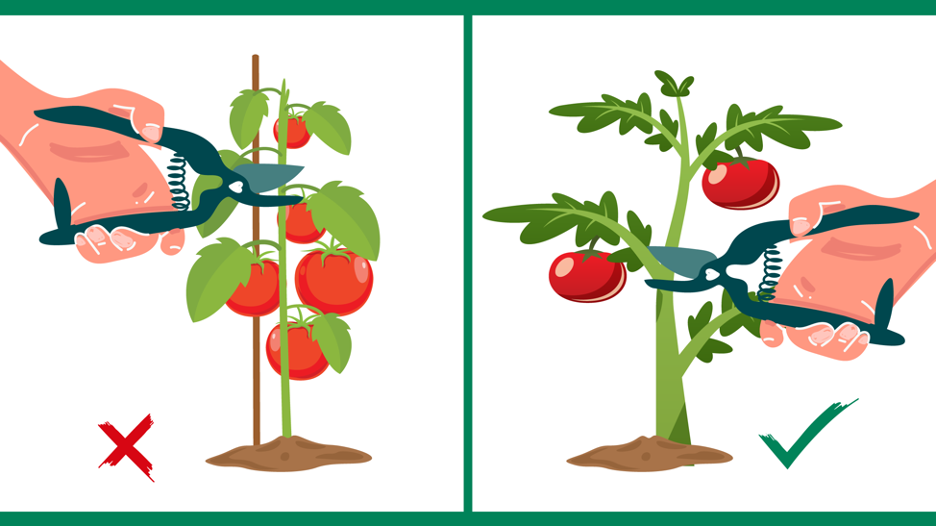
- Avoid heavy pruning during hot weather.
- Consider temporary shade during extreme heat.
Morning watering is generally preferable to watering during the hottest part of the day. University of Minnesota Extension recommends early morning watering and emphasizes deeper watering at the root zone during hot conditions.
A Practical Observation from Plant Disease Diagnosis
One of the biggest mistakes in diagnosing plant problems is assuming that one symptom always has one cause.
Leaf curling is a good example.
The same curled tomato leaf can be the result of heat stress, irregular watering, insects, herbicide exposure, or a disease. That is why plant diagnosis usually requires looking beyond the most obvious symptom.
When examining a plant problem, I prefer to consider the entire picture: the age of the affected leaves, changes in leaf colour, insect activity, weather conditions, soil moisture, plant growth, and any recent chemical exposure.
For example, a tomato plant with green, curled older leaves during a hot period may simply be responding to environmental stress. But if the newest leaves are severely twisted, the plant is becoming stunted, and unusual yellow patterns are appearing, I would investigate more carefully.
The leaf curl may look similar at first glance. The underlying cause may be completely different.
2. Physiological Leaf Roll – The Harmless Type of Tomato Leaf Curl
Physiological leaf roll sounds serious, but in many cases, it isn’t. This is a physical response rather than an infection caused by a pathogen.
University of Minnesota Extension describes the typical symptoms clearly: leaf margins roll upward until they touch or overlap, affected leaves become firm and leathery, and lower leaves are commonly affected first. Once this type of rolling occurs, those leaves may remain rolled even if conditions improve.
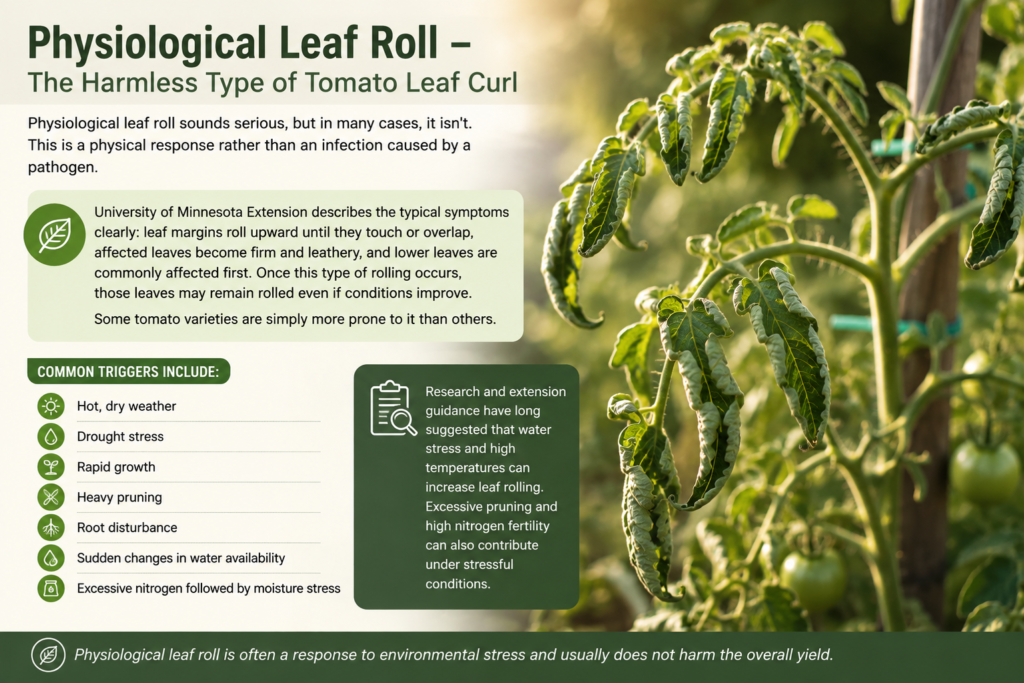
Some tomato varieties are simply more prone to it than others.
Common triggers include:
- Hot, dry weather
- Drought stress
- Rapid growth
- Heavy pruning
- Root disturbance
- Sudden changes in water availability
- Excessive nitrogen followed by moisture stress
Research and extension guidance have long suggested that water stress and high temperatures can increase leaf rolling. Excessive pruning and high nitrogen fertility can also contribute under stressful conditions.
Do you need to treat it?
Usually, no.
If the plant is healthy, producing new growth, and setting fruit normally, physiological leaf roll may require nothing more than good basic care.
Keep the soil moisture reasonably consistent and avoid stressing the plant further.
How I Would Diagnose Curled Tomato Leaves
One thing I would not do is diagnose a tomato plant based on leaf curl alone.
With an academic background in Agriculture and Plant Pathology, I look at the complete symptom pattern before deciding what is most likely causing the problem.
Here is the basic process I would follow.
First, I check which leaves are affected
Are the older leaves curling first, or is the problem appearing mainly on the new growth?
Older leaves rolling upward during hot weather may point toward physiological leaf roll or environmental stress. Severe distortion in young leaves can be more concerning and may require a closer look at pests, viruses, or chemical exposure.
Then, I inspect the leaves closely
I would turn over the affected leaves and check for aphids or other pests. Small insects can easily hide inside curled foliage, particularly around tender new growth.
Next, I look for colour changes
Curling alone is one thing. Curling combined with yellowing, mosaic patterns, vein discoloration, or unusual patches is another.
These additional symptoms can help separate a simple environmental response from a possible disease problem.
I also check the soil
Tomatoes can show stress when the soil becomes too dry, but overly wet soil can also create root problems.
Before adding water, I would check the moisture below the surface rather than judging the soil only by its dry-looking top layer.
Finally, I think about what recently changed
A sudden heat wave, heavy pruning, fertilizer application, irregular watering, or herbicide use nearby can all provide important clues.
In my view, this is the most practical approach for home gardeners: do not treat the leaf curl first try to identify the reason behind it.
3. Inconsistent Watering
Tomatoes can be a little dramatic about water. They don’t like going from very dry soil to soaking wet soil again and again.
A plant that is allowed to dry out severely may curl its leaves as part of its stress response. Then, if it receives a huge amount of water all at once, the roots and plant tissues experience another sudden change.
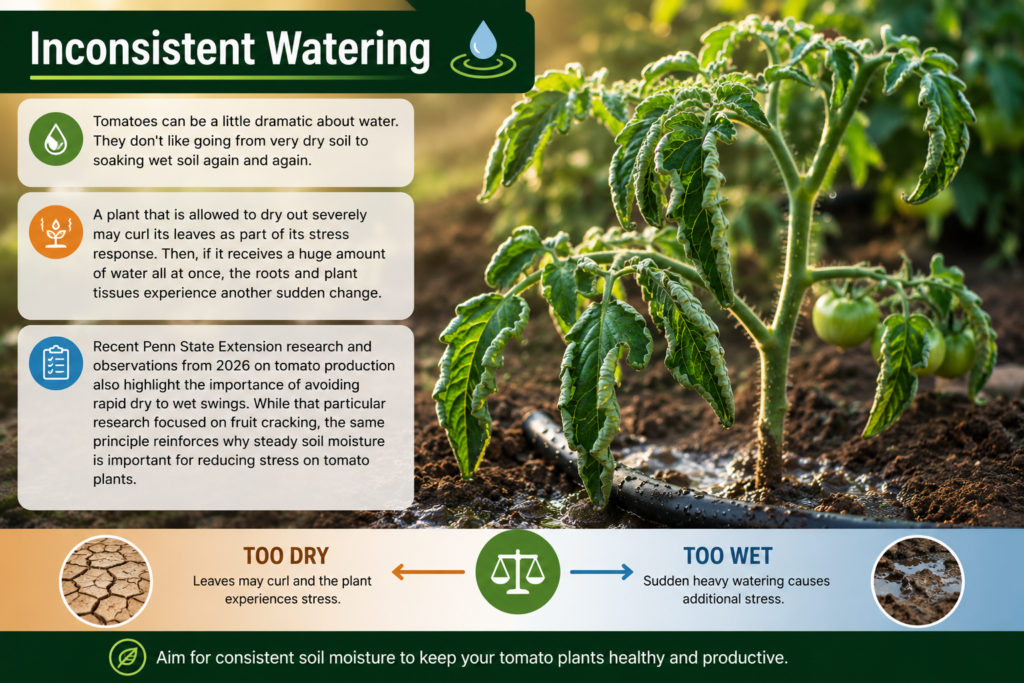
Recent Penn State Extension research and observations from 2026 on tomato production also highlight the importance of avoiding rapid dry to wet swings. While that particular research focused on fruit cracking, the same principle reinforces why steady soil moisture is important for reducing stress on tomato plants.
How to check whether watering is the problem
Stick your finger a few inches into the soil.
Ask:
- Is the soil bone dry?
- Is it constantly soggy?
- Does water drain poorly?
- Do you water a little every day but never deeply?
- Do you forget to water for several days and then flood the plant?
The goal is not to keep the soil permanently wet.
The goal is consistent moisture.
A simple approach
Water the root zone thoroughly when needed. Let the soil guide you rather than watering blindly according to the calendar.
Mulch can make this much easier.
Organic mulch helps slow evaporation and can reduce rapid moisture changes around the roots. Penn State Extension also recommends consistent moisture management and notes the value of mulch in reducing rapid soil drying.
4. Overwatering and Root Stress
Gardeners often focus so much on underwatering that they forget tomato roots also need oxygen. If a tomato plant sits in heavy, waterlogged soil for too long, the roots can struggle.
When roots aren’t functioning properly, the rest of the plant may begin showing stress.
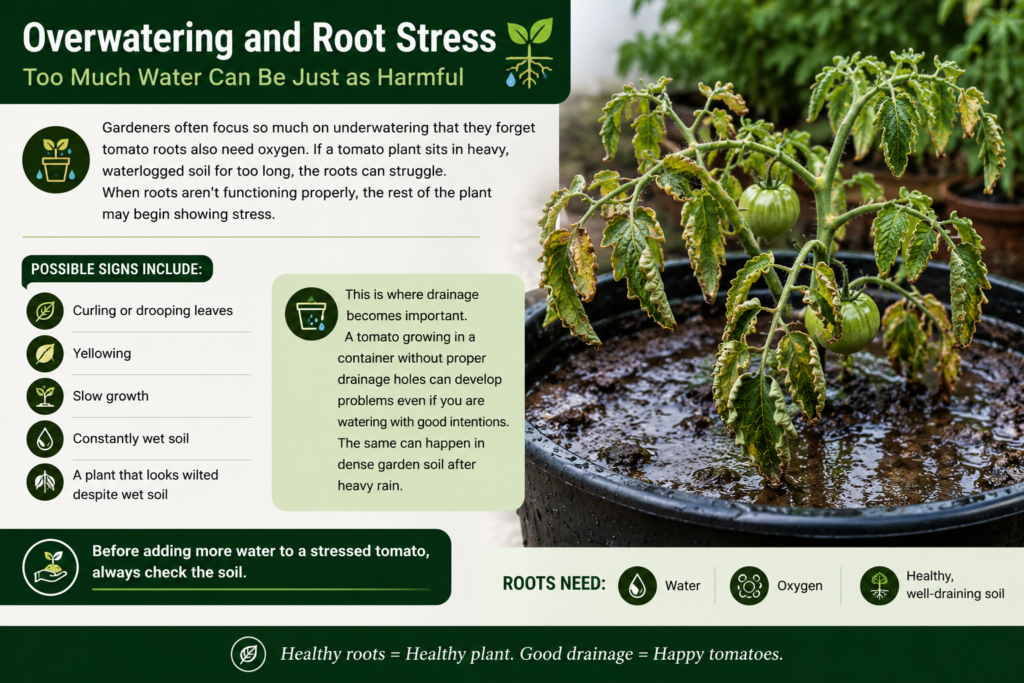
Possible signs include:
- Curling or drooping leaves
- Yellowing
- Slow growth
- Constantly wet soil
- A plant that looks wilted despite wet soil
This is where drainage becomes important. A tomato growing in a container without proper drainage holes can develop problems even if you are watering with good intentions. The same can happen in dense garden soil after heavy rain.
Before adding more water to a stressed tomato, always check the soil.
5. Aphids Can Cause Tomato Leaves to Curl
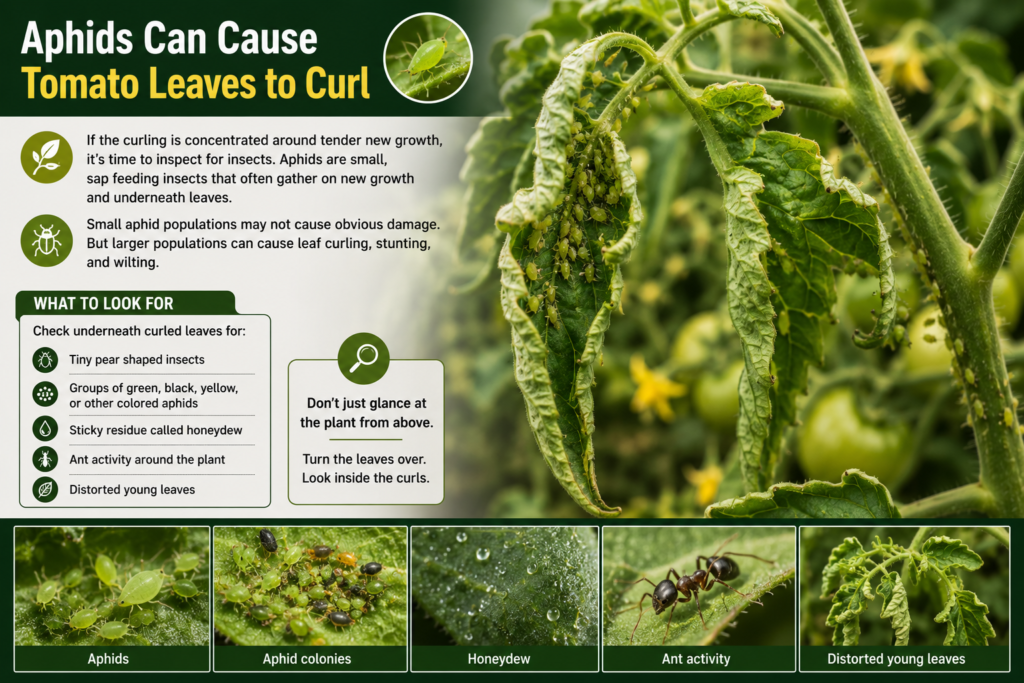
If the curling is concentrated around tender new growth, it’s time to inspect for insects. Aphids are small, sap feeding insects that often gather on new growth and underneath leaves.
Small aphid populations may not cause obvious damage. But larger populations can cause leaf curling, stunting, and wilting.
What to look for
Check underneath curled leaves for:
- Tiny pear shaped insects
- Groups of green, black, yellow, or other colored aphids
- Sticky residue called honeydew
- Ant activity around the plant
- Distorted young leaves
Don’t just glance at the plant from above. Turn the leaves over. Look inside the curls.
What can you do?
For a small infestation, a strong but careful spray of water may help knock aphids off the plant.
If treatment is necessary, insecticidal soaps or horticultural oils may be options when used according to the product label. UC IPM recommends starting with nonchemical approaches and notes that soaps and oils can be effective against aphids when properly applied.
One important point: contact treatments may not reach aphids hiding deep inside tightly curled leaves.
Also, avoid spraying stressed plants during very hot weather unless the product label specifically allows it. UC IPM warns that soaps and oils should not be applied to drought-stressed plants or in excessive heat.
6. Viruses: When Leaf Curl Is More Serious
This is the situation most gardeners worry about, and understandably so. Several tomato viruses can cause curled, distorted, mottled, or unusually shaped leaves.
The difference is that virus related curling often comes with other symptoms.
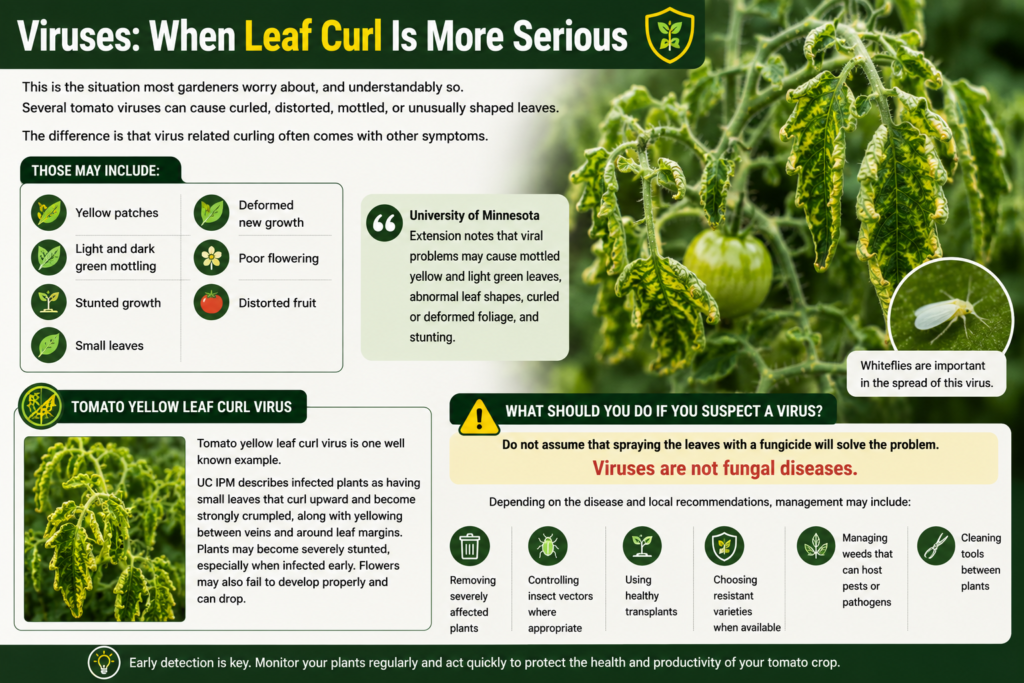
Those may include:
- Yellow patches
- Light and dark green mottling
- Stunted growth
- Small leaves
- Deformed new growth
- Poor flowering
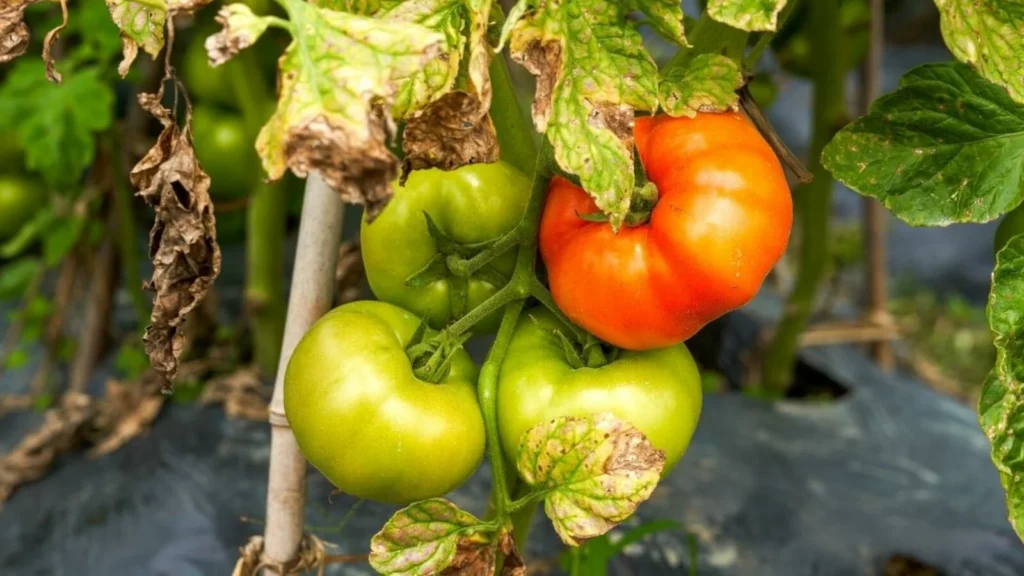
- Distorted fruit
University of Minnesota Extension notes that viral problems may cause mottled yellow and light green leaves, abnormal leaf shapes, curled or deformed foliage, and stunting.
Tomato Yellow Leaf Curl Virus
Tomato yellow leaf curl virus is one well known example.
UC IPM describes infected plants as having small leaves that curl upward and become strongly crumpled, along with yellowing between veins and around leaf margins. Plants may become severely stunted, especially when infected early. Flowers may also fail to develop properly and can drop.
Whiteflies are important in the spread of this virus.
What should you do if you suspect a virus?
Do not assume that spraying the leaves with a fungicide will solve the problem.
Viruses are not fungal diseases.
Depending on the disease and local recommendations, management may include:
- Removing severely affected plants
- Controlling insect vectors where appropriate
- Using healthy transplants
- Choosing resistant varieties when available
- Managing weeds that can host pests or pathogens
- Cleaning tools between plants
For tomato yellow leaf curl virus, UC IPM recommends resistant varieties where available, virus and whitefly free transplants, and whitefly management as part of prevention.
7. Mosaic Viruses and Curled Leaves
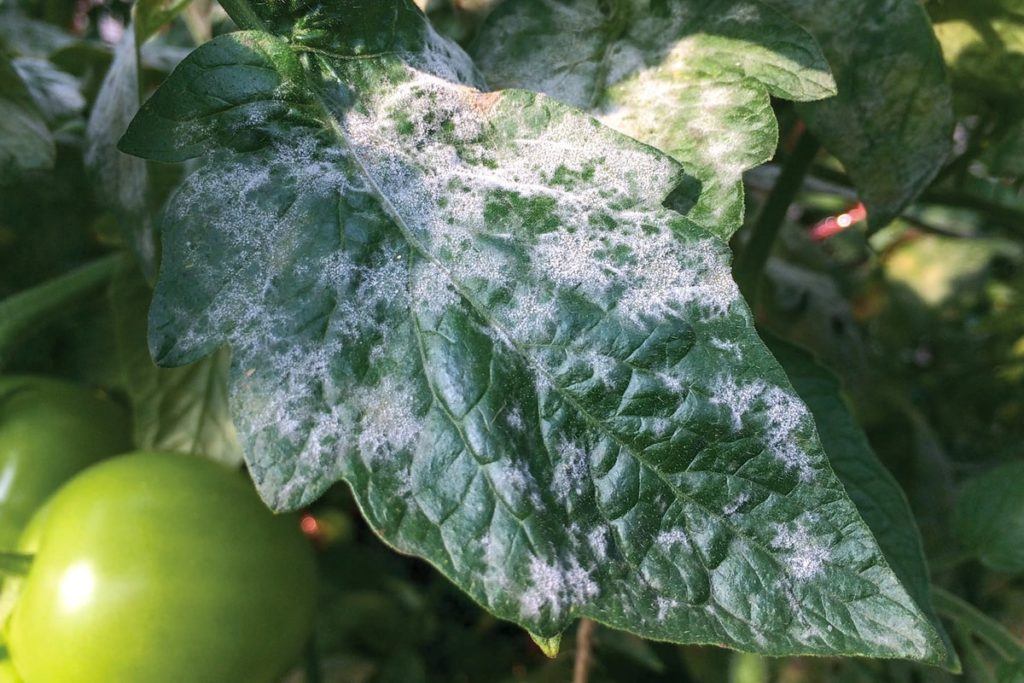
Some tomato viruses produce a distinctive mosaic pattern. Instead of a uniformly green leaf, you may see irregular patches of lighter and darker green.
The leaves can also curl. UC IPM notes that tomato plants affected by certain mosaic diseases may develop lighter overall coloration, a bushy appearance, mosaic patterns on younger leaves, curled leaves, and distorted fruit. Many aphid species can spread some of these viruses.
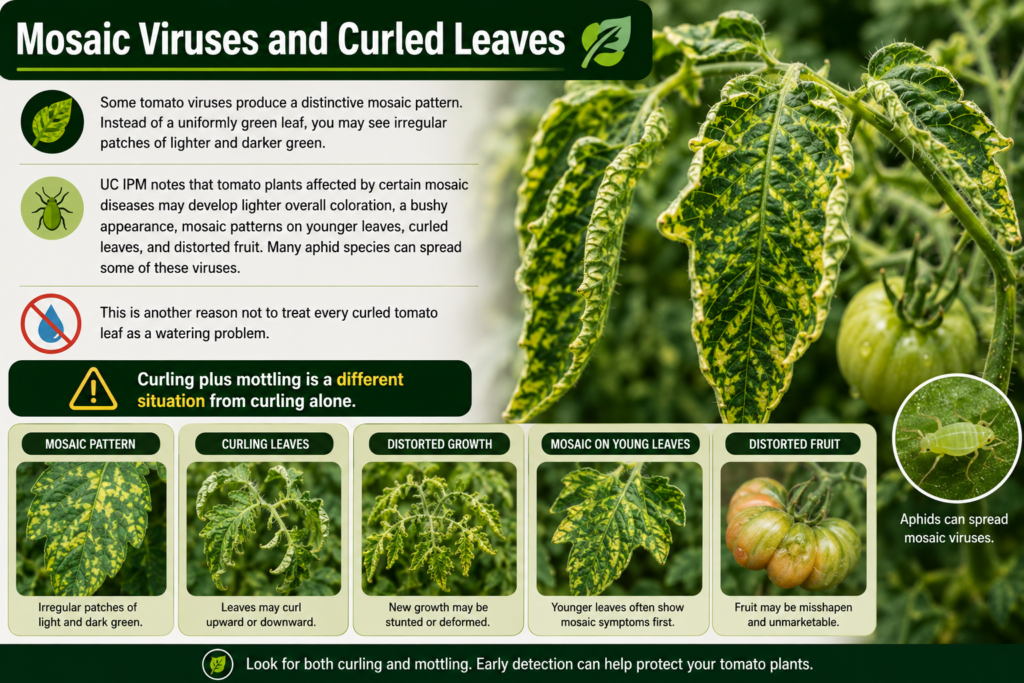
This is another reason not to treat every curled tomato leaf as a watering problem.
Curling plus mottling is a different situation from curling alone.
8. Herbicide Damage Can Look Like a Disease
Herbicide injury is one of the trickiest tomato problems because the symptoms can look strange and dramatic. Tomato plants are sensitive to certain herbicides.
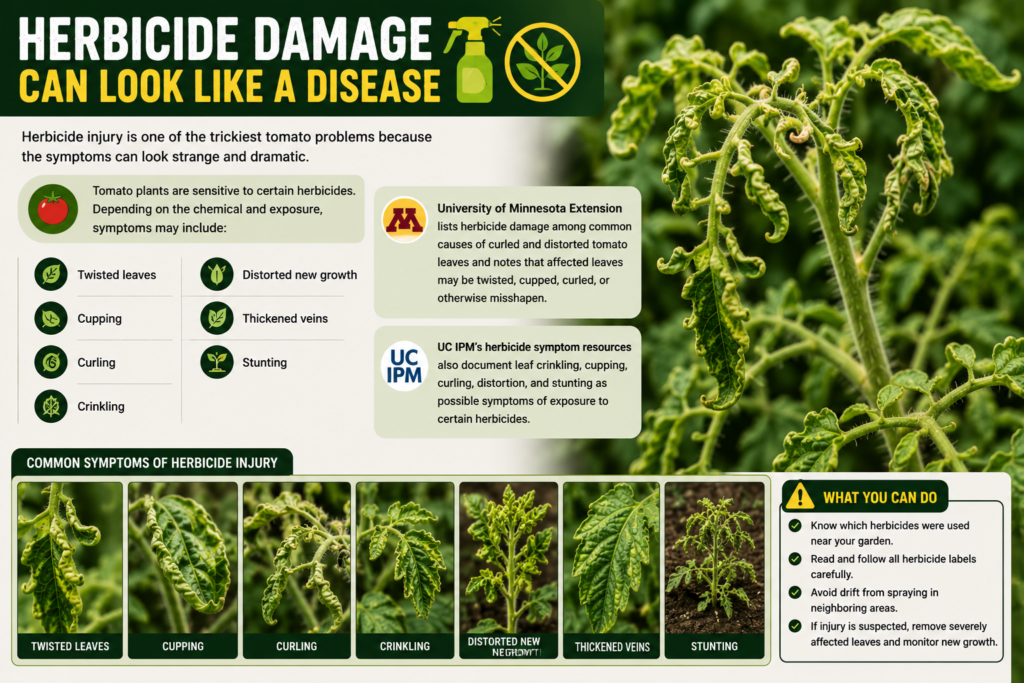
Depending on the chemical and exposure, symptoms may include:
- Twisted leaves
- Cupping
- Curling
- Crinkling
- Distorted new growth
- Thickened veins
- Stunting
University of Minnesota Extension lists herbicide damage among common causes of curled and distorted tomato leaves and notes that affected leaves may be twisted, cupped, curled, or otherwise misshapen.
UC IPM’s herbicide symptom resources also document leaf crinkling, cupping, curling, distortion, and stunting as possible symptoms of exposure to certain herbicides.
Think back before blaming a disease
Ask yourself:
- Was weed killer sprayed nearby?
- Did a neighbor spray a lawn or field?
- Was the sprayer previously used for herbicides?
- Did you use grass clippings from a treated lawn?
- Did the symptoms appear soon after nearby spraying?
Herbicide drift can sometimes affect plants unevenly, with the side closest to the application area showing worse symptoms.
9. Heavy Pruning Can Trigger Leaf Roll
Many tomato growers love pruning. A little pruning can help with airflow and plant management. But taking too much foliage off at once, especially during hot weather, can stress the plant.
Extension guidance identifies excessive pruning as one of the possible triggers for physiological leaf roll.
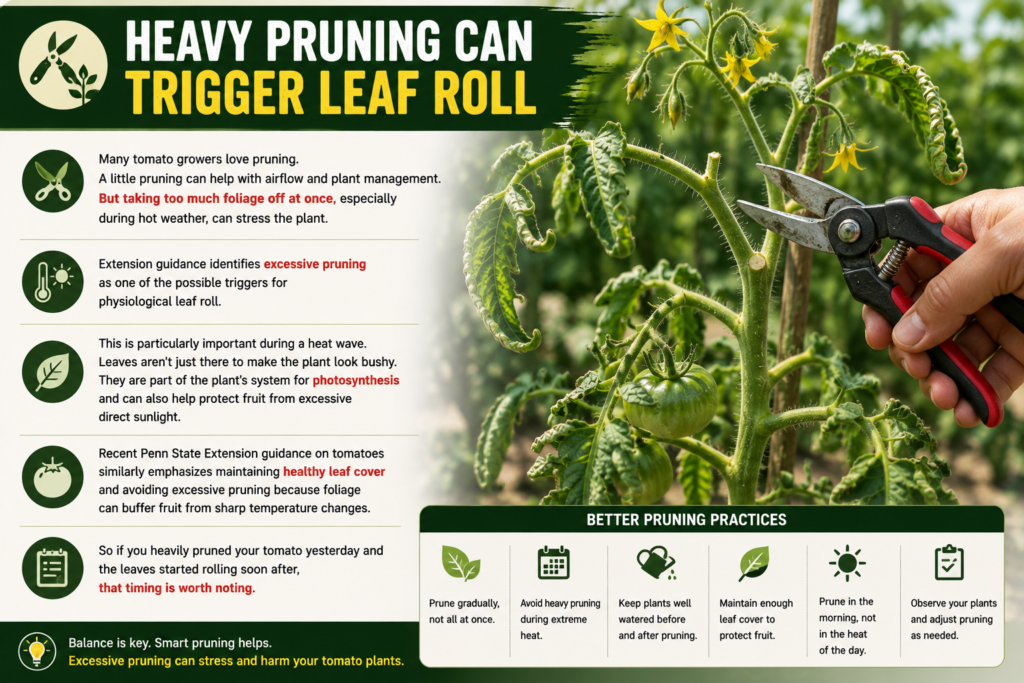
This is particularly important during a heat wave. Leaves aren’t just there to make the plant look bushy. They are part of the plant’s system for photosynthesis and can also help protect fruit from excessive direct sunlight.
Recent Penn State Extension guidance on tomatoes similarly emphasizes maintaining healthy leaf cover and avoiding excessive pruning because foliage can buffer fruit from sharp temperature changes.
So if you heavily pruned your tomato yesterday and the leaves started rolling soon after, that timing is worth noting.
10. Too Much Nitrogen
A tomato plant receiving too much nitrogen may produce lots of lush green growth.
That sounds good, but it isn’t always. Excess nitrogen can push the plant toward vegetative growth rather than balanced growth and fruit production. Under certain stressful conditions, heavy nitrogen fertility combined with moisture stress has also been associated with physiological leaf rolling.
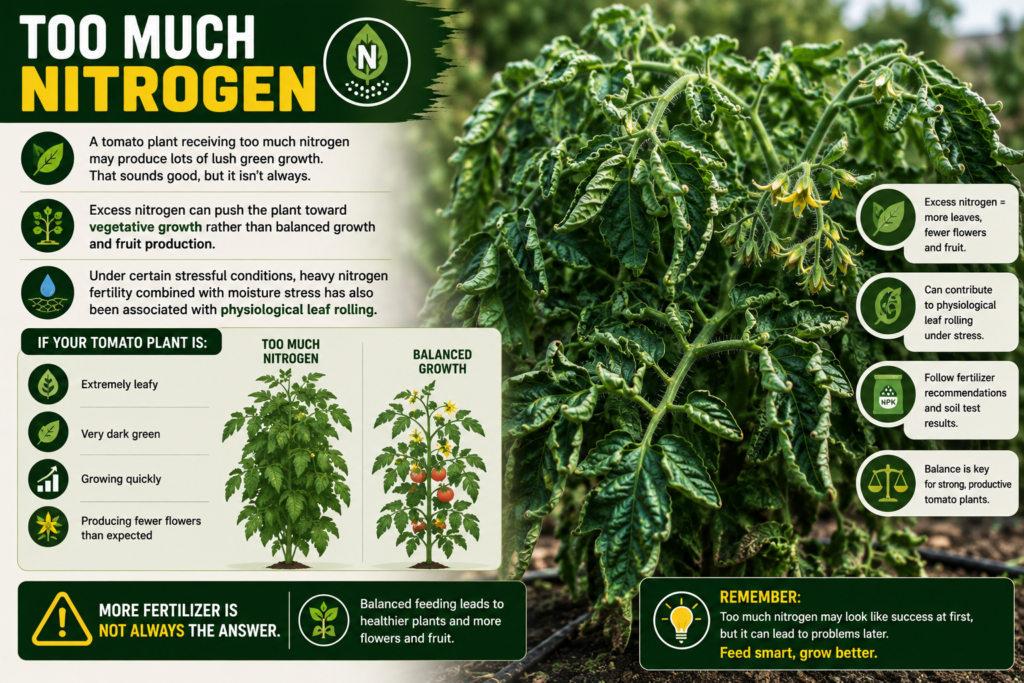
If your tomato plant is:
- Extremely leafy
- Very dark green
- Growing quickly
- Producing fewer flowers than expected
…consider whether you have been feeding it too aggressively.
More fertilizer is not always the answer.
11. Could It Be Curly Top Disease?
In some regions, another virus called beet curly top virus can affect tomatoes.
Infected plants may become stunted, yellow, misshapen, and curled. Young growth may show unusual symptoms, and leaf veins can sometimes develop purple coloring.
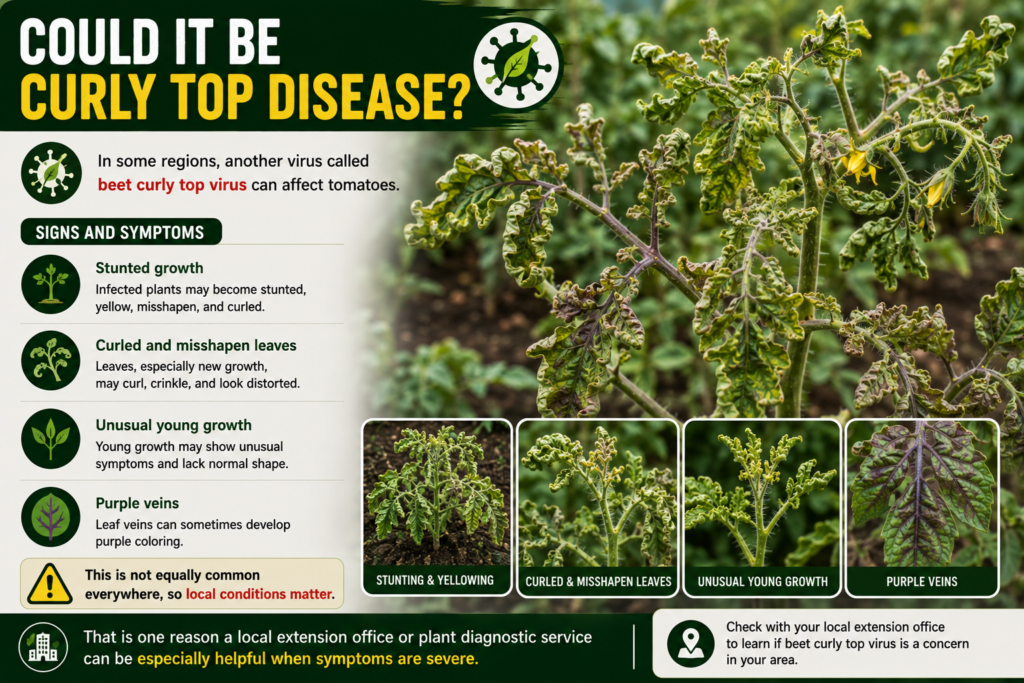
This is not equally common everywhere, so local conditions matter.
That is one reason a local extension office or plant diagnostic service can be especially helpful when symptoms are severe.
A Quick Way to Diagnose Curled Tomato Leaves
Here is a simple checklist.
If older leaves are curling upward but remain green:
Think about:
- Heat
- Dry weather
- Physiological leaf roll
- Water stress
- Pruning
If new leaves are twisted and distorted:
Think about:
- Aphids
- Herbicide injury
- Viruses
If leaves are curled and yellow:
Think about:
- Viral disease
- Root stress
- Other environmental problems
If leaves have light and dark green patches:
Think about:
- Mosaic viruses
If the entire plant is small and stunted:
Think about:
- Virus
- Serious root problems
- Herbicide damage
- Severe pest pressure
If the leaves feel thick and leathery:
Physiological leaf roll becomes more likely, particularly when older leaves are affected.
Before You Try to Fix It, Check These Five Things
Before reaching for fertilizer, pesticide, or fungicide, check these five things.
1. Is the soil too dry or too wet?
Check below the surface. Tomatoes need reasonably consistent moisture, but constantly saturated soil can also stress the roots.
2. Are insects hiding underneath the leaves?
Look carefully around new growth and inside tightly curled leaves.
3. Are the affected leaves old or new?
Older leaves and new leaves can tell very different stories.
4. Are there other symptoms?
Yellowing, mosaic patterns, stunting, or distorted growth can provide more useful information than curling alone.
5. Has anything recently changed?
Think about the weather, watering routine, pruning, fertilizer, and possible herbicide exposure. A few minutes of observation can prevent a lot of unnecessary treatment.
How to Fix Tomato Leaves Curling Up
The correct solution depends on the cause. That sounds obvious, but this is where many gardening problems get worse. If the plant is suffering from overwatering, adding more water won’t help.
If aphids are causing the problem, fertilizer won’t help. If the issue is physiological leaf roll, aggressive spraying may be completely unnecessary.
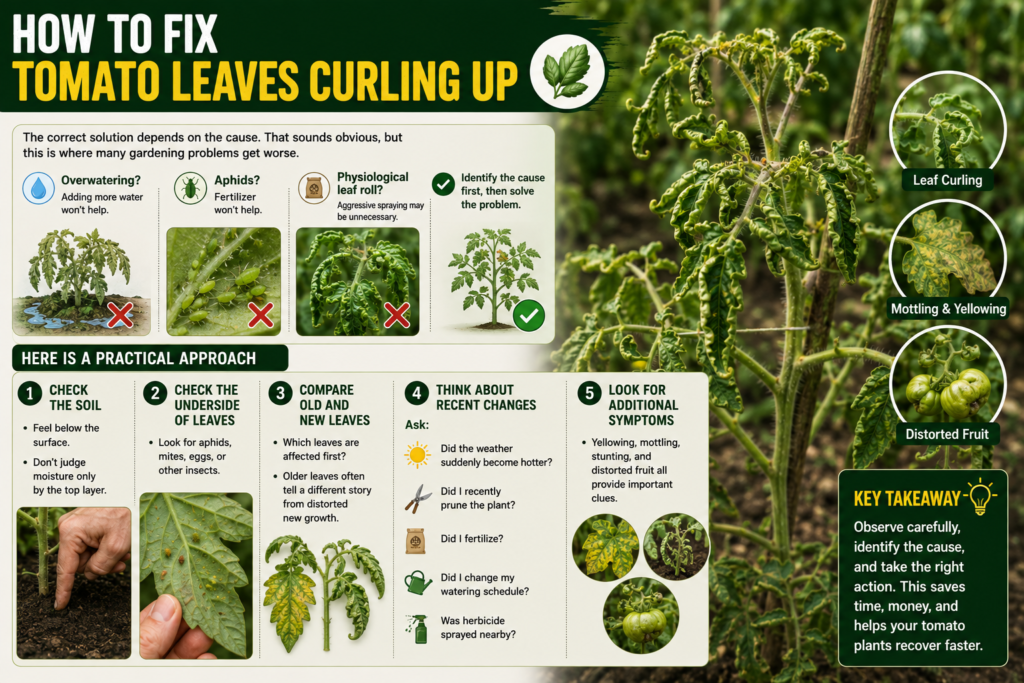
Here is a practical approach.
Step 1: Check the soil
- Feel below the surface.
- Don’t judge moisture only by the top layer.
Step 2: Check the underside of leaves
- Look for aphids, mites, eggs, or other insects.
Step 3: Compare old and new leaves
- Which leaves are affected first?
- Older leaves often tell a different story from distorted new growth.
Step 4: Think about recent changes
Ask:
- Did the weather suddenly become hotter?
- Did I recently prune the plant?
- Did I fertilize?
- Did I change my watering schedule?
- Was herbicide sprayed nearby?
Step 5: Look for additional symptoms
- Yellowing, mottling, stunting, and distorted fruit all provide important clues.
Common Mistakes to Avoid
When tomato leaves start curling, it is tempting to react immediately.
That is where gardeners sometimes make the problem worse.
Adding extra water without checking the soil
Curled leaves do not automatically mean the plant is thirsty. If the soil is already saturated, more water may create additional root stress.
Spraying fungicide on every curled plant
Leaf curl is not always caused by a fungal disease. Fungicide will not solve problems caused by heat, aphids, viruses, or herbicide injury.
Adding more fertilizer
A stressed tomato plant does not always need more nutrients. Excessive fertilizer can create its own problems and may encourage too much leafy growth.
Removing every curled leaf
Green leaves can still contribute to the plant. Removing too much foliage may increase stress and expose developing tomatoes to intense sunlight.
Treating the symptom instead of the cause
This is probably the biggest mistake.
If heat caused the problem, insecticide is not the answer. If aphids caused the problem, extra water is unlikely to help.
Try to understand the cause before choosing a treatment.
How to Prevent Tomato Leaf Curl in the Future
You cannot prevent every tomato problem, but you can reduce stress.
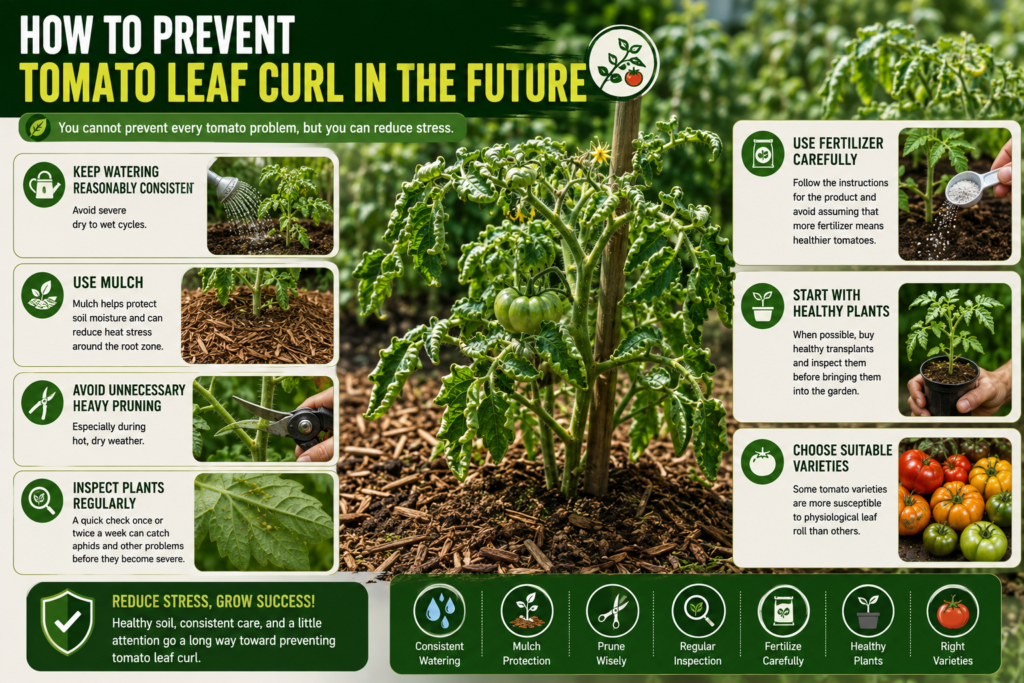
Keep watering reasonably consistent
- Avoid severe dry to wet cycles.
Use mulch
- Mulch helps protect soil moisture and can reduce heat stress around the root zone.
Avoid unnecessary heavy pruning
- Especially during hot, dry weather.
Inspect plants regularly
- A quick check once or twice a week can catch aphids and other problems before they become severe.
Use fertilizer carefully
- Follow the instructions for the product and avoid assuming that more fertilizer means healthier tomatoes.
Start with healthy plants
- When possible, buy healthy transplants and inspect them before bringing them into the garden.
Choose suitable varieties
- Some tomato varieties are more susceptible to physiological leaf roll than others.
What I Recommend for Most Home Gardeners
For most cases of mild tomato leaf curl, I would start with basic observation rather than treatment.
- Check the soil before watering.
- Inspect the underside of the leaves before spraying.
- Look at the newest growth before assuming the plant has a disease.
- And think about what happened during the previous few days.
- Was there extreme heat?
- Did the plant suddenly go dry?
- Did you heavily prune it?
- Did you apply fertilizer?
- Was weed killer used nearby?
- In many cases, the answer is hidden in something that recently changed.
If the plant is otherwise healthy and producing normal new growth, there may be no need for aggressive treatment. On the other hand, distorted new growth, yellowing, mosaic patterns, or severe stunting deserve closer attention.
The goal should not be to make every curled leaf look perfect again. The goal should be to keep the plant healthy and identify problems early when they actually need action.
Should You Cut Off Curled Tomato Leaves?
Usually, no.
If the leaves are green and simply rolled because of physiological stress, they are still part of the plant.
Removing lots of leaves can create more stress and expose fruit to direct sun.
Remove leaves when they are:
- Clearly dead
- Severely diseased
- Heavily infested
- Rotten or damaged beyond recovery
Otherwise, give the plant some time.
A gardener’s instinct is often to “do something.” But sometimes the best treatment is simply correcting the underlying conditions and letting the plant recover.
Can Curled Tomato Leaves Straighten Out Again?
Sometimes. It depends on the cause.
Leaves affected by temporary heat or moisture stress may improve as conditions stabilize.
However, University of Minnesota Extension notes that leaves affected by physiological leaf roll can remain rolled even after weather conditions improve. The important thing is that the condition itself generally does not noticeably reduce growth or yield.
So don’t judge recovery only by whether an old curled leaf becomes flat again.
Watch the new growth.
Healthy new leaves are often a much better sign that your tomato plant is recovering.
When Should You Worry About Curled Tomato Leaves?
A few curled leaves do not always mean there is a serious problem.
However, I would take the situation more seriously if leaf curling is combined with other symptoms.
Watch closely for:
- Severe yellowing
- Light and dark green mosaic patterns
- Very small or distorted new leaves
- Stunted plant growth
- Unusual twisting throughout the plant
- Deformed flowers
- Poor fruit development
- Large populations of aphids or whiteflies
- Similar symptoms appearing on several nearby plants
- Rapid decline of the entire plant
If several plants begin showing the same unusual symptoms at the same time, it is worth investigating whether there is a shared cause.
That could include an insect problem, a viral disease, herbicide exposure, or a major environmental issue.nt if multiple plants develop similar symptoms at the same time.
My Practical Advice Before You Treat Anything
If this were my tomato plant,
- I would not start with a spray bottle.
- I would spend five minutes checking it.
- First, I would look under the leaves for aphids.
- Then I would check the soil.
- After that, I would compare the old leaves with the new growth.
- Finally, I would think about what happened during the previous week.
Did we have a heat wave?
Did it rain heavily after a dry period?
Did I prune?
Did someone spray weed killer nearby?
Those answers usually provide more useful information than immediately buying another garden product.
Tomatoes often tell you something is wrong through their leaves. But the curl itself is only part of the message.
You have to read the rest of the plant.
When a Local Diagnosis Is Worth It
Online articles can help you narrow down the possibilities, but some plant problems cannot be identified with certainty from one symptom alone.
Consider seeking help from a local agricultural extension service, plant clinic, or qualified plant health professional if:
- The symptoms are spreading quickly
- Several plants are affected
- The plant is severely stunted
- You suspect a virus
- You suspect herbicide injury
- You are growing tomatoes commercially
- The problem continues despite correcting watering and other environmental conditions
A proper diagnosis can save you from repeatedly treating the wrong problem.

Final Thoughts on Tomato Leaves Curling Up
Seeing your tomato leaves curling up can be alarming, but it doesn’t always mean your plant has a serious disease.
In many cases, the cause is simple: hot weather, dry conditions, inconsistent watering, or a harmless physiological leaf roll response.
The most important thing is to slow down and inspect the plant before treating it.
- Look at which leaves are affected first.
- Check underneath the leaves for insects.
- Feel the soil below the surface.
- Watch for yellowing, mottling, or distorted growth.
- Think about recent weather changes and changes to your watering, pruning, or fertilizing routine.
A tomato plant with curled older leaves but healthy new growth may need little more than consistent care and time to recover. But twisted, yellow, stunted, or severely distorted new growth deserves closer attention.
There is no single cause behind every case of tomato leaf curl. Your plant’s leaves are giving you clues look at the whole plant, identify the pattern, and treat the cause rather than simply reacting to the curling itself.
In many cases, a careful diagnosis is the best first step toward healthy tomato plants and a productive harvest.
Frequently Asked Questions About Tomato Leaves Curling
Why are my tomato leaves curling up?
Upward curling is commonly associated with heat, drought stress, or physiological leaf roll. If the older leaves are green, thick, and leathery while the plant is otherwise healthy, physiological leaf roll is a possibility.
Why are only the bottom leaves of my tomato plant curling?
If the older or lower leaves are curling while the new growth looks healthy, heat stress or physiological leaf roll may be a possible cause. Check recent weather conditions, watering patterns, and other sources of plant stress.
Why are my tomato leaves curling but still green?
Green curled leaves without yellowing, mosaic patterns, severe distortion, or stunted growth are often associated with environmental stress rather than a serious disease. Heat, temporary water stress, and physiological leaf roll are possible causes.
Does heat make tomato leaves curl?
Yes. Hot conditions can cause tomato plants to fold or curl their leaves as a response to heat and moisture stress. If the plant is otherwise healthy, this may be a temporary protective response.
Should I water my tomato plant more when the leaves curl?
Not automatically. Curled leaves can be caused by dry conditions, but they can also result from overly wet soil, pests, disease, or other types of stress. Check the soil moisture below the surface before adding more water.
Can overwatering cause tomato leaves to curl?
Yes , Root stress caused by overly wet soil can contribute to unhealthy foliage and abnormal growth. Check whether the soil is constantly saturated and whether the plant has good drainage before adding more water.
Can aphids cause tomato leaves to curl?
Yes. Large aphid populations can cause curling, stunting, and wilting. Check underneath curled leaves and around tender new growth, where aphids often gather.
Can a virus cause my tomato leaves to curl?
Yes, Several viruses can cause curled and distorted leaves. Other symptoms may include yellowing, mosaic patterns, stunted growth, abnormal new growth, and distorted fruit.
How do I know if herbicide caused the curling?
Herbicide damage often produces twisting, cupping, curling, and distorted new growth. Consider whether herbicides were sprayed nearby or whether the plant could have been exposed through spray drift or contaminated materials.
Should I remove curled tomato leaves?
Not automatically. Green leaves affected by physiological leaf roll can still be left on the plant. Remove leaves mainly when they are dead, severely diseased, or heavily damaged.
Will curled tomato leaves go back to normal?
Sometimes new growth returns to normal after the underlying stress is corrected. However, leaves affected by physiological leaf roll may remain rolled even after conditions improve.
Will curled leaves reduce my tomato harvest?
Not necessarily. Physiological leaf roll generally does not significantly reduce tomato growth or yield. The outcome depends on the underlying cause. A serious virus, heavy pest infestation, root damage, or herbicide injury is usually more concerning than simple physiological leaf roll.
References and Further Reading
The information in this article is supported by university extension and integrated pest management resources. Because tomato leaf symptoms can have several causes, diagnosis should be based on the complete symptom pattern rather than leaf curl alone.
University and Research Resources
- University of Minnesota Extension — Tomato Disorders
- University of Minnesota Extension — Tomato Leaf Curl Diagnosis
- UC IPM — Tomato Yellow Leaf Curl
- UC IPM — Tomato Mosaic Diseases
- UC IPM — Aphid Management
- Penn State Extension — Tomato Growing Resources

Thesis Link : https://saulibrary.edu.bd/daatj/public/uploads/BAU200601_19-Pp_5.pdf
- Fall Lawn Care Checklist – 9 Jobs Before Winter - October 14, 2026
- 10 Best Garden Tool Sets for Beginners - October 13, 2026
- Lawn Mowing Height by Grass Type -The Complete Chart - October 13, 2026