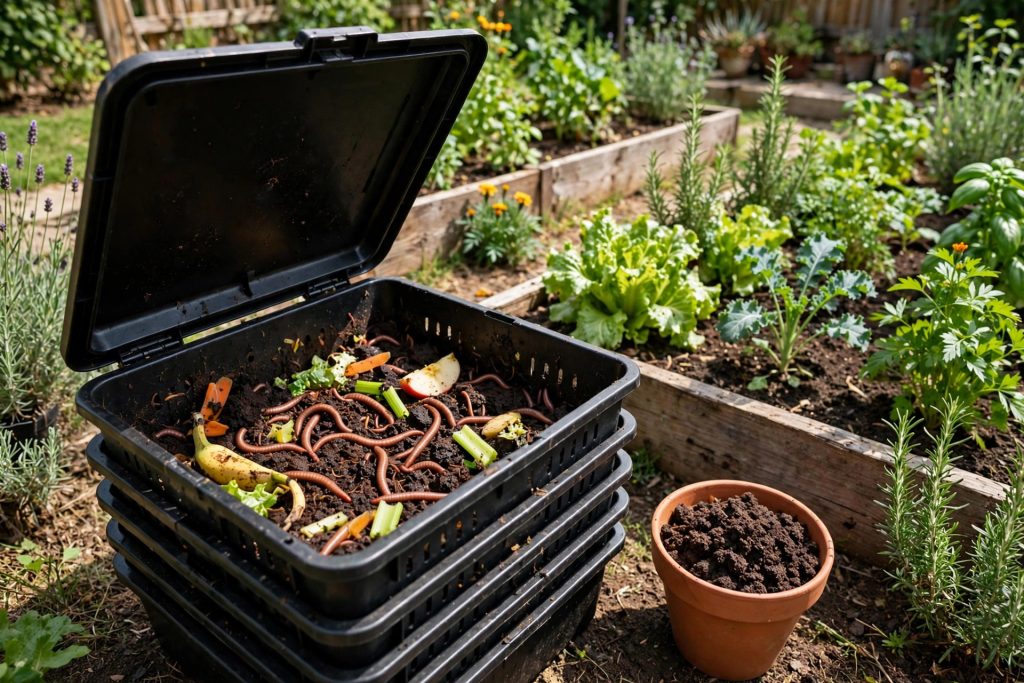

Every week, the average American household throws away several pounds of food scraps that could have become garden gold instead. A worm bin changes that equation. The best worm composter for your home is the one that fits your space, your scrap volume, and your patience for maintenance, and this guide compares 10 real systems using verified manufacturer specifications and owner feedback so you can pick with confidence.
Worm composting, or vermicomposting, uses red wigglers to turn peelings, coffee grounds, and shredded paper into dark, crumbly castings that feed soil gently and steadily. It works in apartments, on balconies, in basements, and in garden beds, and it needs no yard, pile, or strong back. What it does need is the right bin: too small and it overflows, too big and it stays half empty, and poor airflow turns it into a smelly science experiment.
We did not test these bins hands on. Every capacity, dimension, and warranty figure below comes from the maker’s own page or manual, or from a major retailer listing where no official page exists, and conflicts between sources are flagged rather than smoothed over.
Table of Contents
- Quick Recommendation
- The 10 Best Worm Composters Compared
- How to Choose a Worm Composter
- The 10 Best Worm Composters for Home Use
- How We Chose
- Final Choice
- References
- FAQ
Quick Recommendation
Short on time? Start here.
- Best overall for most homes: Worm Factory 360. Four stacking trays, expandable to six, a small 18 inch footprint, and the longest track record in this list. It suits one to four people and works indoors or out.
- Best for apartments and indoor use: Urbalive Worm Composter. A compact, good looking two tray system designed to sit in a living space without looking like a bin, with a 24 month warranty from the maker.
- Best large capacity: Hungry Bin. A continuous flow bin that processes up to 4.5 pounds of scraps a day once the worm population is established, with no trays to lift at harvest.
- Best budget starter kit: Uncle Jim’s Worm Box 5-Tray. Twelve gallons across five trays, a coir bedding brick in the box, and bundle options that add live red wigglers in the same order.
- Best in-ground: Subpod Mini. Buried in a garden bed, it feeds the soil directly where worms come and go freely, handles up to 22 pounds of scraps a week, and doubles as a garden seat.
If you only buy one thing from this guide, buy a stacking tray system. The tray design is the single feature that most helps a beginner, because worms migrate upward toward fresh food and leave finished castings in the lower tray, so harvesting means lifting a tray, not digging through a bin full of worms. Choosing a worm bin starts with that simple idea: let the worms do the sorting.
The 10 Best Worm Composters Compared
The table below gives the short version, and the full reviews follow with specifications, real world limits, and who each bin suits. The right worm bin for a family of four with a big vegetable garden is not the same bin as the right one for a one bedroom apartment.
| Product | Type | Capacity | Best For | Our Rating |
|---|---|---|---|---|
| Worm Factory 360 | Stacking tray | 4 trays, expandable to 6 | Most homes | 9.4 |
| VermiHut Plus 5-Tray | Stacking tray | 5 trays, 50 L | Large families | 9.2 |
| Urbalive Worm Composter | Stacking tray | 2 trays, about 43 L working | Indoor design | 9.0 |
| Uncle Jim’s Worm Box 5-Tray | Stacking tray | 5 trays, 12 gallons | Complete starter kit | 8.9 |
| Hungry Bin | Continuous flow | Up to 4.5 lb scraps per day | Large capacity, easy harvest | 9.3 |
| Urban Worm Bag Version 2 | Fabric flow-through | 5.3 cu ft (122 L) | Airflow and big harvests | 8.8 |
| Tumbleweed Worm Cafe | Stacking tray | 3 trays, 77 L | Patios and small households | 8.7 |
| FCMP Outdoor Hot Frog Living Composter | Stacking tray | 3 layers, holds just over 1 lb worms | Display indoors | 8.6 |
| Maze Worm Farm | Stacking tray | 2 rotatable trays | Small spaces | 8.5 |
| Subpod Mini | In-ground | Up to 22 lb scraps per week | Garden beds | 8.9 |
Ratings are editorial scores out of 10 from our scoring system in How We Chose, based on verified specifications and owner feedback, not on hands-on testing. A higher score means a better fit for home use, not a laboratory result.
How to Choose a Worm Composter
Stacking tray, flow-through, or in-ground?
Three designs dominate home worm composting. Stacking tray systems stack shallow trays on a base: feed the top tray, worms migrate up, harvest the bottom tray. They are the easiest to learn and move. Flow-through systems hold one large mass of bedding: feed the top, harvest from the bottom, with no trays to lift. They hold more and harvest more cleanly, but take more room and a bigger starting worm population. In-ground systems sit buried in a garden bed, worms travel in and out through holes, and they feed the soil directly with almost no harvesting, but they only work if you have a bed to bury them in.
For a first bin, choose a stacking tray system. For volume, choose flow-through. For feeding beds directly, choose in-ground.
What size do you need?
Match the bin to the waste you actually make. One or two people cooking a few times a week fill a two or three tray bin comfortably; a family of four cooking daily wants four or five trays, or a flow-through bin. Washington State University Extension gives a useful rule: about 2 pounds of worms for each pound of food added per day, and a 1 by 2 by 3 foot box handles about 6 pounds of kitchen waste a week, the average for a family of four to six.
One honest limit applies to every bin here: a worm bin is a slow, steady processor, not a garbage disposal. A pound of red wigglers eats roughly a quarter to half its weight in scraps a day once settled, and a new bin needs two to three months before the colony can handle full feeding.
What makes a good worm farm kit
A good worm farm kit includes more than a box: a lid tight enough to keep fruit flies out, ventilation that moves air without drying the bedding, a liquid collection base with a tap or spigot, and bedding material in the box so you can set up the day it arrives. Worms are almost always sold separately, and that is normal, but a kit that bundles worms saves a second order and a week of waiting, which matters when enthusiasm is highest.
Check tray depth too: shallow trays breathe better than deep ones, because red wigglers feed in the top few inches. And check whether extra trays are sold separately, so the bin can grow with your household.
Vermicomposting for beginners: the first 30 days
Starting out with worms succeeds on routine, not enthusiasm. Set the bin up with 4 to 6 inches of moist bedding, shredded cardboard, plain paper, dry leaves, or coco coir, dampened to the feel of a wrung-out sponge. Add a handful of soil for grit, which worms need in their gizzards to grind food, place the worms on top, and leave them alone for a day or two while they settle into the dark.
Feed small amounts at first, buried under the bedding in a different corner each time, and increase feeding slowly over the first month as the population grows. Check moisture weekly: squeeze a handful of bedding, and only a few drops should come out. If it drips, add dry shredded paper; if it feels dry, mist it with water. The first castings usually appear in 2 to 3 months.
Red wigglers vs European nightcrawlers
Red wigglers vs European nightcrawlers is the species question every beginner asks, and the answer is straightforward for indoor bins. Red wigglers, Eisenia fetida, are the standard composting worm: they live in the top few inches of decaying matter, eat quickly, breed fast, and tolerate the warm, crowded conditions of a worm box. Washington State University Extension calls Eisenia fetida the best redworm for home composting.
European nightcrawlers, Eisenia hortensis, are larger and more tolerant of cool conditions, so they suit outdoor bins and cooler climates, but they reproduce more slowly and process scraps less fast than red wigglers in a warm indoor bin. Garden earthworms and common nightcrawlers, Lumbricus terrestris, do not belong in a worm bin at all: they burrow deep, need mineral soil, and die in shallow bedding.
Indoor worm composter: what changes indoors
An indoor worm composter lives by stricter rules than an outdoor one, because you share the room with it. Red wigglers are most productive between 55 and 77 degrees Fahrenheit, with 65 to 70 degrees ideal according to Iowa State University Extension. Bedding above 84 degrees can be fatal, and freezing kills them, so a kitchen, basement, or closet that stays in the 60s year round is ideal, while a garage that freezes in January or a balcony that bakes in July is not.
Smell is the second rule, and it is entirely under your control: a healthy bin smells like damp earth, while bad smells mean overfeeding, excess moisture, or a lack of air. Keep food buried under bedding, never leave scraps exposed, and keep meat, dairy, oil, and pet waste out completely. Fruit flies arrive on fruit skins; burying food and covering the surface with dry shredded paper or a coir mat stops most of them.
How to harvest worm castings without losing worms
Learning how to harvest worm castings turns a worm bin from a project into a supply of fertilizer. With a stacking tray system, harvesting is built in: when the bottom tray is dark, crumbly, and earthy smelling, and most worms have moved up, lift the finished tray out, empty it, and put it back on top as the new feeding tray. That is the whole method, and it is why trays dominate this list.
With a flow-through bin, open the bottom and scrape out the finished castings that fall free, a few litres at a time, every two to six months. With a single bin or fabric bag, use the light method: dump the contents onto a tarp in bright light, make small mounds, and wait while worms move into the centre, then scoop the worm-free castings from the edges. Expect the first real harvest 2 to 4 months after setup, when the castings look like dark, crumbly soil and smell like a forest floor.
Use castings at 10 to 20 percent by volume in potting mix, as a quarter to half inch top dressing on beds, or a small handful in each transplant hole. They will not burn plants the way synthetic fertilizer can, because they release nutrients slowly.
Worm composting mistakes that kill a bin
Worm composting mistakes are almost always the same short list. Overfeeding is first: beginners add a full week of scraps to a colony of 500 worms, the food rots before the worms reach it, and the bin turns sour. Feed only what the worms finish in a few days, and bury it.
Feeding the wrong foods is second. Meat, dairy, oil, and greasy leftovers rot and attract pests, while large amounts of citrus, onion, and garlic irritate worms with strong oils, as do salty food and spicy sauces. Stick to vegetable and fruit scraps, coffee grounds, tea bags, crushed eggshells, and plain bread or pasta.
Letting the bin dry out or drown is third. Bedding should feel like a wrung-out sponge: a bin that dries out kills worms quietly, and a bin that floods drowns them and turns anaerobic. Check moisture every week, not every month.
The last mistake is impatience. A new bin looks empty and slow for the first month, and beginners either overfeed to hurry it or abandon it. Worm populations double roughly every 60 to 90 days under good conditions, so give the bin a season.
The 10 Best Worm Composters for Home Use
1. Worm Factory 360
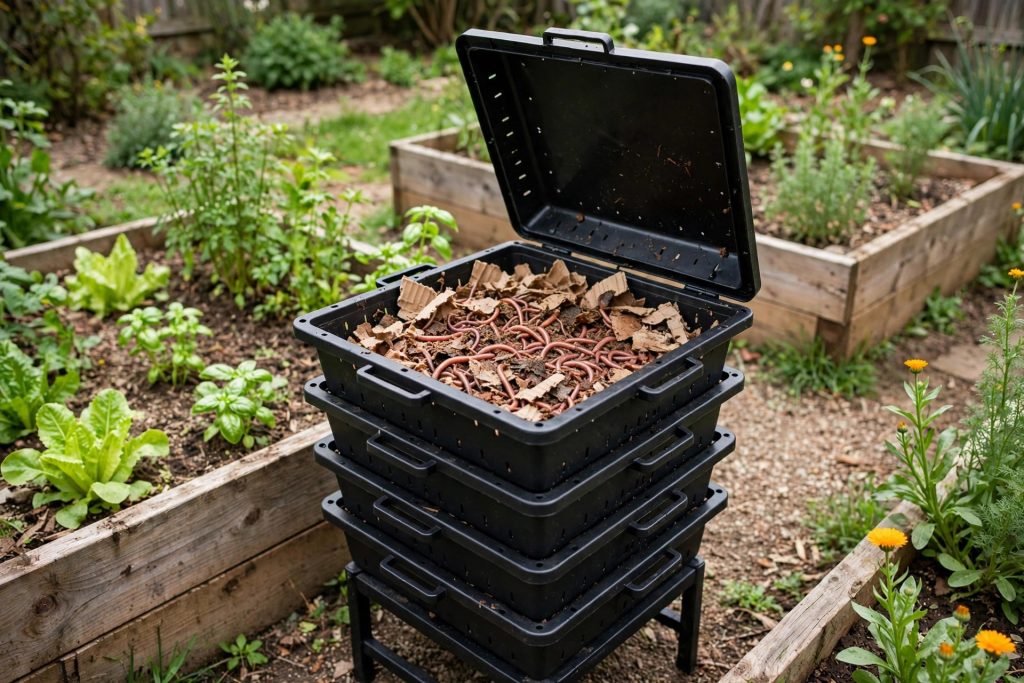
Best overall for most homes. Our rating: 9.4 out of 10.
The Worm Factory 360 is the default recommendation for a reason: it has the largest body of owner feedback of any bin here, and its design solves the beginner’s hardest problem, harvesting, with no tools and no mess. Four trays stack on a base with a collection tray and spigot, worms migrate upward as you feed the top tray, and you lift the finished tray off the bottom when it is ready. A full tray weighs about 12.5 pounds, which most adults can lift with one hand.
The maker’s FAQ lists the assembled size at about 18 by 18 by 25 inches high, with four trays included and expansion to six. Note a conflict: some retailer listings give 17.95 by 17.95 by 14.95 inches, which appears to describe a shorter stacked height, so this guide uses the maker’s figure. The body is US-made, non-toxic ABS plastic in black, green, or terracotta, and a bundle option adds about half a pound of red wigglers, roughly 500 worms, on a voucher. At full population the bin houses thousands of worms and suits households of one to four people.
Real-world limitation: the small square trays make it easy to overload a single tray by feeding too much at once, and the legs can flex if you stack all six trays high with wet, heavy castings. Keep feedings thin and spread across the tray surface.
Who should buy: first-time vermicomposters who want the most documented, most forgiving bin here, and households of one to four people who need a bin for a kitchen corner or basement.
Why it scored 9.4: the largest owner-feedback base here, the simplest harvest, and expansion to six trays; it loses points only for small trays that overload easily and legs that can flex under a full six-tray stack.
Manufacturer: Nature’s Footprint
2. VermiHut Plus 5-Tray
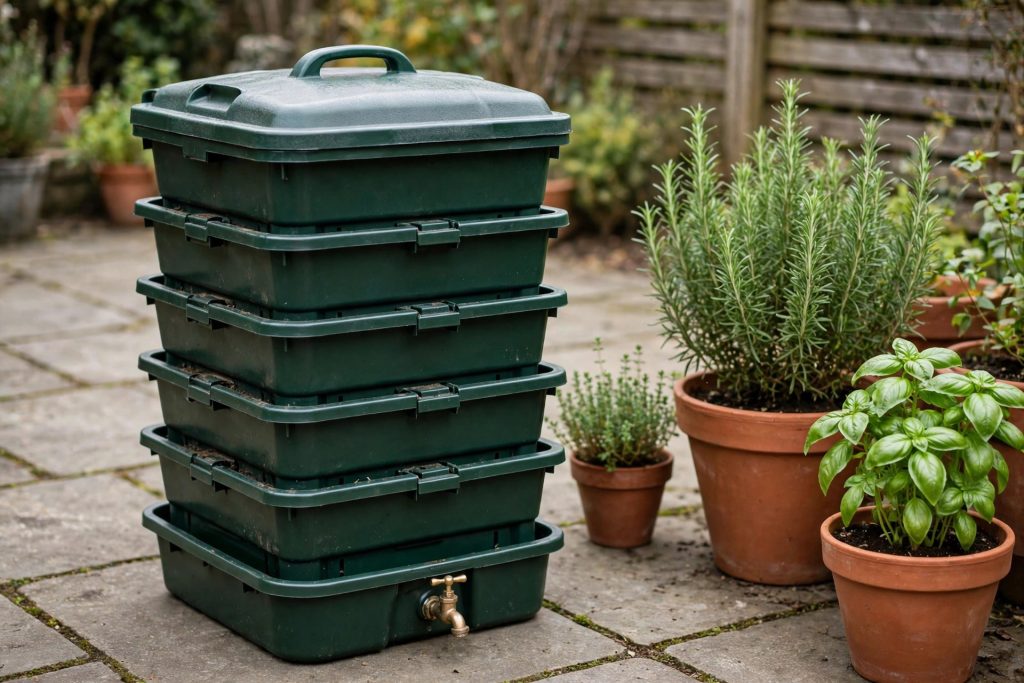
Best for large families. Our rating: 9.2 out of 10.
The VermiHut Plus is the capacity pick among tray systems. Five deep trays give it more working volume than the Worm Factory 360 in a similar footprint, and the maker says a five tray system can support up to 10 pounds of worms, enough to process up to 5 pounds of food waste a day under ideal conditions. For a family that cooks daily, that headroom matters.
The listing gives 50 litres of capacity and dimensions of 17 by 17 by 33 inches high, in dark green HDPE plastic, weighing 12 pounds. A coconut mat and V-board on the top tray hold moisture, a worm-saver tray keeps worms out of the liquid in the base, and small moats on the feet stop ants climbing in. Note a conflict: one review lists 17 by 17 by 15 inches, which cannot fit five stacked trays, so this guide uses the 33 inch height. Worms are not included; start with half a pound and let the population grow.
Real-world limitation: five deep trays make a tall, heavy stack when full, and reaching a finished bottom tray takes two hands and clear floor space. If you have a bad back or a tight closet, a shorter four tray system is easier to live with.
Who should buy: families of four or more that produce a lot of kitchen waste and want one bin to handle it all, indoors or on a patio.
Why it scored 9.2: the most working volume of any tray system here, with a worm-saver tray and ant moats; it loses points for a tall, heavy stack that is hard to manage in a tight space.
Specifications: 5 trays, 50 L capacity, 17 x 17 x 33 inches, HDPE plastic, supports up to 10 lb worms, warranty not published by the maker. Manufacturer details: VermiTek, sold as VermiHut Plus.
Spec source: retailer listing for model B07PRKLCZQ
3. Urbalive Worm Composter
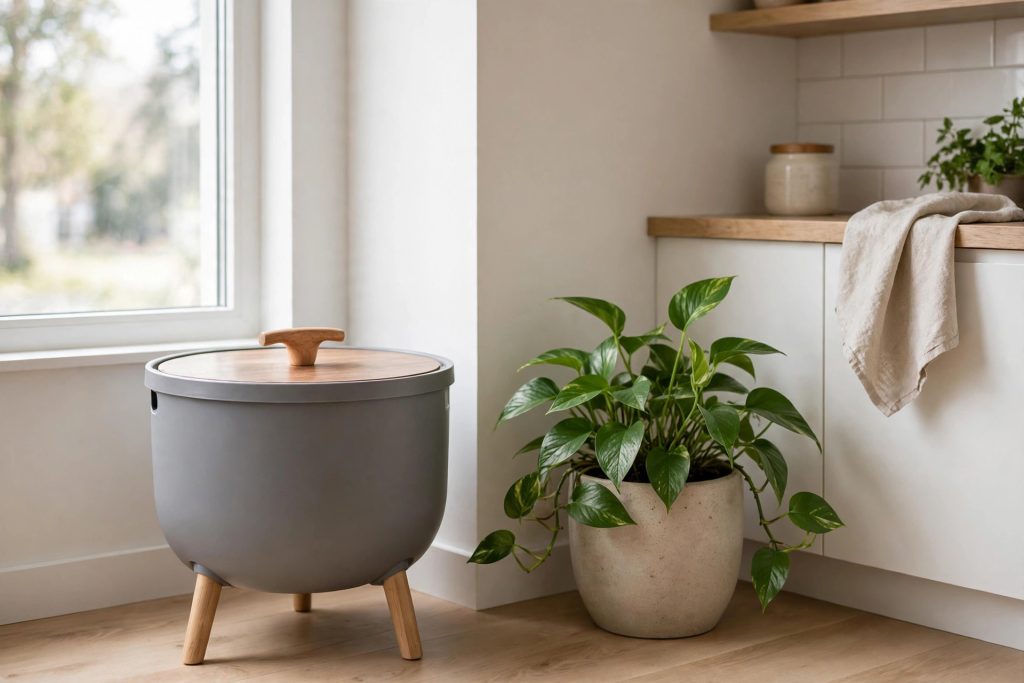
Best for indoor design. Our rating: 9.0 out of 10.
The Urbalive is the only bin here designed by a named industrial designer, Jiri Pelcl, and it shows: it won a Red Dot Design Award and stands on wooden legs like a piece of furniture, so it is the bin most likely to be allowed in a living room. That matters, because a bin you can see gets fed and checked, while a bin hidden in a garage gets forgotten.
The full-size Urbalive ships with two working trays, a liquid collection base, a lid with a wooden handle, and wooden legs. The maker’s manual gives each working tray at 21.7 litres, with a 15 litre liquid base, and a 24 month warranty. Assembled size is about 60.5 cm high, 50.5 cm wide, and 38 cm deep, in 100 percent recycled, UV stabilised plastic. A smaller Compact version also exists, with two 15 litre trays in a 38 cm cube, so check which size you are ordering. Start with half to one pound of red worms; the maker says the bin processes about half a pound of kitchen waste a day.
Real-world limitation: two trays is a small working volume for a family, and the round shape wastes a little floor space against square trays. The cost band also sits above the plain plastic systems, so be honest with yourself: you are paying partly for how it looks.
Who should buy: apartment dwellers and design-conscious homeowners who need a worm bin to earn its place in a visible room.
Why it scored 9.0: the best indoor design here, with a 24 month warranty; it loses points for two trays of working volume and a higher band.
Specifications: 2 working trays of 21.7 L each, 15 L liquid base, about 60.5 x 50.5 x 38 cm, 100 percent recycled UV stabilised plastic, 24 month warranty. Manufacturer details: Plastia, sold as Urbalive.
Manufacturer: Plastia — see the retailer’s Urbalive page
4. Uncle Jim’s Worm Box 5-Tray Composting System
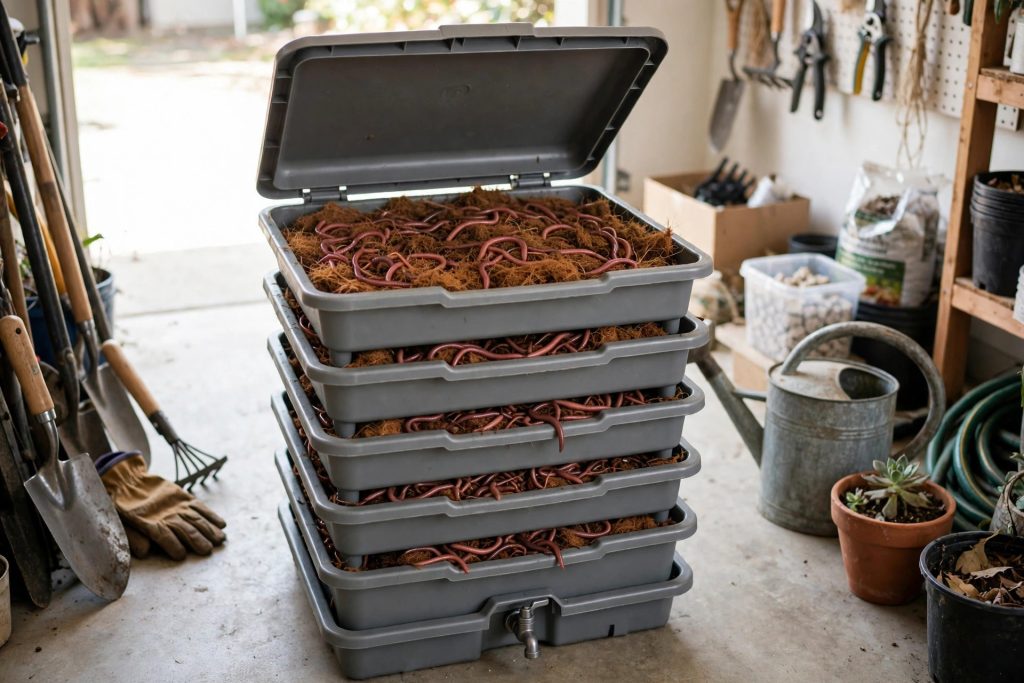
Best complete starter kit. Our rating: 8.9 out of 10.
Uncle Jim’s has raised worms on its Pennsylvania farm since 1976, and the Worm Box is its current home system: five stackable trays, a collection base with a built-in spigot, a coconut coir bedding brick in the box, and bundle options that add live red wigglers to the same shipment. For a beginner, that bundle is the point: one order, one delivery, and the bin is running the same week.
The maker lists 12 gallons across five trays, each 5 inches deep, in durable PP plastic. Dimensions are 15.25 by 20 by 25 inches in gray and 14 by 16.5 by 25 inches in black, so check the colour you order. Start with at least 1,000 red wigglers, or 2,000 for faster processing, and the spigot drains liquid fertilizer from the base.
Real-world limitation: the two colour options have different footprints, an odd quirk to discover after ordering, and the maker publishes no warranty for this system. Five deep trays also fill slowly for a small household, so a single person may take months to fill the first tray.
Who should buy: beginners who want worms and bin in one order, and buyers who prefer a working worm farm to a plastics brand.
Why it scored 8.9: the only bundle here that ships worms with the bin; it loses points because the maker publishes no warranty and the two colours have different footprints.
Specifications: 5 trays, 12 gallons, gray 15.25 x 20 x 25 inches or black 14 x 16.5 x 25 inches, PP plastic, start with 1,000 red wigglers, warranty not published by the maker. Manufacturer details: Uncle Jim’s Worm Farm, unclejimswormfarm.com.
Manufacturer: Uncle Jim’s Worm Farm
5. Hungry Bin
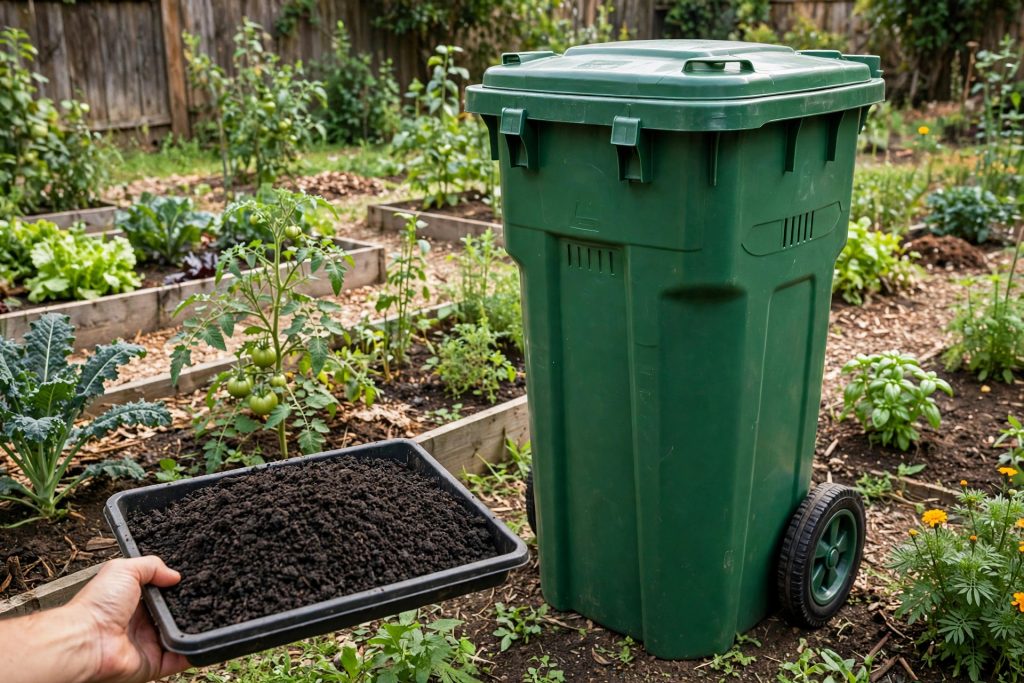
Best continuous flow, best large capacity. Our rating: 9.3 out of 10.
The Hungry Bin is the most capable bin here and the simplest to harvest. It is one large tapered bin on wheels, with no trays at all: you feed the top, worms stay near the surface where the food is, and finished castings collect at the bottom. To harvest, remove the floor and let about 4 litres of castings drop into the tray below. Nothing to lift, nothing to sort, no tray to wash.
The maker, through its US retailer, says the bin processes up to 4.5 pounds of waste a day at full population, about 6.5 pounds of worms grown from a 1 pound starter over 6 to 8 months. Dimensions are 24 by 26 by 37 inches, in food-safe, BPA-free polypropylene on a wheeled frame. Start with at least 80 litres of bedding so the bin is three quarters full, feed about half food scraps and half fibre, and remove castings every two to six months.
Note a conflict: some roundups list this bin at 122 litres or even 368 litres, but the maker gives throughput rather than volume, so this guide uses the maker’s figure: up to 4.5 pounds of scraps a day at full population.
Real-world limitation: this is a big, heavy bin that needs floor space and a long start-up, with a 1 pound starter colony taking 6 to 8 months to reach full population. It is an outdoor or garage bin for most homes, not a kitchen bin, and owners report limited airflow in the deep tapered body, so bedding choice and feeding discipline matter more here than in a tray system.
Who should buy: serious home composters and large households who want a steady supply of castings and will wait a season for the colony to build.
Why it scored 9.3: the highest throughput here and the simplest harvest, with nothing to lift; it loses points for its size, its long start-up, and limited airflow in the deep body.
Specifications: continuous flow, processes up to 4.5 lb waste per day at full population, about 6.5 lb worms at capacity, 24 x 26 x 37 inches, food-safe BPA-free polypropylene, wheels, warranty not published by the maker. Manufacturer details: Hungry Bin, sold in the US by Eartheasy.
Sold in the US by Eartheasy
6. Urban Worm Bag Version 2
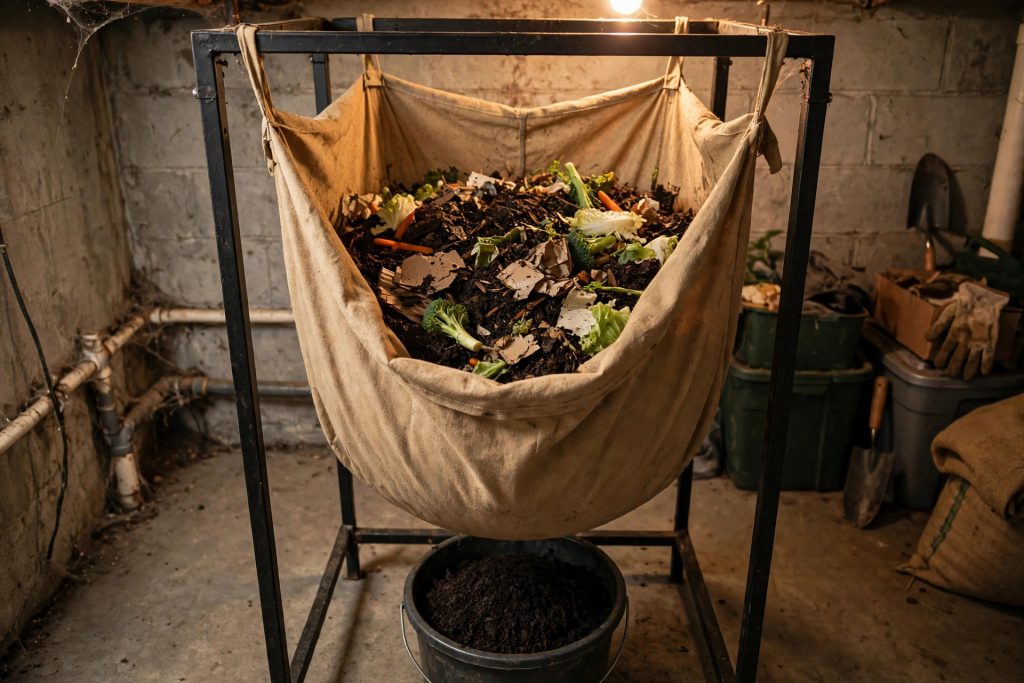
Best fabric flow-through. Our rating: 8.8 out of 10.
The Urban Worm Bag is a fabric flow-through system: a breathable bag of heavy 900D Oxford nylon on a metal frame, fed from the top and harvested from a zippered bottom. Air moves through the whole mass of bedding, so the bin stays aerobic, and aerobic bedding does not smell. The maker says the bag holds over 5 cubic feet of vermicompost in a footprint of about 26 by 26 inches.
The specifications are unusually complete: 26.75 inches wide including the frame, 7.5 pounds empty, 5.3 cubic feet or 122 litres at maximum load, in 900D Oxford nylon with a polyurethane coating. The maker says a bag stocked with 4 pounds of worms may process roughly 1 to 2 pounds of food waste a day under good conditions, with a maximum population of about 8 pounds. Worms and bedding are not included.
Real-world limitation: fabric dries out faster than plastic, so this bag needs more frequent moisture checks, especially in a heated room in winter or a hot garage in summer. It is also large when full, well over 100 pounds of dense, moist castings, so it stays where you put it.
Who should buy: composters who have tried a tray system and want more volume and easier harvesting, with a basement or garage corner where a large bag can sit undisturbed.
Why it scored 8.8: the best airflow here and a large 122 litre capacity; it loses points because fabric dries faster than plastic and the full bag is too heavy to move.
Specifications: fabric flow-through, 5.3 cu ft (122 L) maximum volume, 26.75 inches wide including frame, 7.5 lb empty, 900D Oxford nylon with polyurethane coating, up to 8 lb worms, warranty not published by the maker. Manufacturer details: Urban Worm Company, urbanwormcompany.com.
Manufacturer: Urban Worm Company
7. Tumbleweed Worm Cafe
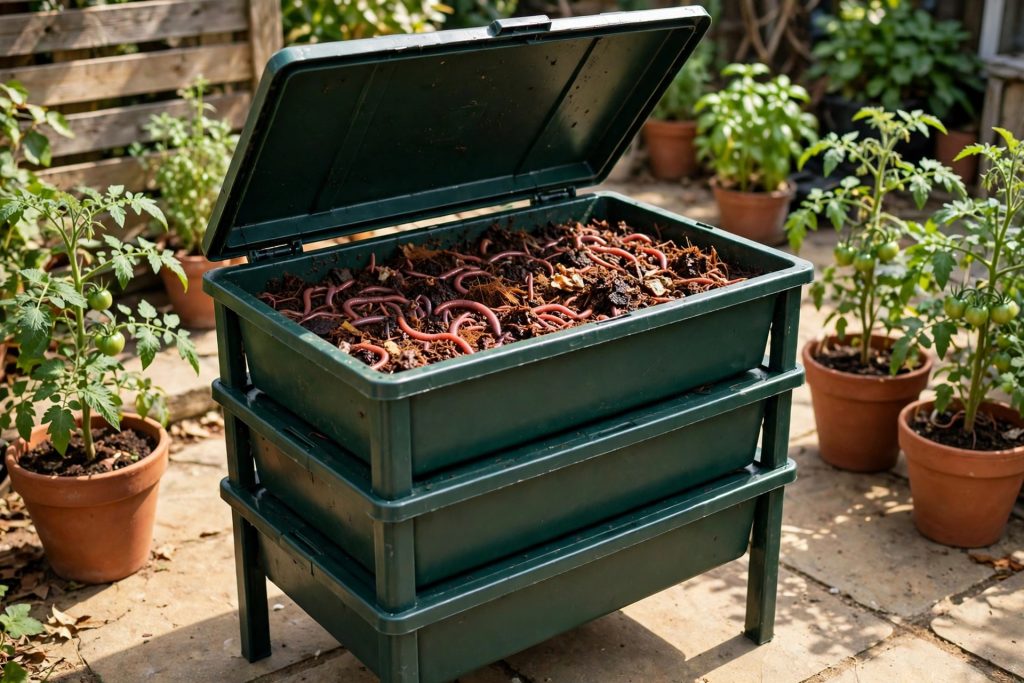
Best for patios and small households. Our rating: 8.7 out of 10.
The Worm Cafe is Australia’s long-running answer to the tray system: three large rectangular working trays, a hinged fly-proof lid, a ventilated collector tray with a drip-free tap, and legs shaped to stop ants climbing in. Rectangular trays give more surface area than square ones, and surface area is what worms use, since they feed in the top few inches.
The maker says the Worm Cafe recycles 5 to 6 kg of organic waste a week, and the starter kit is listed at 77 litres total volume. A reviewer measured the assembled unit at about 1 metre tall, 30 cm wide, and 60 cm deep, but exact dimensions are not published by the maker, so this guide does not state them as fact. The kit includes a bedding block and instructions; start with at least 1,000 composting worms.
Real-world limitation: US availability is limited, and shipping a bulky plastic farm from Australia can cost more than the bin itself in some listings, so check US stock first. Some owners also note the third tray sits unused for a long time in a small household, and worms can escape through the side ventilation if trays are not seated properly.
Who should buy: patio and balcony composters and small households of one or two people who prefer wide rectangular trays to square ones.
Why it scored 8.7: wide rectangular trays and a long track record; it loses points for limited US availability and a third tray that sits unused in small households.
Specifications: 3 large working trays, 77 L total volume, recycles 5 to 6 kg waste per week, recycled plastic, start with 1,000 worms, exact dimensions not published by the maker, warranty not published by the maker. Manufacturer details: Tumbleweed, tumbleweed.com.au.
Manufacturer: Tumbleweed
8. FCMP Outdoor Hot Frog Living Composter
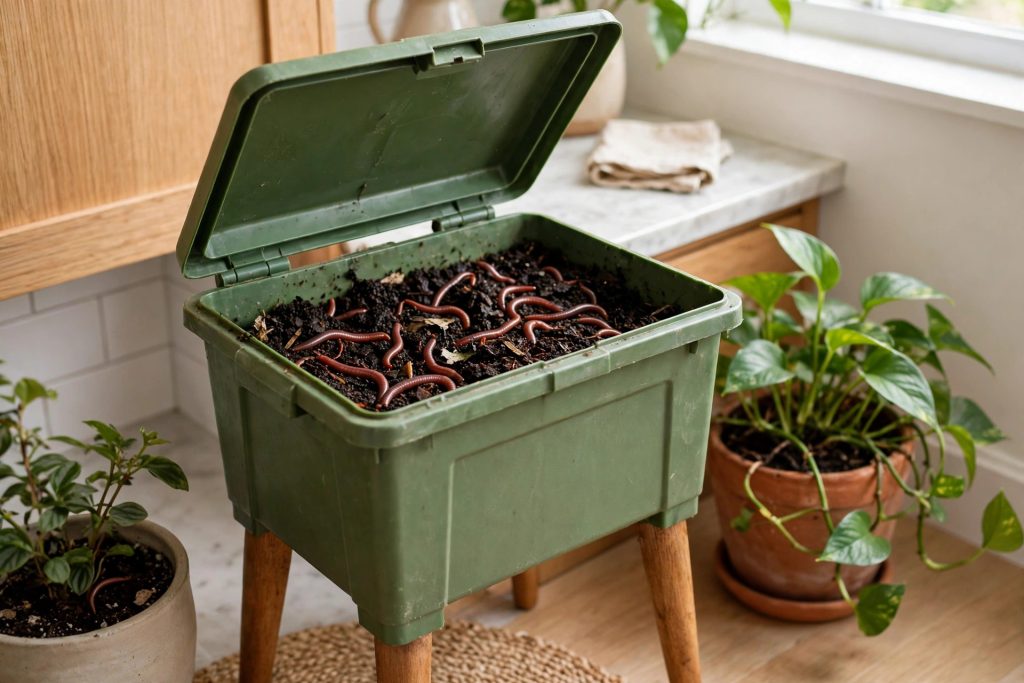
Best for display indoors. Our rating: 8.6 out of 10.
The Hot Frog is the most furniture-like bin here after the Urbalive: a green recycled plastic body on hardwood legs, a double-walled lid, and a water retention channel around the trays make it look more like a side table than a worm bin. It is built to be seen, in a kitchen, a pantry, or a sunroom.
The design is a three layer stacking system: two working trays above a reservoir base with a spigot. Dimensions are 15 by 15 by 22 inches, weight is 15 pounds, and the body is thick BPA-free recycled polyethylene. Each working tray has 40 holes in the bottom so worms can move between layers, and perimeter channels catch water and keep bedding edges from drying out. The bin holds a little over 1 pound of worms, not included, and it expands by adding trays.
Do not confuse this bin with the FCMP Outdoor Hot Frog 37 gallon dual-body tumbling composter, a different product from the same brand that tumbles hot compost and holds no worms. Several listings mix the two, so check the product name before ordering.
Real-world limitation: the working volume is small, a little over a pound of worms, so it suits one or two people rather than a family. Owners also report worms blocking the spigot drain, and the start-up instructions are thin beside the Worm Factory’s manual.
Who should buy: single people and couples who want a worm bin that looks good in a living space, with a small kitchen where appearance matters as much as capacity.
Why it scored 8.6: the most furniture-like design after the Urbalive; it loses points for a small working volume and thin start-up instructions.
Specifications: 3 layers (2 working trays plus reservoir base), 15 x 15 x 22 inches, 15 lb, BPA-free recycled polyethylene, hardwood legs, holds just over 1 lb worms, warranty not published by the maker. Manufacturer details: FCMP Outdoor, sold as Hot Frog Living Composter.
Manufacturer: FCMP Outdoor — no product page published on the maker’s site
9. Maze Worm Farm
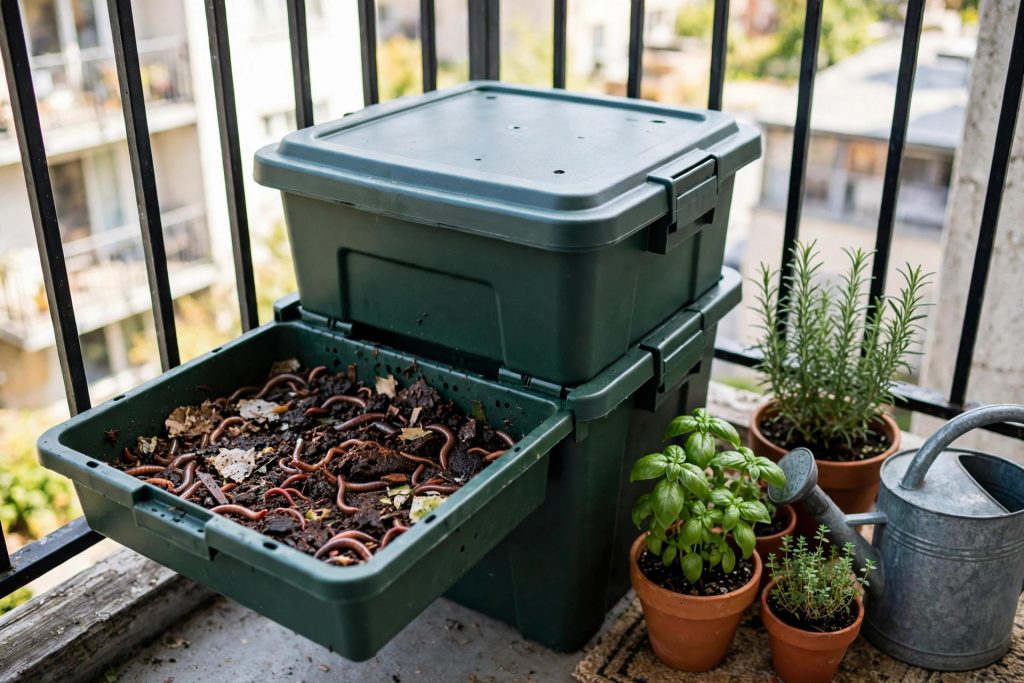
Best compact pick. Our rating: 8.5 out of 10.
The Maze Worm Farm is the smallest serious bin in this list, and it earns its place on cleverness rather than capacity. Two working trays rotate for easy access, a flat 2 litre collection tray gathers liquid fertilizer underneath, and the whole unit measures 40 by 30 by 50 cm and weighs about 3.5 kg, so it is the easiest bin here to move or tuck onto a balcony.
The body is Australian recycled plastic, designed for compact spaces such as kitchens and balconies, for indoor or outdoor use. Total capacity in litres is not published by the maker, so this guide does not state one. The rotatable trays are the feature to notice: most tray systems lift straight up, while these swing, which helps in a tight corner.
Real-world limitation: two small trays fill fast for a family, and the small liquid tray needs emptying more often than the large spigot bases on bigger bins. Like the Tumbleweed, US availability is limited, so check stock and shipping before ordering.
Who should buy: apartment dwellers and balcony gardeners with a truly small space who still want a real worm system rather than a countertop toy.
Why it scored 8.5: the most compact serious bin here, with rotatable trays; it loses points for two small trays that fill fast and a small liquid tray that needs emptying often.
Specifications: 2 rotatable working trays, 2 L collection tray, 40 x 30 x 50 cm, about 3.5 kg, Australian recycled plastic, total capacity in litres not published by the maker, warranty not published by the maker. Manufacturer details: Maze Products.
Retailer listing: Pestrol
10. Subpod Mini
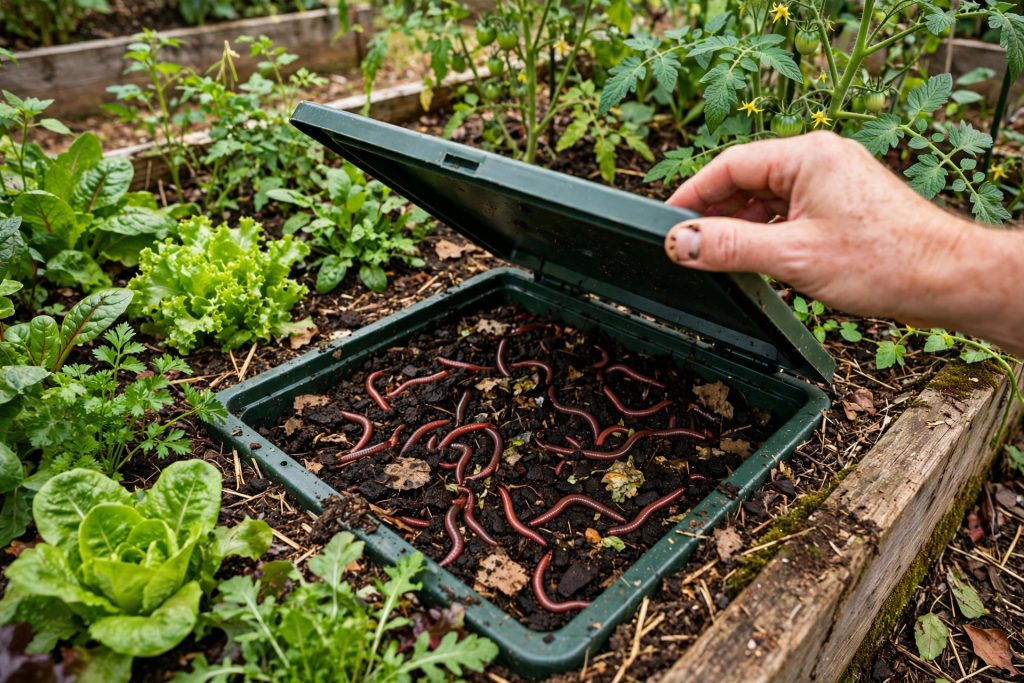
Best in-ground. Our rating: 8.9 out of 10.
The Subpod Mini works differently from every other bin here, and that difference is its strength. Buried in a garden bed with its lid at soil level, it lets worms travel in and out through holes in the sides, carrying nutrients directly into the surrounding soil. No tray to lift, no castings to collect in a bucket, no bin to look at: the garden bed itself is the harvest.
The Mini measures 19.4 by 17.7 by 16.9 inches, in 60 percent recycled plastic, with a dual chamber design and 360 degree ventilation panels that keep the contents aerobic and odour free. It handles up to 22 pounds of food waste a week, suits one to three people, and should be planted about 12 inches underground. About 500 composting worms are needed to start, not included. The lid is strong enough to sit on, and the maker claims a minimum 10 year life for the plastic in soil. A full-size Subpod also exists, at 29.5 by 17.7 by 16.9 inches, handling up to 30 litres or 15 kg a week.
Real-world limitation: this is a permanent installation, not a portable bin, and moving it means digging it up. It needs a garden bed to live in, so apartment dwellers without a bed cannot use it, and it produces no bucket of castings to carry to houseplants: the worms distribute nutrients themselves, so you do not control where they go.
Who should buy: gardeners with raised or in-ground beds who want composting to disappear into the garden, and anyone who dislikes harvesting, lifting, and sorting castings by hand.
Why it scored 8.9: the only system here that feeds the soil directly with no harvesting; it loses points because it needs a garden bed and gives no bucket of castings to carry elsewhere.
Specifications: in-ground, Mini 19.4 x 17.7 x 16.9 inches, 60 percent recycled plastic, up to 22 lb food waste per week, dual chamber, worms not included, plastic life 10 years minimum claimed by the maker, warranty not published by the maker. Manufacturer details: Subpod, subpod.com.
Manufacturer: Subpod
How We Chose
We did not test these bins hands on. We read the manufacturer’s specifications and instructions, and we looked for patterns in owner feedback, both the praise and the recurring complaints. That is the honest basis for every rating here, and the scores are editorial, not laboratory results.
Owner feedback here means the patterns across many retailer and maker-site reviews: a complaint or praise counted only when it appeared again and again from different buyers, and a single review never decided a score.
The ratings were built from the six factors in the table below: each factor was judged on the evidence in this guide, weighted as shown, and combined into a single score out of 10. A bin strong on capacity but weak on harvest, or strong on looks but small in volume, lands in the middle, which is why no bin here scores above 9.4.
Our scoring system weights the factors that matter most over a season of real use in a home:
| Factor | Weight | What it covers |
|---|---|---|
| Capacity and flow | 25% | Tray count or volume, daily waste processing, and whether the design keeps up with a household |
| Ease of harvest | 20% | How simply finished castings come out, and whether worms need sorting by hand |
| Build quality and materials | 20% | Plastic quality, recycled content, frame strength, and how the bin holds up when full and wet |
| Indoor suitability | 15% | Size, smell control, appearance, and whether the bin can live in a shared room |
| Worm health and airflow | 10% | Ventilation, drainage, moisture control, and protection from pests and ants |
| Value | 10% | What the bin includes, whether worms and bedding are bundled, and whether extra trays are affordable |
A bin scores well when it is easy to harvest, holds up when full, and fits the household it claims to serve. A bin loses points for small working volume, thin instructions, limited availability, or a design that makes a common job harder than it needs to be. No bin scores a perfect 10, because every design trades something away: capacity against size, looks against volume, or simplicity against speed.
Final Choice
For most homes, the Worm Factory 360 is still the safest first buy: proven, expandable, small enough for a kitchen corner, and its tray system teaches the harvesting habit that makes vermicomposting work long term. If your household is large or you cook every day, step up to the Hungry Bin and give the colony a season to reach full strength. If you live in an apartment and the bin must share your living room, the Urbalive earns its place on looks and its 24 month warranty, and the Maze Worm Farm is the fallback when space is truly tight.
Whatever you choose, remember that the right bin is the one you will actually feed, check, and harvest: a small bin used weekly beats a large bin forgotten in a garage. Start with half a pound to a pound of red wigglers, feed little and often, keep the bedding like a wrung-out sponge, and give the colony three months. The first handful of dark, earthy castings, spread around a tomato plant or mixed into a houseplant pot, is the moment the system clicks, and the right bin for your home is the one that gets you to that first handful without a fuss.
Before you buy, check what your soil actually needs with our soil testing guide.

If you also want a tumbler for yard waste, see our beginner compost bin picks.
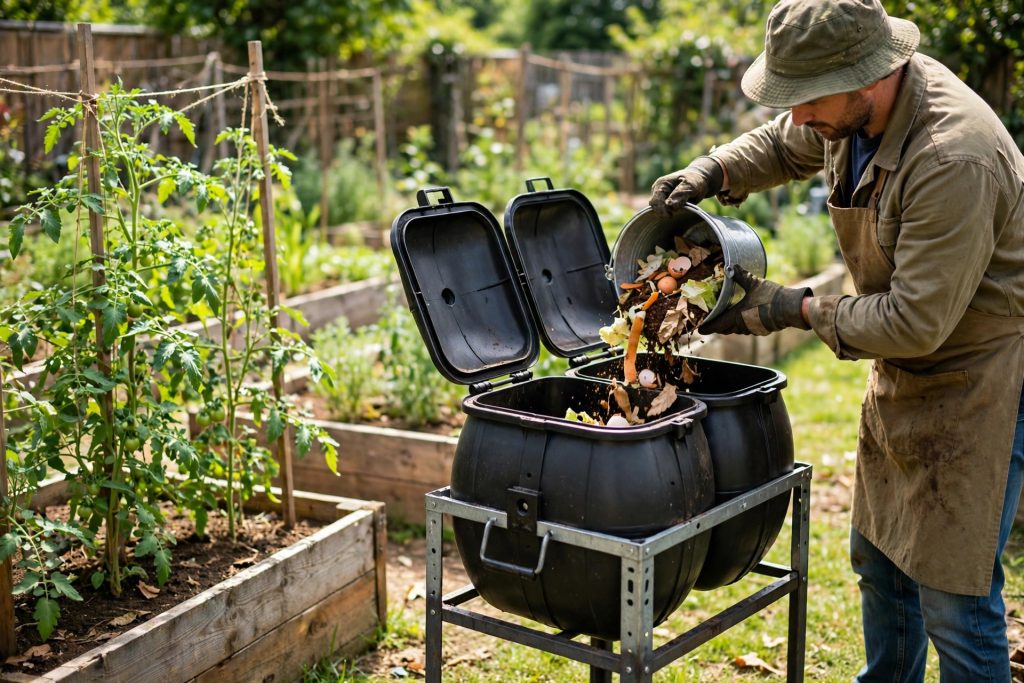
New to composting altogether? Our home composting guide walks through the pile method step by step.

For the bigger picture on feeding soil, see our soil fertility guide.

To learn the vermiculture basics behind these bins, see our vermiculture guide.

References
- Washington State University Extension, Composting with Redworms: supports the ideal temperature range of 55 to 77 degrees Fahrenheit for redworms, the 2 to 1 worm to food ratio, and the recommendation of Eisenia fetida as the best worm for home composting.
- Utah State University Extension, Vermicomposting: supports the 2 to 3 month timeline for a new bin to produce castings, and the feeding guidance of burying scraps in a different spot each time.
- Cornell Waste Management Institute, Vermicompost: A Living Soil Amendment: supports the use of vermicompost in potting media and for plant nutrient management, and the role of vermicompost in suppressing plant disease.
- Iowa State University Extension, How to Create and Use Vermicompost: supports the ideal temperature range of 55 to 77 degrees Fahrenheit, with 65 to 70 degrees ideal, and the guidance that red wigglers are the best species for home vermicomposting.
- Nature’s Footprint, Worm Factory 360 FAQ: supports the Worm Factory 360 specifications used in this guide, including the 18 by 18 by 25 inch size, four trays expandable to six, and the non-toxic ABS plastic body.
FAQ
How long does it take to get worm castings from a new bin?
Expect the first usable castings 2 to 4 months after setup. Utah State University Extension says a new bin generally takes 2 to 3 months to generate castings, and a full tray usually takes 6 to 8 weeks once the colony is established. A starter population of 500 to 1,000 worms doubles roughly every 60 to 90 days under good conditions, so the bin gets faster every month.
How many worms do I need to start a worm composter?
Start with about 1 pound of red wigglers, roughly 1,000 worms, for a family-size bin, or half a pound, about 500 worms, for a small bin. Washington State University Extension gives a ratio of 2 pounds of worms for each pound of food added per day. Do not overstock a new bin: worms regulate their own population to match the food supply, so extra worms in an underfed bin simply compete.
Does a worm composter smell?
A healthy worm bin smells like damp earth, not like garbage. Bad smells mean overfeeding, excess moisture, or a lack of air. Keep food buried under bedding, never leave scraps exposed, keep meat, dairy, and oil out completely, and add dry shredded paper whenever the bedding looks wet and glossy. If a bin already smells, stop feeding for a week, add dry bedding, and loosen compacted areas.
Can I keep a worm composter indoors all year?
Yes, and indoors is often the best place for one. Red wigglers are most productive between 55 and 77 degrees Fahrenheit, which matches a normal heated home. Keep the bin out of direct sun, away from radiators, and out of a garage that freezes in winter. The main indoor concerns are fruit flies and moisture, and both are controlled by burying food under bedding and covering the surface with dry paper or a coir mat.
What should I never feed my worms?
Never feed meat, dairy, oil, greasy leftovers, or pet waste: they rot, smell, and attract pests. Limit citrus peels, onion, and garlic, because their strong oils irritate worms, and avoid salty food and spicy sauces. The safe daily menu is vegetable and fruit scraps, coffee grounds, tea bags, crushed eggshells, and plain bread or pasta, always buried under bedding and balanced with dry carbon such as shredded paper or cardboard.
How do I use worm castings on my plants?
Mix castings at 10 to 20 percent by volume into potting mix, spread a quarter to half inch as a top dressing on garden beds, or add a small handful to each transplant hole. Water them in, and cover a top dressing with mulch where you can. Castings release nutrients slowly and will not burn plants the way synthetic fertilizer can, so they are safe for seedlings, houseplants, and vegetables alike.

Thesis Link : https://saulibrary.edu.bd/daatj/public/uploads/BAU200601_19-Pp_5.pdf
- How to Transplant Pepper Seedlings Outdoors - November 9, 2026
- Best Worm Composters for Home Use: 10 Picks That Turn Scraps Into Black Gold - November 8, 2026
- How to Transplant Tomato Seedlings Outdoors - November 8, 2026