

10 Crops Worth Growing in a Greenhouse for Real Profit
If you’ve ever watched a crop struggle through heatwaves, storms, or surprise frosts, a greenhouse starts to look less like a “nice to have” and more like a business advantage. With the right setup, you’re not just growing plants , you’re selling consistency: steadier yields, cleaner produce, and harvests that show up when the outdoor season can’t.Discover the 10 best greenhouse crops for maximum profit in 2026.
That’s why so many growers are searching for the Best Greenhouse Crops to maximize revenue per square foot.
The industry momentum backs it up. One major market report estimates the global greenhouse market at about $32.84 billion in 2025, with projections reaching around $74.10 billion by 2033. That growth reflects what buyers want: fresh, local, year round produce and what growers need: predictable production in an unpredictable climate.
In this guide, you’ll learn the 10 best greenhouse crops for maximum profit the crops that tend to deliver strong demand, reliable yields, and better pricing potential.
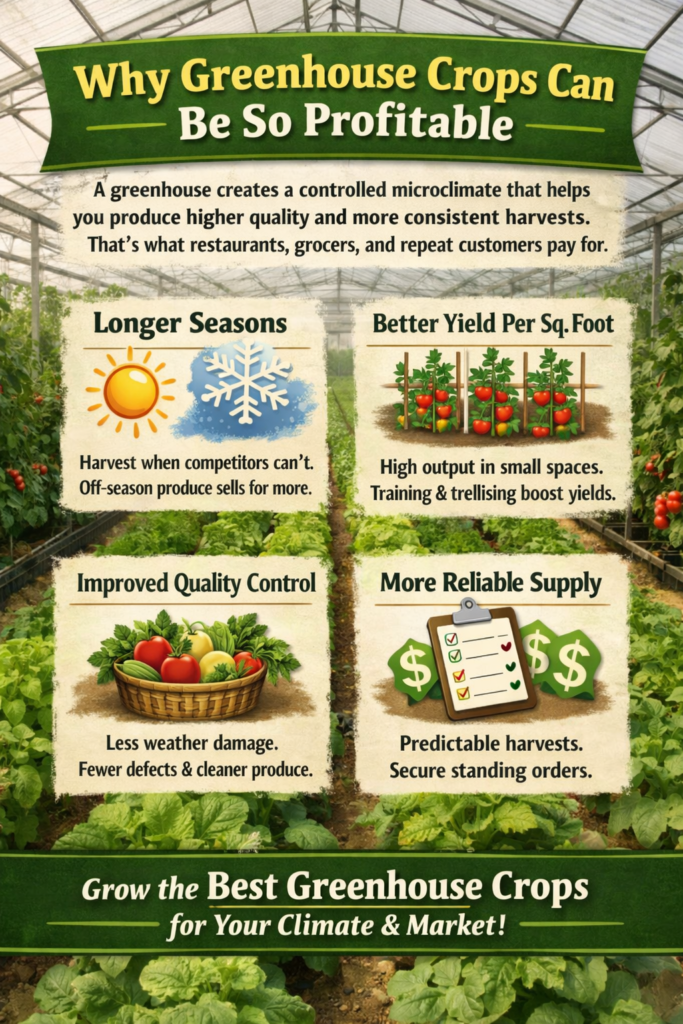
Why Greenhouse Crops Can Be So Profitable
A greenhouse creates a controlled microclimate that helps you produce higher quality and more consistent harvests than many open field systems. That matters because consistency is what restaurants, grocers, and repeat customers pay for.
Here’s where the profit edge comes from:
- Longer seasons : You can harvest when competitors can’t and off season produce often sells for more.
- Better yield per square foot: Training, trellising, and optimized spacing can turn small areas into high output zones.
- Improved quality control: Less weather damage, fewer cosmetic defects, and cleaner produce that holds value.
- More reliable supply: Predictability helps you secure standing orders with buyers and plan cash flow.
The goal isn’t to grow “everything.” The goal is to grow the Best Greenhouse Crops, the ones that match your climate control level, your labor capacity, and your local demand , so every bed, bench, and aisle earns its keep.
Now, let’s get into the list of the Best Greenhouse Crops for maximum profit and what makes each one a strong contender.
1.Tomatoes — High Yield, Fast Sales, Strong Margins
If your goal is reliable cash flow from a greenhouse, tomatoes are hard to beat. They’re one of the Best Greenhouse Crops because they combine three things growers love: long harvest windows, strong customer demand, and premium pricing when you hit the market early or late.
Why Greenhouse Tomatoes Sell So Well
Tomatoes are a daily use food. People buy them every week home cooks, restaurants, meal-prep customers, and farm stands. And here’s the big advantage: a vine ripened tomato from a local greenhouse usually tastes noticeably better than one picked green and shipped long distances. That flavor difference becomes your marketing engine.
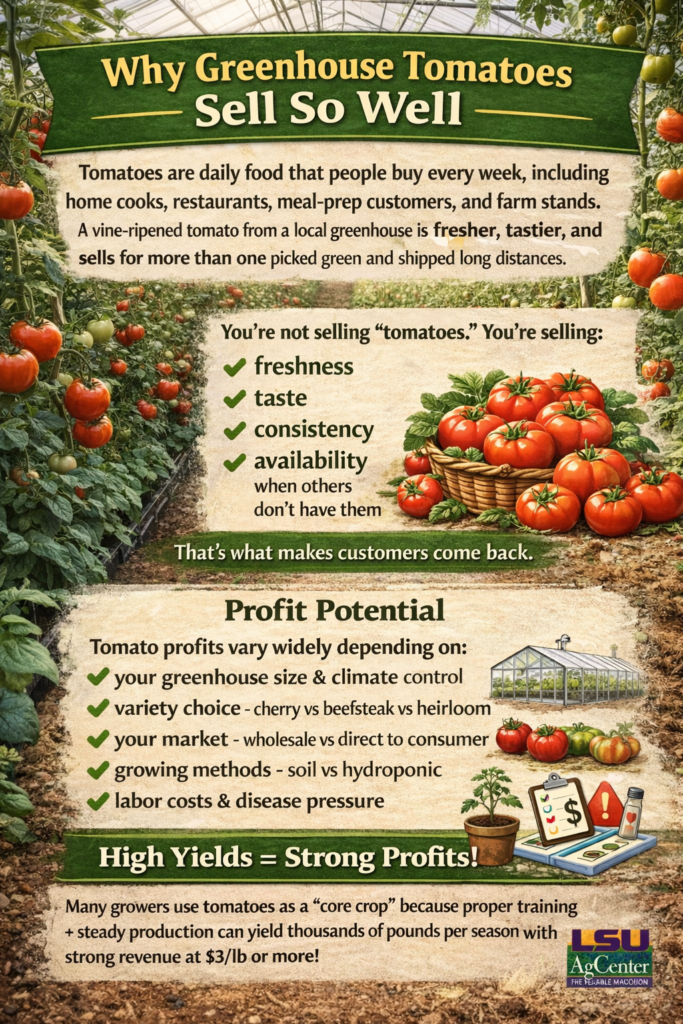
You’re not selling “tomatoes.” You’re selling:
- freshness
- taste
- consistency
- availability when others don’t have them
That’s what makes customers come back.
Profit Potential
Tomato profits vary widely depending on:
- your greenhouse size and climate control
- variety choice – cherry vs beefsteak vs heirloom
- your market – wholesale vs direct to consumer
- your growing method – soil vs hydroponic
- labor costs and disease pressure
Still, many growers use tomatoes as a “core crop” because yields can be huge when plants are trained properly and production is steady. Some industry examples shared online suggest that a 30×96 ft structure can produce thousands of pounds per season and generate strong revenue at $3/lb or more, while university/extension style resources like LSU AgCenter often highlight tomatoes as a reliable greenhouse income crop when managed well.
Market Demand
Tomatoes are a staple, but profits usually improve when you pick the right product angle.
Best selling tomato angles for greenhouse growers
- Cherry / grape tomatoes – high sweetness, easy snacking, great for salads
- Heirlooms – premium pricing, strong farmers market appeal
- Cocktail tomatoes – nice balance of size and flavor
- Off-season tomatoes – late fall, winter, early spring higher prices when outdoor supply is low
- “Chef grade” tomatoes – consistent size + flavor for restaurants
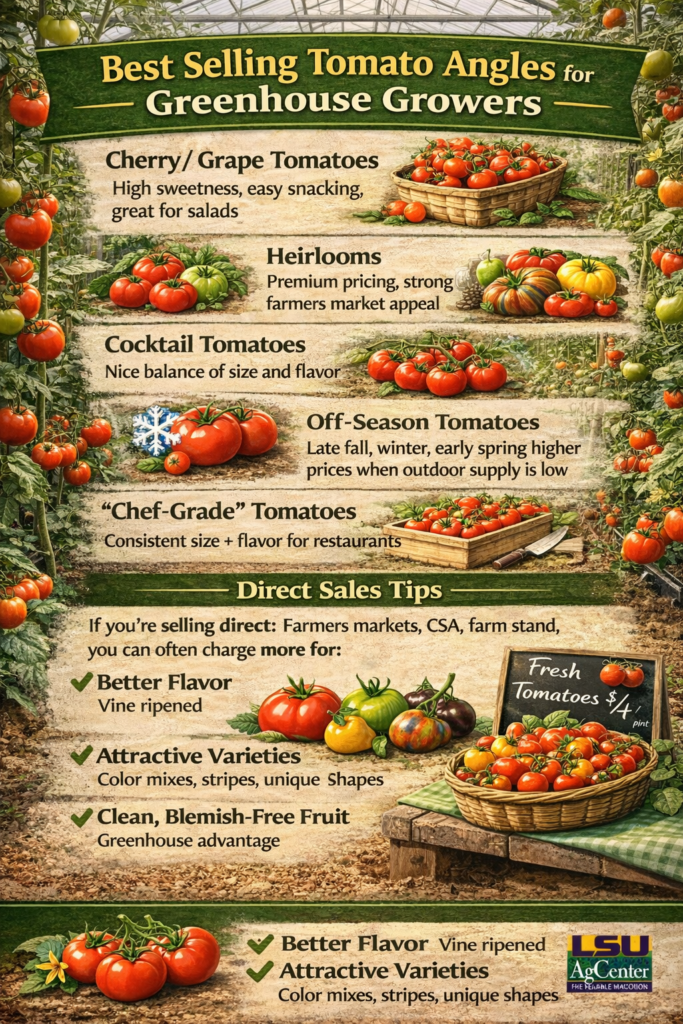
If you’re selling direct , farmers markets, CSA, farm stand, you can often charge more for:
- better flavor , vine ripened
- attractive varieties , color mixes, stripes, unique shapes
- clean, blemish free fruit , greenhouse advantage
Growing Tips That Actually Protect Profit
Tomatoes can pay well but only if you manage the details. These are the practices that separate “good harvests” from “great income.”
1) Trellis early and commit to training
Greenhouse tomatoes grow fast. Vertical training improves:
- air flow – lower disease
- fruit quality – cleaner fruit
- harvest speed – labor savings
2) Prune for airflow and fruiting
Pruning reduces jungle growth and helps prevent humidity related problems. The aim isn’t “pretty plants” it’s:
- fewer leaves blocking airflow
- easier spraying/monitoring
- better fruit set and ripening
3) Keep watering consistent
Inconsistent watering is one of the fastest ways to lose quality:
- splitting fruit
- blossom end rot
- uneven sizing
A drip system + a simple schedule , adjusted by heat and plant size can raise quality and reduce waste.
4) Don’t ignore pollination
In closed structures, pollination can drop without airflow or vibration. Many growers use:
- gentle shaking of trellis strings
- fans for air movement
- or bumblebees – common in commercial setups
Poor pollination = fewer fruit = lower profit.
5) Control humidity like it’s a crop
Humidity is where many greenhouse tomato profits disappear , fungal disease can take a good season and turn it into a headache. Use:
- ventilation
- spacing
- pruning
- watering timing – morning is usually safer than evening
- and sanitation – remove diseased leaves fast
What to Grow
If you want a straightforward plan:
- 1 “fast moving” variety: cherry/grape for steady weekly sales
- 1 “premium” variety: heirloom or specialty slicer for higher margins
- 1 “backup performer” variety: a dependable hybrid known for disease resistance in your region
That mix helps you sell to more buyers without gambling everything on one type.
Why Tomatoes Stay #1 for Many Growers
Tomatoes earn their reputation because they’re usually:
- easy to sell
- high yielding
- profitable with good management
- perfect for season extension
Yes, they require labor , training, pruning, monitoring. But when done right, tomatoes don’t just fill baskets, they fill your order list.ely considered one of the most profitable greenhouse crops available. Growers who can produce flavorful, quality tomatoes consistently will often find eager buyers and healthy profits.
References
- Rimol 30×96 High Tunnel example page
- LSU AgCenter: “Growing Greenhouse Tomatoes Can Be Profitable”
- LSU AgCenter: Hanna Tomato Book (700 plants, 30×96 bay, 17,000+ lbs)
- Ohio State (Ohioline): Bumble bee pollination in tomato greenhouses
- Purdue Extension PDF: humidity and disease issues in greenhouse tomatoes
2. Leafy Greens in the Greenhouse: Lettuce & Vegetable
If you’re looking for a greenhouse crop that turns over quickly and sells consistently, it’s hard to beat leafy greens. Lettuce, arugula, baby kale, and salad blends fit neatly into what buyers want right now: fresh, clean, locally grown food available even when outdoor farms can’t produce.
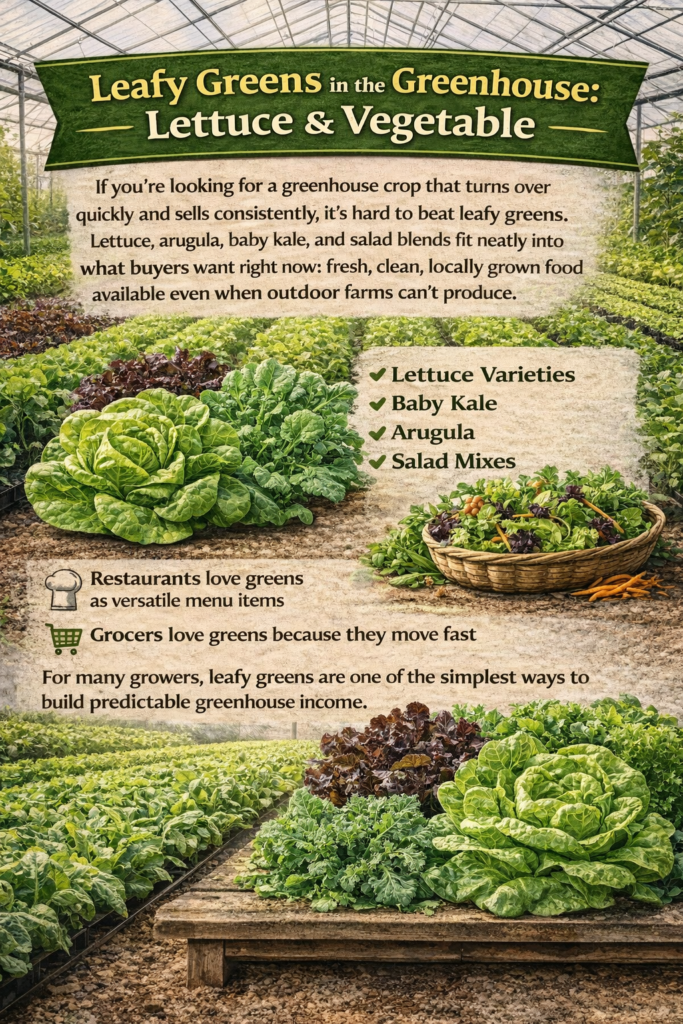
Restaurants like greens because they’re reliable menu items. Grocery stores like them because they move fast. And customers keep coming back because salads and sandwiches don’t go “out of style.” For many growers, that combination makes leafy greens one of the simplest ways to build predictable greenhouse income.
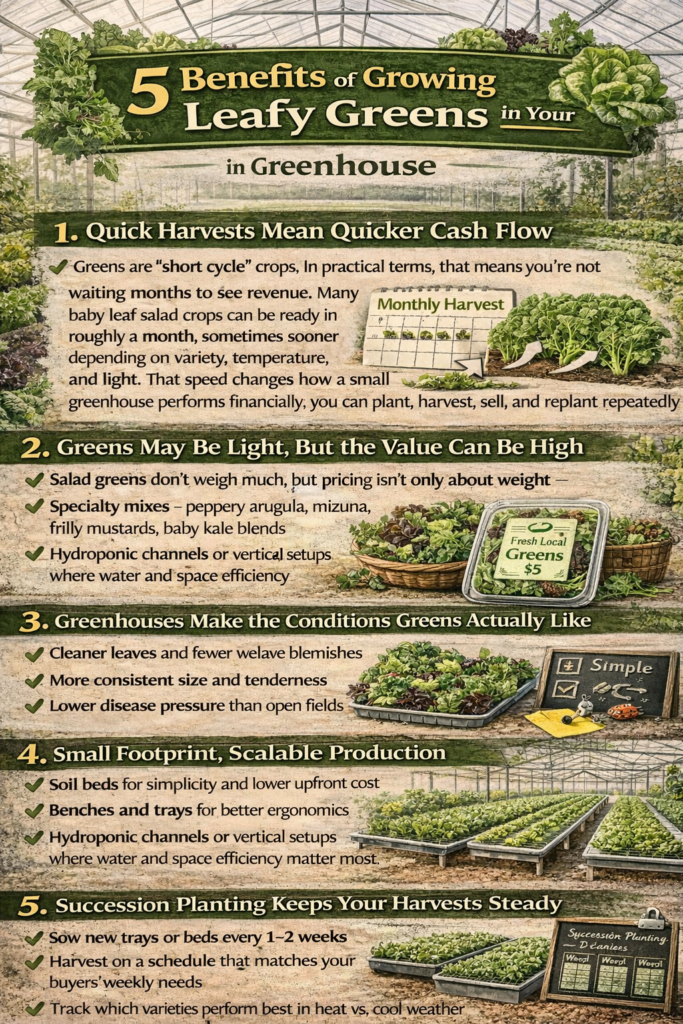
1) Quick harvests mean quicker cash flow
Greens are “short cycle” crops. In practical terms, that means you’re not waiting months to see revenue. Many baby leaf salad crops can be ready in roughly a month, sometimes sooner depending on variety, temperature, and light. That speed changes how a small greenhouse performs financially: you can plant, harvest, sell, and replant repeatedly without long gaps.
A second advantage is how well greens respond to “cut and come again” harvesting. Instead of pulling the whole plant once, you harvest the outer leaves or cut above the crown and let it regrow. With good management, a single planting can produce multiple harvests before quality declines and you reset the bed or tray.
What that looks like on the ground: rather than betting your season on one big harvest day, you’re stacking smaller harvests week after week. That’s easier on labor, and it keeps your product in the market more often.
2) Greens may be light, but the value can be high
Salad greens don’t weigh much, but pricing isn’t only about weight it’s about freshness, consistency, and uniqueness.
- Specialty mixes – peppery arugula, mizuna, frilly mustards, baby kale blends, often sell at premium prices when marketed well.
- Chefs pay for flavor and appearance, and they’ll often pay more for clean, uniform leaves and dependable weekly supply.
- Direct customers – farmers markets, subscription boxes, online orders, pay for “just harvested” quality that supermarkets can’t match.
If you’re aiming for higher margins, the easiest lever is differentiation: grow varieties that don’t show up everywhere and package them well. A simple, well branded clamshell of mixed baby leaves can outperform a generic bag of lettuce especially in winter or during hot months when outdoor quality drops.
3) Greenhouses make the conditions greens actually like
Many leafy greens prefer cool, steady weather. Outdoors, that’s exactly what you don’t always get heat spikes, rain, wind, and pest pressure can make quality unpredictable. A greenhouse lets you smooth out the extremes.
Key benefits growers notice:
- Cleaner leaves and fewer weather blemishes
- More consistent size and tenderness
- Better control of irrigation
- Lower disease pressure than open fields in many regions
Pests can still show up aphids are a common headache but scouting is simpler in a controlled space, and you can respond quickly with physical controls, sanitation, and IPM strategies before an issue spreads.
4) Small footprint, scalable production
One reason greens work so well for greenhouse growers is efficiency. They’re productive per square foot, they don’t require trellising, and they adapt to different systems:
- Soil beds for simplicity and lower upfront cost
- Benches and trays for better ergonomics and cleaner harvest
- Hydroponic channels or vertical setups where water and space efficiency matter most
Some growers also sell “living lettuce” . It can last longer on the shelf and looks premium, which can justify higher pricing with certain retailers.
5) Succession planting keeps your harvests steady
Greens are only “easy money” if you avoid feast or famine production. The fix is simple: don’t plant everything at once.
A steady system usually looks like this:
- sow new trays or beds every 1–2 weeks
- harvest on a schedule that matches your buyers’ weekly needs
- track which varieties perform best in heat vs. cool weather
This approach protects you from gaps in supply and buyers love consistency. A chef would rather purchase the same high quality mix every week than get a huge amount once a month.
Why leafy greens are a strong profit crop
Leafy greens check a rare set of boxes:
- quick turnaround
- reliable demand
- manageable learning curve
- flexible production systems
- strong potential for repeat customers
They also teach greenhouse fundamentals watering discipline, airflow, crop timing, hygiene, and harvest handling without the long wait times and higher risk that come with slower crops.
If you’re building a greenhouse business, greens are often the most practical place to start: you learn fast, you sell fast, and you improve fast.ens are among the best crops to grow in a greenhouse for profit, especially on a small scale.
References
- MSU Extension – How to Grow Lettuce (days to harvest: baby vs mature; succession sowing every 2–3 weeks).
- UC ANR – UC Master Gardeners (Santa Clara County) – Lettuce (cut and come again harvesting above growing tip; succession planting).
- MSU Extension – Cut and come again vegetables (explains the cut and come again method concept).
- USDA ERS – Fruit and Vegetable Prices (average retail prices per pound; data source for price baselines).
- Great Lakes Growers – Living Lettuce (roots attached) (roots intact; marketed longer shelf-life).
- Auburn University thesis (PDF) (academic mention: “living lettuce” with intact roots and extended shelf life).
- ISHS (International Society for Horticultural Science) article (notes living lettuce is harvested with intact roots; advocated to extend shelf life; highlights limited data).
3. Cucumbers in the Greenhouse
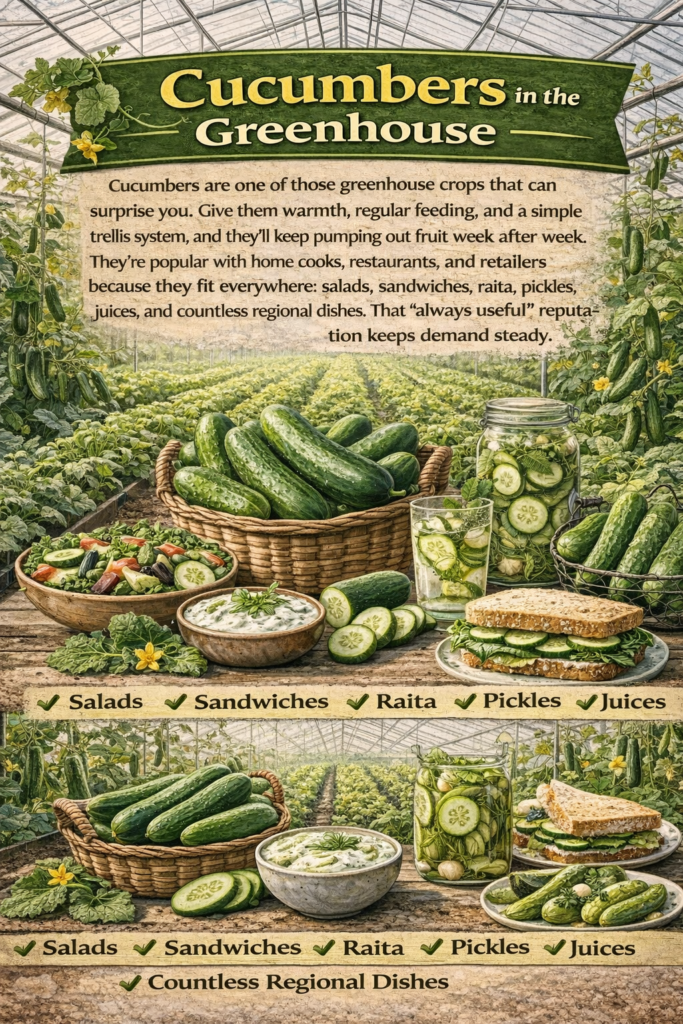
Cucumbers are one of those greenhouse crops that can surprise you. Give them warmth, regular feeding, and a simple trellis system, and they’ll keep pumping out fruit week after week. They’re popular with home cooks, restaurants, and retailers because they fit everywhere, salads, sandwiches, raita, pickles, juices, and countless regional dishes. That “always useful” reputation keeps demand steady.
Why growers like cucumbers: production can be massive
In greenhouse systems, cucumbers aren’t a one and done crop. Once they start, they don’t stop provided the plant stays healthy and you harvest on time.
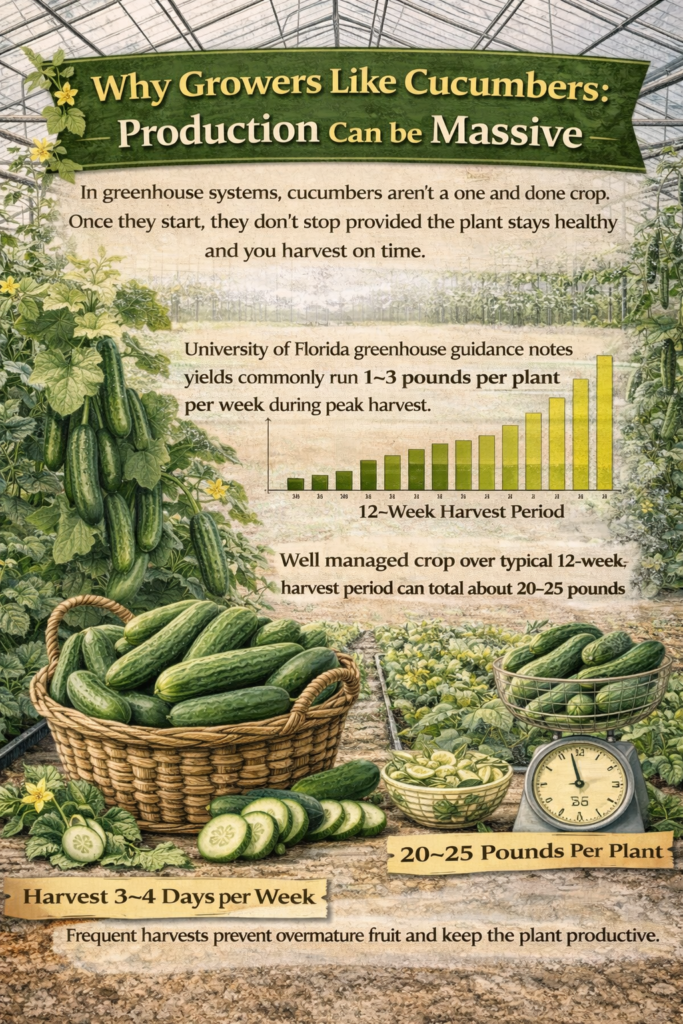
University of Florida greenhouse guidance notes that yields commonly run 1–3 pounds per plant per week during peak harvest, and a well managed crop over a typical 12-week harvest period can total about 20–25 pounds per plant. It also notes harvesting is usually needed three to four times per week to prevent fruit from getting overmature and slowing down the plant.
Fast to first harvest
Cucumbers move quickly compared to many greenhouse fruiting crops. University of Alaska Fairbanks Cooperative Extension states that harvest can begin about 50–70 days after seeding under greenhouse conditions.
That quick start is useful if you’re trying to keep income cycles short or you’re filling a seasonal market gap.
Pollination is simpler than most people think
For greenhouse production, many growers choose parthenocarpic cucumbers, types that set fruit without pollination, which is ideal in closed structures.
Alabama Cooperative Extension explains that the main greenhouse types , like English and Beit Alpha, are commonly parthenocarpic, produce fruit without fertilization, and are often marketed as seedless.
This matters because it reduces risk: you’re not depending on insect activity or hand pollination to get a crop.
Trellising turns limited space into high output
Cucumbers are vines. If you let them crawl, they’ll eat your floor space. If you train them upward, they become a high yield “vertical crop.”
Extension guidance describes vertical trellising systems where plants are grown up strings or supports, improving space use and making harvest easier.
Better airflow around the canopy also helps reduce humidity pockets that can lead to disease.
Post harvest – cucumbers lose quality fast unless you handle them right
This is where many growers either protect profits or accidentally give them away.
- UF/IFAS warns that European greenhouse cucumbers have thin skin and are highly susceptible to water loss and softening. Shrink wrapping is commonly used to reduce moisture loss and extend shelf life.
- UC Davis postharvest guidance recommends an optimum storage temperature around 10–12.5°C (50–55°F) and notes cucumber storage is generally less than 14 days before quality drops . It also warns that colder temps can trigger chilling injury.
If your buyers want crisp fruit, plan your harvest and delivery so cucumbers move quickly especially if you’re selling unwrapped fruit.
Pests to watch in warm greenhouse conditions
Greenhouses make cucumbers happy but some pests love that environment too. NC State Extension notes that in greenhouse cucumbers you’re likely to see pests such as aphids, spider mites, and leafminers and cucumbers can also face cucumber beetles.
Regular scouting and early control matter more than “big rescue sprays” later.
Versatility: more than just fresh slicing cucumbers
Cucumbers give you multiple sales angles:
- Fresh market: consistent weekly supply for shops and restaurants
- Mini/snacking types: easy direct to consumer product, simple packaging
- Pickling/fermentation buyers: local pickle brands, small processors, food businesses
You can also design your greenhouse layout creatively vertical cucumber rows with shorter crops in nearby space if light and airflow allow.
Why cucumbers are a strong profit crop
Cucumbers earn their place on a greenhouse “money crop” list because they’re fast, heavy producing, and easy to sell in many formats. The key is management: trellis them, feed them consistently, harvest often, and treat post-harvest handling like part of production not an afterthought.
References
- NC State Extension – Pests of Cucurbits (common greenhouse cucumber pests: aphids, spider mites, leafminers, etc.).
- University of Florida IFAS (EDIS) – Greenhouse Cucumber Production (yields per plant, harvest frequency, thin skin/water loss, storage guidance).
- University of Alaska Fairbanks Cooperative Extension – Growing Cucumbers in Greenhouses (first harvest ~50–70 days; trellising basics).
- Alabama Cooperative Extension – Greenhouse Cucumber Production (English/Beit Alpha types; parthenocarpic/seedless; vertical training).
- UC Davis Postharvest Center – Cucumber: Produce Facts (optimum storage 50–55°F; <14 days typical; chilling injury risk).
4. Peppers in the Greenhouse: High Value Fruit, High Attention Crop
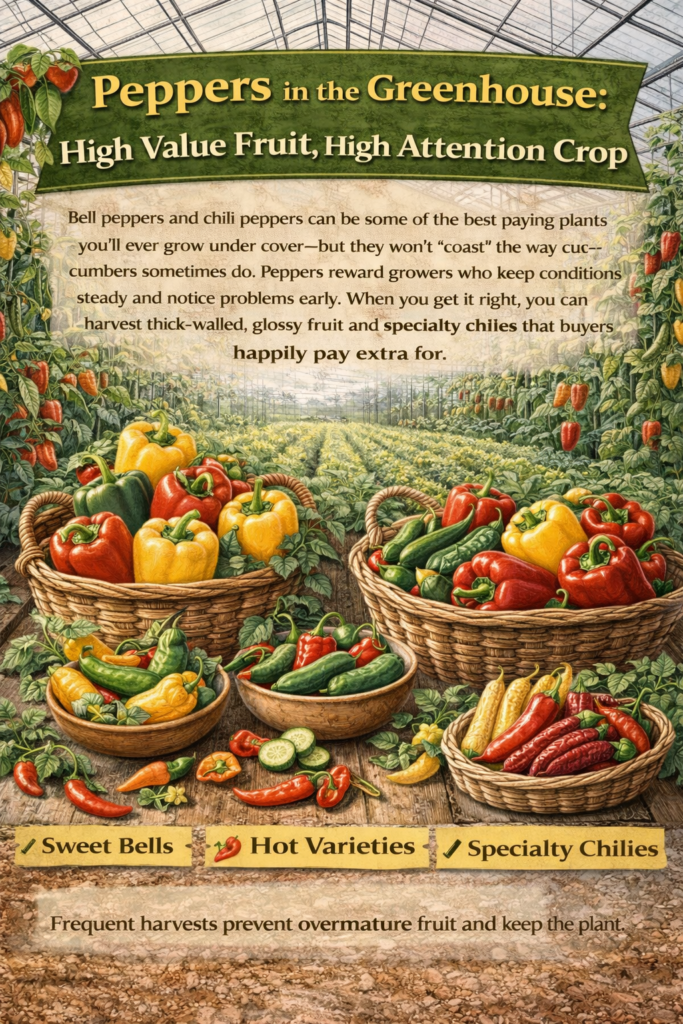
Bell peppers and chili peppers can be some of the best paying plants you’ll ever grow under cover but they won’t “coast” the way cucumbers sometimes do. Peppers reward growers who keep conditions steady and notice problems early. When you get it right, you can harvest thickwalled, glossy fruit and specialty chilies that buyers happily pay extra for.
Why greenhouse peppers sell for more
A big reason colored bell peppers , red, yellow, orange often outprice green bells is simple: color takes time. Many bell varieties reach the mature green stage first, then need another 2–3 weeks to fully ripen and change color. That extra time ties up space, labor, and heating, so the fruit is usually priced as “premium.”
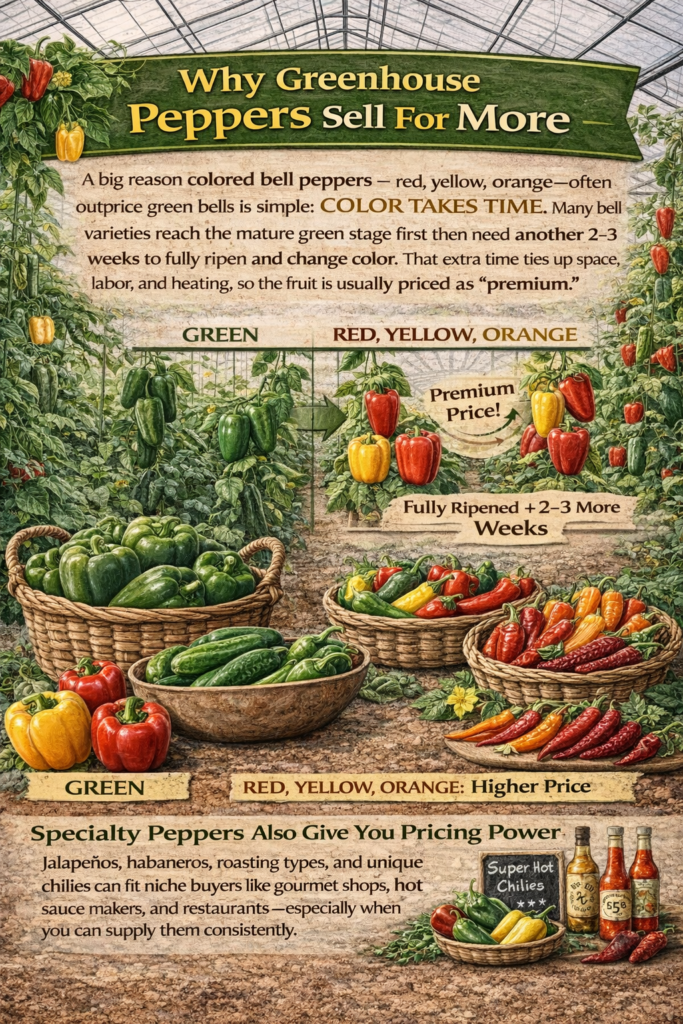
Specialty peppers also give you pricing power: jalapeños, habaneros, roasting types, and unique chilies can fit niche buyers like gourmet shops, hot sauce makers, and restaurants especially when you can supply them consistently.
The honest downside: peppers are picky
Peppers need:
- Strong light
- Warm, stable temperatures
- Good airflow
- Careful watering and feeding
If you swing from hot afternoons to cold nights, or let plants dry out and then flood them, peppers often respond with flower drop or misshapen fruit. They also tend to take longer to reach harvest than fast greenhouse crops, so mistakes cost more.
What “good conditions” actually mean
A widely used target range for peppers is 70–85°F (day) and 60–70°F (night). When temperatures stay cool, peppers slow down noticeably.
Ventilation matters even when you’re heating. Warm, stagnant air increases stress and can invite disease and pests. A greenhouse pepper crop should feel “fresh,” not swampy.
Yield reality: good returns, but not endless fruit
Peppers won’t usually match cucumbers for sheer numbers. Instead, profit comes from fruit quality and market timing , early spring or late fall fruit that outdoor growers can’t supply. A long, steady season is the goal, not one massive flush.
Pollination: peppers can self pollinate, but they still need movement
Pepper flowers have both male and female parts, so they can self pollinate but pollen still needs to move. In the field, wind does this. In a greenhouse, growers often rely on airflow, gently shaking trellis lines, or using bumble bees in larger setups.
If you’re seeing lots of flowers but poor fruit set, don’t jump straight to fertilizer, first check airflow, temperature stability, and whether flowers are getting enough vibration/movement.
Blossom end rot: it’s not “a disease,” it’s management
One of the most frustrating pepper issues is blossom end rot , that dark, sunken spot on the bottom of the fruit. It’s a physiological disorder caused by localized calcium deficiency in the developing fruit, often triggered by uneven watering or root stress , even when calcium exists in the soil.
Practical prevention is mostly boring but effective:
- keep watering consistent
- avoid big dry/wet swings
- protect roots
- maintain a steady growth rate
Pests : greenhouse comfort = pest comfort
Warm protected structures can attract pests that love peppers. Common greenhouse troublemakers include aphids, whiteflies, thrips, and spider mites.
What experienced growers do differently:
- scout on a schedule
- isolate new plants before bringing them in
- clean up crop debris fast
- use IPM tools early rather than waiting for an outbreak
Market strategy that actually works
Peppers pay best when you sell them as something special:
- Color and finish – uniform, glossy, thick walled bells
- Heat level and variety story – chilies labeled clearly: mild/medium/hot
- Freshness + local – especially when competing against shipped produce
If your buyers are chefs, reliability matters as much as flavor. If your buyers are consumers, packaging and clear labeling often lifts sales more than adding more varieties.
References
- UConn Extension (PDF) – Aphids as persistent greenhouse pests; scouting/IPM importance. pepper cultivation, a greenhouse full of red and yellow peppers can truly pay off.
- Clemson HGIC – Pepper temperature guidance (70–85°F day; 60–70°F night; slow in cool periods).
- University of Maryland Extension – Days to maturity + extra time to ripen from green to full color.
- Iowa State University Extension – Blossom end rot is a physiological issue tied to calcium deficiency in fruit tissue.
- UF/IFAS EDIS – Blossom end rot in bell pepper (calcium relation in rapidly expanding fruit).
- Bayer (greenhouse cultivation insight) – Pepper flowers are “perfect,” self pollination, movement/shaking and bees improve pollen transfer.
- University of Tennessee (PDF) – Greenhouse IPM basics and common greenhouse pest groups.
5. Herbs in the Greenhouse: Small Plants, Big Margins
Herbs are one of the most practical greenhouse crops because they sell in small units but can return high value per square foot. A few bunches of basil or cilantro can be a quick add on sale at a market, and a steady weekly delivery can make you a “go-to” supplier for restaurants.
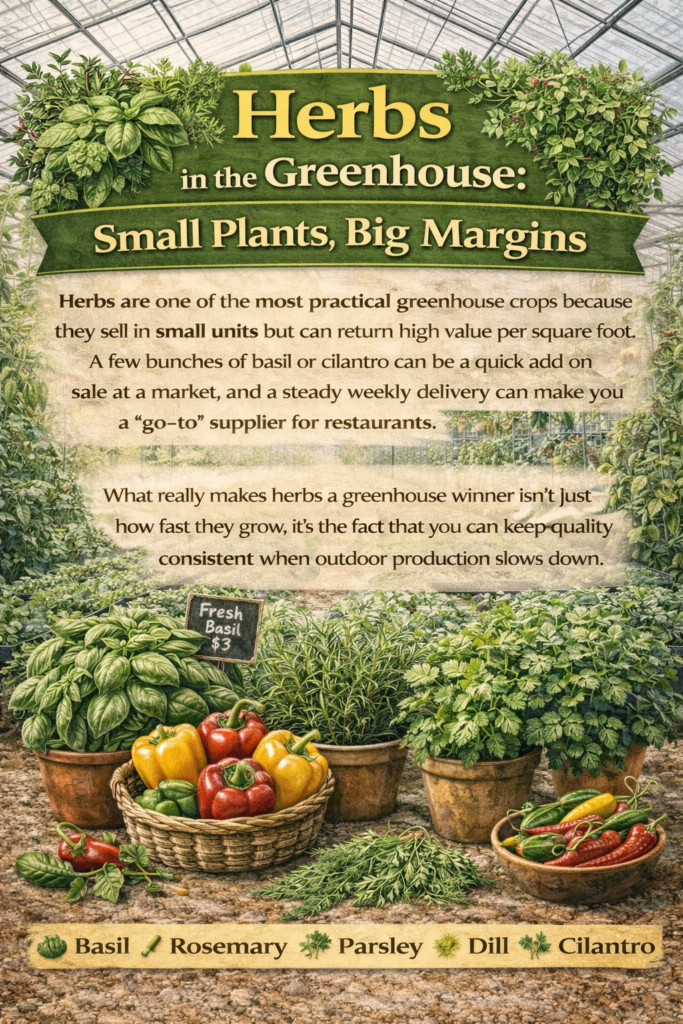
What really makes herbs a greenhouse winner isn’t just how fast they grow, it’s the fact that you can keep quality consistent when outdoor production slows down.
Why buyers keep coming back
Most fresh herbs are purchased on impulse and replaced often. Grocery stores advertise herbs constantly , USDA tracks weekly advertised retail prices across hundreds of commodities, including herbs, which shows how regularly they move through retail channels.
For chefs, it’s even simpler: fresh herbs are flavor. If you can deliver clean, aromatic bunches on a reliable schedule, you become hard to replace.
Year-round advantage
Some herbs tolerate cold storage and winter handling well but basil is the exception. Basil is a tropical crop and is notorious for chilling injury: temperatures below about 54°F (12°C) during storage/transport can damage leaves, and ~54°F is commonly recommended for basil storage and shipment.
That’s where a greenhouse helps twice:
- you can grow basil when it’s too cold outside, and
- you can manage post-harvest temperature so it doesn’t blacken or collapse before it reaches the buyer.
Easy crop cycles, quick starts
Many culinary herbs are beginner friendly because you can start them from seed and begin cutting quickly.
- Basil: seed germination is best around 75–85°F, and transplants often take 4–6 weeks to reach planting size.
- Cilantro: seed germination can take time – USU notes about 21 days, and it can also be started indoors 4–6 weeks before transplanting.
In practice, this means you can run herbs as steady “fillers” between slower greenhouse crops—or dedicate benches to weekly herb turnover.
The real profit switch: post-harvest handling
With herbs, quality can drop fast if you treat them like “just another leafy green.” Water loss and temperature management are everything.
UC Davis notes that herbs may be cooled by hydrocooling or room cooling, and that water loss is a serious cause of quality loss especially for larg -leaved herbs like basil and cilantro. It also mentions that herbs like cilantro and parsley are sometimes iced, and some herbs may be vacuum cooled.
A simple rule that saves a lot of money:
Cool fast, keep humidity high, and don’t chill basil like parsley. Most herbs tolerate colder temps, basil often doesn’t.
How to sell herbs without racing the clock
You’ve got options beyond loose bunches:
- Fresh bunches/clamshells for markets and retail
- Live potted herbs
- Dried herbs for shelf stable sales , works best for many herbs, but note that drying changes flavor—OSU points out parsley/cilantro/dill tend to have milder flavor when dried.
A smart mix is usually: staples (basil, cilantro, parsley) + a few “signature” choices (lemon balm, purple basil, tarragon, unusual mints) so you’re not competing only on price.
References
- OSU Extension (PDF) – Preserving Fresh Herbs (drying effects; parsley/cilantro/dill notes).
- UC Davis Postharvest – Fresh Culinary Herbs (cooling methods; water loss; icing cilantro/parsley).
- UC ANR – Handling Fresh Culinary Herbs (temperature is the most important postharvest factor; handling basics).
- e-GRO (Cornell/Extension) – Preventing Chilling Injury in Basil (basil chilling injury <54°F; recommended basil storage near 54°F).
- USU Extension – Basil in the Garden (PDF) (germination temps; transplant timing).
- USU Extension – Cilantro/Coriander in the Garden (germination timing; indoor start window).
- USDA AMS Retail Reports / Market News (ongoing advertised retail pricing coverage, including herbs).
6. Strawberries & Other Berries in a Greenhouse
Fresh strawberries in winter feel almost “impossible” outdoors, so when you can offer them from a greenhouse, people notice. Strawberries are one of the best known high value greenhouse fruits because they sell fast, look premium, and can be timed for the exact weeks when demand spikes. Raspberries and blueberries can also be grown in protected systems for season extension, but strawberries are usually the most practical place to start if your goal is strong margins.

Why off season berries sell for more
When strawberries are everywhere in peak season, price drops, simple supply and demand. But in colder months, most berries in the market are shipped long distances and picked early. That’s why greenhouse berries can earn a premium: they’re local, fully ripe, and often taste better.
If you can plan harvest windows around high demand moments, winter holidays, early spring, or Valentine’s Day, your pricing power increases because customers are buying a “treat,” not a basic commodity.
What you can realistically harvest
With the right setup, strawberries can produce steadily for months. Many growers choose day neutral strawberry varieties because they can keep flowering and fruiting under managed light and temperature.
Common production approaches include:
- Gutter channels / tabletop systems – clean harvest, good airflow
- Vertical tiers – more plants per square meter, but needs careful watering and airflow
- High tunnels for season extension
A well managed greenhouse strawberry crop can produce multiple “waves” of fruit. The trade off is labor: strawberries don’t wait. You’ll be harvesting frequently and handling fruit gently to keep quality high.
The real challenges
Greenhouse strawberries can be highly profitable, but only if you respect what they’re sensitive to.
1) Pollination isn’t optional
Strawberry flowers need good pollination for proper fruit shape and full yield. In an enclosed greenhouse, wind and outdoor insects won’t reliably do the job, so commercial growers often use bumblebee hives or targeted manual support. Poor pollination shows up quickly as misshapen berries.
2) Humidity can ruin fruit quality
Strawberries are vulnerable to fungal issues, especially Botrytis (gray mold) when humidity stays high and air movement is weak. This is where greenhouse growers win or lose.
Practical habits that help:
- strong airflow across the canopy
- avoiding wet leaves/flowers late in the day
- spacing plants to reduce “crowded” humidity pockets
- removing old leaves and damaged fruit promptly
3) Pests appear faster indoors
Common greenhouse pests include thrips and spider mites. The safest long-term approach is integrated pest management (IPM):
- routine scouting
- biological controls where possible
- targeted interventions only when needed
4) Heat stress affects fruit set
Strawberries prefer moderate temperatures. Excess heat during flowering can reduce fruit set and quality. If your greenhouse gets hot on sunny days, plan for ventilation, shade strategies, or cooling so the plants don’t stall right when they should be producing.
Why the effort can pay off
Strawberries aren’t the easiest greenhouse crop, so the growers who dial it in often face less competition. The biggest profit driver is simple: you’re selling a fruit people love at the exact time it’s hardest to find locally.
And you can increase returns even more by using “seconds” for value added items:
- jam, syrup, and compote
- chocolate dipped strawberries
- dessert kits
What about raspberries and blueberries?
Other berries can work in protected culture, but they usually require more planning and crop specific systems.
- Raspberries can do well with protected production and can be excellent for season extension, but trellising, pruning, and pest control must be consistent.
- Blueberries are possible but more demanding because they require specific growing media and pH management, and they typically take longer to reach full production.
If you’re building skills and cashflow, strawberries are often the most straightforward starting point.
A smart way to start
Instead of filling your greenhouse on day one, run a small trial block first. Use it to learn:
- your pollination plan
- humidity behavior in your structure
- how quickly pests show up
- how long it takes to harvest, pack, and sell at peak quality
Once you can hit consistent fruit quality and predictable harvest timing, scaling up becomes a business decision not a gamble.
References
- USDA Economic Research Service (ERS) – Berry seasonality & off-season price spikes (notes retail strawberry prices in late December can be more than twice May prices).
- Purdue University – “Greenhouse Strawberry Production” (PDF) (overview of year-round production in climate-controlled greenhouses, systems, and production considerations).
- American Society for Horticultural Science (HortTechnology) – High tunnel strawberry cultivar evaluation (reports marketable yields averaging ~1.35–2.27 lb/plant across seasons in tunnel systems).
- UC Statewide Integrated Pest Management (UC IPM) – Botrytis fruit rot / gray mold in strawberry (explains infection timing—flowers + free moisture and how it later shows on fruit).
- University of Arizona – Hydroponic Strawberry Pollination (practical greenhouse pollination guidance; explains poor pollination leads to misshapen fruit and gives hive density recommendations).
7. Microgreens – Maximum Profit in Minimal Time
If you grow in a greenhouse, you already know the painful truth: most crops reward patience, not speed. Tomatoes, cucumbers, peppers great money makers, but they tie up space for months.
Microgreens flip that math.
They’re harvested young right after the first true leaves appear and because the crop cycle is short, the same bench or rack can earn revenue again and again in a single month. Many microgreens are ready about 7–14 days after germination, depending on the variety and conditions.
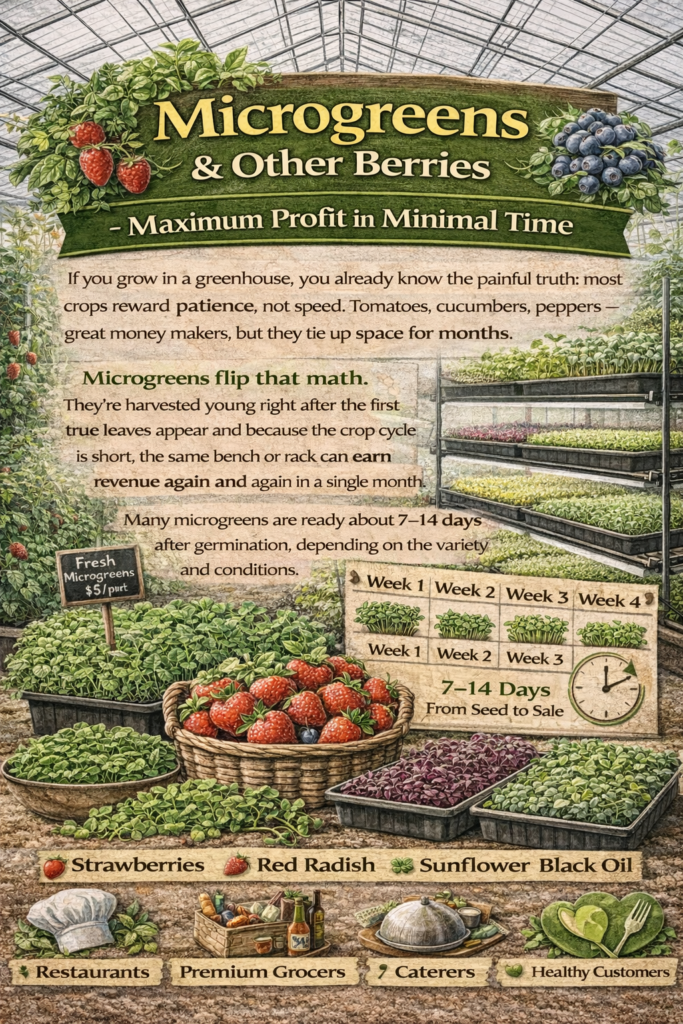
That rapid turnaround is the reason microgreens are often discussed as one of the best “profit per square foot” options for protected growing especially when you can sell consistently to restaurants, premium groceries, caterers, and health conscious customers.
What makes microgreens a greenhouse
Microgreens don’t ask for deep soil, big containers, or long seasons. They need a clean, controlled environment and a predictable routine.
In practice, they fit greenhouse production because you can:
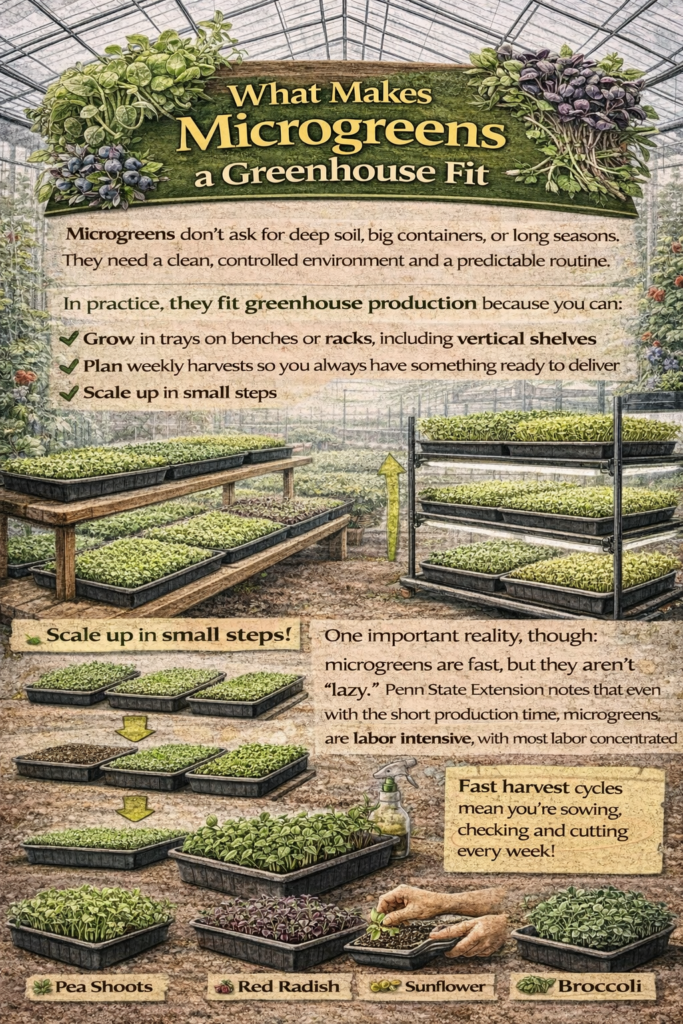
- Grow in trays on benches or racks, including vertical shelves
- Plan weekly harvests so you always have something ready to deliver
- Scale up in small steps
One important reality, though: microgreens are fast, but they aren’t “lazy.” Penn State Extension notes that even with the short production time, microgreens are labor intensive, with most labor concentrated in planting and harvesting.
So the profit is real but it comes from systems and consistency.
The biggest advantage
With a crop that turns in 1–2 weeks, you’re not waiting a season to see whether your plan worked. You can test varieties, pricing, packaging, and customers quickly.
That speed is also helpful for cash flow. Instead of “invest now, earn later,” microgreens can become a steady weekly cycle:
- Seed
- Grow
- Harvest
- Deliver
- Repeat
Once you lock in customers, it starts to feel more like production scheduling than farming.
Pricing: sold by the ounce, not the pound
Microgreens are usually marketed in small clamshells or sold by weight . Prices vary widely depending on your market, variety, and quality. Many growers use a tiered approach: standard varieties at one price, premium or slower-growing varieties at a higher rate.
A practical tip: don’t guess your pricing from the internet alone. Start by calling 5–10 nearby restaurants and specialty groceries, learn what they buy now, and position your product based on freshness, consistency, and delivery reliability.
Space and startup costs: small footprint, scalable setup
Microgreens don’t need a full greenhouse upgrade to start. A small corner with:
- trays
- a consistent watering method
- decent airflow
- and a clean harvest/packing routine
…can be enough to begin.
The key is not the size of your greenhouse, it’s the discipline of your process: seeding density, timing, hygiene, and repeatable harvest quality.
What you must manage to stay profitable
Microgreens reward cleanliness and punish shortcuts.
1) Food safety and sanitation
Microgreens are often eaten raw. That raises the bar on hygiene. Penn State’s microgreens food safety guidance emphasizes preventative practices, cleaning, hygiene, water quality, and risk management, because problems can spread quickly in dense tray systems.
In the U.S., produce safety standards fall under FSMA’s Produce Safety Rule, which sets science-based minimum standards for growing, harvesting, packing, and holding produce.
If you’re outside the U.S., the same principle still applies: treat microgreens like a ready to eat fresh product and build your process accordingly.
Also, University of Nevada, Reno Extension specifically highlights the need to clean and sanitize food contact surfaces like tools, harvest containers, and equipment to reduce contamination risk.
Simple rule that protects your business: every tray, tool, and surface should be treated like it will touch someone’s salad tonight because it probably will.
2) Moisture control
Microgreens are grown densely and watered frequently. If airflow is weak or trays stay too wet, mold and damping-off can wipe out an entire batch.
Your best defenses are boring but effective:
- steady airflow across trays
- avoid overwatering late in the day
- sanitize between cycles
- keep your grow and packing areas tidy
3) Shelf life and delivery timing
Microgreens are at their best right after harvest. If you’re selling to restaurants, you’ll win by being the reliable supplier who delivers fresh product on schedule.
Build your weekly rhythm around harvest and delivery days, then grow to order as much as possible so you’re not throwing away unsold trays.
Why microgreens are a top greenhouse earner
Microgreens sit in a rare sweet spot:
- fast cycle
- premium market positioning
- flexible space requirements
- easy to expand once demand is proven
And demand isn’t imaginary, Penn State has highlighted microgreens as a year-round crop with strong interest in premium markets, which is exactly where greenhouse growers tend to perform best.
If you want one crop that can start small, teach you marketing fast, and scale without needing acres microgreens belong on your shortlist.
References
- University of Nevada, Reno Extension – Microgreens and Produce Safety ”because of how quickly they turn a profit. If maximum profit per square foot is your goal, microgreens definitely deserve a spot on your crop list.
- LSU AgCenter – Microgreens: A Guide to Growing Microgreens (PDF)
- Penn State Extension – Growing Microgreens
- Penn State Extension – Ensuring Food Safety in Microgreens Production
- U.S. FDA – FSMA Final Rule on Produce Safety (Produce Safety Rule)
8. Spinach & Kale : Cold-Hardy Money Makers for Quiet Months
A greenhouse doesn’t have to “wait for summer” to earn its keep. In fact, some of the steadiest winter income comes from crops that actually prefer cool weather, spinach, kale, chard, collards, mustards, and a whole lineup of Asian greens.
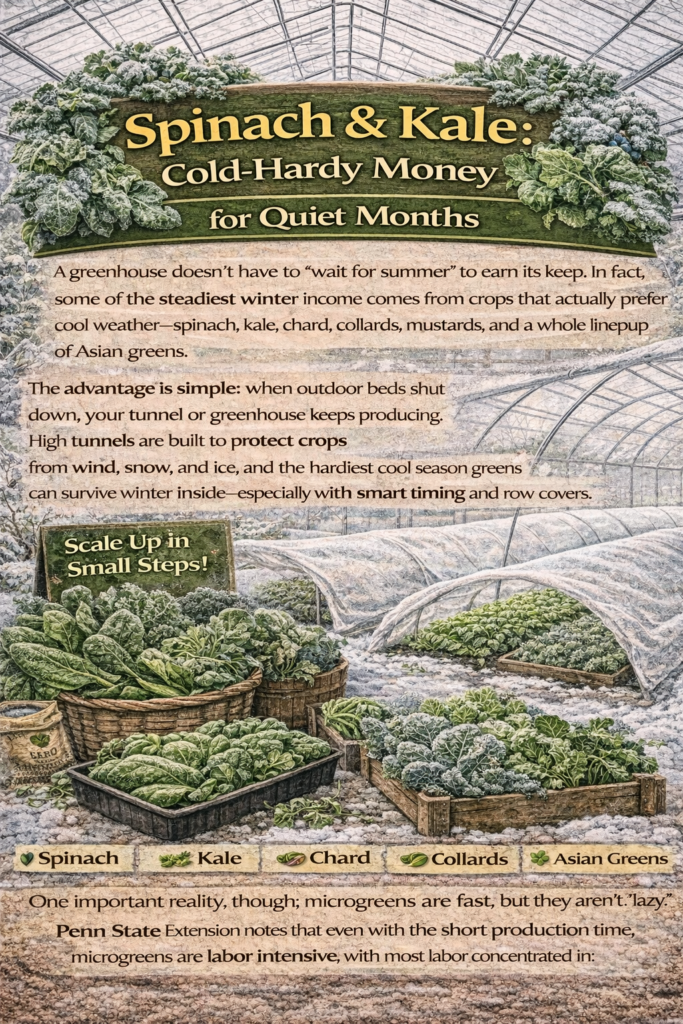
The advantage is simple: when outdoor beds shut down, your tunnel or greenhouse keeps producing. High tunnels are built to protect crops from wind, snow, and ice, and the hardiest cool season greens can survive winter inside especially with smart timing and row covers.
Why winter greens sell so well
Winter greens aren’t a “luxury item” like berries but demand stays strong because people still cook, restaurants still serve, and customers still want fresh food when local options are limited.
Extension guidance on winter high tunnel production notes that off-season growing can increase income and strengthen year round customer relationships, and that winter markets are expanding in many areas.
That steady winter demand is exactly what makes spinach and kale such reliable greenhouse crops.
The cold hardy edge
Spinach is the classic winter tunnel crop for a reason. UMass Extension calls spinach a hardy, cool weather crop and notes that winter spinach production in unheated high tunnels has expanded in New England to supply greens year-round.
Kale, collards, and Swiss chard also tolerate cold extremely well, and many growers notice something else: flavor improves. Michigan State University explains that kale, collards, and chard can taste sweeter after a light frost because cold temperatures shift starches toward sugars.
“Easy” doesn’t mean “hands off”
Winter greens are simpler than warm season fruiting crops, but they still need a few things done right.
1) Timing matters more than temperature
In deep winter, growth slows mainly because of low light and short days. The practical play is to seed or transplant early enough in fall so plants are well established before the darkest period, then harvest steadily as conditions allow. High tunnel scheduling guidance exists for this exact reason.
2) Ventilation still matters
A common beginner mistake is sealing everything tight all winter. But tunnels can overheat fast on bright days, and trapped humidity can invite disease.
Johnny’s Selected Seeds’ winter tunnel guidance warns that plants still need air circulation in winter and that fungus or aphids can become an issue without proper venting.
3) Spinach has one big “gotcha”: downy mildew
Winter tunnels create the cool, moist conditions that spinach downy mildew loves. Cornell’s high tunnel greens notes downy mildew can limit winter spinach, and variety resistance matters.
UMass specifically recommends planting spinach varieties with the broadest downy mildew resistance and even suggests planting multiple varieties to cover resistance gaps.
Crop mix ideas that sell well in winter
If you want winter greens to move quickly, don’t sell just one item, sell options.
Good winter tunnel choices include:
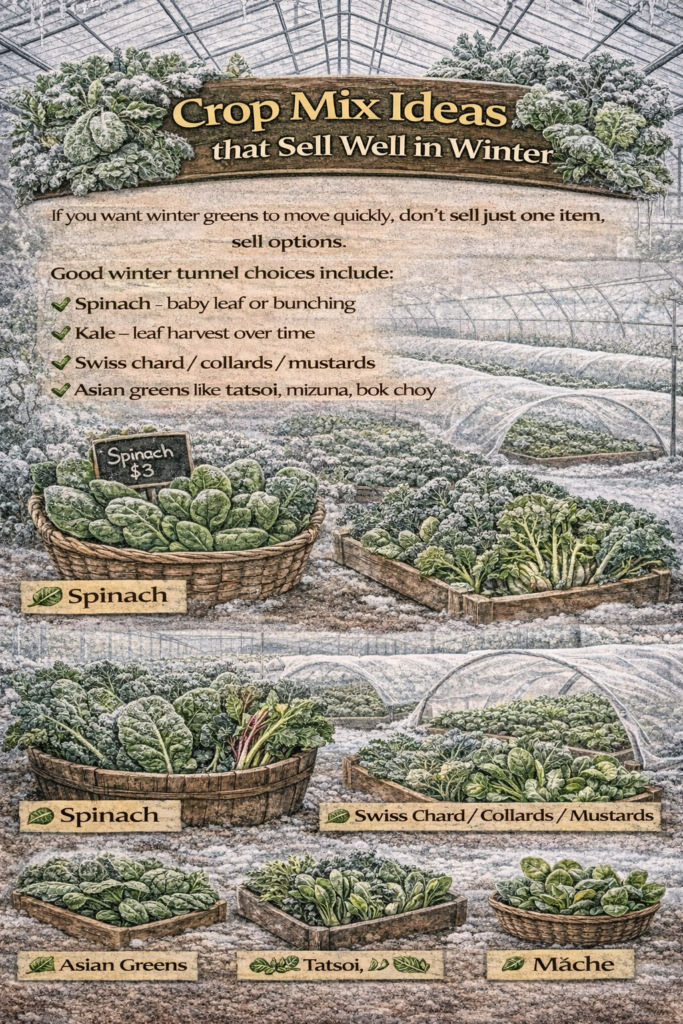
- Spinach – baby leaf or bunching
- Kale – leaf harvest over time
- Swiss chard / collards / mustards
- Asian greens like tatsoi, mizuna, bok choy
- Mâche (corn salad) as a premium salad green, Johnny’s notes it can be grown year-round in northern latitudes using cold greenhouse and high tunnel systems.
Why winter greens matter for greenhouse profit
Winter greens turn your structure into a year-round tool instead of a seasonal asset. And because they’re staples, they help you keep customers engaged through the quiet months then those same customers buy your spring and summer crops later.
That’s the real win: winter greens don’t just make money in winter they protect your market position all year.
References
- Michigan State University Extension — Can I harvest vegetables after frost? (kale/collards/chard sweeter after frost)o-to source for leafy goodness, and your bank account will thank you for it.
- Purdue Extension — HO-330: High Tunnels Scheduling Fall and Winter Vegetable Production
- UMass Extension (New England Vegetable Management Guide) — Spinach: winter production in unheated high tunnels
- UMass Extension — Recommendations for Improving Winter High Tunnel Spinach Production (downy mildew resistance guidance)
- Johnny’s Selected Seeds — Winter Growing Guide: Production in the High Tunnel (ventilation/humidity warning)
9. Cut Flowers – Blooming Profits From a Greenhouse
Vegetables pay the bills, but cut flowers can do something different: they sell on emotion. People buy flowers for birthdays, weddings, apologies, celebrations, and “just because.” That’s why a small greenhouse bench of high quality stems can sometimes out earn a much larger area of basic produce especially when you’re selling when outdoor fields are empty.
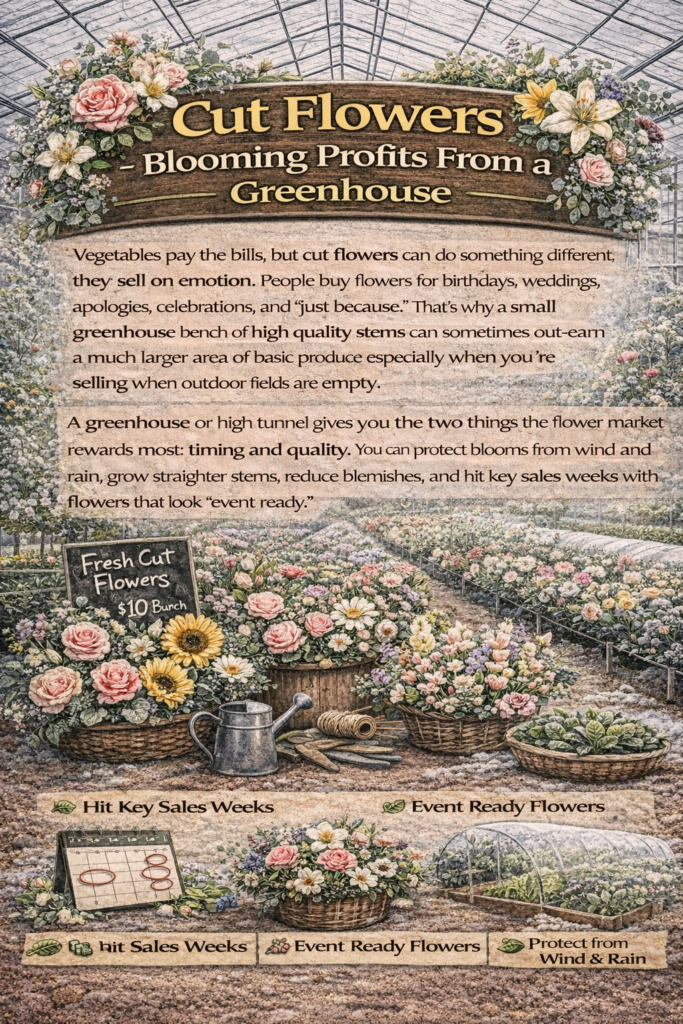
A greenhouse or high tunnel gives you the two things the flower market rewards most: timing and quality. You can protect blooms from wind and rain, grow straighter stems, reduce blemishes, and hit key sales weeks with flowers that look “event ready.”
The money is in which flowers you choose
Not every flower is worth greenhouse space. The winners are usually:
- High value cool season stars like ranunculus and anemones
- Forced bulbs like tulips and narcissus that can be brought into bloom early for premium windows
- Specialty stems that florists can’t easily get fresh and local in your season
Johnny’s (a major grower resource for flower farmers) specifically highlights ranunculus, anemones, tulips, and narcissus as top value hoop house crops especially when you can bring them into bloom early and sell premium quality.
The real greenhouse advantage: timing the market
Outdoor flowers follow the weather. Greenhouse flowers follow your schedule.
That means you can plan around:
- Valentine’s Day and early spring events – forced bulbs, ranunculus/anemone
- Mother’s Day peaks
- Wedding season
- Late fall when outdoor blooms are fading but demand continues
And you don’t have to gamble on “whatever blooms that week.” You can plant in waves and sell with confidence.
Where the best flower growers actually make their sales
You don’t need all channels, just one or two that you can serve consistently.
Common high margin routes:
- Farmers’ markets (bouquets + bunches sell well when displayed красиво/beautifully)
- Florists (reliable weekly availability beats “random availability”)
- Weddings & events (premium pricing, but strict timelines)
- Subscriptions (weekly bouquet programs smooth out revenue)
A lot of greenhouse flower profit comes from repeat buyers, which is why reliability and postharvest quality matter as much as growing.
Growing notes that separate profitable flower growers from hobby growers
1) Photoperiod control
Some flowers are very sensitive to day length. The good news: growers can manipulate it.
- To create long days, many growers use night interruption lighting .
- To create short days, growers use blackout cloth to block light and trigger flowering in short day crops .
This is the boring behind the scenes trick that lets you deliver flowers when the calendar matters.
2) Airflow and humidity management
Flowers look perfect… until Botrytis ruins them.
NC State Extension notes Botrytis often enters through dead tissue and recommends removing dead flowers/plant parts and disposing of them outside the greenhouse. basic hygiene that prevents outbreaks.
In practice, this means:
- keep plants spaced
- keep air moving
- remove aging blooms fast
- don’t let the greenhouse stay humid overnight
3) Pests
Thrips are one of the biggest greenhouse flower problems because they scar petals and reduce market value fast. University of Minnesota greenhouse resources outline multiple strategies including biological options like beneficial nematodes and microbial products used in integrated programs.
Even if you don’t use biocontrol, the takeaway is the same: scout early, because once petals show damage, you can’t sell “perfect stems.”
Postharvest: where profits are won or lost
Cut flowers aren’t like tomatoes you can’t “sell them later.” They’re living tissue, and quality drops quickly if you mishandle them.
Cold storage is one of the biggest levers. Research on postharvest handling notes that storing cut flowers around 2–4°C (35–39°F) reduces respiration/transpiration and helps maintain freshness.
Simple habits that protect your price:
- harvest at the right stage
- hydrate immediately
- cool quickly
- keep buckets and tools clean
- deliver fast
Why cut flowers stay profitable
Flower buyers don’t compare you to grocery store produce. They compare you to beauty, freshness, and longevity. If your stems are straighter, cleaner, and last longer, you can charge more especially when you’re the local option when outdoor fields aren’t producing.
And the best part: flowers diversify your greenhouse income. When one crop slows, another can carry the season.
References
- Oklahoma State University (Endowment Research Report) — Cold storage of cut flowers at 2–4°C helps maintain freshness
- Johnny’s Selected Seeds — Growing Cut Flowers in the Unheated Greenhouse (ranunculus/anemone + forced bulbs like tulips/narcissus)
- Michigan State University Extension — Grower 101: Controlling photoperiod (night-interruption lighting guidance)
- Purdue Extension — HO-253-W Managing Photoperiod in the Greenhouse (blackout cloth for short days)
- NC State Extension — Botrytis Blight of Greenhouse Ornamentals (sanitation + dead tissue removal)
10. Cannabis : High Revenue Crop
In places where cannabis cultivation is legal, few greenhouse crops come close to it on revenue per square foot. That’s the headline and it’s true for many licensed operators. But cannabis isn’t “just another crop.” It’s closer to running a regulated manufacturing business inside a greenhouse, with strict licensing, security, tracking, testing, and audits.
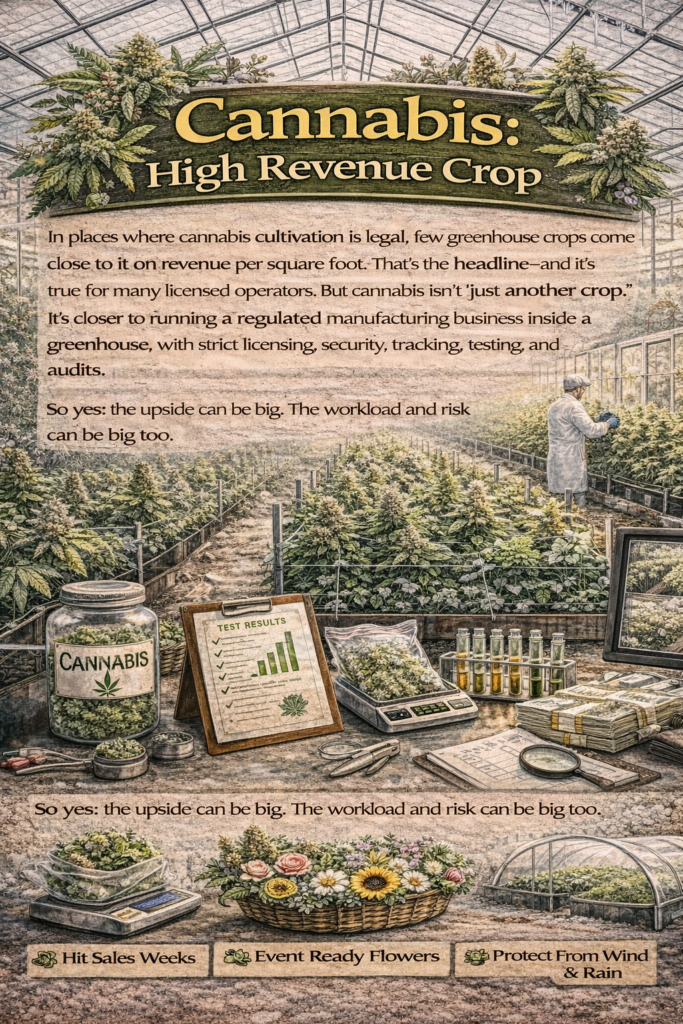
So yes: the upside can be big. The workload and risk can be big too.
Why cannabis can be so profitable in a greenhouse
A greenhouse hits a sweet spot for many producers: you can use sunlight to reduce energy compared with fully indoor growing, while still controlling climate and quality more than outdoor fields. Research on cannabis in greenhouse settings often discusses how sunlight + supplemental lighting is used to manage growth and production consistency, which is part of why greenhouse cultivation is popular.
But “profit potential” depends heavily on:
- local license availability and fees
- taxes and compliance costs
- market saturation
- whether you can consistently hit premium quality grades
The biggest difference: regulation is the business model
If your region allows cannabis cultivation, you’ll still need to meet formal requirements that most food crops don’t face often including detailed licensing applications, ongoing reporting, and compliance systems.
For example, Canada’s federal framework requires applicants to prepare substantial licensing information for cultivation/processing activities.
It also includes defined physical security expectations – restricted access, monitoring systems, intrusion detection, record retention, etc. , depending on licence type.
And licensed operators must use Canada’s Cannabis Tracking and Licensing System (CTLS) and submit tracking reports as part of compliance.
Even if you’re not in Canada, the pattern is similar in most legal markets: security + traceability + documentation are non negotiable.
The “hidden” costs that surprise new growers
Cannabis can look extremely profitable on paper until you price the real world overhead.
Common cost centers include:
- licensing, consultants, legal support, and renewals
- facility upgrades
- compliance tracking systems and reporting workload
- quality assurance and mandatory testing
- labor-heavy postharvest handling
This is why experienced operators treat compliance and QA as core operations, not paperwork.
Market reality: prices can move fast
Cannabis markets can be volatile. Mature markets can swing into oversupply, and when that happens wholesale pricing pressure can be severe. Industry analysis has pointed to oversupply and fragmented state by state rules as key drivers of ongoing price volatility.
If you’re building a cannabis plan, assume:
- pricing will not stay “peak” forever
- competitive differentiation matters
- you need a sales strategy before your first harvest
Market data products like LeafLink’s annual wholesale pricing guide exist specifically because prices vary widely and change quickly across regions and categories.
Sustainability and energy
Cannabis cultivation especially indoor, has drawn attention for energy use and emissions. A peer reviewed analysis in Nature Food modeled greenhouse gas emissions associated with indoor commercial cannabis cultivation.
Policy and research groups have also highlighted how cultivation method affects energy demand and carbon intensity.
For greenhouse operators, this can be both a risk and an opportunity:
- risk: rising energy standards, local restrictions, reporting requirements
- opportunity: branding as lower energy, sun assisted, more sustainable, if you can prove it
References
- Health Canada — Cannabis licensing application: cultivation, processing, medical sales, testing, research
- Government of Canada — Cannabis Licensing Application Guide (overview of licensing/oversight framework)
- Health Canada — Physical security measures for cannabis licences: principles and practices
- Government of Canada — Cannabis Licence Management Guide (CTLS tracking + reporting responsibilities)
- Nature Food (peer-reviewed) — GHG emissions model for indoor cannabis production
Summary Table: 10 best greenhouse crops for maximum profit
| Rank | Crop | Why it’s profitable | Key success drivers | Main risk/cost |
|---|---|---|---|---|
| 1 | Tomatoes | Staple demand + long harvest window + premium for vine-ripened/off-season | Trellising + pruning + consistent irrigation + pollination support + humidity control | Labor heavy; humidity-driven disease can erase margins |
| 2 | Leafy greens (lettuce, arugula, salad mix, baby kale) | Fast turnaround + repeat weekly sales + strong winter demand | Succession planting (weekly/biweekly) + clean harvest handling + airflow | Overproduction/gaps if timing is sloppy; aphids/mildew if humidity stays high |
| 3 | Cucumbers | Very high yield once producing; frequent harvest = steady cashflow | Parthenocarpic varieties + vertical trellis + harvest 3–4x/week + postharvest handling | Quality drops fast if not cooled/handled; pests thrive in warmth |
| 4 | Peppers (bells + specialty chilies) | Premium for colored bells + niche pricing for specialty/hot varieties | Stable temps/light + consistent watering (BER prevention) + airflow/pollination movement | Slower crop; flower drop & BER from stress; pests (thrips/mites/whiteflies) |
| 5 | Herbs (basil, cilantro, parsley, mint, etc.) | High value per sq ft; sold in small units; strong restaurant demand | Tight postharvest handling (esp. basil) + frequent cutting cycles + consistent branding/packaging | Very sensitive to wilting/temperature mistakes; short shelf life |
| 6 | Strawberries (and other berries) | Big premium when local/off-season; “treat” product with strong impulse demand | Pollination plan + humidity/mold control + gentle harvest/packing | Labor intensive; botrytis & pests can spike quickly |
| 7 | Microgreens | Fastest revenue cycle (often 7–14 days) + premium markets | Sanitation/food safety + consistent seeding density + airflow/moisture control + reliable delivery rhythm | Labor concentrated in seeding/harvest; contamination/mold risk |
| 8 | Spinach & kale (winter greens) | Turns greenhouse into a winter income engine; steady demand in “quiet months” | Fall timing before low-light period + ventilation even in winter + resistant varieties | Downy mildew (esp. spinach); growth slows in low light if planted late |
| 9 | Cut flowers (ranunculus, anemone, tulips, etc.) | Emotion-driven buying + premium for timing/quality; diversifies income | Market-timed plantings + sanitation (botrytis prevention) + cold chain postharvest | Strict quality standards; petal damage/pests reduce salability |
| 10 | Cannabis (where legal) | Potentially highest revenue per sq ft | Licensing/compliance systems + security + QA/testing + stable production & sales contracts | Regulatory burden + market volatility + high overhead |
Final Thoughts
A greenhouse isn’t just a place to grow plants, it’s a way to run a steadier, more predictable farm business. The growers who make the best money usually aren’t the ones trying to grow everything. They’re the ones who pick crops that actually fit their setup, their time, and what people nearby are willing to buy week after week.
Reliable sellers like tomatoes, leafy greens, cucumbers, herbs, and microgreens work well because they move fast and customers keep coming back for them. If you manage them well, higher value crops like berries, cut flowers, and peppers can boost your margins. And don’t overlook winter greens, they can keep cash coming in when outdoor growing slows down.
The real secret isn’t just getting big yields. It’s staying consistent: steady harvests, good quality, and produce that holds up after picking. That’s what keeps buyers returning.
Start small, pay attention to what sells, tighten your routine, and only scale what’s clearly working. When every section of your greenhouse is earning its keep, the profit takes care of itself.
FAQ for Best Green House Crops
1) What’s the single best greenhouse crop for beginners who want profit fast?
If you want fast learning + quick sales, start with leafy greens or microgreens. They cycle quickly, teach greenhouse fundamentals, airflow, watering discipline, hygiene and you can adjust production weekly instead of waiting months.
2) Which crops give the best profit per square foot?
Often microgreens, herbs, leafy greens, and cut flowers, because you sell in small high value units, harvest frequently, and can stack production with benches/racks . Fruiting crops can be extremely profitable too, but they tie up space longer.
3) What’s the #1 reason greenhouse crops “look profitable” but don’t net profit?
Hidden operational costs: labor, packaging, postharvest losses, and pest/disease setbacks. Many greenhouse crops pay well only when you build repeatable systems
4) Should I grow one crop or multiple crops?
A simple profitable approach is 1–2 “core” cashflow crops + 1 specialty crop.
Example: Tomatoes (core) + greens (cashflow) + herbs or specialty peppers . This spreads risk and gives you more buyer options without turning your greenhouse into chaos.
5) How do I choose the right crop for my greenhouse?
Match crops to your control level and market:
Limited heat/light control → winter greens, lettuce, spinach, kale
Strong warm-season control → tomatoes, cucumbers, peppers
Strong local chef/retail demand → herbs, microgreens, specialty greens
Event/flower market access → cut flowers
Highly regulated markets → cannabis only if you’re prepared for compliance + overhead

Thesis Link : https://saulibrary.edu.bd/daatj/public/uploads/BAU200601_19-Pp_5.pdf
- Why Are My Zucchini Leaves Turning Yellow? Causes & Fixes - August 31, 2026
- What Is Eating My Plants at Night? - August 27, 2026
- Why Are My Tomato Leaves Curling Up? Causes & Fixes - August 20, 2026